« December 2005 | Main | February 2006 »
January 27, 2006
political shrills
It is hardly the political shrills from the Treasurer surely:

Alan Moir
It is mostly the political shrills from Nationals that can be heard around Canberra these days. They are tearing themselves apart over the independence shown by Senator Barnaby Joyce and the defection of Senator Julian McGauran. The latter joined the Liberals because he judged that the Nationals had no future in regional Australia.
And they don't. They only pretend they are the party of the bush, or even regional Australia. In reality they are an appendage or tail of the Liberal Party. The Nationals do not have a clear independent sense of direction or a future that is worth fighting for. That's why they are on the decline into political irrelvance, for all their huff and puff. They are going to be wiped out by the LIberal Party because there isno distinguishable philosophical or policy difference between the two parties.
Senator McGauran had admitted as much at a media conference.
Posted by Gary Sauer-Thompson at 9:57 AM | Comments (0) | TrackBack
January 26, 2006
'one people, One Destiny'
And so today is Australia Day. Time to fly the flag, hit the beach and have a barbecue. Only its too dam hot. The threat of bush fires is everywhere, given the extreme conditions and an onslaught of north-northwesterly winds across south-western Australia.
The PM has had his say about the meaning or significance of Australia Day. It stands for social cohesion and national unity.

The PM's conservatism is evident in the way that he highlights social cohesion:
In the 21st century, maintaining our social cohesion will remain the highest test of the Australian achievement. It demands the best Australian ideals of tolerance and decency, as well as the best Australian traditions of realism and of balance....A sense of shared values is our social cement. Without it we risk becoming a society governed by coercion rather than consent. That is not an Australia any of us would want to live in...So tomorrow let us indeed celebrate our diversity. But we should also affirm the sentiment that propelled our nation to Federation 105 years ago – one People, One Destiny.
So what are the values of one People?
Those of an Anglo Australian monoculturalism? Are these the shared values (of mateship?) that hold the nation together? Does it suggest a neo-assimilationist narrative that highlights both the ethnic differences within the nation and a structured narrative; then demands that Muslims, or Arab Australians, identify with the dominant Christian Anglo-Australian culture?
What does One Destiny refer to? The phrase just sits there hanging in mid-air. Just what is the one destiny of one Australian people in a globlised world? Howard's structured narrative--Advance Australia Fair---is leading to what end point in history?
Alan Moir captures this perspective perfectly:

Those who question this are seen as the 'shrill voices ' of the left , who are full of 'self-loathing' who hold that Australians should be 'ashamed of ourselves. They---the 'pointy heads and the bleeding hearts' 'knock down those things we believe in' and ' thoroughly disparaged our national day ' as 'xenophobic, intolerant and illogical' .These are the expressions of the voice of Australian conservatism---Murdoch's Australian newspaper.
Posted by Gary Sauer-Thompson at 2:56 PM | Comments (3) | TrackBack
January 25, 2006
medical politics
I see that John Dwyer, Emeritus Professor of Medicine at the University of NSW, is having a go at alternative healthcare, in the name of "evidence-based medicine" and its potential for protecting consumers from spurious health claims. He has been watching the TV coverage of the Australian Open tennisand has found it to be a frustrating experience. He says:
The constant reminder by another Australian Open sponsor, Medibank Private, that, in an effort to boost falling membership numbers, it (as do many other private health funds) provides coverage for a range of "alternative" therapies, demonstrated to be of no benefit, is also disturbing. By so doing, these insurers directly, and the Australian Government indirectly, provide an imprimatur for nonsense techniques such as reflexology, homeopathy, iridology and various massage therapies.
Now I regularly use chiropratic care, massage, fitness clinic, and take diet advice to help manage my stress levels, reduce my weight, and ensure my wellbeing and quality of life. So I take exception to Dwyer's phrase ' "alternative" therapies, demonstrated to be of no benefit'. It is far too sweeping in its characterisation of the bogus health-care market.
Moreover, Medibank Private has moved in this direction because of consumer demand. They are shifting from GP focused primary care to a wellness conception of health care. Modern life is stressful and exhausting and we consumers are looking for ways to cope with that and we are in need of good advice.
The thrust of the Dwyer article is a criticism of the misleading claims about the products of companies such as Nature's Own and Blackmores. It is constructed around consumer deception without ever mentioning the misleading advertising claims by Big Pharma for its pills. Isn't there a profitable, exploitation of the well and the ill on both sides of the pill popping medical/non-medical fence?
I support Dwyer's suggestion that the Therapeutics Goods Administration should be beefed up and fully resourced and its powers increased. I cannot see that happening. Consumer protection is not a big concern of the Howard Government.
Posted by Gary Sauer-Thompson at 7:58 AM | Comments (1) | TrackBack
January 24, 2006
24 television news
When I'm in Canberra I have Sky News on the television whilst I'm waiting for the Parliamentary feed to come on. So I'm usually watching the 24 hour rolling news on Foxtel whilst I'm working.
I do find 24 hour rolling news on television ---the concept of a separate channel and its traditional front-end studio format based on a line of wire copy copied and pasted from Reuters or AP----- boring. I cannot understand what all the fuss is about. It looks like yesterday from the perspective of the digital world that I live in.
Paul Mason writing in The Guardian comments on this opinion:
With news websites starting to fill up with audio and video clips, we are seeing just the beginning of "convergence". When TV over broadband is fully fledged, and the video stream is the dominant element on the page, seamlessly linked to background material and even services, Sky News and News 24 will suddenly look old-fashioned. Almost every other product in the digital broadcast space is a finite piece of video, designed to be downloaded, repeated, paused, shared and even "mashed up".
I do want the timely, authored, edited summary of what has happened - "breaking" or otherwise - updated to reflect new knowledge and events. But I can get this on the web in an instant.
I find the syntax of the web, with its development to converged media, preferable to the rolling channel format. One can ask: "what's the point of rolling news on television?" I 'm much more interested in the convergence between television and the PC. Alas it is yet to be delivered in Australia.
Posted by Gary Sauer-Thompson at 6:42 PM | Comments (1) | TrackBack
a nuclear Iran? some questions
I cannot help but suspect that the US is manufacturing a crisis over Iran's nuclear program.:
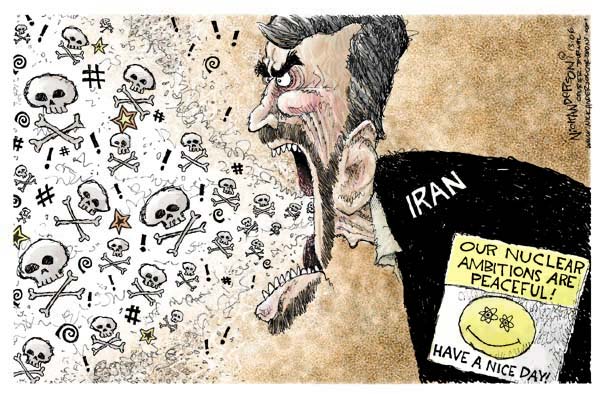
If you stop and think about it, if Iran were to launch a pre-emptive strike on Israel, it would be attacking an opponent that, together with its US ally, had the ability to destroy it many times over. Why would Iran want to wipe itself off the map?
My understanding is that it would take Iraq around a decade to develop a nuclear bomb. What then constitutes the grave threat to Western security?
How is the Islamic republic's determination to go nuclear a serious threat to world peace?
As I understand it Iran is a signatory to the nuclear non-proliferation treaty. Under the treaty countries are permitted nuclear energy. Inspections make certain no weapons are produced. Iran agrees to abide by the treaty and to have the inspections. Israel is not a signatory to the nuclear non-proliferation treaty.
My judgement is that Iraq would become a battleground in any Western conflict with Iran, raising the specter of Iraqi Shiite militias taking on American troops in Iraq in sympathy with Iran. See this article in the Washington Post
Posted by Gary Sauer-Thompson at 4:30 PM | Comments (0) | TrackBack
January 23, 2006
electricity system failure in SA
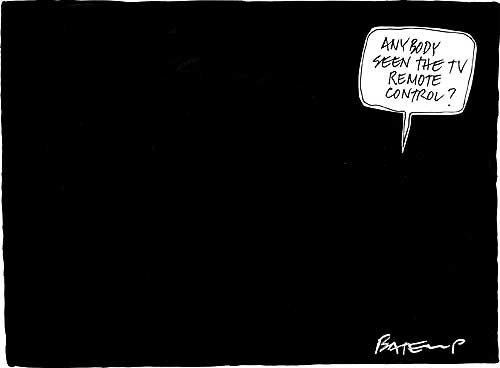
Adelaide has experienced a heatwave of four consecutive days above 40C within a fortnight of hot days in the mid 30s. That heatwave resulted in a number of blackouts across the state, particularly in metropolitan Adelaide that left at least 50,000 people without power over the weekend.
Some power cuts lasted up to 48 hours. Even if you had an airconditioner it would not have worked for some because they had no power available. Since the houses are not built for the hot summer condtions it is hotter inside the house than outside. Consequently, people drive around in their airconditioned cars to keep cool.
Bateman
What we have is an energy system in SA unable to cope with demands in conditions of extreme heat. It is well known that electricity infrastructure has been neglected or run down, even though the heat of Adelaide summers are predictable.
The Rann Government continues to keep saying that all the state's energy problems are due to privatisation of the old electricity utility infrastructure. But that line just doesn't convince. Adelaide is getting hotter and more people are turning to airconditioners to cope with the heat. So there is more demand for electricity than supply. The blackouts are an expression of the shortfall and breakdown in the infrastructure (the transformers couldn't cope).
Since there is no encouragement by the state government for households to make the shift to solar power to increase the supply in peak demand situations, consumers should receive compensation for damage and the lack of power.
The extreme heat conditions are due to return in a few days. So we can expect more power blackouts or rationing. And more promises tto fix things that will not be kept. And we wil have ever more reliance on electricity generated from those coal-fired powerpalnts in the eastern states that produce the greenhouse emissions.That's the national grid for you.
What is not happening in Canberra is a prioritising of the development of a transitional, mixed energy profile (renewables and fossil fuels) by the federal government. What is happening is a consideration of only those measures that allow the fossil fuel industry to conduct business as usual. Business as usual means more noxious by-products from the existing modes of energy production and a resistance by the fossil fuel industry to pay the costs of their greenhouse emissions.
Update: 24th January
It looks like there was enough power to meet demand. The National Electricity Market Management Company spokesman Paul Price said
"..that demand for power peaked at 2838 megawatts on Thursday and 2876 on Friday, eclipsing the previous highest 2832 in February, 2001 -- but confirmed that despite SA's extreme heat and record power demand, there was enough power available."
At the peak of last Friday's power demand there was still 400 or 500 megawatts of spare capacity, which is deemed to be plenty. So why the balckouts across Adelaide for 48 hours? ETSA ETSA is claiming that its infrastructure had coped well with the heatwave, but it had been unable to muster sufficient maintenance crews to replace blown fuses. How come the fuses blow? They are not designed for the heat?
Posted by Gary Sauer-Thompson at 7:25 AM | Comments (0) | TrackBack
January 22, 2006
bribing the enemy
Even the OECD is pressuring Australia to increase fines and toughen sanctions against companies that resort to bribery. The Australian Wheat Board (AWB) cannot be seen as a pacesetter in best-practice management of corruption.
The corruption finger is currently pointed at the AWB because it was engaged in bribing an enemy of the nation state. As Carol Overington reports in The Australian
If the AWB had $100,000 worth of wheat to sell, it would have to inflate the price, to $120,000 or $130,000. AWB would submit the contract to the UN and get paid from the escrow account. It would keep the $100,000 for the wheat, and "kick back" the extra money to Iraq [for "trucking fees" etc.]
From 1999 until the Iraq war in 2003, AWB sold more than $US1.5 billion worth of wheat to Iraq. The "trucking fees" and the "after sales service fees" etc kept growing, until AWB found itself having to inflate the price of its contracts not by 10 per cent but by up to 30 per cent. It was doing this as Australia was preparing to go to war with Iraq and even after Australian troops had invading Iraq.
No Minister or any federal department knows anything about any of this--says the Howard Government. Our hands clean is the message being run.

Matt Golding
The activities of spin doctors and "culture of cover-up" are now engaged in seeking to obscure the real situation and to tranquillise public opinion. This has been standard practice with respect to Iraq hasn't it.
Posted by Gary Sauer-Thompson at 11:56 AM | Comments (0) | TrackBack
shoddy corporate governance
I'm having real connectivity problems at the weekender in Victor Harbor. I came down to the coast to avoid the heat wave that has enveloped Adelaide last week. Alas, the heat storm has hit Victor Harbor as well.
Broadband--which took weeks to get going thanks to a faulty Telstra exchange--- has dropped out. After lots of checking the fault has been traced back to Telstra's infrastructure. I'm not susprised, given the run down nature of the essential telecommunications infrastructure. What did suprise me though was that Telstra will not do any repairs for 48 hours, as they do not work on weekends. They'd do it in a capital city.
So I've fallen back on dialup as a backup. But I could not even get connected yesterday--the lines were too busy/ overloaded/ blocked. I kept dropping out. This is the first connection I've had in 36 hours. This highlights Telstra's indifference to the regions.
I'm really angry with Telstra. They spent and lost billions on overseas investments; money that could have been spent on renewing their copperwire infrastructure in the outer rim of the capital city. Telstra's shares deserve to keep dropping. I hope they do. And I hope the Howard Government loses a lot of money on the sale because it has not established a competitive market where Telstra is forced to ensure that our essential telecommunications infrastructure works as it should.
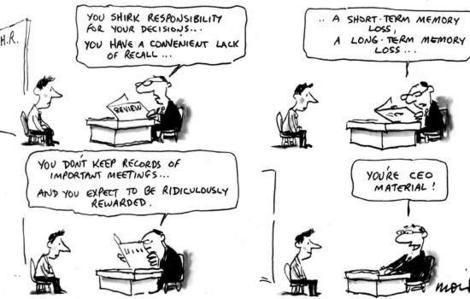
So this cartoon about executive incompetence appealed to me:.
Alan Moir
I know, the image doesn't express my specific black mood about corporate governance in Australia. The lack of service provided in the regions that I've expereienced is due to cost cutting .That means minimal repairs and few maintenance staff. That is seen as good corporate governance because it increases profits. Increased profits keep the shareholders happy.
Still my point remains. Many Australian CEO 's are incompetent. Their strategies are shortsighted, blinkered by corporate fashion, and they avoid competition by seeking protection.
Posted by Gary Sauer-Thompson at 7:24 AM | Comments (0) | TrackBack
January 20, 2006
reforming the health care system
The Productivity Commission has just released its report about refoming Australia's health workforce. Health care reform is sorely needed in Australia:

Lethbridge
It addresses the issue of the healthcare workforce because there are workforce shortages across a number of health professions (especially noticeable in rural and remote Australia) and, with developing technology, growing community expectations and population ageing, the demand for health workforce services will increase while the labour market will tighten.
Hence Australia has an increasing workforce shortage that cannot be meet by doctors, no matter what the AMA spin says about a doctor is a doctor is a doctor, or that Australians want quick and affordable access to a doctor, not a doctor substitute. The AMA is just another bully-boy trade union into restrictive trade practices. Australians turn to non-medical health professinals because they offer a different model of care to that provided by the GP. Competition and consumer choice is what is needed.
The GP shortage means the end of medical dominance, the patch protection by the AMA, and the GP acting as the gatekeeper to the healthcare system. Will the Howard Government have the courage to further that process? It all depends on who is the health minister and why they have been put in the job, doesn't it. Will a reformer be put into the job? Or a free marketeer? Or a timeserver beholden to the Canberra health bureaucrats?
The Productivity Commission, to its credit, does point in the right direction. It says that:
It
is critical to increase the efficiency and effectiveness of the available health workforce, and to improve its distribution.The Commission’s objectives are, therefore, to develop a more sustainable and responsive health workforce, while maintaining a commitment to high quality and safe health outcomes.
The reason fo the AMA's negative response is the Commission's proposal to improve funding-related incentives for workforce change through:
...the transparent assessment by an independent committee of proposals to extend MBS coverage beyond the medical profession; the introduction of (discounted) MBS rebates for a wider range of delegated services; and addressing distortions in rebate relativities.
That opens the door for allied health professionals to play a more substantive and independent role in the provision of quality and cost effective health care.
Posted by Gary Sauer-Thompson at 10:58 AM | Comments (2) | TrackBack
political renewal?
So Senator Robert Hill, the current Defence Minister and resolute social liberal, has finally been pushed out of Cabinet and is to quit politics. The appearance is that he has been promoted to become Australia's ambassador to the UN, that it's a great job, Robert Hill is very capable, he's done a great job etc etc:

That leaves Hill's right wing enemies (Downer and "Minchin) more firmly in control of the SA Liberals.
This retirement also opens the way for a Cabinet reshuffle. Does that mean the fourth Howard Government will have a substantial new look - one that encourages new ideas and policy directions?
Dennis Shanahan in today's Australian says that next weeks reshuffle will go along these lines:
Unless either of them asks for a change, and it is unlikely they will, Costello and Downer will remain in their portfolios. Therefore the real changes will occur with the other senior ministers: Abbott, Kevin Andrews, Nick Minchin and Brendan Nelson.
These are big changes. How do they play out? Shanahan has some ideas on this. Abbott, he says:
...could fill the Defence portfolio and crack down on the bureaucracy of Defence, which is its weakness. Workplace Minister Andrews, a Victorian, could take over Welfare and Family Services. Nelson, who like Abbott is energetic, driven and prepared to philosophise about his portfolio, could go from Education to Health.
There are a lot of could's there, isn't there? Where does that scenarrio lead Nick MInchin, who is likely to take over Hill's post as Senate leader? Here's me thinking that Minchin was considered to be the frontrunner for Senator Hill's vacated defence portfolio. But then how would I know?
IWhat I do know is that I do not see these kind of changes in the senior LIberal ranks as a fostering of new ideas or new policy directions. It's Malcom Turnball, a mere backbencher, who is tossing ou the ideas, and these are evidenced based. He would give the Howard Government a new look.
Posted by Gary Sauer-Thompson at 10:09 AM | Comments (0) | TrackBack
January 19, 2006
kickbacks, stench, corruption
Didn't Australia go to war with Iraq to overthrow an odious totalitarian regime and bring freedom and democracy to the Middle East? If I remember, that was the second justification for the Iraqi war, after the first one-- that Iraq has WMD and threatens our security--was discovered to be a barefaced lie.
So what was the previously-owned government Australian Wheat Board (the AWB was sold in 1999 and listed on the stock exchange), doing paying bribes ($300 million in kickbacks from 1999) to the evil dictator so that we could sell more wheat to a totalitarian Iraq? How does that support for a corrupt regime foster the foreign policy objectives of furthering democracy and freedom? It doesn't. Trade and politics are seperate, says the government.
Yet the Foreign Minister's sabre ratling in 2002 had placed the economic interests of the farmers under threat. Hence the bribes by the AWB to ensure that Iraq did not cancel the wheat contracts.
Early signs from the commission of inquiry in Sydney before retired judge Terence Cole indicate that the AWB's actions had the tacit support of the Howard Government and the Department of Foreign Affairs and Trade:

Bill Leak
In paying the bribes the Australian Wheat Board was breaking UN sanctions ( the oil-for-food program) against Iraq that were designed to bring the Baarth regime to heel. The Canadians knew about it as they complained to the UN) and the UN raised concerns about the AWB's illegal operations with the Australian mission to the UN in New York.
The Australian Wheat Board , as the sole exporter of Australian wheat, always knew they were in breach of UN sanctions. So they covered their carefully tracks with inflated contracts and then claimed innocence, when the evidence of corrupt deal started surfacing with the Volker report. The Howard Government's defence has been the usual 'we know nothing about this', and that the problem lay with the UN rather than AWB.
Presumably, Australia's "on the ball" intelligence agencies did not notice that AWB was deceiving and manipulating the UN, repeatedly violating UN sanctions, and paying massive kickbacks to a corrupt and dangerous dictatorship in Iraq.
This is yet another example of bad corporate governance in Australia. Another example of an Australian corporation failing to put its house in order and trying to spin its way out of the black hole.through denying dirty deeds. So they dig themselves ever deeper into the black hole.
Anyhow what's a leftover agrarian socialist entity, now monopoly exporter, like the AWB doing in a competitive free market economy? Shouldn't it be disbanded? Aren't we supposed to be fighting a war on terrorism to defend the values of the free market?
Posted by Gary Sauer-Thompson at 7:24 AM | Comments (2) | TrackBack
January 17, 2006
Queensland health #3
The emergency department in Queensland's Caboolture hospital on Brisbane's northern outskirts has been closed. The reason? A statewide doctor shortage.
Unsuprisingly, the Beattie state Labor government denied the closure up to the very end; then the Health Minister shifted the blame to his health department for providing him with incorrect information. Canberra is then blamed for the doctor shortages in the state. Where then is the Minister's responsibility in all of this?

Lethbridge
Closure of the hospital's emergency department spells tragedy for road accident victims and others requiring emergency treatment in the area. They have to be transported to other hospitals or flicked over to the local GP's. Crisis situations and newspaper headlines then give rise to stop-gap policy on the run.
It will happen again at another hospital across the state. The problem is systematic as the doctor shortage in the State’s hospitals are the culmination of many years of staffing difficulties, due to the failure of government (both Federal and State) to train, employ and retain doctors to support Queensland’s burgeoning population. So doctor numbers are simply too low to meet patient demand. Around 20 public hospitals in Queensland have been affected by shortages that have centred on emergency and maternity departments.
Posted by Gary Sauer-Thompson at 7:43 AM | Comments (2) | TrackBack
January 16, 2006
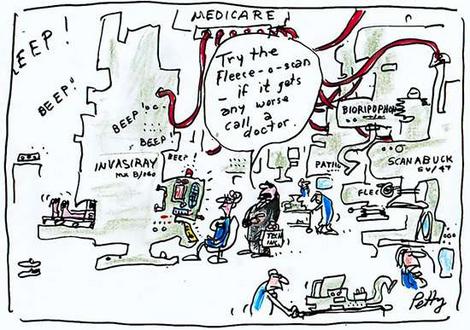
hospital deaths: treat them like road deaths
There is a consensus on what kind of reforms Australia's buckling health system needs. Those needed include significant integration of federal and state responsibilities; finding alternatives to hospital treatment since the rate of hospitalisation in Australia one of the highest in the world; and breaking open the doctors' closed shop to allow more health to be delivered by other professionals.
Bruce Petty
The preferred reform pathway of the centralizing administrators is the commonwealth taking full financial responsibility for healthcare. That magic bullet is not politically feasible under the Howard Government as John Howard has consistently ruled it out.
What is rarely mentioned in the reform talk od the centralizing administrators is the number of hospital patient deaths. Yet these number around 5000 per year due to unintended errors and accidents. This is more than road deaths (around 3000 p.a), yet government agencies work to prevent the disclosure of death and injuries in Australia's hospitals due to poor or negilgent medical practices.
Strange isn't it.
The bureaucratic silence I mean.
 It's a case of hiding the problem. It is a public problem though, just like road deaths, and consumers of health care services, as well as those who work in the health system, are deserving of a safer hospital system.Yet it appears that injuries and deaths will continue to increase in public hospitals and that reform moves for a national mandatory requirement to report doctors to medical registration boards, health departments and consumer groups will continue to be blocked.
Aren't citizens entitled to be informed of important health care information without unreasonable delay? Indirectly, we citizens own most health care research in Australia because it is predominantly funded by our taxes and it is our health that is at stake. Should not health reform include a culture of honest reporting?
If it is mandatory for hospitals to report fatal and serious illness sustained as a result of rare and preventable circumstances, then it should also be mandatory for the Minister to reveal this information to the public. Health deaths shoudl be treated just like road deaths.
Posted by Gary Sauer-Thompson at 11:19 AM | Comments (0) | TrackBack
January 15, 2006
addressing climate change
If the climate crisis is fundamental to our real conditions of life, then global emissions curves must decline, and this cannot really be achieved without firm caps expressed as targets and timetables. Yet the Asia-Pacific Partnership on Clean Development assumes that it is up to industry to do what is needed.and governments onlyneed to put up a few hundred million dollars in research funding. Industry plans to innovate with climate-friendly technologies first, then create a market.

Alan Moir
It's greenwash ---Moir is right. We have the presentation of big energy as environmentally friendly whilst it continues to deploy or advocate the use of environmentally destructive technologies in the background. The Asia Pacific Partnership group will not begin to reduce the growth in emissions until around 2020, In the meantime, real cuts in greenhouse pollution using existing technology under the Kyoto Protocol are occurring now in Europe, Japan and the developing world.
Summertime in Australia means heatwaves, electricity crisis and power blackouts in SA and Victoria. The possibility of a power crisis across the nation is due to the growth in peak demand increasing faster than growth in base load from coal-fired power stations due to economic growth and the use of air-conditioners.
Two points can be made here.
First , as this quote points out markets are important to facilitate the transition to more sustainable energy use:
...given the brief time we have to bend the emissions curves, efficiency and common-sense political realism both demand that mitigation be connected to markets. This is not to say that such markets must not be strongly and creatively regulated. Nor is it to deny that markets are easily exploited by the wealthy and the powerful. Nor is it to claim that markets are the only institutions by which significant mitigation efforts can be channeled, that carbon taxes, emissions permit auctions, and development funds do not have critical roles to play, and that these might not someday eclipse carbon markets. The point, though, is that many of the criticisms that trading skeptics have focused on markets applies as well to the alternatives, that, whatever the institutional structure of the climate regime, vulnerable communities, in the South and in the North as well, must be empowered to protect their own interests during the transition to a low-carbon economy.
A realistic view? Yet the Australian government is carbon trading markets.
Secondly, what is also needed is an ongoing government commitment to solar power. Solar energy is produced on-site, so does not have to be delivered, and is produced during the hottest weather, corresponding with peak power demand, mainly to run air-conditioners. Yet it is expensive to put PV systems on a house. There needs to be some assistance to home owners and developers to purchase PV systems and by paying a higher price to purchase solar electricity, recognising its real value in alleviating peak-load pressure on the electricity grid.
Yet the Federal government has reduced its rebate to homeowners from $8000 to $4000. Though owners of PV systems can sell their power into the electricity grid, they are currently paid the same price as for power generated in cheaper coal-fired power stations. This does not recognize the peak loading power. Yet solar power is the key to the rapid growth in peak demand.
Posted by Gary Sauer-Thompson at 12:42 PM | Comments (0) | TrackBack
January 14, 2006
a saturday joke
Moir's cartoon is a nice way of stating what is happening in Iraq and why the US is going to have to cut and run. What the imperial presidency refuses to recognize that the insurgency develops in response to the US occupation of Iraq:

Alan Moir
And I just love the way that Australia's relationship with the imperial power is depicted.Very apt--we are close to free riding.
Rep. John P. Murtha describes what we whave got into:
According to the Random House Unabridged Dictionary, Second Edition, the definition of a civil war is a "war between political factions or regions within the same country." That is exactly what is going on in Iraq, not a global war on terrorism, as the President continues to portray it. 93 percent of those fighting in Iraq are Iraqis. A very small percentage of the fighting is being done by foreign fighters. Our troops are caught in between the fighting. 80 percent of Iraqis want us out of there and 45 percent think it is justified to kill American troops.
So we have a continued war of national resistance alongside the Zarqawi-inspired terrorism campaign. Some possible scenario's
Posted by Gary Sauer-Thompson at 9:27 AM | Comments (0) | TrackBack
political cartoons
I finally managed to get broadband working at the weekender in Victor Harbor, though not wireless for the work laptop. The old computer I've been using is playing up--it operates on Windows '98. It is time to upgrade, as Windows 98 is very difficult to work with, and the computer is very slow. So it looks like it will take some time to set up a fully functioning office in the holiday shack.
When trying to set things up I accidently deleted yesterdays post. This was the post:
Are Australia's editoriial cartoonists cruel, clever or a nation's conscience? Tis a good question.

Bruce Petty
Leunig has a go at answering the question. He reckons they hold at a mirror at a factured world.
Hardly. They--cartoonists--make editorial comment. Biting editorial comment. Petty's cartoon depicts the threat of the current account deficit better than most of our economic commentators.
'Tis time the old mirror conception fo visual language is dropped, don't you think?
Posted by Gary Sauer-Thompson at 9:06 AM | Comments (0) | TrackBack
January 12, 2006
health reform anyone?
It is now widely accepted that the neo-liberal efficiency approach to Australia's health system has 'squeezed the system too far' in its search for efficiency savings, and it has been too slow in responding to increased demand for health care by providing more primary health care services outside of our hospitals. The health care system is hospital-centric.
The assumption underlying the neo-liberal mode of governance is the seductive notion of progress where an industrialized Australia pumps more wealth in one end of the pipeline and more welfare flows out the other. Yet, what we have discovered with a decade or so of solid economic growth is that you can have more wealth and more people exluded from welfare. This indicates the import of social justice.
Is the shabby treatment of those who are mentally ill the price of progress that must be born? It looks increasingly likely, doesn't it.

Alan Moir
Around one in five Australians will experience mental illness in some form or another. Around 27 per cent of all health-related disability is due to mental illness, and that a staggering 60 per cent of disability among 15 to 34-year-olds is due to depression, anxiety, alcohol and substance abuse, manic-depressive illness (bipolar disorder) or schizophrenia.
The response is pretty poor.
If we suffer from depression, we are often told to 'snap out of it!' or 'that we have nothing to be depressed about'. The tacit assumption is that we choose to be mentally ill, just as we choose to be poor and excluded. It's a lifestyle option.
You don't need to go to line up at hospital to be treated for depression. You need good primary care. That doesn't just mean drugs. It means psychological help and support for families and carers of loved ones suffering mental illness.They carry the burden of the lack of access to basic medical, psychological and social services for those with mental illness, despite a decade of promises by all governments to lift the quantity and quality of mental health care. Hence the basic failures in the system occur on a daily basis and cause a lot of suffering.
I cannot see the full Commonwealth takeover of the financial responsibility of the health system would solve. This Many centralists see it as a feasible option. However, the Commonwealth has been as slack as the states in helping address the basic failures in mental health. It hides behind the fiction that it is the states problem, even though all Australian Governments initiated the National Mental Health Strategy in 1992 to address decades of neglect and assure the rights of people with mental illness.
Posted by Gary Sauer-Thompson at 7:04 AM | Comments (2) | TrackBack
January 11, 2006
hello banana republic
So Australia's current account deficit in November was worse than expected--something of a shocker. The deficit rose from 5.8 per cent of gross domestic product to 6.4 per cent --- we are now above the "banana republic" level of 6.2 per cent. Rising interest and dividend payments to foreigners may well push the current account deficit above 7 per cent by the middle of the year.
Even the economists are starting to worry. So they should, as imports rose by 11% whilst exports rose by 1%. Exports have not really been growing for quite sometime----the last 4 years or so.
Does that blow-out make a dent in the eternal optimism of things getting better? Nay. A mere blip on the radar screen, says the Trade Minister.
You see we have become so rich from exports and years of solid economic growth that we can afford to buy ever more imports ---cars, laptops mobile phones, ipods. So it's a good result really. It shows how wealthy we have become, due to the great economic governance of Treasury.
And the small matter of the CAD deficit? Is that a flaw in governance?
No worries. Soon the mining production will eventually increase. It's just taking time to build capacity, that's all. Eventually the capacity constraints will ease, the mining investment boom will deliver more exports, and we will be able to buy the desired high tech home entertainment systems that are appearing in the glossy trade shows.
Then again it is the silly season, isn't it.
Posted by Gary Sauer-Thompson at 8:14 AM | Comments (0) | TrackBack
January 10, 2006
Kyoto lite
I see that Leslie Kemeny is continuing to do his public relations for Big Energy's conception of Kyoto lite. Writing in todays Australian newspaper Kemeny states:
Astute observers of Kyoto consider that there is considerable merit in the Asia-Pacific Partnership model. Scientists and engineers believe that post 2012, the only way forward in the spirit of the Kyoto treaty will be the adoption of a "clean development" mechanism. This represents a mode of operation whereby members of the partnership assist each other in technology transfer appropriate to the needs, economies and development goals of the constituent countries.
Technology transfers are already built into the Kyoto protocol. The European Union and China have already signed an agreement to develop new and existing clean energy technologies and China has a strong renewable energy program.
Kenemy, however, dismisses Kyoto as 'coercive utopian green politics'. He just ignores the market mechanisms built into Kyoto that enable emissions trading and a 'carbon trading' market that is worth $3.7 billion a year.

Bill Leak
The real point of Kemeny's spruiking is to push big nuclear energy as the only solution to Greenhouse gas emissions and global warming:
Most energy experts now believe that the only effective solution to greenhouse gas minimisation and climate change is the global acceptance of nuclear power technology.
Do we have global acceptance? Is it on the horizon? Or is this more nuclear dreaming?
Kemeny says that Tony Blair is backing plans to recommence building nuclear power stations in the UK, as he is convinced that nuclear power is the only way to secure energy needs and to meet Britain's commitments to reduce carbon emissions.
Kemeny's assumption is that nuclear power is a zero carbon-energy source.To Kemeny's language most energy experts now believe this assumption is false.
My response is let the free market build nuclear power stations. Why is the government needed? Shouldn't the government be getting out of the way so the free market can do its thing?
Posted by Gary Sauer-Thompson at 7:08 AM | Comments (0) | TrackBack
January 9, 2006
Big Energy's talk fest
I see that Ministers from Australia, the US, China, India, Japan and South Korea along with Big Energy will meet this Wednesday in Australia as part of the Asia-Pacific Partnership for Clean Development and Climate Protection. This is the anti-Kyoto group opposes emissions trading as a way of compelling industry and business to switch to more sustainable forms of energy production. Yet the UN Intergovernmental Panel for Climate Change has confirmed that fossil fuels are the cause. Burning oil, coal and gas produces greenhouse gases are responsible for climate change, a changing world climate and rising temperatures.

Big energy does have a public relations problem with global warming. They are the bad guys, as the power sector is the single greatest contributor to carbon dioxide emissions. The market liberals, who say that strong economic growth is the number on policy goal and that the only responsibility corporations have is to create wealth, also have a problem. Global warming is an example of market failure and government intervention is needed to rectify the negative externalities.
Both groups are opposed to the Kyoto Protocol and to big investments in clean energy. So how do they address global warming given the denial of corporate social responsibility by Big Energy and market liberals? Will the meeting just be a public relations exercise? Will it be a case of 'we are doing something by conferencing --learning to get along!' Me thinks they are conferencing in Sydney to do energy business.
The anti-Kyoto crowd do have a high tech solution for global warming--carbon sequestration. They aim to capture and store underground the carbon dioxide generated by burning fossil fuels. However it could be 10 to 40 years before carbon capture and storage technologies are commercially viable and well entrenched in industry, and they could double the cost of fossil fuel power. But why would Big Energy adopt such technologies, given the government's refusal to put a penalty on greenhouse gas emissions because it is bad for business?
Why not go nuclear guys. It's the logical solution. Make this a test of the free market's capacity to do its thing. A golden opportunity awaits.
I'm sceptical about the conference because there is little concern about Australia's current, outdated electricity system being so inefficient that two-thirds of the energy in the fuel is wasted before it gets used at homes and workplaces. The creation of a liberalised, national electricity market based upon apparently cheap sources of power has closed off to the decentralization of the market, and to the generation of electricity close to where it is actually needed. There is no public commitment to electricity being created by solar panels on everyday buildings, with the electricity being used directly by the house or workplace, and the surplus being fed into a local network.
Another golden opportunity for the free market to do the task set it: renew the outdated infrastructure without relying on government intervention, subsidy and corporate welfare.
Posted by Gary Sauer-Thompson at 6:16 AM | Comments (2) | TrackBack
January 8, 2006
a flaw in Australia's economic governance
The self-congratulatory account of Australia's economic performance---14 years of continuous economic growth-- highlights the floating exchange rates, inflation targeting central bank that has ensured low inflation, budget surpluses, high labour productivity and Australia's ability to borrow abroad in its own currency.
Market liberals say this success is held to be due to neo-liberal governance based small government, free markets and low taxes.This claim is refuted by reality. The Howard Government is a conservative one: it is a big-spending government that favours privatised monopoly's, subsidies for big business, protected markets and big taxes. It is economics in the pursuit of retaining power.
Does that reality leave a question mark over the economic performance? Critics say that a record high current account deficit and the deflating housing market put Australia's continued economic growth at risk and place a question mark over the government's good economic management claim. I've raised concerns about the latter off and on at public opinion.
Yet there is a lack of concern amongst economists and policy wonks about Australia's big current account deficits over the last two decades. So it is good to see an economist also raising concerns. John Edwards, writing in the weekend Australian Financial Review, says:
The foreign exchange risk is not eliminated--it is merely transferred to people in other countries who hold Australian-denominated debt. The currency will swiftly tumble if these buyers think the exchange rate may weaken or that Australian-dollar-interest rate premium over other countries is not longer wide enough to justify the risk.
People just shrug at the mention of Australian-dollar-interest rate premium. It is not a sign of a structurally weak economy, merely the cost of doing business. However, if the Edward's scenario plays out, then the squeeze is well and truly on. This is not taken seriously because of the resources boom due to a booming Australian economy.
Edwards goes on to make a second point about the continual large current account deficits. He says:
Nor does Australia's ability to to borrow in its own currency address the more fundamental problem raised by large current account deficits. The currency risk may be minimised but the servicing costs on foreign debt will soon be a real problem. The only way out of this iron arithmetic is for Australia to export more than it imports--which it has not done other than intermittently for the past 30 years.
That's the big flaw in Costello's economic governance--the failure to run a trade surplus and a current account surplus.
Yet the ALP says very little about this big flaw. It gives Costello a free ride. Suprising isn't it? Maybe it's not raised in the focus groups?
Posted by Gary Sauer-Thompson at 5:07 PM | Comments (1) | TrackBack
January 7, 2006
rewriting history
The rewriting has begun even though Ariel Sharon is not even dead. Sharon is being recast as a warrior for peace in Murdoch's Australian:
Soldier statesman Ariel Sharon had one objective throughout his long career – to secure the safety of Israel. Over the years, he found many means to do it, most of them involving Israel's ability to overcome surrounding states on the battlefield.....Mr Sharon was a tough old bird who only became a dove after decades as a hawk...evacuating Gaza Mr Sharon demonstrated Israel was in the market for a permanent peace.
This was a man of muscle whose history is one of opposition to peace; building Israeli settlements in the West Bank, in the Gaza Strip, in Sinai, in the Golan Heights; and having responsibility for the massacre of Palestinian refugees in two Beirut camps by local Israeli-backed militias. This warrior for Israel did everything in his power to prevent the formation of a Palestinian state. He stood for conquest by military means.

Alan Moir
The Sydney Morning Herald reinforces the historical rewriting with its peace hangs by a thread headline. Presumably that is peace in terms of securing the safety of Israel as an expnsionist neo-colonial state, whose occupation of Palestinian territory leaves the Palestinians in a state of impoverishment.
What the two newspapers portray is Israel as a democracy, defending itself from Arab-Muslim terrorists. What they dont show and is the history of an expansionist colonial power engaged in ethnic cleansing and large-scale long-term forced population expulsion.
Sharon was a merciless general with a long-term agenda who used peace as a tactic. Karma Nabulsi describes Sharon''s strategy of 'peace as destruction' well:
To us, to me, his mission had always been thus: to kill our resistance, our organisations, our solidarity, our institutions, and above all our national liberation movement. He did not want us to have a national framework, his desire was to reduce us to small quarrelling groups and factions trapped under his prison rule, disorganised, disintegrated, or co-opted; he planned actively and provocatively (and carefully) to create such an impoverishment of our people's public and private life.
Peace hangs by a thread? Only if you think a Hobbesian world is a world of peace. Karma Nabulsi continues:
This he did through the iron tools of military rule: assassination, imprisonment, violent military invasion. His fate for us was a Hobbesian vision of an anarchic society: truncated, violent, powerless, destroyed, cowed, ruled by disparate militias, gangs, religious ideologues and extremists, broken up into ethnic and religious tribalism, and co-opted collaborationists. Look to the Iraq of today: that is what he had in store for us, and he has nearly achieved it.
This is peace on Likud Israel's terms: keep the illegal settlers in the Occupied Territories, expand settlements at full pace, continue the Judiazation of Jerusalem and build the wall deep into Palestinian land.
Posted by Gary Sauer-Thompson at 11:31 AM | Comments (0) | TrackBack
January 6, 2006
FTA scepticism
The results of the bilateral Australia-US Free Trade Agreement, which was signed in 2004 and came into force at the start of 2005, are beginning to come in. And things are quite different to what they are supposed to be.
Remember the sell? The FTA was meant to be vitally important to Australia's prosperity and global success in the twenty-first century; it was an enormous potential gain to the Australian economy; a ‘once in a lifetime deal’ that binds us to the biggest economy in the world etc etc.
Well, is it a good thing? What do the results say? The results, according to Michael Costello writing in the The Australian, are not good:
According to US Census Bureau figures, the first 10 months of the FTA saw Australian merchandise exports to the US falling 4 per cent.... What's more US exports grew by 4 per cent in the same period as ours declined by 4 per cent. The result is a billion-dollar increase in our trade deficit with the US over the comparable period in 2004.
How is that result a good thing for Australia? I can see that it is for the US. Wasn't it meant to be the other way around?
Wasn't the FTA meant to change Australia's economic history of having a massive net surplus on primary exports and a massive net deficit on manufactured exports? As Evan Jones succinctly puts it:
In a nutshell, ‘Australians’ export coal so that they can import cars and personal computers. Economists call this phenomenon ‘comparative advantage’. Ship the materials overseas, have them processed, then ship them back as manufactured commodities.
Wasn't the FTA meant to be a start to clawing back Australia's indebtedness to the rest of the world (now overA$57 billion) by opening the big US markets to Australia's manufacturing goods?
What has gone wrong? The Australian will have nothing to do with this scepticism.
OPPONENTS of the Australia-US free trade agreement are nothing if not obstinate –---and opportunist. A year after the deal was done the world has not ended, but they still say catastrophe is imminent...
Note the straw dog style of argument. Whose saying that? We are just pointing to the gaps between what was supposed to be and what is.
Oh, and we make an inference from the figures. As a free trade agreement the FTA is a dud. It is not free trade. There is no massive expansion in two way trade. The FTA is a preferential trade agreement in which the US used its muscle to seek preferences for its exports from a weaker nation. The US does this to improve its productive capabilities. Alas this at the expense of Australia's general welfare. The results bear this analysis out.
Posted by Gary Sauer-Thompson at 1:26 PM | Comments (5) | TrackBack
America's global hegemony
When the cold war ended in the 1990s there were many who expected that the fall of Soviet communism would enhance American power, which they welcomed with much hype about the end of history. Some even talked in terms of history has given America an imperial role, that an imperial reality should dominate US foreign policy, that the US is the final guarantor of global security and that it is engaged in policing the world. A few even signed up to empire as some sort of grand messianic adventure.
What has happened a decade latter is that the actual effect of the end of the cold war has been to reduce to US power in the world of nations. This quote by John Gray says it well:
The cold war was not the kind of competition that could have a winner. It could have only one loser---the USSR, with its enormous military-industrial rustbelt, stagnant economy, and devastated environment. The true beneficiary is not America but Asia. The Soviet collapse quickened the pace of globalization, which is enabling China and India to become great powers whose interests may conflict with those of the United States. The era of Western primacy is coming to a close. It is this fact more than any other that precludes the formation of an American Empire and rules out any prospect of the United States being accepted as a de facto world government.
Well said. That creates difficulties for Australia, as the Howard Government signed up to the American empire to the extent of becoming its deputy sheriff in the Asia Pacific region. Yet China is increasingly becoming Australia's main trading partner, whilst the much hyped Australia-US Free Trade Agreement is turning out to be a fizzer.
Posted by Gary Sauer-Thompson at 11:05 AM | Comments (3) | TrackBack
January 5, 2006
here's hoping
Well, we lefties can hope that the contradiction keeps working away like an old mole to deliver this scenario:

Maybe. Who knows? It is more likely to be a steady retreat based on things going well in Iraq, not domestic political considerations.
The contradiction is between the way the elections in Iraq have been portrayed as a sign of success for US policies in Iraq when in reality they in fact meant a tremendous triumph for the enemies of the US. Instead of establishing a pro-western secular democracy in a united Iraq, the December elections have ensured that Islamic fundamentalist movements are ever more powerful in both the Sunni and Shia communities.
Good oh. Isn't that what 'we' (the Coalition of the Willing) invaded Iraq for? To make help the nation of Iraq to make its first faltering stumbles along the path of liberal democracy after living years in the darkness under the Barthist totalitaranism of Saddam Hussein? Yeah, that's what Alexander Downer, Australia's foreign minister, keeps on saying to all and sundry.
Who is listening though? Anybody?
The reality, of course, is the triumph of a fundamentalist Shia-style Islam that is aligned with Iran and is anti-Israel. Aren't the former the enemies of the US? So what is the US response? Why not work towards the U.S. and Israel starting a war against Iran to prevent it from ever acquiring nuclear weapons. After all, wasn't a part of the US strategy for the war in Iraq to defend, develop and promote Israeli interests in the region?
Posted by Gary Sauer-Thompson at 7:51 PM | Comments (3) | TrackBack
January 4, 2006
big pharma makes its moves
I see that Medicines Australia--- the US pharmaceutical firms---are starting to have a go at the Australian PBS scheme by using the recently signed Australia-US Free Trade Agreement. It did not take them long to make a start to begin to wind things back behind closed doors.
Big Pharma does not like reduced prices for their exclusive drugs. They want increased prices to make ever bigger profits. Hence their hostility to the measures introduced this year to cut the price of new generic medicines by 12.5 per cent. Kieran Schneemann from Medicines Australia said that cutting the price of new generic medicines:
"...was a difficult policy for us. It forces the prices of medicines down … and we are concerned in the future as this policy continues to roll out that it will impact on the value of innovative medicines and it may in time prevent some new innovative medicines coming to Australia."
These are old drugs at the end of their life. It is where the big profits are made. Big pharma is not going to give this up. The generics have to be contained so as to protect their monopoly rights to their exclusive drrugs.
Australia cannot expect much sympathy from the US government on this issue. The Bush administration consistently acted to support the interests of Big Pharma in the negotiations around US Australia Free Trade Agreement last year.
Bush basically repeated the big pharma line when in Australia:
"Our research and development costs are enormous, and we need to cover them somehow. As 'research-based' companies, we turn out a steady stream of innovative medicines that lengthen life, enhance its quality, and avert more expensive medical care. You are the beneficiaries of this ongoing achievement of the American free enterprise system, so be grateful, quit whining, and pay up."
Since prescription drug costs are rising so fast, the federal government is particularly eager to get out from under the burden of the PBS by shifting costs to individuals. The result is that more people have to pay a greater fraction of their drug bills out of pocket. Increasingly, many cannot afford them.
Posted by Gary Sauer-Thompson at 8:40 AM | Comments (6) | TrackBack
January 3, 2006
summer in the city
It does feel like this:
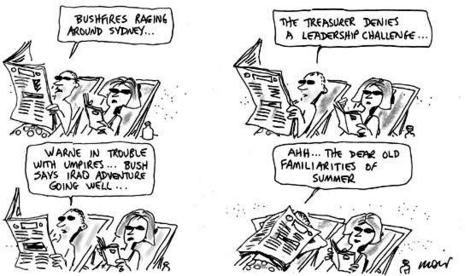
Allan Moir
It is a time to switch off from the media flows as much as we can. But summertime also means this.
Posted by Gary Sauer-Thompson at 6:31 AM | Comments (0) | TrackBack
January 2, 2006
a future pathway of health reform
In the Review section of the weekend Australian Financial Review there is an article entitled 'The World to Come', which has been downloaded from Foreign Policy. The article consists of the views of leading thinkers on what won't last the next 35 years. One piece, by Graig Mundie, a senior vice-president and chief technical officer for advanced strategies and policy at Microsoft, address health care reform in the form of changes to the doctor's offices.
It's an important topic in Australia given this scenario:

Bruce Petty
An earlier post on this scenario.
Mundie rightly says that a crushing burden isincreasingly being placed on national health-care systems, and that governments will:
"..soon be forced to confront a complicated and inefficient system that focuses too much on managing disease when it arrives and not enough on preventing people from getting sick. A critical step in reforming the system will be making visits to the doctor's office as a last resort rather than a first step."
That is beginning to happen in Australia under Treasury governance. We are on the threshold of reconsidering the importance of primary health care, and wellness is becoming a part of medicalspeak.
However, Mundies' focus, as a Microsoft organization man, is on medicine and technology. So what's he pointing to? What is the pathway of health care reform as envisioned by Microsoft?
Mundie says that the web is already allowing patients quick access to quality health information once dispensed only by white coats. He adds:
Soon, patients wil access customised health plans online. Diagnosing and treating many everyday conditions will be as simple as despositing a drop of blood in a machine and, within moments, having the computer tell you what you have and how to get rid of it.
That is happening slowly in Australia, very slowly. The slowness is in sharing e-health records due to the medical profession's tardiness in making a patient's health information accessible to non-medical professionals or even to the patient.
Mundie argues that doctors (GP's) won't be obsolete. They:
...will spend more time assessing options for preventative action and less time sheperding patients through their offices. Doctors will increasinlgy rely on highly personalized treatments--such as new drugs target specifically to personal needs, or even nanomachines that attack bad cholestrol and or eliminate tumors too small to detect today. Specialsts in turn will be free to focus on highly difficult procedure and push the frontiers of health care.
This is a high-tech interpretation of health care reform, much favoured by the Americans. Preventative health care is also about wellness: keeping us out of hospitals and helping us managing lifestyle illness (eg., obesity) through diet and ecercise. We don't need new drugs or cutting edge surgical procedures to address obesity.
Posted by Gary Sauer-Thompson at 8:50 AM | Comments (3) | TrackBack
January 1, 2006
changing media times
I've previously mentioned the ongoing decline in newspapers (Fairfax) magazines (The Bulletin) and free-to air television (Channel Nine) due to the impact of the internet. The media landscape is changing, but in what way?
The Daily Briefing draws out attention to an op ed at Newsday by Todd Gitlin and Oliver Sylvain that confirms the decline of newspapers. Drawing on the US experience they say:
Indeed, virtually every major newspaper holding company in America has announced reorganizations, sell-offs, buyouts, and--- most alarming to anyone who cares about journalism's watchdog role in a democracy---staff cuts. By whacking back staff, newspapers are cutting the very newsgathering resources that are their wherewithal. They're cutting muscle, then cutting into bone. This is not only a disgrace to American journalism; it's a myopic business plan.
This is standard operating practice at Fairfax and Channel Nine, despite the profits being made. So what is happening?
Gitlin and Sylvain say that the media:
"...chains are running scared from the very business of news gathering. In doing so, they're likely tilting into a downward spiral. Shedding reporters, they'll sacrifice scope and depth, range and investigation. This will probably cost them still more readers. Losing readers, they'll lose advertisers and revenue, too."
So they boost their circulation through dodgy practices (giveaways).
Online media are now filling the vacuum thereby created: --eg., Eric Beecher and Di Gribble's Crikey, Margo Kingston's WebDiary, Graham Young's OnlineOpinion, Jeremy Heiman's and David Madden's GetUp, Lindsay Tuffin's Tasmanian Times and John Menadue's New Matilda open up space for something different to the old media.
Natasha Cica, writing in The Age says that none of the online media has fully capitalised on the secret of old media's former success - must-read reportage from surprising angles with pointy hooks that relied, lest we forget, on the shock of exposing the edgy new. Should the new media be like the old media? Isn't the online space one of allowing diverse voices and perspectives?
Posted by Gary Sauer-Thompson at 8:41 AM | Comments (0) | TrackBack