« November 2005 | Main | January 2006 »
December 31, 2005
Iraq: desired results achieved?
The official position of the Howard Government is that Australia will not "cut and run" from Iraq. Australia will stay the course etc etc. 'We are safer' because of the political developments in the Middle East of 2005 and 'we're better off now without Saddam', is the constant message from Canberra, Washington and London. Yet that intervention has resulted in Shiite fundamentalist political control of Iraq. That result and has been cemented by the December elections.
Two-thirds of Australians, now hold that it was not worth going to war in Iraq up from 58 per cent a year ago. Only 27 per cent believe it was worth it, compared with 32 per cent a year ago.
This is the other domestic side of the war on terror in which Iraq is centre stage:

Clay Bennett, War on Terror
Iraq is now a country fractured on sectarian lines that are fuelled by the US, UK and Australia. The Kurds will have autonomy close to independence and there will be a Shia super region established, covering nine provinces in southern Iraq. This represents half of the 18 provinces in the whole country. Iraq is on track to become a confederation, not a single state.
Iraq is still mired in sectarian bloodshed, a weak central government aligned with Iran, and a Sunni insurgency.Iraq was a Sunni state and is becoming a Shia one. The Sunni are fighting the US occupiers and the Shia. Iraq is a failed state. The electricity supply remains poor in Baghdad; kidnapping is rife; security is limited and Iraqis spend much of their time surviving from day to day. The police are not seen as protectors.The state elections in January and December failed to solve Iraq's problems.
The political will to stay in Iraq is weakening in both the US and Britain. As the ebb tide of American and British power in Iraq strenghens with both countries planning to withdraw their troops from Iraq, the new Shiite Iraq-Iran axis threatens Sunni control of Saudi Arabia and Jordan.
Tis a great result. It is one ignored by Canberra. We won't hear much about Australian troops fighting for a fundamentalist Shiite regime aligned with Iran. You just hear the mantra about democracy in Iraq replacing the totalitarian regime of the Saddam Hussein.
Posted by Gary Sauer-Thompson at 6:25 PM | Comments (5) | TrackBack
December 30, 2005
rising costs of health care mean...
I see that Australia's health insurance funds are pushing for another round of premium rises of up to $200 a year: This time the funds have applied for price increases beyond the 5 per cent to 7per cent hikes of recent years for some policies. The current increase is about double the inflation rate for the fifth successive year. We appear to be on an escalator of steadily rising health costs year in and year out.

The steady price increases ensure that private health insurance is becoming less attractive. They offer a limited range of services that adress wellness or healthy human functioning.
Private healh insurance is currently subsidised with a 30% tax rebate, costing taxpayers $3 billion a year. This subsidy is underwriting an uncapped and increasingly costly use of private health care. That means an increasing two tier health system doesn't it. Which is what the Howard Government wants--to shift Australians away from a public health care system that becomes a residual, stop gap system for the poor. Many in the Government want to encourage more people to take out private health insurance and not rely on state provision of health care, thus giving more scope for tax cuts. That is the neo-liberal approach to health care reform isn't it?
So where does the ever rising premium for private health insurance leave health care reform?
I cannot see much reform happening under Tony Abbott. He's done his political job as Health Minister:-- he neutralised Medicare as a election issue, and he succeeded in placing the ALP on the backfoot with its Medicare Gold proposal. Time for a new face, new energy and more reform that is different from pushing citizens into expensive private health insureance.
Will that happen in the new year cabinet reshuffle of the Howard Government?
Update: 31 Dec.
One reform pathway is to make "empowering patients to play a bigger role in choosing where and who provides them with their health service" a reality that is underpinned by the twin pillars of competition and plurality of provision. Choice in the marketplace depend on having good information and the skill of understanding and choosing between options whose probable consequences cannot be measured or even known. How do we do that?
Another reform pathway is the big turn to complimentary and alternative medicine. Women in their mid-20s to mid-40s, with higher income and education and living in the city, are the biggest users overall of alternative medicines and therapies, with most people using them to promote general good health or wellbeing.
Posted by Gary Sauer-Thompson at 5:04 PM | Comments (2) | TrackBack
December 29, 2005
goodbye Packer hello Packer
It's hard to avoid all the eulogising commentary about Kerry Packer the media baron. He is heralded as a great deal maker, made the shift from newspapers to television, encouraged news and current affairs on television, changed the face of world cricket, was a great Australian nationalist etc etc. The culture of Publishing & Broadcasting Ltd (PBL) was a bully boy one, and Packer pretty much ruled his media empire through fear and intimidation. Kerry Packer was a corporate dictator who reckoned that what was good for his Nine Network was good for Australia.
Packer's cultivation of strong links to the anti-democratic NSW Right resulted in government protection to Packer from new competitors. The Hawke-Keating media ownership rules to establish national television networks (ie., companies could not own daily newspapers and television stations in the same market) helped make Kerry Packer a billionaire. In many ways Kerry Packer was a conservative voice of the Fordist past---television was a mass medium for mass market based on a one-way transmission of programs from a central source. Packer delayed Pay-tv and opposed multi-channelling (the creation of sub-TV channels through digital transmission) to ensure Nine maintained its dominance.
Channel Nine, like Fairfax, is old media and it is on the skids --it has been in decline the last 5years or so. Hence the shift to, and expansion of, the gaming interests by PBL.
Now, James Packer, the dutiful son takes over the empire. He's not in the same league as a deal maker, as the corporate failure, and public humiliation, of the One.Tel debacle, in which in which the Packers' public company PBL lost $400 million, highlighted.

What does the change of the boss of PBL mean in terms of the likely shake-up in cross-media and foreign ownership rules in 2006? The proposed reform to the media landscape will be minimal. There will be no fourth commercial TV network, no early switchover from analogue to digital TV, no takeover of the declining Fairfax newspapers by PBL. The restriction of electronic media to protect the interests of established providers is technologically archaic now that Australians with a broadband connection are able to access music, movies and information on-line from anywhere in the world. That places free-to-air TV at real risk.
Presumably, PBL's recent shift to the internet (ninemsn and online classified advertising) will keep going. As will the shift to use of mobile phones to deliver content, including TV pictures (eg., the Hutchison-owned 3 network broadcasting of live cricket this summer to 3G phones).
Posted by Gary Sauer-Thompson at 8:12 AM | Comments (0) | TrackBack
December 28, 2005
about CAD
I 'm a CAD kind of guy. I reckon that Australia's current account deficit (it exceeds 6% of GDP and rising, despite strong resource exports to China) is a problem. You can call me old fashioned, if you like. I'm singing yesterdays tune.
The current position amongst economic policy makers is that CAD not a problem, let alone a crisis. It was in the 1980s. But not now
Why not? Isn't it a problem of Australia's own making? How come it's being shrugged off?
Well, the current reasoning goes that flexible exchange rates and efficient international capital markets have solved the problem of yesteryear. It's not the government's problem as most of the debt is private debt.
Maybe. Peter Urban, writing in the Australian Financial Review, says that:
CAD crises only seem to be a thing of the past...Most obviously, today the current account constraint appears as an interest premium, with countries with large CADs usually having higher interest rates than countries with low CADs or current account surpluses. And while the "price" of CADs has been low for some time, we shouldn't assume it wil always be low.
Urban adds that:
Like musical chairs, the question of our game of growing current account imbalances is not whether the music will stop, but when, and what should we do when it does.
Wisely said.
Posted by Gary Sauer-Thompson at 8:26 PM | Comments (2) | TrackBack
December 27, 2005
no worries mate
This is an American cartoon but it increasingly applies to Australia as well:

China (manufacturing) and India (services) are seen to be the new economic giants and they will become a new economic hub of the global economy. Australia will snugly fit in as farm and quarry and increasingly import goods from them.
Wonderful says the economists. It will enable Australia to grow dynamically.
China and India will become the knowledge exporters, not Australia. We wil lincreasinly import their knowledge. The Howard Government is not worried though.
Posted by Gary Sauer-Thompson at 1:18 PM | Comments (1) | TrackBack
December 26, 2005
consumerism
aah, the Xmas sales:

There will be no sales for me this year. All my money is going into making the city apartment cool during the winter. Although it was only built 4years ago it has no insulation, no solar protected windows and no blinds. Yet it is north west facing, and only has cheap airconditioning that is underpowered and keeps breaking down.
No consideration has been given to heat efficiency by the shoddy builders. Presumably none was required.
Back to the Xmas sales:

Achinson
It would not be Xmas without the sales would it?
Posted by Gary Sauer-Thompson at 4:55 PM | Comments (0) | TrackBack
December 25, 2005
patiently waiting?
This does not bode well for the federal ALP, especially when it is coupled with low interest rates, low unemployment and a strong economy:

Bruce Petty
I notice that Jennifer Hewitt has an op. ed. in the Friday edition of the Australian Financial Review saying that the ALP is travelling well under Beazley. It is increasingly confident, as the tacticians judge that the forthcoming grief around the Howard Government's industrial relations reform to be a vote switcher.
Isn't that the old strategy of waiting for the Howard and Costello to slip up?
Remember the fisaco last time on tax cuts? The ALP was seen to oppose them, due to the clever strategy of Beazley, Swan and Smith. They were decisively out manoeuvered.
Posted by Gary Sauer-Thompson at 6:50 AM | Comments (0) | TrackBack
December 24, 2005
Xmas spirit
I've been without Internet access. Over the last two days I've been trying to make the switch from dial-up to broadband at the holiday shack in Victor Harbor to no avail. Internode says that the problem is at Telstra's end, but Telstra is on holiday and will not check the exchange until 5th January. Telstra were not even willing to provide broadband at Victor Harbor. So they make it difficult for the competitors.
Meanwhile I notice that the newspaper headlines are saying this:

Ron Tanberg
Note its tax cuts not tax reform; and they will be coming in next years budget. They will probably be big, even with the troubling economic news of the trade deficit blowing out and inflation on the rise.
Posted by Gary Sauer-Thompson at 8:41 AM | Comments (2) | TrackBack
December 21, 2005
The US v Iran
The trend from early results from the Iraqi election indicate that the Shi'ite religious coalition, the United Iraqi Alliance (UIA), not only held together, but also can be expected to dominate the new 275-member National Assembly for the next four years.
Freedom and democracy in the Middle East has produced a regime that will be sympathetic to Iran.

Wasn't the neo-con aim of "exporting democracy" to create a US-friendly nation in the region; to build a working model of democracy as the neocons conceived it for the Middle East; to provide Israel with an ally in the Arab world and to isolate Iran from the Arab world.
That has not been achieved. 'Ts time for the US, the UK and Australia to acknowledge defeat and leave the country for the Iraqi's to run. It's their country.
Posted by Gary Sauer-Thompson at 10:39 PM | Comments (2) | TrackBack
social health atlas of SA
A social health atlast on SA has been released by the University of Adelaide's Public Health Information Development Unit. This is the region's first social health atlas and it was prepared for the South Australian Department of Health.
The argument from the interpretation of the data is simple. Half of the SA's population lives in regions with alarming health inequalities, leading to higher rates of obesity, cancer and early death.
The Atlas confirms what we suspected in terms of the geographial spread of inequality.The most disadvantaged people in the Central Northern Adelaide Health Service area (Playford, Salisbury, Elizabeth and Port Adelaide areas) .have a greater chance of being obese and having diabetes and lung cancer and use health services more often.
The degree of inequality is disturbing. The most disadvantaged men and women in the region are, respectively, 59 per cent and 36 per cent more likely to be obese than their most advantaged counterparts. The most disadvantaged were 33 per cent more likely to report a mental health or behavioural problem and were 17 per cent more likely to have arthritis. The most disadvantaged men were nearly twice as likely to die prematurely, the most disadvantaged women 51 per cent more likely to die early.
And the most disadvantaged are 2.3 times more likely to attend hospital casualty departments, 2.4 times more likely to have consultations with specialists and 2.3 times more likely to be admitted to public hospitals.
Clearly, a greater emphasis on primary care is needed to lessen the use of hospital casualty departments and to address obesity.
Posted by Gary Sauer-Thompson at 9:14 PM | Comments (2) | TrackBack
December 20, 2005
a note on Israel
I always had thought that the Gaza "disengagement" plan proposed by Ariel Sharon was meant to push the idea of a Palestinian state into the background, allow Israel to tighten its hold on the West Bank, and facilitate the building of new settlements.
I accepted that the political limits inside Israel meant that Sharon could take 8,000 settlers out of Gaza, and that he would need to split from the settler movement and the radical right-wing Likud party to do it. This has happened.

The Gaza Strip and West Bank are no longer considered one territorial unit .Though it has disengaged Israel continues to have effective control of the Gaza Strip and has become in effect a giant prison for Palestinians .That indicates that the occupation of the Gaza Strip has not really ceased. As Amira Hass says:
Israel ...displays its very real, not merely effective, control of the right of movement of the Gazans and all their civil rights that are derived from it, such as the right to study and the right to get medical treatment.
And Israel continues to jack up the rhetoric against Iran as it draws up plans to attack Iran's suspected nuclear sites; plans that are tacitly supported by the US.
Posted by Gary Sauer-Thompson at 3:13 PM | Comments (0) | TrackBack
Costello's backfoot
In a Treasury minute, dated October 6 and prepared for Mr Costello,Treasury has concurred with my judgment about the negative effect of the WorkChoices IR legislation. Treasury states that labour productivity levels will fall in the short term as employers hire greater numbers of less efficient workers and that any increases in the minimum wage are likely to be smaller than under the old system because of smaller increases granted by the Government's new Fair Pay Commission.
This contradicts the public claims by the Treasurer and Prime Minister John Howard made inside and outside Parliament that the workplace changes passed this month will boost wages and jobs and unleash a wave of labour productivity growth.
Treasury argued that the economic benefits of overhauling the nation's industrial relations system are long term:--they will boost jobs and productivity.-

Bill Leak
The economic reality is that Australia has a high minimum wage in relation to other any developed countries, and this is a barrier for businesses in hiring low-skilled workers. Hence one of the designed effects of the IR reforms is to reduce the minimium wage and working conditions. That means lower income earners are going to lose money in the new world of WorkChoices.
Costello is begining to only look good in the narrow sense of being the Parliament's best performer on the floor of the House. The implication is that Costello is failing to broaden his public persona to convince his parliamentary colleagues that he is capable of being prime minister. He remains as Treasurer.
Posted by Gary Sauer-Thompson at 10:02 AM | Comments (0) | TrackBack
December 19, 2005
surveillance in the USA
This article in the Washington Post gives an insight to the functioning of the national security state: domestic eavesdropping on American citizens.
Listening to U.S. citizens' communications within the US---even though they are not alleged to be terrorists or spies--- is justified in terms of a defense of American freedom by the Bush administration. The President has the authority to do this because the US is at war.
What this example shows is the way the national security state accumulates powers that the checks and balance of the separation of powers (executive, legislature and judiciary) was designed to prevent. As Hilzoy over at Political Animal says Bush:
"... has decided to circumvent the courts' power to decide whether the government has enough evidence to place someone under surveillance, thereby removing a crucial check on executive power, and arrogating one of the powers of the judiciary to himself. "
President Bush has also arrogated the power of the legislature:
The Legislature has the power to make laws; the Executive carries out the laws the Legislature has written. Had George W. Bush wanted to, he could have gone to Congress and asked it to change the laws. Instead, he decided to simply ignore them: to act as though he had the powers that the Constitution reserves to the legislative branch.
The judgement? Bush:
"...is, essentially, claiming that he has the right not just to execute the laws, but to write them himself, and then to judge their application. Moreover, he claims the right to do this in secret. Were he to announce openly that he had decided to concentrate all the powers of government in his own hands, we could at least argue about whether or not we thought that was a good idea. But by acting in secret, he is, essentially, asserting the right to amend the Constitution unilaterally and without having the decency to let us know."
There we have the national security state in operation.
Posted by Gary Sauer-Thompson at 6:36 PM | Comments (0) | TrackBack
December 18, 2005
about the media
A nice comment on the media:

Newspapers are faced with the loss of circulation. Is that the reason for the journalism jobs going at Fairfax?
When will that loss of circulation be coupled with declining advertising revenue.The latter wil have to come, given given the ineffectiveness of newspaper advertising to tap into the heavy spending younger people market. Are not these people living more of their lives online accessing their music, video and online conversation?
Whereas I have made the transition into the digital world the young have grown up with it. So the journalism that relies on a one-way pipeline from newsroom to the public must look rather strange.
I cannot see a return to a more 'traditional' form of journalism" being the answer to the problems besetting Fairfax.
Posted by Gary Sauer-Thompson at 9:32 PM | Comments (0) | TrackBack
December 17, 2005
Dollar sweetie?
So Australia's forecast budget surplus continues to increase (up by $2.6 billion ) to $11.5 billion for 2005-6. and yet Peter Costello, the Treasuer, continues to talk about government savings, keeping spending to a minimum and even shaving spending.
Nicholson has it dead right---Costello increasingly looks to be under seige.
 So he should be underseige. The Howard Government has been sitting on its hands on tax since it won its GST reform in 2000. The tax cuts in recent budgets have done little more than hand back bracket creep, and then only for the 42 per cent and 46 per cent tax brackets.
With all that money slothing around the government's coffers you can understand why people are pushing for genuine tax reform to reduce tax rates at the top and lower end.
Malcolm Turnbull is right: Australia can afford to tackle real tax reform. The tax cuts in recent budgets have done little more than hand back bracket creep, and then only for the 42 per cent and 46 per cent tax brackets.
How can those wringing their hands about the internationally uncompetitive 48.5 personal marginal rates of tax and forget about those shifting from welfare -to-work face 50-70 marginal tax rates? How is that an incentive to work? If there is to be tax reform in the 2006 budget then it needs to be fair.
The Treasurer's message is that the focus should be on containing government expenses so that funds left over can be returned in tax cuts. The crunch is on the Treasurer to show what sort of tax reformer he is. Will he continue to tinker with the marginal tax rates, or will he make a start on substantive tax reform.
Posted by Gary Sauer-Thompson at 1:05 PM | Comments (2) | TrackBack
December 16, 2005
living in bubbles
I heard Alexander Downer on Radio National this morning selling the war in Iraq, and deriding all those who disagreed with his sunshine and roses optimism as silly nonsense. I just switched off when he denied there was a civil war in Iraq. Our Foreign Minister continues to live in a neo-con bubble.
Just like his hero, one George Bush, who still refuses to acknowledge the undeniable evidence that things just aren't going all that well in Iraq. He is 'staying the course' through a major Iraqi civil war, a catastrophic breakdown of the political process, and the possiblity a government coming to power that ends the occupation by asking the US to leave.

Downer is not known for his candour. Nor is he willing to engage in a serious debate in Iraq. This morning on Radio Breakfast he was just spinning the positive images of Iraqi's going to the polls, the lack of violence and the widespread Sunni participation. Downer avoided mentioning the implausibility of his position that Iraq forms a central front in the war against terrorism. So did the journalist.
Downer has boxed himself into winning in Iraq. Victory is in sight etc etc is Downer's message. Victory? Did we go to war to shed blood to create a Shiite Iraq aligned with Iran?
It's the same victory message that pulsates from the White House. The spin is that insurgency is in its last throes etc etc. How does withdrawal mean complete victory?
As Juan Cole points out:
The Iraqi "government" is a failed state. Virtually no order it gives has any likelihood of being implemented. It has no army to speak of and cannot control the country. Its parliamentarians are attacked and sometimes killed with impunity. Its oil pipelines are routinely bombed, depriving it of desperately needed income. It faces a powerful guerrilla movement that is wholly uninterested in the results of elections and just wants to overthrow the new order. Elections are unlikely to change any of this.
It is a failed state that cannot contain the threats emerging from within its own territory.
Posted by Gary Sauer-Thompson at 2:07 PM | Comments (0) | TrackBack
December 15, 2005
WTO in Hong Kong
Trade ministers from around the world are attending the 6th Ministerial meeting of the World Trade Organization (WTO) in the Hong Kong Convention Centre to push forward with their free trade agenda. As usual the blockage is agriculture. The US, the EU and Japan are not willing to stop paying their farmers huge subsidies in exchange for political donations. France is a key figure here.
So these rich countries will not open their markets to developing countries' farm products by lowering trade barriers. The best that will be achieved is an attempt to launch the Doha development round of trade liberalisation by calling for another WTO meeting early next year.
That's a crude account I know. But the key question is the domestic subsidy of the developed countries and the prospect is that the World Trade Organisation will fail to secure a deal on the Doha round. It is also the central trade conflict
And the Non Agricultural Market Access negotiations? Will we have a push for trade liberalization at the expense of the environment? There is a systemic bias in the WTO rules and the WTO dispute resolution process against the rights of sovereign states to enact and effectively enforce environmental laws to protect their ecological comunities.
What will happen to the service sector deregulation? The new trade agreements encompass include banking, telecommunications, postal services, tourism, transportation, waste disposal, oil and gas production and electricity. and they cover services universally considered to be essential to human health and development, like healthcare, education and drinking water.
Is it in Australia's interests to have its health care and schools privatized and freed from public interest regulation?We are talking corporate globalization not free trade here. What we have is a development round to address poverty in developing countries being turned into a market access round for multinational companies from the US and the EU.
Posted by Gary Sauer-Thompson at 6:37 AM | Comments (0) | TrackBack
December 14, 2005
sedition, the media, Cronulla
The tabloid media in Australia has acted to create a fear of Islam that is then clinically exploited by Australia's leaders (eg., the Howard Government) for their own political gain. As Michelle Grattin observes much of what has been done this year in the name of the fight against terrorism has made minority communities feel more besieged and isolated, and has not contributed to a better feeling of belonging. This politics of fear has often resulted in white wing violence against Arab Australians.

How then do we make the media accountaible? Consider a classic example of the above kind of media poiltics, that of Alan Jones, the conservative tabloid journalist, around Cronulla. This guy has form. What the track record shows is more than media bias and lap-dog support for the Howard Government. The significance of Jone's record, and his actions in the Cronulla event, indicate that Jones is a player; just like the Romper Stompers and the Lebanese-Australian gangs . He is a powerful political player wearing the mask of a journalist.
I mentioned earlier that Alan Jones, should not be allowed to get away with his incitement to racial hatred and violence at Cronulla. Here's the case against Jones that points to the need for media accountability.
"I'm the person that's led this charge here. Nobody wanted to know about North Cronulla, now it's gathered to this,” as listener after listener phoned to declare war on Muslims in general and Lebanese in particular. “ A community show of force!”.
This is not to suggest that Jones caused the violence at Cronulla. He didn't. Jones helped simmering the tensions that ignited the fire of racist violence, and he helped to fan the flames of that fire.
Alan Jones also broadcasted, and to repeated, the SMS phone message calling for violence on public radio:
“Come to Cronulla this weekend to take revenge. This Sunday every Aussie in the shire get down to North Cronulla to support the leb and wog bashing day."
This is sedition as defined by the Anti-Terrorism Bill (2) 2005, passed by parliament in the last sitting fortnight.It reads:
A person commits an offence [of sedition] if:
(a) the person urges a group or groups (whether distinguished by race, religion, nationality or political opinion) to use force or violence against another group or other groups (as so distinguished); and,
(b) the use of the force or violence would threaten the peace, order and good government of the Commonwealth.
Penalty: Imprisonment for 7 years.
Now Jones should be charged with sedition. The case is solid. It was also made by Mike Carlton, the 2UE broadcaster, on todays Crikey Daily. Shouldn't ASIO start watching and listening to Jones? He's a threat to the social order stirring up racial hatred.
However, Carlton makes no call for media accountability in general; an accountability that subjects the media to checks and balances to ensure they are accountable and responsible for their content? John Quggin says that 2GB should be stripped of its license by the Australian Broadcasting Authority for broadcasting people like Jones. The ABA is now defunct. So it will have to be its replacement. Will the replacement for Australian Broadcasting Authority investigate Jones? The codes of conduct for commerical radio have been clearly broken.
Posted by Gary Sauer-Thompson at 2:14 PM | Comments (4) | TrackBack
different perspectives
Another way of looking at the Cronulla race riots--- an interpretation from the perspective of the Pacific Rim and the 10-nation ASEAN meeting.

Pryor
The irony is that John Howard was never a fan of multiculturalism. He is a one nation conservative who is also an economic liberal, who practices dog whistle politics. Cronulla is blowback.So the conservatives have a problem. They have to retain the one nation bit but they need to condemn the Romper Stomper racism on their own side of politics to retain credibility. How to do this beyond the usual cry for tough law and order (zero tolerance) to deal with Lebanese Australian violence ?
Janet Albrechtson makes an attempt that is more sophticated than the emotional tabloid rants of a Piers Ackerman or Andrew Bolt going on yet again about the Left's culture of contempt. Albrechtson says:
Suggesting that the nation is swamped by racists, that ordinary Australians need some fine moral instruction from the likes of '[Senator Bob Brown], is just the latest adaptation of the David Williamson school of thought that treats ordinary Australians with disdain. It's a form of elitist self-loathing that gets us nowhere in explaining why thousands of people descended on to the streets of Cronulla in apparent retaliation against the attack on two surf lifesavers by men of Middle Eastern descent.
Swamped? Who's making that claim? We are talking about specific events at Cronulla not Australia. A straw dog has been erected to argue against the Left. Albrechtson does acknowledge the reality of racism at Cronulla.
She says:
Racism was on the streets last weekend. No doubt about it. White supremacists alleged to have links to neo-Nazis admitted they brought in more than 100 people to join the rampage at Cronulla. Young men used their bodies as billboards to read: "We grew here, you flew here". This is racist and it's wrong. Vigilantes bashing young men and women is criminal.
Rightly so. Does that not point to the dark side of One Nation conservatism? Albrechtson makes her move at this point. She says:
But grabbing hold of Hansonism every time racism rears its ugly head and tarring the whole crowd with the same racist brush gets us nowhere. There is so much more to this than racism. And we're fooling ourselves if we pretend otherwise.
True, racism is not the full story by any means. So what is missing? Nationality says Albrechtson. Most of us prefer our own kind. It's human nature (ie., in the genes) and throwing people of different cultures together can cause friction. Not because of any latent racism she adds. She then quotes from David Goodhart's "Discomfort of strangers" to argue that this cultural friction arises because "we feel more comfortable with, and are readier to share with and sacrifice for, those with whom we have shared histories and similar values." Then we have the move against multiculturalism based on the biology:
Recognising human nature means that multiculturalism, though a fine sentiment, can only work if we unite behind a core set of values. Unfortunately though, that policy has become a licence for rampant cultural relativism. We are loath to criticise any aspects of cultures (except our own) for fear of sounding terribly judgmental and unfashionably un-multicultural.
Not at all. The behavior of the Lebanese Australian gangs has been widely condemned as wrong. Who is too fearful to say that? Another straw dog has been introduced.
Posted by Gary Sauer-Thompson at 10:55 AM | Comments (4) | TrackBack
December 13, 2005
The Australian way
Salam Zreika says that at ' the end of the day, Cronulla beach may be home to the locals, and the Sutherland Shire may be predominantly Anglo-Australian, but the beach — and this country — belongs to us all.' Rightly so. That is the Australian way and the culture of the beach as a public space.
Not so for Alan Jones. He supported and fostered the local Cronulla lads, declaring they would decide who would be allowed to visit their beach and on what terms.

Alan Moir
So what happened at Cronulla in terms of its meaning? Tony Parkinson writing in The Age is clear. It is bigotry:
"...what is happening at Cronulla could not be more un-Australian. Two tribes who presume it as their right to attack others who look, speak or think differently have turned a beach playground into a battlefield: on the one hand, Lebanese youths asserting a separate cultural identity, and seeking to rule by fear the streets of their adopted home; on the other, a baying pack of drunken boofheads, susceptible to the worst excesses of phony patriotism and yabbering on mindlessly about teaching "the Lebs" a lesson..... But poverty, unemployment or alienation cannot and should not be used as excuses for either side in the Cronulla turf war.This is about bigotry, plain and simple; two warped narratives feeding off each other."
Just bigotry? It is interesting to see those who have played with the politics of fear running back to the voice of enlightenment reason that says Cronulla stands for the clash of cultures between two groups of young men.
So what is to be done, according to the conservative voice of reason that proudly defends Australian nationalism?
Parkinson follows the law and order pathway of Tim Priest, a retired NSW police detective, who rejects the softly softly police approach to the ethnically based criminal gangs so as to prevent parts of Sydney degenerating into a Los Angeles-style gang warfare.
Note that Parkinson's finger is pointed only at the Middle Eastern crime groups. So what is to be done about the violent nationalist suburban lads, supposedly defending Australian public spaces from Arabs, in the name of defending Australian values?
Parkinson is silent. He's done his job. The strategy is to isolate in event as as a case of alcohol fuelled minority taking the law into their own hands in a reprehensible manner. Then the focus is deflected onto the "Lebs". That 's the Australian way, as understood by conservatives. Multiculturalism has to be placed in the docks to ensure an integrated Australian community.
Why are not the young men of Anglo-Celtic background also described as ethnically based gangs? Are not their tribal actions also criminal? Why not use the sedition part of the anti-terrorism laws against Alan Jones and the other shock jocks? Now that would be the Australian way.
Why not address the patriarchal culture of Lebanese-Australian Muslims?
Posted by Gary Sauer-Thompson at 7:22 AM | Comments (2) | TrackBack
December 12, 2005
the turn of one nation nationalism
It was more than ethnic tensions and the troubling problem of ethnic identity in which Anglo "Aussies" reclaimed the beach, in response to the constant provocations of the very violent Lebanese gangs at the iconic surf suburb of Cronulla.
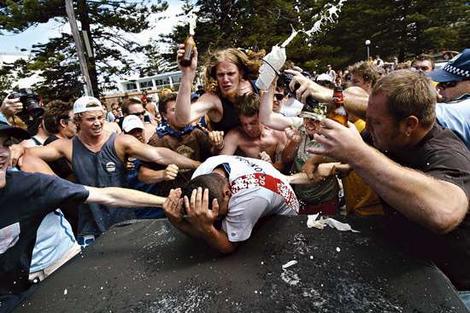
Paul Sheehan says: 'Context is everything. Cronulla will receive saturation coverage, which will balloon the events of yesterday into something more than they were - the actions of a minority of idiots.' Nope, this is more than the simmering tensions of yobbo beach tribes and the redneck suburban working class culture in a primarily primarily Anglo-Saxon community. The initial 'retake the beach' became "Leb and wog bashing day", and so the Lebanese gangs retaliated in the evening.
This was a pre-meditated white racist violence against Lebanese and other Middle Eastern Australians that exploded in the open. The Sydney Morning Herald carries this report:
A crowd of at least 5000 - overwhelmingly under 25 - took over Cronulla's foreshore and beachside streets. Police were powerless as 200-odd ringleaders, many clutching bottles or cans of beer and smoking marijuana, led assaults on individuals and small groups of Lebanese Australians who risked an appearance during the six-hour protest.
And then violence resulted:
The horde swirled after fleeing individuals, sometimes sweeping past police lines and horses, chasing a quarry who sought safety in restaurants, shops, toilet blocks and ambulances and police vehicles. Some were snatched by police, who stood against the swarm and repelled the most violent with capsicum spray
It was not a horde or a mob. It was a political riot with bottles and knives.
Firstly, the Australia First Party was busy handing out ' Immigration out of control" and "Your teachers are lying to you" in the morning --that has its basis in One Nation (ethnic) nationalism. Australia First helped mobilise people for the demonstration to celebrate Aussie nationalism.
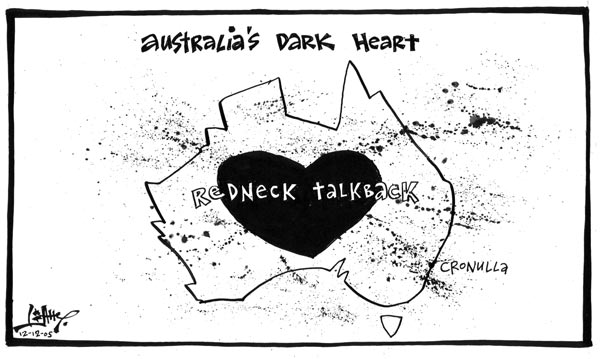
Secondly, the white riots are the mirror side of the One Nation nationalism violently expounded on the Sydney tabloid media (eg., The Daily Telegraph and talkback radio). The media does not reflect society. It is a political player. The ethnic nationalism of the tabloid media is deeply opposed to a multicultural Australia; stands for the hegemony of Anglo-Australia; assimilation and a strong and law order against the crimes committed by Lebanese, Aborigines and Pacific Islanders; and is deeply concerned about drugs, anomie and nihilism.
The tabloid media will wash their hands of responsibility, disown the violence of the race riots, and disconnect their politics from the right-wing white racism on the streets of Cronulla. But they are responsible. Their climate of fear, which they have been stirring since 9/11 and the Bali bombings has metamorphised into a climate of hate.
The war on terrorism is one context for Cronulla. Another context is outlined at philosophy.com
Posted by Gary Sauer-Thompson at 6:50 AM | Comments (16) | TrackBack
December 11, 2005
Kyoto: a step forward
The Washington Post reports some sucesses at the Montreal Kyoto conference. It states 'all the industrialized nations except the United States and Australia reached an agreement early Saturday to embark on a fresh round of formal talks aimed at setting new mandatory limits on greenhouse gas emissions after 2012' when the existing Kyoto Protocol agreement expires. America has refused to engage in future negotiations on climate change.

Both the Howard Government and the Bush administration disavowed the Kyoto Protocol in 2001, and they opposed any kind of mandatory limits on carbon dioxide produced by burning fossil fuels. Both have argued that research, new technology and market forces are the best way to address warming linked to the buildup of greenhouse gases. Both have fiercely resisting any new international talks to address the Earth's warming climate along the lines of the Kyoto protocol.
The news report states that:
"... the agreement among Kyoto parties both commits most of the world's most influential nations to negotiating a new set of emission cuts and forces them to evaluate at their 2006 meeting whether the current climate regime is working. In the second, broader pact, nearly 200 countries agreed to start an informal dialogue to determine what else should be done to address climate change. This accord calls for developing nations such as China and India, which are not obligated by the Kyoto targets, to adopt voluntary emissions cuts that they could trade for credits on the international carbon market established under Kyoto."
Australia's position is that Kyoto would damage the Australian economy. What this means is that the oil, energy and energy intensive companies are affected by legal commitments to reduce greenhouse gas emissions because burning their products produce most of the greenhouse emissions.
In Australia The energy-intensive industries have formed an anti-Kyoto lobby that has been engaged in a systematic campaign to prevent Australia signing up to the Kyoto protocol to reduce emissions that lead to global warming. They run the Howard Government's energy policy and their discourse is about needing to dispel the myth of global warming, highlighting the uncertainties in climate science and disputing the need to take action.
Senator Campbell, the Australian Environment Minister, continues to maintain both that Australia and the US were right not to ratify the protocol and that the Kyoto Protocol was almost buried! Who is he trying to fool?
John Quiggin states that Campbell’s statement is designed to give him cover with the domestic anti-Kyoto lobby for his break with the US position and to support Canada's call for two years of global talks on future co-operation on climate change. John is probably right.
However, the shift that Campbell has made is a minimal one: he's just going to engage in future negotiations on climate change whilst continuing the government's opposition to the Kyoto Protocol. Australia still remains outside the Kyoto Protocol on climate change and so its firms cannot trade for credits on the international carbon market established under Kyoto.
Posted by Gary Sauer-Thompson at 8:44 AM | Comments (0) | TrackBack
December 10, 2005
wine industry: troubled futures
On the drive down to Victor Harbour from Adelaide you pass by the McLaren Vale nestled amongst the Mt Lofty Ranges. It has become a significant tourist attraction with up market wineries, gourmet restaurants and stylish cafes. As you continue to drive to, and along, the southern coast of the Fleurieu Peninsula you cannot help but notice the stretches of newly planted vineyards popping up everywhere.
Where's all the wine going? Whose buying it? Whose drinking it?
In the newspapers you read about the wine glut, in the cafes you hear about the grapes being left on the vines, from the environmentalists you hear about the salt and in the business press you read about the large corporates gobbling up the smaller niche players and their declining profit margins.
The signs are clear. The Australian wine industry has gone for commercial grade fruit, short-term profits, large scale industrial production, lots of water and mass market wines in a big way. You would have expected the industry to have built on its strengths by going for long-term sustainability through the export of prestige---good to valuable wines-- based on an ecologically sustainable fine wine culture built around the marked regional differences.
Simon Evans in the Australian Financial Review says the consequences of the former strategy is that the growers are shouldering too much of the financial burdern of oversupply as the corporate wine companies preserve margins by squeezing their suppliers with lower prices and reduced terms. He says
'
...all that does is put free fruit on the market, which some vulture wil pick up. That "vulture" then puts cheap plonk on the market, which adds to the fierce competition on pricing. It's a self-defeating strategy. '
On world markets Australia's commercial wines are not that much different different to those from South Africa and Chile. Australia is but one of the wine producers jostling for position on the shelves of northern hemisphere liquor retailers and supermarket chains. It just happens to be in favour for the moment.
Quality is the way to go for the global market.
Posted by Gary Sauer-Thompson at 5:41 PM | Comments (10) | TrackBack
December 9, 2005
the light at the end of the tunnel
I guess that we can talk in terms of the US Gulag ---the chain of black sites (airports, military bases, and former compounds or prisons of the old Soviet Gulag) that facilitate illegal detentions, kidnappings (called "extraordinary renditions"), and are used for the torture and abuse of various terror suspects.

We don't hear much about this from the Howard Government. I guess as a faithful ally we are expected to trust that America does not allow rights abuses; or that evidence obtained under torture saves lives. No doubt they would say would distance Canberra from the controversy over claims that terror suspects subject to "rendition" by the United States may have been tortured in third countries. I wonder when the Australian High Court will rule on evidence extracted under torture?
Isn't the doctrine of 'the ends justify the means' the philosophy of the imperial presidency? Isn't the US engaged in achieving democracy in Iraq through force of arms. Isn't US policy to impose its will on Iraq? What we have is the possibility of a total collapse in Iraq; a disaster of a civil war or a regional guerrilla war caused by the long-term heavy US troop presence as an occupying force. The recent Bush rhetoric about victory being on the horizon, that the US mission in Iraq is to win the war, and that US troops will return home when that mission is complete has littel connection with reality.
Posted by Gary Sauer-Thompson at 3:07 PM | Comments (0) | TrackBack
December 8, 2005
Costello's Lucky Country
Peter Costello has withdrawn from the leadership challenge wounded. I must admit that did enjoyed watching the retreat as his political ambition was deflated over two weeks of name-calling, backbiting, point-scoring and finger-pointing in the feisty atmosphere of Question Time. The Costello camp is saying that a truce has been declined.

Yesterdays national accounts figures showed an economy flatlining at 0.2 per cent in the September quarter and indicated the continued weakness of exports, the decline of manaufacturing a fall in productivity and a continual deterioration in the current account deficit to 6.5% of GDP.
Though we know that he is not much of an economic reformer the Treasurer is still seen as a successful economic manager. He talks about the record low levels of unemployment, low interest rates and budget surpluses.The Treasurer's tone is reassuring on the economy. There is no need to worry as ecconomic growth will bounce back from the current 2.6% up over the year. There is no need to worry about the decline in foreign investor confidence or a fall in the Australian dollar due to the high current account deficit.
Where is the export bonanza?
The Treasurer may be an excellent performer in the political theatre of a gladiatorial Question Time in the House of Representatives, but where is the policy substance on the economy? How does he deal with the challenge posed to Australia by China and India in relation to their more cost effective manufacturing and service industries? Through a low wage economy?
Posted by Gary Sauer-Thompson at 2:22 PM | Comments (2) | TrackBack
December 7, 2005
Kyoto Conference
High-level discussions on the future of the Kyoto agreement will take place at the two-week United Nations meeting in Montreal .The delegates will endeavour to hammer out the final details of the first Kyoto phase, including penalties for countries that fail to meet their emission targets, as well as agreeing to a way to take the process beyond 2012.

Kyoto Protocol became operational in February and open a new phase in international efforts to protect the global climate. The Pan-European emissions trading has begun and the Clean Development Mechanism, as a tool to promote sustainable development and combat climate change, is operational,
Australia is not part of these talks as it follows the US administration's anti-regulation approach, which relies on voluntary action and technology to reduce greenhouse gas pollution.
Posted by Gary Sauer-Thompson at 5:50 PM | Comments (0) | TrackBack
rendition--CIA style
The CIA's secret "ghost flights"----eg., covertly transferred terrorist suspects across the European continent---- are deemed by the Washington administration as "a vital tool" in the campaign against terrorism.

These ghost flights are a core part of a state-sponsored form of kidnapping of those suspected of terrorism or involvement with terror groups and then handing them over into torture in foreign countries that torture to obtain information. It is alleged that this use of torture to fight terrorism takes place in secret prisons in eastern Europe (possibly in Romania and Poland) beyond the reach of any legal system.
Condoleezza Rice does not deny that rendition was taking place--only that the US does not knowingly send people to be tortured.
Often the CIA grabs suspects off the street who later turned out to be innocent.That is Mamdouh Habib, 49, an Australian citizen. Given the Australian government lack of sympathy to Habib, after he was released without charge and allowed to return to his wife and three children in Sydney, one presumes the Howard government tacitly supports renditions.
Alas Condoleezza Rice, who had defended the renditions as a necessary part of of the US war on terror, said the US Government had the knowing cooperation of the relevant European Governments, including that of the Schroder Government in Germany. It had publicly broken with the Bush administration over invasion of Iraq yet it remained silent about the ghost flights.
Posted by Gary Sauer-Thompson at 1:42 PM | Comments (0) | TrackBack
December 6, 2005
Costello falters
In commenting on the Gerard affair, which has clipped the Treasurer's wings, John Quiggin makes the following observation:
I don’t share the widespread admiration of Costello as either a politician or Treasurer. I think he has the strengths and weaknesses of a school debater. He’s quick on his feet and can get on top of a brief, but rarely takes the trouble to understand the issues on which he is making debating points.
John is right. Peter Costello comports himself as a barrister with a brief in a courtoom. His performance this parliamentary sitting has been full of passion and bluster, avoided answering key questions, and endlessly repeated simple points. This political theatre looked hollow and unconvincing.
Unlike Paul Keating, Costello hasn't done all that well in terms of his Treasury brief on economic reform, and he has been slack in addressing foreign debt and the current account deficit by reshaping the direction of the Australian economy. Costello is content to ride on the back of the resources boom and for Australia to remain China's quarry. What a future.
The Australian Financial Review notes this failure in relation to economic reform. It says:
Mr Costello has avoided the grand narrative. While he has thrown his weight behind particular reforms---such as the GST, which shouldn't be underestimated, and the more recent pharmaceutical benefits, welfare-to-work and Work Choices reform---he has neither articulated a broad reform agenda nor staked his prestige of his office on one.
Yet this broad reform agenda is needed says the AFR because the productivity benefits from the Hawke/Keating reform have fizzled out; the labour market reforms require the easing of poverty traps arising from the steep tax scales and withdrawal rates on welfare and family benefits; the need for a stage two in national competition reform agenda for schools and hospitals etc etc.
The AFR concludes:
What is strange about Mr Costello's reticience is that it is he who needs to establish leadership creditionals, and from having a wider reform platform to sell in 2007.....What is doubly strange is that he recognized the need for a new wave of reform as far back as 2001 when he asked Treasury to write the intergenerational report on the demographic challenge.That was delivered with the 2002 budget and we are still waiting for the "what next?" chapter.
Costello's record of consistent economic growth benefits from the Hawke/Keating reforms to currency and exchange controls, tarrifs and taxes; and it is at the expense of a worsening current account deficit.
A good opportunity opens up for a Beazley-led ALP to to establish the electorally acceptable economic credentials it needs.
Posted by Gary Sauer-Thompson at 12:58 PM | Comments (2) | TrackBack
Australian fascism?
Gerard Henderon in the Sydney Morning Herald has an op ed. on the responses to the sedition provisions of the Howard Government's anti-terrorism legislation. He says:
So it has come to this, apparently. The passing by the Senate of the Federal Government's industrial relations legislation, and the likely passing this week of its national security legislation, has led to the creation of the Howard fascist police state. All courtesy of Mark Latham's disastrous performance as ALP leader in last year's election, which led to the Coalition obtaining a Senate majority.
Henderson gives instances of those Australians who talk in terms of Australian fascism---an Australian police state.

Moir
Henderson calls for a dose of realism. Rightly so. What is happening with the camps, the roll back of civil liberties, and the use of fear by the national securitry in Australia ais not the same as the totalitarianism of Stalinism and Nazism. As Henderson points out, unlike real totalitarian regimes, the so-called Howard fascist police state will go to the polls in just two years' time.
But that does not mean that something has not shifted in the Australian body politic. What Henderson does not address is the move away from liberalism to conservatism. That shift is marked by increasing power to the state at the expense of the individual. Yet academics are not addressing the significance of that newly forming conservatism.
What has shifted is that the Executive is using the threat of terrorism to introduce laws that put our most basic liberties under threat. What we have is the power of the executive being used to put someone--a citizen--- into detention/prison without formulating any charge and denying the citzen the judgement of his /her peers.They can then be held under house detention.
Is this not the mark of dictatorial regimes? Do we not have a situation in which Australia is fighting a war on terrorism to defend liberty and is losing its own liberty in the process? Isn't this what the Law Council of Australia, and all state law councils, have drawn attention to?
Posted by Gary Sauer-Thompson at 6:43 AM | Comments (6) | TrackBack
December 5, 2005
Queensland health #2
The
The future of an ageing Australia is one of massive tax increases to pay for inadequate services. Hence Premier Beatties' view that the Australian health system will fall apart by 2015 and his call for a national health summit.
An editorial in todays Australian Financial Review takes up the issue. It says that:
Australia's health costs are spinning out of control....Last year Australia's total health bill topped $78.6 billion. Yet public hospitals are grinding to a standstill ....Something's wrong when when a system consumes 9.7 per cent of gross domestic product fails to deliver a reasonable standard of service. The Federal government knows it.....But more resources and skilled people won't solve all the problems...Most of the problems in health provision are about management of financial and human resources. Queues will shorten and services will improve if they are funded, paid for, and managed with clear lines of accountibility.
Very true. But hospitals are not the health system. There is the whole domain of primary health care outside the hospitals; a domain that functions to prevent illness and to reduce the flow of sick people into our hospitals.
Posted by Gary Sauer-Thompson at 3:55 PM | Comments (0) | TrackBack
December 4, 2005
Walkley's & media criticism
I'm down at Victor Harbor this weekend. SoI am forced to use dialup because there is no broadband access. It is very difficult to search the web for ground breaaking op.ed. commentaryor investtgative journalism, so I will make do with this witty comment on the IR legislation.

Matt Golding
I watched the Walkley Awards on SBS last Thursday night. It was a gala ceremony of celebration of excellence in journalism that defended the craft involved in producing the best stories--those that governments, bureaucracies, institutions or crooks want to keep away from the public.
Suprisingly, very little of the finalists work is online.
I was suprised at the liimited awards for cartoonists and they limited presentation of the cartoons entered for the awards. It was mostly about classic investigative journalism--print and visual --with a peer emphasis on stories that throw up technical, physical and cultural challenges in foreign disaster zones, rather than the classic telephone and internet office investigation back in Australia.
Should not both kinds should be celebrated and rewarded?
I found the event rather conservative in its understanding of the media and the way the "media landscape is changing. There was no acknowledging the existence of the new internet forms of media, or the newly emerging journalism that keep the public cyberspace open and vibrant. But then bloggers are not journalists are they? Blogging undermines the conventional objectivity of journalism and thus undercuts journalistic credibility.
Do not alternative news sites and blogs have an impact on politics, power and news consumption? Are not newspapers going increasingly online?
It strikes me that the political media spin machine has reached the stage were it, more or less, runs the media and it produces the self-enclosed world of distorting mirrors that is then taken for reality. Reality is what appears in the media's headlines.
Are not alternative media and blogs becoming the alternative outlets that can deflect spin and provide a credible criticism of the journalists that stay on the PR machine's message as articulated by the media minders and media trainers? Yet The Age cannot keep its media blog going once Hugh Martin left.
Posted by Gary Sauer-Thompson at 9:12 AM | Comments (1) | TrackBack
December 3, 2005
a low wage Australia?
I didn't watch the Senate debating the IR legislation yesterday but I can imagine there would have been angry scenes given the time limit. So the two key planks of the Howard Government's 4th term neo-liberal agenda that entrenches the culture of entrepreneurship and individual initiative are in place.
The Parliamentary debate is over.
Judi Moylan, who declared support for the Government's goal of reducing welfare dependency, asked a good question:
"Why are we including in this policy disincentives to work and cuts in income support which can only drive some of the more vulnerable in our community deeper into poverty?"
Why indeed.
The Prime Minister also asks a good question when he rhetorically asks:' Why would any Australian PM create a low wage Australia?'
Why indeed.
But put the welfare-to-work and the IR legislation together in the context of a global economy, a shortage of workers and user pays education, and that low wage future is what the scenario looks like for the low skilled. The justification for the IR legislation? Any job is better than no job. Prosperity is fairness.
It may well be the case that a strong economy is the only guarantee of job security and future higher real wages. So what happens in a downturn with a flexible labour market when businesses are cutting costs? It is the families who will act as the safety net for the most vulnerable Australians.
Meanwhile, taxation looms as a policy issue for 1996::

Alan Moir
Why not tax cuts for rich and poor? Why not a fairer tax system? The current one savagely penalize those making the transition from welfare to work and stifles their entrepreneurship and individual initiative.
Posted by Gary Sauer-Thompson at 10:30 AM | Comments (2) | TrackBack
December 2, 2005
damaged goods
Over the last couple of days I watched the Costello defence of Robert Gerard's 2003 appointment as a director of the Reserve Bank in the House of Representatives. This was done at a time when Gerard Industries was being chased by the Tax Office for big time tax evasion using a Caribbean tax haven. Not a good example of corporate social responsibility is it?
Costello was not convincing. Apart from the 'didn't know' and 'wasn't told' it was a barrister engaged in hair splitting in response to justified ALP criticisms concerned to make the executive accountable. Costello should be held accountable for Gerard's appointment, and Parliament was exercising its legitimate muscle in questioning the lack of diligence. Howard and Costello's ducking and weaving all over the place only made matters worse.

Leak
After watching it all my judgement was that Rob Gerard, a Liberal party donor, should look after the reputation and independence of the Reserve Bank by resigning from the Board. He is damaged goods and should not remain. No doubt Gerard will become the fall guy to protect the Howard Government. Costello remains tarred.
It is time political appointments (party mates) to the Reserve Bank Board by both political parties ended. Both parties should take the independence of the Reserve Bank seriously. It is one one of the few public institutions that retains its independence and stands between the arbitrary power of the executive governmnet and the citizens.
Update: 3 December 2005
Gerard has done the right thing. He resigned on Friday afternoon. Though he still refuses to acknowledge that he does not pass the requirement of 'fit and proper person ' test, as he says that the accusations against him were out to destroy his reputation and damage the Howard Government. Gerard seems to have forgotten about the need to independence of the Reserve Bank, the need for checks and balances on power in a liberal democracy, and the lack of a proper scrutiny in the appointments system.
Future appointments to the Reserve Bank Board should be the subject of scrutiny by a joint committee of both houses of Parliament, and the appointment should require the support of two thirds of both houses of Parliament. Will the ALP have the political courage to call for this?
Posted by Gary Sauer-Thompson at 12:29 PM | Comments (5) | TrackBack
December 1, 2005
junk legisation
The Senate is debating the IR legislation., which has about 700 pages There history is a truncated committee process (3 days) and the guillotine which cut in at midday. We are now in the committee stage of considering the amendments of the legislation. 39 minutes prior to the committee stage the government dropped in 337 amendments ---100 pages---with a truncated period for disccussing the amendments.
These amendments are designed to fix up the mistakes in the IR legislation--they are not amendments relating to policy issues How can the non government senators read that? How can you relate the 45 pages of the non-government parties to the orginal bill when we have to these government amendments that amend the original bill?
This highlights the lack of proper process and the contempt for the Senate. Legislation is being rammed through regardless of the consequences and without caring whether the Senate does its job properly:

Geoff Pryor
What we now have in the committee stage reading of the bill is Senator Eric Abetz, giving two partisan second reading speeches in the committee stage. He had forgotten to give his second reading speech at the right time. Abetz has no concern about the rules, procedures, values and conventions of the Senate. His position is that we have the numbers, we will do what we like, and there is nothing you can do about it.
Posted by Gary Sauer-Thompson at 11:13 AM | Comments (1) | TrackBack
Queensland health
The Davis Report into Dr Jayant Patel, the rogue surgeon whoss botched operations at Bundaberg Hospital resulted in at least 13 deaths, highlights the mess the state's health system is in. There is a culture of coverup in political, administrative and medical culture, chronic underfunding of the hospital system, and a lack of concern to keep the population healthy.
Inquiry commissioner Geoff Davies, QC, stated that the culture of secrecy involved:
"... involved a blatant exercise of secreting information from public gaze for no reason other than that the disclosure of the information might be embarrassing to government...This culture started at the top, with successive governments misusing the Freedom of Information Act to enable potentially embarrassing information to be concealed from the public. Unsurprisingly, Queensland Health adopted a similar approach, and because inadequate budgets meant that there would be inadequate health care, there was quite a lot to conceal. Again unsurprisingly, the same approach was adopted by administrators in public hospitals, and this, in turn, led to threats of retribution to those who saw it as their duty to complain about inadequate health care."

The health system is a mess yet Peter Beattie, the Queensland Premier, is calling for more funds, not ways to keep the population healthy even though obesity is looming on the horizon as a major health issue. Obesity is still ignored as an illness. Health and medical professions concentrate on treating its results---heart disease, diabetes, hypertension, gallstones, sleep apnoea, bowel cancer, etc. Yet obesity is a preventable disease through changes in diet and by becoming more physically active. It is spreventable because the main causes of obesity are sedentary lifestyles and high fat, energy dense diets.
The health promotion approach--giving out healthy lifestyle messages-- has failed whilst the weight loss medications is that they’re used as a way of avoiding getting exercise and eating less. ye te Premier never mentions health in terms of lifestyle modification.
Posted by Gary Sauer-Thompson at 7:16 AM | Comments (0) | TrackBack