« February 2013 | Main | April 2013 »
March 27, 2013
on Cyprus
The Troika insists that troubled countries get their financial house in order as a condition for receiving bailout money. But the specific austerity measures they have chosen are killing any chance these countries have to grow, and therefore repay their lenders. This creates a vicious cycle, as the less borrowers are able to pay, the tougher the repayment terms get.
In this column on the economic crisis on Cyprus Paul Krugman takes a different tack. He asks us to:
consider the incredible fact that tax havens like Cyprus, the Cayman Islands, and many more are still operating pretty much the same way that they did before the global financial crisis. Everyone has seen the damage that runaway bankers can inflict, yet much of the world’s financial business is still routed through jurisdictions that let bankers sidestep even the mild regulations we’ve put in place. Everyone is crying about budget deficits, yet corporations and the wealthy are still freely using tax havens to avoid paying taxes like the little people.
Cyprus is a place where people, especially but not only Russians, hide their wealth from both the taxmen and the regulators. Whatever gloss you put on it, it’s basically about money-laundering.
Cyprus ran large current-account deficits, experienced a real estate bubble, developed a runaway banking system, public finances were mismanaged, and the state could not afford to rescue insolvent banks. The Cyprus government is trying to remain in the eurozone while retaining the country’s offshore banking model, hence their resistance to imposing a big haircut (40%) on the large (mostly foreign) creditors. Hence their proposal too impose a one-time tax on accounts holding less than €100,000
Democratic resistance by ordinary Cypriots to the one-time tax on accounts holding less than €100,000
has meant that the large (mostly foreign) creditors are to take a large haircut. Can they keep their offshore banking model?
Posted by Gary Sauer-Thompson at 11:04 PM | Comments (2) | TrackBack
March 26, 2013
second rate visions
The ALP has moved closer to its union power base. The wagons are circling.
That is the significance of Gillard's remarks at the Australian Workers Union conference that Labor was not a progressive or a social democratic party, but primarily a workers’ party. In saying that the prime minister has turned her back on the progressive and social democratic tradition of her party; a tradition centred around taming and civilizing capitalism.
 David Rowe
Why the retreat?
Is out of fear of attacks from the Right that Labor is engaged in class warfare? Is it a failure of nerve in the face of neo-liberal globalization? A failure to open up the economy to, and welcome, the highly skilled middle class migrants from Asia who desire to come to Australia? The dead hand of the factions?
I supported the ALP in the last election primarily because of the promise of the National Broadband Network. It was a solution to Australia’s long-term telecommunications problems and it's infrastructure provided the capabilities to enable Australia to a high skilled digital economy. For Australia to compete in a global economic environment, then it is going to be increasingly about knowledge and innovation. So that means we're going to need cities with a skilled and educated workforce that are able to contribute to that economy and prosper.
Given the delays in the NBN’s rollout over the past several months it is now clear that the network will not be built. What's more the plan will be demolished by the Coalition when they return to government late 2013 to be replaced by Turnbull's patchwork of fibre to the node and copper from the node to the premises. There ends the dream of Australia developing a high skilled digital economy. Australia remains a quarry with an ever increasing concentration of wealth and power resulting from ostensibly “free market” activities.
These activities are premised on greed is good for wealth creation. Their vision is still one of unfettered markets creating economic harmony and they continue to represent this as “the end of history”.
Posted by Gary Sauer-Thompson at 12:56 PM | Comments (6) | TrackBack
March 25, 2013
an energy death spiral?
Giles Parkinson in his Energy death spiral – consume more, or prices will rise at Renew Economy highlights what is likely to happen in the rigged energy market in the near future. It also gives us an indication of the conflict around solar politics that will emerge.
Parkinson says with respect to the grid that:
Some $40 billion have been spent and the network operators want their money back, plus the regulated return on their investment that is decided by market regulators. And they will get it.That means that if consumers reduce demand – as they have so dramatically in the last couple of years – they will be hit by higher charges. The cause of this Catch 22 is because total revenues for network operators are set for five years. The recent surge in network investment – which has underpinned the majority of the recent dramatic price rises, but much of which has been criticized as “gold plating” – guarantee a certain return for the network operators.
The energy market is rigged in favour of the fossil fuel industry.
What this indicates Parkinson suggests, is an attempt by the Australian Energy Market Commission (AEMC) to justify the extensive network investment it ushered through to support an inefficient energy system; a system that uses less than 10 per cent of the original energy burned at its end point – and yet which is lauded as being cheap and efficient.
It's a death spiral in that it signals what happens when too many people reduce demand, or even leave the grid – leaving network owners with a redundant system. So the utilities are fighting against energy efficiency schemes, and against the proliferation of solar PV because these reduce demand for electricity produced by the fossil fuel industry. They are also proposing to to make it less attractive for customers to produce their own energy, consume less or even leave the grid buy increasing the fixed component of consumer bills---eg., the type of obligated payments that are in water supply.
The regulators, who have been captured by the industry are effectively protecting the billions of dollars in network investments in recent years, as are the state governments in NSW and Queensland who own their states fossil fuel industry. In contrast households are turning to solar PV because they see it as a good hedge against rising electricity prices. Hence we have the emerging solar politics.
Posted by Gary Sauer-Thompson at 3:11 PM | Comments (3) | TrackBack
March 24, 2013
can the ALP reconcile itself?
Last week's Labor's leadership turmoil is certainly not going to help its electoral chances. The damage Labor did to itself is going to make that task even more daunting.
The upside is that the leadership question has been settled. The white noise created by the leaking/destabilisation campaign of the Rudd camp explanation for the woes of Gillard Labor no longer holds. Gillard is now more in charge of her government than at any point since 2010.
 David Pope
However, can the ALP reconcile itself? If so, can the Gillard Government govern in a less dysfunctional way than it did with the aborted media reforms. If so, does it have the right policies for it to be a reformist government?
I don't know the answer to these questions. I do know that the social basis for its old style Laborism has been weakened and hollowed out due to the decline of the ALP’s industrial union base and that it is unwilling to detach the political wing entirely from that withered base so that it can make different kinds of appeals to different social and economic groupings.
Mark Latham articulates that option in his recent Quarterly Essay. Not Dead Yet: Labor's Post-Left Future lays out a program for renewal that entails breaking ties with the union movement and abandoning any lingering doubts about the market.
Posted by Gary Sauer-Thompson at 1:19 PM | Comments (12) | TrackBack
March 21, 2013
ALP in crisis
It is federal ALP that is in crisis, due to its internal destabilization from those MP's who support the return of Kevin Rudd as leader and PM. Labor is in turmoil from its ongoing leadership tensions. So say the political journalists in the mainstream media, rubbing their hands with glee.
A leadership spill has been called by Gillard for 4.30pm today. The Coalition used Question Time to call for standing orders to be suspended so they could move a no confidence motion against the Gillard Government. The Coalition kept calling -chanting even--- for an election now during today's Question Time. "We cannot wait until September 14."
The motion to suspend standing orders failed to gain the required absolute majority. The media still rubbed their hands at the thought of blood on the floor at 4.30pm. It would be Gillard's blood for sure.
 Alan Moir
It is true that the ALP that is damaging itself. Yet its economic performance is okay, the carbon price appears to have been effective, there have a number of significant reforms (eg.,water reform in the Murray-Darling Basin) and they were starting to shift Australia into becoming a "high-wage, high-skill economy".
Despite a good record Labor turns on itself. Why the destablization from within by people like Joel Fitzgibbon--the Chief Whip---when changing leaders won't change the splits, factions, divisions and hostilities within the ALP? There would be only a facade of unity.
It's all grist for the media's narrative that leadership tensions is the core of political reporting and that the Gillard Government is dysfunctional and incompetent. They reckon that they don't have to make things up anymore or trade in deceptions.
They can now write that the ALP is on its knees and asking Rudd to return. And Ministers desert PM. Rudd gets his sweet revenge. Gillard is gone.
And so on. And so on. It's a hostile media narrative. Is this a case of shooting the media messenger who are merely reporting on what "senior Labor sources" have told them?
Not at all. The media don't even know whether Rudd has the numbers to defeat Gillard, or whether he is even contesting the leadership. They are just speculating and calling it fact. It's more likely a media beat up to reinforce the media's narrative and to help the Coalition crack the Gillard Government so that it falls.
Update
Kevin Rudd did not contest the leadership. It was a week long media beatup. The press revved it up, drove it, surfed it, then savored Gillard's blood on the floor for an hour or two this afternoon. They were denied Gillard's head on a platter.
How long before the mainstream media start beating the leadership drum again? Will the emerging narrative will be " this is not over - there is no settlement"? Or Labor is dysfunctional. Labor is badly damaged. So is Gillard.
The journalists don't even understand what was going on in Question Time today. Thus Jacqueline Maley in the SMH says:
Abbott only got through a couple of questions before he moved a motion to suspend standing orders so he could move a motion of no confidence in the government. The suspension vote was won, and so the no confidence motion was debated.
Not so. The motion to suspend standing orders in order to move a motion of no confidence did not obtain an absolute majority. So the no confidence motion was not debated. Maley also says that the immediate threat to Gillard was at her back. But there was no contest. Maley is writing fiction.
Posted by Gary Sauer-Thompson at 1:44 PM | Comments (13) | TrackBack
March 20, 2013
gossip sheets
Consumers are increasingly deserting the traditional news outlet of the traditional mainstream media and turning to other media sources on the internet for their information. There is lots of competition and lots of stuff to read as Mathew Yglesias points out at Slate.
Recent events in Australia provide a good example for this turn. Ben Eltham finishes his Conroy’s Crash Through Tactics at New Matilda by observing that:
There is a connection be made between the media's over-reaction on self-regulation and its fevered reporting on the shadow boxing over the leadership. Both examples show that journalists and editors are failing their audiences. The former reinforces the point that the media can't be trusted to report on itself. The latter again highlights the deficit of trust between ordinary citizens and press gallery journalists. Taken together, we're missing the bigger debate, about the merits and safeguards of the news media in a modern democracy.
I'd go further. The mainstream media's political reporting from Canberra has become akin to a gossip sheet. All pretence about being the fourth estate informing citizens so they can make their democratic judgements about public policy issues has been dropped.
 David Rowe
The Murdoch media, around the world, sees freedom of the press as meaning the freedom to mislead, misrepresent, and outright make things up. They are engaged in a policy of destabilization of the Gillard Government; that is regime change in favour of an Abbott Coalition Government. They see themselves as king makers who have the rights of kings
We have to accept the decline of the mainstream media's political reporting into gossip but there is a need for the regulation of the media with penalties for wrong doing--ie breaking standards.
Posted by Gary Sauer-Thompson at 4:03 PM | Comments (1) | TrackBack
March 19, 2013
Republican America
An insight into the Republicans vision of a prosperous America comes from Wisconsin Representative, and former vice-presidential candidate, Paul Ryan. It is a roadmap to a minimalist government through a balanced budget that is premised on a fundamental rewrite of the social contract.
The rhetoric of Ryan's economic conservatism is premised on fear about deficits, deficit reduction and fiscal responsibility. He says that:
Unless we change course, we will have a debt crisis. Pressed for cash, the government will take the easy way out: It will crank up the printing presses. The final stage of this intergenerational theft will be the debasement of our currency. Government will cheat us of our just rewards. Our finances will collapse. The economy will stall. The safety net will unravel. And the most vulnerable will suffer.
The only way to prevent this kind of future is the politics of austerity. Ryan proposes $4.6 trillion in spending cuts over ten years, with no increased revenues; dropping the top tax rate from 39.6% to 25%; and higher taxes on low- and middle-income earners to pay for his proposed tax cuts for the wealthy and corporations.
Defence spending remains almost untouched, as does Social Security-- Social Security privatization has been placed on the backburner. The majority of the spending cuts come from cuts to healthcare programs (repealing Obamacare and turning Medicare into vouchers); and cuts to infrastructure, education, research, housing, public health. This shrinks the federal role on priorities like infrastructure and education to a tiny fraction of its current level.
This is no "deficit reduction" plan. It is not about fiscal responsibility. The Republican vision for America is an "expansionary austerity" that starves the government beast' and redistributes income and wealth to the best-off Americans from everyone else. It's the same old vision.
Too much of American taxes now goes to bail outs of banks on Wall Street and that is why the social contract between the liberal state and the middle classes is broken.
Posted by Gary Sauer-Thompson at 11:34 AM | Comments (2) | TrackBack
March 18, 2013
Eurozone: grabbing depositors cash
The Euro debt crisis has taken a turn for the worse and the financial repression of the weaker Euro-Zone members has increased.
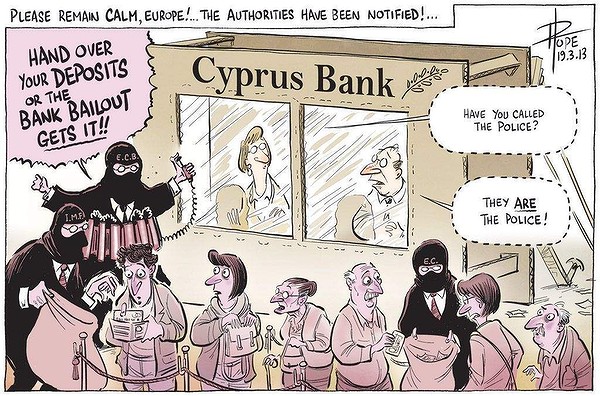
Cyprus' banks have gone bust. They will collapse without a bailout. The Troika--the European commission, the IMF and the European Central Bank – imposed a levy on savers in Cypriot banks on the grounds that Cyprus part-finance their own bailout . Savings of over €100,000 will be subject to a 10% tax, and those under €100,000 one of 6.7%. Around half of all those higher deposits (estimates vary) are owned by Russians, many of whom allegedly use the country as a tax haven from their own domestic charges. The bail-in of Cypriot depositors to the tune of 5.8bn euros is about a third of Cyprus’ GDP.
 David Pope
The levy is part of a 10bn euro “bailout” of Cyprus, which does not have the money to bail out its banks. The Troika's "take it or leave it" ultimatum to the Cypriot government and means the debt burden of the banks has been transferred from the banks, where it properly belongs, to households, who had no part in their lending decisions. This marks a new turn in the European crisis.
Cyprus's banks have a problem. Its banks went on a lending spree during the good times – by 2011, they had made loans worth more than eight times the country's national output. Cypriot banks had made loans to Greece worth 160% of GDP and the losses on that high level of exposure have been rising rapidly.
Cyprus also has a problem. Greece is a key trading partner for Cyprus, so there has also been a direct negative impact on the Cypriot economy from the austerity imposed on Greece. Its debt to GDP ratio is 145% and it is bankrupt. So life is going to be grim.
Germany, Finland and the Netherlands are increasingly unwilling to support the weaker Euro-Zone members. Germany is unwilling to pay up for the bailout. As in the case of the 2012 Greek debt restructuring, the ECB and other official lenders are unwilling to take losses on their exposure to the Cypriot banks.
A "stability levy" on those under €100,000 means that overnight a widow’s life savings, carefully saved up over decades, have been gouged, simply because EU bureaucrats decided to protect hedge funds and the German surplus, and to teach the Russians a lesson.
So it is not simply a simply a wealth tax that shift taxes away from income to wealth. It is a form of confiscation and the EU and the European Central Bank (ECB) have actually spooked world financial markets.
Will the levy--or cash grab--- trigger depositors to pull money out of Cyprus at record speed as soon as they have the chance? In the event that the Italians and the Spanish get an inkling that a bailout is looming, won't they immediately withdraw all their euros immediately, triggering a bank run? Causing deposit runs sure is junk public policy
Rather than using the European Stability Mechanism to recapitalise banks, and thereby weaken the link between banks and their governments, the euro zone continues to equate bank bail-outs with sovereign bail-outs. What is not being adopted is the direction of efforts to improve banks’ liquidity position, which should be to encourage them to hold more deposits.
The bond bond holders get away unscathed. The EU, after the financial crash, has not agreed to forgive much of the debts. The Germans, are blocking debt forgiveness with the Finns, the Dutch and the Austrians and so the Cyprus rescue package favours the vested interests of the financial sector, while treating the "population at large" with disdain and contempt.
However, though the package will stave off immediate collapse it may not address Cyprus’ problem. As in Greece and Portugal, privatisation proceeds and the revenue from increased taxes may not reach targets. As with Greece, there is a risk that Cyprus will need additional assistance, entailing further write-offs in depositor’s fund, because it will not generate enough money from tax receipts to repay the loan.
Posted by Gary Sauer-Thompson at 3:31 PM | Comments (18) | TrackBack
press regulation: a do-or-die battle
The corporate press are acting the same in the UK as they are in Australia---trenchant opposition to steps beyond their own ineffective self-regulation to any form of regulation to make them more accountable for their consistently bad behaviour --- misinformation and misrepresentation--- instead of reporting fairly and accurately as they profess to do.
Accountability here minimally means an effective handling of complaints against the press given the history of neither the newspapers themselves nor the Press Complaints Commission doing anything effective about their bad behaviour.

The bullying corporate press, in acting in their self interest under the guise of freedom of speech are indifferent to the rights of the public, the ordinary people who are at risk from being trampled under foot by the consistent misuse of corporate power.
The press have turned the issue into a do-or-die battle against an independent press regulator that also has teeth and have become hysterical in their over the top commentary about the Gillard Government smashing the liberties (freedom of speech, freedom of the press ) they say they uphold and defend.
The swaggering corporate press are even opposed to the proposed moderate system of independent self-regulation in the form of balancing the rights of newspapers themselves to self-regulate with a degree of accountability and protection for the public from the lies, insults and mas deception.
They want to ensure they can be provocative even if that hair-chested strutting around means trampling over the public. They want to ensure that they remain above scrutiny, requiring no monitoring except from within their own ranks. This they reckon, is the best way to increase their readership and prevent their ongoing decline in circulation.
Posted by Gary Sauer-Thompson at 9:00 AM | Comments (4) | TrackBack
March 15, 2013
market democracy
One implication of the Australian media's very hostile reaction to the Gillard Government's mild reform to beef up self-regulation is the notion that democracies must conform to markets.
This market democracy, which is contrasted with political democracy in which the economy is fundamentally subject to democratic authority, has become increasingly ingrained amongst right wing politicians and the media. The further implication is that capitalistic” institutions are the best way not only to respect political and economic liberties, but also to achieve a just society.
Such a conception of market democracy does not recognize the legitimacy of all four common justifications of market regulation: to protect workers from exploitation, to protect consumers, to protect third parties harmed by market transactions (through externalities), and to preserve the stability of the economy or society as a whole (e.g., through regulation of the financial or media sector).
It assumes that free economic activity is a fundamental expression of human freedom and it entails that corporations have a strong right to minimal regulation and that a minimally regulated capitalism leads to indefinite improvement in human well-being.
Media consumers, in being confronted by the deterioration of media services or the performance of media institutions leave or exit leaving because a better good or service is provided by another firm or organization. However they also seek a voice so as to perform the act of complaining, petitioning or protesting, with the intention of achieving a restoration of the quality that has been impaired. Voice and exit thus distinguish the world of politics from the world of the market. The politics of voice is what we call political reform.
The self-regulation by the mainstream press does not provide for a satisfactory process of complaint or protesting because the press corporations control the levers of power to ensure that their interests are protected not the public interest. Hence the need for reform.
Posted by Gary Sauer-Thompson at 2:36 PM | Comments (8) | TrackBack
March 13, 2013
media reform
It is hard to be enthused about the Gillard Government's media reforms in the context of the news media – consistently seeing itself as above scrutiny, requiring no monitoring or accountability except from within its own ranks.
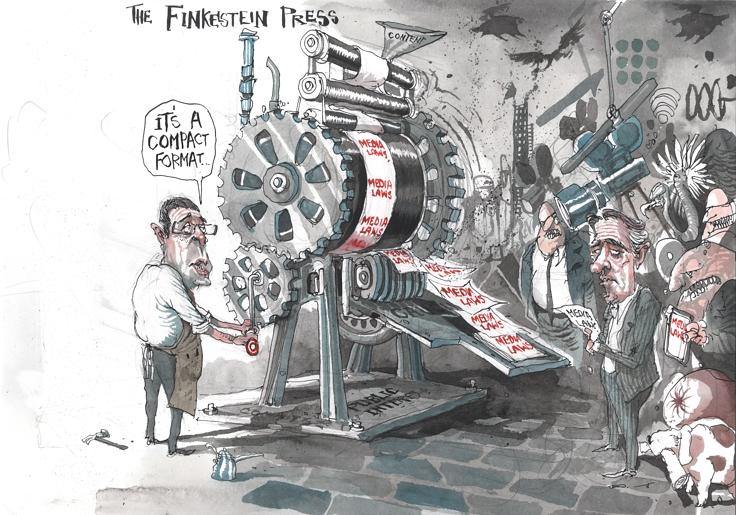
The package consists of a new public interest test for big media mergers; a new self-regulatory press standards model (to include print and online media); a Public Interest Media Advocate who will oversee both; an updating of the ABC and SBS charters to reflect the new media environment; and a permanent halving of the commercial TV licence rebate.
They are a small step towards making the print media more accountable. It's a small step because they work within the established media “silos” of print, broadcasting and online media. The issues raised by convergence are put on the back burner.
 David Rowe
The reforms also reject the need for an official (though independent) government-funded regulatory body to deal with complaints as recommended by the Finkelstein inquiry. Self-regulation remains. The reforms address the issue of the history of bad self-regulation with a Public Interest Media Advocate Advocate ensuring that bodies dealing with media standards, most notably the Australian Press Council, met certain benchmarks for credible and effective self-regulation of print and online media. Self-regulation is still self-regulation.
The need for greater regulation becomes clear when we see this nonsense. Or the way its climate denial has helped it develop into a political and cultural movement that identifies left-wing” opinion with climate science. They link this with the wider green movement initiatives of communes, anti-capitalist sentiments, simple living and eschewing modern conveniences.
We can also recall the way that The Australian and other News Ltd newspapers have published incorrect articles about the National Broadband Network; articles that are based on misinformation and which are designed to deceive readers.
The overwhelming majority of The Australian's articles are bitterly opposed to the network on every measure, and they examples of an incompetent journalism that rejects the very idea of a journalism that is well researched. They write crap and call it journalism.
It is a small step because the reforms are designed to limit the freedom of media outlets to do and say what they like, and it is the first time print and online content will be regulated. But it will not restore trust in the mainstream media given the contempt and disdain the media have for its readers and the ethos of journalism.
Update
The public interest test to be deployed by the Public Interest Media Advocate (PIMA) will draw flack. The Broadcasting Legislation Amendment (News Media Diversity) Bill 2013 defines the test thus:
"the applicant satisfies the PIMA that the relevant control event will not result in a substantial lessening of diversity of control of registered news media voices; or
the PIMA is satisfied:
"that the relevant control event is likely to result in a benefit to the public; and
that the benefit outweighs, or would outweigh, the detriment to the public constituted by any lessening of diversity of control of registered news media voices that would result from the relevant control event."
It's a fairly inoffensive test,there is one in the US and the UK, and there is plenty of room for interpretation in the context of the emerging digital media economy.
It will draw flack because the news media see themselves as a business who should be free to make commercial decisions in the best interests of their organisation’s commercial viability. If that profit making conflicts with the public interest, then, the public interest should be dumped. The reason is that the public interest represents political considerations and government control.
Posted by Gary Sauer-Thompson at 8:50 AM | Comments (6) | TrackBack
March 12, 2013
polls and leadership
Polls and leadership conflicts. Polls and leadership. Polls and leadership. Polls and leadership and crisis.
The narrative of bad poll new leader is the central concern of the Canberra Press Gallery and the mainstream media. It's the frame through which they understand politics. They write about the crisis ad nauseum because it increases the number of clicks on their online articles. They will drive their informed readership away in an attempt to stay relevant with their inflated junk commentary.
 David Rowe
When it does come to policy issues--say the use of foreign workers on 457 visas the debate around the complex issues of globalization, the global movement of labour and migrant labour is reduced to xenophobia and Gillard's flawed judgment.
There is little acknowledgement that the creation of a global economy in the 1990s has produced a global workforce and that this has opened up a range of innovative responses to the squeezing of the middle class, migrant workers and the anti-neoliberal struggles against coercive and repressive work practices.
The dominant neo-liberal ideology hammers out the need for workers and their organisations to be ‘responsible’ and “encourage trade unionists to disavow as ‘subversive’, ‘irresponsible’ or ‘economically disastrous’ any but the most modest of objectives”.
Global neoliberalism has created a crisis for traditional unionism with its mode of governance based on capital mobility, free trade, flexible labour and the market-compliant economic governance of the minimal state and international financial institutions. This has been associated with de-unionisation, hostility towards unionism by conservative governments, and the casualisation of employment through flexible labour relations.
All this make it difficult to protect labor standards, especially for migrant workers. The ACTU highlights the way skilled workers on a temporary 457 Visa (a business can sponsor a skilled worker if they cannot find an appropriate Australian citizen or permanent resident to fill the skilled position) are being exploited by employers so as to undercut Australian wages and conditions.
The ACTU aim is to minimize the ability of employers to use migrant workers to undercut pay and conditions for Australian workers and to protect the interests of migrant workers. The media highlighted the popular nativist reaction of "Australia jobs for Australian workers”.
Posted by Gary Sauer-Thompson at 9:45 AM | Comments (13) | TrackBack
March 11, 2013
the limits of antibiotics
In the battle against bacteria, antibiotics have been formidable weapons. We've been using them widely for only 80 years, but in that time they have helped to transform our lives: we now expect our children to survive into adulthood, we expect to live to a ripe old age.

However, antibiotics don't last for ever, and the reason for that is evolution: bacteria evolve resistance. Antibiotics are failing because bacteria develop resistance to the drugs over time. In the decades after the invention of penicillin it did not seem to be a problem because drug companies developed new versions. But no new classes of drugs have been discovered since 1987 and the pipeline has now dried up.
The pharmaceutical industry have given up tackling the issues of antibiotic resistance. The search for new drugs has become hard and, because resistance always develops, their lifespan is not long, so there is not much profit to be made. The drugs companies see greater profits in medicines that treat chronic conditions, such as heart disease, which patients must take for years or even decades.
If we start running out of effective drugs, that leaves us incredibly vulnerable. The result is that while antibiotics are failing, new bacterial diseases are on the rise. There has been an alarming increase in other types of bacteria, especially the so-called "gram negative" bacteria, which are found in the gut instead of on the skin, are highly dangerous to older and frailer people and few antibiotics remain effective against drug-resistant strains.
The medical profession talks of going back to a pre-penicillin era if we're not careful.
Posted by Gary Sauer-Thompson at 3:51 PM | Comments (1) | TrackBack
March 8, 2013
give me a break
So the faceless men in the Right faction of the Victorian Liberal Party didn't roll Ted Baillieu? That's what the spinners say. Their talking point is that it was an orderly leadership transition wisely executed.
Well, this kind of factional party politics is about numbers. Baillieu didn't have the numbers because the faceless men--eg., Planning Minister Matthew Guy --withdrew their support. Members of Baillieu's own party ---those opposed to “radical Greens-style social policies”---were pushing for a change in leader and they conducted a whispering campaign against him. The Liberal Party suffers from a bitter factional division to the point that it imploded.
The factionalised Liberal Party has been effectively destablising itself, and this has resulted in it becoming a minority government that is dependent on the ongoing support of the cross bench Frankston MP Geoff Shaw on issues of supply and confidence. Shaw is an evangelical Christian who once equated gay sex with child molestation and murder, and he is currently under investigation for abusing his parliamentary entitlements (ie., using his parliamentary car to run his business interests).
 David Rowe
The destablisers said that the Baillieu Liberal government was failing to sell its message. They were behind in the polls. If things were to be turned around the premier had to be replaced if the Liberal government was to continue to govern the state with purpose, implementing its agenda of building for Victoria's future.
It appears to me that the Liberal government's agenda of building for Victoria's future equates to the agenda of the National Party, the fossil fuel industry, and the urban developers--all of whom dismiss energy efficiency as the ravings of starry-eyed greenies wanting to reduce households’ demand for energy. Their's is an agenda that is connected to News Ltd's relentless culture war against “the Left” and to the austerity cuts to schools and cuts to TAFE.
The Liberal government's vested interest agenda is one that dismisses how serious the climate change issue is, and rejects the urgent need for action. Apparently Australia's high emissions per capita is because we have cattle that belch.
This is a government that has turned its back on a burgeoning clean energy industry, has left the state with a shrinking economy, and it has implemented VC82, the regressive planning laws. These laws have four main components – a minimum 2km setback from all homes, a 5km exclusion zone around 15 regional towns, the establishment of several “no-go” zones, and handing responsibility on wind farm approvals to local councils.
Posted by Gary Sauer-Thompson at 9:30 AM | Comments (10) | TrackBack
March 7, 2013
urban development on floodplains
A simple response to the recent flooding in NSW and Queensland is so damaging is that we could stop urban development on floodplains and stop the problem becoming ever larger and more unmanageable.
However, in Whose Fault Are The Floods? at New Matilda Chas Keys argues that the recent flooding is so damaging because governments allow it to happen.
Governments seek development and growth, and so does business. Development is driven to choose the best, often the cheapest locations. But it is not driven by human safety considerations or considerations of long-term economic viability in the context of natural disasters — even those which are certain to occur, will have severe consequences and cannot be prevented.
Secondly:
Government departments.... exist to support the interests of vested interests. Planning departments certainly supports developers and development. They do not exist to create a brake on growth. Indeed in recent times the NSW government’s manual on floodplain development has been modified, at the behest of the department, to make it easier to develop flood-prone land for urban purposes.
Hence the prevalence of residential housing on flood prone land. Floods then cause damage, and governments are forced by the politics of damage rectification to restore infrastructure and provide generous relief to those who have suffered.
Along the way, prolonged periods without floods encourage further floodplain development as councils forget what flooding means. When the floods happen governments spend heavily on flood relief and then allow further inappropriate urban development on the floodplain.
Many reject this argument in favour of building dams as the solution to flood management because they are water-controlling, nature-dominating mechanisms. Thus we have Tony Abbott’s $30 billion solution to build up to 100 new dams to prevent flooding, mainly in northern Australia, coupled with a $500 million expansion of Sydney’s Warragamba dam.
Dams have a minor role in Queensland because the focus on nature and not people in cities. Queensland state governments have never taken flood mitigation seriously, and they have allowed much unwise development on floodplains. It has poor land use management as well as flood-modifying measures like levees.
Posted by Gary Sauer-Thompson at 8:02 AM | Comments (1) | TrackBack
March 6, 2013
a siren song
The Centre of Independent Studies has published a monograph entitled Target 30 Towards Smaller Government and Future Prosperity. Target30 aims to reduce government spending from its current level of 35% of GDP to less than 30% within the next 10 years.
The monograph argues that by defaulting to a big government solution to every problem, we disempower individuals and communities from dealing with their own problems. This ultimately leads to dysfunctional societies. Shrinking the size of government will, the argument runs inject new vigour into the economy.
 David Rowe
This would give us a competitive advantage in the global economy, enabling us to have some of the lowest tax rates in the developed world and boosting economic growth. stimulate the charitable sector, foster personal responsibility, and reforge the community ties that once bound our society together.
Shrinking the size of government will, it is asserted, can also unlock the social and community benefits of smaller government—allowing the charitable sector to once again play a significant role in society, strengthening the bonds of family and community, and recreating the social capital that once kept society functioning effectively.
It is claimed that even though Australia is in an enviable economic position compared to the rest of the world, we still need to learn lessons from the fiscal and debt crises in big-spending, big-government countries. This is because Australia will face serious budgetary pressures from an ageing population, falling economic growth, and rising costs (especially in health). However, achieving smaller government is not the policy of austerity in that it does not propose to abolish the welfare safety net, or punish the poor.
So what is being proposed? Take health, which is seen as health is the area of public expenditure with the greatest potential for substantially increasing the size of government in coming decades. The CIS proposes that in order to address long-term affordability problems in health:
a national health reform program needs to be implemented to increase the role of private sources of health funding, primarily by shifting to a health saving and insurance voucher health care financing system. A sustainable way to fund rising health costs is to save up and pay for health care over time, using a mix of ‘superannuation style’ health savings accounts (HSAs) to pay for minor medical services, and by paying for private health insurance premiums to cover the cost of treating major illnesses.
In addition, redirecting Medicare funding towards an insurance voucher system would allow health funds to choose to organise treatment for members in public or private hospitals based on the price and quality of services. Competition will spur improvements in the performance of public hospitals.
So we have privatisation of the public health system There is no mention of reducing the public subsidies for private health insurance. They say nothing about that kind of burden on the taxpayer.
Posted by Gary Sauer-Thompson at 9:53 AM | Comments (2) | TrackBack
March 5, 2013
Designer suburbs?
In his review of Judith O’Callaghan and Charles Pickett's Designer Suburbs: Architects and Affordable Homes in Australia ---Why don’t we design better suburbs?---- Peter Spearritt says that there are five main reasons why can’t we design better suburbs:
Prospective homeowners give more thought to choosing a home and a locality than they do to how the suburb functions in a day-to-day sense. Architects, even when they do pay attention to the client, focus on external appearance, site location and internal layout. Investors focus on likely rents, rates of return and hoped-for capital gains. Developers have no interest in the environment beyond their cul de sac or model estate, other than for marketing purposes. And local council planners have such modest powers that they have to sweet talk developers and transport planners into trying to create a pleasant street environment where people can safely walk to shop, school or public transport.
The result is vast swathes of our outer suburbs that simply lack appropriate transport infrastructure, especially for those citizens without access to cars. We are now building new housing 50 or even 100 kilometres away from city centres in what amount to satellite cities such as Campbelltown (Sydney) or Melton (Melbourne) or the Sunshine Coast.
Governments have remained locked into a car-centric view of suburban transport and they have lost sight of pedestrian movement in the suburbs. Robert Nelson in The grass isn’t greener in the outer ‘burbs at The Conversation says that this outer urban sprawl is:
part due to the inner areas, which don’t want to accommodate more people. Protecting the low density of the inner suburbs of Australian cities, the outer suburbs have grown ever outward...Inner suburbs have made the choice for the outer city by jealously protecting their own low-density living...
A poorer life in the outer suburbs is the logical consequence of our collective mistake, namely to protect the sparsity of established suburbs that enjoy so many amenities
Posted by Gary Sauer-Thompson at 8:39 PM | Comments (3) | TrackBack
March 4, 2013
witch hunting in Australia
The anti-feminist Bill Leak has accurately represented how many on the centre right of Australian politics--including News Ltd--- see our first female prime minister. The witch flying to her sabbath is a classic Christian image of those women who reject the subservience of women to men. Witches are seen to be malevolent and capable of "maleficium," causing harm to men.
 Bill Leak
As Anne Summers observes since she became Prime Minister Gillard:
has been subjected to vile sexual and at times pornographic vilification of a kind that is new to our political vocabulary (and which still continues). But now there is a new element. The pundits are scoffing and mocking her every action, from her new glasses to every policy or political step she takes, as if to say: why bother, lady, it’s all over anyway...She’s such a loser, this woman, they say. Ergo, everything, every single little thing she does, is wrong, stupid, ill-judged, and thus both the reason she will lose the election and why she deserves to.
Sitting behind this mockery of Gillard as shallow, unpopular and dishonest is Gillard the wicked witch who is feared and hated and so can be persecuted. She is hunted because she rejects the patriarchal male view of how women ought to conduct themselves.
This vilification of Gillard--the witchcraft discourse---goes hand-in-hand with the defence of vague “traditional family values,” particularly those which “put women in their place”, reinforce male dominance in the home, assume traditional patriarchal attitudes and promote the hierarchical nature of conservatism.
Gillard is seen as being counter to the conservative social order-- the stereotypical opposite of the good wife--- and so she must be hunted and persecuted. She is feared as a source of disorder in patriarchal society because she challenges male authority.
Posted by Gary Sauer-Thompson at 10:35 AM | Comments (13) | TrackBack
March 3, 2013
on western Sydney
In his it’s not a freak show out west column in the Australian Financial Review Mark Latham explodes the main stream media's dinky-di westie myth or stereotype about the western Sydney region.
 David Rowe
The weekend AFR's editorial says that western Sydney is important because of the gaggle of marginal seats that Labor has to hold in its traditional heartland if it is to have any chance of retaining power.
'Traditional heartland' is the crucial phrase, and it is what Latham questions. He says:
The true story of western Sydney is one of economic affluence. People who grew up in fibro shacks now live in double-storey, solid stone homes. In their driveways Holdens and Ford Falcons have been replaced by tank-like four-wheel-drives and snappy European roadsters. Several public housing areas have been knocked down and rebuilt as private estates. Across the region, families which once manned the production lines of grease-infested factories now own their own businesses or, at a minimum, invest in the stock exchange.
He says that the new housing estates are a snapshot of prosperity, a powerful legacy of the deregulatory reforms of the Hawke-Keating government 30 years ago.
Latham adds that under Paul Keating’s economic policies working class people were given access to capital financing for home ownership and, better still, small business development. His productivity agenda also delivered real wage increases – lifting the boats in the National Centre for Social and Economic Modelling's (NATSEM) 2012 report.
The tragedy of modern Labor, he says, was the decision, after the party’s 1996 election loss, to shelve the Keating agenda and re-embrace the Crean-inspired claptrap of industry policy.
Ultimately, the reason Labor has not successfully promoted its economic achievements in the region is that the party itself doesn’t believe in them.Old smokestack unions representing old smokestack industries have cajoled federal caucus into opposing economic rationalism and competition policy. This is a missed opportunity. The best way of handling a Santamaria acolyte such as Tony Abbott on economic issues is to attack him from the right.
The ALP has forgotten that their economic reforms western Sydney has become a much better place with less poverty and more opportunity. This ALP equates the middle class with unions and defines its identity as standing for workers versus rich capitalist business owners and their shareholders.
He adds that the region has lost Labor in these sense that it no longer supports the working class template of government regulation, subsidisation and state-led development. If anything, people want government out of their lives, giving them the freedom to turn a dollar and raise their children the way they want. What they need are good schools and a health safety net.
Update
What Latham doesn't say is that the social contract between the liberal state and the middle class is breaking down with globalization. Privatization of everything is one manifestation. Reduction of social benefits of all sorts is another. The mostly modest middle class families, who at one point owned or expected to own a house, can no longer afford to do so.
Systemic change undermining the old connection between the state and middle class, which was formed in the economic growth from the 1940s to the 1970s (suburbanization, manufacturing, household consumption, standardized scale of production etc) is already in process. Economic growth today is not promoting the expansion of the middle class; it is promoting the emergence of a high income professional class and a growth of low wage workers (eg., a casualised workforce).
Posted by Gary Sauer-Thompson at 8:44 AM | Comments (21) | TrackBack
March 2, 2013
a dysfunctional Washington
The $85bn automatic cuts to the federal budget are going to take place after the White House and the Republicans could not agree. Republicans won't agree to raise taxes--ie., rich people do not pay a penny in additional taxes through closing some tax loopholes.
The background to the deficit reduction was the need to avoid default on the public debt. The White House and House Republicans agreed to harsh and arbitrary sequestered” spending cuts if they couldn’t come up with a more reasonable deal in the interim. The idea of the sequester was to force both sides to go back to try at a big or grand bargain with a mix of entitlement [cuts] and revenues
There is no possibility of compromise with this kind of stubborn partisanship. The Tea Partiers had no intention of agreeing to anything more reasonable. They knew the only way to dismember the federal government was through large spending cuts without tax increases. The Republican strategy is starve the state by slashing Social Security and Medicare, ending worker protections we’ve had since the 1930s, eroding civil rights and voting rights, terminating programs that have helped the poor for generations, and making it impossible for the government to invest in our future.
Half the sequester cuts are cuts in the military whilst the other half are cuts in domestic discretionary spending, which will largely affect lower-income Americans. There will be sharp reductions in federal aid to poor schools, nutrition assistance, housing assistance, and the like. That will will cut economic growth.
The Republicans take their stance on austerity economics – the claim that the budget deficit is the nation’s biggest economic problem--and on trickle-down economics – the claim that we get more jobs and growth if corporations and the rich have more money because they’re the job creators, and job growth would be hurt if their taxes were hiked. The austerity crow ignore the fact that austerity causes more austerity, and that additional deficit spending would more than pay for itself with higher growth, producing a reduced debt ratio down the road.
As Paul Krugman points out this has led the House Republicans:
to take everything that’s bad about the sequester and make it worse: canceling cuts in the defense budget, which actually does contain a lot of waste and fraud, and replacing them with severe cuts in aid to America’s neediest. This would hit the nation with a double whammy, reducing growth while increasing injustice.
Their rhetoric is extreme---eg., Speaker Boehner uses the theft language, again and again. He said the dispute with the Democrats amounted to a question of “how much more money do we want to steal from the American people to fund more government.” They are engaged in ongoing trench warfare to make more spending cuts and to increase the decline in social spending.
American voters, however, have made it clear that they don't want this kind of dumb economics--they want to preserve the social safety net while raising taxes on the rich.
Professor Dr. Heiner Flassbeck of Hamburg University (recently with UNCTAD) provides a cogent overview of why the impact of the sequester and any budget deal will be to weaken an already-struggling economy:
The Tea Party conservatives continue to impose politically toxic positions on the GOP and a string of manufactured crises. John Boehner doesn't have enough power to put a stop to their refusal to compromise with Obama.
The politics of budget austerity has left Obama with no real capacity to offer the public investment that the economy needs for a robust, broadly-based recovery. That leaves Obama with the prospect of a weak economy between now and the end of his term and an economy even more unequal than the one that he inherited.
Posted by Gary Sauer-Thompson at 8:35 PM | Comments (4) | TrackBack