|
March 3, 2013
In his it’s not a freak show out west column in the Australian Financial Review Mark Latham explodes the main stream media's dinky-di westie myth or stereotype about the western Sydney region.
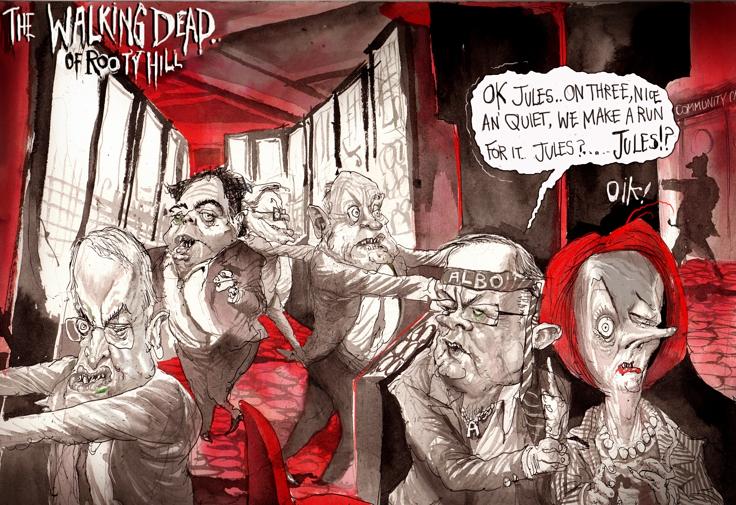 David Rowe
The weekend AFR's editorial says that western Sydney is important because of the gaggle of marginal seats that Labor has to hold in its traditional heartland if it is to have any chance of retaining power.
'Traditional heartland' is the crucial phrase, and it is what Latham questions. He says:
The true story of western Sydney is one of economic affluence. People who grew up in fibro shacks now live in double-storey, solid stone homes. In their driveways Holdens and Ford Falcons have been replaced by tank-like four-wheel-drives and snappy European roadsters. Several public housing areas have been knocked down and rebuilt as private estates. Across the region, families which once manned the production lines of grease-infested factories now own their own businesses or, at a minimum, invest in the stock exchange.
He says that the new housing estates are a snapshot of prosperity, a powerful legacy of the deregulatory reforms of the Hawke-Keating government 30 years ago.
Latham adds that under Paul Keating’s economic policies working class people were given access to capital financing for home ownership and, better still, small business development. His productivity agenda also delivered real wage increases – lifting the boats in the National Centre for Social and Economic Modelling's (NATSEM) 2012 report.
The tragedy of modern Labor, he says, was the decision, after the party’s 1996 election loss, to shelve the Keating agenda and re-embrace the Crean-inspired claptrap of industry policy.
Ultimately, the reason Labor has not successfully promoted its economic achievements in the region is that the party itself doesn’t believe in them.Old smokestack unions representing old smokestack industries have cajoled federal caucus into opposing economic rationalism and competition policy. This is a missed opportunity. The best way of handling a Santamaria acolyte such as Tony Abbott on economic issues is to attack him from the right.
The ALP has forgotten that their economic reforms western Sydney has become a much better place with less poverty and more opportunity. This ALP equates the middle class with unions and defines its identity as standing for workers versus rich capitalist business owners and their shareholders.
He adds that the region has lost Labor in these sense that it no longer supports the working class template of government regulation, subsidisation and state-led development. If anything, people want government out of their lives, giving them the freedom to turn a dollar and raise their children the way they want. What they need are good schools and a health safety net.
Update
What Latham doesn't say is that the social contract between the liberal state and the middle class is breaking down with globalization. Privatization of everything is one manifestation. Reduction of social benefits of all sorts is another. The mostly modest middle class families, who at one point owned or expected to own a house, can no longer afford to do so.
Systemic change undermining the old connection between the state and middle class, which was formed in the economic growth from the 1940s to the 1970s (suburbanization, manufacturing, household consumption, standardized scale of production etc) is already in process. Economic growth today is not promoting the expansion of the middle class; it is promoting the emergence of a high income professional class and a growth of low wage workers (eg., a casualised workforce).
|





Finally a bit of policy substance to the standard Gillard bashing in the mainstream media.