« March 2009 | Main | May 2009 »
April 30, 2009
global threats
There is no mention of Afghanistan or the global war on terrorism in the Nicholson cartoon below. It falls under 'whatever'. But is it a global threat?
The current rhetoric from Canberra is that Afghanistan is the base for global terrorism. Afghanistan stands for an insecure world and that means we Australians cannot be safe. So fighting the Taliban (who are not mentioned) becomes the equivalent of fighting al Qaeda, and the war there is designed to prevent more bombings of Australia in places such as Bali.
However, who takes this guff seriously? The Defence Minister even sounds as if he is going through the motions when he's spinning these talking points for domestic consumption and trying to sell it as an exit strategy.
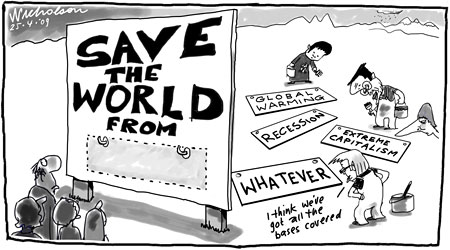
The reality, of course, is that Australia is increasing its commitment in order to fufill its insurance obligations to the US, since the increase in personnel will make no military difference. So why don't the Canberra politicians just come clean and say that the real reason for the deployment is loyalty to the US?
As Hugh White says on Lateline:
I think the chance of this [additional deployment to Afghanistan] making any real difference to the situation there is pretty low and I think really it's best to look at it as a political strategy by the Prime Minister to address the very deep problem he has over supporting the US on Afghanistan rather than a serious attempt to change the facts on the ground... for allies like Australia, because we supported the United States in going into this endeavour, our credibility as a US ally is tied up with trying to support them there.
White points out that though everyone talks as if getting a decisive result in Afghanistan was a really high priority, nobody is putting in the kind of effort - the numbers of troops, the scale of the civilian effort, the diplomatic effort that's really necessary to make a difference.
If success is defined as establishing in Afghanistan a stable and effective Government that can permanently deny the country to the Taliban, then the US is losing the war. The hawks are all for defeating the Taliban even as the Karzai regime is staggering to its end. The US's counter insurgency operations are not providing security to the civilian population, let alone defeating the Taliban. The Americans are still trying to find a military solution to an issue which is essentially political in nature. All that means the Afghan Taliban entering the Afghan government.
Pakistan remains focused on defending the state against long-time rival India and is not well-prepared for a counter-insurgency campaign. The Taliban are deeply entrenched in Pakistan’s west and Pakistan's analysis is that Pakistan’s problems come from the U.S. failures inside Afghanistan, and its strategy is to split the Taliban.
Even if the Pakistani doesn't become a failed state, anti-Americanism and Taliban influence may continue to grow within the Pakistani population and within key institutions -- including the military. For the Americans, the greatest concern regarding Pakistan's future is the possibility that its nuclear arsenal might fall into the hands of anti-American terrorists.
Posted by Gary Sauer-Thompson at 9:37 AM | Comments (7) | TrackBack
April 29, 2009
budget blues
The 2009 budget has to give and take, even though the numbers are going to be written in red ink. The federal budget will show a massive deficit for this year, next year, and the one after and it will detail how much the Government needs to borrow to fund the deficit.
Access Economics gives the context in its Business Outlook March quarter issue:
Batten the hatches. The discussion here focuses on risks and uncertainties around the forecasts, but the first message is the most important – conditions are worsening very rapidly, and we recommend our clients batten the hatches. This is not just a recession. It will be the sharpest deceleration Australia’s economy has ever seen. Apologies for the gloom – we do recognise that, in forecasting mayhem, we make it ever so slightly more likely to happen. Still, we wouldn’t be doing our job if we didn’t tell you
what we think comes next. The emerging economies generated three quarters of global growth in the past eighteen months, but now they too are slowing, and their slowdowns will become Australia’s recession. In brief, much of Australia will feel the pain of the collapse in the global banking system by end-2009. Many businesses will fail as demand gains shrink. Unemployment will leap, and profits will be cruelled.
Giving means distributing more borrowed money to stop the economy's hard landing, preventing the unemployment rising towards 10 per cent, and fulfilling political promises such as tax cuts and an increase in the single aged pension. Increasing economic growth is the way to repay to the loan taken out to fund the deficit.
Taking means pay down the mounting public debt that the descent into deficit financing will feed. That means squeezing the welfare state. Who then will be squeezed to achieve the medium-term goal of bringing the budget back towards balance? Most economic commentators point to middle Australia bearing the pain rather than cutting back on the handouts to the coal or car industries.
In its Business Outlook March quarter issue Access Economics raises some good questions. They say that it is not the short term implications of Budget deficits which worry us. Indeed, running anything other than a Federal Budget deficit in 2009-10 would be irresponsible.
Rather, it is the longer term risk of chicken-hearted policymaking now that Canberra’s ‘rivers of gold’ are drying up. This nation has legitimate policy goals in education, infrastructure, Federal/State relations, climate change and water management. What it doesn’t have any more is the money to help achieve reforms in those areas. That leaves some very uncomfortable choices for Canberra’s politicians – of all stripes – as well as concerned Australian citizens. Do we waste continue to money on welfare to the car industry, or do we have an education revolution? Do we maintain all the personal tax cuts of recent years or do we achieve Federal/State reform? Do we pay the promised increases in age pensions, or do we scrape together the money needed to make serious gains in water reform and climate change policy? Do we continue to pay for the middle class welfare of Family Tax Benefit B, or do we subsidise a broadband network?
Tricky trade offs!
Posted by Gary Sauer-Thompson at 10:18 AM | Comments (5) | TrackBack
April 28, 2009
Ian Pilmer: Heaven and Earth
I've been listening with one ear to the bits and pieces of the responses in the media to Ian Plimer's Heaven and Earth on Counterpoint and Lateline. The text is one in which Pilmer challenges the accepted science of global warming, as his argument is within the tradition of those who argue that natural climate change. The process of natural climate change are outside of human hands and are unable to be manipulated by human efforts. The most we could do is adapt to the changes that are occurring.
The natural science argument is reasonable. The Earth is an evolving dynamic system. Current changes in climate, sea level and ice are within variability. Atmospheric CO2 is the lowest for 500 million years. Climate has always been driven by the Sun, the Earth’s orbit and plate tectonics and the oceans, atmosphere and life respond.I have no problems with that.
My problem is with Pilmer's inference from this ---global warming does not threaten the world because human activity does not cause global warming. The world does not face catastrophic climate change unless carbon emissions are drastically reduced, since there is no global warming as temperatures have been dropping since 1998.
Pilmer's claim that global temperatures have dropped since 1998, thus disproving a warming trend, is one that is contested by many of the world's climate scientists. The counter argument is that though temperatures have dropped a very small amount since 1998, both in surface temperatures and in atmospheric temperatures measured from satellites. However, that doesn't mean that global warming has stopped , since The temperatures, if we average from 1998 to 2008, are warmer than the previous 10 years, or the 10 years before that, or any 10-year period over at least the last 150 years.
That issue will be resolved by the normal procedures of science in terms of theory, evidence and modelling.
PIlmer's second argument is quite different as it steps outside natural science. He argues that climate change politics is religious fundamentalism masquerading as science. It's triumph is computer models unrelated to observations in nature and there has been no critical due diligence of the science of climate change. Moreover, dogma dominates, sceptics are pilloried and 17th Century thinking promotes prophets of doom, guilt and penance. Scientists are part of a new religious-like dogma that closes down debate.
I find this equation of normal science with the dogma of religious fundamentalism masquerading as science as crazy stuff. Though I suspect that it derives from Pilmer's adherence to Popper's philosophy of science, Popper's his equation of Freudism and Marxism as nonscience, and his defence of the open society, Pilmer's claim of totalitarianism still makes no sense to me. My eyes glaze over when I read it given that our cultural history has been characterised by the conflict between science vs. fundamentalist religion since Galileo. Is “climate-change fundamentalism” a little poetic license on Pilmer's part, in which senior scientists are likened to the priesthood, Nobel laureates are likened to doctrinal authorities and that science has sacred texts, cience "has rites and rituals? Or does Pilmer understand fundamentalism as “a movement or attitude stressing strict and literal adherence to a set of basic principles.”
Posted by Gary Sauer-Thompson at 8:13 AM | Comments (11) | TrackBack
April 27, 2009
cracks in the welfare state?
Lindy Edwards, a Research Fellow in the Research School of the Social Science at AN, argues in Reinventing social democracy vital for progress in The Age that three factors lining up to suggest that social democracy will soon face a crisis of its own. It is crunchtime for social democracy.
In spelling these out she refers to Professor Bob Gregory recent presentation at the Australian National University a few weeks ago in which he argued that this recession is likely to be the one that breaks the welfare state. Gregory's argument is this:
The problem is that in each recession since the 1970s, a cohort of people has been thrown into unemployment in the first year of the recession. Most of those people have never got back to full-time work again. They have moved off the dole and on to other forms of welfare, but they have continued to rely on government benefits for their primary source of income. The result is that the primary source of income for about 20 per cent of working-age Australians is a government benefit. The number of working-aged men in full-time jobs has dropped from about 88 per cent in the early 1970s to about 66 per cent in the mid-2000s.
Gregory's argument is that if this recession is only on par with the 1990 recession in the number of people it throws out of work, it will be enough to make the welfare system unsustainable. A workforce of only 10 million people will be supporting between 3.5 million and 4.5 million people on benefits.
The reason? Each recession wipes out a string of unskilled jobs and they never come back. The commonly cited reason for the unemployment problem is the shift from a manufacturing industrial economy to a high-tech service economy. So though neo-liberalism might have exploded the traditional model of social democracy is also heading for a crisis of its own.
Posted by Gary Sauer-Thompson at 8:32 AM | Comments (17) | TrackBack
April 26, 2009
tabloid sensiblities
Toby Mundy in The republic of entertainment at Prospect draws a distinction between two distinct sensibilities have been competing for authority and attention in Britain and other liberal democracies the enlightenment state, and the republic of entertainment. He says:
The former reigns in the quality press, the civil service, the judiciary, science, medicine and, to some extent, the church and the military. The latter is most commonly embodied by the mainstream media, but is increasingly apparent in politics and other spheres.In the enlightenment state, reason triumphs over emotion, experts matter, elected politicians are legitimate, facts are the enemy of cynicism, means are often as important as ends, and the innocent remain so until convicted. In the republic, feelings take precedence, experts are treated with caution (if not contempt), politicians are in-it-for-themselves, cynicism is sophisticated; ends justify means, and people are generally guilty until proved innocent.
He adds that for the last two decades, it is the republican attitudes that have been on the rise, dominating the mainstream and edging into the sensibilities of previously immune institutions in politics, medicine, and the law. It is in the media that this tension is most visible, for it is here that the fight for market share has triggered the import of tropes from tabloids and soap operas into the mainstream—ones that support the narrative element of news, but that also make it more like entertainment.
The narrative is that the increasing absorption of republican values has done the media little good in that independent truth tellers, who believe that facts are more important than feelings, have for two decades been on the run. So the stories are more concerned the weirder, more idiosyncratic aspects of human existence at the expense of serious but more abstract issues like the environment.
High speed broadband will shake this dynamic up since organisations in the world of the arts, media, education, museums and so on, who can now create and distribute their own content. They have the money, expertise and high speed broadband is the spectrum. Peter Bazalgette gives some examples:
Tate Media is part of the Tate Gallery. It is run by techno-visionary Will Gompertz, a man who combines the long hair and casual dress of the art world with military directness. Gompertz acknowledges that the Tate's remit is "to increase people's knowledge and understanding of art." But might it be possible to do that without going to a building? Of course. With funding from BP, Bloomberg, the Arts Council of England and Channel 4, Tate Media now commissions and distributes its own content, just as if it were a small television station or website. They produce documentaries, like one about the Brazilian artist Cildo Meireles (later picked up by ITV's South Bank Show, though it would never have commissioned such a rarefied piece itself).
The Tate Gallery isn't just a museum, it's a content business, with art as its theme."Tate Media produces monthly videos which it distributes on its own website, but also through other galleries, on YouTube and BBC iPlayer. And because the Tate owns the rights, this stuff is free and we the public, have access to it.
Posted by Gary Sauer-Thompson at 1:33 PM | Comments (3) | TrackBack
April 25, 2009
historical memory
The media has gone into overkill on Anzac. Most of this commentary lacks a critical edge about the way this tradition is currently being mythologized as those the nation was born or redeemed in a ruinous defeat at Gallipoli. The subtext of this spectacle is a celebration of the war in the form of historical memory that erases the horror of war at a time when Australia is fighting another war in Afghanistan to support the interests of an imperial power.

There is nothing wrong with commemorating the Anzac tradition and it is great that Australians are recovering their history and developing a historical way of looking at the world. But where is the critical edge about the creeping militarism that equates being an Australian with military virtues, or says that sacrifice for the country is good, even when Australians are treated as cheap fodder in someone else's war?
There is no judgement in the mainstream about the horrors of war, or whether some wars are bad because they, unlike WW2, had little to do with defending Australia's sovereignty. These military ventures ---Afghanistan for instance--- have little to do with Australia's national interest and are wrapped up in mythmaking of courage, honour and sacrifice.
Richard Fyjis-Walker in his review of David Loyn's "Butcher and Bolt - Two Hundred Years of Foreign Engagement in Afghanistan" at Open Democracy observes with respect to this history:
Nor do the invaders change. They come solely for their own ends, politics and profit, be it material, precious lapis, geopolitical concerns or trade routes that today include potential energy pipelines. Arrogant, ignorant and over-confident in their superior armaments and technical development, the invaders seek to impose their own cultures, values and habits - always claiming that they are better for the Afghans than their own, whether they be Communism or Free Market Democracy - by way of puppet leaders and through the barrels of their guns. Meanwhile the Afghan people, a large majority of whom would appear to beg to differ with the invaders and who would like to lead peaceful lives, become the victims of endless misery, death, destruction and poverty.
In this war the Taliban has now become conflated with al-Qa'ida, the land mass of the Middle East has been pushed further east. Once it was Iraq, Iran and Afghanistan. Now it's Afghanistan and Pakistan with the border region between Afghanistan and Pakistan now seen as "the most dangerous place in the world".
Where is the historical memory of this war in the context of previous wars? In the days of the British empire, the British crossed the Durand line from the Raj into Afghanistan. Now the Americans are going to invading in the opposite direction, from Afghanistan into the former Raj. In between were the Soviets. There is a memory hole with respect to Afghanistan.
Posted by Gary Sauer-Thompson at 11:47 AM | Comments (13) | TrackBack
April 24, 2009
PJ's asylum seekers
The latest bit of news to emerge on the current version of boat people hoo haa comes courtesy of the ABC. Interviews with a group of asylum seekers and refugees in Indonesia support the idea that Rudd's policies do encourage more arrivals.
Andrew Bartlett elaborates on the point - some of these people spend 10 years waiting around, after their refugee status is confirmed, waiting to be sent somewhere they can start living again. If ever they did. We spend a fortune keeping them out that could be more productively spent. Meanwhile, these people are sitting around doing nothing, producing nothing.
One of the related issues raised on Q and A last night, in response to the popular and imaginitive notion of queue jumping, was the inadequacy of processing wherever there are, in fact, queues to be jumped. Some of these people in Indonesia, confirmed refugees, are willing to continue the extreme lengths they've already gone to, to get to Australia.
All I knew of P.J. O'Rourke before last night's Q and A could be written on a small postage stamp. Now I know that he used to be a hippie, thinks the banks should have been allowed to collapse, has had a bowel cancer episode, doesn't want his kids reading his books, and is impervious to Julie Bishop's adulation. On TV anyway. Oh, and he'd probably enjoy David Marr's company over anyone else who appeared on the panel last night.
And he's at odds with his conservative counterparts on immigration.
According to O'Rourke we should be taking all the boat people we can possibly get. Anyone who's prepared to do the sorts of desperate things these people are prepared to do to get here have clearly demonstrated the kind of grit and determination we like to attribute to salt of the earth Aussie hero types. By getting to within cooee of our coastline these people have proven themselves to be battlers of the serious kind. Maybe not Aussie ones, but that can be easily fixed. Piece of paper. Coupla days.
In parallel with our quiet achiever stereotype, they don't understand themselves to be doing anything more than what it takes to get on with their lives. All they want to do is live quiet lives with wives, kids, maybe pets, any old job, pretty much like your average suburbanite, but unlike most of us, they'll take extraordinary measures to achieve the ordinary. According to O'Rourke we could do with more such people, not less.
It's a good point and one which left the politicking of both sides looking rather silly.
What is your average Australian prepared to do to get a bog standard job and a small fibro rental in the less salubrious part of town? Walk across the Nullarbor? Leaky boat across Bass Strait or the Tasman? Or any body of water bigger than a backyard pool? Wait months, let alone years, for some personal space, light years away from a first home owner's grant?
It's a whole other way of understanding entitlement.
We're about to indulge our heroic fantasies with the annual ANZAC ritual. While we're thinking about war and how stupid and ghastly it is and how lucky we are that our diggers sacrificed their lives to preserve our way of life, we could give this some thought. We could do worse than think about what it means to the Iraqi, Afghan, Pakistani and Sri Lankan people setting sail for our fair shores. We could think about the bravery and pluckiness of Australians, and how much we value bravery and pluckiness, and how we compare on a global bravery and pluckiness scale.
Or not.
Posted by Lyn Calcutt at 5:10 PM | Comments (24) | TrackBack
Hardie + corporate governance
So James Hardie have finally had a day of reckoning---ten former directors have been found to have breached their duties by making misleading and false statements about the firm's ability to pay asbestos's compensation. The blue-chip board claimed in a statement to the Australian Stock Exchange in February 2001 that the trust for victims was fully funded and could meet future claims when it was latter to have found to have a $1.5---2 billion shortfall. In doing so they breached their statutory duty of care and due diligence.
James Hardie have a track record on bad corporate governance--they shifted their domicile to the Netherlands in an apparent attempt to evade compensation liabilities, For once, the Australian Securities and Investment Commission (ASIC) did their job of a regulator---it bought a case in 2007 against the whole board, including the non-executive directors. They needed to as their track record as regulator on enforcement is mixed, and their credibility is on the line.
This is the first time that anyone from Hardies has been held by the courts to have acted unlawfully. However, Hardies have taken a hard line on compensation. They acknowledge that there is a funding shortfall for compensation, but say that they will not consider alternative funding arrangements to make up the shortfalll.
What will happen to other former high flying corporate directors who presided over corporate collapses in which shareholders were fed constant misinformation but who have so far escaped any sanction whatsoever. ABC Learning Centres for instance. Or Allco Finance? Nothing seems to be happening on these fronts. That is the norm.
Posted by Gary Sauer-Thompson at 10:06 AM | TrackBack
April 23, 2009
CIA , torture, immunity
The Senate Armed Services Committee has just released an exhaustive review of torture under the Bush administration that challenges the notion that the administration only chose torture as a last resort.
The Bush White House began planning for torture in December 2001, set up a program to develop the interrogation techniques by the next month, and the military and the CIA began training interrogators in coercive practices in early 2002. They then redefined the law to create the appearance of their legality, and authorized their use against detainees.
 Martin Rowson
The consensus political elite view in Washington's Beltway culture is that the elites should be exempted from all consequences when they break the law. There must be no investigations or prosecutions for CIA officials who tortured detainees and the Bush officials who designed the torture policies. even though this violates international law and US treaty obligations (both the Geneva Conventions and the Convention Against Torture.
Karl Rove Is upset about recent revelations about Bush administration torture policies. He says that the Obama administration's recent disclosures about torture are:
very dangerous. What they've essentially said is if we have policy disagreements with our predecessors.... [W]e're going to turn ourselves into the moral equivalent of a Latin American country run by colonels in mirrored sunglasses and what we're gonna do is prosecute systematically the previous administration, or threaten prosecutions against the previous administration, based on policy differences. Is that what we've come to in this country?"
For the Republican right represented by Rove, the way for the US to avoid becoming a banana republic is to have a President who ignores the rule of law.
There was firm opposition within the Obama administration to the release of interrogation details in four "top secret" memos in which Bush administration lawyers sanctioned harsh tactics. The memo's were released. The Cheney claim that torture works--ie., a regime of torture staved off terror attacks and saved lives is the current primary line of defence of the torture regime of the Bush administration. Cheney has become the chief defender of the Bush regime.
Paul Krugman says in The New York Times that:
It’s hard, then, not to be cynical when some of the people who should have spoken out against what was happening, but didn’t, now declare that we should forget the whole era — for the sake of the country, of course.Sorry, but what we really should do for the sake of the country is have investigations both of torture and of the march to war. These investigations should, where appropriate, be followed by prosecutions — not out of vindictiveness, but because this is a nation of laws.
These are the people who have been relentless in their efforts to block President Obama’s attempt to deal with our economic crisis and will be equally relentless in their opposition when he endeavors to deal with health care and climate change.
Posted by Gary Sauer-Thompson at 10:25 AM | Comments (22) | TrackBack
April 22, 2009
yet more toxic debt
If the global financial system is stabilising, then the world economy is in the midst of its deepest and most synchronised recession in our lifetimes,; a recession caused by a global financial crisis and deepened by a collapse in world trade. Yet in the IMF's latest Global Financial Stability Report, it is estimated that potential writedowns (of toxic debt) including about $1 trillion already taken, could be nearly $4.1 trillion.
 Ingram Pinn
The implication is that neither short-term macroeconomic stimulus nor restructuring of balance sheets of financial institutions will generate sustained and healthy global growth.Those who are trying to convince us that the world things are soon going to be the way they were before---the credit party---are whistling in the wind.
This is pretty much the same crowd who failed to see the financial crisis, and then consistently downplayed its significance. The same crowd includes the media, who fell down on the job of speaking truth to power' and informing us what was happening. And the economists, who pride themselves on their rigor and analytical deductions from their axioms of instrumental rationality and market efficiency mostly failed to point out fundamental weaknesses of financial markets and they did not foresee the crisis.
No credible response to the crisis has come from the right. They say why worry about the past? Global capitalism has experienced similar crises and, up until now, has always recovered and proceeded to achieve ever higher levels of material prosperity. It is fear that is holding things back. A reflexive, conservative ideology -- support for tax cuts, no matter the facts and circumstances; a preference for policies that favor the well-off; a bias against the use of public institutions and public regulation---functions to delay, water down, and obstruct the kind of coherent and capable action needed to address the crisis.
Posted by Gary Sauer-Thompson at 8:49 AM | Comments (10) | TrackBack
April 21, 2009
at the UN
I wasn't surprised that Australia didn't have the courage to attend the UN conference on racism (known as the Durban Review ) and then debate the views of those it disagreed with, namely President Ahmadinejad's interpretation of Zionist history. They just stayed away---boycotted it along with Germany, New Zealand, the US, Canada, Italy, Holland, Sweden and Israel, rather than making the arguments that need to be made against Ahmadinejad and his followers. Zionism is contested territory.
The realpolitik is that Israel currently has one of the world’s strongest armies, without peer in the Middle East, and its 200 or so nuclear warheads give it the last word in any military showdown with any of its neighbors. Israel’s security doctrine is based on maintaining an overwhelming strategic advantage over all challengers. Israel is here to stay and the Palestinians do not have the fire power to to confront the settlers, let alone even dismantle most of the 600 or so roadblocks that choke life in the West Bank.
The rights of Israel have been given priority over the rights of Arabs, and this skewed perception has been backed by US might, which since the Cold War exercised regional dominance.The US now has a huge and permanent physical military concentration in the region.
If the Zionist movement has managed to successfully create a Jewish nation-state in the Middle East against considerable odds, then whither Zionism today? Has Zionism itself become an obstacle to Israel's future as a cosmopolitan liberal democratic market society in a globalzed world? Zionism has made the Holocaust the centerpiece of Israel's national story, and states that anti-Semitism is inevitable and immutable when Jews live among gentiles. Yet the majority of Jews live in the wider world outside Israel.
However, the assumption is that Zionism does need to be questioned because this form of nationalism rationalizes conquest and colonization and occupation as “redemption” of Jewish territory on behalf of the world’s Jews. It treats the Palestinians only as an obstacle and threat to its own purposes, not as people with the same rights as Jews and with legitimate claim to the land on which they were born. It sees the Arabs and Iran as pits of Islamic terror and anti-Semitic savagery that want only to kill Jews and annihilate Israel.
Contesting fundamentalist Islamic interpretations of Zionism in the context of a questioning of Zionism is one way of engaging with the Muslim world.
Posted by Gary Sauer-Thompson at 7:30 AM | Comments (21) | TrackBack
April 20, 2009
downturn, ever down
Before the global financial crisis and its economic fallout happened new office buildings and apartments were going up all over the Adelaide CBD at a furious pace. For the last couple of months or so the construction in the city has become rather quiet. Eerily so. The holes in the ground remain fenced whilst the building sites that are still active have skeleton crews working ever so slowly. Me? I'm waiting for the boarded-up shopfronts to appear so I can take a photo of the history we are living.
Meanwhile finance has boomed, becoming ever more powerful. The banks have enormous political weight and the executives of the world of high finance believe that they control the levers that make the world go round. For them it was axiomatic that the interests of the financial sector are the same as the interests of the country. The economy was always fundamentally sound.

The words "expanding" , "affluent" , "prosperous" and "efficiency" appear empty, now that the city is no longer trying to cannibalize itself and the dead commercial spaces start appearing. Things are getting worse is how it appears.
Life is being quietly snuffed out from the shock waves of a dirty economic bomb set off by the bankers who continue to make their millions whilst on the living off public subsidies. As the wreckage they have caused continues to mount we suspect that the finance industry has effectively captured our government and they are pushing onto the government the substantial problems (toxic debt) that have arisen. Corruption? Nay. The financiers are God's favoured children.
The shock waves continue to roll across the landscape causing destruction in their wake. More unemployment. Longer bread queues. Another firm collapses. The economic commentators talk in terms of "green shoot"s, “V-shaped” recoveries and “glimmers of hope”, whilst the Commonwealth Government subsides the old industries who promise "clean coal", and it turns its back on renewable energy. Corruption? Nay.
The economic commentators are still in the grip of the market mystique. They still believe in the magic of the financial marketplace and in the prowess of the wizards who perform that magic in the name of rational expectations and efficient markets. This belief system is the finance industry's cultural capital. Yesterday’s “public-private partnerships” have yet to be relabeled “crony capitalism.
As Paul Krugman observes:
But the wizards were frauds, whether they knew it or not, and their magic turned out to be no more than a collection of cheap stage tricks. Above all, the key promise of securitization — that it would make the financial system more robust by spreading risk more widely — turned out to be a lie. Banks used securitization to increase their risk, not reduce it, and in the process they made the economy more, not less, vulnerable to financial disruption.
Banks “do not want to recognise the full extent of their losses, because that would likely expose them as insolvent ... This behaviour is corrosive: unhealthy banks either do not lend (hoarding money to shore up reserves) or they make desperate gambles on high-risk loans and investments that could pay off big, but probably won’t pay off at all. In either case, the economy suffers further, and, as it does, bank assets themselves continue to deteriorate – creating a highly destructive cycle.”
Posted by Gary Sauer-Thompson at 6:23 PM | Comments (8) | TrackBack
April 19, 2009
after capitalism?
Geoff Mulgan in After Capitalism in Prospect asks if one dream is over, what other dreams wait in the shadows? Will capitalism adapt? Or should we be asking again one of the great questions which has animated political life for nearly two centuries: what might come after capitalism? Mulgan responds by saying that:
I do not suggest that capitalism will disappear any more than war has. Complex, interconnected market economies will continue to generate huge surpluses, fuelled by the continuing flow of new scientific knowledge. But just as monarchy moved from centre stage to become more peripheral, so capitalism will no longer dominate society and culture as much as it does today. Capitalism may, in short, become a servant rather than a master, and the slump will accelerate this change. Past depressions were cruel but they also hurled ideas from the margins up into the mainstream, speeding their motion through the three stages that Schopenhauer described happening to all new truths, being first ridiculed, then violently opposed, then treated as self-evident.
He says that it’s only through crisis and institutional reform that capitalism adapts to a changing environment and rediscovers the moral compass that is so vital for markets to work well. He adds that the there are various indications of the transformation of capitalsim. The first is that the new technologies—from high speed networks to new energy systems, low carbon factories to open source software and genetic medicine—have a connecting theme: each potentially remakes capitalism more clearly as a servant rather than a master, whether in the world of money, work, everyday life or the state.
Other indications of transformation are less consumption, greater accommodation between work and family, and states being pulled back into much more active roles as the global recession bites. zMulgam offers a civilizing capitlalism perspective:
The result is that a large political space is opening up. In the short run it is being filled with anger, fear and confusion. In the longer run it may be filled with a new vision of capitalism, and its relationship to both society and ecology, a vision that will be clearer about what we want to grow and what we don’t. Democracies have in the past repeatedly tamed, guided and revived capitalism.
Posted by Gary Sauer-Thompson at 7:59 PM | TrackBack
April 17, 2009
banging an old drum
Doesn't the old hang on in the new? The Liberals are banging the old drum about border security, bad asylum seekers, boat people and soft on security. It is just like a replay of the old children overboard affair with its undercurrent of Asian hordes invading Australia.
Apparently desperate people in Afghanistan decided to catch a slow boat to fair Australia because they read The Australian and were informed that the Rudd Government had gone soft on the processing of asylum seekers. Open borders all round.
 Kudelka,
Sure this, is a mockery of the conservative rhetoric, but my exaggeration is not that great. Thus Greg Sheridan in The Australian says:
There is no doubt the Rudd Government has been widely reported internationally as softening Australian border controls. That must act as a magnet for illegal immigrants. At the same time, there has been a general rise in illegal immigrants and asylum seekers around the world...The problem with taking a soft line on asylum seekers is that you end up establishing that virtually anyone who can physically get to Australia can stay. That will greatly encourage people-smuggling, with all the risks and tragedies this involves.There is also no evidence that the Australian people have any appetite for an unregulated inflow of people in this manner. Such an inflow could easily accelerate rapidly out of control.
The phrases "virtually anyone who can get to Australia can stay" , "unregulated flow", "accelerate out of control" are the rhetoric of the politics of fear. And that is what is being deployed by the conservatives.
The reality is that most asylum seekers arrive by plane, many are sent back, whilst the asylum seekers who arrive by boat are processed on Christmas Island. Children are treated more humanely,d the so-called "Pacific Solution", which had people sent to Nauru has been abolished and it has scrapped temporary protection visas, as well as reforming detention policy. As Michell Grattin points out in The Age:
.
..intercepted boat arrivals are taken to Christmas Island, where the Government uses the big custom-built centre commissioned by its predecessor. Even after their initial checks, these people can't leave the island until their cases are determined.Under the processing there, asylum seekers don't have access to Australian law because the "excision" provision, passed by the Howard government, prevents this. If a person's claim is rejected there is no appeal to an Australian court. Almost all these arrivals are, however, found to be refugees and are then settled in Australia permanently.
Notwithstanding this, the Opposition immigration spokeswoman Sharman Stone quickly blamed the Government for encouraging people-smuggling by moderating procedures for dealing with asylum seekers. This is running a scare campaign on border protection.
Posted by Gary Sauer-Thompson at 9:01 AM | Comments (10) | TrackBack
April 16, 2009
BrisConnections + infrastructure development
BrisConnections, it is fair to say, is yet another example of the disaster that arises from private public partnerships to build urban infrastructure. Why so? What explanations are available. One general argument is that the problem arises from incompetent state governments not the market failure per se. Thus Michael Bounds in The Australian says that:
The BrisConnections Airport Link in Brisbane is the latest casualty of a failure of responsible state governance of infrastructure development. Under the Airport Link funding model the, mostly small, shareholders are obliged to pay a further $2 on shares that have now fallen from $1 in value to 1c. They are understandably reluctant to pay. Anna Bligh remains silent about this elephant in the city.
Isn't this a failure of the Macquarie model of financing infrastructure as distinct from just being a problem of state governance? Why should the state be held totally responsible for the way that Macquarie set up the financing within a neo-liberal mode of governance?
Deregulation has devolved management down to the management of individual developments resulting in conflicts of interest and a regulatory vacuum in relation to both infrastructure development and the quality of life in new medium density developments associated with the rapid transformation of our economy to a service sector driven economy.
There been a shift away from the neo-liberal mode of governance to one based on state intervention as a result of the fallout from the global financial crisis? Bounds, who is an Australian sociologist and Associate Professor in the School of Social Sciences at the University of Western Sydney, uses the BrisConnections example and the cross-city tunnel under Sydney's CBD to argue that state government's should not be trusted with infrastructure development as opposed to the neo-liberal mode of governance. He argues thus:
The federal Government, through the Building Australia infrastructure fund is about to give $12.5billion to the states for infrastructure development. When the leaders of government are routinely blaming the banks and finance houses for the global financial crisis, the answer is to pour money into infrastructure.State governments have proven themselves singularly inefficient in managing the development and financing of infrastructure yet they are about to be showered with billions of dollars and an instruction to spend it as quickly as possible.
He has a point in that the early reports on state bids to the commonwealth infrastructure fund were that bids were so ill considered as to be unacceptable. The Infrastructure Australia Committee has formed its priority list for funding state projects and has produced a checklist of minimum information to be provided.
Bounds in his recent Urban Social Theory: City, Self, and Society is a proponent of the new urbanism. This is a movement that confronts the contemporary problems that beset our cities: problems of urban sprawl, crime, environmental degradation and alienation through the promotion and creation, and restoration of diverse, walkable, compact, vibrant, (and) mixed-use communities that include the housing, work places, shops, entertainment, schools, parks, and civic facilities that are essential to the daily lives of the residents.
Unlike the free market advocates Bounds is not arguing for the market to replace state government within a regulator framework. His concern is that:
we should be hearing proposals for the federal Government to monitor the performance of states in the financing and implementation of infrastructure projects. There should be no impediment to establishing an independent authority to report on the financial engineering and realisation of development targets on such proposals.Without an auditing process, on the basis of experience taxpayers can expect their $12.5billion may well be spent without a successful outcome...
He has a legitimate point.
Posted by Gary Sauer-Thompson at 8:19 AM | Comments (4) | TrackBack
April 15, 2009
Somali, pirates, war on terrorism
The British are leaving Iraq. Basra--with its open sewers, uncollected garbage and shortage of electricity---has been handed over to the Americans. It has been cleared of Shia gunmen who had imposed extremist Islamist views on the population. That leaves the rationale of the threat of international terrorism -- specifically al Qaeda -- justifying the costly, long-term engagement in Afghanistan and Pakistan that threatens to turn into a walk into a quagmire.
 Steve Bell
If the US is still the only imperial power (American servicemen and women are stationed in the 153 countries to protect its imperial interests), then the Somali pirates indicate the limits of the US's military power. Somalia has been a collapsed state for nearly 20 years, it harbours bands of men in light craft armed with rifles who can seize 50,000-tonne tankers flying the flags of western states in the Gulf of Aden. Piracy is Somalia's biggest industry.
Though the Americans could nuke Somalia flat in a few minutes, they are unable to protect the 25,000 commercial vessels every year that transit the Suez Canal, Gulf of Aden and Indian Ocean while travelling between Europe and Asia.
The outraged conservative Republican blowhards in the US, who love sabre rattling on their little papier-mâché Mount Olympus, yearn to blow the pirates out of the water and assert the imperial fist against the Islamists. American sovereignty rules the waves, and to make this point the US needs to hit--nay wipe out-- a few countries.
Somalia is of key geo-political importance for the US. It lies at a commercial crossroads between the Middle East and Asia. A large portion of the world’s oil tankers, particularly European and Chinese, pass along its coast. It has had no central government since 1991.
It was the fear that Somalia could end up as yet another Talibanised state and a safe haven for al-Qaida terrorists prompted the Americans to support the Ethiopian invasion of Somalia in 2006. In this war Ethiopia was perceived as fighting America’s war against Islam--- a partner with the United States in the “war on terror” in Africa.
The rationale for the Ethiopian military deployment to Somalia was to oust Islamist forces Ethiopia believed represented "a clear and present danger" to its national interest. The Ethiopian forces, who spent the next two years fighting a deadly Islamist-nationalist insurgency to prop up a pro-U.S. "transitional" government, withdrew under fire from the same Islamists they came to crush. The client transitional Federal Government (TFG) of warlords collapsed following the Ethiopian withdrawal.
The US now tacitly welcomes an Islamist government that is not markedly different from the one that the US/Ethiopian invasion of Somalia helped to overthrow 2 years ago.
Posted by Gary Sauer-Thompson at 7:54 AM | TrackBack
April 14, 2009
Telstra backs off
So the gorilla of the telecommunications marketplace is starting to sing a different tune. Previously it was hostile to the prospect of even a mild form of further separation. It will now consider a voluntary separation of its wholesale and retail arms, as well as the sale of some assets to the federal Government's proposed $43 billion broadband network in exchange for a minority stake in the new majority government-owned broadband company.
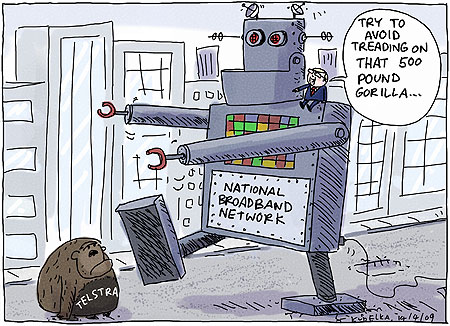
So the Rudd Government's plan to use its resources to undertake the rebalancing of a strategic industry to create a more open competiitive market is having the desired effect. Telstra is taking the necessary steps to head off the forced separation of its wholesale and retail arms.
Posted by Gary Sauer-Thompson at 9:17 AM | Comments (10) | TrackBack
April 13, 2009
time to negotiate
It's time to end the conflict in Afghanistan if not leave. My guess is that US is exploring ways to find an escape route from the escalating crisis in Afghanistan. That would involve coming to terms with the anti-Western coalition resistance in Afghanistan.
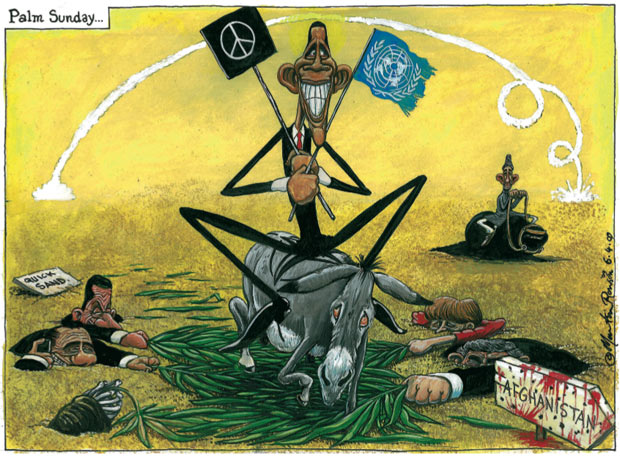 Martin Rowson
The growth of insurgency in Pakistan over the past year of the United States-backed civilian coalition government in Islamabad has been far quicker than that of Afghanistan's insurgency. There is a possibility that the insurgency threatens to take down Pakistani state.
Posted by Gary Sauer-Thompson at 10:27 AM | Comments (6) | TrackBack
April 12, 2009
Easter
The Easter message of the Catholic Church is condoms cannot be used to prevent the transmission of AIDS or HIV because of its absolute ban on condoms and contraception. The reason? The only sanctified sex is sex within marriage for the purpose of procreation. Wearing a condom was a bigger sin (more evil) than infecting your partner with aids.
 Matt Golding
Condoms, according to Cardinal Pell, encourage promiscuity and promiscuity is evil. It is evil because promiscuity stands for sex outside marriage.
Great Easter message.
Posted by Gary Sauer-Thompson at 12:31 AM | Comments (11) | TrackBack
April 10, 2009
Murray River: a toxic drain
I flew back into Adelaide from New Zealand across Lake Alexandrina and saw an utterly parched Murray River system basin. I then heard that inflows into the Murray Darling Basin are at record lows and that the Murray River has become a toxic drain, due to a discontinuous blue-green algae bloom in an 800km stretch of the river from Lake Hume to Barham. Hell, Lake Albert near the Murray's mouth, is in danger of becoming equivalent of battery acid.
Good news though. The Murray-Darling Basin states and the Commonwealth have established a high-level panel of leading experts and senior officials to advise on the ongoing response to the blue-green algae outbreak currently affecting the River Murray. No worries then.
But we have the politics of the water as well its administration. Tim Stubbs, from the Wentworth Group of Concerned Scientists, says:
If we no longer want this national treasure to be little more than a toxic open drain we need to reset the system. We need to ensure we have enough water to keep the river, floodplains and wetlands healthy and use what is left to grow more produce with less water. The potential impacts of climate change underline the need to make this adjustment sooner rather than later so that we are in a position to manage out future in a more proactive way then just praying for rain.
The damage is self-inflicted. It is not just the drought (record low inflows). Nor is it just climate change. If irrigators take water out according to a set of rules and too much water is being taken out within the rules, then the problem lies with the set of rules and those who set the rules. Those who historically set the rules are the states and now the Commonwealth. They have mismanaged the system to the point of turning an iconic river into a toxic drain.
We are taking about 80% of the water from the Murray-River with around 70% taken by agriculture and flood irrigating dairy pasture, rice and cotton; the companies and agri businesses currently pay very very little for the water (13c ents a litre)l; and the states gave away too many rights to use water that was not really there. Developmentalism still rules, even though the consequence of developmentalism for profit is a trashed system. There is now not enough water for agriculture in the lower part of the Murray-Darling Basin.
The implication of no river flows is that the southern lagoon of the Coorong becomes Australia's dead sea. The most likely solution for the southern lakes is that the barrages are moved upstream to Wellington, sea water flows into lower lakes, and the dairy industry around the lakes ends without compensation being paid.
Posted by Gary Sauer-Thompson at 8:25 AM | Comments (7) | TrackBack
April 8, 2009
finally, decent broadband
Surprise surprise. The Rudd Government has decided to scrap its previous plans for a high-speed national broadband fibre-to-the-node network funded by the private sector with the government tipping in $4.6billion and gone for a fibre-to-the-home network costing $43billion.The Government will set up a company in which it will hold a 51 per cent stake and will invite the private sector to invest in the remainder. It's a nation building project

Since the proposed new network will be a wholesale product open to all telecommunications carriers and so provides a solution to the problem created by the Keating and Howard governments when Telstra was privatised a decade ago when it was still holding a monopoly on network infrastructure and dominating the retail market.That was the big mistake.
The solution means that there is no need to compensate Telstra since the new cable will be laid alongside the old copper phone lines. The ISPs will be able to lease capacity from the government-owned NBNCo without having to deal with Telstra. That is good news because Australian business and consumers have been under-served by broadband speeds and overcharged as they have helped to prop up Telstra's near-monopoly profits.
It is about time as the copper wire telephone network is old technology that made Australia an also ran in the international broadband world. Now there is the opportunity to build a new network based on the realisation that wireless broadband is not a replacement for fixed-line digital mega-highways, but rather a supplement. Though fibre to the home would boost upload and download speeds, and decreases the time taken to transmit the data through a network, it will not address the lack of bandwidth on the fibre links between Australia and the rest of the world.
Another other issue is funding. Can the Federal Government fund the $43 billion cost of the National Broadband Network? Will there be private sector investment? If so, will it be the $21 billion envisioned?
In a discussion paper released on the same day as the NBN announcement, countenanced regulatory measures that the Government could introduce as the NBN was being built. These included beefing up the Australian Competition and Consumer Commission's power to regulate other companies' access to Telstra's existing network, some form of separation of Telstra's retail and wholesale arms and forcing Telstra to sell its HFC high-speed cable network and its stake in Foxtel. So are the consequences of the Trujillo/McGauchie strategy.
To enjoy speeds of up to 100Mbps, internet service provider Internode says users would be charged a monthly cost of $99.95. I pay around $80 per month for ADSL 2+. Internode should know, as they already offers the same internet access technology -- fibre to the home -- as the Government's yet-to-be-built broadband network.
Posted by Gary Sauer-Thompson at 11:02 AM | Comments (21) | TrackBack
April 4, 2009
a multipolar world
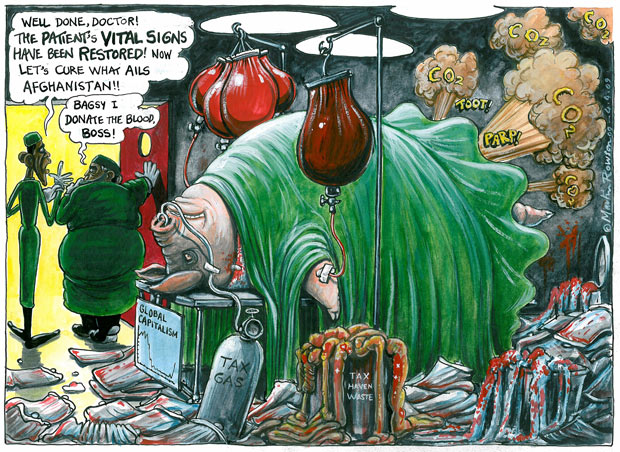
Was it more than a photoshoot? Did the G20 leaders save the global economy? Or did they simply defend their individual national interests?
 Martin Rowson
There was a a huge injection of funds to increase the firepower of the international financial institutions so that they can prop up emerging economies and support trade as well as a recognition of the shift in global power that we are currently experiencing with the rise of China and India. These are rising states challenging the status quo of US unilateralism supported by Europe.
Where will Australia go in a multipolar world?
Posted by Gary Sauer-Thompson at 9:15 PM | Comments (1) | TrackBack
April 3, 2009
TVNZ: public broadcasting?
The Nationals are in power in New Zealand. Surprise, surprise, the state-owned Television New Zealand is facing looming job cuts, with the organization looking to shave $25 million from its annual budget:

The job losses come from most areas including news and current affairs, finance and legal, marketing, sports, broadcast services and corporate affairs.The national Government sees things in terms of having $200 million invested in TVNZ, that's the equity in TVNZ. If the government doesn't receive a return on that equity in the form of a dividend then that's less money the government has to pay for hospital beds, less money it has to pay its doctors and less money it has to pay its teachers.
So much for public broadcasting--or what Eric Beecher calls "public trust" journalism.
This "public trust" journalism applies scrutiny, analysis and accountability to governments, parliaments, politicians, public servants, judges, police, councils, the military, NGOs, diplomats, business and community leaders and the recipients of public funding. It is an essential element of a functioning, informed democracy and just as important as the parliament or the judiciary and therei s here is no hint anywhere of an emerging commercial model for the large-scale "public trust" journalism. Not a hint.
Posted by Gary Sauer-Thompson at 9:05 PM | Comments (1) | TrackBack
April 2, 2009
calling the shots
Washington is calling the shots with respect to Detroit.
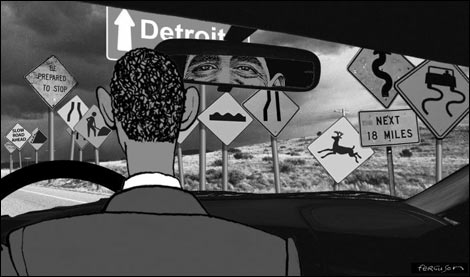 Ingram Pinn
Will Obama force them to develop genuine green cars? Or will we have more rhetoric and resistance from Detroit, as we have in the Australian car industry to the desired change? Then again, Ford and Holden in Australia are American owned. So they will do what Detroit tells them. And what Detroit does will depend on how much Washington calls the shots to protect its investment.
Posted by Gary Sauer-Thompson at 7:44 PM | Comments (2) | TrackBack
April 1, 2009
G20: humour
The OECD is warning that the world economy is in the midst of its deepest and most synchronised recession in our lifetime caused by a global financial crisis and deepened by a collapse in world trade.The IMF warns that G20n leaders need to clean up the toxic assets poisoning the global banking system or risk prolonging the worst global recession in generations.
 Martin Rowson
The Rowson humor is a bit rough. But there is a lot of scepticism and cynicism about the capacity of the G20 to do much in terms of developing some substantive form of governance of the global market. Maybe the best that we can expect is the end of the "old Washington consensus".
Update: 2nd April
The Communique is thin. Mark Thoma in the Guardian comments on the G20 after the event:
the failure to move aggressively on an international stimulus package, while expected, was still a disappointing outcome. The attitude, it appears, is that the US caused the problem and it is up to them to fix it. But the US cannot solve this problem alone, and if other countries do not join in and help with fiscal policies to stimulate economic activity, their economies will suffer and their citizens will be worse off because of it.
The G20, by all accounts, has not produced anything like the response needed to pull the world economy out of the current unprecedented mess. The idea is to put back the broken pieces somehow in order to produce more of the same pattern of growth as before. It is unclear that that strategy will work.
Posted by Gary Sauer-Thompson at 7:51 PM | Comments (1) | TrackBack