|
April 30, 2009
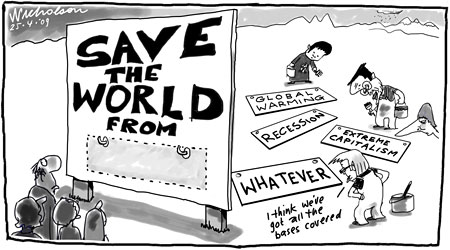
There is no mention of Afghanistan or the global war on terrorism in the Nicholson cartoon below. It falls under 'whatever'. But is it a global threat?
The current rhetoric from Canberra is that Afghanistan is the base for global terrorism. Afghanistan stands for an insecure world and that means we Australians cannot be safe. So fighting the Taliban (who are not mentioned) becomes the equivalent of fighting al Qaeda, and the war there is designed to prevent more bombings of Australia in places such as Bali.
However, who takes this guff seriously? The Defence Minister even sounds as if he is going through the motions when he's spinning these talking points for domestic consumption and trying to sell it as an exit strategy.
The reality, of course, is that Australia is increasing its commitment in order to fufill its insurance obligations to the US, since the increase in personnel will make no military difference. So why don't the Canberra politicians just come clean and say that the real reason for the deployment is loyalty to the US?
As Hugh White says on Lateline:
I think the chance of this [additional deployment to Afghanistan] making any real difference to the situation there is pretty low and I think really it's best to look at it as a political strategy by the Prime Minister to address the very deep problem he has over supporting the US on Afghanistan rather than a serious attempt to change the facts on the ground... for allies like Australia, because we supported the United States in going into this endeavour, our credibility as a US ally is tied up with trying to support them there.
White points out that though everyone talks as if getting a decisive result in Afghanistan was a really high priority, nobody is putting in the kind of effort - the numbers of troops, the scale of the civilian effort, the diplomatic effort that's really necessary to make a difference.
If success is defined as establishing in Afghanistan a stable and effective Government that can permanently deny the country to the Taliban, then the US is losing the war. The hawks are all for defeating the Taliban even as the Karzai regime is staggering to its end. The US's counter insurgency operations are not providing security to the civilian population, let alone defeating the Taliban. The Americans are still trying to find a military solution to an issue which is essentially political in nature. All that means the Afghan Taliban entering the Afghan government.
Pakistan remains focused on defending the state against long-time rival India and is not well-prepared for a counter-insurgency campaign. The Taliban are deeply entrenched in Pakistan’s west and Pakistan's analysis is that Pakistan’s problems come from the U.S. failures inside Afghanistan, and its strategy is to split the Taliban.
Even if the Pakistani doesn't become a failed state, anti-Americanism and Taliban influence may continue to grow within the Pakistani population and within key institutions -- including the military. For the Americans, the greatest concern regarding Pakistan's future is the possibility that its nuclear arsenal might fall into the hands of anti-American terrorists.
|





the public justification for the Australian deployment is now on the need to prevent future terrorist threats to Australia, which could emanate from an Afghanistan back in extremists' hands.
Who are the extremists? The Taliban? They are fighting a civil war.