« June 2012 | Main | August 2012 »
July 31, 2012
just click bait?
Steve Bracks, the former Premier of Victoria, makes a good comment on the ABC's Lateline about the way the media frame politics in terms of leadership contests. He says:
my view is that we will see a very stable, strong policy period up to the next two years, up to the next election - or 18 months. I don't sense any movement at all in relation to the leadership, frankly, and I think we're seeing that really being put to bed currently. Look, if I can be frank with you, I think it's largely a media issue. It's always the case - and I made reference to some of this in my book as well - that sometimes the media get worried that they might miss a story so they want to get ahead of the story. And then in getting ahead of it, they want to make the story themselves.
I reckon that it is a media issue as well. Another example is the tensions that were endlessly predicted by the media around NSW senator Lee Rhiannon knocking off Christine Milne in the post Bob Brown Greens. These leadership tensions have failed to eventuate in conflict.
Bracks adds that he doesn't see the leadership issue being talked about publicly on the street and that he thinks people expect that the Labor Party have resolved this matter. The reason? Federal Labor have got a leader who has been confirmed by an overwhelming majority and I think they want to see the Government just get on with the job.
Bracks may be optimistic on the stable, strong policy period, but the Canberra media Gallery's obsession with leadership issues has become tiresome and tedious. I'm coming around to the view that they can only talk about this --at the exclusion of policy---because that is all they are capable of doing. Or is it simply lazy journalism. Stirring the leadership pot also probably required of them to sell newspapers. It's tabloid click bait.
But even click bait can becomes so cliched that it simply turns people off. People then become aware how impoverished the public discourse is around politics and how much junk the media produces. So we start to give up reading the newspapers.
Posted by Gary Sauer-Thompson at 1:51 PM | Comments (4) | TrackBack
July 29, 2012
a political moment
The Australian Financial Review's Nielsen poll shows that the strong push from the NSW Right before this month’s state Labor conference to abandon automatic preferencing of the Greens is not shared by the broader ALP support base. This contrasts with Liberal-National Party voters’ views on the Greens, where 67 per cent say Labor is too close to the Greens and 67 per cent say the Greens should be put last in preferences.
So the NSW Right is out of touch with the ALP's Labor base, who say that the ALP's relationship with the Greens is about right or not close enough.
 David Rowe
Why the disconnect? The NSW Right just love open cut coal mining. The more exports of coal the merrier, even if prime agricultural land is dug up in the Hunter Valley and tourism is damaged.
Just under 90 per cent of NSW's energy needs are currently met by locally mined coal, but that is just a fraction of what the state exports internationally. NSW exports just under three times as much coal as it supplies for domestic use and exports will double. No doubt you can holiday amongst a sea of open-cast mines.
Australia’s corridors of power are increasingly being mined to roll back environmental regulation to do with climate change and shifting to wards a more sustainable Australian economy. That shift is deemed to be left wing---The Greens are in favour of increased regulation to protect the environment---and this ideology must be opposed.
Posted by Gary Sauer-Thompson at 6:41 PM | Comments (8) | TrackBack
July 28, 2012
playing hardball
If the premiers of the conservative states are determined to make things very difficult for Gillard Labor at CoAG, then they sure chose the wrong issue to do so with the National Disability Insurance Scheme. Though conservative commentators were quick to blame the failure to get trials up and running all on Gillard's incompetence, Victoria and NSW quickly backpedalled.

The mining states of Queensland and Western Australia are still holding out--that is resisting funding a series of trials. Queensland Premier Campbell Newman is still saying no deal and holding the partisanship comes before the people with disabilities line. Newman even tried some classic buck-passing when he suggested introducing a Medicare style levy to fund the NDIS long term, even though the terms of this COAG meeting was the trial and the long term arrangements are yet to be discussed.
Campbell Newman’s recently claimed that "Queensland is on the way to being bankrupt" and becoming "the Spain of Australian states". It is a slogan being used to justify the neo-liberal politics of austerity, initially targeted at the pubic service.
Posted by Gary Sauer-Thompson at 7:13 PM | Comments (5) | TrackBack
July 27, 2012
Liberals: energy policy
It is becoming increasingly clear that the Liberal Party's energy policy is designed to protect the fossil fuel (coal and gas) industry.
Their main line of attack is that wind or solar are not able to supply much more than their current 3 per cent because they couldn’t provide baseload power, are expensive and unreliable. The tactic is to delay or slow the deployment of renewables, and to keep them locked into pilot studies, research and development and niche markets. Behind this sits the next line of defence: a campaign against the idea of anthropogenic climate change, wind farms and solar PV.
The tactic here is sow doubt in the public mind about the credibility of the scientific warnings and the need to respond. For instance, they argue that solar PV has taken off only because of the poorly designed political quick fixes with tariffs imposed by populist Labo) state governments. These are unsustainable schemes that were shifting enormous costs on households that do not have solar.
If the less ideological defenders do not reject the principal conclusions of climate science, then they work to water down the implications, and to boost “sensible” and cautious economic solutions that would allow the continued exploitation of fossil fuels. This would ensure ongoing economic growth, prosperity and jobs.
Posted by Gary Sauer-Thompson at 2:28 PM | Comments (6) | TrackBack
July 26, 2012
Queensland: slash and burn
I watched Campbell Newman perform at COAG for the media. We had all these slogans. "Queensland is broke." It's suffocating from a huge debt burden--Labor's debt. "Queensland cannot afford to be a part of a national disability insurance scheme."
The debt is so bad that the Newman Government just has to slash funding, cut 20, 000 public service jobs, and privatise public services. You can see more of the Newman Government's political spin here and the deconstruction of it here. The partisan rancour behind the "any government debt is bad" sloganizing from Newman was straight from the US Republican textbook--the strategy is one of causing gridlock to help destroy a federal government.

The justification is of the massive black hole thesis of the Queensland Commission of Audit headed by Peter Costello, the former Liberal Treasurer in the Howard Government.
He argued that the Government of Queensland had embarked on an unsustainable level of spending which has jeopardised the financial position of the State. Queensland cannot be a high spending and low taxing State. It needs to choose between two alternatives: (1) high taxing and high spending; (2) lower taxing and lower spending.
Given the relatively narrow State tax base and the heavy reliance on Australian Government payments, there are limited prospects to boost revenue. It is likely therefore that a major part of the adjustment burden will need to be borne by the expenditure side of the budget.
There you have the justification for the slash and burn politics of austerity, and the neo-liberal rhetoric of black holes, balanced budgets and household economics. Queensland, according to Costello, is currently locked into a debilitating cycle of over-expenditure, ever-increasing levels of debt, and crippling increases in debt servicing costs. A major task of fiscal repair is the imperative to prevent further damage to the future prosperity of the State.
And here's me thinking that Queensland, the coal state---we're in the coal business, says Newman---is a boom state in which economic growth would pay off the debt incurred from the global financial crisis and the floods. So what has happened to the massive mining boom and Queensland experiencing an unprecedented period of expansion and the huge inflow of capital ($75 billion) to fund the mining expansion?
Or is that Queenland's mining boom that is pushing up the exchange rate and this causing the manufacturing sector to shedding jobs for the past four years; or for accommodation and food services industry, which includes a large portion of the tourism industry, to not have positive economic growth in five years? Could it be the unconstrained growth of the mining industry that is causing Queensland's economic woes?
Posted by Gary Sauer-Thompson at 2:04 PM | Comments (9) | TrackBack
July 25, 2012
educational reform
Educational reform in Australia is now primarily seen in terms of increasing labour productivity and workforce participation rates in order to increase economic growth. It is usually discussed in terms of funding with the subtext being that of class rather than the quality of the education or encouraging critical thinking. Despite this, teacher quality is commonly held to be the key to improving the required neo-liberal educational outcomes.
In Gonski Takes Labor Back To Schools in New Matilda Ben Eltham reminds us that it was the Howard Government that broke with the 25-year settlement in Australian schools funding, in which the states funded the government schools, the Commonwealth funded the universities, and parents and churches funded private schools with some residual support from the feds.
The settlement was overturned by Howard and Kemp when they poured billions into private school education, with the result that Canberra now gives more money to private schools than it does to universities: more than $36 billion in federal funds will flow to non-government schools in the period 2009-2013.
According to Eltham the recent policy review of the schools system by David Gonski established the following:
One was that Australia’s school standards were dropping compared to international benchmarks. Another was that big gaps in quality had opened up in the Australian system — between top private schools and run-of-the-mill government schools, between capital cities and remote regions, and between indigenous and non-indigenous students. Finally, the Gonski report restated what everyone knew, but some were trying to deny. Schools funding is a dog’s breakfast — a complex and confused mish-mash of Commonwealth, state and territory funding systems and socio-economic formulas that were neither sustainable nor adequate.
Gonski recommended that the entire system of schools funding be reformed, with the eight state and territory standards and the alphabet soup of SES and AGSRC replaced by a single, national standard for funding per student that would apply across all the education systems of the land, public and private.
Will the Gillard Government bite the bullet?
Posted by Gary Sauer-Thompson at 1:35 PM | Comments (3) | TrackBack
July 24, 2012
Australia: an obese nation
The ABC's Foreign Correspondent highlight the explosion of global obesity in places (China, India, Mexico, Brazil) where just a few decades ago hunger was a headline health concern.
Australia is also becoming an obese nation. Around 60% of Australians are overweight or obese, even though this epidemic only began around 1980? The consequence is increased risk of diabetes, heart attack and stroke, fatty liver, and breast and bowel cancer. Obesity has overtaken tobacco as the major burden of disease in Australia.

The reasons for this situation are two fold. The first lies in our food supply, which is highly processed, high fattening but very tasty and easy to get. The globalised food system generates a huge quantity of processed foods rich in fat, sugar and salt, which provide energy (calories or kilojoules) at very low cost. The energy-dense, nutrient-poor processed foods are much cheaper in terms of calories per dollar than are fresh minimally-processed foods that are the recognised basis of a healthy die--such as fresh plant foods, wholegrain cereals, lean meats and fish.
Secondly, there is inactivity through leisure-saving and entertainment technology such as cars, television, and computers. This points to action in areas that encourage incidental physical activity at the population level – urban planning to encourage walking, cycling and the use of public transport and workplace innovations.
The financial pressures on the health system from the burgeoning burden of disease attributable to overweight and obesity will probably be the trigger to push governments into action. The processed food industry is an extraordinarily powerful and influential lobby in Australia and throughout the world. It successfully lobbied against traffic-light labelling in Australia and it will resist significant public health initiatives to address obesity.
Posted by Gary Sauer-Thompson at 11:59 PM | TrackBack
July 23, 2012
in Washington Wall Street rules
In Getting Away with It in the New York Review of Books Paul Krugman and Robin Wells explain why there has been no second New Deal and why the policy response to the prolonged economic slump has been so inadequate.

Steve Bell
Krugman and Wells say that compared to the New Deal of the 1930s:
neither the Democrats nor the Republicans are what once they were. Coming into the Obama presidency, much of the Democratic Party was close to, one might almost say captured by, the very financial interests that brought on the crisis; and as the Booker and Clinton incidents showed, some of the party still is. Meanwhile, Republicans have become extremists in a way they weren’t three generations ago; contrast the total opposition Obama has faced on economic issues with the fact that most Republicans in Congress voted for, not against, FDR’s crowning achievement, the Social Security Act of 1935.
The consequence of being captured by Wall St is that the Obama administration saw wits primary response to the b global financial crisis as one of restoring financial market confidence, which meant doing nothing that might upset Wall Street. There was no discussion of blame, no hint that the bankers had done a bad thing by putting the economy in such a predicament. That would, after all, undermine confidence.
Democrats in general, and Obama in particular, were too close to Wall Street to deal effectively with a crisis that Wall Street had created. Wall Street received a lavish bailout, with remarkably few strings attached, while workers and homeowners were let down by radically underpowered plans for stimulus and debt relief.
With respect to Republicans haven become extremists in a way they weren’t three generations ago Krugman and Wells say that one reason for the Republican intransigence is ideology:
for three decades before the financial crisis American politics and policy had been increasingly dominated by laissez-faire ideology, by the belief that markets—and financial markets in particular—should be allowed to run free. Then came the inevitable crash. But far from demanding a return to stronger regulation, much of the American electorate turned to the view that the crisis was caused by too much government intervention.
Secondly, the Republican Partyat has been radicalized not by a struggle over resources—tax rates on the wealthy are lower than they have been in generations—but by fear of losing its political grip as the nation changes from the immigrants and their children changing the face of the American electorate. The GOP is gambling that it can continue to win as a white party despite the growing strength of the minority ethnic vote, and it has adopted a strategy of radical, no-holds-barred confrontation over everything from immigration policy to taxes and, of course, economic stimulus, some part of which would be paid to minorities.
Posted by Gary Sauer-Thompson at 10:01 AM | Comments (1) | TrackBack
July 22, 2012
Syria: Going, but not yet gone?
Are we seeing the beginning of the end of the Bashar Assad Baath regime in Syria? A large rebel force had advanced on the capital from three directions and loyalist troops are battling rebel forces in Damascus in an attempt to seize control of ground they had lost in the capital. Will the overthrow of this dictator allow the emergence of rising Islamist political power in Syria as has happened elsewhere in the Middle East with the so called "Arab Spring"?
 David Rowe
Assad is the last representative of a political form that has dominated the Middle East for half a century. This form is that of the secular strongman, the dictator backed by a merciless intelligence apparatus that ruthlessly suppresses any revolts.
The Syrian regime violently represses the popular uprising, increasing sectarian tensions and radicalism, while sanctions erode the economy and weaken the middle class. The regime--a police state held together by fear and corruption ---- will stop at nothing to remain in power. There will be more massacres to come even though Assad is finished.
Paul Rogers at Open Democracy says that the ongoing violence (a civil war) has taken the form of proxy war. He observes:
There is now here is now abundant evidence that Saudi Arabia is leading the way in arming the rebels. The United States supports this process, and is deploying CIA personnel in eastern Turkey to help it along...Iran, the main ally of Damascus in the region, is doing its best on the other side to maintain the Syrian government in power.
The bleak Syrian situation opens up the question of where the Middle East is heading in the near future. A very likely scenario is for Syria to become a sectarian tinderbox that is Lebanon, rather than democratic, stable Syria.
Posted by Gary Sauer-Thompson at 11:09 AM | TrackBack
July 21, 2012
Melbourne: Go Greens
Let's hope that the voters of Melbourne decide that the Greens deserve the Victorian seat of Melbourne in the by-election held today.
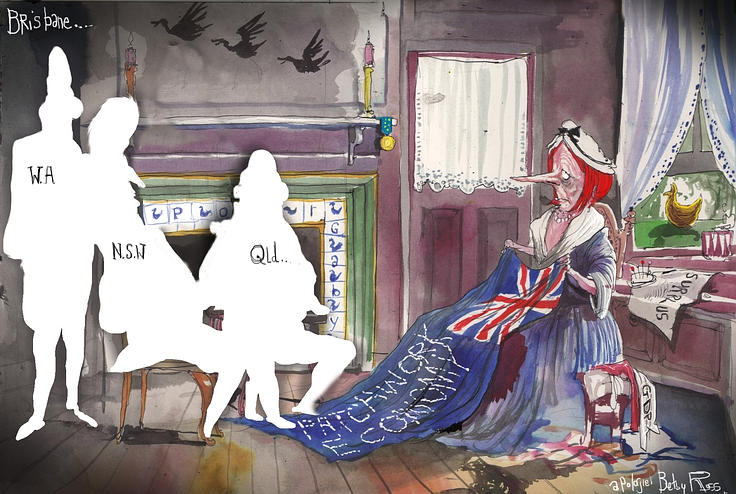
The by-election has been sucked into the vortex of national politics with the Canberra press gallery journalists indulging in their h overheated rhetoric with its federal implications.The shock waves will be felt in Canberra, Gillard will be further weakened, and the ALP will face an existential crisis.
The end of Gillard Labor is written into the basic structure of the world is the Gallery's basic narrative, and every event that happens is fitted into this frame as they act to fan the flames. So what happens if the ALP narrowly wins the Melbourne by-election?
 David Rowe
The Canberra media gallery appears to have forgotten that the Greens came within 2.0% in both 2002 and 2006 before being shot down by Liberal preferences in 2010. So the suggestion that a Green win this time should in and of itself cause “shock waves” is pure media spin. Is this the hand of the NSW Right being played?
My gut feeling is that the Greens will out poll the ALP in primary votes but the ALP will recover the lost ground through preferences from the smaller parties. These mostly favor the ALP, due to it securing the political deals that will probably allow it to scramble over the line. If it wins then it went into the election with very limited policies and comes out as just a political machine to gain and retain power.
If Labor wins narrowly, what does that say about the Canberra Gallery's theory of a big shock wave in Canberra? No doubt the journalists will continue to fan the flames of leadership turmoil for this is the only game in town for them.
The real problem for the ALP is its toxic, corrupt culture ----eg., the HSU scandal and its support for poker machines--- and that is not going away. It is what Labor is. The Greens, in contrast, stand by their principled position on pokies and genuine support for transparency, good governance and fair campaigning.
Update
It looks as if the Greens will have to rely on increasing their primary vote to win the inner city seats in capitol seats, since it looks as if the Labor and Liberal parties will close ranks against them and preference one another. An article in the AFR by Nick Economou says that:
the implication of the byelection result is clearly that the Greens vote has peaked in inner Melbourne. If the best the Greens can muster in inner Melbourne is 37 per cent of the vote, Bandt may not be able to retain his seat at the next election....The byelection tells the Greens that, while their vote may have peaked in inner Melbourne, it certainly is not falling and expectations of upper house success in Victoria and beyond should remain high.
The implication is drawn by an editorial in The Australian--- the by-election confirms Greens' status as a protest party on the fringes, with no serious hope of governing.
Posted by Gary Sauer-Thompson at 7:43 PM | Comments (10) | TrackBack
July 19, 2012
Will Ford be next?
Ford Australia's recent firing of 440 staff from its manufacturing operations in Melbourne and Geelong primarily comes from its bad corporate governance. It is a failure to adapt to a changing market--rising fuel costs, the shift in consumer preferences for smaller, more fuel efficient cars, and the emergence of electric cars. Unsurprisingly, the Ford Falcon has had poor sales.
Why would you provide protection and subsidies for such a company? The shift noted above has been coming for many years and Ford Australia has been a dumping ground for second-hand technology by Detroit, which has not allowed its local subsidiary to be innovative. So Ford Australia continue to produce large, fuel inefficient motor vehicles, and they sell fewer and fewer vehicles.
Australian governments have compounded the problem because they have refused to introduce emission standards on Australian cars that have been in place for five to ten years in other developed countries. Secondly, the Australian car industry persists only because of industry protection and government subsidies designed to prevent industry collapse.
The Australian market is too small for car manufacturing. Nissan has gone. Followed by Mitsubishi. Is Ford next? Those that remain must innovate and export if Australia is to have a car industry.
The global market shift to low-emitting, fuel-efficient vehicles is going to make it difficult for the local car industry--- which produces predominantly large, high-emitting vehicles – to compete internationally. High emission standards mean Europe and parts of Asia no longer want locally produced cars.
Anna Mortimore rightly says:
Simply throwing money at the local car industry will not necessarily increase sales and save jobs. Funding should not be supported if the local car industry fails to make the necessary technological changes to significantly reduce emissions of its large vehicles to meet the government’s proposed targets. The industry must also introduce new fuel-efficient vehicles that consumers would rather buy.
Australia doesn't need an backward looking industry dependent on corporate welfare to survive. In a global market Australia needs an industry that expands the technology base--eg., ensuring that Australia is not left just with internal combustion production and R&D, but that it is centrally involved in designing and making alternative car power plants.
Update
An editorial in the Australian Financial Review entitled Car industry is not worth the price argues thus:
the problems of the domestic car industry are likely to become worse, with local car plants already operating at below optimal scale. ....Multinational car manufacturers are too accustomed to working the old political economy of Australian protectionism that delivers handouts from the government when they run into trouble, rather than becoming efficient enough to stand on their own two feet.....A fully fledged car industry capable of designing and producing a new model from concept through to on-road testing confers prestige, and has an innate appeal.....But that prestige is unlikely to be worth the annual price tag, estimated by the Productivity Commission at $1.6 billion a year in industry subsidies.
It concludes by saying that in the midst of a mining boom that is generating severe skill shortages, those funds would be better directed to pursuing our comparative advantage in resources and mining-related services, rather than throwing subsidies at an industry that is not market focused and does not deliver on promises it makes.
Posted by Gary Sauer-Thompson at 3:50 PM | Comments (5) | TrackBack
July 18, 2012
fossil fuel heaven?
We are used to the vested interests of the fossil fuel electricity generators acting to protect their stranded assets----the coal fired power stations --and the coal export boom with its big coal infrastructure development in the Galilee Basin in central Queensland.
 David Rowe
But we hear very little about who is buying Australia's coal exports in the media. One such customer is India which has a shortage of coal to produce the energy needed to develop its economy. India is facing an energy crisis and it has natural constraints in increasing the supply of fossil fuels (gas, oil and coal) to keep up with the increasing demand for more energy and electricity from economic development, a growing population and massive urbanization.
India needs all the energy it can harness to sustain its high economic growth rate and it will increasingly have to import oil, gas and coal. Coal, it is argued, will continue to be the main driver of India’s economy.
Hence Gina Rinehart's development of her massive coal project in the Galilee Basin; a development premised on India relying on energy produced from coal fired power stations. It looks a winner---an eternal boom according to the Big Miners. Coal is the future.
What if fossil fuels are not the only possible solution? What if the imported coal becomes too expensive for India compared to renewables? What if renewables offer more in the way of energy security than imported Australian coal?
Expensive energy is going to impact heavily on the poor. Hence the idea of bottoms up technology---ie.,decentralised, stand-alone systems --- at a village level as opposed to the coal and gas fuel mix in a centralized grid system.
Posted by Gary Sauer-Thompson at 1:20 PM | Comments (6) | TrackBack
July 16, 2012
sitting atop the wreckage
In Melbourne we have a Victorian state ALP, which is still recovering from an unexpected election defeat, fighting to retain a once-safe, Labor seat where the rise of the Greens has changed the game in the inner city seats of the capital cities. The NSW Labor Right have decided to attack The Greens just before an important by-election for the Melbourne seat in the Victorian state parliament.
The over the top attack has been calculated to offend progressive or centre-left voters (ie., the inner city, middle class trendies) to keep them out of the ALP and to shore up the NSW Right's power base amongst the socially conservative, blue collar, white working class vote.

The NSW Right go on and on about preferences when the real problem lies in the ALP's low primary vote. That vote is so low it is highly doubtful if the ALP will ever govern in its own right again. The ALP needs an alliance with the Greens to be able to govern, and the party is going to have to swallow its pride and deal with its resentment.
If Labor is a cause and not a brand, then why not accentuate the policy differences with The Greens and with the Coalition. Wouldn't that help to articulate what Labor stands for?
Resentment because the Greens stand a good chance in the near future of taking previous federal ALP strong holds in the inner-cities: seats such as Batman, Sydney, Grayndler, Denison and perhaps even Fremantle. The logic of the NSW Right's position is that preferencing against the Greens in the next federal election will deliver Tony Abbott more votes in the Senate, enabling the Coalition to undo the ALP's reforms.
Posted by Gary Sauer-Thompson at 9:02 PM | Comments (7) | TrackBack
Ken Henry on Australia's two speed economy
In his speech to the Australian Conference of Economists at Victoria University, Melbourne on 12 July 2012 Ken Henry argued that Australian businesses outside the booming resources sector will continue to face falling international competitiveness and options such as “offshoring” will need to be considered.The implication is that Australia is in for some potentially turbulent times despite our strong resource-led economy.
He also argued that the debate around lifting Australia’s productivity and our international competitiveness has become confused, with a common but incorrect belief that growth in the resources sector can off-set weakness in the non-resources sector:
there is simply no feasible set of such adjustments that would reverse all, or even a large proportion, of the loss of international competitiveness that is presently being experienced by Australia’s trade exposed non-resources industries. The shock to resources prices has simply been so large that a considerable structural adjustment, including a reallocation of labour, is required. It will happen.
He adds that though it is true that Australia is not the only economy experiencing substantial structural adjustment because of the re-emergence of the major Asian economies, that is not the same thing as saying that Australia will avoid substantial structural adjustment.
He finishes thus:
It is no exaggeration to say that, if Australia is going to navigate successfully the structural adjustment to the terms of trade shock presented by the extraordinary growth of China and others in the region, a new mindset will be required: a new mindset in government, certainly; but a new mindset in business and the broader community also.
While the mining industry has surged ahead in terms of employment growth, areas such as manufacturing, transport and warehousing, agriculture and retailing have gone backwards. Hence Australia's two-speed economy and why many Australian’s seem so pessimistic despite the apparent strength of the nation’s economic performance at the macro-level.
Hence a future of constant change, structural unemployment, labour disputes and political divisions between perceived winners and losers in Australia’s non-mining and resources firms as they struggle to reinvent their business models.
Posted by Gary Sauer-Thompson at 8:16 AM | TrackBack
July 14, 2012
Sydney = Australia?
The foot-stamping from the representatives of Sydney in particular – over the decision to choose Brisbane for the G20 indicates that Sydney thinks that it should be the only global city and that Sydney is Australia.
The superiority and condescension that was on display in such a naked fashion took the form of Brisbane being a mediocre alternative to Sydney and that mediocrity signifies the mediocrity of the rest of Australia.
 David Rowe

Sydney has become a dysfunctional city with respect to its airport, public transport and traffic jams and little has been done by its state governments to make it a more functional city.The system of governance in NSW is both dysfunctional and corrupt.
Posted by Gary Sauer-Thompson at 9:13 AM | Comments (7) | TrackBack
July 12, 2012
scrutinising Abbott
Abbott's political style is one of endlessly repeated slogans, such as "turning the boats back" or the "great big tax on everything." He avoids going on those programs where the slogans are analyzed and he is forced to spell out the details of what turning the boats back means. He simply links turning the boats back to strong border security, another slogan.
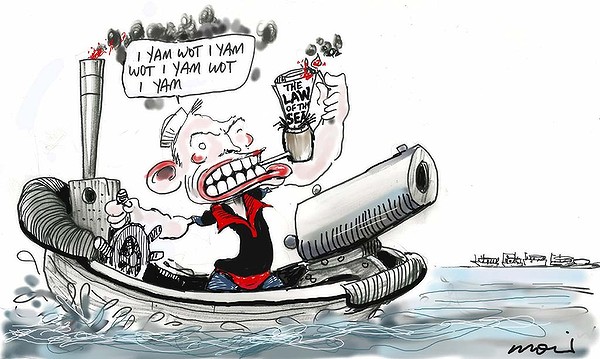
What is surprising is that the Canberra Press Gallery has let him get away with this kind of rhetoric. They give him an easy ride. No better example is the way they talk about the carbon tax instead of carbon pricing, thereby accepting Abbott's central claim.
Posted by Gary Sauer-Thompson at 7:48 AM | Comments (5) | TrackBack
July 10, 2012
whistling in the wind
So the Labor Right has decided that their best strategy is to attack The Greens through caricature (the Greens are the bogey man). Apparently, it is The Greens that are the cause of Labor's current woes, not the actions of the right wing of the ALP. The Greens, apparently, are the most dangerous fringe group in Australian politics.
 David Rowe
The tactic is to designed to appeal Labor’s traditional blue-collar base and suburban voters, who are now prepared to vote for a conservative government led by Abbott, by dumping on the left. In that way---eg., saying that the arrival of a few thousand asylum seekers would amount to a breach of Australia’s border security and threaten Australia---- the ALP will regain the momentum to become a majority party in their own right. This indicates that if Labor governs then the Green Senators are needed by Labor to pass its legislation.
They are dreaming. The ALP will only regain power with the help of The Greens because its primary vote is too low. That means some form of coalition, just like there is coalition on the right of centre between the Liberal and National parties.
To put it bluntly, Labor will have to get used to both dealing with the Greens in the Senate, regardless of who’s in government, and the big shift of Labor’s vote to the Coalition. It is the latter, not the former that is problem for Labor. The 2010 agreement between the Greens and Gillard has been a successful alliance--The Greens have ensure that legislation for the National Broadband Network, the mining tax, and the carbon pricing (and its associated tax cuts) have passed in the face of opposition from the Coalition.
Posted by Gary Sauer-Thompson at 11:11 AM | Comments (21) | TrackBack
July 6, 2012
changing the work culture
In Why Women Still Cannot Have it All in The Atlantic Anne Marie Slaughter argues that under current work arrangements it is not possible for highly educated, well-off women to combine professional success and satisfaction with a real commitment to family. The 16 hour days at work that are required are too long if they want to raise children and lead a balanced life. It leads to a one dimensional life.
The reason is the system of work, which is one of inflexible schedules, the conflicts between school schedules and work schedules, unrelenting travel, and constant pressure to be in the office. Given this kind of work culture--- arrive early, stay late, and always be available---it is possible women can have high-powered careers as long as their husbands or partners are willing to share the parenting load equally (or disproportionately) that means they have put work ahead of family to achieve their work-life balance.
But why not change the work culture to allow easier integration of work and family life? More working at home, greater use of video-conferencing,and changing the assumptions about adapting the work culture to allow for the routines of family life through family -friendly policies offer ways to begin to challenge the assumptions underpinning this male culture and the view that women can have it all.
As Eva Cox observes inarticle at The Conversation:
This notion [that women could have it all]is a media myth that somehow translated the idea that women should not be excluded from any sphere on the basis of sex into the sexy but fallacious view that we could have it all.
She says that feminists need to point out that we want to take on our share of decisions and jobs, but not until the structures and cultures change in recognition that is not the good way to run the country or other organisations.
Posted by Gary Sauer-Thompson at 3:23 PM | Comments (1) | TrackBack
July 5, 2012
blaming the carbon tax for price hikes
Companies have already started started to make misleading price claims about the impact of the carbon price. The impact of the carbon tax on small businesses will be modest--around $4 or $5 a week for a very small business.

The Australian Trade and Industry Alliance is an anti-carbon tax group that has claimed that the price of electricity would rise 20 per cent immediately and up to 400 per cent by 2019 because of the carbon price. The group is made up of the Minerals Council of Australia, the Australian Chamber of Commerce and Industry, the Australian Coal Association, the Australian Retailers Association, the Housing Industry Association and Manufacturing Australia.
They have been part of the sustained campaign of fear and disinformation around climate change and the carbon pricing that has resulted in the whole field of climate policy in Australia becoming so polarised.
What is going to happen is that the dirtiest fossil fuel power generating capacity in Australia will be closed down by 2020. The plants under consideration are Hazelwood, Yallourn and Energy Brix in Victoria, Playford B in South Australia and Collinsville in Queensland.
Posted by Gary Sauer-Thompson at 3:41 PM | Comments (4) | TrackBack
July 4, 2012
thinking about politics
Geoff Gallop draws a distinction between pragmatic politicians with an eye to the future, and pragmatic politicians with an eye to the next headline. He adds that it is possible for the idea of reform to stay alive and produce results – even in our current system with all its emphasis on publicity, events and personalities.
 David Rowe
What has been pushed into the background in contemporary political discourse is citizenship. We rarely here about this even though Liberalism once placed a great emphasis on the ideas of both rights and civic obligation.
Geoff Gallop, for instance, says that a good deal of his thinking in his book Politics, Society, Self: Occasional Writings has been on the subjects of democratic reform, co-operative federalism, multiculturalism, and public sector effectiveness. Nothing on citizenship even though he highlights the importance of well-being for public policy and the person.
Citizenship is a core of democracy and a central premise of any long-term progressive strategy is to renew the very system of democracy that empowers ordinary citizens, amplifies their voices, and makes all other changes possible. At the very least, renewing the systems of democracy will mark a fundamental shift away from the entrenched and well-funded interests which still dominate governance that contribute to the long-standing decay of Australia’s democratic institutions. This has worsened markedly in the past decade since 9/11.
The problem comes not only from the executive. Parliament has degraded alarmingly as a coequal and strong institution. Its internal deliberative processes have atrophied as the influence of lobbyists has increased.
Posted by Gary Sauer-Thompson at 9:30 AM | TrackBack
July 3, 2012
urban sprawl
Peter Newton in Unlocking the greyfields to inhibit urban sprawl at The Conversation that the NSW and Victorian state governments (and I would add the SA one) continue to encourage the development of new housing on the fringes of their cities.
In theses growth areas, the pace of development continues to outstrip the ability to provide public transport to employment, and the capacity of social infrastructure to meet the needs of the growing population. Households on our cities' fringes are most vulnerable to projected increases in mortgage and petrol prices.
 Howard Arkley, Superb + Solid , 1997
 In The Age Carolyn Whitzman and Billie Giles-Corti say that Australian cities have unsustainable per capita environmental footprints compared with other developed cities around the world. We are more car dependent, our cities sprawl over a larger proportion of prime agricultural land, and we have higher rates of obesity than most countries in the world.Health and wellbeing, liveability and environmental sustainability are all closely linked.
In the inner cities, new apartments and the increased density they bring have added to the richness of street life and cultural options. But these apartments have not been built for families and there is a shortage of schools. With increased density, there is also a need to provide more walking, cycling and public transport opportunities to ease traffic congestion.Many of these new city apartments apartments are small and poorly built.
Newton says:
In the face of sustained population growth, our big cities continue to sprawl into the greenfields, despite the now well recognised problems associated with higher infrastructure costs, lack of amenity, car dependency, poor job access, diminished agriculture and open space.
He says that the solution lies in the greyfields – those ageing but occupied tracts of inner and middle ring suburbia that are physically, technologically and environmentally failing and which represent under-capitalised assets. Here, attempts have been made to intensify housing and employment around activity centres and transit oriented development projects.
Though attempts have been made to intensify housing and employment around activity centres and transit oriented development projects in the greyfield middle suburbs little regeneration has happened in any systematic way. Newton says:
Most infill housing in the middle suburbs has been occurring in a fragmented, sub-optimal fashion. As greyfield housing comes onto the market (typically properties where 80% or more of the total value is vested in the land) it is purchased, demolished and rebuilt, typically resulting in yields of 1:1 and 1:2-4 dwellings.
Consequently, state governments continue to apply mid-20th century solutions to a 21st century urban problem. Hence the concern about the state of Australian cities.
Posted by Gary Sauer-Thompson at 11:48 AM | Comments (11) | TrackBack
July 2, 2012
fear and loathing
The conservative populists are on the march. They are angry, bitter and resentful.They want blood in the form of sacrifice.
They will probably not shift their position on carbon pricing despite the compensation and the lack of evidence for the doom and gloom rhetoric: the carbon tax is wreaking devastation on the economy, laying waste to industries and destroying jobs.

They can sense victory---its 60:40 against the Gillard Government on everything. They know that Labor has its back to the wall. So every price rise will be attributed to the carbon tax so as to confirm their deeply held belief that the increase in the price of carbon is a bad tax put in place by a bad government.
Why will the conservative populists not shift their view in the light of facts and being properly informed? Because their opposition to the carbon "tax" has become part of their identity as a conservative. It's become foundational, just like a belief in God is for Christians. It help defines who they are in opposition to their political enemy, so they are not going to change their mind because of facts or plausible arguments.
Posted by Gary Sauer-Thompson at 2:46 PM | Comments (8) | TrackBack
July 1, 2012
a cynical politics
Jonathan Green highlights the tabloid's cynicism over asylum seekers to foster fear and loathing. What he doesn't mention is the cynicism of the Coalition defending human rights in the debate in parliament over the same issue.by saying that the Malaysia solution was beyond the pale because it did not respect human rights of asylum seekers.

In doing so they were appealing to a liberalism, which asserts that there are general but substantial moral truths, universally applicable, on which liberalism’s claim to deliver the human good is founded. The guiding idea behind fat-face liberalism is that there is a single life, best for everyone, on which everyone can rationally agree, at least in principle. This has given rise to legalistic liberalism, which seeks to referee conflicts about values and lifestyles by constitutional law and legal procedures.
The Coalition has a long history of being hostile to the universalism of human rights and to a Bill, or even, a charter of human rights in political life even though individual rights is designed rights to limit the power of government. They hold that a bill of rights leads to a politicised judiciary that would have the power to halt conservative political agendas.
Posted by Gary Sauer-Thompson at 11:12 PM | Comments (1) | TrackBack