« July 2010 | Main | September 2010 »
August 31, 2010
Andrew Wilkie plays a cool hand
Whilst conservatives rediscover the liberal principles of federalism and continue to denounce green populism the Independent member for Dennison, is talking good political sense.

Andrew Wilkie says that his core position is that wants Tasmania's only acute care hospital (The Royal Hobart) to be refurbished and the laws governing poker machines reformed. He adds that in the last few months the Labor government has been neither stable, competent or ethical and he's yet to be persuaded that the opposition can do any better. They must do better.
These are not the words either the ALP or the Coalition would want to hear from Wilkie, who seems to be modeling himself on Brian Harradine's conception of the role of an Independent.
On Wilkie's interpretation, that role of Independent does not include using the levers of power to push for root and branch parliamentary reform, which would include a Parliamentary Budget Office. He is more interested in policy than trying to break down the procedurally corrupt two party system of governance in order to strengthen the Parliament and allow it to act as an effective check on the Executive comprised of the Prime Minister and Cabinet.
Wilkie does spell out his criteria for support:
If I decide to support the ALP or the coalition parties, then that support, in essence, will only extend to a commitment to not block supply and not to support any reckless no-confidence motions.I will fiercely defend my right to vote on any piece of legislation on its merits....They will know they will have to negotiate with me on every piece of legislation and I'll have to be convinced on the merits of that legislation...If a no-confidence motion is brought to bear with substance, if someone has acted dishonestly or grossly unethically, of course, I will vote to bring down whoever that is. I will always vote to bring down people who are dishonest, grossly unethical and who are letting the people of Australia down.
Ethical government is a bit left of field for both Liberal and Labor, both of whom will be gunning for his seat in the next federal election.
Update
As expected The Greens have formally sided with Labor. In return Labor has offered
the formation of a climate change committee
a parliamentary debate on Afghanistan
a referendum on recognising Indigenous Australians
restrictions on political donations
legislation on truth in political advertising
the establishment of a Parliamentary Budget Committee
a leaders' debates commission
a move towards full three-year parliamentary terms
two-and-a-half hours of allocated debate for private members' bills
access for Greens to various Treasury documents.
The Greens don't seem that interested in pushing for substantial parliamentary reform so that Parliament acts as a check on executive power.
Posted by Gary Sauer-Thompson at 10:30 AM | Comments (8) | TrackBack
August 30, 2010
roads are for cars folks
One negative aspect of urban planning undertaken by our state governments is the way that their transport planning has for decades been focused on building more roads while applying the tourniquet to a moribund public transport network. As a consequence there there has been a negative reaction to urban congestion --meaning gridlock--- and the state government's habitually respond by building more freeways, increasingly with tolls.
They don't seem to get the scenario that if you build new roads then more people drive and they drive overwhelmingly with four empty seats in the car. They allow urban sprawl to continue and make such infrequent invest in public transport and bike ways that there is zero public transport improvement apart from extra buses and few delineated cycleways on central roads into the CBD. State governments and their urban transport planners are in love with the Los Angeles-style spaghetti junction system of flyovers and ramps that is part of the suburbia, automobiles and car culture nexus.
Conservatives (free minds and free markets) are onto the suburbia, automobiles and car culture issue. They are wheeling out their classic form of right-wing argumentation that begins with a set of erroneous assumptions about the current state of affairs in our country, then proceeds to make use of either/or binaries, and generally ignores both the substance or merit of the ‘arguments’ they decisively refute.
From the context of their argument, one would assume that Australia is being over-run by anti-suburban, anti-automobile advocates dressed in lycra, and that this wave of greenie resentment is threatening our intrinsic rights to mobility and freedom. What is usually ignored is the middle ground.
The pro-automobile, pro-sprawl policies advocated by free market capitalists say that traffic congestion, automobile inefficiency and clogged roads can be solved…by more roads and freeways. The Greens, who hate freedom, have an agenda to force people out of their cars, out of the suburbs and into congested, cramped high-rise cities. Public transport is for losers not winners.
So we have the standard either/or binary: you can either live in the burbs’ and drive a car, or you can give up the Australian dream—as well as your personal mobility and freedom—to live in a cramped city with expensive rent and smelly, homeless street people and drunken aborigines. The roads are for cars not bikes.
Posted by Gary Sauer-Thompson at 9:53 AM | Comments (2) | TrackBack
August 29, 2010
a note on education
If globalization is here to stay (and it is given the global reach of many corporations), then should we be investing in human capital rather than subsidizing Australian firms? Isn't the former option --investing in people--- a better one to keep the Australian economy competitive than the latter one?
The big idea of centre-left political economy, which was popularised by Robert Reich in the early 1990s—is that globalisation would benefit almost everyone, so long as governments in rich countries equip their citizens with the education and skills needed to switch into growth sectors, and away from the low-skilled work that is emigrating to poorer countries. The well- being and the standard of living of societies in the twenty-first century will depend to a large extent on the skills and insights of their citizens.
It is worth returning to the argument in the light of the limits of Labor's "education revolution" that concentrated on national tests, memorisation, apprenticeships and its computers in schools program. The significance of the latter can be seen if we turn to Reich's The Work of Nations: Preparing Ourselves for 21st Century Capitalism, where Reich divided jobs into three broad categories for assessing their contribution to new the global economy. These are "symbolic- analytic" services, routine production services, and "in-person" services.
The first of these is carried out by what Reich calls "symbolic analysts" engineers, attorneys, scientists, professors, executives, journalists, consultants and other "mind workers" who engage in processing information and symbols for a living. These individuals, which make up roughly twenty percent of the labor force, occupy a privileged position in that they can sell their services in the global economy. They are well-educated and will occupy an even more advantageous position in society in the future.
Reich argued that routine production workers and in-person service workers will fare much worse in the new economy. Routine production workers include those who perform repetitive tasks — assembly line workers, data processors, foremen, and supervisors. Examples of in- person service workers are waitresses, janitors, hospital attendants, and child care workers. These two categories of workers do not compete in the global work force and are at a considerable economic disadvantage. This is especially true of routine producers. The future of service workers is less clear cut since their services are in demand by symbolic analysts.
The skills people need to develop have to do with problem solving and identification, developing critical facilities, understanding the value of experimentation, and the ability to collaborate. In other words, given that economies are changing so rapidly, the most valuable skills someone can acquire are the skills to learn rapidly and efficiently and to go into almost any situation and figure out what has to be learned.
Relatively unskilled people who have not gone to college, who do not have the conceptual problem-solving skills of the future, are finding themselves in competition with millions of unskilled people around the world who are eager to work for a small fraction of their minimum wages. They need to have the skills to survive and to be productive in this new emerging world economy so that they can get better jobs and generate high incomes of real value.
Presumably, that is what Labor's computer in schools was beginning to do. Or gestured towards. But it was only a tentative shift away from working with your hands to working with your brain . Beginning and tentative because we hear little about basic skills such as abstraction, system thinking, experimentation and problem solving; or teaching teachers to nurture analytic minds instead of filling them up with facts.
Posted by Gary Sauer-Thompson at 10:30 PM | TrackBack
August 28, 2010
the fracturing of the body politic
Unsurprisingly, many in the Canberra Press Gallery cannot see beyond the two party system.That is liberal democracy for them, so they just dismiss the situation by saying that a new election would be the best way out of our federal political imbroglio; or they dump on the Independents.
There is not much thinking through about what has happened in terms of a challenge to the two party system or what it means for Australian democracy. Australia's political culture is not about to change.

The position of George Megalogenis is more thoughtful than simply saying that minority government is a minefield or a gridlock. In his Divided we stand column, he says that Australian society fractured along lines of state, age and sex.
He highlights the shifts happening in the electorate as revealed by the 2010 election:
Both sides now have a base revolt on their hands. To the left of Labor in the capitals, the Greens are on the rise; to the right of the Coalition in the bush, the independents are claiming a moral victory in their turf war with the Nationals.
However, he doesn't take it much further than that in terms of the significance of the long term trends --the formation of loose right-of-centre and left-of-centre coalitions.
Sure, the party system will endure, and it’s likely that the next election will bring a return to majority government. However, the fracturing on the right and the left will continue to happen bit by bit, opening up a space in the middle for the Independents to locate themselves and for us to hear their different voices. At the moment these voices are not taken seriously. Thus Tony Wright says:
They are legitimate voices with a number of legitimate axes to grind, but their current influence - and the potential for continuing influence over national policy - is a distortion of reality, even if Oakeshott and Windsor are more considered men than Katter, have been placed in their current position through no fault of their own and sincerely want stable government.....nevertheless, the peculiarities of the election-without-end mean that if either Abbott or Gillard can't woo the blokes from the bush, there will be nothing for it but another election, which would likely be as popular as poison to all concerned.It might, however, be a better alternative than to have the likes of Bob Katter holding a blunderbuss to the nation's decision-making process.
Despite the appalling state of parliamentary politics there is no consideration of the Independents push for reform of Parliament. No consideration how this situation may lead to more infrastructure investment in renewable energy or regional development.
Posted by Gary Sauer-Thompson at 10:18 AM | Comments (17) | TrackBack
August 26, 2010
troubled by an absence
In his Both parties need a new look before the next poll in The Australian Arthur Sinodinos briefly sketches a big picture around the recent federal election. He says:
The alleged "Greenslide" should be kept in perspective. The main parties still got at least 85 per cent of the total vote. The Greens and independents do not have a coherent strategy for government. Nothing that would replace the economic modernisation project of the past three decades.
Presumably, the economic modernisation project of the past three decades is the one neo-liberal of free markets, small government delivering prosperity; a project premised on the roll of back of the welfare state and the destruction of social democracy coupled to the exploitation of the deep uncertainty created by the pace and unpredictability of change.
Sinodinos points out how the Right were able to exploit the mood of deep uncertainty:
The Howard credo of economic liberalism and social conservatism attempted to smooth the passage of reform by promoting social cohesion in the face of change. This combination works best in the upper half of the country. The southern states seem to be more socially liberal and economically conservative. Commonwealth assistance accounts for more than half of state income in Tasmania. This quasi-welfare dependency is reinforcing the drift to the Greens, with their aggressive opposition to growth policies and focus on wealth redistribution and new age issues.
Of course, Sinodinos does not mention the politics of fear in the Howard credo --eg., the exploitation of fear of outsiders and strangers, which culminates in putting up barriers against immigration, refugees or exiles; or the fear that we may lose our jobs next year if we introduce a carbon tax or tax the miner's profits.
The southern states are committed to social democracy which has been enfeebled by the neo-liberal mode of governance of the past three decades in which public spending is deemed to be a recipe for future disaster, and that ‘private’ is better than ‘public’ . If the core of the ALP's version of social democracy is equality (albeit watered down to a fair go and equality of opportunity), then its current understanding of social democracy is feeble and it has lost its language. As Tony Judt points out with the cheating language of equality deep inequality is allowed to happen much more easily.
What we don't have is active interventionist states protecting us against things that frighten people: states controlling changes so they don’t get out of hand or create a political backlash. Labor is not willing to face up to this challenge in the name of a progressive state with collective objectives and purposes, which preserves institutions that give us a sense of shared identity and values.
Nor do we have something that would replace the economic modernisation project of the past three decades whose goal was the pursuit of wealth --ie., the greening of social democracy. This is the absence that is troubling. If there is to be a rebirth of social democracy in the space opened up by the discrediting of neo-liberalism over the global financial crisis, then it will come from The Greens rather than Labor.
Posted by Gary Sauer-Thompson at 10:20 AM | Comments (11) | TrackBack
August 25, 2010
foreboding futures
There is a lot of commentary around the new politics due to the emergence of a multi-party democracy, the three regional Independents holding the balance of power in the House of Representatives and a minority government with some form of coalition. The promise emerging from this balance of power situation is parliamentary reform, better public services in health and education, more economic development for regional Australia and a more sustainable economy.
My own fear is that what will eventuate is a closure of this possibility, due to a minority Liberal government returning to power with the support of the Nationals and the regional Independents. That means three years of the economics of austerity based on the politics of fear constructed around the crushing government debt and financial catastrophe scenario that will bring ruin.
 Brian Jennings
This is a politics of neo-liberalism's free markets and small government economics that uses Johan Norberg's recent book Financial Fiasco as a road map. A politics designed to make the world safe for bankers and brokers in the citadels of capitalism.
My argument is that the Liberals are deeply opposed to the use of Keynesian style stimulus in preventing the economy from sliding into recession---because such governments continue to pursue a course of endless debt, higher taxes, more regulation. The Liberals have an explicit program of deep cuts to the government budget to reduce the deficit and government debt. Behind this is theory that tax cuts for the rich yield prosperity. No doubt their rhetoric will be one of "progressive austerity", unavoidable cuts, and returning the budget to surplus.
The economics of austerity and a hard deflationary budget---means that working families on the lowest incomes – particularly those with children – would be the biggest losers in the cities. For those living in the regions, already facing unemployment and reduced health and education services, it means more social pain from increased unemployment. It does not mean major investment in regional Australia and it does not mean overcoming the increasing levels of inequality and which equate the ‘good’ with what is economically efficient.
In these circumstances will the 3 regional Independents become Abbott's fall-guys? Will the coalition become unstable over the budget cuts? Will the Independents help to hold the axe handle, or will they turn the other way? They are not fools. They must know what Abbott's economics of austerity means for the bush and regional Australia. Are they critical of a neo-liberal mode of governance? Bob Katter certainly is.
And if the regional Independents decide to support Gillard Labor? Well, the budget cuts to return the budget to surplus over the next three years will be less severe than those advocated by the Liberals, and they could be counterbalanced by greater investment in public infrastructure in regional Australia.--eg., renewable energy grids and high speed broadband that would make a difference to everyday life in the regions.
Posted by Gary Sauer-Thompson at 11:42 AM | TrackBack
August 24, 2010
voices from the past
A recent editorial in The Australian --Nation sends a message to its political class--- calls for a renewal of politics based on its standard talking point of equating minority governments with uncertainty and instability. How then does The Australian understand and conceptutalize the new politics?
Like others it understands the new politics in terms of a tectonic shock to the two party system. It says:
the election has delivered a severe shock to the predominantly two-party system that has served the nation well since federation. In itself, the breaking down of rusted-on, tribal voting patterns of the past is no bad thing. A modern, technically savvy and more politically literate nation is always going to question the old verities. But both major parties are paying the price of underestimating voters and for taking their loyalty for granted.
Most commentators agree on that. What then, given the emergence of the three country Independents, the big electoral shift to The Greens, and the refusal of both major parties to acknowledge and accept that ''good economic management'' also means devising the best way to tackle climate change?
The Australian's editorial is crystal clear and direct as to what the 3 Independents must do in the national interest:
It would be tempting for the three independents from regional areas to enter a Dutch auction or to allow past bitterness with the Nationals to sway their judgment. They must act purely in the interests of their voters, who have overwhelmingly rejected Labor. All other things being equal, common sense, not to mention the national interest in stable government, would lead them to back Mr Abbott.
That is clear. Labor must be tossed out of office. The Coalition, which represents authenticity, understands Australians much better than both the dysfunctional Labor machine men and the urban elites who have lost touch with the world beyond the inner cities.
This sounds like the old politics to me. The Australian's message is clear: Power is within the reach of the Coalition and Blue Australia must rule. The implication is that the Coalition's task is to cement power in 2013 or earlier, thereby consigning Labor's 2007-2010 government to a mere interlude across two decades of conservative rule. That is how things should be and the role of the 3 country Independents is to ensure that.
What of Labor then? What does it do when the Coalition entrenched in power for a decade or more. Well, The Australian has a clear message for Labor.
Labor's political class has paid a high price for losing touch with its heartland. The hemorrhaging of votes from both ends of the party is now confirmed and creates a Waterloo moment for Labor. It is being pushed to the Left by its Green wing but its future rests with its capacity to move more comprehensively to the centre-right inhabited by the new, aspirational, often self-employed enterprise class that wants competent service delivery, a tax system that rewards hard work, and a government that maintains a light touch over their lives.
Labor must move to the centre-right and so isolate the Greens. What is needed from Labor in The Australian's version of the "new politics" is to block the formation of a pro-climate action balance of power in both houses of parliament that would see progress on climate policy.
The Australian's scenario implies the Coalition has shifted even further to the Right, if Blue Australia is to rule the nation for another decade or more. So how are the conservative's going to fracture the left-of-centre Coalition (ALP + Greens) that is in formation to ensure that the ALP moves to the right-of-centre?
Update
The Australian has another go in sorting out its understanding of the new politics in its ALP has no reason to lurch Left. It says:
The ALP vote fractured in favour of the Greens on Labor's far Left, not on the mainstream centre-right. Were Labor to lurch to the Left, its would alienate its middle Australian base, courting electoral disaster. It would surrender the mainstream centre of politics to Tony Abbott, whose leadership saw the Coalition make major inroads on Saturday among the former Howard battlers, who later became Kevin Rudd's working families. Labor has nothing to gain by wasting political capital wooing Greens voters. Under Australia's compulsory preferential voting system, the ALP gains the lion's share of Greens preferences anyway.
The Greens will implode just like One Nation and the Democrats:
The Greens will not survive as a political third force if they stray from the values of their voters and must occupy the ground between the major parties...In the long run, the Greens will not capitalise on their "doctors' wives" base in some of Australia's most prosperous electorates by clinging to tomato Left economics, pursuing policies to increase taxes, reintroduce death duties and ban uranium mining and new coalmines.
So Labor would be foolish to overreact by lurching to the Left at the expense of vacating the centre ground.
Update 2
Guy Rundle in Crikey observes that with this election the political question has come to the fore after it had been taken over, and submerged, by economics since the 1970s. He says:
The political question who leads, how and through what institutions has barely been regarded as political at all, or cynically manipulated, as in Howard's handling of the Republic debate. ...What's happened in this election is that the process of parliamentary electoral politics which is minimally democratic and the party-based politics of interests, which isn't democratic in the slightest, have come into contradiction, in a situation where the system usually silently serves the interests. The profound cynicism and mild fear of the commentariat have caused them to back the interests against the system.
The mere process over the last three days has made visible the invisible structures of power, and their potential (if not straightforward) transformability. The political apparatus has been put into question by the regional independents whilst the business-as-usual Canberra Press Gallery is trying to play catchup.
Posted by Gary Sauer-Thompson at 12:33 PM | Comments (46) | TrackBack
August 23, 2010
in the twilight of a hung parliament
We have a period of political uncertainty until the Australian Electoral Commission counts the postal and pre-polls votes in the three seats in doubt--Hasluck, Denison and Brisbane-- in the context of the possibility of the global economy entering a double-dip recession.
The three country Independents (Katter, Windsor and Oakeshott) are now in the centre of the political stage, and we now know that whichever party forms government it will not have a clear majority in either the House of Representatives or the Senate. Amidst all the furious political spin of the moment few are addressing the implications of this political shift and the possibilities for reform to address long-term policy issues:
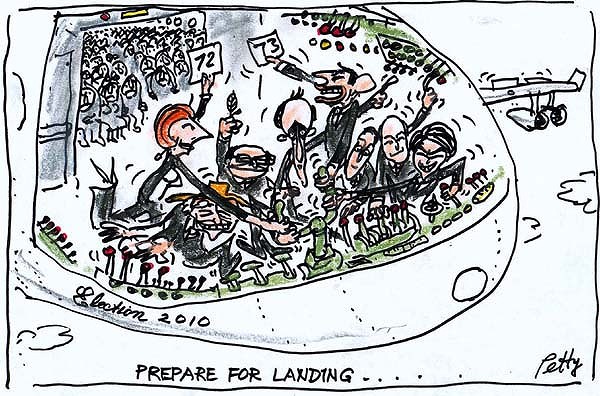
The three independents are different political voices in that they are talking about political process, public policy, discussing ideas and acting in terms of the public interest rather than politics being driven by short-term, poll-driven politics. Will the country Independents be able to reform Parliament enough so that it actually debates public policy instead of uttering the mind-numbing demonizing the other side as partisan slogans?
It's a long time since Question Time has been about genuinely holding ministers accountable, or even seeking genuine information about government policies. When has the Parliament acted as a genuine check and balance on the increasingly centralised exercise of executive power in Australia's political system?
Mark Bahnisch in Dawn of a new political era at the ABC's Unleashed says that:
We've seen 21st century politics finally wash over insular Australian shores... the tectonic plates of change have been moving at a slower pace, just as they have in America and Great Britain.We've entered the world of a new politics.
What is the new politics, now that majority politics as practised by both Labor and the Coalition has broken down? Bahnisch doesn't actually say, but implies it is the breakdown of two party politics and the emergence of coalition governments and The Greens. What does that political shift signify?
Here's one suggestion. Parliamentary reform. Both the Coalition and the Labor have acted to hollow-out Parliament with their tactics, and they have remained indifferent to what they have done. The lower house has become a rubber stamp for the executive of the incumbent party, the debates are gagged and the many 'Dorothy Dix's' make a mockery of the debating chamber. Both parties don't care that much about democracy, as they tell voters to get used to their schoolyard games and antics.
One aspect of the new politics is the need to reform Parliament so that it does actually function as space for diverse political interests to be heard; acts as the clearing house of public policy ideas, especially those long-term policy issues that includes climate change; functions as a check on the centralised exercise of executive power; addresses the "corruption" of electoral funding; and moves to the full public funding of elections.
Another aspect is the shift from the idea of a hung parliament between "us" and "them" to a multiparty democracy based on co-operation and coalition as well as adversarial confrontation. This shift would be resisted by both the rightwing factional leaders and strategists (Bitar and Arbib) behind Gillard and those behind Abbott. Their old game of politics is be one of attempting to just buy the Independents off with promises/policies/handouts; and to ensure that they become the government in the House of Representatives by running to an election as soon as they see an opportunity to rid themselves of the irritating independents.
Posted by Gary Sauer-Thompson at 9:57 AM | Comments (13) | TrackBack
August 22, 2010
towards a hung parliament
It may not happen, but it will be good if it does. A hung parliament, which means that neither major party deserves to govern, coupled to strong independents determined to change things for the better, may mean improved political governance. A hung House of Representatives and minor parties holding balance of power in senate should ensure greater check on executive power.
Though tougher times are coming to Australia, a hung parliament with strong independents, in the context of market failure of the self-regulating financial system and subsequent global recession, could result in a reform of the Australian parliament and an improvement in the functioning of our liberal democracy. We may even get better policy outcomes.
What has been disclosed by the result of the 2010 election is that the political establishment has been put on notice. The politicians have been placed on trial because citizens, in giving neither political party a majority of seats, have forced the politicians of different persuasions to start to talk to each other in fresh ways about how to govern the country.
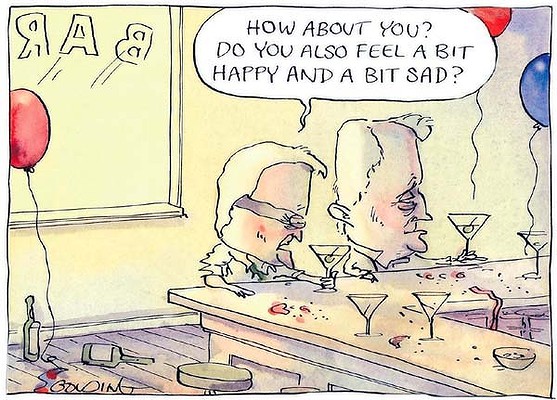
There is a general sense that the institutions of liberal democracy are antiquated, unrepresentative, and undemocratic. They are not working, and like Question Time, they have become an embarrassing farce that is celebrated as political theatre.
The game has changed, even if the rhetoric of the ALP, the Coalition and the mainstream media is about justifying the past, and they are still unwilling to look through the hung parliament window to what lies ahead.
No doubt we will hear talk of "stable and durable" government that will stand for the "national interest" and take the country in a "historic new direction" whilst the two major parties will continue to try to ensure the continuation of politics as usual. However, the election results indicate that we citizens no longer not trust either major party to form Government in their own right.
In a hung parliament situation the Independents have the power to start changing things. For instance, as Glenn Milne points out at The Drum:
The biggest problem for Abbott will be what to do about Labor's $43 billion National Broadband Network (NBN) rollout. Katter, Oakeshott and Windsor all want it and went out of their way on election night to point to the communications problems in their electorates. All three had to conduct phone interviews. There were no pictures available. In this case it was the absence of those pictures that was worth a thousand words.
Milne reminds us that Abbott is dependent on junking the $43 billion NBN plan to pay for his election promises:
The money is critical to any Coalition plan to bring the Budget back into surplus - a core economic election promise. But not only do Windsor, Katter and Oakeshott want regional broadband connectivity as part of any deal struck with the main parties, so too do the Greens' Adam Bandt and independent Andrew Wilkie in Tasmania, where the broadband rollout has already begun.
The political authority of the major parties has been undermined and both Abbott and Gillard know it.
Do they also know that citizens have delivered a hung parliament because they have ignored sections of the the electorate---the only way to interpret the Andrew Wilkie result in Dennison. Wilkie says that he is beholden to nothing else but the public interest in supporting stable, competent, ethical government; he's made a dig at Labor for taking Denison for granted for 23 years with a neglect of infrastructure; particularly roads; he's after a better deal for Hobart; says that many government pensions and payments had fallen behind the cost of living; and also mentioned issues of mental health, dental care funding and just funding for all schools.
Posted by Gary Sauer-Thompson at 9:52 AM | Comments (23) | TrackBack
August 21, 2010
Election Day
To the ballot boxes we go today after a boring and inane campaign. I've gone for green rather than red or blue. My priority is a Green Senate to ensure a check on executive power, then Labor in the House of Representatives because the national broadband network represents the future. I voted Liberal over Labor in the Senate to block the mandatory internet filter, as this is the religious right's form of censorship.
Though negativity ruled the campaign, the polls say that The Greens are riding a wave to the Senate, whilst the Liberals will struggle to gain the 17 seats they need to bring back the Howard years, and return us to the glory days of peace, security and prosperity through savage budget cuts.
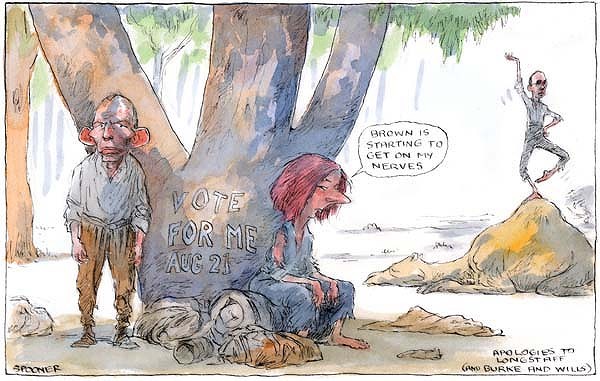
In the National Times Lenore Taylor says that this election campaign:
has been a showdown between major parties, neither of which had many broad policy offerings, neither of which had a cohesive vision and a full suite of policies, and both of which have been running an essentially negative message. It has been a fascinating, rollicking, roller-coaster ride of photo opportunities, without most of the substantive bits that are supposed to come in between.
A fascinating, rollicking, roller-coaster ride of photo opportunities? Spare me the media spin. Maybe the analysis of the electoral strategy and branding would be fascinating, but we need to go deeper than photo opportunities to the marketing strategy itself.
What was fascinating during the campaign was the political humour: not the political satire of the Chaser's Yes We Canberra, but the edgy humour of Gruen Nation that critically examined the branding strategies of four political parties.
Of course, this focus on branding and marketing says nothing about what is happening amongst citizens: how they feel about Australian democracy; the capacity of the political parties to deliver reform and good government; and whether they are happy with politics -as-usual.
Update
I'm watching the ABC's coverage of the election results at home whilst keeping an eye on Twitter for inside information. There's little coming.
As the results roll in, the shift away from the ALP is evident in Queensland and NSW, and it increasingly looks as if the ALP was unable to contain or sandbag its marginal seats. The Rann strategy, which was successful in SA, has not worked. There is evidence of a geographical split: Tasmania, SA and Victoria are now solid red states whilst Queensland and WA are the blue states.
It is also increasingly evident that neither the ALP or the Coalition will gain a majority tonight, that the Greens have finally arrived as a third force, and Senator Fielding is now in the dustbin of history.
The result, with an emergence of the Independents and a Green Senate, suggests a deep disenchantment with both the major political parties. I doubt that they will see it this way. The ALP will talk about its mistakes whilst the ALP diehards will snark about The Greens. The Coalition will celebrate a historic victory.
Posted by Gary Sauer-Thompson at 11:20 AM | Comments (23) | TrackBack
August 20, 2010
politics-as-usual
The 2010 election is almost over. The newspapers are coming out with their latest opinion polls, the horse race commentators are making their final call, all the politicians are saying that it is too close to call, and the analysts are saying which marginal seats will be won and lost.
Now is a good time to think about filling the vacuum with what has been noticeably missing-----good progressive policy ideas. We sure need these, especially with a ‘quarry economy’, peak oil and climate change. Empowered as consumers yet disenfranchised as citizens, we confront an ALP that has been hollowed out by the apparatchiks to become a technocratic shell that is unable to deal with substantive policy issues in an effective manner.
The excellent Centre for Policy Development has published an e-book entitled More than Luck: Ideas Australia Needs. The Introduction says:
A stasis has settled over government and opposition in Australia. We need to change the game....the present stasis isn’t simply the product of the people at the top of the political food chain. The current Labor government is a symptom of a broader political system that no longer seems to know or care what issues are important, even crucial, let alone how to begin to address them. A system bogged down in its own cultures...Is...the media... caught up in the logic of old politics which necessitates a straightforward political and popularity contest and an electorate driven by the hip-pocket, and is unable to canvas a more complex narrative? It often seems as if our major parties don’t trust voters to look beyond narrow self-interest – even when opinion polls and research groups tell them otherwise. Rather than focus on what politicians can do to improve people’s lives, the media focuses on personalities. Politics is usually reported as if it were a horse race. Journalism lives for the leadership contest and little else.
The result is that the political world is locked between two mirrors – whichever direction it looks in, it sees infinite images of itself reflected back with less and less clarity. It's akin to living in a fish bowl.
It's hard to disagree with that, isn't it. Has the Canberra Press Gallery started to lift its game as a result of criticism? The Introduction continues:
To begin to map out a new political agenda for Australia requires at least two things. First, we need a conceptual framework in which to think through what is new about the world we live in and what that means. Second, we need to identify and strategise our way around obstacles to change..... If we are to do more than merely rely on luck, we need a viable, hopeful narrative about the future...As many of the old standards of modern life lose their viability — the established print media, abundant fossil fuels, unconstrained economic growth, the availability of an endless environmental sink for pollution by the ‘externalities’ of industrial production — so we need to rethink our conceptual maps and write the story of our new political and economic future.
Again it is hard to a disagree with that. My gut feeling is that we won't get a conceptual framework in which to think through what is new about the world we live in and what that means from the Canberra Press Gallery or from the "politics is everything" apparatchiks in the ALP.
Posted by Gary Sauer-Thompson at 9:43 AM | Comments (4) | TrackBack
August 19, 2010
an uneasy Australia?
The 2010 federal election is not characterized by big reform promises from the political parties, or the leaders of our political parties providing a vision for the future. As the boring election campaign draws to a close we can look back and ask: 'what has the election been about beyond the advertising, spin, manufactured images and the cautious policy announcements targeted to marginal electorates'? Can we discern what Australian citizens are concerned about?
In The west can see its future on planet Australia in the Financial Times John McTernan, a political secretary to Tony Blair and a thinker-in-residence for the Australian state of Victoria, identifies the three main issues of the 2010 federal election. These are climate change; an underlying anxiety about threats to Australia’s living standards, expressed most prominently through concerns about migration; and an underlying unease about Australia’s place in the world.
McTernan sums up the 2010 federal election thus:
Whoever wins on Saturday, these issues at first seem very Australian pre-occupations. But they represent a toxic and introspective political mix. The desire to enjoy growth while defending our lifestyles against outsiders, accepting climate change intellectually while rejecting its implications for our behaviour, and a nagging concern about the rise of China – all are issues which will quickly move up the agenda in Europe and North America. Eventually what’s going on down under could turn our world upside down too.
McTernan gives us a very different perspective to the standard business one one of poor infrastructure planning, insufficient investment in transport and ports, schools and hospitals, and water and sewerage systems. Or the economist's concerns about low productivity growth since 2002.
Or the terrors of debt or the horrors of government waste of the fiscal hawks. Or the tech head's national fibre-to-the-home broadband network, even though investment in broadband has become a significant issue in a national election campaign and, as such, is an indicator of just how important broadband is becoming in our lives.
In some ways McTernan's three issues have been expressed in the debate over a Big Australia, especially in the concerns over Australia needing to become more sustainable. However, these concerns have been pushed aside by the proponents of Big Australia, who advocate increased population and high rates of economic growth, disparage their opponents as little Australians, and launch attack after attack on the Greens.
Posted by Gary Sauer-Thompson at 9:26 AM | Comments (15) | TrackBack
August 18, 2010
reverse momentum in Canberra
In Don't blame Latham for highlighting home truths in the National Times Peter Costello says that the Labor base is drifting away because it does not see this as a successful government:
Labor's primary vote is at 38 per cent. Last election it was 43.3 per cent. About 700,000 voters have left in three years. If Labor is re-elected, it will be on Green preferences. In fact the election is being fought between two coalitions - the Liberal-National one and the Labor-Green one. The Greens will deliver more votes to their coalition partners than the Nationals will to theirs.
There is is, he adds , a wider disillusion with Labor, which Mark Latham puts it down to stage-managed campaigns and "spin", eg., the way Gillard is being manufactured for the campaign. What Costello fails to mention is that the Coalition also engages in stage-managed campaigns and "spin", eg., the way Abbott is being manufactured for the campaign.
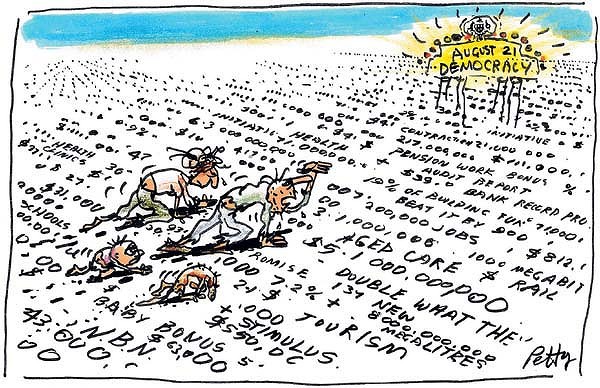
Though Costello's main point stands--- the election is being fought between two coalitions - the Liberal-National one and the Labor-Green one, and the Greens will deliver more votes to their coalition partners than the Nationals will to theirs--- he doesn't mention the lack of action on climate change. Yet the decline in Labor's fortunes began with the abandonment of the ETS.
Costello doesn't address the core issue that both the Coalition and Labor have turned away from the path to a greener economy, nor the unpopularity of their limited climate policies. As Adam Morton highlights in Sorry state of play when China leaves us for dead on climate in the National Times an:
emissions trading has been abandoned by one party and delayed by the other. Neither can guarantee they will meet even the minimum national target of a 5 per cent cut below 2000 levels by 2020. The plummet to the bottom on climate during this election campaign has only further highlighted how far Australia has fallen behind.While Prime Minister Julia Gillard talks about record levels of investment in renewable energy, she has cut hundreds of millions of dollars from solar programs - Labor had more money committed to ''harness the wind and the sun'' before she became leader. The Coalition has promised similar cuts.
Neither Gillard nor Abbott shows much sign of understanding the risks of climate change, let alone the opportunities that come with moving early. Neither understand that the crucial first step to decarbonising the economy is to curtail the current coal burning binge. Only The Greens understand.
Under both major parties Australia’s greenhouse pollution will increase, even though there is general support amongst citizens for action on climate change to reduce Australia's emissions. They major parties could stop supporting the new coal mines and coal-fired powered stations.
What does that kind of lack of action, and the gap between the political parties and citizens, mean for Australian democracy? Can we still see the ALP as a vehicle for making a genuinely better society one that attacks poverty and inequality as well as an unsustainable economy? I have my doubts. I'm sceptical.
Will we begin to see the Australian political system being placed on the table as an issue, and a debate about Australia's democratic deficit staring up?
Posted by Gary Sauer-Thompson at 1:41 PM | Comments (14) | TrackBack
August 17, 2010
T. Abbott on Q+A
I watched Tony Abbott on the ABC's Q+ A last night. I was curious as to what he would, as a conservative, say on the welfare state and on Australia's digital futures. This was my criteria of judgment.
Though Abbott put in a professional, workman like performance as a compassionate conservative, the audience did not warm to him, as happened with Julie Gillard in the previous Q + A. Part of the problem was Abbott's ignorance, especially in his response to a national broadband network. He acknowledged that broadband services are going to be incredibly important for our future. So he has stepped outside his conservative base with its traditional social values, dislike of change, its risk averse approach to life and like to follow rules and the path most travelled.
Having rejected the stance of the digital laggards Abbott then said wireless would be do the job required:
I think, though, that the best result is much more likely to be achieved by competitive markets than by a government monopoly and, sure, high speed fibre is very, very important but most of the people who you see making use of these services at the moment are doing it via wireless technology. I mean, all of the people who are using their Blackberry's or their iPhones for Facebook. All of the people who are sitting in cafes and hotel rooms doing their work, they're all using wireless technology and we shouldn't assume that the only way of the future is high speed cable.
This is true. It works when we are "on the road" with our laptops and smart phones. What wireless supports is low bandwidth associated with mobility. In this case mobility is traded off against bandwidth.
But we also have homes with multiple users and in this location wireless is limited in terms of its functionality and speed. It is at this point that realize that wireless ends up running into capacity constraints due to a lack of spectrum, and the large downloads make broadband prohibitively expensive for most people.
Abbott's response to this digital faultline is that:
I'm not sure that we should assume that just because wireless is today slower than fibre cable that it's always going to be slower than fibre cable and even if we could get 100 megabits or more here our speeds are still limited by the connectivity of the sites that we're using and apparently some 70 per cent of the sites that Australian's use are hosted overseas, so they're dependent upon more than just our own broadband.
The overseas cable link is a problem. But I thought that a high-speed underwater fibre cable capable of carrying Australian internet traffic overseas at speeds of more than a terabit per second is in the process of being built by Pacnet and Pacific Fibre. Presumably more such cables will be built by the market as the demand rises from those using the national broadband network.
Geoff Huston, an expert in internet architectures at APNIC, has said that it was extremely challenging to "get high speed data through the air" and the limited availability of wireless spectrum meant we would fast run into capacity problems.
What's going to happen with wireless is that as we crowd it, only those with the deepest pockets will be able to afford it, so rather than being a communications medium for everyone, it becomes only a medium for the few who can afford to pay.For the same $50 a month that people pay for a couple of gigabytes of wireless, they can get 10-20 times that amount of data down the wire - wireless has its role but it also attracts a premium price.
I cannot afford to do my weblogs (research and uploading) and my photography (downloading and uploading) on wireless on a daily basis in Adelaide. I rely on ADSL2+ and I can just manage my work with it.
All the focus in Q + A was on the technology (speed+ technological development) rather than on content and enabling more Australians to use it, more creatively and on fostering research and applications in user-led innovation for the creative industries. Abbot's limitations were apparent when he failed to to link e-health developments to the National Broadband Network (NBN). He did not seem to realize that early diagnosis and after-treatment patient monitoring are two areas where significant synergies may be found using applications provided to users at home.
At no time did Abbott mention the emergence of a knowledge based digital economy implies an economy where the benefits of digitisation, and in particular the internet, become part of most if not all areas of economic activity. He had no idea of Australia as a leading knowledge based digital economy in the 21st century based on innovation, creativity and education in digital skills and literacy.
Posted by Gary Sauer-Thompson at 11:38 AM | Comments (16) | TrackBack
August 16, 2010
austerity is prosperity
In an op-ed in The Australian entitled ALP's knight is a thief in rusty armour the economic historian Niall Ferguson challenges Labor's economic narrative that the Keynesian style fiscal stimulus injected by the Rudd Labor government saved Australia from a much more serious recession.
In doing so he is challenging Labors claims about its good economic management:

Australia has dodged a global economic crisis and it has emerged with low unemployment, inflation under control and interest rates still well below their historical levels. Ferguson's argument is that there are more plausible explanations for Australia's relative out performance of the other western governments during the global downturn or recession arising from the global economic crisis. This is the core of his case.
How plausible is it?
Ferguson's explanation for this is:
Step forward five candidates with a better claim to the credit: 1. Lady Luck 2. The Howard government 3. The RBA 4. China 5. The mining industry...Stimulus? Yes, sure, Labor has stimulated the Australian economy, in the same way that Ned Kelly used to stimulate the economy of Victoria.
Sure, these are factors but they need to be weighted along with the fiscal stimulus. Monetary policy, for instance, would not have delivered even the limited recovery we have had on its own.
What is denied by this account as Tim Colebatch points out in the National Times is that:
Because private sector activity collapsed. In the non-residential sector - excluding education - approvals halved from $28 billion in 2007-08 to $14 billion in 2009-10. Bank lending to business has shrunk by $87 billion, or 11 per cent - and for many companies there are no other lending sources.Think about that. Even now, there are 150,000 more Australians out of work and 180,000 more working shorter time than before the crisis. Growth is sluggish, and GDP per head remains less than two years ago. Ask yourself: what would Australia be like now had the government not pumped all that money into new construction?
The stimulus kept the industry going. In the March quarter, 38 per cent of work on non-residential buildings was on schools and the like, up from 5 per cent before the crisis. Work also began on 4259 public housing units, more than they normally build in a year.
Ferguson is advocating “counterfactuals”---the study of alternative historical outcomes based on “what if” scenarios. What is implied is a counterfactual argument that a conservative fiscal policy on the part of the Australian government to fight the recession would have had beneficial results.
Ferguson sees the Labor Government as clinging to their dog-eared copies of John Maynard Keynes's General Theory to justify their profligacy. Ferguson, in other words, is a deficit hawk who would argue that the biggest problem with Australian fiscal policy is that, under Labor there is simply no plan to return to fiscal stability.
Deficits cannot continue indefinitely and this is acknowledged by Labor. Secondly, there is an international debate over fiscal tightening. Thirdly, in this austerity versus stimulus debate the deficit hawks, such as Jean-Claude Trichet the president of the European Central Bank acknowledge that western economies:
are emerging from the worst economic crisis since the second world war, and without the swift and appropriate action of central banks and a very significant contribution from fiscal policies, we would have experienced a major depression. But now is the time to restore fiscal sustainability. The fiscal deterioration we are experiencing is unprecedented in magnitude and geographical scope.
The growth of public debt has been driven by three phenomena: a dramatic diminishing of tax receipts due to the recession; an increase in spending, including a pro-active stimulus to combat the recession; and additional measures to prevent the collapse of the financial sector.
Ferguson acknowledges that governments were facing the collapse of the financial sector but questions the Keynesian prescription of government deficit spending. A question we need to ask the deficit hawks is: "how would the Rudd Government's balancing their budget, as many conservatives demanded, have had little effect on activity, and even produced beneficial results? What is Ferguson's argument?
The general answer is that austerity is not bad news for business for much of what is being planned by the Coalition attacks waste in the public sector; it is the bloated public sector that the Labor Party allowed to expand is going to feel most of the pain. That is going to reduce the burden that the private sector has to bear in terms of taxation. This is good austerity---if you want business confidence to bounce back do some radical things that send the kind of signal that the Thatcher government and the Reagan government sent to business in the early 1980s.
Ferguson's argument is that the private sector (think mining) would have borrowed and spent as if no crisis at all had happened. In other words, a massive fiscal tightening would actually expand the economy. Private enterprise does the trick. Oh yeah. This is akin to magic thinking. The construction industry in the eastern states (SA, Victoria, NSW) would have deflated and there would have been a big rise in unemployment.
I suspect the more important issue is the longer term economic sustainability of keeping growth going. The international situation is sobering. We a have entered a world of interminable fiscal deficits, increased government debt reduced effective demand, and downward pressure on prices. This suggests long-term deflation, which is what debt-heavy Japan has experienced. Indeed, the future that many countries face may well be unfolding before our eyes in Japan today.
Posted by Gary Sauer-Thompson at 12:32 PM | Comments (10) | TrackBack
August 15, 2010
listening to the past?
An English cartoon about the conservative heritage---but Margaret Thatcher is a touchstone for Australian conservative ideologues and their dislike of ghastly foreigners. Gillard Labor's "moving forward", was designed to suggest that the Coalition's politics and morality are regressive, misogynist and a little too religious.

The starting point of the Coalition conservatives in this election is private sector good, public sector bad. The right simply cannot abide publicly funded institutions, even ones that manifestly contribute to Britain’s social, economic and cultural welfare. If it’s funded by taxation, they start from the assumption that something is profoundly wrong.
The Coalition have also returned to Treasury think circa 1920: namely the notion that public spending is crowding out private investment, and that if public spending is cut the private sector will rush to take up the slack.
Tony Abbott doesn't talk about David Cameron's big society versus a 'big state.' There is no mention of Edmund Burke's 'little platoons', and they run a mile from the republican tradition's emphasis on civic engagement and bottom up democracy. Its more about welfare reform (reducing welfare dependency) and more for stay-at-home mums.
What the Conservatives share with Labor is getting back as quickly as possible to business -as-usual: short-term policy wonkery that takes us to the golden future of ever-rising material prosperity, fuelling and fuelled by ever-rising consumption, both public and private. The world for both of them is one of more and more growth, affluence, materialism, consumerism.
Gillard Labor has increasingly sounded like the Coalition on asylum seekers and education whilst its commitment to its reform tradition of Chifley, Whitlam, Hawke and Keating does sound hollow , given the way that focus groups, polling data and stage-managed pragmatism are now centre stage.
Update
In Just a lot of hot air in The Age Waleed Aly questions Labor's appetite for reform:
The accidental magic of ''moving forward'' is that it simultaneously captures the spirit of Labor's past and its present. It summarises Labor's reforming tradition, and its present timidity. Much like Labor's reforming zeal, the slogan is now an empty shell.There is something odd about this. Today, it seems the Coalition is the more ideologically driven force. It is the team more likely to adopt unpopular reform positions, then argue relentlessly for them until it gets its way
He adds that perhaps the question is not: is Labor still reformist? Perhaps it is: how can it be? How does one implement reform when cyberspace and digital or cable television is ready to pounce on even the slightest mould-breaking thought?
Posted by Gary Sauer-Thompson at 11:56 PM | Comments (6) | TrackBack
August 13, 2010
'horse race' journalism
The normal way to cover an election is to cover campaign strategy, attack ads, candidate gaffes and poll numbers. Political journalism during an election campaign is limited to the day-to-day reporting of events in the campaign. The journalists highlight the cut and thrust of what the leaders are up to all day, and who is winning in terms of getting the best exposure in the media headlines. This construct is what we call news, which is then commented upon. The increasing reference to The Greens is what is new.
Ben Eltham in The longing for engagement at the ABC's The Drum says that:
The lack of attention to serious policy issues seems to have been one of the most common complaints about the 2010 federal election. Voters seem apathetic, the media cynical, politicians clueless. Above all, the dominant theme seems to be disengagement: between politicians and voters, between politicians and the media, and between the media and voters...No wonder, then, that the best election coverage of this campaign is to be found on an advertising show: the ABC1's Gruen Nation. When substantive policies are thin on the ground, when great moral challenges are cause for delay and procrastination, and when even the audience at a campaign debate can be accused of being biased, it's not surprising that the most insightful political analysis comes from a panel of ad-men.
My sentiments too. However, Eltham doesn't explore how the media is integrated into the stage-managed and media-centric nature of modern election campaigning in a televisual and multi-mediated society that has emerged during a protracted crisis of social democracy.
It's integration can be seen in what Jay Rosen of Pressthink who is in Australia for the Walkley Media Conference 2010, calls horse race journalism. He says:
Horse race journalism is a reusable model for how to do campaign coverage in which you focus on who's going to win rather than what the country needs to settle by electing a prime minister.And it's easy to do because you can kind of reuse it sort of like a Christmas tree every year and it requires almost no knowledge either. And it kind of imagines the campaign as a sporting event, right? And everything that happens in the campaign can potentially affect the outcome. And so you can look at it as 'How is it going to affect the horse race?' And every day you can ask, 'Who is ahead and what is their strategy?' And I think this perspective appeals to political reporters because it kind of puts them on the inside, looking at the campaign the way the operatives do. By the way, I'm told that you actually have a program here on Sunday morning called the Insiders.
Touche. The 'insiders' are the journalists who see themselves the chroniclers of the inside game and tell us from the point of view of the professional strategists who's doing better.
Rosen says that an alternative model of journalism:
might start with 'What do the people of Australia want this campaign to be about? What are the issues they want to see the candidates discussing?'And then to ask each day, 'Well how did we do on advancing the discussion of the citizens' agenda today?' Was it ignored? Was it addressed? Was it demagogued? Was it slighted? And if the journalists helped citizens get their agenda addressed during the campaign they would be performing something that's actually very important - a role that's very important for them to do.
This kind of journalism is definitely not done by the Canberra Press Gallery or by the traveling political journalists embedded in the political parties campaign.
A good example of the citizen's agenda population pressures and the state of our cities which the politicians reduce to immigration that surfaced on Q+A as a result of Dick Smith's Population Puzzle documentary. (You can watch it on iView). Few who practice the craft of journalism are looking at the election from the perspective of a better quality of life in our cities; the urban sprawl that is gobbling up valuable farmland; or the sustainability of our cities.
Instead of this we get horse race journalism based on the journalist with contacts eg., Glenn Milne being told information from inside a political campaign. These inside sources are authoritative and this supports said journalists claim that they have special insight into the political process that the rest of us don't have. That insight into the political party's strategy means that they can predict what happens next. That is why they are the classy professionals they are.
Rosen says that the practical strengths of horse race journalism are:
Who's-gonna-win is portable, reusable from cycle to cycle, and easily learned by newcomers to the press pack. Journalists believe it brings readers to the page and eyeballs to the screen. It "works" regardless of who the candidates are, or where the nation is in historical time. No expertise is actually needed to operate it.bIn that sense, it is economical.....Who's going to win -- and what's their strategy -- plays well on television, because it generates an endless series of puzzles toward which journalists can gesture as they display their savviness, which is the unofficial religion of the mainstream press. But the biggest advantage of horse-race journalism is that it permits reporters and pundits to "play up their detachment." Focusing on the race advertises the political innocence of the press because "who's gonna win?" is not an ideological question. By asking it you reaffirm that yours is not an ideological profession.
They identify with the strategists for a political campaign and their focus of whose going to win rather than policy debates, even though campaign tactics are not all that interesting in themselves. They see getting into policy as getting into what the Americans call the weeds.
Posted by Gary Sauer-Thompson at 12:30 AM | Comments (15) | TrackBack
August 12, 2010
due credit to T. Abbott
Much to my surprise Tony Abbott has done an excellent job in enabling the Coalition to unify the conservative base (with climate change and boats of refugees) have a fighting chance in this election. The tactics of negation to gain support in the middle of the electoral ground have worked a charm in both spooking Labor, and achieving a shift in the primary vote. All credit to Abbott, despite the scrambling campaigning by Labor.
This has placed the Coalition in the lead at the primary vote level:
Abbott's public image has been remoulded so that he now looks safe, sensible, and a man of the people. That is some turnaround from the "madmonk" by the image makers and Liberal powerbrokers. Is the Coalition ready to govern?
The consensus is that this federal election is similar to what happened in the recent elections in South Australia. In that state the published opinion polls showed a big a swing against Rann Labor. However, when the votes were in Labor retained government in Adelaide, primarily because the Coalition were out-campaigned in the marginals by Labor.
No doubt Labor strategists are sandbagging Labor's marginals in both NSW and Queensland and appealing like crazy to the undecideds in these marginals. Has Abbott made inroads into middle ground here? It seems so. If so how much is the swing in the marghinals? I have no idea. What is happening in the marginals is a black box for me and the media are of little help.
I cannot see that the Coalition strategy of just opposing something Labor has done will do the trick. "End the waste, pay back the debt, stop the big new taxes, and stop the boats" has been the mantra, and it only gets you so far. They are light on real action on policy to take them the next step. I doubt that it can be done by appealing to prejudice, fluff and deception. They need more good policies--like their mental health and and paid parental leave.
Their real action on water is money for irrigators to improve their infrastructure (they are not expected to do it for themselves) with most of the benefits from the efficiency savings going to irrigators. Real action on broadband takes us back to the 20th century. Apart from that what?
We cannot expect much information from the media on what is happening in the marginals. As Michael Gawenda says in One night in Rooty Hill won't kill you in Business Spectator about the journalism of those reporters who are travelling with the leaders:
These reporters are captives, embedded. They do not know, from hour to hour, sometimes from minute to minute, where they are going. They do not know where they will be spending the night. They do not know when they will be asked to be ready to get on the bus for a trip to a place unknown to them. When they are on planes, they do not know, literally, where they will land.What sort of reporting, beyond reporting of the moment, can they be expected to produce? It is hard to see how this reporting could be considered interesting or informative, apart from the unplanned dramatic eruptions – the leaks by the Labor rat, Rudd’s gall bladder problem, his campaign interventions, Latham’s menacing bullying of Gillard.
These reporters are helpless to do much more than go along for the ride, accept the rules of this game and in the main, settle for reporting nothing much of consequence.
Gawenda adds that most election campaigns make virtually no difference to the outcome; the polls at the start of the campaign are usually pretty accurate predictors of the result;and that what is happening in the marginals is a mystery. This is because the mainstream media does not have the resources to cover the local campaigns being waged in these seats in a meaningful way.
Posted by Gary Sauer-Thompson at 11:00 AM | Comments (17) | TrackBack
August 11, 2010
South Australia: the deficit hawks
I have mentioned the conservative deficit hawks before---in this post on the new austerity and election scripts + mantras who denounce and decry the government’s “irresponsible” and “unsustainable” fiscal policy.
These neo-liberals defend the proposition that they don’t want to have government intervention in economic affairs unless it benefits them. They preach austerity as the solution to recession. The way to prosperity is through austerity by scaling back social spending in order to “stabilize” economies by a balanced budget. This is to be achieved by impoverishing labour, slashing wages, and reducing social spending.
A wave of fiscal austerity is rushing over in South Australia. The deficit hawks are well and truly in control. The Rann Labor Government has set up a Sustainable Budget Commission to assist the Labor Government to move the State’s finances back to a sustainable position following the global financial crisis in order to maintain the state's AAA credit rating.
At that time the State Government was expecting a sharp decline in tax revenue as a result of the Global Financial Crisis (GFC), but since then the fears about a major hit to budget revenues have been replaced by forecasts of growth rather than decline.
The State Government's 'Sustainable Budget Commission' has been operating on the assumption that revenue to the State Budget will decline by around $3.8 billion over the next four years. The rationale for the budget cuts is this:
The global financial and economic downturn has helped push South Australia’s budget and financial position into a potentially unsustainable position, in the absence of corrective action.This is temporary. Ratings agencies recognise this. For now, the State retains its triple-A credit rating.Economic recovery will help restore the State’s finances. But more is needed.The Government has announced a savings target to restore financial sustainability.The Commission’s role is to advise the Government how it can achieve that savings target.Sustainable Government finances are important. South Australia would be a less attractive investment destination without them. Weaker economic and employment growth would be the result.Unsustainable Government finances also ‘cost’ South Australians in the form of higher taxes and less services (eg, for health and education).
The Government's immediate priority is to rein in spending and balance the books after successive deficits. The figure publicly mentioned is $750 from the public sector, which means 1600 jobs. The indications are that the cuts will be much deeper, despite a windfall in GST revenues from the Commonwealth. That means more jobs gone.
SA Health faces a cut of $450 million that is expected to eliminate 4,000 jobs which will will affect hospital and out-of-hospital clinical services; up up to 800 Justice Department jobs are expected to go.
The September budget cuts don't add up, and so the global financial crisis is being used as a rationale to slash and burn. You create an artificial financial or budget crisis, then come in and “save” the situation. Creating jobs is out, inflicting pain is in. Condemning deficits and refusing to help a still-struggling economy in the name of fiscal orthodoxy by neo-liberals posing as hardheaded realists, doing what has to be done.
The argument is that markets are demanding austerity and social justice has to go. That hurts, but it is for a necessary purpose. If we don't do it, the bond markets will downgrade our debt and we will be even worse off. Only austerity can hold off the prospect of a debt crisis, even if that means increased unemployment reduced public services, their schools and hospitals being chronically underfunded.
The implication is that basic government functions — essential services that have been provided for generations — are no longer affordable. The antigovernment campaign to roll back the welfare state has always been phrased in terms of opposition to waste and fraud — in SA today it is the vast armies of bureaucrats uselessly pushing paper around. Nationally it is government waste.
What is rejected by Rann Labor is that when consumer spending collapses in a major recession governments need to borrow and spend to prevent a depression -- and then pay off the debt from the proceeds of growth once we have brought the good times back.
Posted by Gary Sauer-Thompson at 11:57 AM | Comments (6) | TrackBack
August 10, 2010
Coalition going backwards on NBN
There are substantive policy policy differences in this election and the national broadband network is one example. The Coalition's recently announced telecommunications policy explicitly rejects the national broadband network, which which they have labelled “reckless” and a “white elephant”.

Why it has chosen to fight the National Broadband Network as a major election issue is beyond me. In its place the Coalition's cheaper broadband plan ($6.25 billion) composes four separate aspects, and makes wireless technology the centre of its "affordable" broadband strategy.
* $2.75 billion of public funding and an additional $750 million private funding on building an open access, optical fibre backhaul network
* $750 million on “fixed broadband optimisation” with a focus on upgrading telephone exchanges without existing ADSL2+ capabilities
* $1 billion public grant funding and additional, undisclosed private funding for building a wireless network for rural and regional area
* $1 billion on building a metropolitan wireless network focused on outer metropolitan areas
So it basically stays with what we've got now in the cities (ADSL on the old copper wire +hybrid-fibre coaxial [HFC] cable networks); wireless to the outer suburbs; and gives regional Australia the old Opel network that would bring a wireless system to Australia.
This pre-NBN network would result in the reinforcement of the current digital divide. It's cheaper and much much slower--a minimum of 12 megabits per second compared to speeds of 100Mbps. Only those premises connected to he hybrid-fibre coaxial (HFC) cable networks in the capital cities would get 100Mbps.
This is a return to the past, since the Coalition opposes the structural separation of Telstra and so would allow, by default, Telstra to regain market dominance once more--- a dominant Telstra means that it isable to influence both how quickly rather slow broadband is delivered, and its price. Leaving Telstra and its copper network intact, with all the access concerns that accompany it for Telstra's competitors and the ACCC, means a return to Telstra’s aggressive monopolistic behaviour.
This resulted in Australia falling significantly behind in the international race to provide affordable high-speed broadband. Entrenching the incumbent is how the Coalition's claim that, harnessing the entrepreneurial drive of the private sector, and unleashing competition through the private sector deployment of broadband across arrange of technologies, for national benefit would work out in practice. The Opposition's plan of leaving it up to the market to decide what the last mile will be means leaving it up to Telstra which simply is not going to happen.
The current mess is what the national broadband network was designed to overcome. Fibre, not Telstra's copper network, needs to be a central element in any credible national broadband plan that is supplemented by rapidly growing mobile broadband. The global economy of the future would increasingly be digital and the productivity of our nation in that economy will be one of the major determinants of our prosperity and that requires a national investment in ubiquitous high-speed digital infrastructure that would support smart electricity grids, electronic-health and the digital education revolution.
Posted by Gary Sauer-Thompson at 3:19 PM | Comments (33) | TrackBack
water politics in a neo-liberal world
If politics in a neo-liberal world has become a manufactured reality little different from a reality TV show, then we citizens in a democracy do have to be sceptical of politician's promises. Our experience of politics is of a simulation of reality.
In this world that is ours the advertising slogan has become reality. The simulacrum ("likeness or similarity") is no longer a copy of the real, but becomes truth in its own right: what Jean Baudrillard termed the hyperreal. In this manufactured world of surfaces the carefully manufactured image is reality.
The Advertiser is reporting that the ALP is making a commitment to buying back all the water required to save the River Murray. Gillard says:
We anticipate that by the time the Murray-Darling Basin plan comes into effect (in 2014) federal Labor's buybacks and infrastructure investment will have already delivered much of what the rivers will require to be sustainable. If re-elected, we will bridge any remaining gap between what has been returned and what is required to be sustainable. A Labor government will do this by continuing to buy back water each year beyond 2014 until it had returned all the water the Murray-Darling Basin Authority determined the rivers needed in the final basin plan, due next year. Any buybacks will be subject to the availability of water for purchase from willing sellers. Now, farmers can move forward with confidence knowing they will have options to sell their entitlements when the basin plan comes into force.
The promise or the slogan is the reality. The promise is being made in Adelaide for SA and it is composed of references with no referents.
Remember the narrative of resistance to buyback: a 4% cap trading cap imposed by Victoria until 2019, and the intense resistance from Big Ag to any form of water buyback. In this narrative the dominant, politically powerful groups used language to obscure rather than reveal reality.
There are no figures, no targets. If If there is a reference it is to the basin plan which is not even the release. This plan is just another sign that has no referent. What we have is an election slogan, the ALP positioning its brand in the SA market. For the ALP the simulacrum is never that which conceals the truth --it is the truth which conceals that there is none. The simulacrum or promise is what is true.
The substantive problem--ie., the referent--- is that the drying out of the southern part of the Murray-Darling Basin is due to global warming party caused by greenhouse gas emissions from coal fired power station. Since the ALP is doing very little to address global warming with some form of pricing on carbon (a carbon tax or an emissions trading scheme) the basin will continue to dry out, as will our rivers. This referent is never mentioned in this content by the ALP --only the Greens are willing to do so.
Posted by Gary Sauer-Thompson at 10:07 AM | Comments (16) | TrackBack
August 9, 2010
a soap opera
Everybody has been hanging during the election campaign out waiting for that unscripted moment of excess that bursts the boundaries of the tightly controlled election campaigning, with its set pieces, talking points, controlled glossy appearances and media commentary concerned with the candy floss surfaces and the the repetition compulsion of politics as soap opera.
An excess in the form of a touch of wildness that ruptures the surfaces and shows the tensions and seething passion that indicated the political unconscious of politics. This tension threatens politics as soap opera and by exceeding it, pushes politics beyond itself thereby opening politics up.
Bill Leak has made a couple of attempts at representing a transgressive excess to a politics as a carefully manufactured marketing reality. He highlights the madness and violence that gestures towards sacrifice as a central social gesture:
 Bill Leak
The postmodern moment of excess for me is Mark Latham's stage managed intervention as a journalist for Channel Nine. Insignificant in itself, that moment of physicality or bodily intrusion has opened up the expression of the fear and loathing of politics for us to see.
We need to historicize the narrative constructed around Latham, because Latham is a creative/destructive energy force in Australian politics. The texts about Latham and his outrage to common sense come to us as already read and interpretation weaves between previous interpretations in the public sphere. This narrative is one in which the Canberra Press Gallery has little love for Latham after he bagged them in Latham's Diaries.
Latham called Laurie Oaks (Jabba) a kindergarten commentator whose primary role as a conservative commentator was to bag the ALP on Channel Nine for Kerry Packer. His criticism was that Oakes was a Packer company man who was the most biased television reporter in favour of John Howard. Latham also exposed how Rudd ( 'Heavy Kevvie' ) consistently used Oakes as a feed when the ALP was in opposition during the Howard regime.
What Latham highlighted in the Diaries, which were part of a larger body of work, was a cracking open of an inner sanctum of the political realm to revel that the Australian political system has been reduced to falsity, treachery and showmanship - and that the media interface between that system and the Australian people, supposed to serve each of those, is even worse. The response from those in the politics/media club was that Latham was merely unloaded his bile from the bitterment of losing the election.
Their revenge narrative is that Latham had lost it (afflicted by the violence of madness), and the Canberra Club's strategy has been to demonise Latham. Oakes, for instance, in his review of Latham's Diaries used descriptions such as "poisonous," "bucket of bile," "weird and ugly mind," and "vulgarity" and "horrible". Peter Hartcher in the Sydney Morning Herald describes The Latham Diaries as the most vicious piece of political filth and sociopathic slander ever written in Australia.
Now that's an "unconscious" eruption that shows the political unconscious of the Canberra Club to be a teeming, active violent space of discontent. Latham has to be sacrificed to ensure the logic of a manufactured politics in the neo-liberal market place.
Few will embrace Leak's reference to the persistence of sacrificial elements at the centre of culture--let alone acknowledge their desre to to seek out and savour the disgorging of a force that threatens to consume. It is too disconcerting to acknowledge the desire for sacrifice as part of the sacred. Some may be more willing to accept politics as a sublimated form of sacrificial violence.
Posted by Gary Sauer-Thompson at 9:37 AM | Comments (17) | TrackBack
August 8, 2010
our future's present
The neo-liberal mode of governance, which emerged out of the critique and assault on regulated welfare capitalism and works at a number of levels has become the economic commonsense of our time. The bipartisan consensus on neoliberalism is now sufficiently deeply entrenched that there's almost no public discussion as to how it has transformed our society; or how it will continue to transform Australia in the future.
The taxi driver account which has passed into everyday usage: get the state off our backs, why should people get welfare for doing nothing, and the market knows best. Underpinning this commonsense is a suspicion of the state, the stress on freedom, a belief in entrepreneurship, and the capacity of individuals to do what’s best for themselves. Market relations are the only relations recognized as real.

The paradox is that for all the talk of economic growth and prosperity from the long global wave we have increasing inequality; for all the talk of change, innovation and digital technological utopianism we have a deep conservatism and conformity.
Update:
Jeff Sparrow in his Manufacturing political reality at ABC's The Drum makes reference to neoliberalsim. He says:
One of the most socially significant developments in Australian political and cultural life over the last few decades has been the evolution of neoliberalism from a fringe doctrine to a philosophy now largely ubiquitous. The neoliberal turn was always about more than pure economics, involving an insistence that notions of individual autonomy, consumerism, efficient markets and transactional thinking should be extended into all social relations, even - or, perhaps, especially - those that had previously been dominated by quite different rules.
Neoliberalism, however, recognises only one kind of social engagement: the market transaction. The neoliberal marketisation of society explicitly and consciously reshapes the country to suit homo economicus, who is defined exclusively as a rational profit-maximiser, for whom any collective identity constitutes a market failure.
Posted by Gary Sauer-Thompson at 1:45 PM | Comments (2) | TrackBack
August 7, 2010
corporate media spam
A quote from a comment on a post by Rob Beschizza at Boing Boing on claims by the editor of the Financial Times defending newspaper paywalls whilst attacking the old slogan that information wants to be free:
I suggest that much of today's media like to refer to as "journalism" resembles that craft much in the same way that a McDonald's meal resembles a healthy diet. Which means that even when distributed free, much of the corporate spam that some would pass as journalism is overpriced and indeed harmful.
Few would disagree with this in the context of the media's coverage of the current federal election. Most of it is junk that is best avoided if you hold that a healthy conversation over issues in a vibrant public sphere is a good thing for democracy. There is both a public disgust with the white noise of the press, and an intellectual crisis in journalism.
James Carey, the media theorist, argued in his Communication as Culture that democratic politics was born in the domain of oral exchange in a public sphere in which there is face to face discussion and conversation, as in the townhall and public square meetings. Democratic politics and reason are the products of an oral tradition that embraces discussion and argument, relies on the devices of memory and is free from the domination of experts and elites who seek to protect special interests and monopolies of knowledge.
The term conversion applies to speech, stylized writing, journalism and scholarship. Journalism, Cary contends, is more akin to storytelling and argument; a process of making society intelligible, which also means inhabitable by all.
Our conversation is now technologically mediated, and our modern electronic and digital systems of communication have drastically altered our experience and practices, and shaped the ordinary structures of interest and feeling. The media has made possible the grafting of the vivid democracy of the Greek city state on a continental scale and it is protected so as to amplify the debate of democracy, to serve as a check on government and to help bind the nation together.
Strong press, strong democracy is the argument. Carey wrote:
The press justifies itself in the name of the public,” the press scholar James Carey wrote. “It exists—or so it is regularly said—to inform the public, to serve as the extended eyes and ears of the public, to protect the public’s right to know, to serve the public interest.
That was then.
Now we are no longer one nation under television. The media fails us in terms of facilitating the conversation amongst citizens and, as a result, there is a decline of the audience for journalism. Journalism suffers from a credibility crisis and the growing cynicism about the media's role in liberal democracy. All terms of the political equation—democracy, public opinion, public discourse, the press—are now up for grabs.
One pathway is to uncouple "journalism" from "media," while recoupling "journalism" to the keyword "democracy." The sign indicates deliberate democracy and that implies a core commonality of shared information.
Posted by Gary Sauer-Thompson at 11:58 AM | Comments (14) | TrackBack
August 6, 2010
onward Christian soldiers
It's taken a while but the Christian fundamentalists have entered the election with their message about moral decline, threats to the Christian way of life, concerns about a godless atheism, that are coupled to attacks on human rights and The Greens. This doesn't dissuade the ALP from courting the evangelical vote in the Sunshine State.
Although the Australian Christian Lobby gives the appearance of having moved from the political right to a centre right position Australia for them, it would seem, is a Christian society founded on Christian values. Human rights liberalism is the enemy. It represents unlicensed freedom. Presumably, licensed freedom stands for regulation and censorship designed to protect Christian values and beliefs. That means teaching scripture not ethics in schools.
There is no separation between Church and State here, given the support for the presence of religious institutions within government. The tacit assumption is that the country was founded by Christians as a Christian Nation, hence their opposition to the secular culture of liberal democracy. Hence the opposition to the liberal concept of the separation between Church and State.
The argument appears to be that any expression or use of values that does not start from a literal interpretation (an oxymoron since all texts require interpretation) of scripture (Holy Scripture is "the Word of God" and it is an absolute and unchanging truth) is a denial of that scripture and hence represents a threat to, and denial of, religions rights. The Fundamentalists turned inwards to the centre of the religion – the Scripture, doctrines and traditions - and seek to protect these from the intrusions of the modern, secular world. For the fundamentalist, the secular world must adapt to and come under the control of the religious world.
This leads to a hostility to pluralism of religion and other lifestyles in civil society in modernity, whilst the submission to authority puts it at odds with a democratic republic and liberalism's assumption of the autonomous individual with his or her rights. Individual rights now stands for an excessive individualism, where people are free from all constraints and may believe anything they want and do anything they want so long as it does not hurt anyone else. For many traditional believers "secular humanism" or just "liberal" are used as pejorative catch-all words for this worldview.
The resulting belief is that, therefore, separation of church and state is for liberals only. So the separation of church and state needs to be undermined.
Fundamentalist Christianity concerns itself with the moral conduct of Australian citizens—morality as defined by Biblical precepts and taboos. In so far as it takes any interest in science, fundamentalist Christianity is defensive, attempting either to reconcile the Bible with, or to subvert, science.
Its main preoccupations appear to be the control of female sexuality and reproduction (no birth control, no possibility of abortion), the criminalization of homosexuality, access to government funds and support for their religion, the injection of a primitive Christianity into all aspects of the public sphere, from government ceremonies to public school classrooms and extending censorship over the internet
Posted by Gary Sauer-Thompson at 10:33 AM | Comments (7) | TrackBack
August 5, 2010
elephants in the room
Petty misses the really big elephant in the room that the major political parties are steadfastly ignoring. This is the building of new coal fired stations that emit greenhouse gases and contribute to global warming, which in turn, help to dry out southern Australia. This is one real issue that Labor has choked on, and then run away from. Australia is in a state of policy paralysis compared to China.

Australia is moving backwards on climate change reform. Consider the plan to build a new coal power station at Morwell in the Latrobe Valley, Victoria. Though its new ''clean coal'' gasification technology would reduce greenhouse gas emissions up to 36 per cent lower than the cleanest existing Victorian brown-coal power plant, the plant would still release up to 4.2 million tonnes of gas a year - increasing Victoria's annual emissions by about 3 per cent.
Its current design is also likely to breach emissions standards for new coal power plants announced in last week's state government climate change white paper. The plant's emissions would also cancel the cut in pollution achieved under a government plan to shut a quarter of the Hazelwood brown-coal station by 2014.
Now that will be a test of Victorian and federal Labor's commitment to reducing greenhouse emissions, won't it, given its risk-free politics based on focus-group-driven policies and personality issues. Labor is unwilling to fight on this issue whilst the Canberra Press Gallery are eagerly focused on leaks and manufactured scandals.
Apparently, it will go ahead if the Environment Protection Authority was satisfied it met the emissions limit for new plants - 0.8 tonnes of carbon dioxide emitted per megawatt hour generated, which is roughly equivalent to a modern black-coal power plant.
There's no talk of a carbon tax. The politicians are not considering our future; their concern is just political survivalism over the next three years. As the Garnaut Review pointed out:
Australia has a larger interest in a strong mitigation outcome than other developed countries. We are already a hot dry country; small variations in climate are more damaging to us than to other developed countries.
The scenario of rapid climate change is still regarded as extremism in Australian policy circles!
Posted by Gary Sauer-Thompson at 10:28 AM | Comments (9) | TrackBack
August 4, 2010
election scripts + mantras
The Coalition's mantra or slogan --- end the waste, pay back the debt, stop the big new taxes and stop the boats--- is wearing rather thin. Instead of being a framework for their ideas about economic policy it looks more like an election script based on zombie economics.
The reason that it is more mantra than framework is that the Coalition is giving the impression that there was no global financial crisis at all. The mantra about Labor's ''reckless spending'' and ' big 'waste'' and "huge debt" gives the impression that government's stimulus package thing just went to Labor's head---(its what Labor does) and because they are Labor they throw money around----"Labor is borrowing 100m a day"--- to keep the state big. Labor just loves a big state that crushes individual freedom. Or Labor are just tizzy.

The government is the problem not the economy is the implication. The global financial crisis and the global recession that followed is simply airbrushed out of history.
So there is no need to say what the Coalition would have done to deal with the global financial crisis; how they will bring the budget back to surplus other than cutting the waste (eg., killing off the national broadband network!) or how they will "stop the big new taxes" when they are proposing a new tax on larger companies, a 1.5 per cent levy, raising $6.1 billion in the first two years, to help pay for his paid parental leave scheme.
The reality is that Australia has low public debt according to the Glenn Stevens, the Governor of the Reserve Bank, good credit ratings, limited pressure on interest rates due to moderate inflation, and a mining boom that will increase government revenue.
So where is the Gillard Government's attack on the Coalition's mantras? Where is their economic narrative to show their good economic management? The general economic consensus is that the Rudd Government's fiscal stimulus package designed by Treasury, which includes the school building program and the $900 Commonwealth payment, saved the Australian economy from the worst of the economic crisis.
Posted by Gary Sauer-Thompson at 9:10 AM | Comments (12) | TrackBack
August 3, 2010
the media: politics v policy
I've often argued that the Australian media is pretty bad if evaluated from the perspective of the role of the fourth estate as the watch dogs for democracy. They are content to recycle media releases, engage in a "he said, she said" journalism to represent the complexities of policy debates; and have dumped policy in favour of politics.
Instead of a media that questions and critiques policy proposals we have the media presenting politics as entertainment. This weakens the effective functioning of our national public sphere.
Last Friday Grog's Gamut had a critical post on the way the media operates during this election that added depth to this critique of the media. It indicates how the media have become part of the political narrative. Gamut says:
Here’s a note to all the news directors around the country: Do you want to save some money? Well then bring home your journalists following Tony Abbott and Julia Gillard, because they are not doing anything of any worth except having a round-the-country twitter and booze tour.It is a sad thing to say but we could lose 95 percent of the journalists following both leaders and the nation would be none the poorer for it. In fact we would probably be better off because it would leave the 5 percent who have some intelligence and are not there to run their own narrative a chance to ask some decent questions of the leaders. Some questions which might actually reveal who would be the better leader of this country.
The point he makes is that the media ask about the appearances of politics and ignore public policy issues. Politics rules these days.
He adds:
I think they for the most part ignore it because analysing policy is hard – you actually need to have some understanding of the issues and how they will affect the economy, the people, the Government. It is even harder to then crystallise it in to an informative and interesting 1000 words.Many in the media when they try analyse Government documents get it completely wrong.
The reason the Canberra Press Gallery get it wrong is twofold. First, their conception of politics is a partisan one. A recent example is Jettison super clinics: doctors by Mathew Franklin and Lanai Vasek in The Australian:
Doctors have demanded Julia Gillard scrap her GP super clinics program.They have warned that the taxpayer-funded clinics are stealing patients from existing surgeries.The Australian Medical Association has also questioned whether the clinics are being built in marginal seats for Labor's political gain, rather than in the areas where they are needed.
The medical argument is that the centres the potential to be "very negative" if they were not properly integrated with existing services, that should be built in areas of socio-economic disadvantage and workforce shortage, although such areas already had existing GP clinics that could be built up to provide more services with government assistance.
Are the GP super-centres properly integrated with existing service? That was not explored. Are the centres being built in areas of socio-economic disadvantage and workforce shortage. No research on that. Do the centres offer different kinds of heath services to that provided by GP's? No analysis of that. All that is offered Franklin and Vasek is partisan politics in the form of commentary about health policy.
If Franklin and Vasek were interested in health policy in their campaign journalism they would have introduced ideas of chronic illness, allied health care, integrated team care, and longer consulting times. If it was about politics in a substantive way they would mention the AMA's hostility to this kind of health care; its opposition to primary care reform that undercut the GP as gatekeeper; and its opposition to GP Superclinics. The article is just junk partisan spin functioning as the publicity arm for a particular lobby groupthat is being used to continue the daily attack on the ALP. The Australian's front page is the attack weapon.
However, the critique of the media goes deeper than the partisan bias of The Australian and the Murdoch tabloid Press campaigning to help win an election for the Coalition.
The second reason the Canberra Press Gallery get government policy documents wrong is that they don't have the skills, training or knowledge of policy areas This is really noticeable is in economics. The journalists do not question the Coalition on their mythmaking about government debt and budget deficit; or their implicit denial that the global financial crisis actually happened.
The Canberra Press Gallery just accept the lies that are being rolled out about Australia being ruined by the burden of debt; and are unable to question the claim that the only economic policy is to reduce government debt.
Posted by Gary Sauer-Thompson at 9:27 AM | Comments (9) | TrackBack
August 2, 2010
Victorian Bushfire Royal Commission
The 2009 Victorian Bushfires Royal Commission's final report has been released. Its final recommendations are here. It makes for interesting reading given that the fire agencies stated they were fully prepared for the extreme conditions of February 7, 2009 that resulted in a firestorm that caused 173 deaths.

Unsurprisingly, the Commission found that there were system failures: problems in planning and serious deficiencies in top-level leadership that, combined with "divided responsibilities" and incompatible processes and even communication systems, hampered planning and response actions. In particular, the commission found "no single agency or individual was in charge".
That is what many suspected: no one was effectively in command as the fires roared out of control in the early evening of Black Saturday. So much for being fully prepared for a firestorm.
Surprisingly, it has found the "stay or go" policy is be basically sound, but qualifies this by saying that people should only stay and defend their houses if fires are less severe. It recommends building community refuges and bushfire shelters, burying aging powerlines underground and fuel reduction.
However, a firestorm---as distinct from a bushfire--- cannot be fought, and the fire authorities only act to contain them. Why isn't the stay or go policy scrapped for a firestorm given that there are some areas (heavy forest or on the crests of hills) that are just indefensible?
Will the report be a catalyst for far-reaching change?
The Report says that some places are too dangerous for people to live . . . and development should be strongly discouraged in these areas, and that the state government should adopt a "retreat and resettlement" approach in which the government offers to buy back people's property to encourage them to move to safer locations. This would create buffer zones.
The core political question is: will the Brumby Government be willing to embrace a policy that effectively admits parts of Victoria are unfit for human habitation, given that his government's Victorian Bushfire Reconstruction and Recovery Authority has as its motto "We Will Rebuild"? Brumby is considering his response to the Commissions' report and needs to talk and consult.
I suspect that the decision to allow bushfire victims in Victoria to rebuild in high fire risk zones will stand since the Brumby government's pledge is to rebuild every community "brick by brick". However, the costs of doing so in those parts of the destroyed areas that are too dangerous to re-inhabit and cannot be protected will be more than the property is worth. Paul Austin in Premier's moment of truth in The Age says:
For Brumby, leading a faltering and ageing government that faces a tight election in less than four months, the timing could hardly be more awkward....As he seeks to limit the political damage inflicted by these findings, Brumby is confronted with having to craft a response to culturally and financially difficult policy recommendations.His dilemma is acute: rejecting any of the recommendations should carry a political price; accepting some of them will impose a financial burden.
The commissioners note the lack of progress on implementing recommendations of their interim report, released a year ago, especially on Brumby Government has been slow in creating fire refuges for the 52 most at-risk towns in the state and enhancing the preparedness of incident control centres.
Update
The Age reports that the Brumby government will support in principle 59 of the 67 recommendations made by the royal commission into Black Saturday.Premier Brumby said those recommendations not on the interim list, including burying powerlines and residents selling high risk properties to the government, were still under consideration. These are neither ruled in or out.
Posted by Gary Sauer-Thompson at 11:54 AM | Comments (22) | TrackBack
August 1, 2010
Big Oil rules
As of mid-July, the BP spill--or blowout--- from its Deepwater Horizon rig (the Macondo well ) in the Gulf of Mexico is supposed to be plugged at last; except that the plug is temporary at best, and the millions of gallons of oil are out there in the ocean, on the coast – and in the air. This blowout is one indication of the cost of oil and other fossil fuels, being our principal sources of energy for ‘years down the road’.

In Big Oil Makes War on the Earth: The Gulf Coast Joins an Oil-Soiled Planet at Tom Dispatch Ellen Cantarow says that:
Our addiction to oil is now blowing back on the civilization that can’t do without its gushers and can’t quite bring itself to imagine a real transition to alternative energies...corporations presume that it’s their right to control this planet and its ecosystems, while obeying one command: to maximize profits. Everything else is an “externality,” including life on Earth.
The costs of dealing with Big Oil's externalities is borne by the public in terms of both the costs of cleanup and the effects of the devastation on their lives.
In an earlier article at Tom Dispatch Michael McClure adds that:
While poor oversight and faulty equipment may have played a critical role in BP’s catastrophe in the Gulf, the ultimate source of the disaster is big oil’s compulsive drive to compensate for the decline in its conventional oil reserves by seeking supplies in inherently hazardous areas -- risks be damned. So long as this compulsion prevails, more such disasters will follow. Bet on it.
What also follows is the attempts by governments captured by the oil and fossil fuel companies to hold back the development of alternative sources of energy and transport, and to sustain high levels of oil consumption.
The consequences of the Macondo well blowout are spelt out by Rebecca Solnit at the London Review of Books:
The Gulf....can look forward to the death of the shrimping industry, massive unemployment, an outmigration of those who can go, leaving behind the elderly, indigent and infirm, a loss of trust and social capital, a lot of despair and a lot of medical consequences of the chronic stress of living in a ruined world. And to living in a poisoned environment.
BP rules the waves in the Gulf of Mexico and a lot of Louisiana, its policy is one of disguising, repressing and hiding the damage and it treats scientists and journalists as the enemy. It has the financial might to defend its from the devastation it causes and the legal assault or challenges on the citadel of corporate profit.
Posted by Gary Sauer-Thompson at 1:58 PM | Comments (2) | TrackBack