|
August 23, 2010
We have a period of political uncertainty until the Australian Electoral Commission counts the postal and pre-polls votes in the three seats in doubt--Hasluck, Denison and Brisbane-- in the context of the possibility of the global economy entering a double-dip recession.
The three country Independents (Katter, Windsor and Oakeshott) are now in the centre of the political stage, and we now know that whichever party forms government it will not have a clear majority in either the House of Representatives or the Senate. Amidst all the furious political spin of the moment few are addressing the implications of this political shift and the possibilities for reform to address long-term policy issues:
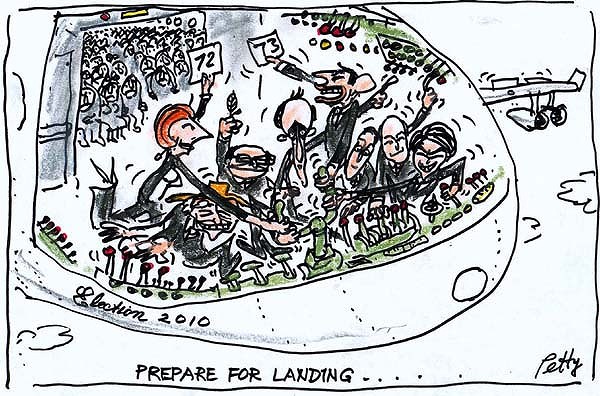
The three independents are different political voices in that they are talking about political process, public policy, discussing ideas and acting in terms of the public interest rather than politics being driven by short-term, poll-driven politics. Will the country Independents be able to reform Parliament enough so that it actually debates public policy instead of uttering the mind-numbing demonizing the other side as partisan slogans?
It's a long time since Question Time has been about genuinely holding ministers accountable, or even seeking genuine information about government policies. When has the Parliament acted as a genuine check and balance on the increasingly centralised exercise of executive power in Australia's political system?
Mark Bahnisch in Dawn of a new political era at the ABC's Unleashed says that:
We've seen 21st century politics finally wash over insular Australian shores... the tectonic plates of change have been moving at a slower pace, just as they have in America and Great Britain.We've entered the world of a new politics.
What is the new politics, now that majority politics as practised by both Labor and the Coalition has broken down? Bahnisch doesn't actually say, but implies it is the breakdown of two party politics and the emergence of coalition governments and The Greens. What does that political shift signify?
Here's one suggestion. Parliamentary reform. Both the Coalition and the Labor have acted to hollow-out Parliament with their tactics, and they have remained indifferent to what they have done. The lower house has become a rubber stamp for the executive of the incumbent party, the debates are gagged and the many 'Dorothy Dix's' make a mockery of the debating chamber. Both parties don't care that much about democracy, as they tell voters to get used to their schoolyard games and antics.
One aspect of the new politics is the need to reform Parliament so that it does actually function as space for diverse political interests to be heard; acts as the clearing house of public policy ideas, especially those long-term policy issues that includes climate change; functions as a check on the centralised exercise of executive power; addresses the "corruption" of electoral funding; and moves to the full public funding of elections.
Another aspect is the shift from the idea of a hung parliament between "us" and "them" to a multiparty democracy based on co-operation and coalition as well as adversarial confrontation. This shift would be resisted by both the rightwing factional leaders and strategists (Bitar and Arbib) behind Gillard and those behind Abbott. Their old game of politics is be one of attempting to just buy the Independents off with promises/policies/handouts; and to ensure that they become the government in the House of Representatives by running to an election as soon as they see an opportunity to rid themselves of the irritating independents.
|





Paul Kelly is continuing to push his hung parliament=political instability line.
In his latest op-ed in The Australian he talks in terms of "the palpable fear of weak government"; "there is only one path to a fragile stability at this point"; "hopes that Australia can organise stable government from this hung parliament are heroic"; "a short-term parliament leading to a more decisive second election cannot be dismissed."