« November 2012 | Main | January 2013 »
December 30, 2012
US: cliff hanging
A polarized Washington needs to engage in bipartisanship and compromise if it is to avoid the fiscal cliff scenario of a series of automatic tax increases and a program of drastic spending cuts that would immediately cut the budget deficit almost in half.
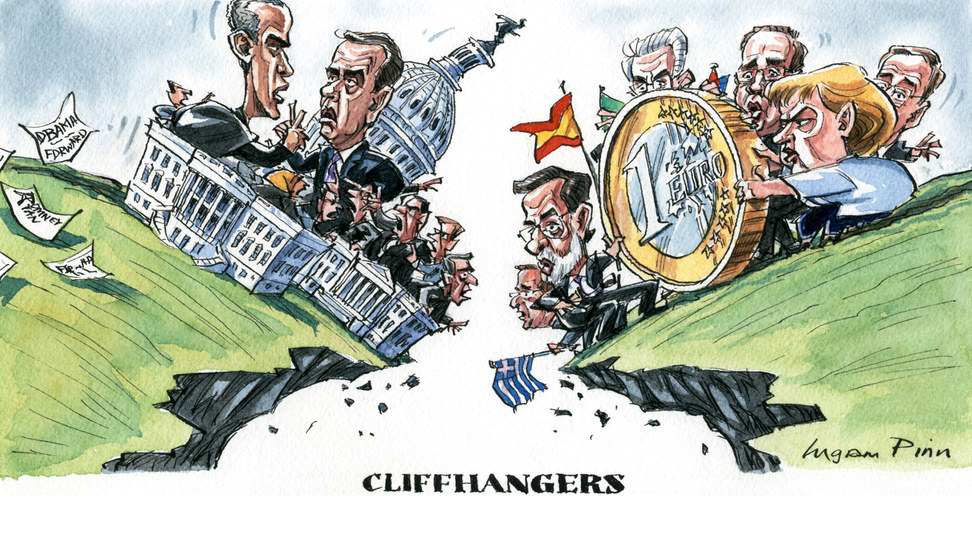 Ingram Pinn
The fiscal cliff is a creation of the US Congress, which could not agree on a yearly budget that would also help the country reduce its deficit, or long-term debt, of $1.3tn. To resolve the impasse in August 2011, the Congress decided to push the big decisions off by 17 months. Now the 1 January deadline looms, and with little sign of a grand bargain l in Washington, the automatic tax hikes and automatic spending cuts loom.
Behind the deal making is the austerity economics. Michael Hudson says about this economic ideology:
Wall Street lobbyists blame unemployment and the loss of industrial competitiveness on government spending and budget deficits – especially on social programs – and labor’s demand to share in the economy’s rising productivity. The myth (perhaps we should call it junk economics) is that (1) governments should not run deficits (at least, not by printing their own money), because (2) public money creation and high taxes (at lest on the wealthy) cause prices to rise. The cure for economic malaise (which they themselves have caused), is said to be less public spending, along with more tax cuts for the wealthy, who euphemize themselves as “job creators.” Demanding budget surpluses, bank lobbyists insist that austerity can enable private-sector debts to be paid.
Shifting the tax burden onto labor and industry is achieved most easily by cutting back public spending on the 99%. Attacking the safety net is the root of the December 2012 showdown over whether to impose the anti-deficit policies proposed by the Bowles-Simpson commission of budget cutters whom President Obama appointed in 2010.
We need to be careful here for two reasons. First, the expiration of the Bush-Obama tax cuts will, on its own, eliminate roughly half of the long-term gap between federal government revenues and expenses. Higher tax revenues will reduce the pressure to do something about entitlement spending—at least the pressure that is due to budgetary constraints, though not the pressure that is due to ideological opposition to those programs.
Secondly, the automatic sequesters mandated by the Budget Control Act of 2011 barely touch the major entitlement programs. Social Security and Medicaid are specifically exempted; most Medicare spending cuts are limited to 2 percent. That means that the rest of the government gets smaller, again reducing budgetary pressure on these crucial programs.
Update
After all the manufactured drama and political theatre a deal has been cobbled together at the last minute. The Senate has pushed the issue of the sweeping government spending cuts that were designed in 2011 off for two months.
The tax cuts now don't apply to those earning less than $450,000 threshold, which covers less than 1% of Americans. It also extends unemployment benefits for millions of Americans – at least, for another year; extends tax breaks for research and development and interest on student loans. Estate tax also rises, to 40% from 35%, but inheritances below $5m are exempted from the increase.
There is no new infrastructure spending and no continuation of the payroll tax cut.
The House Republicans expressed opposition to the bill passed by the Senate mainly over the failure of the bill to include cuts in federal spending.Right wing conservatives, backed by the Tea Party movement, are hostile.
Posted by Gary Sauer-Thompson at 9:46 AM | Comments (8) | TrackBack
December 29, 2012
being irrelevant
It is sad really.
 John Spooner
Spooner, shows the poverty of the climate sceptic case. He says:
The reason why scientific consensus emerged in this debate is because political activists want to get things moving, and if they say that consensus is scary and urgent, then sceptics had better get out of the way....The science was "settled", the debate was said to be over and no further discussion was required. Any media professional should have been aroused by such an excited censorship campaign, and it stimulated my first cartoon on the subject [bellow], which depicted the family TV set as mediaeval stocks with an imprisoned climate sceptic being pelted by the family with their TV dinner.
The scientific consensus has nothing to do the confirmation of the IPCC's hypothesis by scientific evidence. It's all politics and groupthink for Spooner, who has embraced an anti-science position that highlights scientific fraud, plagiarism, and ghost writing.
Meanwhile, governments have started to make the shift away from the heavy use of fossil fuels (coal, oil, and natural gas) that threatens the world with human-induced climate change to a low carbon future. The aim is to make the shift to a future climate with less than 2C of warming. Staying below two degrees is not a matter of science or technology. It will be determined by political and social decisions to take the necessary steps to shift to low-carbon living
The deniers have shifted from saying there was no such thing as warming or climate change, then the change in climate was a natural cycle and not the result of human interference, finally some are saying that though we may be responsible for some warming but not much it would cost so much as to send civilisation back to the dark ages. I'm waiting for them to say let “free markets determine what the science is”.
Posted by Gary Sauer-Thompson at 10:22 AM | Comments (4) | TrackBack
December 26, 2012
happy holidays
on vacation:
 Gary Sauer-Thompson
Suzanne, Ari and I are at Victor Harbor for the Xmas week. Suzanne then goes back to work for week, before we have ten days or so at American River on Kangaroo Island.
Posted by Gary Sauer-Thompson at 7:37 AM | Comments (3) | TrackBack
December 24, 2012
the NRA lashes out
The National Rifle Association's promise of "meaningful contributions" to the US debate about gun violence consisted of a denunciation of the media, the president, the culture, mental illness, and violent video games. N.R.A. president Wayne LaPierre proposed that armed volunteer guards be stationed at every school in America on the grounds that signs proclaiming schools to be "gun-free zones" are practically an invitation to killers. More guns equal more safety.
 Pat Campbell
According to the NRA it is the unknowable numbers of deranged monsters roaming the streets who were responsible for gun crime. The NRA's position is that the only thing that stops a bad guy with a gun is a good guy with a gun. It was red meat for the conservative base--the angry, ageing white male southern base who fear that they are losing their power.
Christy Wampole in her Guns and the Decline of the Young Man opinion piece in the New York Times says that it is not just the angry, ageing white male who is angry. Writing in the NYT's The Stone forum she says that young men in southern USA are having a very hard time of it. They are unemployed or underemployed, sullen and full of rage. Wampole asks:
Can you imagine being in the shoes of the one who feels his power slipping away? Who can find nothing stable to believe in? Who feels himself becoming unnecessary? That powerlessness and fear ties a dark knot in his stomach. As this knot thickens, a centripetal hatred moves inward toward the self as a centrifugal hatred is cast outward at others: his parents, his girlfriend, his boss, his classmates, society, life.
And they are still not allowed to cry!
Her argument is that the women and people of color who are skyrocketing to the top of the heap and displacing the white male and that there is need to cultivate empathy for the young white male, because it appears to them that life seems to have stacked the cards against them.
Wampole doesn't really address the world view of the NRA's base. This world is one of a hyper toxic masculinity, where civil society has broken down, and people are paralyzed with fear. In this world the only way men can prove their worth--stop other men laughing at them--- is through a fistfight or a gunfight.
In the light of this Wampole’s cultivation of “empathic habit” through development of a school curriculum that centers around an empathic practice, particularly in courses such as history, social studies, literature, and political science” doesn't really cut it. The NRA's more guns only means more violence.
Posted by Gary Sauer-Thompson at 7:07 AM | Comments (8) | TrackBack
December 23, 2012
a sleazy year
And so the political year 2012 ends. It's a year in which the Gillard Government finally clawed back some of the ground it immediately lost after its formation; the mainstream media lost even more creditability; some reforms were implemented over fierce resistance; and the old white blokes in power looked ever more out of touch.
 David Rowe
It was a sleazy, tawdry year of hand to hand fighting in the trenches between political friends and enemies. It was a situation of mutual enmity with its possibility of war and mutual killing between them.
This partisan conflict undercut a political liberalism that assumes that conflicts between political groups can be solved to everyone's advantage through an improvement of civilization, technology, and social organization; or be settled, after peaceful deliberation, by way of amicable compromise.
Posted by Gary Sauer-Thompson at 3:11 PM | Comments (2) | TrackBack
December 21, 2012
economic realities
Finally the Gillard Government accepts economic reality.
The politics of austerity (savage cuts) is not appropriate when economic growth is low and government revenue has taken a large hit. A slowdown in economic growth means that as you try to achieve a surplus through austerity all you do is drive economic growth downwards.
The economic reality is that annualised growth rate during the quarter was only 2 per cent, and the government's tax receipts in the first four months of the year to June were $3.9 billion lower than estimated. This has been caused by lower commodity prices and competitive pressures on the economy that are related to the Australian dollar not following commodity prices down. The Australian dollar is becoming a reserve currency.
The anti-Keynesian neo-liberals will attack the Gillard Government under the guise of government waste, spending too much money, broken promises, and bad economic management. A national failure the AFR calls it. In the neo-liberal view a budget surplus signifies good management of the economy irrespective of context.

What the neo-liberals won't say is that the politics of austerity involves slash and burn and the privatisation of public services. Will the Coalition go down that road--ie., follow the conservative government’s in the states who are pushing for surpluses at all costs? Or will they back off the spouting the party line in the face of the economic reality of declining economic revenue and reduced government spending?
Labor shot themselves in the foot because they made a budget surplus into a symbol of their responsible economic management. Now that they can’t deliver this will be used to indicate they’re not economically responsible. Therefore they have bad economic credentials.
Labor has been unable to argue the basic principle in the public sphere: namely, that deficits per se are neither good nor bad. What matters is the appropriate use of fiscal policy and the specific purposes of a deficit. They accepted the naive neo-liberal view that getting one’s household in order and paying off the bills was the measure of good economic management of small open economy such as Australia’s.
Posted by Gary Sauer-Thompson at 6:36 AM | Comments (6) | TrackBack
December 20, 2012
Australia is an obese nation
The latest figures from the Australian Bureau of Statistics Health Survey show that more than 60 per cent of Australians are now overweight or obese. Around 25 per cent of Australia's population is obese and another 40 per cent is overweight. Dr Paul Jelfs from the ABS says men are more likely to be overweight or obese (70 per cent) than women (56 per cent) while one-quarter (25 per cent) of our children are overweight or obese.
Australia is an obese nation and this has consequences for public health, given the impact this will have on type 2 diabetes, cardiovascular disease and cancer.

Some argue that there is a lack of political will l to tackle what has been called the obesity epidemic. That ignores the power of the food industry (food, beverage and advertising) to block reform (improving labelling, and tax and pricing strategies) in order to protect their economic interests. The dominant view in Canberra's political circles is that obesity results from the poor choices of individuals rather than an increasingly obesogenic environment.
What we have are social marketing campaigns, industry self-regulation and funding for school and community programs rather than reforms to to the current Australian food system. The powerful multinational food and beverage manufacturers, (“Big Food”), are strongly against taxes on unhealthy foods. Trade associations representing the food industry have campaigned vociferously to avoid these types of taxes and the introduction of traffic-light labelling on foods.
Posted by Gary Sauer-Thompson at 7:59 AM | Comments (1) | TrackBack
December 19, 2012
the high Australian dollar
Whilst the media are obsessed with the black and white politics of a budget surplus the economic policy concern is that a high Australian dollar is here to stay for some time---even though the terms of trade are down around 15 per cent.

That means the structure of the economy is going to change. Some sectors of the economy will grow (the resources sector will have a larger share of the economy than it used to be), some will shrink (eg., in the trade-exposed industries) that’s what happens when relative prices alter in a market economy. It also means low interest rates (3 per cent rate which is very low by historical standards for Australia) to compensate for the high dollar.
That makes it difficult for economic growth to come from non-mining investment. Where would that growth come from, now that the mining sector is winding back, and the high dollar means a weak manufacturing sector?
The broad answer is by taking advantage of the opportunities Asian growth. Australia is in the right place at the right time. So where are the new growth drivers? Those in a digital economy? Those in the green economy from decarbonising the economy? The current position is who knows?
How about a good, old fashioned housing boom, due to the historically low interest rates? Monetary policy is pretty limited in its options, especially when the effect of fiscal policy (budget surplus) is to constrain economic growth.
Posted by Gary Sauer-Thompson at 8:33 AM | Comments (1) | TrackBack
December 18, 2012
a flawed media
In Biased newspaper reporting on the carbon pricing mechanism at The Conversation a group of University Melbourne academics and students found that The Age, Herald Sun and The Australian newspapers contributed to an uninformed and inadequate public debate on the carbon price and Australian climate change policy. The reason, they say, is that:
The Australian and Herald Sun were found to be overwhelmingly unsupportive of the policy. Articles in The Age were also unbalanced, with a preference for a supportive stance .... Of more concern was the small number of articles quoting economists, climate scientists and other independent experts. This gap in coverage contributed to a shallow media discussion. It contextualised the policy in terms of short-term economic effects rather than long-term environmental – or economic – goals.
Well we knew this.
A question that can be asked is: Why was there this campaign by News Ltd against the carbon price policy? Why was there a focus on the short-term economic consequences rather than long-term environmental – or economic – goals. Why did it happen?
Their answer for the current reporting techniques and standards failing to give the issue the level of analysis required is this:
journalists work to tight deadlines, often making it difficult to report on issues with great depth. The way newspapers have traditionally worked is changing with the arrival of online news. Newspapers are receiving reduced revenue from advertisers, which means less money for funding investigative journalism, which is more expensive than simply reporting news.Deadlines and funding limitations may partially explain the lack of depth in the coverage of the carbon price, but they do not explain the difference in coverage across the three newspapers.
What then explains this difference? Their answer is that the way the media is currently regulated is not adequate to ensure accountability to the public, or to make sure reporting is as accurate and balanced as it should be.
Sure. Things are bad. Fairfax Media is on its knees, commercial broadcaster Network Ten will shed one third of its journalists and the Nine Network is now in the hands of US hedge funds. There is also a need for better regulation. Self-regulation doesn't work.
However, it is a surprise that there is no mention of the media campaigning on behalf of economic interests of Big Mining, Big Coal, and the fossil fuel generators. It was protection of those interests that lay behind the carbon tax scare campaign. It is a surprise because it is well known.
The Minerals Council, the Business Council of Australia and the Australian Chamber of Commerce and Industry bombarded us with their claimed that the carbon price would lead to widespread economic damage, many destroyed businesses and significant unemployment. All their negatives were blamed on the carbon tax. They stated that those arguing for carbon pricing are blocking progress.
Posted by Gary Sauer-Thompson at 11:48 AM | Comments (1) | TrackBack
December 17, 2012
because....
It's the USA and there is no resolution in sight for gun control in spite of the recent violence in Newtown, Connecticut at the Sandy Hooke Elelmentary school. This was a massacre of 20 children and six adults on Friday, Dec. 14, by an intruder with an assault rifle (a Bushmaster .223). This is a semi-automatic version of the civilian model of the U.S. military M-16 manufactured by Colt.
Despite a history of mass shootings it's either gun rights or gun control for Americans. There are an estimated 280 million to 300 million guns in private hands in America—many legally owned, many not. Each year, more than 4 million new guns enter the market.

In District of Columbia v. Heller (2008) the US Supreme Court clearly held, for the first time, that the Second Amendment guarantees an individual’s right to possess a gun. That Amendment says:
A well regulated Militia, being necessary to the security of a free State, the right of the people to keep and bear Arms, shall not be infringed.”
The present day gun-rights movement in the USA, which is predominantly white, rural, and politically conservative, interprets this to mean a right to own a hand weapon beyond the home to defend themselves against attackers with guns. They have to be prepared for the worst, they say.
Many of these gun owners are absolutists opposed to any government regulation of firearms and they argue that an increasingly armed public means a decreasing crime rate and that requiring background checks on buyers at gun shows represents a threat to the Constitution. Guns are a means to a less violent society. If the students and adults had guns then they would have been able to defend themselves. Schools and universities can turned into places for shootout.
The National Rifle Association's (NRA) little slogan is "guns don't kill people, people kill people." Many Americans are predisposed to agree with the basic message of the NRA that their right to bear arms is grounded in the Constitution, and they assume that gun violence is just the product of troubled or deranged individuals and not shaped by the economic and social context of places and class.
The cycle is a mass shooting, public outcry, political inaction, followed by the gun lobby 's victory in allowing lethal force to be used in more public places. In this culture of guns mourning the consequences of gun violence is acceptable but discussing how to prevent more tragedies is not.
Posted by Gary Sauer-Thompson at 6:51 AM | Comments (10) | TrackBack
December 13, 2012
rethinking cities
Peter Mares in Can we afford to get back on the rails? at Inside Story mentions that Adelaide, unlike the other capital cities has made no significant investment in rail and, as a result, Adelaide’s passenger numbers are still below ten million. These are the same numbers as the early 1990s.Adelaide is a car city, even more so than a congested Sydney; and despite the return to a small light rail network, Adelaide is “Australia’s car capital”.
Light rail is the key to moving people quickly and easily around the city, especially when the single family home on a large suburban block looks to be a thing of the past. The young "creative class," eschew the car-centric, big-yard suburban lifestyle of their parents. But the parents – "empty nesters"----are also showing a preference for living downtown.
 Alan Moir
Buses and traffic lights were seen to be the answer to the congestion of the city caused by the car, which had been accommodated in the past by increasing the space between buildings for roads. The bus was a mild shift away from the car, but it still worked within a model of the city being an engineering one of networks and vehicles. Cities being about people was an alien concept. The suburbs were about people.
In their Transport Policy at the Crossroads: Travel to work in Australian capital cities 1976-2011, Dr Paul Mees and Dr Lucy Groenhart, from RMIT’s School of Global, Urban and Social Studies, say that there has been a revival in public transport at the expense of cars, despite receiving relatively little policy support. The revival is largely due to the growth in train travel which offers a genuine solution to the serious congestion and environmental problems faced by Australia's capital cities.
Posted by Gary Sauer-Thompson at 9:49 PM | Comments (3) | TrackBack
December 12, 2012
dirty politics
There you have it.
Justice Steven Rares in the federal court has found that James Ashby's sexual harassment against Peter Slipper an abuse of process; that the case was brought ''for the predominant purpose of causing political damage to Mr Slipper''; and that Mal Brough, who has been pre-selected by the Coalition for Slipper's seat, acted with Ashby to advance the interests of the Liberal National Party.
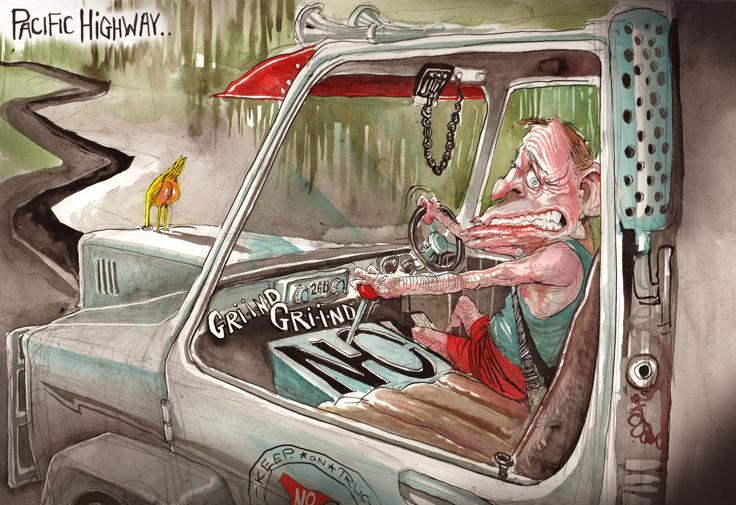 David Rowe
The judgment by Justice Steven Rares was over an application by Mr Slipper to have a sexual discrimination case that was brought against him by a former staff member, James Ashby, dismissed through abuse of process. The judgment made no finding on the harassment allegations by Ashby.
The case was designed as part of the Liberal Party's political campaign to both delegitimise the ALP's minority government, and the judgment and character of the Prime Minister Julia Gillard. Slipper resigned as Speaker of his own accord, and he is unlikely to be returned to the job.
If the LNP are willing to trash the joint to get their own way, the legal system does not take kindly to the law being used to run a political campaign. An appeal by Ashby is said to be likely. The LNP is not likely to change its conduct-- politically motivated beat-ups is their tool-in-trade-- in an election year.
Posted by Gary Sauer-Thompson at 12:17 PM | Comments (9) | TrackBack
December 11, 2012
economic mythology
Whilst the global economy appears to be in an ever-deepening crisis---a failed growth or stagnant economy--- the economic spin is that the world is increasingly being governed by competition and market forces. Perfectly competitive markets, it is held, will provide answers for all of our ills and that this self-governing system will lead to progressively increasing welfare for all. Boom times are just around the corner.
The real world is very different from this neo-liberal economic mythology. There is an emerging ecological challenge as well as a stagnant economy. Consider this Dohar Dispatch by Giles Parkinson about the Sustainability Expo that runs with the COP18 climate change conference. He says that the Expo is:
dominated by the Gulf nations and a single technology, CCS, and overwhelmed by the corporate power of the fossil fuel giants that pervades over this conference, and are still desperate to burn as much oil and gas as they can. Renewables hardly get a look in. It should be recognised that the world’s biggest exporters of fossil fuels are investing heavily in solar technologies, so much so that they might have the greatest influence of over the cost curve of new technologies such as large scale solar thermal and concentrated solar PV than any other country. But they do so with one single goal in mind – to free up as much of their oil and gas as they can so they can export it to other countries.
The fossil fuel industry is unwilling to invest in carbon capture and storage technology itself and so pay to clean up its own mess. Nope, what Big Oil, Big Coal and Big Gas want is Big public subsidies for CCS technology--- but not for renewables.
These big fossil fuel oligopolies are deeply opposed to carbon policies and clean energy policies and they waged a campaign of obfuscation, delay, and downright hostility that has bent nation state governments to favour their interests.
What this shows is that in the real world, there is an absence of “free markets,” with market rigging and failure everywhere in the economy. Power rules in that a few corporations dominate large sectors of the industry, economy, and market. There is a strong tendency in contemporary capitalism to seek out more fossil-fuel intensive forms of production in an attempts to restart the growth engine by, in effect, giving it more gas or fuel. Increasing production and productivity are the sovereign panacea for all the ills of capitalism.
Posted by Gary Sauer-Thompson at 3:48 PM | Comments (3) | TrackBack
December 10, 2012
Steve Keen on the US fiscal cliff
Steve Keen, reflecting on his recent presentation the US Congress says that his expectation is that the Congress will bash out some compromise with respect to the fiscal cliff. This will reduce the severity of the cliff, but it won't eliminate it completely.
Keen says that the 'fiscal cliff' developed because both sides of the House concurred that reducing the growth of government debt was the most important economic policy objective, but they could not agree on a common program to do so.
Instead, a program of indiscriminate spending cuts and tax concession abolitions was passed, as a 'Sword of Damocles' that would drop on America’s collective head if Congress could not reach a compromise by the end of 2012. So unless a deal is bartered by December 31, a set of tax increases and across-the-board cuts in government expenditure will reduce net government spending by about $500 billion, or roughly 3 per cent of GDP.
He adds that both Democrats and Republicans now fear what this future might be. The fantasy that reducing the government deficit might actually stimulate the economy has clearly been abandoned, in the light of the tragic results of austerity programs in Europe.
Keen argues that reducing government debt now may hurt the private sector far more than it helps it. It
(1) may also throw the US back into recession whilst doing precious little to reduce government debt as a percentage of GDP.
(2) could trigger a renewed period of private sector deleveraging that would put the economy back into a recession driven by falling private sector aggregate demand.
(3) the focus of the public discourse on debt should be on the dominant problem, which is the private debt bubble that caused this crisis in the first place.
Posted by Gary Sauer-Thompson at 10:39 AM | Comments (1) | TrackBack
December 9, 2012
a downbeat national mood
Here is one reason for why the national mood is downbeat. Luke Foley, a NSW Labor MP of the left, gives us an insight in the NSW Labor Right, after the departure of the former Premier Bob Carr. The NSW Labor Right, which was the dominant faction inside the government declared itself open for business.
 Leunig
"Open for business" for the NSW Right meant letting it rip whether it be for the coal, coal seam gas or property development and this was associated with a contempt for, and repudiation of, Labor's environmental agenda. The implication is that the NSW Labor Right is the political wing of the property development industry and of the coal and coal seam gas companies. That means a deep contempt for community concern over mining and development.
A further implication is that the NSW Labor Right is opposed to climate change, the Kyoto Protocol and to carbon pricing and to preventing coastal development in areas affected by rising sea levels. They have been consistent in their attacks on the green economy and associate with the professional dis-informers who facilitate and encourage climate denial, and who obstruct and delay a solution to the problem at great cost in dollars and human lives in support of their own short-term economic and ideological agenda.
The national mood is downbeat because sectional interest is placed before the national interest and that sectional interest is premised on political patronage and political corruption as the NSW Independent Commission Against Corruption (ICAC) is increasingly showing.
Posted by Gary Sauer-Thompson at 9:48 PM | Comments (3) | TrackBack
December 7, 2012
survival time
Another News Corp digital venture bites the dust.
Yesterday it was MySpace, once a leading social networking site. Today its The Daily --an American online newspaper , which was held up as embodying the news media's future. It was the first to be designed for the iPad and it had the backing of the deep-pocketed News Corporation. It was a loss making venture. It shows that the content of Murdoch's subscription news (an iPad newspaper) not worth paying for and that it isn't unique enough.
 David Rowe
The Daily needed at least 500,000 subscriptions to make ends meet, but it was stuck at a mere 100,000 in its second year of existence. It would suggest that there are limits to the typical general newspaper selling commodity news in an online existence. Only a few of these --eg., the New York Times -- are likely to make the transition from the demise of the ad market to a digital world.
The situation is depressing--- in the UK, for instance, the Times and the Sunday Times, the Independent and the Guardian and Observer all lose money. Its depressing in Australia because of the low quality of journalism. Mark Latham spells it out:
The public has seen too many errors and too many smear campaigns masquerading as “investigative reporting” to take the media seriously. Unable to get reliable, independent information about politics, they see little point in following the public debate. Hopefully, a decade from now, newspapers and TV news bulletins will no longer exist, having gone the way of record players and typewriters.
There is a deep-seated distrust of journalism, which to all intents and purposes, is a dying profession.
Is the digital future primarily one of niche sites --eg., Politico in the US , which targets election junkies, policy wonks and candidates with ambition; or Crikey in Australia. The Huffington Post made it through a unique combination of unscrupulous "aggrelooting" of contents from a variety of willing and unwilling sources, legions of unpaid bloggers.
Posted by Gary Sauer-Thompson at 1:48 PM | Comments (3) | TrackBack
December 6, 2012
rolling back green tape
Big Business wanted to roll back green tape (a single track approval process to avoid duplication) by getting the Federal Government to hand over its regulatory powers to the states for major projects. This would see a return to a highly decentralised system of environmental management in Australia.
What Big Business has in mind is the Environment Protection and Biodiversity Conservation Act 1999, which provides the legal framework to protect and manage nationally and internationally important flora, fauna, ecological communities and heritage places.
Basically the states cannot be trusted because they have a history of putting development above environmental protection. You can see that in Queensland with the Traveston Crossing Dam in 2009 and Rinehart's $6.4 billion Alpha coalmine in the Galilee Basin; in Victoria with cattle grazing in the Alpine National Park; in Western Australia with James Price Point; in NSW the blanket approval for coal seam gas ; and in Tasmania with the Gunns pulp mill near the vineyards and wineries in the Tamar valley.
In these cases Commonwealth approval, has been and is, a necessary check and balance to avoid a conflict of interest. This has been very clear with the over allocation of water licenses by the states in the Murray-Darling Basin. It has required the Commonwealth to ensure that there is a reform movement through the process of co-operative federalism.
It is the case that the federal government has entered agreements which allowed states to undertake environmental impact assessment for the purposes of the EPBC Act. But to date the federal government has retained the power to make the final decision on whether or not to approve a development that could affect a matter of national environmental significance.
The EPBC Act is in need of some reform to better protect our national natural heritage--as argued by the Hawke Review and the federal government can do a much better good job of protecting our natural environment, But devolving Commonwealth approval responsibilities to the states is unlikely to ensure that protection as the conservative state governments dismantling environmental protections established over the past 30 years to facilitate development.
Posted by Gary Sauer-Thompson at 6:59 AM | Comments (4) | TrackBack
December 5, 2012
Faulkner on the lack of political integrity
Senator John Faulkner in this annual Neville Wran lecture given at University of Melbourne goes beyond the muckracking of recent weeks that has plagued political life in Canberra.
 David Rowe
Faulkner addresses the political corruption in general and that in the Australian Labor Party in particular:
It is time to publicly acknowledge that there have been some in our party's ranks with neither political principles to defend nor moral convictions to uphold.It is clear that the current power balance, the current power structures, have enabled too much disgraceful conduct and arrogantly corrupt behaviour. It is clear, too, that some of those empowered by our current structures are resistant to measures which curtail their power.
He says that to have integrity, politicians must have the courage to defend their political principles and the strength to uphold their moral convictions. Fail either of these two challenges and political integrity is an impossibility. He adds that recent ICAC hearings in NSW have seen serious allegations made that some Labor Parliamentary and Party representatives in NSW have failed these two challenges.
Each of Faulkner's reforms seeks to diminish the power of factions inside the branch, increase accountability and empower the rank-and-file. I doubt that the ALP will be able to reform itself as some of its members hope.
The factions wield too much power. At best the NSW ALP may cap the worst excesses or make cosmetic changes. However, Labor will die unless it increased and invigorated its membership by democratising its processes.
Posted by Gary Sauer-Thompson at 8:53 AM | Comments (5) | TrackBack
December 4, 2012
Energy reform
Expectations ought to be low for electricity reform in Australia despite the marked increase in electricity prices for consumers, due to the gold plating of the grid to strengthen the network to cope with rising peak demand and consumer angst. This is so even though the reality is that Australian electricity consumption is falling. The grid requires less electricity than the energy companies (eg., Origin and AGL), which are heavily invested in coal and gas, say.
The reason for the slow reform progress is that electricity regulation is largely a state responsibility, and the state governments have far more control over the important legislative and regulatory levers. States, such as Queensland and NSW are recalcitrant as they own the fossil fuel power stations. Their rhetoric is that carbon pricing and renewable energy schemes (eg.,the Renewable Energy Target) are the cause of price increases. These green imposts, they say, have no discernible environmental benefit. This is the standard right wing position.
The Gillard Government's proposals, which include the national rollout of smart meters, more flexible pricing and extra resources for the regulator, are not going to do much in terms of reform. Firstly, the core reform is to shift the power generation to non-fossil fuels to reduce greenhouse gas emissions. Secondly, the National Electricity Market, is rigged in favour of generators and retailers, and against consumers.
Thirdly, better interconnection in the national electricity grid is required so that Victorian wholesale electricity prices would drop rapidly whenever the wind blows in South Australia, because of the latter state’s extensive wind power assets. The fossil fuel lobby in Victoria is opposed to this because it means less money for them.
Fourthly, the objectives or the design goals of of the national electricity market (NEM) are about the interests of the energy companies selling us more power; not energy efficiency, or reducing greenhouse gas emissions. The the interests of consumers and the environmental sustainability take a back seat.
The NEWM was designed by neoliberals, who purport to liberate the market from political interference. The state, neo-liberals assert, should do little but defend the realm, protect private property and remove barriers to business. Neoliberalism protects the interests of the corporate energy elite against all-comers. Today, neoliberalism is the ideology used to protect the fossil fuel industry from both the disruptive technology of renewable energy and the new renewable energy entrants into the national electricity market.
Posted by Gary Sauer-Thompson at 6:35 AM | Comments (7) | TrackBack
December 2, 2012
heating up
The British thinktank Carbon Tracker has pointed out, it's really just simple maths. Though Copenhagen climate conference in 2009 failed spectacularly it formally recognized "the scientific view that the increase in global temperature should be below two degrees Celsius" and agreed that deep cuts in global emissions are required... so as to hold the increase in global temperature below two degrees Celsius.
So far, we've raised the average temperature of the planet just under 0.8 degrees Celsius, and that has caused far more damage than most scientists expected. (A third of summer sea ice in the Arctic is gone, the oceans are 30 percent more acidic, and since warm air holds more water vapor than cold, the atmosphere over the oceans is a shocking five percent wetter, loading the dice for devastating floods.)
 Edel Rodriguez
If the world is to limit global warming to 2C, it must keep greenhouse gases in the atmosphere to under 450 parts per million. We are currently at 392, and rising fast. To have a good (80%) chance of staying within the 2C limit, that means the world can emit only another 565 gigatonnes of carbon dioxide. But global fossil fuel reserves are much bigger than that, equivalent to 2,795 gigatonnes, or five times the safe amount. In other words, we can only avoid devastating climate change if we keep most of the world's fossil fuels, including almost all of its coal, in the ground.
We'd have to keep 80 percent of those reserves locked away underground to ensure the 2 degrees scenario. That means creating a decarbonised energy system; something opposed by the fossil fuel industries who are in favour of a high-carbon one and higher global warming. Putting a price on carbon would reduce the profitability of the fossil-fuel industry.
Those global fossil fuel reserves are their primary asset, the holding that gives their companies their value. If they couldn't pump out their reserves, the value of their companies would plummet. They say that populations can acclimatize to warmer climates via a range of behavioral, physiological and technological adaptations
The goal of the Doha talks – to hold global temperature rise to 2 degrees – is probably out of reach, and we are on the way to an planet that is 4 to 6 degrees warmer by the end of this century. tThe fossil-fuel industry is systematically undermining the planet's physical systems.
Posted by Gary Sauer-Thompson at 9:35 PM | Comments (8) | TrackBack