« October 2012 | Main | December 2012 »
November 30, 2012
enough
Another Liberal Party campaign to destroy the prime minister bites the dust.
 David Rowe
This was a campaign that accused the Prime Minister of criminal conduct. Gillard had knowingly committed fraud was the allegation. It was done so on the basis of no evidence. When Gillard offered Abbott 15 minutes in Parliament to argue the case for unlawful behaviour Abbott failed badly. He only got to "conduct unbecoming". Gillard made it very clear in her reply that Abbott had failed.
The Liberal Party campaign has been exposed as a politically motivated smear campaign--a witch hunt, to give it a gender interpretation. The Liberal Party and its media blowhards in News Ltd and Fairfax (Mark Baker of the SMH) are now in damage control with their "Questions remain to be answered " campaign, which was designed to remind the public that Gillard once associated with shady and dodgy characters. Therefore, she cannot be trusted. The issue is about character etc etc
The Liberals have adopted an American Republican strategy and it turned into a train wreck. What will be salvaged from the wreckage. A reframing to go after dodgy and shady unions?
Posted by Gary Sauer-Thompson at 8:23 AM | Comments (8) | TrackBack
November 29, 2012
Coalition's attack on Gillard escalates
The Coalition has ramped up its attack on the Prime Minister in the light of Julie Bishop failing to show that the Coalition's campaign was more than smear and innuendo in the form of guilt by association through the tactic of yet more unanswered questions. It has taken the form of slapstick entertainment with a touch of sleaze.
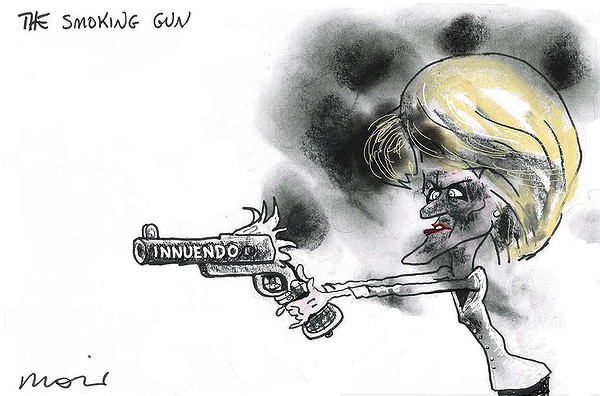
In the Senate Senator George Brandis, the shadow attorney-general, said that it was clear Ms Gillard knew the association's funds would not be used for their stated purpose, which was for the advancement of workers' rights. According to Brandis Gillard knew the funds would be used for the "private purposes" of Mr Wilson and fellow union official Ralph Blewitt.
There is no doubt - no doubt whatsoever - that at the time she was involved in setting up the slush fund, Ms Gillard knew what its purpose was. It is already clear, that from (the association's) inception, Ms Julia Gillard's involvement in this matter has been characterised by concealment, deception, professional misconduct, and it would appear several breaches of the criminal law.
The grounds for this claim? It appears to be that Gillard knowingly mislead the WA Corporate Affairs Commission when she addressed its queries to the incorporation of an association later used as a slush fund.
The West Australian Corporate Affairs Commission wanted to bar the Australian Workers Union Workplace Reform Association because of its "trade union" status. It asked was it a union? If it were a trade union it would therefore be ineligible for incorporation'' under the WA Associations Incorporation Act. Gillard said no. It wasn't a trade union and argued the case for its incorporation.
In so doing, the Coalition claims, Gillard made fraudulent representations and she would appear to be in breach of the law says Tony Abbott. Gillard's position is untenable, says the manager of Opposition business, Christopher Pyne. Some in the media agree.
Why so? What is the argument? We sure need one because Gillard's letter says that the organisation to be registered was not a trade union and the association wasn't a trade union. How do we get to fraud and breaking the law from this?
The problem with the Coalition is their assumption that Gillard is guilty---personally benefiting from the slush (Julie Bishop) fund and knowingly deceiving the authorities about the nature of the association (George Brandis). They then hunt for evidence (documents) to back up their assumption. The problem they have is the documents produced so far do not support their assumption.
So it still looks, and smells, like a smear campaign. Fostering the smear campaign continues to preoccupy the media and the journalists show no interest in the context of the 1990s: ie., the AWU slush fund in relation to union activities (the BLF and later the CFMEU) and the construction industry. The AWU was seen as a tame cat union and had significant employer support in the construction industry. Shouldn't the media be digging into this context instead of engaging in distortions?
Meanwhile, Parliament has taken the first legislative step towards a National Disability Insurance scheme, and it is considering the Gillard Government's watered down pokies reform bill. Yesterday the government introduced the legislative framework for its Gonski-related education reforms, and its Murray-Darling Basin water reform bill is before the Senate.
Posted by Gary Sauer-Thompson at 6:37 AM | Comments (16) | TrackBack
November 28, 2012
Greece: more of the same
The next tranche of bailout money for Greece has been approved to prevent Greece’s immediate insolvency, and the Greek government is imposing fiscal austerity as it sticks to its end of the bargain to qualify for the cash handouts.
The package is a kick of the can as this lightening of Greece's debt-load will not produce economic growth on cue. Austerity measures – a condition of the deal - still seem likely to extend recession. Greece's budget reduction promises can’t be met without economic growth.

Alan Kohler spells it out. Greece's economy is expected to shrink:
...by 4.5 per cent next year. In order not to default and to stay in the euro, Greece needs a dramatic turnaround in economic growth. But that is impossible because it is caught in an austerity loop where a fiscal multiplier larger than one is amplifying the impact on the economy of budget cutbacks.
Greece’s social economy is sinking deeper and deeper under the austerity measures that are the condition for maintaining any hope for more tranches of these EU loans.
Why cannot some fraction of the officially held debt be set aside to be written off gradually over the next five years or so conditional on Greece achieving a set of milestones concerning institutional and market reforms? This would help to stimulate growth by making it easier to implement key structural reforms and by reducing the large uncertainty hovering over the economy.
Costas Meghir, Dimitri Vayanos and Nikos Vettas, (members of the Greek Economists for Reform group) say in their Reform and Restructuring article that:
Greece’s public debt reached 142% of GDP in 2010 and is projected to rise to 160% in 2012. This is because the government is still running a deficit and because GDP is shrinking. Insisting that the debt is repaid in full can drive the Greek economy into a prolonged recession and ultimately into bankruptcy.
They propose to debt forgiveness being tied to concrete and measurable reforms with a system of guarantees. The reforms they have in mind are:
The necessary reforms include not only a further reduction in public expenditure (although cutting waste is necessary) and increase in tax revenue (although tackling tax evasion is also necessary)...We need truly open markets for goods and services, and competition. An efficient justice system, and institutions that are strong and independent of the political parties. Flexible labour markets, with insurance and training for the unemployed. A funded pension system that allows free choice by savers. An educational system with independent units that compete and are evaluated based on academic excellence, so that there is access to high‐quality education for all children and youngsters. A radical redesign of the health system. A small public sector where performance is evaluated and jobs may not be permanent.
They say it is time fro Greece to shift the debate away from the short‐run management of the debt to how its citizens would like their country to look in a decade’s time.
Posted by Gary Sauer-Thompson at 12:05 PM | TrackBack
November 27, 2012
fossil fuel resistance
As is well known the national electricity market in Australia, has been based exclusively on a baseload/peakload scenario, where large generators provide the bulk of energy, and a whole bunch of flexible generators are added to meet “peak demand.” This has led to massive over-building (gold plating) of networks.
This energy system is being disrupted by renewables and reductions in energy consumption. However, there are lots of barriers to renewable energy sector growth, as Australia starts the process of decarbonising the grid and building a low carbon economy.
These include fossil fuel subsidies to the tune of over $10 billion a year. They also include Victoria, NSW and Queensland putting in place policies to hold back the development of renewable energy, such as cutting back on feed-in tariffs for residential solar photovoltaic generation (PV) and restrictions on the siting of windfarms. News Limited publications in Australia systematically misrepresent the decarbonising policy shift. The independent pricing regulators unable or unwilling to keep up with developments, and are continually out of the ball park on technology costs, and like to present rosy scenarios of conventional fuels (gas and coal).
 Steve Bell
The Australian fossil fuel electricity industry is under severe pressure from PV and wind, the implementation of energy efficiency measures, and falling demand. The industry is using captured state governments to attempt to keep PV out of the market place, and to block the transition from the current fossil fuel dominated energy systems. There is little in the way of big renewables in regional Australia.
There is an indifference to the consequences of business-as-usual emissions. Things are getting worse than predicted not better, and there is now a 25 per cent risk of exceeding six degrees of warming above pre-industrial levels. That means a different kind of earth system.
Business as usual in Australia means that if you wanted more power, you went and built another coal-fired power station. This is not so anymore. Nobody is building any new coal-fired power plants and there is decreasing domestic coal consumption. Coal is a sunset industry. Instead of renewables providing top-up power, the big power generators will become the backup, and they will need to be able to quickly ramp up production or turn it down. That means gas. King Coal has got 10-20 years.
On the other hand, decline or stagnation in domestic consumption does not equate with decline or stagnation in the industry as a whole. Growing coal exports to India and China will be the industry’s future. It is developing country demand that has driven annual global coal use up over the last decade. Australia's coal exports are increasing.
Posted by Gary Sauer-Thompson at 7:28 AM | Comments (1) | TrackBack
November 26, 2012
where's the regional solution?
Gillard Labor has pretty much adopted the Coalition’s policies on asylum seekers. They don't work in terms of deterrence. Australia will have a lot of asylum seekers to deal with in coming years because of the political upheaval in the region and the international flow of labor. All that's left for the ALP to adopt is towing the boats back to Indonesia.

What is puzzling is that neither political party is seriously canvassing a regional solution to slow the number of, asylum seekers arriving by boat by paying Indonesia and Malaysia to keep them there while their claims for refugee status are assessed by the UN.
I would have thought that this would be preferrable to the route towards forced labor camps where by irregular migrants become stateless ‘by geographic design’.
You get the impression that a regional solution is just rhetoric. All that matters is domestic politics-- that requires building a bare life in camps where asylum seekers are expunged from society and deprived of all rights and civil functions. What is crucial in the domestic politics is the management of the media and this is taking dominance over policy development and delivery.
There is a contradiction here: on the one hand, professing a neo-liberal commitment to liberalize the world economy and the other hand seeking to protect the interest of nation state and the l economic powerhouse in terms of Fortress Australia.
Posted by Gary Sauer-Thompson at 4:06 PM | Comments (2) | TrackBack
November 25, 2012
give it a break
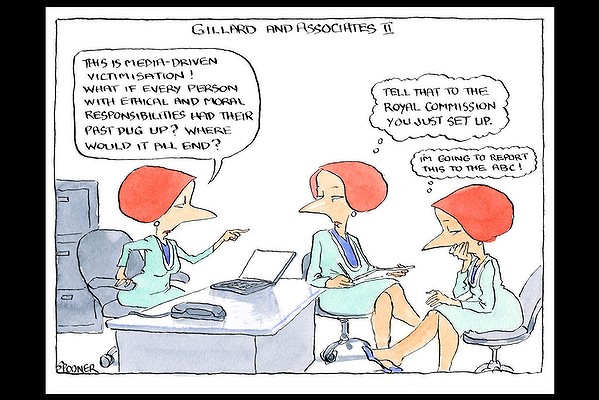
I'm utterly sick of the media going on and on and on about an the AWU slush fund and allegations of what Gillard might have known or done when she was a Slater & Gordon lawyer 20 or so years ago. It's primarily been the Murdoch media (News Ltd) but, in the last week, it has spread to the ABC and Fairfax (eg., Mark Baker at The Age).
From what I can make out Julia Gillard provided the initial legal advice on the AWU Workplace Reform Association fund, and it was Bruce Wilson and Ralph Blewitt who used the money for union election campaigning. It is they who acted in a corrupt manner and committed fraud, not Gillard.
 John Spooner
Nothing I have read shows anything different, nor even gives an explicit account of the allegations against Gillard. It's still all innuendo. The media have now convinced themselves that there is more substance to this story than the agreement on the Murray-Darling Basin plan, or an end to the 30-year battle over the protection of Tasmania's forests, even though its mostly taken the form of slurs, smears and beatups from News Ltd.
Gillard, the media keep saying (eg., Hedley Thomas at The Australian), has an avalanche of questions to answer. But they keep on forgetting to say what these questions are; or how these questions relate to what allegations. They just assume that Gillard has done something wrong, and they are tacitly suggesting that the ALP is responsible for the defrauding of hundreds of thousands of dollars from the AWU. The media demands a comprehensive response from Gillard etc etc.
The media should take a long hard look at itself, as some of the journalists increasingly appear to be acting like the right wing nut jobs who have constructed Julia Gillard as a gender card playing victim who was a corrupt lawyer. They--mostly old white men of the anti-carbon price campaign--- are using the issue to justify their view that Gillard is empty of ability and a proven failure at everything she has tried to achieve. She is an illegitimate Prime Minister with no morality.
The Prime Minister has answered all the questions the media has put, at considerable length at press conferences. So what questions are there to answer? Shouldn't the onus be on the media to provide evidence for their claims of alleged wrongdoing. They need to back up their claims, rather than just reduce journalism to a smear campaign full of innuendo.
Update
The other aspect to The Australian's smear campaign against Gillard is that it is also a corrupt union narrative. This killing two birds with one campaign enables the News Ltd smear campaign to become a legitimate political story for the Canberra media gallery. It has become their group think, or feeding frenzy, a national obsession judging from the media frenzy. The longer this event continues the more the poverty of political journalism in this country is exposed.
As Dennis Atkins points out in The Courier Mail:
Something that began as a charge Gillard benefited from slush fund money for renovations to a house transformed into an incorrect claim the Prime Minister set up the fund and myriad allegations about the purchase of a house in Fitzroy. It now turns on the application of AWU rules and the fine print of the incorporation of the association Gillard advised on.
The allegations keep shifting. The rhetoric from Julie Bishop, the deputy Opposition leader, is now that Gillard has been involved in a breach of the law, since she created the stolen vehicle that the bank robbers drove to the bank, to rob the bank. Cue Hollywood.
Update #2
Ms Bishop, who has been running the Coalition's pursuit of the issue, dramatically escalated her attack on the Prime Minister this morning by suggesting, for the first time, that Ms Gillard benefited from siphoned-off funds. Bishop said:
I’m the deputy leader of the party and I have very detailed knowledge of the workings of law firms. That is why I am able to say that Julia Gillard set up an unauthorised incorporated association that was in breach of the laws of Western Australia and the reason she didn’t open a file within Slater & Gordon, a file that would have shown a new legal entity was set up was because she, Wilson and Blewitt wanted to hide from the AWU the fact that an unauthorised entity was being set up to siphon funds through it for their benefit, not for the benefit of the AWU.
Bishop is implying that Gillard benefited from the slush fund. No evidence was provided by Bishop in Question Time in Parliament today to support this allegation. She now denies she made the allegation saying that she said, "Wilson and Blewitt are the beneficiaries from the slush fund. I'm not saying she benefited."
It's about time the Canberra media gallery started doing their job and asking Bishop some questions about the Coalition's political strategy. It's pretty clear that it is not about getting answers--it's just to keep on asking questions ad nauseum to crack Gillard and damage the Gillard Government.
Posted by Gary Sauer-Thompson at 5:30 AM | Comments (27) | TrackBack
November 24, 2012
no to a 2 state solution
In A Pillar Built on Sand in the London Review of Books blog John Mearsheimer says that at the most basic level, Israel’s actions in Gaza are inextricably bound up with its efforts to create a Greater Israel that stretches from the Jordan River to the Mediterranean Sea.
Despite the endless palaver about a two-state solution, the Palestinians are not going to get their own state, not least because the Netanyahu government is firmly opposed to it. The prime minister and his political allies are deeply committed to making the Occupied Territories a permanent part of Israel. To pull this off, the Palestinians in the West Bank and Gaza will be forced to live in impoverished enclaves similar to the Bantustans in white-ruled South Africa.
The Palestinians will continue to resist Israel’s efforts to deny them self-determination, resist the Zionists’ efforts to colonise their land and subjugate them in the process. The US provides the necessary diplomatic cover.

David Rowe
Mearsheimer says that Israel’s aim in bombing Gaza is not to topple Hamas or eliminate its rockets, both of which are unrealisable goals. Instead, the ongoing attacks in Gaza are part of a long-term strategy to coerce the Palestinians into giving up their pursuit of self-determination and submitting to Israeli rule in an apartheid state.
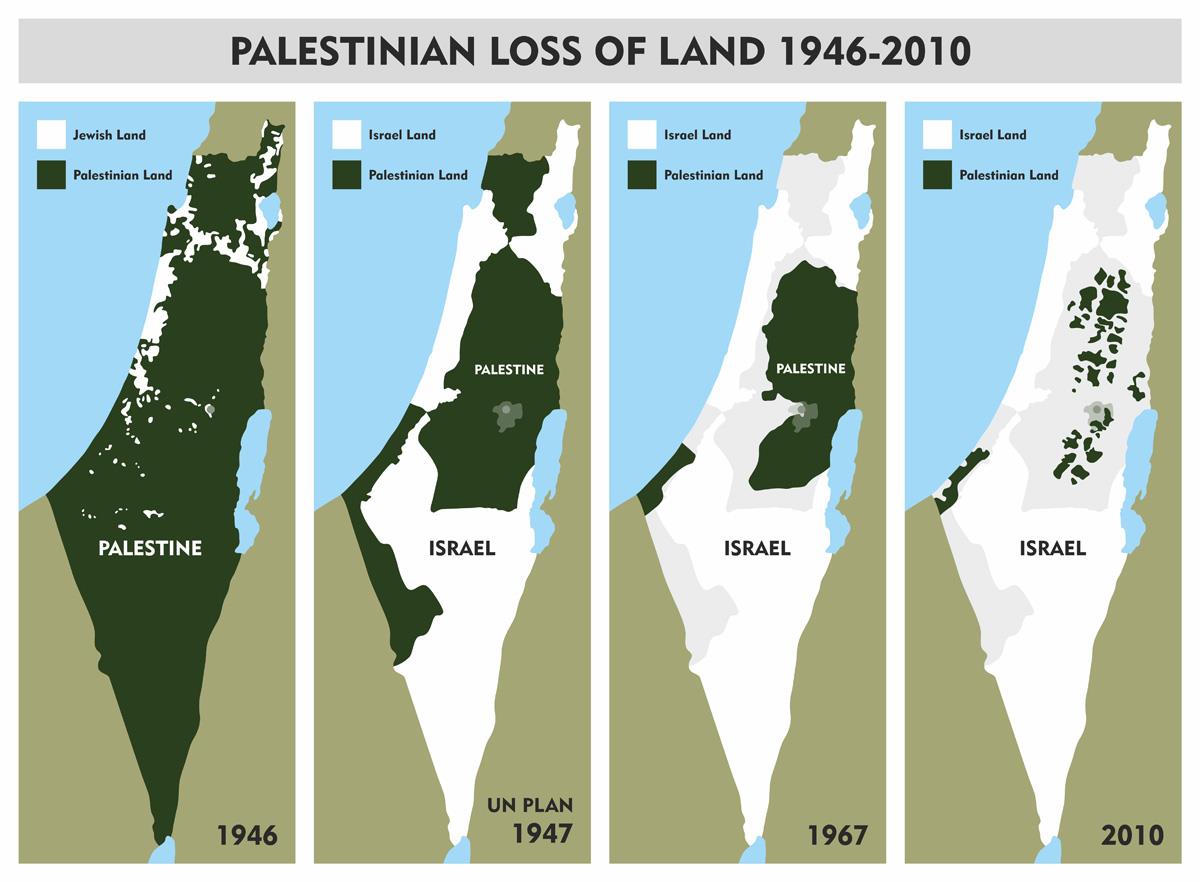
The flaw here is that the Palestinians will not abandon their pursuit of self-determination and accept being consigned to a handful of enclaves in an apartheid state.
Posted by Gary Sauer-Thompson at 9:51 AM | Comments (1) | TrackBack
November 23, 2012
Murray-Darling Basin: finally,
Minister for the Environment Tony Burke has signed the Murray-Darling Basin Plan into law. It has taken a 100 years of parochial bickering for Australia to produce a single, national plan for managing water in the Murray-Darling Basin. It was a historic step.
Burke will now present the Basin Plan to the parliament next week, in the final sitting week of the year. A disallowance motion must be moved within 15 sitting days of the Plan being tabled, and a vote held on whether or not to strike down the Plan would then be taken within a further 15 days. The Greens are opposed on the grounds that there is insufficient water for the river.
 David Pope
It commits the Federal Government to return a total of 3,200 gigalitres to the Basin environment, once the primary target of 2,750 GL is reached in 2019. On the other hand, there is a significant increase in the amount of groundwater that can be diverted each year, even though many of the rivers in the Murray-Darling Basin rely on groundwater. There is no allowance for no climate warming in the Basin Plan, even though less rainfall is likely during winter in the southern MDB.
The political pressure from the Big Irrigators has ensured the shift away from more large-scale buying back of irrigators' water entitlements towards returning water through public subsidies for irrigation upgrades.The latter is not the cheapest option since buying irrigation water from willing sellers is up to two-and-a-half times cheaper than investing in water efficiencies through infrastructure upgrades.
Posted by Gary Sauer-Thompson at 12:59 PM | Comments (5) | TrackBack
November 22, 2012
between a rock and a hard place
Deterrence with respect to asylum seekers is not working. The numbers keep increasing--about 7600 people have arrived since August 13. The Gillard government needed to deal with the fact that its offshore processing centres would soon be full. So Labor toughens up the deterrence to send a message of dissuasion--that it was not worth getting on a boat.
The government will release into the community thousands of arrivals who will be stripped of the right to work and other privileges afforded to previous asylum seekers. They will be left for up to five years with limited bridging visas which forbid work and family reunions, and offered limited rental assistance and welfare payments of $438.40 a fortnight. It is increasingly adopting cruelty as a deterrent.
 David Rowe
The ALP is tying itself in knots as it slowly crawls its way back to embracing more of the Coalition policy of the Howard era (offshore processing and mandatory detention are now Labor policy) under its ''no advantage'' test. The Coalition continues to call the asylum seekers illegals and to use the “opening of the floodgates" (the swamped meme) rhetoric. Now it will stir the resentment about the illegals living off welfare being paid for by the struggling hard working Aussie battlers by playing the politics of demonising refugees.
2013 is an election year and so the high-octane polarized political debate over a complex issue will continue with its appeal to the Anglo-Australian marginal electorates in western Sydney. The realities of region give way to the local demands of the political parties and a core problem – namely, what to do with the increasing numbers of transit migrants coming to Indonesia for whom fast resettlement is unavailable – remains unsolved.
What has happened to the idea that substantial refugee processing facilities to be set up in Indonesia to help speed up 'legal' resettlement through our recently expanded humanitarian resettlement program – up from 13,000 a year to 20,000? What has happened to the the 'Malaysia solution', with its e 'swapping' 800 sea-borne refugees, for 4000 processed refugees from Malaysia and plans for basic health and education for refugees flown to Malaysia?
Update
Refugee status is going to be deferred four or five years in implementation of the “no advantage” test. If you are a fair dinkum refugee you will stay here but be forbidden to work, not able to get a protection visa, and therefore not able to get family reunion.
Won't moving asylum seekers out of detention and into the community without adequate access to rights and entitlements foster destitution? Won't it create a supply of labour and expose asylum seekers to exploitation and harm in workplaces? What does living in the community mean? Does it mean that asylum seekers are clustered in remote areas far from amenities and services?
Posted by Gary Sauer-Thompson at 6:46 AM | Comments (22) | TrackBack
November 21, 2012
tedious and boring
The reaction to the appearance of Kevin Rudd and Malcolm Turnbull’s appearances on Q&A this week indicates that politics for most of the mainstream media's political journalists is leadership speculation. This provides commentators with an opportunity to fuel talk of leadership challenges to the leaders of their respective parties.
 David Rowe
It's horse race politics connected with movement in opinion polls--who is going to stab who, when and how---often based on off the record messages from nameless insiders in the various warring camps. In doing so the media operate as a pack, interview one another about their speculations on the state of play on cable television, write an article reporting what was said about their special insights as insiders.
They then interview various politicians about the leadership challenges circulating in the media big time. That provides the fuel for another around of speculations with the journalist breathlessly reporting that said politician smiled wrongly or shifted their foot. This is interpreted as counting the numbers. The race is on.
It's tedious and boring. They are trading in fictions and bogus narratives. But hey, it brings readers to the page and eyeballs to the screen and no expertise is required to speculate about who is going to challenge who. Recall the bogus narrative of the Canberra Pres that was almost certain that Gillard would be gone by the end of 2012 probably much sooner, and that Abbott would win a crushing victory in 2013 against Rudd Labor because the carbon tax meant the end of the world. Some even called on Gillard to resign.
The Canberra Press hasn't really addressed that they got this wrong, and badly. There's been little self-examination of their political journalism. Nope the dogs barked, the caravan moved on, and the political journalists continue with their horse race journalism based on reporting the messages being sent by the-behind-the-scenes message senders ("senior sources ....") in the political parties.
They have little interest or knowledge to assess how the Liberal Party's Direct Action response to climate change is a short-term solution; that it would not be sufficient if Australia was to aim for a higher abatement target than its current level of 5 per cent below 2000 levels by 2020; or how much it would cost in public subsidies until 2020.
Posted by Gary Sauer-Thompson at 10:14 AM | TrackBack
November 20, 2012
ALP: the NSW factional smell
The Australian, continues to obsess about what was going on in the Australian Workers Union (AWU) in the early 1990s. It is so dedicated to the Gillard Government’s demise that it ignores the significance of the World Bank spelling out what the world is likely to experience if it warmed by 4 degrees Celsius.
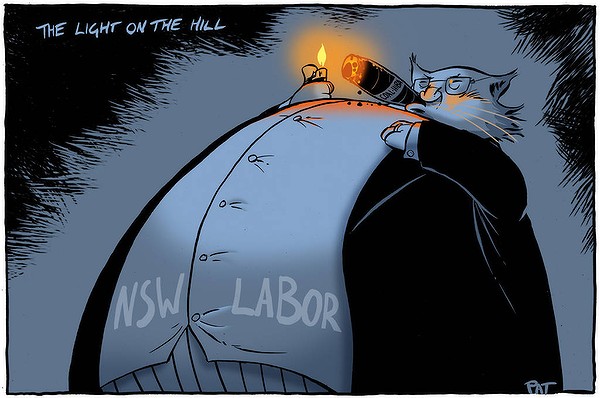
Yet the current heartburn for the ALP in the short term is not the AWU scandal; it is the corruption in NSW Labor being uncovered by the ICAC. This involves the factional warlord Eddie Obeid and former resources minister Ian Macdonald over decision to open a mining area in the Bylong Valley for coal exploration.
 Pat Campbell
It's a problem for the ALP because it highlights yet again the factional system, the internecine warfare it institutionalises, and the corruption that often results. This uncovering can only be bad news for a Labor brand that already looks tacky and tawdry.
The corruption by the Labor Right-faction powerbrokers --using political office to amass personal wealth--kicks the standard defence of the factional system out the window. That defence is that factionalism is a useful means to organize political differences within a political party and to ensure the unity of the political party. The ICAC in NSW is now uncovering the mryiad of linkages between the Labor Right-faction powerbrokers and corruption.
Meanwhile, the World Bank's report is ignored.This spells out what the world would be like if it warmed by 4 degrees Celsius, which is what scientists are nearly unanimously predicting by the end of the century, without serious policy changes:
The 4°C scenarios are devastating: the inundation of coastal cities; increasing risks for food production potentially leading to higher malnutrition rates; many dry regions becoming dryer, wet regions wetter; unprecedented heat waves in many regions, especially in the tropics; substantially exacerbated water scarcity in many regions; increased frequency of high-intensity tropical cyclones; and irreversible loss of biodiversity, including coral reef systems.And most importantly, a 4°C world is so different from the current one that it comes with high uncertainty and new risks that threaten our ability to anticipate and plan for future adaptation needs.
It points out that we already know a great deal about the threat before us. The science is unequivocal that humans are the cause of global warming, and major changes are already being observed: global mean warming is 0.8°C above pre-industrial levels; oceans have warmed by 0.09°C since the 1950s and are acidi- fying; sea levels rose by about 20 cm since pre-industrial times and are now rising at 3.2 cm per decade; an exceptional number of extreme heat waves occurred in the last decade; major food crop growing areas are increasingly affected by drought.
Higher levels of warming above a 2° increase above pre-industrial climate are increasingly likely. The Australian continues to be besotted with Gillard's involvement in the slush fund events of the Australian Workers Union (AWU) in the early 1990s.
Posted by Gary Sauer-Thompson at 9:59 AM | Comments (4) | TrackBack
November 19, 2012
AFR: losing its independence?
Has anyone noticed how the Australian Financial Review has certainly gone downhill in the quality of its commentary on public policy as it increasingly becomes just a mouthpiece for big business in Australia? The tone is increasingly one of resentment and open hostility to Gillard Labor's economic agenda, including investments in skills, innovation and clean energy, infrastructure and digital technology, tax reform and regulatory reforms.
 David Rowe
The AFR's weekend editorial ---Gillard and her wasted opportunities--- states that the central tenet of Gillard’s speech annual Business Council of Australia dinner was that the government is the driving force of the economy. It comments that:
This betrays how Labor has its priorities all mixed up. There is no recognition of the centrality of business in the economy or of the role of the profit motive and investment in driving job and wealth creation. John Howard is right to say the Gillard government is tone deaf to the legitimate concerns of business. It does not acknowledge that its industrial relations, tax and regulatory policies have added to costs and risk, all of which discourage business investment.
That's fair enough as far as it goes since there is a legitimate debate about the roles, and size of, the government and the market in fostering economic growth and what kind of economic growth is best.
So how does the AFR argue its case for the market and smaller government? The editorial goes on to cast doubt on whether Gillard Labor will deliver its projected $1.1 billion surplus, without saying why such a budget surplus is significant; and it adds that the Gillard government rarely, if ever, acknowledges the extent to which China’s demand for our resources has aided our economy under their watch and helped us through the GFC.
I would have thought that the Gillard Government places too great an emphasis on the resource boom at the expense of facilitating the shift to a high skilled digital/ knowledge economy. The sniping at Keynesian economics ---government investment to prevent a deep recession--- is developed along the following lines
If there are grave doubts about the government’s short-term fiscal outlook, the medium term outlook is murky.The Gillard government has made marginal progress in tackling the culture of entitlement that is stoking the structural deficit, but at the same time it has made a number of worthy, expensive and unfunded promises, for example, in its disability insurance scheme. If Ms Gillard wants to avoid the complacency that she talked about in her BCA speech, her government has some obvious targets. She should make it clear it will not fund any new initiatives until it has devised a serious medium-term plan to deliver substantial budget savings to get it out of structural deficit. It should conduct a full blooded review of the role of government, especially in health and education where more private sector involvement should be encouraged.
The reference here is to government handouts and to big-spending government programs. There is no acknowledgment that the Liberal Party, the party of individual initiative, freedom and responsibility, deregulated markets and small government is opposed to reducing middle class welfare, and that it consistently blocks any attempt to reduce the subsidies for private health insurance. There is no mention that Big Business could not find ways to cut its subsidies to reduce company tax.
What we get instead is the line that Gillard is relying on superficial attacks on the Opposition Leader (political spin) to raise Labor’s electoral standing, rather than engaging in reform---tax, infrastructure, and workforce deregulation. The inference? Gillard Labor fails to construct a credible policy agenda to deal with the opportunities and disciplines of the next phase of Australia’s resources boom.
The real neo-liberal agenda --wind back the welfare state and start to privatize health and education--- is then just slipped in. No argument is offered why this is good policy.
Posted by Gary Sauer-Thompson at 8:50 AM | Comments (6) | TrackBack
November 17, 2012
here we go again
The Arab-Israeli conflict is escalating again and innocent civilians are dying. It is unfolding according to a decades old script in which the Israeli attacks on Gaza are in self-defense. This narrative, in which Israel always sells itself to the west as a democracy in a sea of Arab fanaticism ("civilised Israelis v Islamist terrorists") is a false narrative.
The latest episode flows from Israel's targeted assassination of Ahmed Jaabari, the commander of Ezedin al Qassam, the military wing of Hamas, who's prevented attacks on Israelis for the past five years. Rockets were then launched from locations around Gaza and reach the outskirts of Jerusalem and Tel Aviv. Gaza is now under military attack.
 Steve Bell
Recall that in the winter of 2008-9 Israel's Operation Cast Lead, coupled with the blockade of Gaza, was meant to root out "the infrastructure of terror" from Gaza and eradicate the Hamas threat. It did nothing of the sort. It left up to 1,400 Palestinians and Hamas remained in control. In the summer of 2006 Israel went to war against Hizbullah in order to eliminate its missiles and weaken its political position in Lebanon. That offensive failed as well: Its failure indicated that military operations will solve not the Palestinian problem.
We have the usual good guys (Israel) v the bad guys (Hamas ) scenario by the western media and governments with its implicit denial that the Palestinians have the legal right to resist violent occupation, Israel's targeting a population of civilians, and Israel’s efforts to deny them self-determination. The right wing Israeli aim--ie., Likud--- is to create a Greater Israel through the colonisation of the Occupied Territories.
The Netanyahu government is dead-set against allowing the Palestinians to have a viable state of their own and wants them to accept permanent Bantustan status under Israeli rule instead. If the two-state solution collapses’ then Israel will ‘face a South-African-style struggle’. What happens to the unconditional US support for Israel then?
Update
Both houses of Congress overwhelmingly voted for resolutions in support of Israel's "inherent right to act in self-defence".The two houses of Congress expressed:
unwavering commitment to the security of the state of Israel as a Jewish and democratic state with secure borders, and recognises and strongly supports its inherent right to act in self-defence to protect its citizens against acts of terrorism.
So Israel is the innocent victim of indiscriminate terror attacks by Hamas and Hamas is not democratically elected. This is taking pace on the eve of a Palestinian bid for greater recognition at the United Nations and with an Israeli election around the corner.
Posted by Gary Sauer-Thompson at 1:33 PM | Comments (10) | TrackBack
November 15, 2012
Big Coal's wet dream
The 2012 World Energy Outlook, released by the International Energy Agency, makes for sobering reading. This presents current views of possibilities over the next 25 years for energy markets and energy-related CO2 emissions, with these possibilities presented through three core scenarios.
This is based on the assumptions and output of the World Energy Model (WEM), which in the IEA's words, is a large-scale mathematical construct designed to replicate how energy markets function and is the principal tool used to generate detailed sector-by-sector and region-by-region projections for various scenarios. While these scenarios differ, many exogenous factors are kept consistent between scenarios ie.,
assumptions about population and economic growth are the same in each scenario.
The Outlook reinforces the emphasis in the Energy White Paper about Australia's expansion of coal and gas exports to facilitate the economic growth of China and India; and the Gillard Government's primary concern to secure another wave of resources investment.
The assumption here is the business-as-usual one in which the world does nothing about climate change. According to the World Energy Outlook, locks the world into average temperature rises of 6C; coal demand grows by 1.9 per cent per year out to 2035, and coal actually dethrones oil as the leading primary fuel around 2025, settling in at a share of just under 30% of the global energy market by 2035.
This scenario is Big Coal's wet dream---Gina Rinehart, Clive Palmer, and BHP Billiton and Rio Rio Tinto stand to make billions of dollars. Hence the coal industry's (miners and generators) deep opposition to the science of climate change and secondly against doing something about it through making a shift to a low carbon economy.
A second scenario takes account of the broad policy commitments and plans that have been announced by countries around the world--ie taking action in the form of the politics of climate change. In this scenario, whioch locks in average global warming of 3.6C, gas (Woodside, Santos and Origin) has a “very bright” outlook to the mid 2020s whilst the coal industry use is predicted to rise by 21 per cent by 2035. So the less action that is taken to reduce global warming means the greater profits for the fossil fuel industry. So they have no interest in reducing global warming to 2.0C and every economic reason to oppose it.
Taking climate change science seriously and achieving the 2 °C goal means the collapse of coal, unless carbon capture and storage (CCS) technology is widely deployed. Coal's share of the global primary energy mix (which includes all forms of enegy), tumbling to just 16 per cent by 2035, by which time it is overtaken by renewables and gas. King Coal faces dethronemen if the decarbonisation crowd wins. Hence the importance of (CCS) technology for Big Coal.
This is the IEA's 450 Scenario and it is the one that it supports. It is a scenario in which fossil fuel subsidies are abolished, fast.
Posted by Gary Sauer-Thompson at 11:54 AM | TrackBack
November 14, 2012
Catholic Church: the rogue defence
It sure has taken a long time break down the defensive walls of legal protection that the sexual abusers, paedophiles and predators in the Catholic Church have hidden behind so successfully, for so long. Several decades in fact to set up a Royal Commission to expose the systemic network of abuse and its coverup. The Catholic Church, and it appears the police, have been very skilled in covering up the atrocities.
 David Pope
The Church's defence has been the few rotten apples one (the rogues defence) and dismissed the existence of institutional sexual abuse There has been entrenched resistance to addressing the issue from the political parties, the churches and police.
The Church's position had been that is insufficient evidence to justify a Royal Commission into the sexual crimes of the Catholic church, that it has changed, has taken decisive steps to make child safety a priority and to help victims and been the victim of a biased media. It knew what has happening, it relocated the abusers who offended again, and it did not inform the police.
Update
The Australian weighs in with an editorial entitled A time for open confession:
The Australian supports the royal commission as a vehicle for exposing institutional failures. If radical secularists want to propose a separate royal commission to consider the abolition of the Catholic Church, they are welcome to put the arguments forward. But this subversive game being played by the usual suspects, with the connivance of the ABC, is a distraction the real victims of abuse could do without. Let us not beat about the bush: their fight with Catholicism is, in part, a proxy war against Tony Abbott.
I haven't heard any radical secularists proposing a separate royal commission to consider the abolition of the Catholic Church, nor have I heard the public broadcaster's using the issue to wage a proxy war against the Opposition leader. That's fantasy land stuff ----Catholic conservatives are living in an inverted world that has become an alternate reality.
The issue is to do with abused children and predatory priests and the Catholic Church not reporting the cases of sexual abuses it knows to the police, not the dismantling of the Catholic Church or an attack on the First Section 116 of the Constitution that bans the commonwealth from prohibiting the "free exercise of religion".
Posted by Gary Sauer-Thompson at 6:37 AM | Comments (13) | TrackBack
November 13, 2012
Treasury's wellbeing framework
In the latest issue of the Economic Roundup (Issue 3, 2012) there is an article on Treasury's wellbeing framework that underpins its whole-of-government, whole-of-economy perspective to policy analysis and advice.
Treasury's view of wellbeing is one that:
primarily reflect[s] a person’s substantive freedom to lead a life they have reason to value. It gives prominence to respecting the informed preferences of individuals, while allowing scope for broader social actions and choices. It is open to both subjective and objective notions of wellbeing, and to concerns for outcomes and consequences as well as for rights and liberties.
The elements of this are: opportunities, distribution, sustainability, the level and allocation of risk, and the complexity of choices.
This wellbeing framework is what neo-liberals contest. Thus Judith Sloan in The Australian says that the proper end of economics is maximising per capita gross domestic product; and that Treasury's turn to the end of economics as the wellbeing of the Australian people is the primary cause of Treasury's declining standards, second-rate output and bodgie advice.
The wellbeing framework, according to Sloan, is mushy, confusing and unhelpful and it can be used to justify virtually any decision because the framework relies on the subjective (and political) value judgments of Treasury officials to weight the five dimensions of wellbeing.
As we've come to expect from Sloan's work in The Australian there are no arguments to justify these assertions. She does not, for instance, engage with the ‘capabilities’ approach that underpins wellbeing: an approach that is concerned with providing individuals with the substantive freedom to lead a life they value: where a person’s substantive freedom depends not only on their rights and liberties but also on their own abilities and characteristics, and the economic, social and natural environment around them.
Nor does Sloan bother to explore Treasury's emphasis on what each individual values, with reason, in their life with the more traditional economic interpretations of utility as both preference-satisfaction and happiness.
Posted by Gary Sauer-Thompson at 7:22 AM | Comments (1) | TrackBack
November 12, 2012
'War on Terror': drones
A report, produced by the law schools at Stanford and NYU entitled, “Living Under Drones”, documents the damage and terror that drone-strikes have inflicted on the tribal areas of Pakistan. The report challenges the idea that the drone-strikes that enable the “targeted killing” of terrorists, are “surgically precise” and cause minimal civilian casualties.
On the contrary, it argues the targeted killing program in this remote-control war has resulted in hundreds of civilians having been killed – including 176 children. The fact that drone strikes are so frequent has, it is argued, made residents of the tribal areas frightened to gather in groups, whether for a funeral or a marriage.

The continuous killing with drones does not eliminate violence aimed at the US but rather guarantees its permanent expansion. Mark Danner in the New York Review of Books says that:
There is much evidence to suggest that many, at least by any reasonable definition of “threat,” do not—indeed, that in as many as 94 percent of the cases the targets are “mere foot soldiers” about whom, according to terrorism expert Peter Bergen, “it’s hard to make the case that [they] threaten the United States in some way.” What is not in dispute is that these killings of thousands of Muslims, conducted by remote control by a distant superpower, have caused enormous resentment and hatred of the United States in Pakistan and throughout the Islamic world, a consequence that helps revivify and perpetuate the political sentiments at the root of the war on terror.
The War on Terror was successfully locked into the familiar political constellation of a four-decade-long cold war by George Bush and the Republicans by linking it back to the fascism, Nazism, communism and totalitarianism of the 20th century.
The Republican justification is that killing Muslim children with drones protects American children from terrorism. It makes America safe. However, it is Obama who has institutionalized the highly classified practice of targeted killing, transforming ad-hoc elements into a counterterrorism infrastructure capable of sustaining a seemingly permanent war in many different regions of the world.
Glenn Greenwald says that:
What has been created here - permanently institutionalized - is a highly secretive executive branch agency that simultaneously engages in two functions: (1) it collects and analyzes massive amounts of surveillance data about all Americans without any judicial review let alone search warrants, and (2) creates and implements a "matrix" that determines the "disposition" of suspects, up to and including execution, without a whiff of due process or oversight. It is simultaneously a surveillance state and a secretive, unaccountable judicial body that analyzes who you are and then decrees what should be done with you, how you should be "disposed" of, beyond the reach of any minimal accountability or transparency.
The US is continuing its steps along the path to a state of endless war and the powers and benefits it engenders.
Posted by Gary Sauer-Thompson at 9:03 AM | Comments (6) | TrackBack
November 11, 2012
China: looking back
As China engages in its week long change of leadership it pays to look back at its recent past to the Great Chinese Famine to see how great the economic transformation has been. That famine led to the Cultural Revolution from 1966 through to 1976 and, ultimately, today’s reform period of state controlled capitalism that began with Deng Xiaoping's economic reforms that lead China towards led China towards a market economy.
In Tombstone: The Great Chinese Famine, 1958–1962, the Chinese journalist Yang Jisheng gives an account of the worst famine in Chinese history. Yang conservatively estimates that 36 million people died of unnatural causes, mostly due to starvation but also government-instigated torture and murder of those who opposed the Communist Party’s economic plans under the Great Leap Forward that caused the catastrophe.
In this review of Jisheng's text in the New York Review of Books, Ian Johnson says that Jisheng's main point is to prove that the Party, from the village chief up to Chairman Mao, knew exactly what was going on but was too warped by ideology to change course until tens of millions had died.
The famine grew out of Mao’s desire to speed up China’s development and force it into a utopian Communist vision that few in the Communist Party’s leadership had thought possible or desirable. When the Communists took power they had forced through a brutal land reform that killed millions of landlords and imagined enemies, but they had also redistributed property to peasants—an immensely popular measure that won Mao goodwill among many people....In 1957, however, Mao launched the Anti-Rightist Campaign, a wave of terror that wiped out or cowed much of the intelligentsia, terrifying even members of his inner circle. That allowed him to pursue collectivization, which reversed land reform by taking land from the peasants. Instead of peasants owning the land, the state did, giving it complete control over agricultural production.Local officials began sending all their village’s harvests to granaries to meet impossible grain targets, leaving villagers with nothing to eat. The Great Leap Forward and the commune system were an economic failure.
Deng Xiaoping opened China to foreign investment, the global market and limited private competition to ensure that China became a modern, industrial nation.
Posted by Gary Sauer-Thompson at 3:38 PM | Comments (1) | TrackBack
November 10, 2012
China: rebalancing
The global economy faces an extended multi-year period of low growth, with the policy gridlock and mistakes in Europe, the US, and elsewhere in dealing with deleveraging the bad debt that was due to the destructive exuberance of the culture of the deregulated finance industry since the 1980s.
Economists reckoned that government's could do more damage taking control of the boom than they would by having a crash and picking up the pieces. They were dead wrong.
 David Rowe
Post crash Australia looks towards Asia to ease it through a period of low global growth in the north Atlantic region. China, in particular, will jumpstart the stagnating global economy. However, as Changyong Rhee in Asia’s Stifled Services, observes:
Asia’s boom was driven largely by intraregional manufacturing linkages: intermediate goods and parts were sourced from within Asia for assembly into final goods exported to advanced economies. But, with budget-tightening around the world, demand for Asia’s exports is expected to continue to falter. Where, then, should Asia look for another source of growth?
Upgrading the service sector – for example, business processing, tourism, and health care – could play a critical role in the region’s future growth.
A good example is China, which has huge net foreign assets due to its current-account and capital-account surpluses over the last for two decades. However, its economic growth is highly sensitive to global conditions and Europe’s malaise has hit China’s exports badly. China’s 12th Five-Year Plan calls for a shift in the country’s economic model from export-led growth toward greater reliance on domestic demand, particularly household consumption. That means slower economic growth and less demand for Australia's iron ore.
Yu Yongding in How Should China Respond to the Slowdown?
While huge amounts of money have been poured into physical infrastructure, public expenditure on human capital and social security is below the world average. More resources should be reallocated from physical capital formation to human capital formation.
In Australia there is too much focus on a single economic power, namely China, and its impact on Australia's economic growth; too great an emphasis in Canberra on bilateral relationships are all that are necessary to secure Australia's future; and too much scepticism in Canberra about the feasibility of a new regional economic architecture in Asia, such as the northeast Asian region around China, South Korea and Japan.
Posted by Gary Sauer-Thompson at 9:35 PM | Comments (6) | TrackBack
November 9, 2012
US: budget hysteria
The result of what Obama calls the "Grand Bargain" with the Republican Party (GOP)---ie., the pigfight over the fiscal cliff---- is likely to be a deficit- and debt-cutting agreement whereby the GOP agrees to some very modest tax increases on the rich in exchange for substantial cuts to entitlement programs such as social security and Medicare.
The root of the problem for the Republicans is the rising cost of Social Security and federal health programs--not the bailout of, and corruption on, Wall Street. Republican memes is that the safety net is unsustainable and that it harms the nation.
 Steve Bell
Wall Street gunned for Obama in the election. As Paul Krugman puts it on his Conscience of a Liberal blog:
The story, as you may recall, is that the financial industry — having brought both itself and the rest of the world to the edge of disaster — was bailed out by taxpayers. Yet far from being grateful, top financial types were furious at Obama for occasionally hinting that some of them might have misbehaved a bit. And investment bankers — who normally lean Democratic — went overwhelmingly to the other side, pouring cash into Mitt Romney’s coffers in the no doubt correct expectation that a Romney administration would dismantle financial reform and treat their wealth with the adulation they believe to be their birthright.
Wall Street lost.
Wall Street's central assertion is that there is no alternative – the safety net must be cut--not defence. Immediate austerity is necessary. The best policy is to privatize social security because that means Wall Street is able to charge tens of billions of dollars in fees annually. So gutting the safety net is the essential act necessary to save the nation.
It is hysteria because austerity through budget cutting means that GDP falls even more than the deficit is reduced whilst the central problem for the US should be fostering economic growth to reduce unemployment. Obama should say no even though the looming combination of tax increases and spending cuts looks easily large enough to push America back into recession.
Why? Krugman says:
Because Republicans are trying, for the third time since he took office, to use economic blackmail to achieve a goal they lack the votes to achieve through the normal legislative process. In particular, they want to extend the Bush tax cuts for the wealthy, even though the nation can’t afford to make those tax cuts permanent and the public believes that taxes on the rich should go up — and they’re threatening to block any deal on anything else unless they get their way. So they are, in effect, threatening to tank the economy unless their demands are met.
The Republicans are into hostage taking.
Posted by Gary Sauer-Thompson at 3:32 PM | Comments (1) | TrackBack
November 8, 2012
Energy White Paper
The Gillard Government's Energy White Paper--Australia’s Energy Transformation-- is being published in the context of massively rising power bills, falling wholesale prices and reducing demand for electricity. What we have is market failure.
An energy policy debate should be about how best to re-design the electricity market institutions to achieve an integration with climate policy goals: cheaper prices for consumers, reduced greenhouse emissions and the emergence of a low carbon economy.
However, the energy white paper appears to equate the supply and, demand and use of electricity with energy security, the exploitation of natural resources and mining policy. The bureaucratic blurb reads:
The 2012 Energy White Paper sets out the Australian Government's strategic policy framework to guide Australia’s energy transformation to a cleaner and more productive energy economy. The central objective of the Energy White Paper is to provide the settings to deliver secure, reliable, clean, competitively priced energy to consumers; while building our national wealth through the safe and sustainable development of our energy resources.
Thus the white paper rules out the domestic nuclear power option, but supports increased uranium mining, and supports growth in the mining and export of of fossil fuels, especially coal and gas. What has the mining and export of of fossil fuels---uranium coal and gas--got to do with energy policy? Isn't this harnessing and exploiting natural resources to enhance Australia's prosperity an indication of developmentalism?
The Energy White Paper is about digging up as many fossil fuels as possible as quickly as possible to make as many billions as possible. That has to do with, and contradicts, the aim of taking climate change into account.
Secondly, the biggest defect of the National Electricity Market is its complete absence of policies to reduce emissions, even though electricity generation is the source of over 35% of Australia’s emissions. Environmental sustainability and climate change mitigation are not included in the objectives of the National Electricity Law. The inference is that dealing with greenhouse gas emissions is not an objective of energy policy in Australia.
Thirdly, the objective of energy policy in Australia is for the national electricity market to provide accessible, reliable and competitively priced energy for all Australians. Clean and sustainable energy is something that is added on from the outside, because it is not written into the legislation and rules that govern the national electricity market.
Consequently, renewable energy and reducing emissions is a constraint on the market because the objective to provide accessible, reliable and competitively priced energy for all Australians through an open and efficient market with good, intelligent regulation. For energy policy makers the market has a fundamental role in delivering the energy future, and they are adamant that their focus should be on “economic” efficiency and on keeping environmental considerations out of the rules and operation of the electricity market.
The Green's on the Senate Select Committee on Electricity Pricing addressed this issue. They recommendated that the National Electricity Objective be re-written to include an environmental objective and an objective that there are no regulatory barriers to demand management, energy efficiency and distributed generation.
Posted by Gary Sauer-Thompson at 2:25 PM | Comments (8) | TrackBack
November 7, 2012
US: Presidential election
I've been offline for a couple of days in Victor Harbor due to the storm that swept through South Australia. I've just started catching up with the US presidential election since my return to Adelaide. It looks as if the Democrats will hold, and maybe even, increase their majority in the Senate.
According to the pundits and the media the presidential contest is tight. Despite being ahead in the popular vote, the door is closing on Romney in the Electoral College votes with Obama winning in Wisconsin, Pennsylvania and Michigan. Obama's firewall in the Midwest holds up as the rustbelt strategy is working.
Romney's path to victory is narrowing since to win the presidency he has to take all four of Ohio, Florida, Virginia and North Carolina. Then on top of that he needs one further smaller state to take him over the top and there's only three of those left in the pot: Colorado, Iowa and Nevada. There are not a lot of options for Romney if he doesn't win Ohio. Is there another path for Romney.
 David Pope
Fox News is becoming a little glum. In their eyes traditional White America is threatened by nonwhites-- ie., blacks and Hispanics--and Republicans are seeing their electoral map narrow rather than widen. The problem for the Republicans is that their base is shrinking and they struggle to appeal to a broader cross-section of the electorate? How do they do that? They cannot just slag off Obama as Fox News does.
The House of Representatives looks to remain Republican, and so power in Washington looks again likely to be shared between the parties. America remains a sharply divided society and there will be further confrontation, impasse and political dysfunction in Washington.
On December 31, the Bush tax cuts are due to expire and automatic spending cuts are due to begin, as a result of the Congressional deadlock over raising the debt ceiling. These will create problems for an Obama presidency, as President Obama has threatened to veto any legislation that extends the Bush tax cuts for the wealthy. Republicans want to cut spending and avoid raising taxes, while Democrats are looking for a combination of spending cuts and tax increases.
In dealing with the fiscal cliff, U.S. lawmakers have a choice among three options, none of which are particularly attractive:
They can let the current policy scheduled for the beginning of 2013 – which features a number of tax increases and spending cuts that are expected to weigh heavily on growth and possibly drive the economy back into a recession – go into effect. The plus side: the deficit, as a percentage of GDP, would be cut in half.
They can cancel some or all of the scheduled tax increases and spending cuts, which would add to the deficit and increase the odds that the United States could face a crisis similar to that which is occurring in Europe. The flip side of this, of course, is that the United States' debt will continue to grow.
They could take a middle course, opting for an approach that would address the budget issues to a limited extent, but that would have a more modest impact on growth.
Update
Obama is projected by the networks to win Ohio and so regain the Presidency. The three rustbelt states of the Midwestern firewall (Iowa, Ohio and Wisconsin) held. Was it due to the white working class voters, particularly women being won over by the auto industry rescue? Most blue-collar whites vote Republican while most minorities and affluent suburban whites go with Democrats.
Romney's strategy assumed that the low growth economy with high unemployment would automatically turn voters against the president fell short and that they would vote for the low tax/small government option. No doubt many Republicans will say they would have won with a more conservative candidate. Their future is to go more conservative, even though their social conservatism around women's reproductive health care would have caused many women to vote for Obama.
President Obama won easily. The Senate barely budges. The House stays about the same. It's the status quo. The health care reform--The Affordable Care Act---will remain.
Posted by Gary Sauer-Thompson at 12:19 PM | Comments (15) | TrackBack
November 5, 2012
US: myth and denial
I see that Mitt Romney adopts the same tactics as Tony Abbott --he says different things to different folks--- across the battleground states. The meme for both Abbott and Romney is to play on local fears and rely on untruths.
Probably the Liberal Party in Australia copied the tactic from the Republicans.
 David Rowe
Another similar tactic is that the policies of Abbott and Romney are little more than buzzwords, slogans and declarations that they know how to fix the problem, whatever that problem is. Their opponent, by contrast, creates problems rather than solves them. This tactic is all about winning and has little to do with what they will do to govern if they win.
The political reality is that the institutions of government in Washington are increasingly dysfunctional--eg., the partisan gridlock in Washington---and this makes any strategy of promoting economic development to address both the recession and economic decline almost impossible.
Yet the assumption underlying practically all US discussion is that any slippage in America's global standing is the result of misguided policies that can be reversed by an act of will, even though the capture of US policy-making by financial institutions effectively rules out any serious attempt to tackle the country's economic problems for the foreseeable future.
The hollowing out of the middle class is what is fueling the Tea Party populism, with its feelings of dispossession, loss and resentment. That won't be enough to flip the swing states Romney's way despite the voter suppression and the tightening of election laws aimed at suppressing turnout among minorities, the elderly, and other voting constituencies that traditionally favor Democrats at the polls
Posted by Gary Sauer-Thompson at 6:51 AM | Comments (10) | TrackBack
November 3, 2012
social democrat woes?
Rob Manwaring argues that social democracy is not traveling well these days. He refers to the increasing numbers of the public turning to the right rather than to the left to govern them; the fragmentation of support for the left with the rise of the Greens; a suspicion of state power, and the issue of immigration being a real Achilles heel in centre-left politics.
 David Pope
However, he adds, the under-pinning structural problem facing centre-left parties since the 1980 is the dominance of neoliberalism. Neoliberalism has a powerful internal logic with popular appeal: economic growth takes place when tackling inflation is prioritised over securing full employment; taxes are low, the welfare state is minimal, and privatisation and marketisation are rife.
The centre-left, he says, has struggled to adopt a sufficiently distinct and electorally appealing alternative to this agenda. Labor today stands for being a competent manager of the economy and incremental change that modify the edges of a neoliberal mode of governance.
John Gray digs deeper into this relationship between neo-liberalism and social democracy by pointing out the contradictions of neo-liberalism. For example:
Neoliberals wanted to limit government, but the upshot of their policies has been a huge expansion in the power of the state. Deregulating the financial system left banks free to speculate, and they did so with reckless enthusiasm. The result was a build-up of toxic assets that threatened the entire banking system. The government was forced to step in to save the system from self-destruction, but only at the cost of becoming itself hugely indebted. As a result, the state has a greater stake in the financial system than it did in the time of Clement Attlee.
Gray adds that although the deregulated banking system may have imploded, capital remains highly mobile. Bailing out the banks has shifted the burden of toxic debt to the state, and there is a mounting risk of a sovereign debt crisis as a result. In these conditions, maintaining the high levels of public spending that social democracy requires will be next to impossible.
Hence the Gillard Government's education reforms are designed to prepare people for the labour market, rather than developing any substantive form of social justice.
Posted by Gary Sauer-Thompson at 10:16 PM | Comments (10) | TrackBack
November 2, 2012
Canberra Gaze: changing dynamics
I see that the some journalists in the poll-driven Canberra Press Gallery have started to revise their gold plated narrative about a doomed Gillard Government. They have begun to recognize the changing dynamics in the Parliament favouring Gillard Labor, and they are even starting to question Abbott's 'axe the carbon tax' roadshow with its scare campaign rhetoric.
 David Rowe
What the journalists in the media aren't doing is stepping behind the surface point scoring politics of the budget surplus -to the fact that Gillard Labor has pulled off a big fiscal turnaround in just one year from a deficit of $43 billion to a $1.1 billion surplus forecast. The don't analyze the policy issues of this in the context of a stagnant global economy, and the economic reality that Canberra needs to rejig its revenue base.
How plausible is the politics of austerity, with its rhetoric fiscal black holes, as advocated by the Coalition in today's world? This is one in which the global economy is very interconnected, there is a synchronized economic downturn in almost all countries, and there are major problems for government finances. So what to do?
The politics of austerity, as advocated by the Coalition, is still just accepted by the Gallery, and they rarely criticize the deficit demagogues. They don't appear to ask whether the strategy of a politics of austerity---lower taxes and public services slashed to the bone---is an agenda that helps a few powerful people while hurting the rest of us. Or question the claims of some supporters of austerity who argue that fiscal adjustment to achieve budget surpluses could restore economic growth. They don't ask why state intervention in demand management through fiscal means is anathema for finance and mining capital.
Nor do they ask whether the neo-liberal preoccupation with the virtues of "sound finance" ---(ie, of balancing budgets) and reducing public debt--- is flawed as a long term approach to the revenue shortfalls, due to the global economic crisis. Is it the right approach to the opportunities for Australia that are being opened, and shaped by, developments in the Asia-Pacific Rim region.
They don't seem to weigh this up in relation to whether a better approach to Australia's future is one of strengthening our economy and preserving the essential functions of government?
Posted by Gary Sauer-Thompson at 11:16 AM | Comments (2) | TrackBack
November 1, 2012
US: presidential race
It is difficult for me to assess the state of play in the US presidential elections. I can report that the standard view based on the national polls is that the Republicans had the momentum before the Sandy super storm, its a tight presidential campaign, and the state polls suggest that Obama has the edge in the Electoral College.
It's difficult to say more in terms of analysis because there's just too much partisan noise in the context of the current adversarial divide, "sure things" in the media are generally illusions, the polls in the battleground states (Ohio, Colorado, Nevada, Wisconsin etc) have little certainty with respect in forecasting, and there is too much cherry-picking of polls that confirm political biases of the pundits.
 Steve Bell
What was obvious was that the three presidential debates were not much of the guide to the deep issues that confront the US in a global world, to the deep discontent circulating throughout the nation from the growing inequality, or to the failure of governance with respect to the financialization of the US economy.
Both presidential candidates shied away from the issue of who was responsible for the global financial crisis that caused the deep recession and the slow recovery of the last five years and they both work within the politics of austerity.
This suggest that there is large and growing distance between the rhetoric and pronouncements of the politicians and pundits and the actual deepening, immense, and largely ignored problems that afflict the people of the United States. US democracy is more akin to form of plutocracy---the rule of money rather than the rule of the people---and the corruption in Congress and across the government today is a structural dependence upon corporate money built into the DNA of the political system. This plutocracy is one in which the neoliberal mode of governance has transformed the political domain into a domain of money.
We have a situation today where the politics of austerity is used to oppose the view that the use of government to build infrastructure, create jobs, and end stagnation, even though the historical record appears to demonstrate that democratic governments have it within their power to make capitalism operate far more efficiently and effectively. Government, according to neo-liberal's politics of austerity, is inherently bad, whilst the corporate interests effective domination of government, means that the capacity of the democratic state to address market failure on behalf of the general public is undermined.
The politics around the global financial crisis in Washington suggests that the politics of austerity is primarily interested protecting Wall Street's financial assets and capital gains than in the risky enterprise of investment in new productive capacity. What is always opposed is anything that jeopardizes their control over the government and their dominant position in society.
Posted by Gary Sauer-Thompson at 5:29 PM | Comments (8) | TrackBack