« September 2012 | Main | November 2012 »
October 31, 2012
is stagnation the new normal?
The current fetish in Canberra about the budget surplus is an expression of austerity now being “in fashion”. Governments respond to the revenue shortfalls of the global economic crisis through deficit reduction plans whilst economists blame it on the profligate spending of countries with social democratic governments.
The economists say that deficit spending is inflationary, and in any case will not help in the long run as budget deficits raise interest rates, “crowding out” business and household spending. They talk about as inflexible labor markets and “sticky prices”.
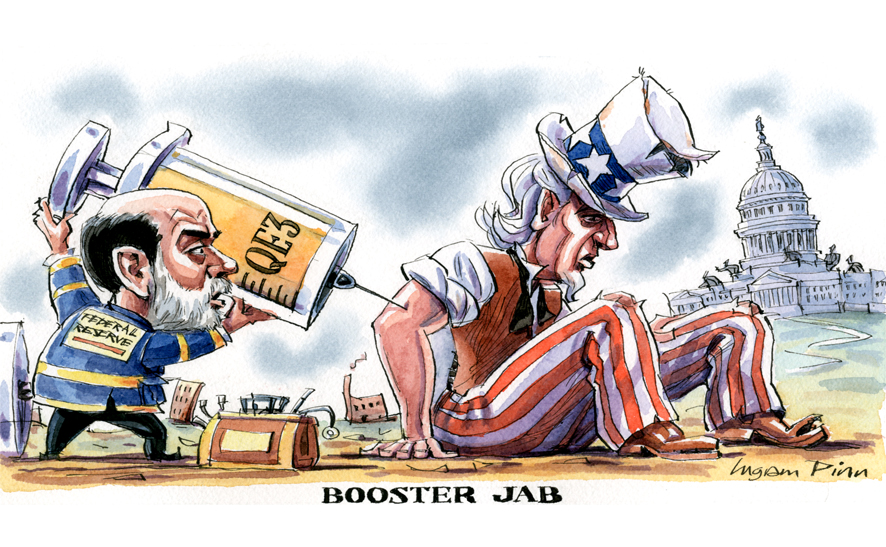 Ingram Pinn
This is the pre-Keynesian stance of the economics profession on display. The politicians reason from the analogy between the individual household and society as a whole assuming that what holds for the individual household holds also for all households together. Maxing out the credit card is bad.
Hence the need for belt-tightening. For these economists the bursting of the financial bubble and the subsequent crisis represented events that were not supposed to happen. For them ---e., their conventional macroeconomic wisdom---the economy was now free of major crisis tendencies, due to the advent of new, improved monetary policies.
There has been a shift in focus from financial crisis of 2007 to economic stagnation in the global economy; to a sense that there will be a prolonged period of stagnation, what Paul Krugman called a Third Depression (the first two being the Long Depression following the Panic of 1873 and the Great Depression of the 1930s).
The defining characteristic of such depressions was not negative economic growth, as in the trough of the business cycle, but rather protracted slow growth once economic recovery had commenced. In such a long, drawn-out recovery “episodes of improvement were never enough to undo the damage of the initial slump, and were followed by relapses.” It is a long period of anemic growth.
The logic of neoclassical economics is that rapid growth was natural under capitalism, except when outside forces, such as the state or trade unions, interfered with the smooth operation of the market. The economic reality is that global economic growth since the 1970s has been driven b;
(1) the much greater role of government spending and government deficits;
(2) the enormous growth of consumer debt, including residential mortgage debt, especially during the 1970s; a
(3) the ballooning of the financial sector of the economy with its explosion of all kinds of speculation, old and new.
A new financially driven capitalism centered in Wall Street had emerged. That financialization style of growth crashed spectacularly in 2007.
The situation now is one of financial instability and a deep economic malaise (stagnation), which has set in during the current period of financial deleveraging and the declining hegemony of the US. The hope is that China can carry the world economy on its back, and so keep the developed nations in America and Europe from what appears to be a generation of stagnation and intense political struggles over austerity politics. The big hope is that China could provide capitalism with a few decades of adequate growth and buy time for the Us and Europe to sort themselves out.
China---the new perpetual growth machine--- will act to counterbalance the tendency toward stagnation at the global level. We are now in the realm of economic illusions.
Posted by Gary Sauer-Thompson at 9:31 AM | Comments (17) | TrackBack
October 30, 2012
Murray-Darling Basin: a small win
Gillard Labor announced that the Commonwealth will spend $1.7 billion to increase water return to the Murray-Darling River by a further 450 gigalitres. The extra 450 gigalitres will be achieved "largely" through on-farm investments. The extra water savings are in addition to the draft Murray-Darling Basin Plan that recommends 2,750 gigalitres be returned to the environment, taking the new total to 3,200 GL.
The announcement, which is a small win for South Australia, may start to see a reversal of the environmental degradation at the lower end of the basin system due to the overallocation of a water by the various state governments. It is 'may' because New South Wales and Victoria have been campaigning for a limit of 2,100 gigalitres on how much water can be recovered for environmental flows.
If the Commonwealth attempts to override the resistance to reform the overallocations of water by New South Wales and Victoria, are we heading for a constitutional showdown being decided by the High Court? Would it not have have easier and more effective to buy back the water? The reason is that the basin irrigators in New South Wales and Victoria have largely rejected that market based approach.
It's a depressing scenario but i see little chance of co-operation at the level of CoAG. The history has been one of conflict between, not consensus amongst, the states with respect to reducing the overallocation of water. Overallocation of water for irrigation is not fair use.
Posted by Gary Sauer-Thompson at 10:36 AM | Comments (1) | TrackBack
October 29, 2012
the Asian century?
The Australian Government’s Australia in the Asian Century White Paper comes at a time when the mining boom is over and Australia needs to shift beyond being Asia's quarry, or Australia's traditional 'rocks and crops' engagement with Asia. It's a picture of Australia after the mining boom.
 David Rowe
The White Paper recognizes, it's own words, that:
The Asian century is an Australian opportunity. As the global centre of gravity shifts to our region, the tyranny of distance is being replaced by the prospects of proximity. Australia is located in the right place at the right time—in the Asian region in the Asian century....An increasingly wealthy and mobile middle class is emerging in the region, creating new opportunities. They are demanding a diverse range of goods and services, from health and aged care to education to household goods, and tourism, banking and financial services, as well as high‑quality food products.
It argues that it is in the interests of all Australians—and therefore in the national interest—to develop the capabilities and connections that Australia will need, so that we can contribute to, and learn from, the region, and take full advantage of these opportunities.
It's a good and familiar roadmap, as it one that we know quite well: Australia needs to lift productivity, be fairer, be smarter, be better educated etc. It is a more realistic road map than the Queenland's dinosaur one of coal being the future based on the coal industry's carbon capture scenario. Treasury secretary Martin Parkinson shows why.
He talks about three phases of Australia’s Asian Century boom: Asia’s extraordinary demand for our minerals and energy; then, as incomes rise, its demand for high-quality food; and finally, with the rise of Asia’s middle class, its demand for professional and tourism services and niche manufacturing.
However, the roadmap assumes that Asia is out there which Australia needs to adapt to. It does not see Australia as being within Asian, nor does it address the fear of Asia held by many Australians.
The puzzle is: how are we going to get to this kind of high skill future? The road map states that with the right plan, we can make the new middle-class Asia a new market for a high-wage, high-skill Australia. What is the right plan? For instance, how would the NBN facilitate this? If so, how?
Will it be through high-growth tech companies? Creating a world-leading technology city to rival Silicon Valley? Does Australia's Tech City---the Digital Harbor in Melbourne's Docklands---have a global profile? Are the majority of serious tech people in Asia and around the world now aware of "Tech City"? Does Australia even have entrepreneur visas' [a fast-track visa scheme for entrepreneurs]? Does Australia have a world-class computer science university near "Tech City"?
Unfortunately, there is no plan to implement the vision other an increase in schools studying an Asian language by 2025 and engaging with the history and culture of the nation states in the region. This "Asian literacy' covers over the probability that in a high-wage, high-skill Australia the wages of semi-skilled and unskilled workers in declining industries will continue to fall further behind those of skilled Australians. The gap between high and low-income earners will widen because unskilled workers will struggle to gain a foothold in the expanding skill-intensive sectors.
Posted by Gary Sauer-Thompson at 8:15 AM | Comments (11) | TrackBack
October 28, 2012
South Australia: Labor's Right faction
A central problem with the modern Labor Party is not the variety of views contained within the party and among their partners and allies, nor the transfer of Catholic allegiance from Labor to the Liberals at the parliamentary level over the past 50 years. It is the factions of the machine politics getting out of control. A classic example is the current actions of the South Australian Right. The out of control factions are concerned with furthering their own power even if it goes against the interests of the Labor Party.
Senator Don Farrell, the Federal Parliamentary Secretary for Sustainability and Urban Water, is a powerbroker of the South Australian Right faction. He has form in using his power to dump "left of centre" Senators (eg.,Linda Kirk) and help to overthrow Kevin Rudd. Out of control factions are a destablizing political force.
Farrell's roots are in the Shop, Distributive & Allied Employees' Association (SDA), Catholicism, the DLP and Santamaria. The policies, ministerial appointments and pre-selections of a Labor government in South Australia are controlled by the executive of the Shop, Distributive and Allied Employees Association, a socially conservative, Catholic dominated union.They have the numbers and use it to defend a moral conservatism premised on blocking gay marriage, stem cell research, abortion, euthanasia etc.
Catholicism is the backbone of Australian conservatism. They accept the market and economic liberty but desire to use authority to regulate the public in their battle against the forces of modern nihilism, decadence and perversion exemplified by the liberal left and the greens. Order and stability (provided by religion) is the only viable antidote to modern nihilism. It is the Romantic notions of self expression which erode the order and stability of tradition.
This Catholic conservatism has a deep faith in the sanctity of family and traditional male and female roles; by an equally profound hostility to the new social movements – feminism, gay liberationism, environmentalism – and to the forces of “nihilism” and “relativism” that had supposedly taken root among the intellectual class. They see a need to save civilisation by turning back the cultural tide of progressivism.
For Australia conservatism the source of disorder in the world are those individuals who work with ideas and abstract concepts, such as academics, teachers and journalists. The backbone of order and stability are the middle class and lower middle class as these are least affected by the changes of the contemporary world and so have best preserved traditional values.
Posted by Gary Sauer-Thompson at 7:03 AM | Comments (10) | TrackBack
October 26, 2012
Canberra Gaze: clean energy
Gillard Labor's economic plan is to scrabble and scratch to get out of, and stay out of, deficit in the face of a collapsing revenue base resulting from the after math of the global financial crisis. For many in the Canberra Press Gallery Labor’s credibility rests on it being able to present a half credible explanation of how it will fund the Gonski education reforms and the National Disability Insurance Scheme (NDIS) if revenue falls further. The surplus is their policy issue for the week.
 David Rowe
For these political journalists economics has nothing to do with the transition to low carbon economy, even though the objective of the Mandatory Renewable Energy Target (MRET) is to encourage additional investment in renewable energy generation and to reduce emissions of greenhouse gases in the electricity sector.
There had been a concerted push to cutback the scheme, led by Origin Energy, TRUenergy (Energy Australia) and eastern state governments, particularly New South Wales and Queensland.
They were backed by lobbying from heavy industry, the Business Council of Australia), miners (the Minerals Council), the Australian Coal Association and farmers, and even some pricing regulators. Their aim was to stop the declining wholesale prices of electricity for the coal-fired power generators and utilities and to protect the future of their fossil fuel assets.
That has nothing to do with the economy either. What matters is economic growth and prosperity and the shift to green energy indicates the anti-business and anti-growth attitude of the Gillard Government.
The Climate Change Authority (CCA) in its Discussions Paper on the Renewable Energy Target (RET) scheme has rejected this push by the major energy players to reduce the 20 per cent renewable energy target. The paper says:
The Authority’s preliminary view is that the existing LRET target should not be changed, and that the benefits of any change at this time (either an increase or decrease) would be outweighed by the costs of increased regulatory uncertainty.....The Authority considers that the projected resource cost savings to society overall that might be achieved by reducing the target would not be large enough to offset the damage to investor confidence that such a change could entail.
This represents a defeat for the incumbent generators, state-owned electricity networks and other vested interests. The CCA has cut through their threats and the scare-mongering that were used to slow down Australia's transition to a clean energy future.
A clean energy future has nothing to do withe economy either. That's environmental stuff. They fail to see that the fossil fuel industry will only continue in the medium term as a form of back-up to renewable energy.
Posted by Gary Sauer-Thompson at 11:23 AM | Comments (7) | TrackBack
October 25, 2012
Big Business wimps tax reform
The Business Tax Working Group has issued its draft final report on company tax reform. Its brief was to figure out a way to lower company tax rates in Australia, by reducing the special tax breaks and other loopholes. The fundamental core of the Working Group's brief was revenue neutrality.
The Working Group argued that reducing the company tax rate (from 30 to 27per cent) could deliver net benefits to the economy:
A reduced rate would result in greater foreign investment flows into Australia by increasing the after‐tax return on investment. Greater investment would enhance the capital to labour ratio, a process known as ‘capital deepening’, which could increase the marginal product of labour, resulting not only in higher economic growth but also higher wages in the long term.
However, the Working Group's report states that it is unable to recommend a revenue neutral package to lower the company tax rate. It has rejected ejecting the possibility of finding the revenue for reducing the overall company tax rate by getting rid of special industry perks and exemptions in the areas of tax deductibility of business debt, capital depreciation write-offs, and research and development tax refunds.
The inference is that Big Business wants lower company tax rates (to 27 per cent ) and their own special tax breaks as well. We can further infer that lower company tax rates should be financed by higher taxes for workers and consumers, or by more government borrowing, or by cuts to government services for everyone. Big Business' preference, stated in the past, is for broadening the GST and cutting heavily into the welfare state.
So Big Business stands exposed in terms of tax reform. They are only interested in protecting their own interests not tax reform. This of course, would not surprise anyone familiar with the Business Council of Australia.
Posted by Gary Sauer-Thompson at 1:37 PM | Comments (2) | TrackBack
October 24, 2012
neo-liberalism + the "free market"
The Big wilderness's veto on development column by Nick Cater in The Australian spells out the conservative's imaginary that lies underneath, and supports, the myth of the real Australia being usurped by the election of Gillard and The Greens. The myth holds that the real Australia will soon be restored. Hence their obsession with Gillard.
Cater's says:
The 30th anniversary of the Franklin campaign is an opportunity to assess the relative power of conservationists and industrialists and the state of play in the conflict between the wilderness industry - the anti-industrial industry if you like - and the industry that drives progress, productivity and prosperity.
His claim is that big wilderness, by inference is anti-progress, anti-productivity and anti-prosperity. It has a veto over development. The corporations have lost their power. The inference is that it needs to be returned if progress, productivity and prosperity are to achieved.

Eric Lobbecke
The above is a very bad state of affairs for conservatives because the proper order of things should be one in which big corporations have the power to outwit and outgun environmentalists at every turn. That was the case before the 1970s and the campaign to stop the Franklin Dam. It's been downhill since then.
So there needs to be a fightback against the environmental state. The general strategy of the political right is to deny the seriousness of environmental problems and to adopt scepticism as a tactic to combat environmentalism. However, with Cater, we are a long way from the traditional conservative instincts about the environment, localism, society, community and family based on the attachment to the home.
Cater, as a journalist at The Australian, is working with the freedom, efficiency and profit ethos of neo-liberalism. This is deemed to be economic orthodoxy, with its development v environment duality, its mode of governance based on the commodification of nature, its desire to roll back of the environmental state and its appeal to the self-regulating market. Many environmental regulations (e.g., factory pollution standards, automobile emission standards) were widely criticized as unwarranted intrusions on business and personal freedom --ie., the free market---when they were first introduced in Australia not so long ago.
What is left unsaid is what constitutes a "free market", given that some state regulations (and the rights and the obligations that they support, or even create) are accepted, such as automobile emission and safety standards. For neoliberals the free market is equated with the perfectly competitive market of neoclassical economics, and they assume that the market has primacy or supremacy that emerged spontaneously from the natural order of things. Non-market institutions, in contrast, are seen as human-made substitutes that emerge to address market failures.
Politics opens the door for sectional interests to distort the rationality of the market system, and the neoliberal solution to this problem is to depoliticize the economy. This is to be achieved by restricting the scope of the state (through deregulation and privatization) and by reducing the room for policy discretion in those few areas where it is allowed to operate.
One problem with this neoliberal conception of the free market is that it ignores that the "free market" is a political/social construct. iThe establishment and distribution of property rights and other entitlements that define the endowments of market participants is a political exercise. Neoliberal economists take these property rights as given, but water entitlements as property rights, were only created in the Murray-Darling Basin in the 1990s. A market in water was created by politics.
This indicates that market rationality, which the neoliberals want to rescue from the corrupting influences of politics, can only be meaningfully defined with reference to the existing institutional structure, which itself is a product of politics.
Posted by Gary Sauer-Thompson at 1:56 PM | Comments (2) | TrackBack
October 23, 2012
SA Liberals: changing leaders again?
The SA Liberals are at it again--fighting amongst themselves. It is what they do best, and they have done this for decades. Today is leadership spill day for the scatty, policy-free Opposition, even though the Liberals are currently way ahead of Labor in the polls. They even keep on talking about unity, undivided loyalty and moving forward. Go figure.
It is unclear that the divisions and the conflict causing the leadership spill between Martin Hamilton-Smith and Isobel Redman are policy ones, as distinct from those over personality. The Liberal Party is committed to private enterprise, championing small business, slashing the public sector, more law and order etc --the standard conservative policies. These underpin the small target electoral strategy for 2014.
Check out Mark Hamilton-Smith's "policy vision." He's the one standing for change and policy engagement.
Changing leaders and destabilization is what they do best, not policy, and as a result, state government is a bit of a novelty for most SA Liberals. Behind the personalities of the Liberal Party lay the deep division between factions, which for 40 years, have played out their warfare in the public arena. The moderates--or social liberals--- are now out of fashion with the shift to the right.
Latter-day conservatives in the Liberal Party consider that moderates have no place in that party. Any moderate objection to the conservative agenda is met with a chorus of "Why don't you go and join the Labor Party?"
One gains little sense of the Liberal Party's policies as to how SA should define itself in the context of a global economy, or even how the city of Adelaide should reinvent itself as a city. The SA Liberals deliberately shirk the big issues affecting South Australia which, however imperfectly the Weatherall Labor Government is in addressing them, need to be addressed and not avoided.
Update
Isobel Redmond has retained the Liberal leadership 13-12 over Martin Hamilton-Smith. Her new deputy will be Steven Marshall. If that marks a line in the sand for the Liberal party, it doesn't resolve the tendency for constant speculation about leadership challenges that quickly surface whenever the current leader makes a gaffe.
So nothing much changes. The politics of the SA Liberals remains mired in conflict and empty talking points about the private sector being more efficient than the public sector, public debt is always a risk and running down wind farms. They seem to be so anti-renewables (wind farms especially) that their position could have been written by someone in the fossil fuel industry, even though wind power has allowed South Australia to transform itself from almost entirely being an importer of power from Victoria to being an exporter during high wind periods, whilst significantly reducing the state's carbon emissions.
They say nothing about the $40 billion of network upgrades have been committed over five years in the National Electricity Market to ready us for ever increasing peak demand, such that now around a quarter of our generation is used on only 1-2 per cent of days. Nor do they say anything about both demand in general falling, and the peaks in demand falling. The latter makes the claims of ‘gold plating’ a serious policy issue.
Nor do they say anything about the current regulatory arrangements of the national electricity market creating an incentive to over-invest in network infrastructure.
Posted by Gary Sauer-Thompson at 9:01 AM | Comments (14) | TrackBack
October 22, 2012
fiscal discipline
The consensus is that today's Mid Year Economic and Fiscal Outlook (MYEFO) is driven by political imperatives rather than economic ones. The surplus itself is a political figure as it is really to show that the Labor government can manage the economy.
Today's MYEFO statement seeks to replace $4 billion in lost tax revenue this financial year, and $21 billion over four years through savings and increases in charges. Swan has made good on his 2012-13 promise to return the budget to surplus, even if it does involve accounting illusions of shuffling money in the way that company tax is collected.
 David Rowe
Gillard Labor continues to slowly dismantle the Howard-era policy of middle class welfare and subsidies for private health insurance. Rightly, as I cannot see the importance of the baby bonus--it strikes me as bad public policy. No doubt the conservative's rhetoric will be along the lines of " cooking the books" to achieve an "imaginary surplus", but the Coalition do have a track record of opposing the means testing of the Private Health Rebate and reducing the amount of taxpayer subsidies going to big business.
Today’s rather predictable MYEFO confirms that government spending, in real terms, will fall by a record 4.4 per cent in 2012-13 with government spending being 23.8 per cent of GDP. So we have fiscal discipline and loosening monetary policy from the Reserve Bank of Australia in a slowing economy that is due to the low growth of the global economy. The fall-off in revenues is largely due to the fall in our terms of trade — that is, the global prices of our exports have come off the boil. The Australian dollar continues to remain high.
In this context Labor's commitment to the knowledge nation takes another battering with cutting skills training and investment in research spending and higher education. Half a billion dollars will be cut over four years from a program that helps pay overhead costs for Australia’s researchers. How does that kind of cost cutting help to develop the future of Australia beyond digging up, and exporting minerals?
Posted by Gary Sauer-Thompson at 4:52 PM | Comments (6) | TrackBack
October 21, 2012
ACT election....
The Greens in the ACT election have definitely gone backwards. There has been a swing against them of around 4.6 per cent and, at this stage of counting, they appear to have lost two of their four seats, but they still retain the balance of power in the Assembly. Though neither major party won a majority in the election it is more than likely that the Labor/Green alliance will be returned.
The Greens' momentum is no building across the nation. Antony Green says:
The Greens are clearly not travelling as well as in 2008. Along with the Queensland state election results in March, the failure to win the Melbourne by-election in July, and set backs in NSW local government in September, Saturday's set back for the Greens suggests the Green vote has declined since the last Federal election.
Another interpretation of the ACT result is that the 2012 result is not a desertion of the Greens, but rather a return to status quo with the Greens again determining which party governs the territory for the next four years.
 Pat Campbell
Though the Liberals have gained eight seats on the back of a 7 per cent swing, they have neither the numbers nor the right to claim government --they failed to take votes from Labor, or gain a majority of seats. Around 52 per cent of the electorate voted for the Labor Party and the Greens.
Presumably, the Greens will determine which party governs the territory for the next four years on policy grounds---on the major party's willingness and capacity to deliver on the Greens’ agenda. This includes a light rail system for Canberra and emissions reduction as part of a climate change policy. What will the Liberals offer in the way of policy concessions?
Posted by Gary Sauer-Thompson at 8:49 PM | Comments (5) | TrackBack
October 19, 2012
The AFR's sexist ideology
Well the debates around misogyny in Australian political life are sure bringing the nasties out from the dark spaces of their hole under the rocks. A recent example is the AFR's editorial reaction to Susan Sheridan's op-ed The ugliness of misogyny in the AFR.
Sheridan had said that Tony Abbott's (and we can add Alan Jones') misogyny can be explained by them inhabiting a culture with a long tradition of hatred and fear of women – and that Abbott reflects that culture. He mirrors it. She adds:
Misogyny is an extreme form of sexism. Misogyny is prejudice against women of such intensity that it is their very femaleness that comes under attack.... One of the prime functions of misogyny is to forge bonds among men, an invitation to snigger together about what they fear and distrust... Misogyny is not an individual pathology (although it may be that in some cases). It affects – it infects – the whole culture. We all, female as well as male, inhabit this misogynist and sexist culture.
She adds that the proposal by the compilers of the Macquarie Dictionary to update their definition of misogyny, to add to “hatred of women” the idea of “entrenched prejudice against women” omits that visceral dimension. I suggest they consider adding “fear” and “resentment” to “hatred”. And that they find a way of describing misogyny as a cultural norm rather than an individual aberration.

The AFR's response---Misogyny debate ignores reality--- is that they find it troubling that our national dictionary should so readily follow the diktat to conflate the centuries-old idea of a pathological hatred of women with modern feminist notions of sexism. Diktat as opposed to popular usage? This is an indication that the AFR is going to go beyond its free market stance to defend social conservatism.
The editorial's defence of misogyny as a cultural prejudice states that:
Sheridan's op-ed is an absurd insult to the vast majority of Australian men and women and a sorry commentary on the indulgent nonsense that foments in our social “science” university departments...... is ridiculous to claim we are part of a culture “infected” by a hatred and fear of women. Sexuality and gender roles are far more complex and deeply embedded in the human condition than antagonistic “power” relations: you could say there are many shades of grey to it. In other words, there are many shades of gray to this issue.
The assertion in the form of fact that biology is more fundamental than power relations is not argued for, nor is any evidence provided. The editorial finishes thus:
Ms Gillard’s decision to accuse Mr Abbott of misogyny was based on political motives rather than any genuine grievance, and the debate has subsequently been hijacked by social media radicals and our politically correct chattering class. Rather than using outlandish claims and Orwellian word manipulation to exaggerate differences between people, politicians and thought leaders should encourage all Australians to make the most of the abundant opportunities this privileged society provides, whatever their gender, race or social background.
The argument is that Individual freedom pushes gender power relations into a background context, rather than act as a constraint that bounds individual freedom to cause inequality between men and women.
What we can infer is that the AFR is defending prejudice against social science.
Posted by Gary Sauer-Thompson at 7:38 AM | Comments (14) | TrackBack
October 18, 2012
the closure of coal-fired generation?
The Productivity Commission's Draft Report on the regulatory framework of electricity networks is a further nail in the coffin of the Liberal's scare campaign around carbon pricing. It means people not taking their views taken seriously, even though they are entitled to hold or express those views. They've lost the argument.
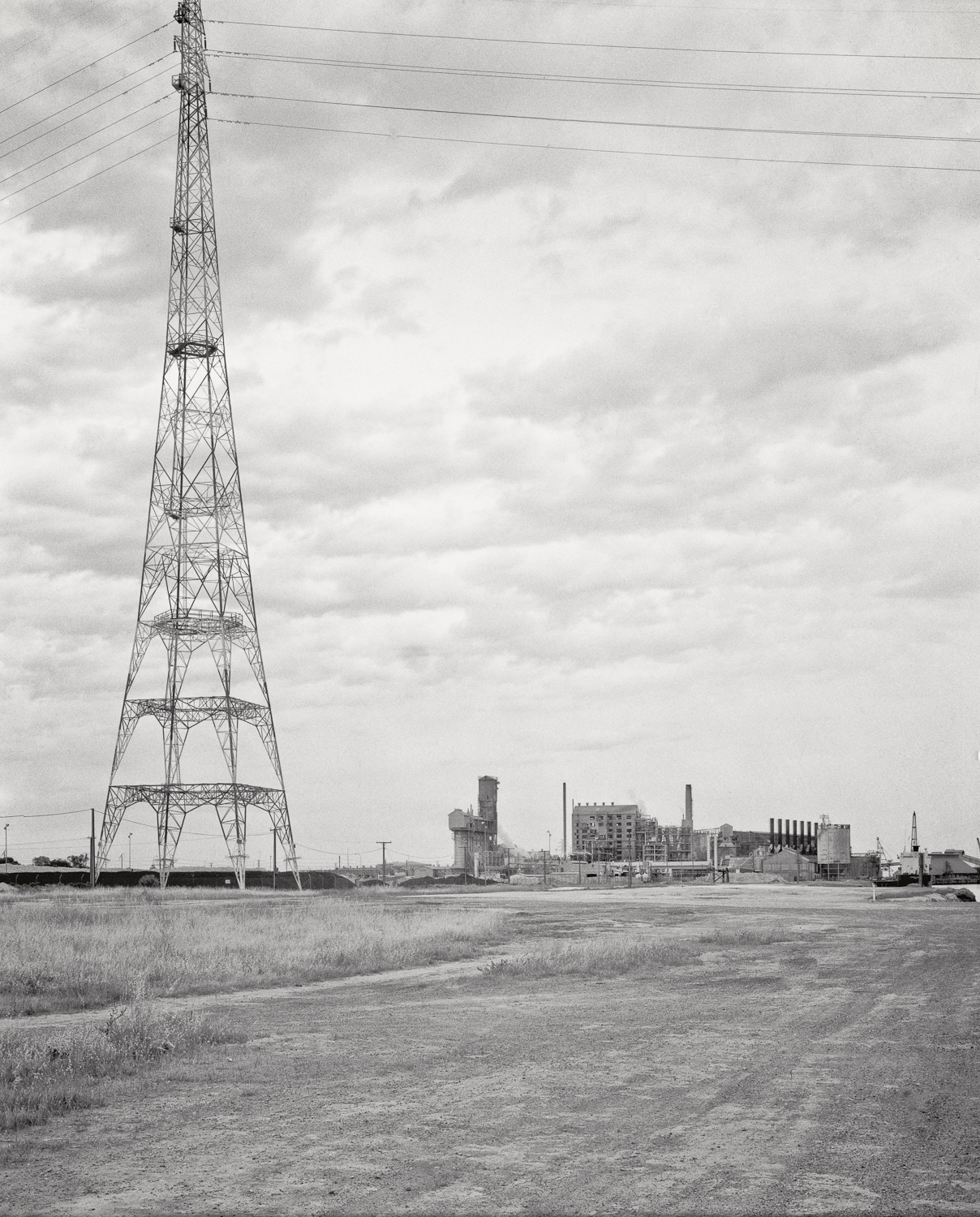 Gary Sauer-Thompson, Electricity Pylon + Osborne Power Station, South Australia
 The PC report states:
Electricity prices have risen by more than 50 per cent in real terms over the past five years. Spiralling network costs are the main contributor to these increases, partly driven by inefficiencies in the industry and flaws in the regulatory environment.....Some 25 per cent of retail electricity bills are required to meet around 40 hours of critical peak demand each year....The overarching objective of the regulatory regime is the long-term interests of electricity consumers. This objective has lost its primacy as the main consideration for regulatory and policy decisions...The incentive regulation regime encourages businesses to build too much.In other words it is the 'gold plating' of electricity distribution networks that is the main problem with respect to rising electricity prices--not carbon pricing or the renewable energy target (RET).
This is in the context of falling demand for electricity and the falling wholesale price of electricity in Australia, which is resulting in coal-fired generation industry making cutbacks through mothballing their plants or taking them offline.
In Renew Economy Giles Parkinson says that the mothballing of one of the units at the Yallourn brown coal generator in Victoria’s Latrobe Valley:
follows the halving of output at Tarong in Queensland, the closure of Munmorah in NSW and Playford B in South Australia, and the seasonal closure (since reversed) of the Northern power station in South Australia. Some of these had hoped to receive payments from the government for the privilege of closing, but have done so anyway despite the withdrawal of the contracts for closure scheme.
That results from a loss of revenue for the coal-fired power stations. There in lies the reason why they don't like renewable energy and for why they want both a stop to the rapid deployment of rooftop solar and the deployment of large-scale wind farms curtailed.
They want to protect their revenue. To hell with consumer choice, customers having some say over their power bills, or reducing environmental harm.
What we have, as Jason Wilson points out at The Drum, is a shrill, partisan and campaigning styles of coverage:
To take a prominent example, across the Murdoch empire, from Fox News to The Australian, we can see an ideological project lining up with niche marketing to produce strident, right-wing outlets which are themselves accused of testing the bounds of civility.This shift has had the consequence of de-stablising liberal-democratic politics, throwing doubt on its ground rules, in ways that we're yet to fully appreciate.
Although incivility, and the conflicts over how to define incivility, will continue, we do not need not take those views seriously that are evidence free or plain deceptions.
Posted by Gary Sauer-Thompson at 11:23 AM | Comments (9) | TrackBack
October 16, 2012
from welfare to workfare
This legislation supported by the Coalition is an indication of how the social democratic state is changing and how welfare is being transformed into workfare. It moves single parents off the parenting payment, and onto the Newstart Allowance once their youngest child turns eight.
The Newstart Allowance is considerably less money than the parenting payment and the discipline of Newstart (an obligation to look for fifteen hours a week paid work) aims to change the personal behaviour of certain groups (teenage mothers?) who are seen as being too reliant on welfare.
Eva Cox says:
The core issue is whether the decision to further extend this program can be justified by evidence supporting the claim that changing the payment system will actually benefit sole parents. The proposition is that that lower pay rates, together with some improvements to employment support services, will increase their workforce participation rates.
The argument is that if almost half of all Australian children living in poverty are in single-parent families; and 25% of single-parent families live below the poverty line, then employment and training is seen to be the best way out of poverty.
The neo-liberal assumption is that single-parent resist pursuing the goals of improving their lives and the wellbeing of their children through education and employment and downplay the institutional barriers to entering the workforce. Their personall responsibility policy has a moral overtone: one of punishing single parents that cannot find suitable work, rather than encouraging anyone back into the workforce. It is about appearing tough on the (undeserving and unproductive) poor.
It is very difficult to sustain a “good” job, generally a full-time job, while being the only parent. Problems were exacerbated when children had special needs.Veronica Sheen says that:
Where women are raising children alone, the tensions between work and family are particularly pronounced. This has the effect of pushing them into lower paid, casual jobs. The current policy directed to the workforce participation of single parents must be supported by training and assistance in finding sustainable, decent jobs which fit with their children’s needs – and which, of course, serve to lift these families out of poverty.
Most single parents become single parents because of a breakdown in a relationship, or the death of the other parent. Providing adequate child care and giving more incentive to those that wish to study or train to gain skills, would help to overcome the barriers to re-entering the workforce.
Posted by Gary Sauer-Thompson at 4:02 PM | Comments (3) | TrackBack
October 15, 2012
contradictory policies
Ross Gittens has a succinct account of the way that Australia's economy has been hit by two powerful, but opposing economic shocks: the expansionary shock from the resources boom and the contractionary shock from its accompanying very high exchange rate:
It's reasonable to attribute the Aussie's remarkable strength since the start of the resources boom predominantly to our high commodity export prices and vastly improved terms of trade.That makes it reasonable to expect the fall in export prices would lead to a commensurate fall in the Aussie, thus reducing its contractionary effect on our export and import-competing industries. But the historical correlation between our terms of trade and our exchange rate, while strong, can also be quite loose for fairly long periods. So it's not surprising the Aussie has held up so well.
Gittens says that is the Australian dollar could stay much where it is for years to come because those countries with the best growth prospects tend to have strong exchange rates whereas those with poor prospects tend to have weak exchange rates.
 Alan Moir
Australia has a changing economy in a low growth global economy and the latter means lower economic growth for Australia. So the Reserve Bank lowers interest rates to stimulate the economy whilst the Gillard Government's attempts to save the budget surplus will contract the economy.
That contraction will provide more grist to the mill of the conservative populist movement as this movement stems largely from a decline in the economic and social status of the white lower middle classes and working classes which has been gathering pace sharply over the past five years.
Globalization has seen the squeeze on the middle class economic that is helping drive the conservative populist movement and increasing its volatility. Each right-wing populist wave--eg., Pauline Hanson--- as it recedes, leaves the Coalition Party several notches to the right from where it had been previously. Their rhetoric is built around a desire for a return to an idealized past, of a culturally and ethnically purer nation, a stable, traditional society, and a “moral economy” in which decent, hardworking people are guaranteed a decent job.
The white middle class feels embattled and threatened both economically and culturally with respect to the cultural world of conservative Christianity (both Protestantism and Catholicism). This culture is, to a very great extent anti-Enlightenment, and for convinced adherents of this tradition, much of modern Australian mass culture is a form of daily assault on their passionately held values.
The class resentments on the part of lower middle class and working class whites have largely been channelled into cultural hatred of the “liberal elites” and the increasing contempt for scientists and experts of every kind.
Posted by Gary Sauer-Thompson at 3:03 PM | Comments (9) | TrackBack
October 14, 2012
you can’t take the money out of politics
James Bennett in The New Price of American Politics in The Atlantic raises the issue of the way that Americans pay for their politics after Citizens United Citizens United. The term is shorthand for a Supreme Court decision that gave corporations much of the same right to political speech as individuals have, thus removing virtually any restriction on corporate money in politics.
Bennett says that these:
are defined by a series of interlocking mazes—of congressional statutes and federal regulations, court cases and state laws. But those mazes are built on top of some of the most basic ideas about the nature of the republic, about the right of free speech, the sources of power and corruption, and the relationships of citizens to the state and to one another. That foundation is shifting now, to a degree not seen since Watergate, and perhaps not in more than a century, with effects that even the most-experienced politicians are just coming to appreciate. In the wake of Citizens United (though not only because of Citizens United), the combination of permissive judges, paralyzed regulators, and a deadlocked Congress has emboldened political operatives—quite sensibly—to raise and spend money in ways they wouldn’t have dared before. Not since the Gilded Age has our politics been opened so wide to corporate money and donations from secret sources.
The Supreme Court had striked down laws that blocked corporations and unions from spending as much as they wanted to elect or defeat candidates. This paves the way for a new type of political-action committee—the “super pac” that could raise limitless contributions from corporations and unions, as long as it spent the money independently of any campaign.
In wiping out the McCain-Feingold’s ban on contributions from corporations and unions the majority opinion resoundingly endorsed the idea that for purposes of politics, corporations are the same as people, with the same protection under the First Amendment. Political speech is commercial speech in that political speech advances the corporation’s interest in making profits. The Roberts Court, it appears, will guarantee moneyed interests the freedom to raise and spend any amount, from any source, at any time, in order to win elections.
The shift to political finances being lightly regulated in the US legally legitimates what is happening in liberal democracy: that corporations realize that political power is necessary; that such power must be assiduously cultivated; and that, when necessary, it must be used aggressively and with determination.
You can see this in Australia with both Big Mining and Alan Jones and 2GB. As Neil Chenoweth in the AFR points out about the latter:
Fighting the carbon tax is a business – it’s arguably the most successful business in Australian media right now. Alan Jones has earned a fortune for his employer from his determined campaigning against the tax.....Through those months, when Jones was railing at Ju-Liar, when he was addressing campaigns with Tony Abbott while protesters behind them held up “Ditch the Witch” banners, or while he led the Convoy of No Confidence to Canberra, Jones’ ratings were in the stratosphere and 2GB was raking in the advertising money. It wasn’t just Jones – all of 2GB’s hosts were on fire, particularly Hadley, whose share reached 20.7 per cent.
Like Fox in the US Jones makes money by polarising the community and reinforcing prejudices.The media company is both a political weapon and a major money-spinner.
Posted by Gary Sauer-Thompson at 8:23 PM | Comments (1) | TrackBack
October 13, 2012
the missing figures
There are two missing figures in David Rowe's cartoon of Aussies at Parliament House. Despite the newspapers the first is a person from the Canberra press and media gallery talking to a politician. They are an integral part of this political culture, as it becoming ever more explicit through the way that they continue to defend their hypocrisy interpretation of Gillard's speech from the criticisms in the social media.
The gallery says that they got it right, because the real story is that Labor exploits misogyny as a tactic for its own self-interest. The real story is Gillard's hypocrisy by playing the gender card.
The criticisms of the gallery's interpretation hold that political coverage and journalism as it is currently practiced by the gallery is broken. The gallery's response, in which the press is trying to be serious by providing “analysis” instead of entertainment and trivia, is designed to highlight their savviness. This savviness increasingly relies on an impoverished notion of politics.
 David Rowe
We can approach this through the second missing figure: the figure of populist conservatism and its paranoid style of politics. For instance, The Australian has now added a lefty Twitter to its long list of enemies of Old Australia. The Australian has so many enemies who need to be put in their place once and for all that it is clear their paranoid style of politics needs a scary, domestic enemy.
The significance of these two missing figures is that the defensive response of the Canberra media gallery to the criticism from social media is that it journalists fail to analyze the core elements of populist conservatism. Lenore Taylor, one of the more thoughtful members of the gallery, says:
To be clear, I thought Gillard gave a great speech, but that it was delivered for at least some of the wrong reasons, in the wrong context, at the wrong time ...The point is that understanding and calculating the political context, the strategies, the deal-making, the sequences of events, is a critical part of our job. Politics is about presenting a message-as-product, which is what most observers see. We are supposed to gather information and make assessments about how and why the product is made. Assessing the actual political impact of this out-in-the-open gender debate, rather than simply how it made some people feel as Julia Gillard spoke, is something that will only be possible over time.
So according to the gallery, it is not part of the gallery's job, as savvy insiders, to analyze the sexism in populist conservatism, the defence of patriarchy (blokes rule by nature, and women are destroying the joint) or its use as a political weapon to undermine Gillard.
This sexism has no part of the political context or the sequences of events in Canberra. It is just how some people--the outsiders, the viewers, the electorate--- feel, even though the Slipper episode is a part of the political context of the pervasive sexism and misogyny in the political workplace and political life.
So the gallery are unable to give a proper analysis, or a full estimate of Abbott or his strategic work. That is why the gallery has an impoverished notion of politics.
Posted by Gary Sauer-Thompson at 12:23 PM | Comments (14) | TrackBack
October 11, 2012
The Canberra Media Gallery has lost it
I finished the post on Gillard's misogyny speech in Parliament by remarking on the interpretation of that speech by the Canberra press/media gallery. I noted that we would expect the Right wing journalists in The Australian and elsewhere to continue putting a strident Gillard in the dock for her double standards--Gillard was a base tactician, cynically holding up her sex as a smokescreen. Partisan attacks on Gillard is what they are paid to do. It's their job.
But why did the media Gallery as a whole make this interpretation? Why the group think? Isn't this what needs to be explained? I said:
What is puzzling, though, is why those journalists in the Canberra Press Gallery who are not on the Right --eg., those on the ABC, such as Leigh Sales and Emma Alberici ----uncritically repeated the Right's spin and talking points of this event. For them it was a flawed Gillard who was in the dock. Why this interpretation? Why not something different? An interpretation that was their own? Where was the political context of the event for these oh so savvy insiders who take pride in their professionalism?
Anne Summers made a similar point in her column on The Drum. She said that the reportage and commentary this morning out of Canberra was so startlingly at odds with the reactions of such vast numbers of people both here and abroad that you have to ask: why and how could this be the case? She added:
They are, after all, seemingly so out of kilter with how so many of the rest of us reacted that they need to provide some explanation for us to have any reason to take at all seriously anything they write in future.
It is a good point. The majority of the comments on her post agreed with Summers.
I added in the post that I thought that the credibility and the authority of the Canberra Press and Media Gallery has taken a severe knock from this event. The ground has shifted under them. Tim Dunlop concurs--the gatekeepers of news have lost their keys he says. They sure have. They haven't just lost their keys though --they've been taken from them and thrown away and they are wandering around in circles looking for them.
We watch Parliament ourselves, we trust our own judgements, we publish them in social media, we evaluate other interpretations of events, and we critically judge them for their plausibility. We look at the work of the savvy insiders, such as Annable Crabb, Leigh Sales and Emma Alberici, - and reckon that they actually missed what has been going on. They ignored the sexism and misogyny in political life, and the way that it had been used against Gillard as a battering ram by the Coalition and the conservative movement in general.
Leigh Sales attempted to restore some of her credibility in this interview with Penny Wong, but it is obvious that she cannot see beyond the argy bargy of political life, or the "he said she said" style of journalism --the name-calling comes from both sides of politics. Sales' basic position is that, though she acknowledges that it is obvious the Prime Minister has been attacked with sexist language, Gillard is using gender as a shield against any criticism of her performance. Once again it is Gillard who is in the dock for defending herself from the sexist attacks.
Why? Because Gillard is defending Slipper, the sexist sleazebag. The constitutional argument made by Mark Drefyus and Daryl Melham that Labor's position was based on the separation of powers and the due judicial process was completely ignored by Sales. It had to be passed over as it directly challenged Sales interpretation of Gillard's actions. If asked Sales no doubt would have said that the legal arguments were a fig leave. They would have been dismissed as insincere, even cynical. It's an easy cynicism.
Tim Dunlop observes that what has actually happened is the people formerly known as the audience have, thanks to the tools of social media, become media critics and content shapers. He adds that this:
causes angst in the journosphere, and much of their reaction to this new dispensation is the reaction of an industry who have not only had their authority and prestige stripped from them, but of one that is struggling to find relevance in a scary new environment that threatens their very livelihood...The bottom line is this: we no longer trust the media to tell us the story of our lives. We no longer have to settle for the narrative they impose on events. We are no longer passive observers, but active participants in the way our news is shaped.
The rejection of the Canberra Media Gallery's interpretation of Gillard's speech by a large number of Australians indicates how the ground has shifted---we citizens simply don't need journalists to explain and analyse political events for us anymore.
We can expect the old media, in trying to reassert its power and authority, to attack those keyboard activists using Twitter, blogs, Youtube and Facebook. In this defence we will find some explanations for why their account differed so markedly from ours. Make no mistake, it is the Canberra gallery that is on the defensive.
Update
Jonathan Holmes of Media Watch provides one line of defence or explanation. He defines the issue as the claim that the Twittersphere represents 'ordinary people', and the cynicism of the gallery does not. The press gallery is utterly unaware of how we 'ordinary' folk think, so the bloggers step in to set things right.
He argues that such a view ignores the fact that the press gallery spends a lot of time talking to people who are aware of what people think. Whilst many bloggers talk only amongst themselves, it is the media gallery that is more in touch because they mix with backbenchers from both sides of the political divide. They spend more time talking to 'ordinary people' - not on social media, but face-to-face - than the vast majority of the rest of us do. The backbenchers also have:
a vital professional interest - especially if they're in a marginal seat - in assessing which issues are liable to change people's vote, and which are not. That's the lens through which a professional politician views everything that happens in the glass house in Canberra: how will it affect my vote? And it is the backbench politicians, not just ministerial aids stuck in ministerial offices, and the 'spinners', or each other, that the press gallery journos talk to, day in, day out.
Well, blow me down. The Canberra bubble, the Beltway, the insider view of politics, with its distorted view of the world has just disappeared. However, it soon reappears because Holmes says that the problem with those in social media, who responded favourably to Gillard's speech, is that they will have seen the speech in isolation, torn from its political context.
'Political context' is key term. Holmes means the following:
When the press gallery opined that the moment was ill-chosen, that Gillard declared that enough was enough about Abbott, but declined to declare that enough was enough about Slipper; and that the Speaker's subsequent resignation at the insistence of the cross-bench exposed the Gillard Government to charges of hypocrisy; they were reflecting, you can be sure, the rueful grumblings of many a Labor backbencher with his or her eyes on how it would play in Penrith or La Trobe or Longman.
The problem that Holmes has, of course, is that the press gallery's 'hypocrisy narrative' is what has been explicitly rejected. An alternative "gender narrative" has been constructed by those who saw the speech and expressed their views on social media; a narrative that says this political moment placed gender issues at the centre of political debate. For this narrative political context means the systematic misogynist abuse of Gillard from sections of the Right outside Parliament, whipped along, and shaped, by shock jocks and sections of News Ltd.
With the alternative narrative being vigorously defended in the public sphere we now have competing narratives that cannot be reduced to party political ones. That in itself is a sift in the ground of politics.
Posted by Gary Sauer-Thompson at 8:19 AM | Comments (26) | TrackBack
October 10, 2012
energy: a contested policy space
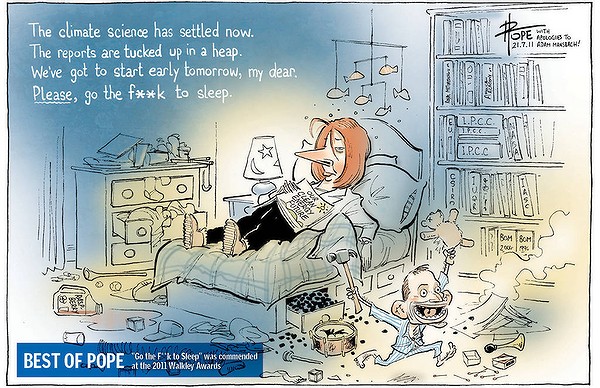
As Michelle Grattan notes the first three months of carbon pricing (she continues to calls it a carbon tax) have been an anti-climax even though Abbott seeks to keep the tax as centre of his campaigning. She also notes that climate change has turned from an emotional rallying cry to a practical policy challenge with all the accompanying difficulties.
That is a reasonable interpretation of the current state of play in Australia---the carbon price framework and the renewable energy target orients the country in the right direction, and they provide the long term predictability and stability necessary to decarbonize the economy. The immediate target is to get to 20% renewables by 2020.
 David Pope
What Grattan does not say is that the core policy issue has shifted to electricity and the growth of renewables. Energy has become a fiercely contested policy space due to the policy of phasing out fossil fuels and replace them with renewable energy and other forms of very low emission energy.
There is the large gap between wholesale and retail price of electricity; the fight against the increasing supply of renewable energy (wind and solar photovoltaic) to protect the interests of the fossil fuel generators; and the structural barriers in the way of renewable energy that have been created by the electricity market rules to protect the electricity market operators.
Big Energy is waging a fear campaign whilst the Gillard government’s ministers are fighting backroom battles among themselves (Martin Ferguson, the energy and resources minister, is pro-fossil fuels).
We know that the states have been increasing prices due to infrastructure gold-plating ----one sixth of our national electricity networks ($11 billion in infrastructure) caters for peak events that last for barely four days per year.
There is $45 billion that’s going to be spent in the next five years on new poles and wires and gold-plating the system. That means increased prices for consumers because the rules of the National Electricity Market allow the networks to pass on their costs by charging consumers for upgrading their infrastructure. This gold plating gives the states that own the fossil fuel generators (eg.,Queensland and NSW) a profit stream from the existing system. The Victorian government, which privatised its electricity generators has been captured by Big Energy.
These states are opposed to regulatory reform and the big energy companies have a exceptionally well-honed ability to game their system through strategic lobbying and because of the power they hold in Australia’s economy. To date, the costly and uneconomic nature of clean energy has been the most effective argument wheeled out by fossil fuel industries protecting their turf.
However, the problem they face is that rising electricity prices themselves is driving the installation of household solar and making their households more energy efficient. Reduced demand means reduced project for Big Energy. Solar threatens the existing business models of retailers and wholesalers.
Posted by Gary Sauer-Thompson at 10:09 AM | Comments (8) | TrackBack
October 9, 2012
Parliament: Gillard's white hot anger
In Parliament today Tony Abbott attacked on Gillard for her support for the Speaker in the context of the Peter Slipper affair---- the claims of sexual harassment brought against him by James Ashby---- and the crude private text messages that compared a woman's vagina to shell fish (mussels). The federal court judge has reserved his judgment on the civil case before the court.
Abbott had moved a motion that called for the Government to remove Peter Slipper as Speaker under section 35 of the constitution, which states that the Speaker can be removed by a vote in the House of Representatives. Abbott argued that Peter Slipper is not a fit and proper person to be Speaker of the House of Representatives because he is a misogynist.
He said that the Gillard government is desperate and unethical, and appointing Mr Slipper proves it. Gillard is a running a protection racket. Its "another day of shame for this parliament, another day of shame for a govt which should have already died of shame."
Gillard's response:
In one of the most extraordinarily passionate parliamentary performance of her career Gillard was on fire with white, hot anger. She changed the debate from being one solely about Slipper as a sleaze bag who was no longer a fit and proper person to uphold the dignity of the Parliament--- to one about sexism and misogyny in political life, and its systematic use by the Liberal Party as a political tactic. It lanced a festering boil on the body politic.
The motion to remove Mr Slipper was defeated by 70 votes to 69 with the Gillard Government supported by Independent MPs Craig Thomson, Rob Oakeshott, Tony Windsor and Greens MP Adam Bandt. Andrew Wilkie voted with the Coalition.
It was the right decision. Given the separation of powers in the Australian Constitution (ie., (the separation of the executive, legislative and judicial powers) Parliament shouldn't do anything until the federal court makes its ruling with respect to the claims of sexual harassment brought against Slipper by James Ashby. If Parliament dumped Slipper before that ruling, then its acting as a de facto kangaroo court.
The High Court is the pre-eminent interpreter of the Constitution and defining the nature of the separation of powers in Australia. It has defined a separation of the judicial power from the executive and legislative powers, says (ie., the Mason Court) that that it not only interprets the law but also ‘makes’ the law; and shifted our understanding of the separation of powers doctrine towards a more American conception of institutional checks and balances to help to protect individual liberty.
As Justice McHugh pointed out:
the distinction between the judicial and the executive powers of government in particular continues to be jealously guarded in the federal sphere16 and operates in "full vigour"....in a Federal system, the absolute independence of the Judiciary is the bulwark of the Constitution against encroachment whether by the Legislature or by the Executive....legislators and members of the Executive Government have accepted - although often reluctantly - that in a federal system the courts must have power to declare invalid purported exercises of legislative power invalid. As a result, courts have often invalidated legislation that gives effect to major platforms of political parties.
The Coalition was on shaky legal ground with its motion that called for the Government to remove Peter Slipper as Speaker under section 35 of the constitution, prior to the courts deciding the sexual harassment case.
Update
Slipper has resigned as the Speaker of the House of Representatives. He remains a member of Parliament as an independent backbencher. He finally got the message that he'd outlived his usefulness and that his position had become untenable. The Independents pulled the plug.
The Australian's columnists are out in force today defending Abbott. Their general line of attack is that Labor has egg on their collective faces because of its double standards. Peter Van Onselen, for instance, says:
The motion failed by the narrowest of margins, but not before Tony Abbott was directly accused of being a sexist and a misogynist himself. Not by an attack-dog minister mind you - by the Prime Minister herself. happened after the Opposition Leader had already engaged in a little rhetorical overreach of his own. He said that the government should have "died of shame": words eerily similar to Alan Jones's now infamous (and condemned) comments. But rhetorical errors by Abbott pale into insignificance alongside the government's attempts to defend Slipper, especially on the back of the moral outrage they have expressed about Abbott's attitude to women.
There is no mention of the extensive history of the use of sexism and misogyny by the conservative movement as a tactic to attack and damage Gillard. That too, presumably, is a little rhetorical overreach.
Update2
The Canberra Press Gallery do appear to be singing from the same songsheet. Gillard failed as a leader on the Slipper issue. They go on and on about a hypocritical Gillard defending the indefensible.
Some say that the judgement of the journalists have failed. Maybe for some ---given this New Yorker perspective. They all ignored the history of the sexism and misogyny that has been directed at Gillard, or the constitutional realities.
In my judgement what we have here is a strategy on the Right to up the ante on political conflict -- to increase the temperature, the tension and the stakes. They want blood--and they will keep battering Gillard non stop to bring her down, and then to ensure the blood flows. That strategy is obvious and one dimensional.
What is puzzling, though, is why those journalists in the Canberra Press Gallery who are not on the Right --eg., those on the ABC, such as Leigh Sales and Emma Alberici ----uncritically repeated the Right's spin and talking points of this event. For them it was a flawed Gillard who was in the dock. Why this interpretation? Why not something different? An interpretation that was their own? Where was the political context of the event for these oh so savvy insiders who pride themselves on their professionalism?
I do think that the credibility and the authority of the Canberra Press and Media Gallery and its gatekeepers has taken a severe knock from this event. The ground has shifted under them. We now watch Parliament, we trust our own judgements, we publish them in social media, we evaluate other interpretations of events, and we critically judge them for their plausibility.
Posted by Gary Sauer-Thompson at 3:27 PM | Comments (20) | TrackBack
South Australia: renewable energy
It is well known that The Australian newspaper is opposed to the increasing use of renewable energy and the shift to a lower carbon intensive economy. It stands behind the interests of the fossil fuel industry and King Coal and is hostile to what it terms green ideology.
The Australian constructs its opposition in terms of renewable energy being very expensive. This can be seen from this June article on South Australia, which has both the highest installed capacity of wind in Australia (wind generation now supplys approximately 20% of annual demand.) , and the highest per capita installation of rooftop Photo Voltaic (PV) solar power.
 Gary Sauer-Thompson, Star Fish Hill, Cape Jervis, South Australia
The Australian's story was based on an 18% price increase announced by Essential Services Commission of SA. According to The Australian the extra costs---estimated to be $140 a year to household power bills--- are primarily attributable to the state's solar feed-in tariff scheme, green scheme subsidies, carbon pricing and the federal government's 20 per cent renewable energy target.
What is missed out from this account is the wholesale price reduction resulting from the use of renewable energy and lower demand. The Australian is silent about the wholesale price of electricity decreasing whilst the retail price of electricity has increased.
According to the Australian Energy Market Operator (AEMO) The 2010/11 South Australian wholesale electricity market price is at its lowest since the start of the National Electricity Market (NEM).
The reasoning is fairly obvious--if you introduce more supply into the market, then prices fall if demand is static or flat. The Essential Services Commission of SA now recognizes this and it has made a Draft Price Determination to potentially reduce electricity prices by an average of $160 per household.
When put in the context of the resulting wholesale price reduction the actual cost of the feed-in tariffs and the cost of the RET is offset by the resulting wholesale price reduction.
What The Australian also doesn't acknowledge is that price rises in electricity are being used to prop up coal fired power stations and the networks.
Posted by Gary Sauer-Thompson at 8:56 AM | Comments (4) | TrackBack
October 8, 2012
sqwarking shock jocks
Alan Jones, the 2GB shockjock, is rather upset at the campaign in the social media against his comments about Julia Gillard. The campaign against hate speech aimed to pressure advertisers to 'boycott' the Alan Jones Breakfast Show. It has has been so successful that Macquarie Radio Network has indefinitely suspended all advertising on his 2GB breakfast show after a week of sustained pressure.

David Rowe
Alan Jones, the shock jock bullyboy par excellence, is outraged. The management of 2GB is furious. They say that they are the victims of ''21st century censorship, via cyber-bullying''. This fits in with Jones argument that it is the backlash against his comments which is at fault. In claiming that it is his own freedom of expression which is under attack he ignores the way he and the other shock jocks have consistently trashed the liberal ethos of civility in public debate.
Jones says that Australians:
do not have the right to interfere with that freedom of choice, or should not. And they don’t have the right, or should not, have the right to attempt cyberbullying of people who listen to this program or advertise on it ... These false petitions are anything but civilised. The hypocrisy is breathtaking .... If this is not illegal, it ought to be. As I said, if it happened anywhere else in society, this kind of bullying or harassment or intimidation or threatening conduct, the police would be called in.
Jones adds that the decision taken not to advertise had one purpose: to give innocent, hard-working people employing advertisers a break from cyber-terrorism, a break from bullying, a break from harassment.
It's about time the right wing shock jocks were made accountable for their attack dog mode of public speech, given the failure of the toothless media regulator---the Australian Communications and Media Authority, whose job it is to investigate alleged breaches of broadcast regulation, to call the vitriol for what it is. Remember Jone's inciting the Cronulla violence in 2005? It is still being resolved.
Jones and his grumpy old supporters, in trying to frame the issue as one of free speech being trammeled on by a lynch mob, look very defensive and anti-democracy. The campaign against Jones is yet another indication of the tremors taking place in the mediascape. The tremors are not just the global print media crisis in the face of the digital revolution resulting in cutting pay and reducing editorial staff because of a serious drop in revenue.
The traditional power relationships, which have been locked in for so long, are beginning to melt. Social media is providing the tools for people to organize to use them to make the shock jocks accountable for what they say in the public sphere on their syndicated radio program. More broadly, if the vacuum being left by the collapse of newspapers is resulting in the increased influence of social media, then it is also being filled by the PR industry's spin and misinformation.
Posted by Gary Sauer-Thompson at 8:32 AM | Comments (30) | TrackBack
October 6, 2012
the parties of big business?
Glenn Greenwald highlights how US presidential elections are now conducted almost entirely like a tawdry TV reality show with personality quirks and trivialities about the candidates dominate coverage. There is a little room for substantive debates on many of the nation's most pressing political issues.
 Steve Bell
Greenwald identifies these issues as penal policies, drone attacks, America's steadfastly loyal support for Israel and its belligerence towards Iran, the rapidly growing domestic surveillance state, climate change, and the refusal to prosecute the Wall Street criminals who precipitated the 2008 financial crisis. He argues that the highly debatable and profoundly significant policies are excluded due to bipartisan agreement and that this agreement is covered up by a handful of disputes that the parties relentlessly exploit to galvanise their support base and heighten fear of the other side.
He doesn't mention the conflict over private markets versus government in the form of the welfare state.
If the Republicans and Democrats represent different fractions of big business---eg.,the Republicans Big oil and the Democrats Wall Street---the Republican party's main goal is to preserve low tax cuts on capital gains and dividends. There is little indication that the United States will be able to address its enormous fiscal deficit. This is now about 7% of GDP, and it is predicted to grow rapidly in future decades as an aging population and rising health-care costs increase government outlays for the “entitlement programs” that benefit middle-class seniors.
Martin Feldstein says that:
Fiscal consolidation.....requires additional revenue as well as slower growth in entitlement spending. The challenge facing US politicians after the election will be to find a politically acceptable way to raise that revenue without undermining incentives and economic growth. The task is made more complex by the large number of legislators who insist that the deficit should be reduced by spending cuts alone.
Feldstein says that slower growth in entitlement spending will probably involve slowing the growth of Social Security pension benefits for future middle- and upper-income retirees.
The tougher problem will be how to raise revenue--- I expect there to be gridlock, given the history of non-cooperative behavior, even if that results in a credit-rating downgrade of the US. True, there is the 2011 agreement on immediate spending cuts and tax increases that would automatically kick in (the “fiscal cliff”) if agreement on a comprehensive set of fiscal reforms eluded them. Why not postpone or dismantle that agreement?
Posted by Gary Sauer-Thompson at 12:33 PM | Comments (5) | TrackBack
October 5, 2012
after the mining boom
I'd always wondered why conservatives are indifferent to Australia becoming an information, knowledge or digital economy. The indifference remains even though the resources boom is giving way to falling export prices and a slump in the development of mines.
Glenn Stevens, the Governor of the Reserve Bank of Australia, says:
Economic activity in Europe is contracting, while growth in the United States remains modest. Growth in China has also slowed, and uncertainty about near-term prospects is greater than it was some months ago. Around Asia generally, growth is being dampened by the more moderate Chinese expansion and the weakness in Europe. and, as a result, increasingly restrained government expenditure and declining standards of living.
That means restrained government expenditure and declining standards of living. Overall economic growth rate being essentially a composite of Australia's many different cities and regions in the context of the growth of emerging Asian economies.
 David Rowe
Where to next to avoid declining standards of living in a reshaped economy? Should economic policy try to kick-start those areas of the economy that had been slowed down as part of the longer-term 'structural adjustment' to the mining boom? What do the conservative, free market economists say on this issue?
In The Australian, Henry Ergas is explicit. He says that Australia should stick with exploiting its natural resources:
It's hard to disagree with Ross Garnaut that China's slowing growth will place new pressures on our economy. But the implications he derives from that are wrong-headed...Garnaut's prescription is straightforward. It's time, he said on ABC1's Lateline program earlier this week, to shift our focus towards "high-value manufactures and high-value services".... Whatever Garnaut may think, the reality is that we are and will remain a commodity-based economy. Blessed with a natural resource endowment that is among the highest in the world and extraordinarily diverse, comparative advantage drives us to specialise in mineral resources and agricultural production. No surprise then that our prosperity has always rested on putting that endowment to good use.
He adds that the challenge is to ensure we continue to do so in the face of falling prices, slowing demand and the rapid development of competing sources of supply. A sharper focus is required on our cost competitiveness in every step of major resource projects, from initial exploration to construction and operation.
It follows that the Gillard Government should repeal the carbon tax, scrap IR laws and dump the mining tax. These are reforms designed to give big mining more money during a time of falling commodity prices. Straight forward really. The problem with the Ergas option is that the mining sector is expected to rise from 5 per cent of gross value added in the early 2000s, to around 10-12 per cent in the decades to come. What of the other 88 per cent?
Ergas is right to highlight that the demand for agricultural produce increases with the economic shifts in Asia. So we are likely to see a significant increase in demand, particularly from China, for high-end agricultural products like fruit, dairy, high-grade meat and seafood. Agriculture is around 20 per cent of Australia's exports. That takes us to less than half. Why ignore financial capital?
What Ergas doesn't mention is that the middle-class consumers in the Asia Pacific region will also demand better services, goods and experiences. This leads us to the Garnaut option, which is the high-value services, high-value manufactured goods one. This results from the shift to a knowledge economy--a high-tech knowledge economy as opposed to real estate development and expansion. The argument here is that it makes sense to focus the future economy less around housing, roads, and physical capital, and more toward the accumulation of human capital and knowledge assets.
What is surprising is that Ergas offer us yet another great either or divide rather than thinking in terms of an open economy that is in transition.
Posted by Gary Sauer-Thompson at 9:12 AM | Comments (13) | TrackBack
October 4, 2012
defending political staffers
Jennifer Westacott, the Business Council Australia chief executive, gave a speech to the Institute of Public Administration Australia (IPAA) International Congress in Melbourne in September that opens up a debate about the power of political advisors and improving public policy advice.
The purpose of the development of the advisor’s role from Whitlam onwards was to have someone to provide political support to the minister. It is accepted that policy experts like John Rose, John Hewson, Ross Garnaut, Don Russell, Jenny Macklin and others, made important intellectual contributions to the economic and social reforms of the 1980s.
They broke the public service’s virtual monopoly over policy advising, and introduced new ideas and greater contestability that many argue has improved the quality of advice. However, it is also widely acknowledged that there are problems in the interface between ministerial staff and public servants.
Westacott said the authority of the public service had been undermined by the power of political staffers, and she called for a halving of ministerial staff and a reinstatement of the tenure system for departmental secretaries. Westacott's argument is that:
many modern politicians have lost sight of the fundamental role of the public service. Its authority has been undermined by political gatekeepers, often with little expertise and no accountability.Its custodianship of the long-term policy agenda has been eroded by short-term thinking, and the necessary investment in capacity building, succession planning, technology and new ways of providing services just isn’t there. The effect of these trends is felt most keenly by public servants themselves; the frustration from the lowest to the highest levels of seniority is palpable in every conversation I have.
Westacott's solution of halving the number of staffers doesn't really address the reactive policy-making that she rightly criticises. That style of policy making emerges out of populism seen through the prism of 1996 (suburban, socially conservative and monocultural) and adversarial partisan politics. What is far more crucial than numbers is the accountability of political staffers.
I agree with Terry Barnes' response in the AFR to Westacott's argument. Barnes' rightly sees this as an attack on political staffers and he responds by highlighting the functions performed by staffers:
Westacott’s comments reflect that senior public servants hate their advice being questioned and contested by staffers who may not have a background in the portfolio or relevant expertise. But a good staffer needs only sceptical common sense and a personal stake in the political future of the minister they serve. Their job isn’t to rubber stamp: it’s to question, consult more widely and, if needed, give their minister more options. They should this by working positively and courteously with public servants, and a successful staffer is one who positively influences the thinking of both his or her minister and the bureaucrats they work with.
There are different types of roles within ministerial offices and many different kinds of people working in them and the job is often seen as a stepping stone to pre-selection. Political staffers--as distinct from say administrative and support people---are trained to see the political implications of public policy options. They need the political smarts to do this policy job properly.
Why is this important? Barnes gives one good reason. He highlights Westacott's assumption that that public servants are expert, impartial and have no other agendas than that of the elected government and he argues that this assumption is implausible:
The bureaucracy is a maelstrom of institutional and personal politics, often played at a ferocity that would make the ALP Right, or the NSW division of the Liberal Party, look like amateurs. Secretaries compete with each other for policy dominance and for resources..... Westacott seems to think, like her former secretary colleagues, that ministers are merely ciphers, portfolio advocates in Cabinet, and the political fall guys when things come a cropper.
I would go further than this. The political smarts are necessary for political staffers because departments are often captured by, and develop policy on behalf of, vested economic interests. A classic example is the Greenhouse Mafia ie., a term that refers to complete regulatory capture by the fossil fuel industry.
Or the departments develop bad policy which can have negative long term political consequences with respect to the public interest. An example is the deeply flawed design of the National Electricity Market (NEM) and the subsequent gold plating of the poles and wires that have lead to the rapid rises in electricity prices of the present.
One way to counter the reactive policy-making typified by the recent NSW Labor government is to have high quality political advisors offering good long term policy advice. This would also avoid the debacle of real bad policy the telecommunications industry has suffered from for over two decades.
The Business Council of Australia is a part of the history of that bad policy. For all their talk of competition, light regulation, deregulated markets creating greater economic growth the BCA failed to defend actual competition in the telecommunications market or to facilitate the shift to a digital information economy. The BCA engaged in reactive short term policy making.
Posted by Gary Sauer-Thompson at 8:35 AM | Comments (5) | TrackBack
October 3, 2012
a media performance
A media performance by John Laws on the ABC's 7.30. He's a performer with an eye for the backdrop, the clothes and style. It all says 'excess'. The knife is turned on Alan Jones over the latter's remarks about the Prime Minister's father at a Young Liberals Sydney University function, whilst Law's disdain for the media is upfront.
The broader context here is that print is giving way to screen and young people are gradually turning away from the TV screen to computer and mobile screens. Hence the decline in the popularity of printed newspapers. Digital technology isn’t destroying journalism--- “it’s destroying the business that subsidized journalism. So it needs a new form of subsidy.
More worrying though is the declining trust and confidence in the media as many journalists assume that they are entitled to their own facts as well as opinions. The future of journalism may well be the Alan Jones model:---confirming and shaping the opinion and prejudice of their fragmented audience.
This relies on falsehoods and deceptive claims, for instance, abound around the energy debate, and the shift to renewable energy and climate change.
Like many politicians in the Liberal Party Jones doesn't care for the facts or what the fact checking journalists say. Jones' position is that he is entitled to his own facts, over rides the fact checking with bluster and bullying, declares a cultural war on the watch dog press that judges truth from falsehood, and tells his audience to be outraged at their victimhood.
So we tune into the Murdoch press for the latest Gillard Labor outrage that is written up in a way that is designed to reinforce the partisan political divide with deception and deliberate, carefully crafted falsehoods.
Posted by Gary Sauer-Thompson at 12:44 PM | Comments (6) | TrackBack
October 1, 2012
going negative
Conservative shock jocks such as Alan Jones function as a battering ram for the Coalition and the conservative movement. They have routinely used political communication in the form of the tactic of personal attacks on Gillard that have been vicious, confrontational and continuous. Theirs is an anything goes model of politics premised on political political warfare as opposed to political governing.
These attacks are designed to both cause harm and to incite anger, outrage and resentment amongst economically working-class, socially conservative, older people. The Australian version of the Tea Party movement see this bile as a no-holds-barred, rough and tumble politics. They thrive on extreme rhetoric and dismiss the disgust that their over-the-top-comments cause as an example of the hypocrisy of their political opponents.

The vitriol of the political discourse of the shock jocks crowds out the policy debate and argument in the public sphere of deliberative democracy, and it is an illustration of the degradation of Australia's political processes. Political incivility and polarization is now the norm, and the animosities it has engendered continue to deepen the political enmity in a highly partisan political climate.
The partisans are not interested in any resolution of policy issues. It is about power and the negativity rhetoric to humiliate political opponents is used to achieve that power. Going negative “works” in terms of turning elections and drawing devoted radio and television audiences even if it undermines the liberal ethos of rational and informed decision making. The democratic public spaces for reasoned discussions on matters of public importance are shrinking.
People have turned off by the political outrage carnival, even if they still tune in to their favorite sideshows whilst the reputation of Parliament has never been lower. Are we reaching the point when there is a shift to a restoration of at least some civility brakes on political discourse, in at least some contexts? Many would see a call for more civility as the regulation of the form of political speech and a denial of free speech.
Posted by Gary Sauer-Thompson at 7:46 PM | Comments (36) | TrackBack