« August 2012 | Main | October 2012 »
September 27, 2012
the global economy slows down
All the signs are that the global economy after the global financial crisis continues to slow down. It is world of lower economic growth with the US no longer able to play the role of ‘consumer of last resort’, the engine of growth for the world economy as a whole.
 Steve Bell
Ben Hunt observes:
China’s stimulus of 2009 helped Germany, other advanced industrial nations, and commodity producers in emerging markets to rebound. The US stimulus, such as it was, helped Asian and European trade. But Europe always seems to have been the weak link in the chain, dragged down by its eurozone debt crisis. Whereas the US has been treading water, Europe has more clearly deteriorated. Chinese exports have slowed, in turn dampening prospects for China-bound exporters. Concern has mounted in the US regarding its manufacturing and export sector, seen as one of the bright spots of the economy.
This, in turn, reduces Australia's mineral exports.
So we have a crisis that is global with Europe generally seen as the critical problem area in the world economy. The harsh austerity being imposed is causing popular unrest and anger in Greece, Spain and Portugal.
Yet it is still the Western nations that can generate the demand necessary to rebalance the global economy, because China cannot do this on its own. China cannot become the global engine of growth in the near-term with the Chinese consumer replacing the US consumer as the driver of world growth.
Globalisation today means that the economy is global, but government is national. This suggests that the flaws in globalisation cannot and will not be tackled effectively unless and until there are much better mechanisms for politicians and people to hold in check global capital and global businesses. How in the hell is that going to be done?
Ha-Joon Chang points out in The Guardian that what is being done in Europe is a rewriting of the social contract. In this contract:
the renewed legitimacy was bestowed on the capitalist system, once totally discredited following the great depression. In return it provided a welfare state that guarantees minimum provision for all those burdens that most citizens have to contend with throughout their lives – childcare, education, health, unemployment, disability and old age. ...Instead of it being explicitly cast as a rewriting of the social contract, changing people's entitlements and changing the way the society establishes its legitimacy, the dismembering of the welfare state is presented as a technocratic exercise of "balancing the books". Democracy is neutered in the process and the protests against the cuts are dismissed.
The imposed austerity measures are damaging the European economies and threatening the very legitimacy of European democracies – not just directly by threatening the livelihoods of so many people and pushing the economy into a downward spiral, but also indirectly by undermining the legitimacy of the political system through this backdoor rewriting of the social contract.
Posted by Gary Sauer-Thompson at 11:15 AM | Comments (6) | TrackBack
September 26, 2012
Goodbye Gunns
Gunns has been entered into voluntary administration after posting a $904 million loss. The banks finally pulled the plug on Gunns.
Poetic justice for the history of Gunns corrupting the polity, cowing the media, poisoning public life and seeking to persecute those who disagreed with Gunn's proposal for a world-scale Bell Bay pulp mill in the Tamar Valley. They decided to fight the environmental assessment of the proposed pulp mill rather than negotiate with green groups and the local community.
Gunns, the logging of old growth native forests, woodchipping, and a pulp mill were, until very recently, seen to be the core driver of Tasmania's development. As Richard Flanagan accurately observes in the Tasmania Times:
The demise of Gunns brings to an end a tumultous three decades of Tasmanian history that began with Robin Gray losing the Franklin Dam battle to the Bob Brown led environmental movement in 1983, continued with Robin Gray losing both the Wesley Vale pulp mill battle and government to a Labor-Green government in 1989, and now the loss of Gunns and Gray’s third white elephant, the Gunns pulp mill.
Gunns wasn't able to make the transition to a plantation-based timber company. The company had a debt load and a declining asset base, and it faced a high Australian dollar and falling woodchip prices. Secondly, the plantation woodchip industry in Tasmania couldn't compete with the low cost chips exported from Vietnam and other places.
After the demise of the one big project maybe the Tasmanian state government can move onto considering a different kind of future--a clean, green, and clever state---as opposed to the old model of economic growth based on the exploitation of natural resources.
The AFR's editorial --Tasmania needs to pay its own way--- opposes this kind of development. It defends the old style development with foreign capital:
Tasmania faces a range of problems due to both external circumstances and its own making. Rather than expending so much effort in preserving their forests by blocking all development, Tasmanians should be working out how to pay their own way.....there is no reason for wealthier states to subsidise Tasmania if the state remains intent on preservation at the expense of economic development. Rather than government subsidies from the rest of Australia that it uses as working capital, Tasmania needs investment capital, including foreign investment, to develop its natural resources.
Tasmania cannot continue to rely on the substantial subsidies at the expense of resource rich states (WA and Queensland), so it has to get its house in order. So what does developing its natural resources mean after the global financial crisis? Ever more mining in the Tarkine with Chinese investment?
A Tasmania of small and medium businesses in the epicure food and beverage sector, tourism, informational technology and a science hub premised on Hobart being the gateway to Antarctica is not a future for the AFR. Yet it is the most realistic one.
The Giddings Labor Government's ongoing defence of the Bell Bay pulp mill as an economic driver is a good example of Lindsay Tanner's argument in Politics in Purpose that Labor was stuck in the 1970s when politics was over the battle for material resources within a nation state. It illustrates how Labor has become an electoral machine largely devoid of purpose other than defending entrenched commercial interests.
Posted by Gary Sauer-Thompson at 9:59 AM | Comments (11) | TrackBack
September 25, 2012
The AFR's blind spots
The AFR's weekend editorial ---Federal election: finally, a fight is on----opens with the remark that the next federal election now appears to be contestable for the first time in quite some time. Many would disagree, but lets put that to one side for another time and use the editorial to examine what the AFR thinks the political context should be about.
 David Rowe
The AFR consistently refers back to the clear rationalist policies Australia adopted after the mid-1980s currency and debt crisis and the bipartisan support for policy reform that helped open up the Australian economy in the 1980s and 1990s. It's advice, with respect to the present, is that:
This political struggle must hinge on a genuine contest of ideas and policies for managing the economy through a period of challenging structural change. But with strategists on both sides saying the economy will decide the next election, Labor and the Coalition need to do more to recognise and articulate the risks and opportunities ahead.Genuine policy debate has been eroded in recent years by what Business Council of Australia chief executive Jennifer Westacott this week described as political “short-termism” driven by ministerial staffers riding roughshod over the public service and the tactics of the 24-hour media cycle.
These are good substantive points. Policy matters because when then the mining boom ends, it leaves a weak, hollowed out economy. Hence the importance of how to address the Dutch disease.
However, the editorial immediately contradicts this policy position when it says that Abbott has been justified in calling Gillard out for breaking her promise not to introduce a carbon tax. That is politics not policy. The policy is about pricing carbon pollution, an emissions trading scheme, and shifting the economy from fossil fuel to renewable energy. The AFR simply ignores the policy.
The editorial says that the Australian Financial Review has been at the forefront of public debate about what needs to be done to make the economy more competitive and innovative as the mining boom moves into its next and more challenging stage. But there is no mention of the failures of energy market reform to incorporate the consideration of social and environmental policy issues, even though this has its roots in the 1990s framework of competition policy. Or the gold plating of electricity networks. Or the "Dutch disease" which occurs when a resource boom pushes the dollar up, hurting other industries which can’t compete internationally.
What then are the policies that the AFR reckons need to be in place to ensure economic growth post the mining boom? The AFR editorial says:
Our nation’s first priority should be to tackle the chronic underlying problems afflicting the federal budget, caused by governments on both sides squandering the wealth created by the biggest resources boom in more than a century. Labor seems to see just about everything through an equity prism framed by a redistributive ideology and its political opportunism. But now is not the time to kick off unfunded welfare schemes such as the costly National Disability Insurance Scheme and national dental care program, unless we have a clear handle on how to pay for them over the next decade.
Nothing about shifting to renewable energy, investing in digital infrastructure, or the information economy there. It's all about the politics of austerity.
There is a growing disquiet about disquiet about the growing gap between revenue and spending pledges. There is a structural problem in the commonwealth's revenue base in that that tax revenue isn't going to bounce back as they once did. So why highlight welfare reform and ignore the subsidies to the fossil fuel industry and the big miners?
The AFR's concern is with the high cost and low productivity economy:
The other key issue raised by the companies trying to generate wealth for Australia is our nation’s lacklustre productivity. Tackling this challenge means we have to recognise our industrial relations system is imposing high labour costs at a time when lower-cost mining competitors are increasing output to meet Chinese demand.
So we need lower wages and working conditions. There is nothing about investing in skills and education to improve productivity in a high tech economy.
The AFR reckons that it is focusing squarely on the quality of debate, analysis and advice that informs decision-making about public policy issues that are of vital importance to Australia’s prosperity, competitiveness and the living standards of its citizens. However, the issues it highlights are simply those of big business opposed to reform. It is about budget deficits, increasing and broadening the GST and reducing the power of unions whilst ignoring the other issues.
Posted by Gary Sauer-Thompson at 6:26 AM | Comments (13) | TrackBack
September 23, 2012
The Republican's not yet?
The US Republicans have a core problem in a country that continues to divide ever more clearly into a nation of the rich and a nation of the poor. The problem is not contemporary conservatism's attempts to fuse anarchic free-market politics with traditional fixed values. It is the long term decline in public support, which means that there is not a Republican electoral majority.

Andrew Hacker in the New York Review of Books says that:
Since the close of Reconstruction, the GOP has been seen as the party of the top bosses—there’s really no other way to put it. Theirs is a long lineage of the one percent. So its candidates try to amass majorities by diversions ranging from race and firearms, to abortion and immigration. The party also makes a place for persons below the median in income who seek to enhance their status by allying with the well-to-do.
The GOP will need a surge of outside recruits if it hopes to win this year. Romney’s campaign has chosen to make the economy his principal plank, claiming that he brings talents for creating jobs.
Another strategy is Republicans realize that their best prospect for winning is to downsize the electorate, particularly people who have low incomes and are not white. Downsize here means to chop whole segments of the citizenry from the electoral rolls. They also have a financial edge and a majority on the Supreme Court.
Will that help to make up the GOP's decline in public support in a nation state where that all things bright and beautiful are associated with the word private whilst terminal squalor and toxic waste is associated with the word public? Money rules in the US and it lets fall into disrepair nearly all of the infrastructure—roads, water systems, schools, power plants, bridges, hospitals—that provides the country with the foundation of its common enterprise.
Posted by Gary Sauer-Thompson at 3:59 PM | Comments (3) | TrackBack
September 20, 2012
Greece: a great depression?
As we know finance capital used the global financial crisis 2008 as an opportunity to panic the US and European states into taking all of the losses of the big gambling banks into the public balance sheet and to adopt the politics of austerity and unemployment. This drives down wages and working working conditions. Finance capital uses the legacy of public debt to privatise the public domain and dismantle public administration and welfare services.
We can see this debt-deflationary spiral with Greece. Greece's national income is projected to fall 25% by 2014 and its debt load still at a whopping 166% of GDP – despite banks and hedge funds and other private creditors accepting a massive writedown in the value of their Greek holdings. It is on the verge of a Great Recession becoming a 1930s-style Great Depression.
It has to sell off its islands, royal palaces, prime real estate, marinas, airports, roads, the state-owned gas company, lottery and post office--a firesale. We can imagine that e Greece becomes a protectorate with the euro as its only currency but with no functioning state, a derelict banking sector and a disheartened mafia-ridden society whose only export is its people plus tourism.
Yanis Varoufakis has argued that the primary reason why Europe was allowing a preventable debt crisis to engulf the Periphery had to do with the sorry state of the German banks and with the determination of the German government to do nothing that exposes their precarious condition. So we have large-scale transfer of ‘debt’ from the banks to the taxpayers, via the institutions of the Eurozone.
A core problem Varoufakis identifies is how to deal with the Periphery’s public debts without revealing the depth of the black holes in Germany’s (and, less so, France’s) private sector banks. What is needed is a banking union that succeeds in its main task: to de-couple the banking crisis from the crisis of national debt in the Eurozone’s Periphery.
The German banks are fighting to avoid a proper banking union (central supervision of banks) and a fiscal union--gradual federation. This is the path to more Europe. The German banks are fighting against the revelation of their interests and situation (e.g. their insolvency). They want to keep this out of sight of the ECB.
Posted by Gary Sauer-Thompson at 9:19 AM | TrackBack
September 19, 2012
the empire lives on
Tom Dispatch makes a good point about the trajectory of Obama's foreign policy. Recall that Obama was opposed to the use of hard military power of the Republican hawks in the George Bush administration and their national security state.
What has happened since 2008 is that Obama has:
expanded the country’s war in Afghanistan, struggled to keep American troops in Iraq (before fulfilling his predecessor’s pledge to withdraw), and oversaw escalating military interventions in Pakistan, Somalia, Libya, and elsewhere. [He has] failed to close Guantánamo, radically expanded the robotic assassination program, continued and expanded domestic surveillance, vigorously pursued and used the Espionage Act against more governmental whistleblowers than all other administrations combined (but prosecuted no one else in the National Security Complex for illegal activities), and kept his own extensive kill list, personally okaying assassinations.
Mitt Romney would be worse: more profligate military spending, even more troops to send to war, and possibly the addition of a new war or two to the American agenda---eg., restart a cold war with Russia, and possibly undertake a hot war against Iran.
As John Feffer says:
President Obama has largely preserved the post-9/11 fundamentals laid down by George W. Bush, which in turn drew heavily on a unilateralist and militarist recipe that top chefs from Bill Clinton on back merely tweaked.
America has no intention of giving up its empire or its massive machinery for waging war. The US is now “pivoting” to Asia with drones flying surveillance from Australia. Australia is part of the US's elaborate network of its own drone bases on foreign soil.
Seumas MIlne in The Guardian observes that:
Since launching the war on terror, the US and its allies have attacked and occupied Afghanistan and Iraq; bombed Libya; killed thousands in drone attacks in Pakistan, Yemen and Somalia; imposed devastating sanctions; backed Israel's occupation and dispossession of the Palestinians to the hilt; carried out large-scale torture, kidnapping and internment without trial; maintained multiple bases to protect client dictatorships throughout the region; and now threaten Iran with another act of illegal war.
They assume that the U.S. has had nothing but good intentions for the past century, but the intended beneficiaries of its generosity don't get it solely because they've been misled by their leaders and media. Presumably drones don't exist the occupation of Iraq in 2003 was just a little misunderstanding,
Posted by Gary Sauer-Thompson at 12:53 PM | Comments (10) | TrackBack
September 17, 2012
stirring the pot
The right wing commentators reaction to the Islamic riots in Sydney about the fundamentalist Christian anti-Islam video that depicted the prophet Muhammad as a murderous paedophile is that these riots are the unacceptable face of multiculturalism in Australia.
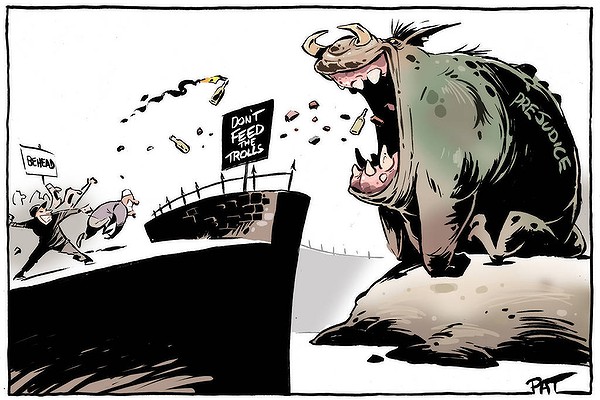
The Australian's editorial says that the riots were the work:
of an international movement devoted not to changing Western society but to its downfall. They want to abolish modernity and the principles on which Australia's free and democratic society is founded. Instead, they want to pursue their peculiar dystopia, a caliphate of medieval unreason.
The Australian refers to the black flag of evil jihad (ie., al-Q'aida), but it makes no mention of the Islamophobia of the Christian right 's rhetoric about Islam's intolerance and the imposition of sharia law; or that the film was a provocation aimed at inciting violence in order to show the world what a violent religion Islam is. It was designed to enflame Muslims through its contempt for Islam.
Presumably, this kind of Islamophobia is an acceptable face of Australia for outraged conservatives. They quickly appeal to free speech and then infer that (backward and unenlightened) Muslims do not accept that Western liberal democracies like Australia permit freedom of expression.
Here's something to consider. The right wing commentators are appealing to those on the right who support a combination of populist, anti-immigrant and increasingly anti-Muslim policies. The core of the conservative movement want a halt all further nonwhite immigration, a reduction in the the number of Muslims or the presence of Islam in society, and to prioritise native Australian values over those of other cultures. The inference is that Muslims will never truly be Australians.
The appeal of the conservative commentators is to the core conservative base---those older, angrier, Anglo-Saxon Australians who desire a party that adopts a tough, populist stance toward elites, immigration, Muslims and British values. They are outraged by the Sydney riots and their deepseated hostility to Islam surfaces in their comments.
There is no mention that the protests in the Muslim world are not just about a film. They are also about a US foreign policy in the Middle East that supported tyranny and dictatorship that ensured that the citizens' views, so contrary to US policy, would be suppressed and rendered irrelevant. Or, as the SBS's documentary The Secret War on Terror showed, the US programme of drone strikes in Afghanistan, Pakistan, Yemen that kill civilians.
This event is another example of what Anne Summers said recently, namely:
we are experiencing an era in politics where there is very little civility. The overall temperature of discussion and debate is torrid and people use language towards and about each other that even a few years ago would have been considered totally out of line. This, sadly, is the new norm.
In her speech Summers was referring to, and spelling out, the misogyny towards Julia Gillard--where the prime minister is attacked, vilified or demeaned in ways that do specifically relate to her sex. Islamophobia is another example.
Posted by Gary Sauer-Thompson at 11:13 AM | Comments (14) | TrackBack
September 15, 2012
The Daily Telegraph's moral outrage
Jonathon Green in The staggering hypocrisy of the supertrollers on the ABC's The Drum refers to the Daily Telegraph being up in arms about a lack of civility in public discourse. Its running a Stop the Trolls campaign---waging a war on the monsters that lurk on the internet.

Green says about this tabloid's style of "journalism":
It would be fair to say that their routine journalistic tone is hectoring, enraged and pugilistic ... these are the leitmotifs of a modern mass media that sees a future in venting at its audience and in encouraging a sense of shared outrage in response. It is a community built on anger and nameless omnidirectional dread. It is also a mass media alarmed at the penetration and mainstream subverting influence of social media.
The Daily Telegraph, which routinely uses anger, confrontation and provocation as the foundation of a populist business model, is a paper that is profoundly and utterly incensed by the conduct of vile and abusive trolls on Twitter.
What Green doesn't refer to is the way that Murdoch's tabloids condone practices which had encouraged their journalists to pay cash for unauthorised disclosures – from the alleged bribery of police officers and public officials. It is a well-established procedure in the tabloids that is fostered and condoned by Murdoch and it results in a network of corrupted officials across public life.
Posted by Gary Sauer-Thompson at 1:27 PM | Comments (10) | TrackBack
September 14, 2012
where to now?
The current political fight between centre-left and centre-right is between two different visions of a post-mining boom Australia, and between two sharply discrepant views on the role of government. The writing is on the wall: Australians can no longer rely on mining alone to sustain economic prosperity.
 David Rowe
So were to now? More technocratic progressivism? A greater emphasis on tyhe means of achieving a more equal society from the ALP? More debates over the market versus state? More in the way an individualistic and entrepreneurial interpretation of freedom for Abbott's particular brand of Conservatism?
One issue is stark. Australia's failure to improve productivity sufficiently in recent years can be attributed in large measure to a lack of skills that would enable it to make the shift to high tech manufacturing. Instead we have calls to take the tough decisions required to deal with our high costs.
The AFR editorial says:
The Gillard government mouths this message with talk of productivity gains, but its heart and its headspace remain trapped in the politics of redistribution....Rather than making our industrial relations system more flexible and our tax system less complex, Labor is re-regulating workplaces and has imposed on business a poorly designed mining tax and an ill-conceived carbon tax. And rather than reining in spending to address the budget’s gaping structural deficit, Labor has committed itself to new spending that this newspaper estimates will cost about $120 billion over the rest of the decade.
The AFR's proposal to overcome the slowdown in productivity growth is the federal government needing to get its fiscal house in order; dumping the pricing of carbon; improving Australia's competitiveness by reducing the costs of doing business; rejecting the politics of redistribution; and for the federal government to fall in line with the what the big miners want. After all, this is an industry that has the potential to be globally competitive and wealth-creating for decades to come.
There is nothing here about Australia currently experiencing a classic case of ‘Dutch Disease' in that the mining boom results in the value of the currency going up, manufacturing becomes less competitive, the country losing quite a few industries to lower wage countries, people became more concerned and spend less. With the inevitable downturn after the mining boom there is here was a lot of political pressure on the need for massive spending cuts.
It is fascinating that the AFR makes no mention of using the wealth from the mining boom to ensure that significant part of the NBN is in place to create a sufficient mass to start building new business models on top of this infrastructure. This would create new economic opportunities in the emerging digital economy. Maybe the AFR is in the dark about the benefits of the NBN?
Posted by Gary Sauer-Thompson at 6:18 AM | Comments (14) | TrackBack
September 12, 2012
class warfare
The politics of austerity are alive and well in Victoria, NSW and Queensland. It is the essential services that cater for the more disadvantaged sectors of the community---health and education (including TAFE) --- at a time when income inequality has risen steadily in Australia since about 1980, and Australia’s educational achievement is slipping.

Gonski argued that educational disadvantage is concentrated in the public school system and that the funding of the system exacerbates those inequities. The Gonski Review called for a big increase in funding to ensure that the growing equity gap between advantaged and disadvantaged communities is closed.
The other side of the politics of austerity is the attack on social justice--ie., the redistribution of resources to the poor and disadvantaged --as a form of class warfare and class envy in conservative political discourse. This politics here is to defend private health insurance and private education at independent schools.
So we have a winding back of the welfare state and to tell the poor to adapt to a transition to a health and education system that involves more personal responsibility and individual contributions. The rhetoric is that this wind back is necessary to avoid a debt burdened Queensland becoming like Greece.
Posted by Gary Sauer-Thompson at 8:39 AM | Comments (8) | TrackBack
September 11, 2012
Soros on Euro crisis
Many heavily indebted European governments are reducing their budget deficits at the same time as their economies shrink so that the debt burden as a percentage of GDP actually increases and they are forced to pay hefty risk premiums for access to funds. The real economy of the eurozone is in decline, Germany is doing relatively well, and the political and social dynamics are working toward disintegration.
In his The Tragedy of the European Union and How to Resolve It in the New York Review of Books George Soros says that:
The policies pursued under German leadership will likely hold the euro together for an indefinite period, but not forever. The permanent division of the European Union into creditor and debtor countries with the creditors dictating terms is politically unacceptable for many Europeans. If and when the euro eventually breaks up it will destroy the common market and the European Union. Europe will be worse off than it was when the effort to unite it began, because the breakup will leave a legacy of mutual mistrust and hostility. The later it happens, the worse the ultimate outcome. That is such a dismal prospect that it is time to consider alternatives that would have been inconceivable until recently.
In his judgement the best course of action is to persuade Germany to choose between becoming a more benevolent hegemon, or leading nation, or leaving the euro. In other words, Germany must lead or leave.
Soros argues that Germany has been thrust into a position where its attitude determines European policy. The primary responsibility for a policy of austerity pushing Europe into depression lies with Germany. As time passes, there are increasing grounds for blaming Germany for the policies it is imposing on Europe. Soros adds that the European Union that will emerge from this process of resolving the crisis :
will be diametrically opposed to the idea of a European Union that is the embodiment of an open society. It will be a hierarchical system built on debt obligations instead of a voluntary association of equals. There will be two classes of states, creditors and debtors, and the creditors will be in charge. As the strongest creditor country, Germany will emerge as the hegemon. The class differentiation will become permanent because the debtor countries will have to pay significant risk premiums for access to capital and it will become impossible for them to catch up with the creditor countries.
The prospect of a prolonged depression and a permanent division into debtor and creditor countries will result in the periphery seething with resentment, anger and hostility.
Posted by Gary Sauer-Thompson at 9:21 AM | Comments (1) | TrackBack
September 10, 2012
that eternal Chinese boom
One major mega economic trend is the world economy shifting from west to east. Australia is potentially well-positioned to take advantage of the new world economy.
Today we have a mining bust in iron ore prices (55%) that few predicted in the mining industry, Treasury or the Gillard Government. Those in the mining industry saw sky high iron ore prices, and they believed these would continue, and they geared up their expansion plans for the ongoing boom.
They held to this belief even though post the global financial crisis Europe was in a depression and the US in a recession; and so the demand for Chinese manufactured export goods would fall, and there would be a decline in the Chinese steel mills demand for Australia's iron ore.

What we were feed by the mining boosters was the eternal Chinese boom story:----ongoing Chinese urbanisation will effectively guarantee strong demand for commodities such as iron ore for the next couple of decades, while Beijing has several economic tools with which to arrest any immediate dramatic slowdown. Things are otherwise to this booster narrative.
In the AFR Elena Douglas points out that:
the terms of trade dividend delivered by the Chinese hunger for our commodities was returned to Australians as family payments A and B; royalties and tax receipts which could have been invested in productivity improving reform of all levels of education.... Real income growth that lasts comes from productivity improvement, and education is one of the biggest productivity levers governments have access to. It’s the education system, stupid, and it always will be.
Education is crucial for the development of high-tech manufacturing in Australia.
Posted by Gary Sauer-Thompson at 7:42 PM | Comments (8) | TrackBack
September 9, 2012
the great free market
Neo-liberals say that state planners don’t know what people want. People know what people want, and entrepreneurs will invest and compete to supply those wants. If the product or service supplied is underused, useless or too expensive, it’s the entrepreneur who loses out, not the customers. That is the beauty of the free market and opening up the electricity system to competition.
In Australia in the mid-nineties State Government’s agreed to privatise their electricity public infrastructure under pressure from the then Howard Government. Privatization occurred in Victoria and South Australia.
James Meek in How We Happened to Sell Off Our Electricity in the London Review of Books makes a good point about the realities of privatising essential services such as electricity.
If you define the problem as the lights not going out... you misunderstand everything about the way the new world of electricity markets works. The ideal situation for private electricity firms is one where there is only just enough electricity to go round. Then they can charge as much as they like, and people will have to pay.
Though people think insecurity of supply means will the lights go off or not, that is not the issue. It is what happens just before the lights go off. For instance, the global electricity company takes a coal fired power station off line for "maintenance". This drives up the price of electricity, which meant more money for the global power company (eg., International Power and TRUenergy) for the other owners of coal-fired power stations. The customers pay the price.
In Australia despite the fall in wholesale electricity prices, customers have seen big increases in their electricity bills. The beneficiaries are the firms that distribute and sell the power. The inevitable next stage is for the companies that distributed electricity to merge with the companies that generated it--ie., the companies t sell customers electricity that they’ve ‘bought’ wholesale from themselves. This is ‘vertical integration’ with all its with all its potential for price-fixing and abuse of market dominance.
In Australia the international power companies have convinced the regulator and government that they have the right to be compensated for decommissioning electricity generation plants that are among the most polluting in the OECD. When they bought the Hazelwood and Yallourn power plants through the Kennet Governments privatizing process they knew that their emissions would be capped, a price paid for the right to pollute, and that a system of regulating emissions would be adopted and would affect the value of their power-plant assets.
Posted by Gary Sauer-Thompson at 10:47 PM | Comments (2) | TrackBack
September 7, 2012
gaming the energy market
The Gillard Government has made a right mess of reducing the greenhouse gas emissions of the fossil fuel industry as part of the shifting to a low carbon economy.
The contracts for closure to secure the closure of 2000 MW of Australia’s dirtiest power stations like Hazelwood and Playford was part of the Clean Energy Future package. It was there because the carbon price agreed to by the Multi-Party Committee on Climate Change was never going to be high enough to retire our most polluting power stations; therefore an additional mechanism was required.

The Clean Energy Future package aimed to secure the closure of a handful of power stations while paying these same power stations $5.5 billion in compensation. Our dirtiest power stations were to be given a $5.5 billion compensation package for loss of asset value. $1 billion in cash payments has been paid in 2011-12.
The other compensation was handing out free permits to dirty industries like brown coal. Currently, these generators receive 94.5 per cent of their pollution permits for free — meaning they only pay one twentieth of the true price for carbon in this country.
These power stations are not going to be closed down.Thankfully Contracts for Closure is being ditched because the owners of the coal-fired power stations were asking too much for their ageing assets. They should never have been compensated in the first place. The Gillard Government has shown some sense in walking away.
On the other hand, these fossil fuel power stations are actually better off due to all the compensation. The system has been gamed by the power of vested interests in the fossil fuel industries. So why not make the coal plants pay the full price of their carbon permits? Why not invest the money in renewable energy--into large-scale solar power with thermal storage?
Posted by Gary Sauer-Thompson at 4:26 AM | Comments (6) | TrackBack
September 6, 2012
Gina Rinehart offers some free advice
Gina Rinehart is pretty free with her advice for how Australian citizens should live their lives. Last week week advised the poor who are jealous of the wealthy to stop whining and drinking, smoking and socializing so much, and work harder and longer. Presumably We should aspire to be billionaires like herself.
Rinehart also gave some advice to the socialist government in Canberra--to avoid Australia ending up like Greece the government needed to lower the minimum wage, as well as taxes.
 David Rowe
Speaking at the Sydney Mining Club, Rinehart said that Australia's mining industry couldn't compete with nations that are willing to pay workers less than $2 a day for their sweat and labor. The implicit suggestion: Employers should be free to pay workers whatever they please. She also added that Australia is becoming too expensive. Australia could not afford the carbon tax or the mineral resources rent tax.
Rinehart's new economic zone for northern Australia would have fewer taxes and regulations and lower wages.
Posted by Gary Sauer-Thompson at 3:26 PM | Comments (3) | TrackBack
September 5, 2012
Tasmania: Forestry not the key economic driver
Changes are afoot in Tasmania.The Tasmania, where the old resource industry's dominated the economy, is fading. This is a state in transition--economically and politically.
Fred Gale says that the Tasmanian forest industry is experiencing its worst downturn in a decade. There is a sea of red ink, failed investments, lost contracts and redundancies everywhere. He spells out the reasons:
Structural factors are at work. These include a historically high Australian dollar; a decline in per capita paper demand thanks to computerised workplaces; the superiority of plantation over native hardwood woodchips coupled with a significant increase in plantation woodchip volumes; and the growth of third-party, Forest Stewardship Council, certification.
He adds that though there can be much debate over the relative importance of these factors they have collectively placed a greater load on Tasmania’s forestry model than it can bear. A debt ladened Gunns cannot afford to proceed with the Bell Bay pulp mill--its a zombie company--- and Forestry Tasmania is loss making and faces major restructuring.
One inference to be drawn from this episode is the need to transition the forest products industry around sustainability--the brand that is Tasmania - clean and green--- and to diversify the broader economy.
Saul Eastlake argues that a single ‘mega-project’, particularly one based on commodity-processing (ie., selling large volumes of essentially undifferentiated commodities at the lowest possible price), is never going to be ‘the’ solution to Tasmania’s economic and other problems. He then refers to the smart state:
Tasmania’s future economic success is far more likely to be found in the production of highly differentiated goods and services, embodying a significant intellectual content (for example in their design or branding), for which customers can be persuaded to pay premium prices. There are many successful examples of that strategy working in Tasmania – but they are all relatively small enterprises, not mega-projects.
One problem in embracing innovation to create the highly differentiated goods and services embodying a relatively high intellectual content and for which customers are willing to pay premium prices is Tasmania’s relatively low levels of educational participation and attainment. Another is that it needs to attract and retain people with creative skills and aptitudes. A third is the low investment in infrastructure.
Posted by Gary Sauer-Thompson at 8:59 AM | Comments (3) | TrackBack
September 4, 2012
Gonski: first moves by Gillard
Gillard presses on with education reform in her response to the Gonski Review to lift teaching standards in spite of saying little about funding. The states, who are responsible for education, are close to broke and the Commonwealth has to stump up most of the 6.5 billion cash required.
Education is a core Labor issue in that the welfare state attempts to address the capitalist logic of ever increasing inequality through educational opportunity and a safety net. Schools for the well-off are better than ever; those for everyone else continue to deteriorate. It becomes self-reinforcing as the middle class continues to believe that their interests will be best served by an ever-freer market and a smaller state.
Gillard, in her speech to the National Press Club, stated that new funding will be contingent on states and systems agreeing to and delivering school improvement in the form of improving g teacher quality, including requiring more classroom experience before graduation and higher entry requirements for the profession; giving principals more power, including over budgets and staff selection; and providing more information for parents through the My School website.
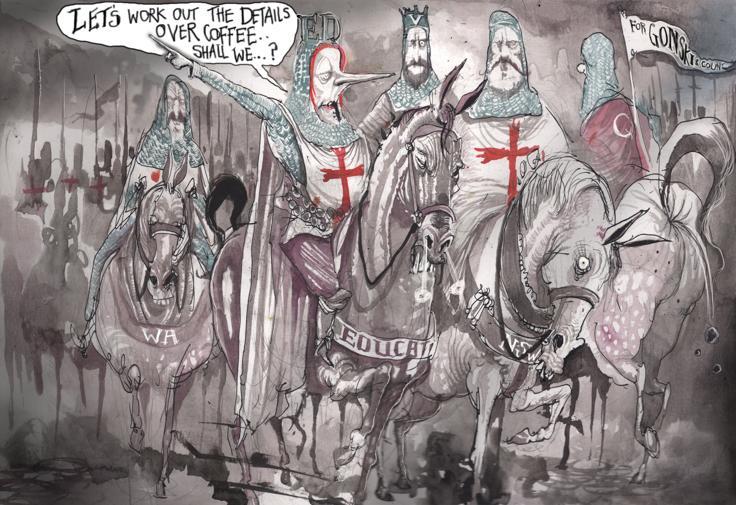 David Rowe
Gillard is opening up the negotiations with the states by mapping the field in terms of reforms aimed to achieve excellence rather than equity. On the table for negotiation are the states' share of the extra funding, the level of the basic benchmark grant under the Gonski plan (which would be topped up for needs, such as economic disadvantage), the amount of indexation and how quickly the funding is scaled up.
The states will have to scramble to avoid looking like the bad guys--as happened with the Disability Insurance scheme.---if they don't come to the table to negotiate. There is little doubt that current funding model is broken, leaving (mostly state) schools with high proportions of disadvantaged kids lacking the resources needed to ensure they get the education they need to live in a market economy. In contrast, (mostly private) schools, with more favoured clienteles, have further funding heaped on them by generous government grants.
People are now asking whether Gillard Labor is going to go into the next election with unfunded spending commitments. Will it trim middle class welfare to fund its commitments, given that the tax receipts this financial year are expected to drop 22.1 per cent of GDP to somewhere just above 21 per cent by next budget time due to falling commodity prices?
If we step back from this politics of the moment and look at what is happening at a deeper level, then we can discern the increasing inequality in our schools and society. This is what Gonski was addressing in educational terms. Philip Blond from the ResPublica thinktank says that:
While the left has tended to embrace the state as the agent of equality, the right invariably looks to the market as the agent of prosperity. And yet the left has not solved the problem of poverty through state redistribution, and the right has not delivered mass prosperity through the market. Instead, both the left and the right have presided over rapid and rising inequality and the seizure of wealth and opportunity by those at the very top of society.
His critique of the social democracy assumptions of Gillard's educational reforms would be that in the 20th century the poor represented the bottom 20%. But they have subsequently become the bottom third, and now with changes in the nature of modern capitalism in the 21st century they threaten to encapsulate the middle class itself.
It does appear that the development of technology and globalization undermines the middle class, and makes it impossible for more than a minority of citizens in an advanced society to achieve middle-class status. Francis Fukyama says that there is:
a lot of happy talk about the wonders of the knowledge economy, and how dirty, dangerous manufacturing jobs would inevitably be replaced by highly educated workers doing creative and interesting things. This was a gauzy veil placed over the hard facts of deindustrialization. It overlooked the fact that the benefits of the new order accrued disproportionately to a very small number of people in finance and high technology, interests that dominated the media and the general political conversation.
It is a reality that liberal democratic society's in the West cannot maintain a middle class without welfare support. We could add that the Australian society and economy cannot afford that kind of welfare support without increasing levels of taxation--eg., broadening the base of the GST (and cutting the corporate tax rate).
Posted by Gary Sauer-Thompson at 9:08 AM | Comments (14) | TrackBack
September 1, 2012
a return to yesterday?
A mythic Australia is being constructed by Australian conservative with the constant appeal to John Howard. Its not simply an appeal to the policies of the Howard era in Australia---Howard, on this political construct, stood for a particular kind of Australia. A wholesome white suburban Australia of the patriarchal family behind the white picket fence.
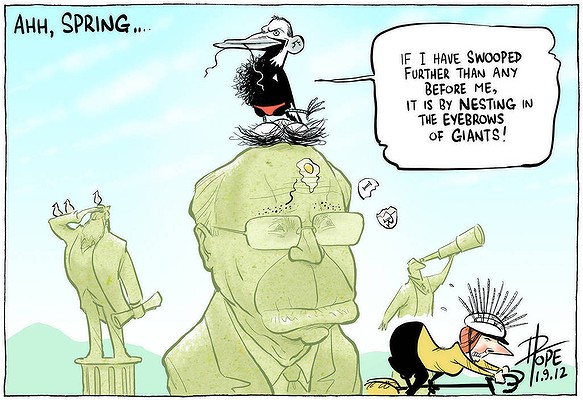 David Pope
Everything was fine in that picture of Australia. It was a relaxed, comfortable and harmonious Australia where everything was in its right place, common sense ensured that everybody did the right thing,. This world was bathed in golden light. It's a deeply nostalgic picture--akin to a Kodak moment of yesteryear. Though it never was it still resonates deeply in our culture.
You can see its hold in education. In this mythic world there were no failing teachers in failing schools. The traditional teacher-centred approach to the basics of education ensured that students learned and disadvantage overcome. When that was displaced by progressive teachers things declined --eg., the gap in outcomes between our best and worst performed students became high and is growing. Teachers don't know what to teach.
So we have to get back to basics to ensure that Australian's can read and write like they did in yesteryear.
Posted by Gary Sauer-Thompson at 6:54 PM | Comments (2) | TrackBack
an insider's judgement of Gillard Labor
Shaun Carney has written his last article for The Sydney Morning Herald. He leaves Fairfax along with 1900 others leaving the Sydney Morning Herald, The Age, the Canberra Times and the Australian Financial Review. The era of gatekeeper journalism is over.
Carney's final column is an assessment of the Gillard Government. So it offers us an opportunity to look at the press think of "savvy" insider political journalism in Australia that often has the appearance of being an echo chamber.
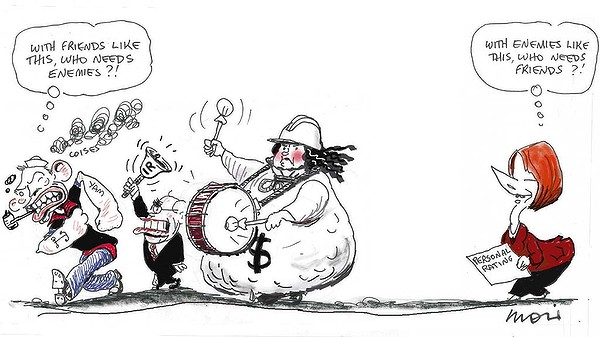
In Carney's judgement Labor is in an irrecoverable position under Gillard's leadership. In making this judgement he acknowledges the positives of the Gillard Government:
The government has done a lot of what it said it would do. It has put a price on carbon and repealed WorkChoices. It has met some of its pledges on health funding. It has put considerable amounts of money into universities and school education, and has introduced important reforms on the national curriculum and school accountability. It has pursued an activist stance on industry and innovation.
Its unfinished business includes a new funding model for schools and a national disability insurance scheme. Legislative success cannot be ruled out.
He adds that though legislative success is an important benchmark in a liberal democracy it cannot be the only one. That's true enough. So what else needs to be considered?
Carney says that:
Politics in a liberal democracy is about more than getting legislation through. In a political system with a three-year election cycle, sustaining public confidence, demonstrating authority and using politics to advance a nation's belief in itself is also vital.
His judgement is that this is where the Gillard government comes up short. No one would disagree with this. Why has it come up short? What has gone wrong? Why is the Gillard government on the nose?
The reason Carney says, is the Labor Party itself. His argument is this:
The caucus and the national union bosses who knifed Rudd in favour of Gillard, by their actions inadvertently set her up for failure.....The fundamental problem was the coup against Rudd. Behind that was a systemic problem within the ALP: the change of the rules that gave the leader the power to appoint frontbenchers, a right previously enjoyed by the caucus. The corollary of that decision was a change in attitude to the leader among caucus members. By taking away collective responsibility for ministerial appointments, the rule change encouraged backbenchers to adopt one of two courses: to plot to change the leader who was blocking their advancement or, alternately, to become uncritical suck-ups to the leader to try to get ahead.
This is okay as far as it goes. However, there is nothing at all about the difficulty of reform, the campaign waged against Gillard in the media by News Ltd, the Dutch disease, Abbott's successful strategy of opposing reforms that take Australia away towards a liberal-progressive future, the culture war, or the ever deepening partisan divide into friends and enemies. The failure of the Gillard Government to sustain public confidence, demonstrate authority and use politics to advance a nation's belief in itself is reduced by Carney to the internal workings of the ALP.
Therein lies the poverty of the political journalism in Australia--its remarkable blindness the context of politics and its single eyed focus on leadership. This is a political journalism that has failed, until just recently (eg., the Leigh Sales Abbott interview on the ABC's 7.30 programme) to call Abbott to account on his deceit, blatant dishonesty and lies about carbon pricing. The political journalists simply failed to do the basic fact check.
Don't journalists continually remind us that journalists in contrast to bloggers are the champions of facts, accuracy and truth? Yet the pack response by the journalists was to do nothing. They just talked in terms of the cleverness of Abbott's tactic of opposition based on political lies-- ie., the campaign had Gillard on the ropes. They then speculated about which Labor operatives---those national union bosses---would knife Gillard. Political journalism in Australia goes round and round in ever diminishing circles.
Political journalism in Australia has a serious problem. What are they going to do in the face of the political lies? Are they going to call it for what it is. Are they going to ignore the agitprop and stick to their insider journalism, being savvy, and endless leadership speculation ?
Posted by Gary Sauer-Thompson at 7:30 AM | Comments (8) | TrackBack