|
September 1, 2012
Shaun Carney has written his last article for The Sydney Morning Herald. He leaves Fairfax along with 1900 others leaving the Sydney Morning Herald, The Age, the Canberra Times and the Australian Financial Review. The era of gatekeeper journalism is over.
Carney's final column is an assessment of the Gillard Government. So it offers us an opportunity to look at the press think of "savvy" insider political journalism in Australia that often has the appearance of being an echo chamber.
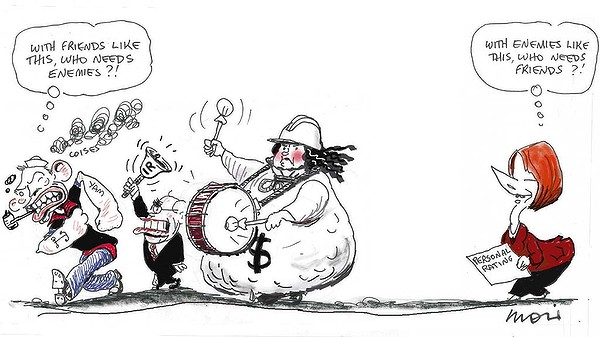
In Carney's judgement Labor is in an irrecoverable position under Gillard's leadership. In making this judgement he acknowledges the positives of the Gillard Government:
The government has done a lot of what it said it would do. It has put a price on carbon and repealed WorkChoices. It has met some of its pledges on health funding. It has put considerable amounts of money into universities and school education, and has introduced important reforms on the national curriculum and school accountability. It has pursued an activist stance on industry and innovation.
Its unfinished business includes a new funding model for schools and a national disability insurance scheme. Legislative success cannot be ruled out.
He adds that though legislative success is an important benchmark in a liberal democracy it cannot be the only one. That's true enough. So what else needs to be considered?
Carney says that:
Politics in a liberal democracy is about more than getting legislation through. In a political system with a three-year election cycle, sustaining public confidence, demonstrating authority and using politics to advance a nation's belief in itself is also vital.
His judgement is that this is where the Gillard government comes up short. No one would disagree with this. Why has it come up short? What has gone wrong? Why is the Gillard government on the nose?
The reason Carney says, is the Labor Party itself. His argument is this:
The caucus and the national union bosses who knifed Rudd in favour of Gillard, by their actions inadvertently set her up for failure.....The fundamental problem was the coup against Rudd. Behind that was a systemic problem within the ALP: the change of the rules that gave the leader the power to appoint frontbenchers, a right previously enjoyed by the caucus. The corollary of that decision was a change in attitude to the leader among caucus members. By taking away collective responsibility for ministerial appointments, the rule change encouraged backbenchers to adopt one of two courses: to plot to change the leader who was blocking their advancement or, alternately, to become uncritical suck-ups to the leader to try to get ahead.
This is okay as far as it goes. However, there is nothing at all about the difficulty of reform, the campaign waged against Gillard in the media by News Ltd, the Dutch disease, Abbott's successful strategy of opposing reforms that take Australia away towards a liberal-progressive future, the culture war, or the ever deepening partisan divide into friends and enemies. The failure of the Gillard Government to sustain public confidence, demonstrate authority and use politics to advance a nation's belief in itself is reduced by Carney to the internal workings of the ALP.
Therein lies the poverty of the political journalism in Australia--its remarkable blindness the context of politics and its single eyed focus on leadership. This is a political journalism that has failed, until just recently (eg., the Leigh Sales Abbott interview on the ABC's 7.30 programme) to call Abbott to account on his deceit, blatant dishonesty and lies about carbon pricing. The political journalists simply failed to do the basic fact check.
Don't journalists continually remind us that journalists in contrast to bloggers are the champions of facts, accuracy and truth? Yet the pack response by the journalists was to do nothing. They just talked in terms of the cleverness of Abbott's tactic of opposition based on political lies-- ie., the campaign had Gillard on the ropes. They then speculated about which Labor operatives---those national union bosses---would knife Gillard. Political journalism in Australia goes round and round in ever diminishing circles.
Political journalism in Australia has a serious problem. What are they going to do in the face of the political lies? Are they going to call it for what it is. Are they going to ignore the agitprop and stick to their insider journalism, being savvy, and endless leadership speculation ?
|





it is sad to hear about the 1900 jobs gone from Fairfax. They have lost a lot of expertise and experience. Where will all the journalists who have taken redundancy go?