« March 2007 | Main | May 2007 »
April 30, 2007
a media campaign
It's an old bogey isn't it. The ALP is controlled by the union bosses who desire to run the country. Does the image resonate like it used to?

Bill Leak
If the nasty old images refer to times past, when unions had a stranglehold on the industrial system and strikes were rife, then those times have long gone. Today, a large proportion of the workforce is non-unionised, and we have the ALP proposing new restrictions on the capacity to strike and a considerably curtailed version of previous unfair dismissal provisions.
Still, that reality wont stop the Right Wing Noise Machine, from loyally running the Howard Government's 'union bosses run the country under Labor' campaign. I guess something has to replace the relentless drumbeating for war that has well and truly seen its used by date.
Posted by Gary Sauer-Thompson at 8:57 AM | Comments (6) | TrackBack
April 29, 2007
harassing the White House
A Democratic-controlled Senate has passed legislation that would require the start of limited US troop withdrawals from Iraq by October 1. The 51-46 vote was largely along party lines. With House doing the same earlier Congress has moved towards a historic veto showdown with President George W. Bush on the war, who immediately promised a veto. Congress needs the two-thirds margin to overturn the president's threatened veto.
Though President Bush says that he is more than willing to meet with Democratic leaders to resolve the differences, between them he always signals that he has no intention to compromise with them on the funding bill for the wars in Iraq and Afghanistan.
Bush is not going to change his mind on Iraq. The US occupying force in Iraq looks like it's planning to stay forever under the Bush /Cheney scenario. That means the US continues to occupy a sovereign Muslim country indefinitely, against the wishes of a clear majority of Iraqis; even though this project has little chance of success and considerable chance of creating ever more problems as long as it continues.
So we can expect more of the fear-based rhetoric, an intentional simplification of a complex situation into victory versus surrender, a demonization of those who hold alternative views and unwillingnes to respect people who hold opposing viewpoints.
The President has the option to continue the war in Iraq by using the mercenary army of the corporate security companies.
Posted by Gary Sauer-Thompson at 11:57 PM | TrackBack
ineffectual diplomacy
Condelezza Rice, the current US Secretary of State, has few real and substantial achievements in the Middle East. Iraq is a mess and there are no good signs that any peace talks of any kind between Israel and the Palestinians are likely in the foreseeable future.

An interesting article in Haaretz on land acquisition in 19th century Ireland and contemporary Palestine. Israel has been taking land from which Palestinians have been evicted. Rice says very little about the settlement enterprise in the occupied territories is the central mechanism for this land grab.
Rice says very little about the awful killing and destruction Israel caused in Lebanon, alongside the heavy price that Israel paid. One thousand Lebanese killed, thousands injured and crippled, and billions of dollars in damage for what purpose or objective?
Posted by Gary Sauer-Thompson at 5:30 PM | TrackBack
April 28, 2007
playing catchup with a wedge
The wedge is being played in energy as well as old growth forests with Howard going down the road of nuclear power by removing all unnecessary restrictions on mining, processing and exporting uranium to open the way for domestic nuclear power generation. Howard is playing catch up on climate change and nuclear power is a big button issue that makes the Coalition Government look proactive and future orientated, as well as pushing the ALP into a corner and dividing them.

Bill Leak
It's unclear whether the nuclear wedge will work as all the Labour states and territories remain opposed to nuclear power, it is not economically viable without substantial subsidies, and most Australian's remain opposed to nuclear power and are not prepared to live near a nuclear reactor. He opens the door to Labor's scare campaign that the Coalition would pepper the country with nuclear reactors.
The political reality is that the Prime Minister is being forced by public pressure to act on climate change by committing to some sort of emission reduction target. Howard has to do something as the fiction that Australia is reducing its greenhouse emissions becomes more obvious, whilst the spin that action to reduce greenhouse emissions will damage Australian jobs and reduce economic growth far more than the costs of doing nothing looks like spin to protect the coal industry and heavy energy users. It is spin because there is no explanation of why emission reduction targets will be so damaging to jobs and the economy.
There is little evidence to support Howard's position---and from we know from Treasury comments the evidence does not exist because the Government has not been interested enough in climate change to do the work. Treasury has revealed it had done no economic assessment or modelling on the consequences of climate change.
What we do have is the CSIRO advising that big cuts in greenhouse gas emissions appear to be both inevitable and affordable for Australia.
Posted by Gary Sauer-Thompson at 2:24 PM | TrackBack
April 27, 2007
snap shot of the Middle East
Its many a long year since I've read the New Left Review. I stumbled into its website with a link to Frederic Jameson on postmodernism. In the latest issue I came Tarig Ali's editorial entitled 'Mid-Point in the Middle East.' It offers a snapshot that you rarely come across in Australia.
Ali sums up his editorial thus:
The crisis in the Middle East that began in 2001 is not in sight of any dénouement. At best, we are perhaps only at mid-point in the unfolding drama......A radical wind is blowing from the alleys and shacks of the latter-day wretched of the earth, surrounded by the fabulous wealth of petroleum. The limits of this radicalism, so long as it remains captured by the Koran, are clear enough. The impulses of charity and solidarity are infinitely better than those of imperial greed and comprador submission, but so long as what they offer is social alleviation rather than reconstruction, they are sooner or later liable to recuperation by the existing order.
Ali argues that the current turmoil is still confined to those areas of the Middle East where for twenty years or more American power never really penetrated: the West Bank, Ba’athist Iraq, Khomeinist Iran. He says that the real us anchorage in the region lies elsewhere: in Egypt, Saudi Arabia, the Gulf States and Jordan. There its traditional clients have held the line, and are on hand to help out with regional problems. So it is too soon to count on imperial defeat.
Posted by Gary Sauer-Thompson at 7:21 PM | TrackBack
ALP: conferences + regulating labour markets
The ALP is looking increasingly confident and united. It has shifted from the old negative campaign strategy of saying no, being a small target, and returning to the past to providing substantive policies that address real problems. Remember a desperate Labor's opposition to tax cuts in 2005? The IR plan is a good example of the shift under Kevin Rudd.
It proposes a modern decentralized workplace system, rather than the rejection of the Howard Government's Workchoices and a return to the earlier model. Even though the architecture is a rebadged IRC, that restores to the function of setting minimum wages along with some new functions, the message is that the ALP is the party of the future. It has an IR policy for the 21st century.
At the core of the proposals about a new IR architecture are a uniform national industrial relations system, the introduction of secret ballots over strikes, a ban on pattern wage bargaining, and changes in unfair dismissal laws for small businesses. It abolishes the Australian Industrial Relations Commission and replaces it with an organisation called Fair Work Australia; described as "a one stop shop", that replaces the Australian Fair Pay Commission, the Office of Workplace Services and, with the abolition of Australian Workplace Agreements, the Office of the Employment Advocate. The market would continue to determine wages above the minimum wage.
Julia Gillard suggests that Fair Work Australia will be out in the community, with offices in shopping centres in suburbs and in country towns rather than in city tower blocks.
It is a proposal because the plan has to be debated and agreed at the 43rd ALP national conference on the weekend at Darling Harbour Sydney. We can be sure that it will be agreed as the tightly controlled, stage managed Conference is more a series of set pieces and political theatre on the conference floor. The debate about how to protect workers in a neo-liberal world takes place behind the scenes amongst the various factions and unions. What we see as citizens is a political convention structured for television that reflects the dominance of executive power in the ALP.
Even though big business is unhappy with the IR proposal the ALP is rebuilding the IR architecture on the foundations of the Howard Government's unitary system on the corporations power.It addresses the way that WorkChoices causes unease and anxiety with the claim that the ALP can restore balance and fairness to the system. It is electorally astute politics, since the plan can be marketed as a reform rather than a roll-back.
Posted by Gary Sauer-Thompson at 7:37 AM | TrackBack
April 26, 2007
between Iran and Afghanistan
In accepting the war on terror Australia is hostile to Iran as a regional power and is fighting the Taliban in Afghanistan. Australia accepts the American control over the Kabul regime as legitimized internationally, and it supports Washington's attempts rollback of Tehran's influence in Afghanistan, including in the western provinces.
Yet Iran is also hostile to the Taliban. As M K Bhadrakumar points out in Asia Times Online:
Tehran has a fundamental problem with the Taliban's virulent anti-Shi'ite ideology - the main reason why Saudi Arabia and the US found the Taliban movement attractive in the mid-1990s. The Iranian leadership will not easily forget or forgive the Taliban for massacring (often burying alive) thousands of Shi'ites in the Hazarajat region and in northern Afghanistan during its years in power in Kabul. In Mazar-i-Sharif in 1997, when the Taliban executed eight Iranian diplomats, Tehran came close to war.
These are the sorts of distinctions "the war on terror" blurs--purposely. The "war on terror" provides the legitimation or the justification for perpetuating the Western military presence in the region.
M K Bhadrakumar says:
Iran has made no bones that its Afghan policy is essentially three-pronged. First, Iran must hasten the vacation of the American military presence in Afghanistan. Second, everything possible should be done to ensure that the Taliban don't regain power in Kabul. Third, it is in Iran's historical, cultural and geopolitical interest to ensure that western Afghanistan remains in its sphere of influence.
So neither the US nor Iran want the Taliban back in Kabul. So the military presence in Afghanistan is to target Iran and undermine the regime. Hence all the US spin about Iranian support of the Taliban.
Posted by Gary Sauer-Thompson at 8:19 PM | TrackBack
being an Australian
According to conservatives I cannot be much of an Australian. I haven't been to Anzac Cove to feel the connection with the place. Though I am an Australian citizen I have never worn an Australian uniform, nor am I likely to. Nor am I persuaded that those whose sacrifice in war gave us freedom.They were fighting for the British empire, not defending Australia from attack.
So, according to the now conservative Brendan Nelson, the Defence Minister, I cannot be fully Australian. I do not grasp that the truths by which we live that are worth defending. I talk in terms of a war in Iraq not a war against terrorism, and about an imperial USA rather than the defence of freedom and democracy by bombing and torturing Iraqi civilians. Therefore, I am not a patriot is the neocon reasoning.

Alan Moir
I remember the chest-beating warmongers and the attack on Islam by conservatives. I remember the lies and spin about Iraq and the systematic attempts to conceal the truth about torture rather the values of courage and mateship. I recall government sources feeding falsehoods----Saddam had WMD's---to ink-and-paper journalists working at influential and prestigious media outlets in order to manipulate Australian public opinion about the Iraq war. We are dealing with myths here folks not truths.
Some our most prominent journalists were eager to be feed as chooks, and they then repeated the falsehoods uncritically. When it is discovered that what they were fed was a lie, they say nothing and continue to protect the identity of the spinners so that their sources will continue to leak to them.
I'm not sure that this is the light in the darkness that the Defence Minister talks about?
What I suspect is that unions, such as CFMEU, who routinely attack decisions to protect more old growth forests from logging, do understand and embody the Anzac spirit (values) the Prime Minister continually talks about. That kind of suspicion is a further indication that I am not fully Australian. The suspicion-driven hermeneutics leads to the conclusion that 'Australian identity' these days is a conservative construct. It is about patriotism, war and sacrificing my freedoms to ensure national security.
The neo-conservatives live in a mythic world. Saddam had WMDs. Radical Islamists are everywhere, and they want to impose sharia law on us and they want to kill us because they hate us, our values and way of life.
Posted by Gary Sauer-Thompson at 8:13 AM | Comments (4) | TrackBack
April 25, 2007
political messages: economic goodies
There is no need for the Howard Government to run a scare campaign on the economy against the Rudd ALP is there? The recent inflation figures are on the low side. There is an annualised inflation is 2.4 per cent, which is within the Reserve Bank's mandated maximum of 3 per cent.

So the federal budget will provide the platform for tax cuts and big spending. The old economic management team of Howard and Costello deliver again. It is the economy--growth and jobs---that is the key. Reform (eg., climate change) can be postponed until tomorrow. We voters can to continue to party and aspire to investment properties and overseas trips.
These are the messages from Canberra.
Well, the messages that I see and hear as I return from five days in the wilderness without any media at all. Oh, the scare campaign will be put into play for sure. It will be Rudd the destroyer of the good times. Rudd the moral zealot. He's a destroyer of prosperity and freedom because his strings are pulled by the union bosses.
Posted by Gary Sauer-Thompson at 7:19 AM | Comments (2) | TrackBack
April 24, 2007
water futures
Severe water shortages are not just in south east Queensland. I've just spent five days holidaying on Kangaroo Island. Many parts of the Island ran out of water in October 2006. The Kingscote dam is near empty.
Water is being trucked in at great expense. Even the source for the trucked water--a private dam --- is not secure.

Alan Moir
The Island is drying out compared to five years ago when I was there. The immediate water crisis is the same as in in the Murray-Darling river system. It is the lack of rain and run off. So little rain has fallen this year. It hasn't rained for over a year in Kangaroo Island. The weather was like summer time. Everywhere we went there were signs about needing to conserve water. Most of the explanations by the Islanders were in terms of the drought --not climate change. Climate change was rarely mentioned.
What I was seeing was a hot dry world with little water. The Island already has a desalinisation plant at Penneshaw. More will be needed. The Island's economy was struggling as the old drivers of growth were doing it hard. Agriculture was on its last legs, whilst pastoralism was barely surviving with food or water. Without significant rain soon there will be no water for these industries in 2007-08. It is (international) tourism that was keeping the Island's economy going. Flinders Chase, which sells heritage, is a major economic player on the Island in terms of economic growth and employment.
If we come back to water futures then we need to think in terms of the long-term decline in runoff, less river flow and water as the effects of human-caused climate change, not just the drought. That means water allocations will need to be reduced for irrigated agriculture in the Murray-Darling Basin--- for past over allocations and reduced river flows in the future.
Update: 26 April
It's been raining all day in Adelaide. Will it be the same pattern as last year--good autumn rains then nothing? Hence a year of below average rain?
John Quiggin has an interesting post on water. He says that in Queensland:
there is talk of evacuating towns that are running out of water. This seems an over-reaction (or more likely media beatup) to me. A reported cost of $8000 per week for tankers to supply water to a town of 1500 people is not a huge sum. Stlll, unless rainfall returns to higher levels soon, a lot of communities are going to face decline and maybe in some cases disappearance.
Quiggin also has an op-ed in the AFR on the politics of water as opposed to long term policy that addresses the long term effects of climate change. He rightly argues that Howard's Murray-Darling Basin takeover plan mainly consists of funding for on-farm works and is inadequate to the severity of the problem.
Quiggin has just posted the AFR op ed on his weblog.
Posted by Gary Sauer-Thompson at 9:42 PM | TrackBack
April 19, 2007
US: Gun control
The US is a very strange place. Guns are like wrist watches. Guns are linked to individual rights. It's in the constitution they say. Gun control means trashing individual rights.
Few state or federal politicians will use the latest mass slaughter at Virginia Tech by Cho Seung Huito to argue for more gun control to argue for gun control. There is even little pressure to renew the federal law banning the sale of assault rifles, which was recently allowed to lapse. What seems to be on the agenda is the gun lobby's for no free gun spaces---the solution to the mass slaughter at Virginia Tech is for the students to carry weapons at college!

Allan Moir
In order to ensure its election the Democratic Party's national platform commits it to uphold the Second Amendment — the right to keep and bear arms---and so it is no longer committed to about gun control. Right wing American nationalists will argue that guns are needed because foreigners everywhere, and next time it really will be a Muslim shooting up the native born white Americans in one of the universities!
Posted by Gary Sauer-Thompson at 10:24 AM | Comments (3) | TrackBack
April 18, 2007
Telstra: gouging the customer
It would appear that a rattled Howard Government's response to the ALP's broadband policy is to bunker down with Telstra to develop its own broadband policy. The Government doesn't really have one. An election looms. So why not a cut a deal with Telstra to come up with a plan that would trump Labor's? It looks to be a plan to counter the ALP, which is developed behind closed doors and cuts out the ACCC.
Remember it is Telstra that has consistently blocked the development of high speed broadband in Australia Even where it has installed high-speed broadband equipment in its exchanges, it won't allow it to run at full speed until another company puts in competing equipment. So the 20 Mbps service is limited to exchanges where competitors are also offering those speeds.
Why is Telstra is playing a spoiler role. Regulatory constraints says Telstra. So what does 'regulatory constraint' mean in this context apart from less constraint?
Peter Martin at the Canberra Times describes the situation clearly:
What it means is that if it does turn on its high-speed equipment it will be forced to allow other internet companies to buy the high speed service from it at wholesale rates and compete against it. If it doesn't turn up the speed it won't have to give what it sees as a leg-up to a retail competitor. But where a competitor goes to the expense of installing its own competing equipment, it will turn up its speed in order to match the competition. It's the commercial equivalent of a strike..
Telstra, it would seem is demanding access charges as $90 a month a customer to proceed with a fiber-to-node roll out. It's called gouging the customer. Telstra is not even considering fiber to the home.
Telstra's competitors would prefer to pay something closer to $20 per month, which they say would represent the actual cost to Telstra of adding them on to the service, and in any event they would like the ACCC to adjudicate, as the present law requires.
It's Telstra preventing the development of high speed broadband because it wants monopoly pricing power.That's what regulatory constraint is designed to prevent. It is designed to ensure competition in the telecommunications industry. So will the Howard Government, that is under political pressure, cut a deal with Telstra on Telstra's terms and condemn consumers to price gouging?
Posted by Gary Sauer-Thompson at 8:40 AM | Comments (1) | TrackBack
April 17, 2007
neo-con illusions
In his latest op-ed at National Review Online Charles Krauthammer continues with the Washington neo-con line that the surge is working. He says:
By the day, the debate at home about Iraq becomes increasingly disconnected from the realities of the actual war on the ground. The Democrats in Congress are so consumed with negotiating among their factions the most clever linguistic device to legislatively ensure the failure of the administration’s current military strategy—while not appearing to do so—that they speak almost not at all about the first visible results of that strategy.And preliminary results are visible. The landscape is shifting in the two fronts of the current troop surge: Anbar province and Baghdad.
The message is that the US has turned the corner. Why even in Baghdad people here are happy to enjoy a life that looks almost normal. It's always the same message isn't it from the Washington neo-con war crowd.
The Weekly Standard's agenda is focused on the Middle East and Muslims, and anything that promotes the all-important agenda of Middle East hegemony and the war against the US's enemies is, by definition, good. The neo-cons see themselves as fighting al Qaeda in Iraq, with Iraq being the central from in the war on terror against radical Islam. For the Australian neo-cons Muslims are lurking everywhere, on every corner, and the entire world is one big "battlefield" in the "War on Terrorism," including Australian soil.
However, things are improving. The Surge is working. Victory is in sight. It's just around the corner. The US just needs to stay longer, keep occupying Iraq, doing what it has been doing, and triumph will result. It's been the same message for four years or more. I guess the illusions are needed to provide over for how terribly and tragically wrong the neo-cons were about this war.
Posted by Gary Sauer-Thompson at 11:08 AM | Comments (2) | TrackBack
ministerial responsibility+journalism
And so we have another case of a Minister evading all responsibility, pointing the finger at the department, and making public servants scapegoats. This time around it is Bronwyn Pike, the Victorian Minister of Health, and the issues are the management of HIV issues and four poisoning deaths of four elderly patients at a Camberwell nursing home.
The minister was not informed, she said. So the embattled Minister terminated Robert Hall's contract as Victoria's Chief Health Officer, and then announced two major reviews of the state's health administration.

Tandberg
The communication failures concerning a string of public health catastrophes have nothing to do with Minister Pike. Nor do the rising notifications of HIV infection in Victoria. If there is a problem, and the systems in place at the moment are not working, then it is not the Ministers responsibility. It's her departments or the Commonwealth's responsibility for letting diseased foreigners in. The minister has made the tough decisions when they needed to be made. Her hands are clean as she has been diligent and professional in her job.
Will the media blowtorch be turned on the Minister? Will the media fulfill its function of being watchdogs for democracy? Will political journalists actually do political journalism?
Sacking Robert Hall does looks to be an example of political expediency to save the Minister's job. Though the Minister did not know about her department's failure to stop Michael John Neal and three other men from allegedly spreading HIV, the media did and reported it. Yet the minister claims she knew nothing as she was kept in the dark by her department while it failed to prevent several men from allegedly intentionally spreading HIV. However, it is hard to accept that the department's recommendation to detain the most serious alleged offender among those accused of spreading HIV, Michael John Neal, was not passed up the chain, to the Minister.
What this case indicates is the lack of accountability in the political system compared with the accountability for public servants. We have a failed system of ministerial accountability and an unwillingness by politicians to do anything substantive to repair it other than say that they are accountable through elections. It's what Ministers do between elections that matters in terms of their contract and being publicly accountable. Ministers should be judged by a statutory privileges committee according to a legal code of conduct. This is one way to put some checks and balances on executive dominance.
Isn't this a good issue for political journalism? To highlight and critique the efforts by our governments to evade checks and balances and to gather power to the executive? Isn't a better role to keep the spotlight on what the government does, in contrast to just repeating what it says. Systematically doing the latter is why our press gallery is seen to dysfunctional, corrupt, superficial and barren. They are no longer watchdogs for democracy.
Posted by Gary Sauer-Thompson at 8:56 AM | TrackBack
April 16, 2007
Al Jazeera, Iraq, US occupation
I watched Control Room last night. It looks at the second Iraq war and the U.S.'s proclaimed liberating purpose in Iraq by centring on the television news network Al Jazeera. It wasn't a simplistic Arab-good, American-bad narrative, as it highlighted the conflict for journalists between their media professionalism and nationalism.
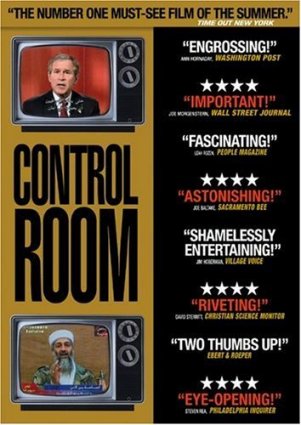 . It shows the war and its horrifying toll for civilians ands soldiers from an Arab perspective, instead of American cable television's sanitizing it for mass US consumption.
Though dated Control Room talks about media bias, the journalistic myths of "objectivity" and "impartiality", the way the Arab street interprets the American invasion, regime change and democracy, and the way CentCom, the headquarters for American invasion, treated the press and how the press responded.
It shows Al Jazeera's articulate, sophisticated, Westernized men and women, often BBC trained, taking their professional integrity fully as seriously as their American counterparts. They were liberal voices of Arab Islamic modernity who questioned the American military tried to control of the narrative and shape the information environment.
They offer alternate sources of information about what happened in Iraq at the start of the war to what we saw here in Australia as seen by Jehane Noujaim's classic fly-on-the-wall journalism with interviews with the station's reporters and producers.That was back then---2003. Since then there has been a pan-Arab satellite revolution, which is felt at every level of Arab society – and in every form of media, including political blogging and the emergence of a highly popular mass-mediated culture.
Today, after Abu Ghraib, we have the hell of Baghdad where people live with starvation, reprisal, violence and brutality. American counterinsurgency forces have begun the process of segmenting the city into smaller sectors with the goal of pacifying one area at a time. Large sections of Baghdad will be chopped up into walled enclaves.
We also have more than a million Iraqi nationalists, waving Iraqi flags responding to Muqtada's call for "Occupation out!" The Shi'ite million-man march have shown once again that the Sadrists rule the Shi'ite street - and that Iraqi Shi'ites nationalism cannot be squashed by all counterinsurgency means necessary.Then we have the Sunni insurgency's turn against al-Qaeda - so as to fight a better insurgency against the American occupation. We also have a suicide bombing by Sunni insurgents of the cafeteria of the Baghdad Convention Center, which houses the Iraqi Parliament, inside the Green Zone a US gated area in Baghdad. The rest of Baghdad is the Red Zone. Then there was a prolonged street battle in the Al-Fadhil section of Baghdad in which local residents joined insurgent forces after Iraqi and U.S. soldiers raided a mosque.
The message from the Baghdad street is clear. Rejection of the American narrative that says the Sunni insurgents are essentially part of al-Qaida while the Shi'a protagonists are allied to Tehran; hence the Iraq war is all about fighting the terrorists who caused 9/11 and the leading member of the "axis of evil". The Sadrist street message is clear. Americans out. The war on terror---the "long war"--is failing in Iraq, and this failure highlights the limitations of US military power, notwithstanding its global dominance. Presumably, a majority of Americans are no longer listening to the imperial presidency's 'democracy in Iraq' talk.
Posted by Gary Sauer-Thompson at 6:52 AM | Comments (1) | TrackBack
April 15, 2007
Sally Young on media repetition
Sally Young, a senior lecturer in media and communications at the University of Melbourne, has an op-ed in The Age, that addresses the way that the press gallery in Australia acts as "a pack" in that it writes the same stories, using the same angles, and then reporting on one another. It's a loop.
Young's argument is that this repetition is due to the media having to rely on the same pool of material, and describes how the media coverage of federal politics in Australia now often follows a set pattern.
John Howard does a radio interview in the morning. Footage of the interview is then edited into sound bites, which are used on television news that night. The next day's newspapers also regurgitate quotes from the interview because journalists will have been supplied with the transcript but probably won't have had an opportunity to question the Prime Minister directly. They may have tried to put follow-up questions to press secretaries but these are often brushed off, with media minders directing the journalist back to the transcript.
Young, who wrote The Persuaders: Inside the hidden machine of political advertising, describes this pattern as part of the government's strategy to muzzle the media, in that as Australian journalists are less able to get an interview, they must turn to the material they receive in abundance — interview transcripts and press releases supplied by politicians and their media minders. So the Press gallery has to deal with the spin on an issue.
Young, who is associated with the Southern Review, argues that relying on interview transcripts for news reporting is problematic, as John Howard repeats one line, with only minor variations, over and over, regardless of the question being asked and even when no question had been asked at all. It is what media advisers call staying on message.This is how politicians have limited and controlled media access, and it has had a major impact on how Australian politics is reported.
I concur with Young's argument. Where to now? Well the Press Gallery could do more than 'report' the political spin. They could analyze the issue and do a bit of research on the issue. That would be helpful to citizens. The problem is that many just report on the fluff because they do not know much about the policy issue, nor are they interested in it. They could also analyse the spin, and its erosion of democracy.Or they could critique the 'way we are living in a PR state characterised by an army of media advisers and the siphoning of public money into polling, marketing, advertising and media monitoring'
Isn't that what journalists have been trained to do in their media and communication courses?
Posted by Gary Sauer-Thompson at 7:30 AM | Comments (2) | TrackBack
April 14, 2007
rightwing shock jocks
The Australian Communications and Media Authority's report this week that found 2GB broadcaster Alan Jones was likely to have encouraged violence and vilification of Australians of Lebanese and other Middle Eastern backgrounds in the days before the Cronulla riots in late 2005. Jones infamously endorsed a listener's letter calling on "biker gangs" to greet "these Lebanese thugs" when they arrived at Cronulla and send "this scum" scurrying back to their "lairs".

Remember this code was developed by industry in the first place--its a Code of Practice, not an Act or a regulation. The Authority said:
The suggestion to invite bikers gangs to intimidate Lebanese rail passengers was made in the context of other comments which gave the impression that people of Lebanese background or people of Middle Eastern background were forming gangs intent on causing harm to 'Australians', had no respect for the law and that existing law enforcement agencies were powerless. ACMA is of the view that, in these circumstances, an ordinary reasonable listener would regard the endorsement of the biker gang invitation as likely to encourage violence and thereby stimulate violence by approval."
The impression is that Jones help incite a riot and that his 2GB audience are a bunch of rednecks. I guess the advertisers are happy with that. The Howard Government comes out in support, with the PM enthusiastically endorsing him. Kevin Rudd also supports Jones. So what has happened to Rudd's ethics in politics position?
Is there any politician who considers it inappropriate to take the side of the side of a broadcaster who's tried to stir a racist gang war at Cronulla Station? Many know that there are votes in siding with Jones and that's what matters isn't it. You cannot allow yourself to get offside with Jones. Jones rules okay. Communications Minister Helen Coonan effectively threatened to gag the independent watchdog she had appointed.
Posted by Gary Sauer-Thompson at 4:55 PM | TrackBack
CoAG reform
So CoAG failed to deliver anything on substance on the national reform agenda proposed by the Brack's Government and signed on in July 2006. Some progress was made on health. There was national registration and accreditation and the first step was taken in switching the emphasis of health spending towards more prevention and ongoing treatment of chronic illnesses (eg., obesity) to ensure that that less costly crisis intervention is needed latter.

Bill Leak
There was no movement on human capital issues (such as skills and health), no incentives to encourage the states to launch a third wave of reform as happened under national competition policy, no across the board funding agreement, little movement on energy or infrastructure.
Posted by Gary Sauer-Thompson at 12:41 PM | TrackBack
April 13, 2007
sustainable energy futures
CoAG is meeting today in Canberra and climate change is still the big issue, even though people are started to talk about productivity and the national reform agenda. Even Peter Costello, speaking in London, is starting to talk sense on the issue. He says:
One of the other factors that is working against our longer term economic prospects is climate change. Climate change is recognised as a crucial environmental challenge – one that calls for a careful balancing of environmental and economic considerations, and a deep understanding of the long-term implications of actions taken today. Australia is on track to achieve its Kyoto target.
Costello goes on to say that for a country like Australia, which has huge resources of fossil fuel, the economic cost of moving to substantial cuts in greenhouse emissions will be enormous. Consequently, the best strategy will be to pursue technological improvements which will allow existing resources to be used more efficiently. And technological improvements will be the greatest assistance we can deliver to our regional partners.
Mark Diesendorf, director of the Sustainability Centre, has an op-ed in The Age where he contests one of the assumptions underpinning Costello's reasoning.
Diesendorf says:
The barriers to a sustainable energy future are neither technological nor economic, but the immense political power of the big greenhouse gas polluting industries — coal, aluminium, iron and steel, cement, motor vehicles and part of the oil industry.
He says that opponents of renewable energy from the coal and nuclear industries, and their political supporters, are disseminating the fallacy that renewable energy cannot provide base-load power to substitute for coal-fired electricity.They are endeavouring to ensure that renewable energy will remain a niche market and to prevent it from achieving its potential of being part of mainstream energy supply technologies.
Diesendorf's recent report, The Base Load Fallacy, challenges the myth that renewables were unable to provide Australia's base load electricity needs and it argues that a mixture of bio-energy, solar thermal, geothermal and wind power could provide the answer.
Update
tAs expected the Howard Government refused to o adopt the states target of reducing greenhouse gas emissions by 60 percent by 2050 at CoAG. The reasoning was the same: the target that could cause damage to the economy, particularly jobs.
Posted by Gary Sauer-Thompson at 5:49 AM | TrackBack
April 12, 2007
Per Capita think tank
I see that a new Australian think tank has been launched. It is called Per Capita and it says that it is progressive. Hence it is a contrast to the well established right of centre Institute of Public Affairs and the Centre of Independent Studies and joins the Australia Institute in Canberra.
Per Capita states that such a think tank is needed because progressive ideas are currently not well represented in the intellectual marketplace; and that it aims to re-shape the progressive public policy agenda for Australia. Presumably, progressive means social democratic. So what does that actually mean in shaping the progressive public policy agenda for Australia?
There is nothing on the website, which is still very minimal. It is just about recent appointments: the Executive Director is David Hetherington (based in Sydney), and the Policy Director is Michael Cooney (based in Melbourne). Cooney said on Radio National Breakfast this morning that Per Capita will be doing long-term thinking and fighting the battle of ideas rather than short-term electoral politics, and that it would pick up on third way ideas opened up by Hawke and Keating in the 1980s and then developed by Tony Blair in the UK.
So how independent will it be from the ALP? Does that mean Per Capita will be akin to Demos in the UK?
One question is how is the agenda-setting phase of policy development going to be funded? Consultancies? A big donor? Fund raising? The suggestion is from private and corporate donors. It's an important question because there are not many career options for policy wonks. Most is currently done without meaningful institutional support or adequate remuneration on either side of their paying day.
The think tank's focus would be on human capita and on "full-cost economics". The latter is about factoring in the environmental and social costs of economic activities. That is crucial for water, energy and child care. However, no indication is given of the research that is in the pipeline.
Posted by Gary Sauer-Thompson at 9:27 AM | Comments (2) | TrackBack
April 11, 2007
Afghanistan: more troops
So Australia is sending more troops---300 Special Air Services and commando forces---to southern Afghanistan to fight the Taliban. They are part of a military strategy in this "theater" of operation to counter the expected spring insurgency by the Taliban, which operates from safe Pakistani base in its borderlands.

Geoff Pyror
Why is Australia involved in this "front" in the global war of terror. Sure the Taliban gave safe haven and support to Al-Qaeda terrorists until they were overthrown. Is there not a civil war going on in Afghanistan now? Is not the international coalition (NATO) defending one side against another? For the ALP, which supports the extra troops, the reason is to fight Osama bin Laden and al-Qa'ida. So a long-term Australian military presence in Afghanistan confirms that this theatre remains at the centre of Australia's military contribution to the global jihadist war.
So where does the Taliban fit into the ALP account?
As Tom Engelhardt over at TomDispatch observes, five years after its liberation from the Taliban, Afghanistan is a failed state, home to a successful guerrilla war by one of the most primitively fundamentalist movements on the planet, and a thriving narco-kingdom. Seven years on the war on terror is still seen as essentially a military matter backed up by traditional counter-terrorism operations---more rubble, less trouble for the pro-war, chest-beating Right.
If Afghanistan is the forgotten front in the neo-con's Global War on Terror, then it seems to be following a distinctly Bush administration surge-style path. AsTom Engelhardt says the pattern is one of:
more U.S. (and NATO) troops, more military aid, more reconstruction funds, more fighting, more casualties, heavier weaponry, more air power, more bad news, and predictions of worse to come.
Afghanistan is part of "arc of instability" that stretches from North Africa through the Middle East, Iran, Afghanistan, Pakistan and which would be safe for Israel and American hegemony. Iraq and Afghanistan stand on either side of Iran, with the Americans promoting instability in Iran by heightening separatist sentiments in that country to destabilize the Iranian regime.
I have seen little critical analysis of the Howard government's decision to send more troops to Afghanistan in the Canberra Press Gallery. Is this media patriotism? Afghanistan is being treated as a stand alone event, and not as one front in a regional campaign involving many fronts (Iraq, Iran, Somalia). The Canberra Press Gallery is not connecting the dot's.
Posted by Gary Sauer-Thompson at 7:18 AM | TrackBack
April 10, 2007
CoAG's reform agenda: politics rules?
Next Friday's Council of Australian Governments meeting represents a historic opportunity to embrace far-reaching reform, which the Productivity Commission estimates will deliver tens of billions of dollars in economic dividends.The Labor states and territories have outlined their ambitious reform agenda after months of negotiations and, critically, it locks the eight state and territory jurisdictions into a national approach on a range of important issues to lift productivity and work-force participation through a series of reforms involving competition, regulation and human capital.
The plan tackles what the states argue are the big challenges facing Australia, and it builds on a "third wave" of reform outlined by Victorian Premier Steve Bracks in August 2005, that is designed to increase competition, remove red tape and improve health and education outcomes. The states, in delivering a comprehensive program of reform to Howard, have explicitly rejected Peter Costello's suggestion that the states are heading down the road of becoming merely service delivery vehicles, leaving the leadership on reform - and the national economy - to the commonwealth.
I'm not sure about the politics of CoAG. Howard and Costello are under pressure with respect to reform and CoAG is the Labor States versus the Coalition commonwealth. No doubt Howard and Costello will resist sharing the distribution of the economic benefits of reform with the states. Will they resist reform? Will they act as spoilers? It is an election year after all, with the federal Labor opposition dominating in the polls.
So far there has been no agreement on the funding formula. The traditional formula of a 50-50 split is running into resistance, as the Commonwealth is swimming in money, while the states' revenue base, even with the GST, is barely keeping up with growth in the economy.The states want an independent, objective umpire to work out an agreed formula.
Presumably, Treasury would support the reform process as it understands that it is crucial to boosting productivity and workforce participation by an ageing population. Will it be able to persuade Canberra to sign off? Or will politics overrule economics once again? Costello is trying to pick a fight with the states over a national ports plan, by arguing for a national regulator rather than common national regulations.
Posted by Gary Sauer-Thompson at 9:04 AM | Comments (2) | TrackBack
April 9, 2007
an Australian template for emissions trading?
We know that Australia will be hit by more frequent and intense heatwaves, bushfires, floods, drought and landslides as global warming causes the temperature to rise this century. Global warming is coming at us no matter what we do or how much individual government ministers deny, or downplay, the effects.
So what is being done? Paul Kelly in The Australian has an interesting op-ed on the economic response to climate change. He says:
Have no doubt what is happening: Australia's pro-market economic establishment in the Treasury and the BCA is trying to seize control of climate-change policy. The aim is to reverse the water policy saga where Treasury was sidelined.
Australia needs to adapt as the report by the Intergovernmental Panel on Climate Change warns that Australia faces a rise in the sea level from global warming "is virtually certain to cause greater coastal inundation, erosion, [and] loss of wetlands". Water security problems are very likely to increase by 2030; coastal development is likely "to exacerbate risk to lives and property from sea level rise and storms"; and major infrastructure will be at risk from both increased temperatures and storm activity. Hot spots include major cities such as Brisbane and Sydney and the spreading urban coastopolis of the sea-changers.
Is Treasury trying to make a comeback? It is Prime Minister and Cabinet (PM& C) that runs the policy agenda these days, as we shift to a more presidential style of government. Policy is made by the Prime Minister and his office, and for political, not economic, reasons. Kelly says that:
The politics of global warming in Australia has been conducted in a policy-free zone. That is about to change. In two months the debate will be policy driven and will focus on an emissions trading model for Australia.
And who, pray, is devising this blueprint for John Howard? The Treasury and the Business Council of Australia (BCA), that's who. Given the leaking this week of Treasury chief Ken Henry's March 14 internal speech critical of government, the irony is exquisite.
I would suggest that Treasury is trying to get its foot in the door. Does that mean a "cap and trade" policy (as in the fishing industry), is supported by Treasury? Does that mean Treasury is advocating government intervention to tackle "externalities" --the costs an activity ( such as emitting greenhouse gases) imposes on others? Is the pro-market economic establishment in Canberra acknowledging market failure?
Kelly argues that the vehicle is Howard's taskforce on emissions trading, which was set up last year by Howard to report before June. It is PM & C that runs the task force, not Treasury. Kelly's argument is that the best insight into the taskforce's likely position came this week with the BCA submission prepared by Rod Sims:
It proposes, in effect, an Australian template, sharply different from the European Union trading model. It assumes a single trading scheme ("there should be only one scheme in Australia that puts a price on carbon") relying on commonwealth constitutional powers. It presumes the abandonment by Labor state governments of their own schemes along with the mandatory renewable energy targets cherished by Labor and the Greens.
I cannot find the submission by Sims online so it must have been leaked to Kelly. So why Sims?
Posted by Gary Sauer-Thompson at 4:33 PM | TrackBack
April 8, 2007
And so it goes
Maybe the episode of Iran seizing British troops was a pointless and foolhardy provocation.Perhaps it's shown up the Iranian government as, disorganized and unable to keep control of its own military. Maybe its shown that diplomacy works as opposed to military intervention.

Garland
The real front is still Iraq. Iraq still stands for quagmire of a horrible war.The roadside bombs are still going off. The Washington neo cons are still hankering for regime change in Syria and Iran even though the chaos in Iraq is a dire threat to Israel. Israel continues its illegal land-grabs.
Posted by Gary Sauer-Thompson at 12:02 AM | TrackBack
April 6, 2007
ignoring the message
Well, it does look as if the tide is finally turning for the Howard Government. It is not just the wreckage of the Bush administration, its failure in Iraq, and the collapse of the neo-con's vision for a New American Century that aimed to to reshape the world, which is dragging the Howard Government down.

Allan Moir
The Howard Government look as if it has a past by date as they are now shooting themselves in the foot, especially on developing an economic rational response to the effects of global warming on Australia. The climate is changing and Australia cannot continue with business-as-usual as if there is no tomorrow. Even business knows that things have to change.
Fear is working against the Howard Government on this issue, not for it. All its past talk about strong leadership to provide the safe shield for us to get on with our lives highlights how it is not providing leadership on global warming. It even refuses to make the link between the drought and climate change, and it is still preoccupied with looking for enemies (loonie greenies etc) to demonize and shoot down. The ground is shifting and cracking and wedging the ALP on climate change amongst blue collar workers looks like refusing to embrace new ideas to respond effectively to a changed world.
Posted by Gary Sauer-Thompson at 10:17 AM | Comments (2) | TrackBack
April 5, 2007
Gunns: from Tasmania to Canberra
After Gunns withdrew from the bilateral Resource Planning and Development Commission inquiry in Tasmania in early March, the Federal Government is obliged to ensure that the mill will meet all Commonwealth environmental laws in an assessment process separate to the Tasmanian Government's whitewash. The relevant commonwealth act is the EPBC Act.

Ray Norman, You always know when its Autumn in Tasmania #1, 2007
The Australian Greens have indicated that an inadequate inquiry into the mill's impact will trigger a legal challenge, especially if the Federal Government refuses to assess the effect of more logging on endangered old growth native forest, animal and bird species.
Hopefully the Commonwealth assessment will break with Gunns being in the driving seat dictating pulp mill matters to the Tasmanian Government, which then does Gunn's bidding.
There is a lot for the Commonwealth to assess since, in its latest submission, Gunns contends that:
#Seven endangered species in the local area, including the green and gold frog, the Tasmanian devil, the spotted-tailed quoll, the wedge-tailed eagle, the swift parrot, the masked owl and the eastern barred bandicoot will not be affected by the mill's construction and operation.
#The wood supply source for the mill is not an issue the Commonwealth should consider.
#Its 200m-long treated effluent discharge pipeline into Bass Strait will not impact on the local salmon fishery.
#Its 100ha pulp mill and associated power plant will not harm endangered plant species at its Bell Bay land through "micro-siting" principles.
#During construction of the ocean outfall, recreational fishermen will be affected by temporary exclusion zones.
Posted by Gary Sauer-Thompson at 3:29 PM | TrackBack
Rudd,Treasury, policymaking
Kevin Rudd, the leader of federal Labor has an op-ed in The Australian on Treasury's criticisms of the Howard Government's economic policy making and the way it has been sidelined in policy making under the Howard Government:

Geoff Pryor
The simple tactic attack and discredit of Treasury by the Howard Government----'Treasury knows nothing about water' spin of Malcolm Turnbull, for instance--- will not work. Rudd, in praising the role of Treasury in economic policy making, shows why:
Treasury is staffed with the most competent policy elite that can be attracted to the Australian Public Service. They are part of a tradition that sees their role as the continuing custodians of the nation's long-term economic wellbeing, providing robust advice to the government of the day, irrespective of the political complexion of that government. The Treasury, like all agencies of state, also recognises the role of the democratically elected government to accept or reject the advice it is provided.
Ken Henry, the Treasury Secretary, has too much creditability for the old blow torch approach. Though Rudd defends the old style mandarin offering advice without fear or favour, there is still the politics that evaluates the advice, and that can give you policy being made on the run. That leads to inferior or bad policy.
Ruddd goes on to highlight the core issue raised by Henry's speech ---bad policy. He says that:
both the tone and content of Henry's address underline the fact that on two core economic policy challenges facing the nation in the coming decade (climate change and water scarcity), the Howard Government and its Treasurer, Peter Costello, are happy to throw Treasury's advice to the wind. And we can only conclude the reason for doing that has been Howard and Costello's chronic addiction to short-term political advantage against the long-term economic interests of the nation.
A reasonable inference. Policy has fallen hostage to politics.That undercuts both the reformist credibility and economic credibility of the Howard Government. It is a also a shot across the bows of the Howard Government about expansionary fiscal policy--- spending up big or big tax cuts in the budget--- to claw back its standing in the polls----that increases inflationary pressure.
Good economic policy, Treasury says, should concentrate on the long term public interest by boosting productivity, participation and population. Rudd concurs. Howard and Costello have a political problem.
Posted by Gary Sauer-Thompson at 8:55 AM | TrackBack
April 4, 2007
Treasury comes clean, finally
I see that the Federal Treasury has been reflecting on its economic policy and advice to the government and its reception. In a speech to Treasury officers at the Hyatt Hotel in Canberra on March 14 Ken Henry, the Treasury Secretary, reviewed Treasury's achievements and challenges, and gave some context and direction to the tasks ahead in an election year with an economy operating at close to full employment. Consequently, any benefits to one sector are likely to drag workers from more efficient sectors, reducing our output. So Treasury needed to be vigilant against "bad" policy proposals, of which there is a "greater than usual risk" in this election year.
The speech was not intended to be made public. However, an edited text of his speech is published in the Australian Financial Review, and it makes for interesting reading. Ken Henry has gone beyond giving a sound and timely warning that good policy can often fall victim to political opportunity when an election beckons, as he talks about problems with policy leadership on water and climate change.

Scratch media, Climate Change fridge magnet, 2006
Ken Henry says:
As an exercise in policy leadership, the superannuation reform is as good as anything I've seen the department produce in the 20-odd years of my Treasury career. We have also worked hard to developed frameworks for the consideration of water reform and climate change policy.
Really? Water reform and climate change policy are marked by major policy failure! So what happened?
Henry explains:
All of us wish that we had been listened to more attentively over the past several years in both of these areas. There is no doubt that policy outcomes would have been far superior had our views been more influential. That is not just my view. I know that is increasingly widely shared around this town. But we are not giving up. Water has got away from us a bit in recent time, but it will come back for some at some stage--it will have to---and we are, at last, right at the centre of policy development in the climate change area.
Henry does did not spell out what Treasury's advice had been on water. Presumably, Treasury would be critical of the way that the buyback of water for the environment has become mixed up with the politics of the Nationals who have their hands in the cookie jar for subsidies for the irrigation industry.
However, you could have fooled me on the quality Treasury input into the climate change issue, judging by its non-consideration in Treasury's own Intergeneration Report 2007. Fossil fuels underpin all of our economic activity, science and technology, and at the moment there is no developed alternative for the future. Since the prosperity of the past decade and a bit has been brought by unchecked use of fossil fuels, so global warming and economic growth are deeply intertwined. The central issue for the policy elite amongst the Canberra bureaucracy is to show whether it is possible to cut carbon output dramatically without trashing our economy.
Treasury acknowledges that it was cut out of the Howard Government's $10 billion water package earlier this year. Treasury is also implying that it has done the work on the economic implications of the warming caused by greenhouse gases, that the Treasurer has failed to grasp the implications, and so the Howard government's policies are full of shortcomings? Does that mean Treasury supports the need for an emissions trading scheme, that it has done the economic modeling, and that it is the Howard Government that is out of step?
This is a government that has removed science from the policy-making arena, has gone to the dark side over science with many members embracing anti-scientific irrationalism, and has acted as a wholly owned subsidiary of the energy and coal industry combined with an apparent attempt to suppress the scientific realities.
So you can see why why Treasury needs to speak out about the need for government to act in a meaningful and rational way. Is this leaked speech Treasury speaking out?
Posted by Gary Sauer-Thompson at 9:05 AM | Comments (2) | TrackBack
April 3, 2007
sidelining Condoleezza Rice
Gideon Levy has an op-ed on Condoleezza Rice's diplomacy in the Middle East in Haaretz:
It happens once every few months. Like a periodic visit by an especially annoying relative from overseas, Condoleezza Rice was here again. The same declarations, the same texts devoid of content, the same sycophancy, the same official aircraft heading back to where it came from.....Rice has been here six times in the course of a year and a half, and what has come of it? Has anyone asked her about this? Does she ask herself?
Levy goes on to ask:
It is hard to understand how the secretary of state allows herself to be so humiliated. It is even harder to understand how the superpower she represents allows itself to act in such a hollow and useless way. The mystery of America remains unsolved: How is it that the United States is doing nothing to advance a solution to the most dangerous and lengthiest conflict in our world? How is it that the world's only superpower, which has the power to quickly facilitate a solution, does not lift a finger to promote it?
Good questions.
The Washington spin is that Rice is at the center of a realignment of forces in the Middle East, building a united front of Arab moderates to stand alongside the U.S. and Israel against Iran and other "extremist" elements.Tony Karon observes at Tom Dispatch that:
In reality, if significant diplomatic maneuvering is currently underway in the Middle East, it is the work of the Saudis. The Saudi royals had grown so alarmed by the passivity and incompetence of the Bush administration -- and by the rising influence of Iran as well as Islamist movements in the Arab world (whose popularity and credibility is boosted by their willingness to stand up to Israel and the U.S.) -- that it launched an uncharacteristically robust diplomatic campaign on a number of fronts.
Karon adds over at Restless Cosmopolitan that what is interesting about the sudden public break from Washington and assertion of political independence by the “Arab moderates” that were supposedly the vanguard of Bush Administration Middle East policy Version 7.4, is that it is a profound vote of no-confidence in U.S. policy. The Saudis, Egyptians and Jordanians could simply no longer sit back and watch the U.S. wreaking havoc throughout the region, because the resulting catastrophe would sweep away their regimes, too.
Posted by Gary Sauer-Thompson at 8:09 PM | Comments (2) | TrackBack
Intergenerational Report 2007
Though I was in Canberra on Monday I did not attend Treasurer Peter Costello's National Press Club speech on the Intergenerational Report 2007. Costello looks less and less impressive these days in terms of being a reformer, and more and more like a political hack.
This is someone who opposed the National Reform Agenda pushed by the states and is now claiming it as his own! The commonwealth government had to be dragged into the room to endorse the agenda worked up by the Bracks Government in Victoria. Costello was busy shooting bullets at the states.
The second Intergenerational Report (IGR2) shows that the Australian Government's long-term fiscal sustainability has improved since IGR1. The good news is that Australia now faces the future from sound foundations as a result of strong policy frameworks, robust economic growth and a strong fiscal position.
However, it is argued in IGR2, that projections show that over the next 40 years:
# the population will continue to increase in size but with a higher proportion of older people;
# economic growth per person will slow as the proportion of the population of traditional working age falls; and
# substantial fiscal pressures will emerge due to projected increases in spending, particularly in the areas of health, age pensions and aged care.
Notice what is missing--the elephant in the room: the economic costs of the effect of global warming on Australia over the next 40 years. Isn't that an intergenerational issue: ‑ isn't there a need for a policies to address the benefits and costs for current and future generations with respect to global warming? What are the fiscal implications?
See what I mean about Costello looking less and less impressive? His economic credibility has been undermined.
What is offered by Treasury in the Overview is some wishy washy stuff:
Reforms are underway to improve human capital, reduce unnecessary regulation, boost competition in energy, transport and infrastructure and increase the sustainability of our water resources. Progress from these reforms will help improve economic growth prospects and better manage spending pressures. But the reform task remains ongoing....Further steps taken early will reduce the need for large adjustments later. Our policies also will need to help us manage and adjust to other long-term trends, including pressures on our natural resources, global climate change, international security issues and globalisation.
It's motherhood policy statement since global warming is going to have a big impact on population, participation and productivity. It is argued that:
Health, age pensions and aged care are projected to account for most of the increase. These areas are sensitive to demographic change. Factors other than ageing, such as technological change, also are projected to increase costs.
Eventually we come to environmental sustainability, where it is stated that:
Maintaining the environment and its capacity to contribute to growth is a significant challenge. Concerns include land degradation, salinity, and the issues of water and global climate change. Improved knowledge of environmental issues has led to a greater capacity to address the problems. However, there is no single policy solution to the diverse range of environmental issues. Policy approaches include market-based mechanisms as well as budget funding to deliver sustainable outcomes. While addressing environmental issues can affect economic growth, in many cases it will act to safeguard future economic growth potential. In other cases, such action may provide for both improved environmental and economic outcomes.
That says nothing much at all. And that's it! Where's the economic modelling? So much for long term governance.
What Treasury needed to do was to engage with the Stern Review on the the Economics of Climate Change, and its case for action to reduce the risks of climate change.
Posted by Gary Sauer-Thompson at 9:35 AM | TrackBack
April 2, 2007
blogger's criticism of the Canberra Press Gallery
As I understand it the blogger's key criticism of the mainstream media is that journalists are partisan, because they now spin government claims and right-wing narratives, and do so uncritically and often with inaccuracies. The disaster of the Iraq War and the myths about that war which the Murdoch journalists allowed to take root -- and which they never investigated, exposed or attacked -- is an indictment of their profession.
I appreciate that Canberra has been a town dominated by the Liberal power structure for a decade or more, and that those journalists who see their job as breaking stories need to have meaningful political source. Consequently, they have needed to cultivate relationships with Liberal Party sources.
However, that process of currying favor with the Liberal power structure, listening to Liberal sources, being dependent upon Liberal favors and access means that many journalists in the Canberra Press gallery are on the Liberal Party drip feed, with several becoming spinners and attack dogs for the conservative movement against "the Left."
The second criticism is that the journalists are unwilling to address the way the above linkages is producing biased and corrupt journalism that undermines what the media claims is their core responsibiliy: -- to act as an adversarial check on government. This watchdog for democracy responsibility is what has been abdicated by large sections of the Canberra Press Gallery during the formation of the national security state.
This core watchdog responsibility is important because the conservative movement is an authoritarian movement, whose slogan "security leads to freedom", covers up the way that the Howard Government embraces and seeks ever-expanding government power within Fortress Australia. This power is based on the claimed need to protect the Australian people from all the scary, lurking dangers in the world just outside our national borders. These dangers about global terrorism are constantly stirred and inflamed in order to ensure the need for "security," from terrorists is ensured by vesting more and more power in the hands of strong, protective Leaders. These are leaders willing to take the tough decisions to deprive citizens of their liberty to ensure national security.
Posted by Gary Sauer-Thompson at 8:43 AM | Comments (2) | TrackBack
April 1, 2007
Hicks as political football
David Hicks, who has spent five years in Guantanamo Bay without trial after he was captured in Afghanistan in late 2001, pleaded guilty to a charge of giving material support to terrorism. Hicks pleaded guilty to a charge which didn't exist until October of last year.

Matt Golding
Hicks is coming back to Australia by the end of May, where he will serve out the nine months of his prison sentence. Hicks was able to avoid a show trial but he has to shut up about what happened in the black hole of Guantanamo Bay. Andrew Sullivan has a good post on this process of a political fix between Howard and Cheney. It was politically inconvenient to keep Hick's locked up forever whilst the US was engaged in endless warfare.
The support for these kind of activities by the Howard Coalition suggests that the dominant right wing factions of the Liberal Party are hostile to our most basic constitutional traditions and defining political /legal principles. They simply do not believe in them.
Posted by Gary Sauer-Thompson at 1:46 PM | TrackBack
federal election: protecting coal
I have to admit that I was suprised by the way that John Howard responded to Nicholas Stern's argument that the cost of inaction would reduce GDP. Howard locked himself into a corner on climate change --defending the coal industry whilst leaving himself with little wriggle room. It was all about protecting jobs and international competitiveness. But why are coal miners' jobs more precious than jobs in textiles, the vehicle industry or in manufacturing?

Ron Tandberg
So I guess that the Coalition's election strategy is blatant protectionism, energy saving light bulbs and gimmicky projects about saving forests overseas, whilst allowing Gunns to chop native forests down in Tasmania, and building more coal fired power stations to meet increased demand for electricity.
What is being put into place is a scare campaign based on a wedge that says the ALP's commitment to climate change ---Australia under a Labor government would have a target of cutting greenhouse gas emissions by 60 per cent by 2050---means the destruction of the economy and the end of prosperity.
Howard refuses to consider the possibility that the coal industry and business activity in general may need to move significantly away from the business-as-usual scenario to deal effectively with the climate change issue. So Howard stands for the past. That kind of defensive protection and inaction is not going to play well in the marginal seats in Adelaide, especially when no evidence is produced to back up Howard's economic devastation claim. The ALP, in embracing an emissions trading scheme, is looking good on climate change. They are seen to stand for the future.
Stern said that the failure of economic activity to include the effects of greenhouse gas emissions on climate change as "the greatest market failure the world has ever seen". He went on to argue that markets can play a central role in stabilising the atmospheric concentrations of carbon dioxide and similar gases before the worst consequences are realised. These impacts for Australia would include declining rainfall, changing weather patterns that force many species into extinction, and more damaging storms and tide surges, warnings echoed by recent United Nations studies.
What is suprising in this climate change debate is that no one is talking about energy efficiency---including insulation, retrofitting office buildings and improving fuel efficiency in transport. Turning the lights off for an hour doesn't highlight the need for energy efficiency.
Posted by Gary Sauer-Thompson at 1:19 PM | Comments (2) | TrackBack