« October 2003 | Main | December 2003 »
November 30, 2003
chomping away at Palestine

Israeli illegal settlement outposts (previously) built on confiscated Palestinian lands. Later, they become legal and protected settlements (Khalil Abu Arafeh, 11/28/03).
This process of chopping away at Palestine until it disappears is what is not discussed in Australia, whenever the Israeli-Palestinian conflict surfaces in public life.
This piece gives a good description of the "chomping away":
"Since Israel signed the Oslo Accords, the settler population has doubled to 390,000, strewn over a thick web of at least 145 settlements and their interconnecting Jewish-only roads, blanketing the Palestinian West Bank. Since the beginning of the Second Intifada three years ago, the Israeli army has been systematically wrecking Palestinian infrastructure throughout the West Bank and Gaza. Water mains, wells, and pumping stations, sewage systems, telephone and Internet hubs, markets, airports, police stations, roads, civic buildings, mosques and churches, all have felt the special attentions of Israel's bulldozers, bomb teams, helicopter gunships, and F-16s. It is a slow-motion version of what Gulf War I did to Iraq."
The strategy of the Isreali right is not just to starve the Palestinians into submission. The strategy is a part of part of a larger accelerating project of land theft and dispossession that Israelis call "Judaization." The "security fence" will extend 450 miles, nearly five times longer than the Berlin Wall. And that's not including the 'eastern fence' beginning to amputate the Jordan Valley into Israel. As the article says:
"When it is all done, perhaps by the end of next year, there will be three walled Palestinian islands controlled by the Israeli army; one north, one south, and a tiny enclave around Jericho, marooned inside the Zionists' dream; a Greater Israel reaching from the Mediterranean to the Jordan River..."
The strategy is leave the Palestinians with little land or resources to build a future state and society.
Posted by Gary Sauer-Thompson at 11:10 AM | Comments (1) | TrackBack
November 29, 2003
Saturday Cartoon

The imperial president flying into Baghdad at a Thanksgiving dinner with the troops was little more than a public relations stunt to shoot some campaign footage.There was not even enough time to eat meet some ordinary Iraqi's.
It would have more meaning if Bush had delivered a speech about real democracy for Iraq and praised the traditionalist Grand Ayatollah Ali Sistani for emphasising the importance of democratic elections in the creation of a sovereign Iraqi government. As Abu Aardvake says in relation to Ayatollah Ali Sistani's call for a democratic Iraq:
"I'll say it again - nothing else is going to work, if the goal is to create a legitimate Iraqi government that can command popular support. Or, for that matter, if the goal is to spread democratic values, as Bush says. The US should be thanking its lucky stars that Sistani is being so obstinate - this could be a really dramatic example of the US being saved from itself."
The imperial President sneaks in and out. How ironic. According to the media spin from the White House, the script was otherwise. The Iraqi people would welcome him with garlands and dancing in the street. They would regard him as the great liberator; the one who had liberated them from an oppressive dictator. Juan Cole spells out the details of the script.
Update
A good article on Sistani's call for demcoratic elections can be found here
Posted by Gary Sauer-Thompson at 10:58 AM | Comments (0) | TrackBack
its not fair but....
There are some good insights from Matt Price writing in today's Australian
"In modern politics, the alternative prime minister must be comfortable and competent tackling and exploiting the electronic media. Yet Crean proved hopeless on television; more wooden than Pinocchio, delivering carefully scripted lines like a reluctant B-grade actor.
On radio, his grating voice was poison. By the end, talkback producers were loathe to invite Crean on air for fear of sparking an exodus of listeners to rival stations. At breakfast time, when the radio audience is at its peak, Crean's often carping, always strident tones threatened to curdle the kiddies' orange juice."
That shows the importance of the media in politics. Crean was filtered out no matter how hard he worked. Filtered out despite the tensions within the Coaliton, the failure of the Howard's Bali/terrorist hand to resonate in the electorate (he was resoundingly booed at the Rugby World Cup for playing it) and the low primary vote for the Coalition.
Crean could not cut through the media filter. He could not manage the public persona so that citizens did not turn off when he spoke to them about the issues that mattered to them. Consequently, his policy pronouncements had little impact and the ALP was seen to be poor on the vision thing. It was unclear what the ALP as a social democratic party stood for.
Posted by Gary Sauer-Thompson at 10:36 AM | Comments (0) | TrackBack
November 28, 2003
painful times for social democracy
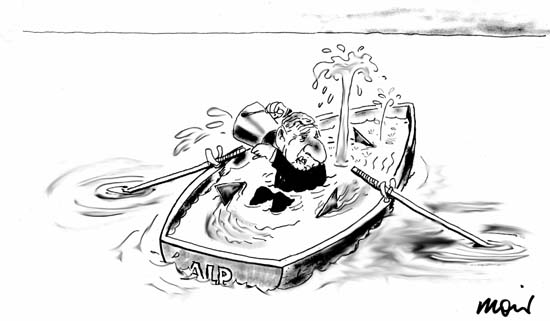
Moir
A politically isolated Simon Crean is what the media flows from Canberra are all about at the moment.
Simon Crean is on the ropes gain. He's been there before, many times from the punches thrown at him. This time, however, Crean is a dead man walking. His factional support in the Labor caucus has eroded. He was tapped on the shoulder Wednesday night by the factional heavies who supported him. That means, as John Quiggin says, that Crean's gone. More on the ins and outs of this tapping on the shoulder can be found over at Backpages
Indeed Crean, after sleeping on it all after Parliament closed for the week, resigned as leader of the ALP this morning. Geoff Kitney's judgement of Crean as leader can be found here.He says that "Crean's problem is Crean."
I'm not an ALP person myself. I take my stand with the Australian Greens. Why so?
Briefly, the ALP's commitment to social democracy is thin; they care little for democracy; are indifferent to citizenship; they lack courage in taking a stand on crucial new issues of principle; are unwilling to be a genuine opposition; and resistant to developing a substantive agenda in social democracy in a globalized world. What's left is a defense of the basic principles of the welfare state and a slightly different method to support and to correct a self-regulating market's allocation of scarce goods.
Crean's problem was not just Crean. Changing leaders is going to dramatically change the declining fortunes of the ALP The problems are too deep and structural. I know we are witnessing a social democratic party in transition, and that there are big tensions in the ALP's multiclass appeal and support. But its Third Way is policy thin; it is in disarray; and its right wing blue collar trade union support support remains deeply hostile to the new social movements---especially environmentalism. Will it make that much difference if its Mark Latham, or Kevin Rudd or Kim Beazley?
Geoff Kitney says is about survival first and revival second:
"...this contest is not about directional change. It's a vote for a more effective leader still essentially with Crean's policies. Party members, and voters, looking for an ALP with policies more like the Greens or Democrats are not going to get them, whether Crean stays or goes.
A change of leadership will be about trying to neutralise the Government's big advantages - on national security, border protection and economic policy - and trying to win on Labor's best issues, health, education and equity."
We may as well sit back and watch the political theatre. The Canberra Press Gallery will be all over the details, the political junkies will get their fix, and the conservative Howard Government will stir the pot with glee.
On a personal note I do feel sorry for Simon Crean. Though he was unpopular in the electorate, his has been political death by a thousand cuts in his back. He cut a tragic figure caught up in political cycles of self-destruction that became ever more enclosing. I hope Simon Crean is treated honourably and kindly. He has served his party to the best of his ability.
It is another example of the treachery with a smile on its face in the corridors of power. This time it was practised by the kneecapping, corrupt NSW Right. This mob is deeply in love with corporatism, think that goal of social democrats is just to win elections; reckon the role of government is to keep the growth machine ticking over; are willing to sacrifice a rudimentary system of social welfare to please global financial capital;and just want to hang out with the imperial president in Washington.
The turmoil within the ALP can only continue. The effects of globalization will see to that.
Posted by Gary Sauer-Thompson at 8:05 AM | Comments (5) | TrackBack
November 27, 2003
the politics of medicare
In this piece in the Melbourne Age Kenneth Davidson says "I can't see why MedicarePlus is a political winner for the Howard Government. It does nothing to address the fundamental issues that concern voters about the Government's duplicity in its management of the health portfolio."
At one level the answer is simple. As Laurie Oaks writing in The Bulletin says MedicarePlus is a political package designed to provide the Coalition with political cover. It is designed to neutralize an issue that the ALP was starting to use to its own advantage. And Howard has probably succeeded in defusing health as a political problem for the Coalition.
MedicarePlus is not designed to address the fundamental issues that currently plague public health. It exposes Crean even more, puts more pressure on the ALP, feeds the conflicts within the ALP, and helps to keep the ALP demoralized at the prospect of another three years in opposition. Buying Senate support keeps the ALP on the ropes.
Davidson is right in his judgement that:
"The Howard Government (and the Fraser government before it) has been undeviating in its central health policy objective: to undermine the universal character of Medicare (and Medibank before it) and turn it into a safety net for the poor..."
The popularity of Medicare amongst Australian citizens means that it is difficult for right-wing governments to reverse the social democratic public health system, turn it into a two tier health system, and transform Medicare as a form of welfare. The political strategy is to characterise Medicare and bulk-billing as a system for the poor. This would then justify Government underfunding of the public health system, and legitimate tax cuts for those who refuse to acknowledge that health is a public good that should be paid through taxation.
We can read the politics of MedicarePlus in terms of electoral strategy for the next federal election. Howard is buying Senate support for bills that would count as a double dissolution trigger. He is avoiding a double dissolution election because it would weaken the Coalition's post election numbers and return more Australian Greens to the Senate.
Posted by Gary Sauer-Thompson at 1:43 PM | Comments (1) | TrackBack
what should have been said

Leunig
These guys are about spin.Their real reasons for going to war with Iraq were either a determination to display Australia and Britain as totally loyal allies of the US empire; or they were aware of the real agenda of the US's wider strategic interest in the Middle East, and persuaded themselves that to join the imperial presidencies war would be in Australia and Britains' overall commercial and security interests. But they never came clean. Their political practice was to mislead and manipulate public opinion.
The US plan for democracy in Iraq is for regional caucuses to select a national assembly by the end of May, and this will pick a transitional government by the end of June. The government would take over sovereignty from the occupying power in July, a constitution would be written and democratic elections held by the end of 2005.
What is being said about this plan by Grand Ayatollah Sayyid Ali al-Sistani, widely revered as Iraq's most influential Islamic leader is that it does not give any real role to the Iraqi people. Sistani has also said said that as an appointed body the Interim Governing Council lacks legitimacy. From reading Juan Cole, it would appear that Grand Ayatollah Sistani probably has the power, prestige and authority to scuttle the US plan for transitional government, and pressure the US to stay the course to produce a soundly based, decent and democratic government in Iraq.
Posted by Gary Sauer-Thompson at 11:20 AM | Comments (0) | TrackBack
November 26, 2003
Electricity: whose pocketing the benefits?
There is a report in today's Australian (not online) that says electricity prices in South Australia are to be reviewed by a Parliamentary committee. The Advertiser says that the review would be an Upper House select inquiry into all elements of the electricity market in SA.
There needs to be one. SA was meant to be a major beneficiary of electricity reform through accesssing the surplus energy from states (Queensland and NSW) that generated a surplus when its own generators could not meet the demand.
There have been reductions in wholesale price of electricity. Nigel Wilson, in an article in The Australian says:
" ....most of the benefits of greater competition in the electricity sector caused by deregulation have been captured by the power generators and those that operate the transmission and distribution sectors. There is precious little left of the competitive gains to pass on to household consumers."
Will they SA politicians inquire into themselves? In the 1990s the SA politicians embraced national competition policy and energy industry reform, but today they are unable to live with the consequences.
SA is a microcosim of the national electricity market. It's not working. Nigel Wilson says:
"That the national electricity market is not working as expected is demonstrated by the fact that more than $8billion of Australia's energy assets are up for sale - including Victoria's biggest power station Loy Yang B - because returns from the partially privatised system are not as high as the owners anticipated or were promised by state government sellers. "
Since returns are not high, so there is little private money going into investment in the desperately needed new infrastructure. So the real problem is that there is not enough deregulation. We need more deregulation. Lots more. Why, there are signs that benefits from the national electricity are flowing. So argues The Australian. It says that across "Australia, household electricity prices actually fell by up to 7 per cent in the decade to 2001." According to this business view of the world the problem of rising electricity prices in SA can be laid at South Australia's door:
"South Australia has been too hesitant about splitting up the former state-owned monopoly into small enough pieces to foster competition. Private companies paid too much for the "wires" businesses, transmission and distribution, and that is now being passed back to consumers. And because South Australia does not have the infrastructure of NSW or Victoria, shortages create an imbalance between supply and demand, driving up prices."
And the solution is so very simple, opines The Australian:
"...it is a national electricity market where generators compete with each other to supply electricity into a single grid ... In such a market, South Australians would be taking advantage of excess generation in NSW and Victoria. But all this has proved elusive. Overlapping regulatory fiefdoms in each of the states have scared off investors, with the result that South Australia has neither the capacity to meet its own needs, nor the additional interconnector needed for it to tap in fully to the national grid. What we need is a national market and a single regulator. Follow that with smarter meters that allow discriminatory pricing between peak and off-peak usage, and an end to the hidden subsidising of rural consumers by metropolitan ones."
A wave of the magic wand and its utopia. There is no need to talk about the ecological sustainability of the national electricity market generating electricity from coal fired power stations. Nope, that's a distraction from the main game.
Update
It is reported in today's Advertiser that "South Australians are struggling to pay rising power bills for a less reliable supply and worse customer service." So much for the broad rule of national competition policy to ensure that consumers benefit from competition and efficiency in the energy industries. Jus the opposite is happening.
Posted by Gary Sauer-Thompson at 2:45 PM | Comments (0) | TrackBack
free trade & national culture
Free trade and culture. Is it a public policy issue? Should the liberal state be concerned with protecting its national culture when cutting bilateral and regional trade deals. Some think so. Others do not.
The argument for the state's concern with, and shaping of national culture is given by George Miller, the name behind the "Mad Max" and "Babe" films. He says we are:
"...witnessing nothing less than the spiritual death of Australian storytelling on screen... we exported all our top actors and directors but none of our stories.. sleepwalking Australia had slipped back into a comfortable habit of complacency.. our filmmakers no longer had anything new to say - the boys were making Tarantino movies and the girls relationship movies - and had no different ways in which to say it. We had neutered film culture by slashing the AFI..."
In his comments on this statement David Tiley over at Barsita says that the old system, which had nurtured directors such as Peter Weir, Fred Schepsi, Gillian Armstrong, Jocelyn Morehouse, PJ Hogan, Phil Noyce, Bruce Beresford, Michael Jenkins, has disappeared. Commercials have been deregulated, the tax systems has been replaced by the cheaper FFC, Film Australia has been cut, and the ABC has been slashed. David says that all this:
"... has happened in a decade in which the digital revolution has brought huge capital costs, the Americans have developed their formidable production machine, our best people keep leaving, the rest of the world has learnt how to do quirky, the audiences are declining, budgets in television are devised by vampires, and we have become addicted to spectacle."
He says that his fear that globalisation is destructive since the whole world is dreaming Tarantino whilst a generation focused on consumerism, on competition, on spectator sports, is losing its heritage. The net result is that we are left with an impoverished public culture reduced to strange ideas about Gallipoli, mates and the evils of independence.
The conclusion of the cultural nationalist argument is that the Free Trade Agreement (FTA) with the US will result in Australia becoming a media colony of the US.
Boilermaker Bill, a columnist over at Crikey.com.au, will have none of this. Commenting on the recent AFI Awards shown on ABC he says:
"....If they said it once, they said it a hundred times. A Free Trade Agreement was going to deny Aussie kiddies Australian stories in Australian accents. For what's supposed to be the cream of our creative and cultural communities, the seemingly endless parade of poseurs parroting the same anti-free trade mantra showed a distinct lack of creativity."
Bill's argument? Well he takes exception to the style of the visual literati. He says that for an awards ceremony that was supposed to attract viewers at home:
"... the speeches showed either arrogance or an indifference to the audience. For all their passion and purity of purpose, they lacked persuasion. I wonder if any of them in the cold hard light of day would realise that their display on Friday evening reflects what's wrong with contemporary Australian film, and to a lesser extent, television - and what's wrong with their campaign against the Free Trade Agreement. They were telling rather than showing. And they were either preaching to the converted, which was arrogant, or they had no idea what would communicate their message, which is an indictment on their so called story telling skills."
Fair enough. But why shouldn't the state step in and subsidise this culture industry? Bill does concede some points to the cultural nationalists:
"... Of course I want to see Australian stories - but I want them well told. And yet far too many Australian films come to the cinema undercooked and undernourished. More often than not the acting and production values are high quality, but they're let down by a story and script that's patronising, slap happy, or just lacking the verisimilitude of contemporary life in Australia. I look at the theatre pages of the New Yorker every week with envy: the sheer variety of stories is amazing."
Australia is not the US. If we want quality product full of diversity then we Australians have to nurture it. Boilermaker Bill acknowledges this:
"So, instead of trying to keep the competition out, how about lifting the quality of Australian story telling. Far too many scripts smack of the writer thinking they know it all after attending a Robert McKee workshop, and reading the Cliff Notes of Joseph Campbell's Hero of a Thousand Faces. For a start, how about we invest in scriptwriting workshops, and make leading writers available to mentor up and coming screenwriters? How about we co-opt cinema and television reviewers - who make their lives from watching and critiquing our films and shows - to work with writers? I'm even in favour of tax breaks for film and television - after all everyone else does it."
Is Boilermaker Bill a closet cultural nationalist after all? Nope. In the end culture does not matterfor him:
"What worries me most is that the luvvies will distract us from what's really important in the FTA negotiations: such as preserving our Pharmaceutical Benefits Scheme, maintaining our labour and environmental standards, and getting a fair shake of the American markets. That's the story I want to hear - and I don't give a bugger what accent I hear it in."
In the end Boilermaker Bill does not really care about our national culture. It is not an important public policy issue. As Boilermaker Bll says:
"The US FTA does raise a number of important public policy issues requiring careful consideration. What's going to happen to the Wheat Board's export monopoly, or the Pharmaceutical Benefits Scheme? How will the FTA affect our car industry? Will it be good or bad for the global trading system? Some of these issues could have real consequences for ordinary Australians. But the impact of the FTA on Australian culture is not one of them."
Boilermaker Bill's focus on 'accent' displaces the culture industry as an industry. What disappears into the background with 'accent' is media producers, cross media projects, investments, employment , exports and profit. Boilermaker Bill has yet to wake up to the existence of the information economy.
Since it means nothing our future cultural industries can be sacrificed for gaining access to US markets for agricultural producers. That is John Howard's position as he moves to cut a deal with the US over free trade.
We should remind ourselves that is in a context of a looming international trade war that is being driven by a protectionist USA, which is closing off more and more of its domestic market to exports from China, Japan and other Asian nations. It is okay for the US to be protectionist but not Australia in a globalized world.
Posted by Gary Sauer-Thompson at 7:36 AM | Comments (7) | TrackBack
November 25, 2003
Tides and rocks
I see that the Senate is using its constitutional powers to flex its muscle. It has overturned the federal government's move to cut thousands of islands in northern Australia from the migration zone. More here.
Now it confronts the need to improve Tony Abbott's Medicare and Brendan Nelson's Higher Education legislation now lying before it. Both Abbott and Nelson are possible competitors for Liberal leadership and they strut their stuff as can do men who have what it takes.
The MedicarePlus package will be passed. It was designed as a political fix to neutralise an electoral problem of being seen as tough and mean and so stem the leakage of crucial votes from the Coalition. Howard deliberately squeezed the GPs hard by refusing to adjust the schedule fee for a visit so that it was in line with the rising costs of running a medical practice. This strategy was designed to lead to the eventual demise of bulk-billing. But the doctors rebelled. Howard backtracked from killing off Medicare.
Most of the changes proposed by Tony Abbott are being implemented through regulation. It is the safety net bit that has to pass through the Senate and what Senator can stand against, or oppose, a safety net? The tide of public opinion will sweep MedicarePlus through, even though Abbott's extra $5-a-pop incentive payment will help preserve bulk-billing for cardholders and children, but do nothing to halt its decline for everyone else.
The question is: can the Senate create enough wriggle room on the safety net bit to broaden the safety net so that there is enough money to ensure universal bulkbilling? The card game on this boat is not over.
The Higher Education legislation is another matter. Its passage through the Senate will come up against the rocks known as the Independents. Brendan Nelson's boat is not travelling well. It is taking on water from leaks rather than from heavy seas.
Admittedly, Nelson's boat is weighed down from carrying Abbott's deadweight. Abbott successfully inserted into Nelson's reform package the proviso that $400 million in funding is dependent on universities accepting tough industrial relations regulations that would minimise the role of unions and strip back industrial conditions in tertiary institutions that exceed community standards.
And Nelson has shifted ground by reducing the amount of intrusive regulation to be imposed on the universities. But he has lost the Vice-Chancellors. Around May they were supportive even if somewhat divided, since they wanted deregulation to increase their cash flow. These days they are pressing the Government to compromise.
To compromise to meet their demands (eg., roll back the prescriptive industrial relations demands & cut the the link between funding and workplace change) and to satisfy the 4 independent senators--- the Australian Progressive Alliance's Meg Lees, One Nation's Len Harris, and independents Brian Harradine and Shayne Murphy from Tasmania.
In this interview on the ABC's Lateline program Senator Lees said that she and the Senate's other independents have found some common ground in their opinions on the proposed education reforms, and that they intend to push for $1.5 billion in additional funding.
Posted by Gary Sauer-Thompson at 11:02 AM | Comments (2) | TrackBack
November 24, 2003
shoddy service in the information economy
I'm very annoyed. I'm been down in the holiday shack on the South Coast of the Fleurieu Peninsula in South Australia. The internet service is appalling compared to broadband in Adelaide. We are not on the technological frontier here; nor is that frontier being customised to the needs of users and investors in this particular place. There is little innovation at the local or the regional level.
It's dial-up internet in the shack. It is very slow (around 29 bhps); it keeps on dropping out; it cannot handle working in a visual culture; and it cannot handle the data flow of music feeds which I need to prevent the access being cut off by the ISP for inactive use after 5 minutes.
I have been without access to the internet for around 18 hours--from 2pm yesterday. It was either the server being down, or Internet Explorer jamming up. Either way it is a shoddy service and an indication of the flaws of the free market.
It should be better than this, given the coastal seachange is giving rise to a new culture or way of life that is different from the rural one of the 19th century and the urban/suburban one of the 20th century.
South Australia being a part of the information economy is a joke in which innovation is the key driver for the economic development. You know the buzz words: the new economy; entrepreneurs driving prosperity; knowledge-induced growth; the digital economy; the learning society; progress as technological change and creative destruction; strong regional clusters of core technologies around which innovation and economic activity takes place; the space time nexus, shifting to a new techno-economic paradigm etc etc.
The State Government says it is trying to catch the wave of the Internet and of digital technologies and creating the conditions for an IT boost to regional economic development. It's hype that apes the US. Even though computers and the Internet are changing the way we act and interact, we in Australia are pretty much users of IT technology and not producers of it. We in Australia are not challenging the pre-eminent position of the US in techno-science innovation.
From my experiences over the weekend the productivity gains from IT and the Internet are overhyped. A magic wand is being waved here. The gains are made by the IT producing forms in the US--Cisco, Microsoft, Dell, Oracle, IBM, Apple. These productivity gains are not spilling over into the rest of the Australian economy despite its increasing integration with the US one.
It is much better to think in terms of knowledge-based industries as this brings in biotechnology and health and policies to build systems of innovation and competence building. The focus then shifts to the quality of human resources the activities and incentives orientated towards the generationn and diffusion of knowledge and the institutional framework of the market and civil society.
Posted by Gary Sauer-Thompson at 9:04 AM | Comments (0) | TrackBack
November 22, 2003
Saturday Cartoon

Powerful huh?
Posted by Gary Sauer-Thompson at 12:08 PM | Comments (2) | TrackBack
November 21, 2003
US hegemony under challenge
Contrast this with this. The former says that Al-Qa'ida is all but finished. So says the US ambassador for counter-terrorism J. Cofer Black, who is currently in Australia. The latter is the worst terror bombing in Turkey's history. It was organized to coincide with US President George W. Bush's trip to Britain.
I would suggest that the terrorist bombing in Istanbul that targeted the British consulate and the London-based HSBC bank (and last week's synagogue bombings in Istanbul, and the bombing in Saudi Arabia the week before that), indicates that Al Qaeda has managed to regroup and rebuild its operational capabilities in the Islamic world. Rather than Al Qaeda being on the defensive it is on the offensive. Al Qaeda is capable of politically challenging the hegemonic power of the US.
I would also suggest that these attacks make evident the limits of America's capacity to create a benign world as espressed its conception of its manifest destiny to promote democracy and freedom in the world.

A. Dyson
The militant Islamists cannot win militarily, ie. defeat the US empire, but then they are not trying to. The strategy is to challenge US hegemony by destablising Turkey, Saudi Arabia and Afghanistan----and Pakistan and Indonesia. If, as Owen Harris suggests, Iraq is the testing ground for implementation of the manifest destiny of the imperial presidency; then it is hard to disagree with George Paine's sober account:
'I see a continued American occupation causing a gradual — or not so gradual — slide into anarchy in Iraq. I see it causing the deaths of more and more American soldiers — these deaths are already becoming "routine" in the eyes of the media — and the oppression and death of even more Iraqis. I see a continued occupation continuing a not-so-gradual radicalization of the Iraqi population and world community while causing the accelerated growth of anti-American sentiment.'
In London the imperial president's visit was greeted with a carnival of protesters. He gave this speech. It is a more substantive speech than the one he gave in the Australian Parliament.
Posted by Gary Sauer-Thompson at 11:05 AM | Comments (1) | TrackBack
Observa on the electricity crisis
I am posting remarks by Observa on the ongoing electricity crisis in South Australia. The remarks were initially comments to this previous post. They highlight the politics played within state governments over the privatisation of public utilities, and the effects this politics can have down the track.
Observa writes:
I heard an exchange with Sandy Canale of AGLSA and Pat Conlon the Energy Minister along with some irate callers on ABC Radio this morning. Sandy is the bearer of more bad news on prices- ie the 5% increase on top of the 25-30%increases for small end users already, which I believe is largely due to the end of cross subsidies from big end users.
Be that as it may, Sandy has some other points to make about higher pricing in SA which can be found at the AGL website under media releases of 28th Oct 2003. Firstly he points out that SA has the greatest load variability requirements of all States. (Large idle network capacity for peak summer load has to be paid for) Secondly he is quoted as saying-"Residential customers bills are higher in SA than Vic due predominantly to the high network charges levied on all customers. These network charges account for the major component of the average electricity bill(43 per cent)." He claims SA network charges are 40-50% higher than Vic which he states is backed up by Prof Dick Blandy's 5AA Oct23 2003 statement(albeit somewhat hedgingly) that "If you treble the value of poles and wires, you're going to have some impact on the cost of electricity." For that diplomatic statement we should all read- The Olsen Govt maximised its immediate return from the sale of ETSA and bugger the long term costs to consumer.
With a gun to its head from the Keating inspired reform plan and a Labor Opposition hyper-critical on idealogical grounds, of its every move on inevitable privatisation, it had to look like it was doing a good deal. Essentially Olsen cut a good short term deal forced on him by Rann and ran from the long term consequences. The problem is that Rann has to run with the long term consequences of his short-sightedness in Opposition. Now he froths the position that AGL will raise prices 'over his dead body' (and probably the corpse of the watchdog Lew Owens)Is it any wonder with all this going on, that an intelligent bloke like Dick Blandy would diplomatically say that flogging off something for 3 times its value would have 'some impact'.
Now that all the impacts of past choices, coupled with the vagary of SA's load variability problem have been etched firmly into the voter's electicity bills, along comes AGL to remind them that of course costs move on. Sandy says- "AGL's costs would be further increased by the regulated Murraylink and a new network outage system" as well as the usual rises in running costs. Hence AGL holds out its hand to the regulator and says 'Please sir can I have some more, the porridge is getting a bit thin' Actually 5% more which it is happy to justify. The answer of course from Rann to his profligate overseer Owens is, "What the Dickens do they think they're playing at. Give them gruel the thankless urchins!"
Of course he can get away with this for only so long before he unsheaths the Sword of Damocles hanging over his head, with his self-interested baying to the masses. That sword is like the one unsheathed in California. He can't afford in the long run to shoot the AGL messenger. Is AGL overfed and cossetted or is it a normal profit enterprise. For that answer we'll have to watch its share price over the next year or so.
Posted by Gary Sauer-Thompson at 9:52 AM | Comments (1) | TrackBack
November 20, 2003
A C21 Australia
During the last week the Australian Financial Review (AFR) has been running a series that pushed for more market reforms as the way to build a 21st century economy. This neo-liberal pathway to a C21 Australia would enable Australia to be amongst the most prosperous people on the earth. It's cry was the need to overcome reform fatigue, and accept as normal the neccesity to work longer, harder and faster with the elimination of job security.
Peter Bain has addressed this (AFR, subscription required, 18 11 03, p. 71) by saying that we need to be critical of past reforms and and policy trends. Some of these have failed--he mentions superannuation reform and financial deregulation. He says that deregulation has lead to credit-drive consumer boom of the last decade that will probably end in economic misery. I would l add that the consequences of the reforms in the energy industry, which aimed to create a profitable energy industry, will lead to massive social costs and people on lower incomes not being able to pay their power bills.
Bain mentions that the reality of C21 Australia is falling living standards. He argues that workers in Australia are in direct competition with Chinese and Indian labour, and will have to reduce their real wages or accept fewer hours of work. He says:
" The wage floor is the Australian subsistence wage rate, which at current exchange rates is well above the Chinese/Indian rate, forcing reduction in hours of work and increased reliance on social security payments....As convergence [between China/India and Australia] continues more and more Australian workers woill come in direct competiton with developing economy labour.Computer progrrammers and finance sector back-office staff are the latest Australian workers to expereince this effect, with Indian labour providing the competition."
If you put the consumer credit bust and declining work conditions together you get rising unemployment. Bain says:
"After the current consumer debt boom fades, the numbers of working age people depending in whole or part on social security payments can be expected to start increasing rapidly again."
This is the bit that the AFR leaves out from its C21 Australia. The neo-liberal picture involves shifting people off welfare into low paid work as quickly as possible; routinized redundancies and the conflicts between work and family.
Posted by Gary Sauer-Thompson at 9:58 AM | Comments (0) | TrackBack
November 19, 2003
Medicare
Judging from news reports it would seem that the Howard Government is willing to spend big enough on public health (from $917 million to $2.4 billion) to neuter health as an election issue favouring the ALP. By all accounts the revamped package (dubbed MedicarePlus) has enough goodies (paying GPs an extra $5 to bulk-bill children; more doctors and nurses) and concessions (an expanded safety net for low and middle income families) to ensure that it will pass the Senate within weeks.
Health was a key negative issue for the Howard government with voters in the lead-up to the federal election. It has been addressed with buckets of money replacing the old modus operandi of bashing the Senate for its wilful obstruction has been quietly dropped.
Much of the Package will go through the Senate under ministerial regulation rather than legislation. Louise Dodson explains the strategy:
'By using regulation to get key parts of the package through the Senate, the Government has made it difficult for opposition parties to influence the new package because they will be presented with a "yes" or "no" choice on topics such as incentives for doctors to bulk-bill children of low-income families. The strategy does not give them the chance to propose amendments. Saying "no" to many of the proposed changes would be political suicide.'
Despite the modest investment MedicarePlus is a political winner as it leaves the Opposition Labor Party with little room to move.
And so the federal election has begun. Medicare is safe with the Howard Government is the political message.
Given that the incentives for doctors to bulk-bill are restricted to welfare recipients and children, the MedicarePlus package continues the trend towards a two-tiered health system: private health for the rich and public health for the poor. We already have a two tiered health system where wealth does buy better access and the user-pays principle that is replacing bulkbilling.
The long-term strategy of the Howard government is to push as much of health care spending off the federal budget----shifting to private health insurance. That is the right and proper policy intones the editorial in the today's Australian Financial Review (subscription required, 19 11 03, p. 70). The Howard Government is making the shift through a policy of eroding Medicare through shifting costs to patients. It does this in MedicarePlus by refusing to put public money into bulk billing for all citizens and by targeting concessions to specific groups. For the spin on this see Chris Sheils' Back Pages.
It is also doing little to reform the market for health-care services.
Posted by Gary Sauer-Thompson at 10:54 AM | Comments (7) | TrackBack
speaking truth
Summer has returned to SA with its scorching temperatures. That concentrates the mind on airconditioners, electricity, rising prices and blackouts----ie., the mess that is the national electricity market and the spin surrounding it. Nemmco's standard view is that there is some tightness in the system, but that needs to be taken in the context of extreme weather conditions leading to extreme use of energy. It's all just a question of supply and demand.
It takes someone who is an independent consultant to say what we know, but many continue to deny. Speaking at an international power conference in Adelaide Robert Booth, an electricity consultant, said that:
"The crisis in the South Australian electricity market is as bad as the disastrous experience in the Californian market, which almost bankrupted the world's fifth-biggest economy....South Australians had suffered more under the national electricity market than any other Australian state. It was so bad that comparisons with California, which only last week lifted a state of emergency imposed in January 2001 to limit consumption, were appropriate."
Right on. And why is that? Robert Booth speaks plainly and directly. He pointed to the:
"... botched privatisation system initiated by the previous state Liberal [Olsen] government and an imperfect national electricity market for the high prices. He said it could take another two years for the system to be fixed."
What about the role of the regulator. What role has Lew Owens, the watchdog Essential Services Commissioner, played in the botchup? He should be criticised for allowing retailer AGL to charge too much.
Under fire Lee Owens is beginning to sign a different tune to his "alls well with the free market, competition policy and the national electicity market." He now says that:
'... public trust in the energy industry was "particularly low" because of privatisation and the perception that it had led only to higher electricity prices....Energy is a public good, an essential commodity and the public is not convinced it is best provided via a competitive market... .It may be opportune to take control of the reform, to slow it down, to stop shooting everything that moves and to concentrate on the issues that really matter.'
Welcome to the Californian experience.
From the perspective of living the Californian experience, the South Australian Government has been too hands-off and has left things to the market to decide. What has been forgotten is that without proper guidance and without proper rules a self-regulating market will never make the right decisions.
Update
The local newspaper, The Advertiser reports that AGL, the electricity retailer, is pushing for further price increases of 5% to cover the costs of the new Murraylink interconnector charges and a CPI increase on operating costs. Business SA supports the move in the name of competition on the grounds that profits for the power companies must be high enough to encourage more competition. That is the only way the power industry can remain viable in South Australia. The SA Government is currently standing firm against the price increases.
Posted by Gary Sauer-Thompson at 9:30 AM | Comments (2) | TrackBack
November 18, 2003
More on River Murray
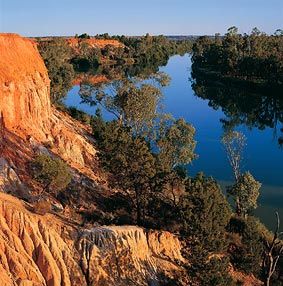 There is a comment in today's Australian that opens up what is normally remains hidden behind the bland press releases and the sound bites of ministers who have an eye on looking good before the court of public opinion.
The news item says that the South Australian Rann Government has ensured that irrigators will receive an extra 72 gigalitres from the Murray, due to better-than-average rainfall this year.
This has allowed South Australia, along with NSW, to ease restrictions by up to 10 per cent. So irrigators would be able to take up 95 per cent of their annual allocation of water. It had restricted them in June to 55 per cent of their allocation.
The comment that is of interest is the response to a question about where the the water for 500 gigalitres of environmental flows is going to come from. A spokesman for the South Australian Environment Minister John Hill said the source for the large water injection had not yet been decided. However, two possibilities were improvements in irrigation infrastructure, allowing the water savings to remain in the river, and going to the market and buying water. An then this:
'"That way only willing sellers would part with their water - leaving the high-value end of the market in South Australia largely immune," the spokesman said.'
The message? Though the Rann Government is concerned about the River Murray's health, it is the interests of irrigators dominate. We cannot upset the irrigators. That is the bottom line.
Why does this open up what is normally concealed? Consider these remarks by Warren Truss when calling on South Australia to increase its contribution to the river fund. SA, which is at the end of the river, and extracts only 6 per cent of total flows, has imposed a household levy of $30 to raise $79 million over four years as a contribution to river works.
'"I'm disappointed with South Australia's offer," Truss tells Inquirer [The Australian] "NSW and Victoria are putting in about double the amount of South Australia. South Australia's going to have to make a contribution, financially and in giving up water. We'll be looking for a proposal from South Australia for water savings. It can't just be a matter of demands on other states."
Now juxtapose the two comments.
For all its public rhetoric about saving the Murray, SA is concerned to protect its wineries. Water for development is its key concern: managing the river in a sustainable way so that we can continue making money out of it There is nothing said here about SA finding water for the River Murray, even though SA favours using most of the money on buying back users' water rights. In contrast Truss is wanting SA to give up some water for the River Murray.
No way says John Hill, the Environment Minister. He dismisses such comments as bizarre! Water savings must come from the eastern states. SA does not need to help to find environmental flows for the Coorong.
That is what sits hidden behind the press releases.
Posted by Gary Sauer-Thompson at 9:20 AM | Comments (1) | TrackBack
November 17, 2003
Iraq war
The Australian Prime Minister continues to build a firewall around the reasons for Australia jumping on the US imperial adventure in Iraq. 'WE ACTED ON THE ADVICE given by the intelligence organizations', Howard says. We citizens cannot see that advice to make our own judgements, since the intelligence advice remains secret.
So the name of the game is to shut out the general public, muffle the debate and forestall the judgements of citizens. The name of the game is to keep the lid on democracy.
We know that it basically came from the US, as Howard pretty much parroted the Washington line. Here is a good evaluation of that US intelligence advice by Thomas Powers in the New York Review of Books. What we have is:
'...the insistence of the President that Iraq threatened America, the willingness of the CIA to create a strong case for war out of weak evidence, and the readiness of Congress to ignore its own doubts and go along..."My colleagues," Colin Powell said at the UN, "every statement I make today is backed up by sources, solid sources.... What we're giving you are facts and conclusions based on solid intelligence." But now, only six months later, we have ample reason to conclude that the intelligence wasn't solid at all, there was no need for war, Iraq's weapons of mass destruction didn't exist.'
What then of the aftermath?:---- the argument that the war was worthwhile since the repressive regime of Saddam Hussein is history. Well, the postwar planning is a disaster. We have ongoing war with US occupation and nationalist resistance.
And the US is looking for a quick exit strategy that will restore sovereignty to the Iraqi people, whilst arranging things so that the Iraqi's do not elect an anti-American government.
Posted by Gary Sauer-Thompson at 9:14 AM | Comments (5) | TrackBack
November 16, 2003
it's Indonesia's problem you know
I hadn't read The Australian yesterday when I was looking for material for the weekend cartoons. So I missed this one by Bill Leak, until William mentioned it in his comments on yesterday's post. I concur with his judgement. It's good.
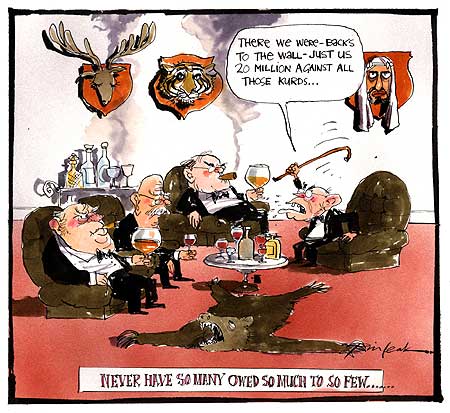
Bill Leak
Even though Howard is a satrap of the imperial presidency in Washington he is really an Anglo-Australia; a 50 year throwback to the Menzies era when Australia was still a part of the British Empire.
The Kurds from Turkey who seek a better life for themselves remain the uninvited. We do not want them----asylum seekers---- here. So fortress Australia repels the asylum seekers to Indonesia. None shall cross the line. The border is and remains closed. Detention within its borders is punitive and harsh----it is a form of punishment to deter future asylum seekers. Australia does not want a situation in which asylum seekers reach Indonesia with some hope of resettlement in Australia. The Howard Government argues that the boats have stopped coming, the borders are secure, and Australia can choose those refugees to whom it wishes to offer places under its generous offshore refugee selection program.
The current Fortress Australia policy presupposes that it is up to Indonesia to prevent people smuggling. This implies better policing of Indonesia's borders. It also implies that Indonesia's policy towards asylum seekers is identical to Australia's. However, Indonesia argues that Canberra is using Indonesia as a dumping ground (a trash can), and that in sending the boat people from Australian waters back to Indonesia Australia is breaching international conventions.
Canberra knows that it is extremely difficult for the Indonesian state to defend its vast and fragmented sea borders and that it has a massive internal refugee problem. Moreover, the Indonesian military (TNI) is not able to control current ethnic and religious tensions and conflicts; an under-resourced Air Force and Navy are unable to prevent increasing piracy in key sea-lanes like the Straits of Malacca; the legal and bureaucratic system was degraded under President Soeharto in order to minimize their capacity to interfer in the corrupt activities of his fascist New Order cronies. Canberra knows that Indonesia has a limited capacity to deal with asylum seeker.
Dealing with foreign asylum seekers is a low priority for Jakarta. It has yet to create an effective immigration system that would slow the flow of asylum seekers to Australia.The bulk of those illegally entering Australia from Indonesia enter Indonesia "legally" with visas given by bribed Indonesian officals whilst others lack the skills or equipment to spot fake passports. Nor does it have the institutional capacity to change this.
The underlying rationale of the Fortress Australia policy is that the persecuted poor or displaced are to be quarantined from the developed world, and contained as close as possible to the places they want to leave behind. Go back home is the message. There is no such thing as the free movement of people, only capital.
So Australia is unlikely to achieve much by attempting to blame Indonesia and shift the responsibility to a poorer nation state. That quick and dirty strategy will fail to produce long term results because Indonesia does not have the capacity to deal with a large movement of displaced homeless.
And lastly, the construction of Fortress Australia in a globalised world is at a time when Canberra is relinquishing control to the global market, and control over foreign capital. The violent insistence on sovereignty against the threat to the nation by the uninvited stranger reworks an old discourse based on prejudice, (dishonest), ambiguity (terrorists), and fears (the greatest assault to our borders in history). Behind this first line of defence sits a second line, the appeal to social cohesiveness and harmony of Australian society. Thsi seconfg line has a tacit link to third line of defence, the old unconscious racist premises of the white nation.
For Labor's policy re the Kurd's, see Tim Dunlop over at Road to Surfdom
Update
The spat between Australia and Indonesia over the Kurdish asylum seekers continues. And the Howard Government continued to fan fears of a new influx of asylum-seekers whilst accusing Dr Carmen Lawrence, the new ALP President, of trying to dismantle the whole of Australia's border protection policy.
Posted by Gary Sauer-Thompson at 8:10 AM | Comments (2) | TrackBack
November 15, 2003
Saturday's cartoon

The cartoon provides a good counterpoint to the way John Howard's London Memorial speech sought to create moral legitimacy for the invasion of Iraq on the backs of a century of our war dead from WW 1 and 11. In this speech Howard says:
"With each year, our living links with the two great global conflicts of the 20th century gently fall away. Few are left who remember that moment 85 years ago, at this hour, on this day, when peace descended on a world still numbed by the magnitude of battlefield losses, and on an Australia changed forever by names such as Gallipoli, Lone Pine, Fromelles, Bullecourt and Pozieres.
So, too, the march slows for the World War II generations of Australians roused to action by acts of brutality against innocent, peace-loving people.
And yet there is a resonance to this memorial's message, inspiration in its example and a warning in its shadows that compels us to reach back across that void in time. In doing so, in recognising the many thousands of Australians who fought and died alongside their British allies, we affirm the enduring hope of a world set free from hate. In mourning our fallen, in numbers still difficult to comprehend, we also acknowledge the terrible power of those forces that would conspire against such a dream.
History's lesson is that evil will always dwell within the world - in the past represented by armies rolling across national borders, in this new century finding forms in acts of indiscriminate terrorism inspired by distorted faith. Such intent can be defeated by the willingness of decent men and women to put aside the comfort, safety and security of their own lives, to understand that militarism and totalitarianism and terror are creeping sicknesses that will inevitably spread if left unchallenged and unchecked, and by the willingness of nations to stand together in mutual defence of the common values which underpin the progression of man.
The young Australians we honour here comprehended those truths ..."
This image of sacrifice by Australian citizens is what Howard is invoking in his speech. It is a powerful image whose diverse meanings resonate through the emotional unconscious of the nation.
 I would have thought that the war with Iraq had more similarity with Vietnam than the World Wars.
It was a war that divided a nation.
But then so did WW1 when Billy Hughes and his Labor Government tried to introduce conscription.
And then WW1 signifies that although Australia became a nation in 1901, its loyalties still lay with Britain. So the Australian government had committed itself to supporting the British war effort. That is exactly what it did with the Americans in Iraq.
Posted by Gary Sauer-Thompson at 1:49 PM | Comments (3) | TrackBack
November 14, 2003
Returning water to the River Murray
 The Murray-Darling Ministerial Council meets today to consider ways to improve the health of the River Murray. It is expected to adopt a 5 year river plan to return water to the troubled river.
Judging from the media reports a targeted approach will be adopted.
The focus of the plan is on improving the 4 iconic sites of the Barmah, Koondrook-Perricoota & Gumnbower forests near Echuca, the Chowilla floodplain near Renmark, and the Coorong near the Murray Mouth.
The media reports say the plan:
"....chooses specific forests and wetlands to receive extra water rather than simply proposing extra flows for the whole river, in a change of thinking recommended by the Murray Darling Basin Commission...The plan will devote 500 gigalitres a year... to the four areas, averaged over five years. It is believed the plan revolves around water savings of up to 300 gigalitres a year from "engineering" water use - by covering irrigation channels to reduce evaporation and offering farmers incentives to change their irrigation patterns, among other approaches."
The short term plan is seen as a necessary first step to protecting these iconic sites. The plan will allocate 180 gigalitres to the Murray Mouth annually, and 160 gigalitres to the highly degraded Chowilla floodplain. Hence we may have a process of working on what these iconic sites need to ensure their ecological health. Though the small amount of water will not keep the Murray Mouth open, nor save the Chowilla-floodplain, water is set to be returned to the Murray River for the first time in more than 100 years.
The negative is also important. To flush out the now hypersaline Coorong estuary and keep the mouth open would require at least the full 500 gigalitres, leaving nothing for other sites. There is a long way to go, even though the return of water to the river is historically significant.
This environmental flows strategy is contested by irrigators. Writing in the Australian Financial Review (subscription required, 13, 11, 03 0.78) John Cox continues to beat the anti-reform drum of the "simplistic green lobbying which advocates that environmental outcomes in rivers like the Murray can be improved by increased river flows." Cox says:
"The present debate on the future of the River Murray has been conducted solely in terms of environmental outcomes and the fact that Australians give a 60 per cent weighting to economic outcomes in regional communities [15% each to social and health outcomes and 10% to the environment] along the River Muray does not seem to be relevant to the debate and to the decisions being made."
Cox argues that the environmental scientific approach is simplistic because its strategy of increased environmental flows ignores the economic and political effects of buyback. Cox says:
" ...a reduction in water for irrigation will result in a significiant loss in regional income and have serious financial, social and psychological effects on these [regional] communities."
Cox's intervention appears to be backed Lee Benson's Science Behind the Living Murray report (not online), which was done for Murray Irrigation Ltd in NSW.
The small amount of water to be allocated (ie the 500 gialitres) will not keep the Murray Mouth open, or save the Chowilla-floodplain and the ecology of the river between the iconic sites. Much more water is needed to save these. As The Age recognizes that "more water will eventually need to flow down the whole length of the Murray and not just at environmentally sensitive sites." A third of what needed has been allocated. The next step is for the Federal Government to make a long-term commitment to restoring flows to the whole river when it meets again with the states in April.
Update
As expected the Murray-Darling Basin Ministerial Council approved the Federal Government's 500-gigalitre "first step" flows to six iconic river assets, with the Hattah Lakes in Victoria's north-west being added to the list of sites to get the extra water.
As expected Federal Government ministers assured farmers that most of the 500 gigalitres (billion litres) promised for the Murray yesterday would most of the water will not be bought from farmers and that there will be no adverse social or economic impacts on river communities.
As expected the Miinsterial Council agreed to invest in water saving techniques and engineering works to save substantial amounts of water, rather than buy back water allocations on the market and so reduce the over allocation of water licences by the basin state governments.
Posted by Gary Sauer-Thompson at 1:15 PM | Comments (0) | TrackBack
November 13, 2003
Iraq: US Exit Strategy

Is the US exit strategy from Iraq underway? The increasing insurgent nationalist resistance, which wants to expel the US from Iraq, has meant a rapidly deteriorating security situation.
It does appear that US wants to turn power over to an Iraqi government as soon as possible. Is Bremer on the way out? Josh Marshall seems to think so.
The news reports this morning are talking about the acceleration of a transfer of power involving the dumping the Governing Council.
It would be replaced with an Afghanistan model of a president who would appoint a cabinet and establish a legitimate government while the new constitution is being written. Juan Cole thinks so. He says that the:
"....frantic anxiety [in Washington] is mainly political, and is fueled in part by Karl Rove's realization that if Iraq is still in the headlines next summer, it will sink Bush's presidency.....Rove thus needs to move Iraq off the front page. By leaving Bremer in charge of the country, the Bush administration created a 51st state as far as the US press was concerned, and they covered it the same way they do New York. Moreover, this 51st state had a lot of newsworthy things going on in it, like daily attacks on US troops. Of course, the danger is that the US will fob rule of the country off on a failed state and the whole thing will blow up in the face of the Bush administration."
President Bush may be moulding Iraq to his 2004 election strategy but Iraq belongs to the Iraqi people. So you would expect some nationalist resistance instead of just Al Quada guerrillas acting as foreign terrorists. The fall of the Saddam Hussein regime did not mean the surrender of all Iraq. It meant war phase 2; a shift from being welcomed by the majority of the population as liberators to a paramilitary or guerilla resistance that wants to see the end of the US occupation. And President Bush is finding it ever more difficult to keep the nation rallied behind him in his transformation of Iraq and the Middle East.
Creating an Iraqi government will head off provoke a massive nationalist insurgency or uprising. The US model of governance is one from the late colonial period. It is military occuaption coupled with the developmentalist rhetoric of the colonial authorities making lives better and contributing to literacy, schooling, industrialization, etc. The twist is the emphasis on the free market and cosy deals with US firms, such as Halliburton.
Posted by Gary Sauer-Thompson at 6:34 AM | Comments (1) | TrackBack
November 12, 2003
just get used to it
I have just come a copy of last Friday's Australian. In it there is a report by Terry Plane on energy prices in South Australia (no link). Electricity prices for consumers have risen 25% whilst domestic gas prices are due to rise by 20% next January. It's a mess.
Remember the hype? It was about all the benefits — lower prices and more
efficient and better service — of a fully privatised and competitive
system with media commentators arguing for the need to free the industry of its last vestiges of government "meddling". That was part of a package of promises. South Australia would alleviate its supply problems by entering the NEM. This would mean having access to the surplus generating capacity to be found in NSW and Victoria.Further down the track, the growing demand and the lack of generating capacity would attract investment into the State, especially to the lucrative market for power in periods of peak demand.
The message in the article about the consequences of the privatisation of the power industry by the former Olsen Liberal Government is blunt, and it shows that the mantra about more competition bringing price relief is little more than market dreaming.
"South Australia would never benefit from the national electricity market, the state's power regulator declared yesterday. ...Lew Owens said that $15 of the $71-a-megawatt-hour rate he approved could be put down to the cost of privatisation.....Mr Owens has described this (the higher energy prices) as the new order of utility prices and told consumers they should he get used to it."
The article also mentions that Stepehn Kelly the chief executive of the National Electricity Code Executive Administrator, has said that South Australia has enjoyed the biggest decline in wholesale prices of any state over the past four years. The decline had been in the order of 63%. All the evidence, he says, suggests that contract prices have come down.
So wholesale prices for electricity come down 63% and retail prices go up 25%. That looks like price gouging to me by AGL, the Sydney based utility company. They are making a killing in the SA market.
The Energy Consumers' Council agrees. They say there is a lot of fat in the current prices (about 10%) and that South Australian consumers are being overcharged.
The inference? Lew Owens, the energy regulator, has gone along with monopoly pricing in SA by AGL, whilst the Rann Labor Government has allowed it to happen. Pat Conlon, the SA Minister of State Energy, has a simple line that is endlessly repeated. The higher prices are due to the previous Liberal Government botching the privatising process.
It has nothing to do with private operators in the National Electricity Market "needing" to charge more than can be justified on the maths of the
business; or even contrary to movements in costs in order to establish a
"risk margin"?
What can be done as more and more as more and more South Australians find themselves unable to pay for this basic service? The Energy Consumers' Council says let's have a look at AGL's purchasing contracts and review the decision made by Lew Owens to approve the 25% increase in prices. It's a good place to start clawing back price increases through government intervention.
Posted by Gary Sauer-Thompson at 6:47 AM | Comments (4) | TrackBack
November 11, 2003
Trying to make sense of.....
The recent campaign against the awarding of a peace prize to the Palestinian activist, Hanan Ashrawi, was disturbing. But it is hard the finger on what is disturbing. I't has to do with ethics in politics and I'm struggling. So here is a stab.
It was not disturbing that the campaign was conducted by those supporters of Israel who are clusted around the right-wing, independent think tank the Australia/Israeli & Jewish Affairs Council(AIJAC). Nor was it disturbing that the campaign succeded in getting Sydney University to withdraw the use of its Great Hall for the presentation of the peace prize; or that the Lord Mayor of Sydney, Lucy Turnbull, dissociated the City of Sydney, sponsor of the prize, from the presentation.
It was the content in the campaign that was disturbing, given that this was one of the few times we had heard a Palestinian voice in Australia. So what was disturbing about the campaign content?
In an earlier post I said that there was a resistance to any erudite Palestinian being recognized or honoured; as a well as an attempt to prevent Palestinians from speaking their own moral/political language of resistance to occupation by a hostile power and the systematic and intense violence against the Palestinian population.
However, what is disturbing goes deeper than language. It is also the blindness to the implications of that campaign: the support for Israel as an exclusivist Jewish state.
I found this article by Antony Loewenstein useful in trying to make sense of the blindness. Antony starts by quoting an Israeli philosopher:
'The distinguished Israeli philosopher Yeshayahu Leibovitz said in 1968 about the then recent occupation: "A state governing a hostile population of 1.5 to 2 million foreigners is bound to become a security service state, with all this implies for the spirit of education, freedom of speech and thought and democracy. Israel will be infected with corruption, characteristic of any colonial regime."'
Andy then comments:
"Thirty-five years on, these words have become tragically prophetic. Many Jews can no longer sit by and watch the continuing catastrophe without comment, and look in shame at the ways in which successive Israeli governments have behaved in the occupied territories."
Israel has changed and some Jews are speaking up. Why so? What do they find disturbing?
First, the current mindset, which is one in which the Sharon Government has convinced itself and Washington that it is fighting a war on terrorism. In this mindset Israel----now identified as the Jewish state---is besieged by fundamentalist Islamists who want to see its destruction. This mindset blocks out the reality of many of Israeli state's questionable actions; such as those that parallel apartheid-like policies towards Palestinians. Or those that displace Palestinians from their homeland, the violence against them by the settlers and the lack of redress for their grievances.
Let us call that the Zionism mindset. That term refers to the ultra-right nationalist strand in Israeli politics which currently holds power in Israel. This mindset is what was behind the campaign against Hanan Ashrawi. This mindset reduces the problem to Israel's right to exist and it identifies Israel as exclusively Jewish. Since Arab-Israeli citizens are non-Jews, so they must be made to leave Israel and never be allowed to return. This is ethno-nationalism with a vengance.
Secondly, we have a very closed discourse in Australia about the Palestinian/Israeli conflict. The critics of this right-wing expansionist Zionism in Australian political discourse are characteristed as the Australia Left, and they are seen as denying Israel's right to self-determination. So they are defined as anti-Jewish, viewed as a racists denying the Jews' right to a homeland and vilified as anti-Semites.
What is also disturbing is the way the critics are misrepresented by the Zionists in Australia. Let me state my position clearly to avoid polemics about my sympathies for the Palestinians. Jews are entitled to a homeland. Israeli has the right of self-determination. Israel has the right to exist. Israeli needs security and secure borders. A two-state solution is the only viable one at the moment.
What is questionable is the way the Israeli state as a regional power currently treats the Palestinian people. The occupation smacks of colonialism of their land, as do the discriminatory laws against Israeli Arabs. So also the continually expanding settlements, the building of a Berlin Wall and the constant confiscation and destruction of Palestinian land. Some of the Israeli state's actions indicate a shift to an apartheid regime; if not the ultimate expulsion of all Palestinians to Jordan.
Right wing Zionism means that Israel's drive to maintain dominion over the occupied Palestinian territories is shaped by an exclusivist ethno-nationalism. An expanded Israel can only a homeland for Jews.
That ethno-nationalism is not acceptable for Australia, since it gives us an Anglo-Celtic Australia. By failing to stand firm in the face of right-wing Zionist campaign, the Sydney liberal establishment (eg., Sydney University and the Sydney City Council), tacitly embraced, and accepted exclusivist ethno-nationalism. They did so despite their official commitment to multiculturalism in Australia.
So why is an exclusivist ethno-nationalism ethically okay for Israel when it is not ethically okay for Australia? What is the ethical difference here? I just see ethical blindness.
It is the lack of criticism of the right-wing Zionist conception of Israel as an exclusivist Jewish state that is disturbing.
What does that say about Australia?
Posted by Gary Sauer-Thompson at 2:01 PM | Comments (5) | TrackBack
November 10, 2003
slipping behind yet again
The Australian Financial Review(AFR) is on a mission to sell the Free Trade Agreement (FTA) with the US. It has opened up its new political front of the FTA being an instrument to lever another round of reforms to Australian society. These reforms are designed to do away with our social democratic heritage and transform Australia into a market society. Our social democratic ethos, conventions and institutions are seen to be shacklng a market economy and frustrating its free workings.
The older round of reforms, those pushed through under the Hawk-Keating Labor Government, are seen to have their course. They are not delivering productivity increases. Hence a new round of reforms need to pushed through. So argues the AFR last Friday in a column entitled , 'The Race is on to catch up with future' (subscription required, 7 11 03, pp.1 & 80-81).
The Howard Government is showing reform fatique. It needs a booster injection to enable it to continue shaping society so that it is in harmony with the free market. Harmony is beautiful. Progress must be maintained. Otherwise Australia wil drift downhill, and fall behind the race to acquire the wealth of nations. There is no other choice but another major round of micro-economic reform. It's time to do the hard yards says the editorial in the AFR.
What are these reforms? Those mentioned include: further deregulation of the labour market and reducing the minimium wage level; reducing tariffs on manufacturing, accelerating progress on the market-orientated reform of our universities; more market-orientated reform of the public health; a greater rationalization and shakeup of welfare; lower taxation to attract mobile capital to Australia.
And while we are at why not throw some golden oldies into the mix. Population needs to be increased. Australia needs a bigger population if it is to be internationally competitive.
Why? Why is that necessary in an open economy integrated with the US?
Posted by Gary Sauer-Thompson at 12:54 PM | Comments (2) | TrackBack
November 9, 2003
Sunday Cartoon
Amanda Vanstone has a holiday home three doors down the road from our holiday shack in Victor Harbor. So I couldn't resist this.

Alan Moir.
The political cooking needed to lock in the emotional unconscious of public opinion is pretty obvious, even for a half-educated punter such as me. Philip was the master chief who created the conservative receipe for the national security, terrorism and immigration mix.
The newly appointed Minister used to have her own personal website. No more.
As with cooking to a receipe there will be a touch of difference and flair. It is called Ministerial discretion and it is all about performance as represented in the media. That difference is determined by political considerations. Then, isn't everything for the people in Canberra?
The conservative political receipe to retain political office appeals to, and shapes, public emotions of pride and fear: pride in Australia's achievements and fear of terrorists and asylum seekers. The mixture of patriotism and suspicion has the effect of dampening down dissent and criticism of the national security state. The unconscious emotion is simple: we face the threat of invasion but we are strong and will defend what is right.
Posted by Gary Sauer-Thompson at 8:41 PM | Comments (0) | TrackBack
November 8, 2003
Saturday Cartoon

I know. Everyone says Iraq is not like Vietnam. I accept that.
But the feeling lingers. It is still looking pretty swampy terrain for the US. They do seem to be getting bogged down, Baghdad is a hostile city and Iraq is a divided nation regionally and religiously. Washington is faced with the choice between the risks of disorder due to the lack of troops and civil war if it arms Iraqis.
And the similarities? The US's uncritical faith in its overwhelming firepower, its modern equipment, mobility, and mastery of the skies. But war in Iraq, as in Vietnam will ultimately be won politically.
Meanwhile, the imperial president gives a stirring speech about freedom and democracy so shape public opinion in the US It announced changing the old practice of America's long-standing policy of tolerating corrupt and brutal Middle Eastern, pro-American autocrats in the name of realism and national security. Democracy was a secondary consideration.
Is that the kiss of death for Saudi Arabia? Not quite. Yesterday's corrupt autocracies are today's potential democracies for the imperial president:
"The Saudi government is taking first steps toward reform, including a plan for gradual introduction of elections. By giving the Saudi people a greater role in their own society, the Saudi government can demonstrate true leadership in the region."
What about those Arab societies that are actual democracies to the extent that they have a parliament with substantive budgetary and oversight powers and hold elections? Iran, it seems, is just not democratic enough for Washington:
"As changes come to the Middle Eastern region, those with power should ask themselves: Will they be remembered for resisting reform, or for leading it? In Iran, the demand for democracy is strong and broad, as we saw last month when thousands gathered to welcome home Shirin Ebadi, the winner of the Nobel Peace Prize. The regime in Teheran must heed the democratic demands of the Iranian people, or lose its last claim to legitimacy."
Freedom and democracy huh. How come Saudi Arabia is a more legitimate regime in the eyes of Washington than Iran?
I accept that the Bush speech was about changing past practices and policies in the Middle East. But the hand of history weighs heavily here. It will take more than a neo-con speech about making the world better by bringing democracy to the Middle East to lift the weight of that colonial hand of history. The Europeans and Amercians created the Middle East, drew its borders and weaned and supported their grotesque dictators.
Since bringing democracy to the Middle East will bring the fundamental Islamists into power (ie., those whom the US has defined as the enemy), the imperial president's speech is about the credibility of America's military power and strategy.I would suggest that the US under the Bush administration is deeply unpopular in the Middle East. Apart from Israel, the populations of the nation-states would be hostile to the US military presence in the region.
Posted by Gary Sauer-Thompson at 9:45 PM | Comments (6) | TrackBack
November 7, 2003
Arguing about free trade
There was an editorial in the Australian Financial Review(AFR) (subscription required 3 Nov. 03, p. 70) that addresses the arguments made against Australia's proposed free trade agreement with the US. It says that the main argument currently being being advanced is the size one. The size argument has been deployed by public opinion
The AFR characterises the argument as follows:
"The opponents of free trade warn sagely that big and powerful nations like the US and China will only act in their own interest. We should be grateful for that penetrating insight....The FTA opponents argue that, given the size differential, Australia will surely fail to win any concessions. In the US case, detractors say that the US will never give up its sugar program to suit Australia canegrowers. "
Well not quite. The size argument holds that Australia will have to make more concessions than the US, that the US will not remove its protection on agricultural commodities in the short term, and that the FTA will seek to remove Australia's environmental regulations. (See Blogger on a Cast Iron Balcony for more on the impact of the FTA on Australian's polcies to protect its ecology).
So how does the AFR respond? It says the argument:
"....is based on a wrong premise. In the context of the FTA talks, the goal of the Australian canegrowers is better access to a lucrative market (where the prices are about three times the world price), not necessarily the end of the sugar program. In short, the FTA, should deliver a larger share of that protected market, while latter multilateral negotiations can later achieve the broader goal of destroying the US sugar program."
The response by public opinion is that Australia will have to make lots of concessions in other areas to gain that access and integration with the US market. This, no doubt, would be accepted by the AFR.
The AFR then gives an insight why the price of making lots of concessions is worth paying:
"Closer economic relations with the US and China (and others) offer the chance of regaining momentum on domestic structural reform, and locking Australia's future with the economic superpowers sof the 21st century. They are opportunites not to be missed."
So free trade is an instrument of social engineering to reshape society so that it harmonizes with a free market. That's the point of making the concessions.
Posted by Gary Sauer-Thompson at 1:44 PM | Comments (0) | TrackBack
Iraq: an exit strategy
Iraq is America's problem.
It did not have to be that way, but that is the way it has turned out. It is what the American neo cons wanted.
Iraq is a problem for the US, given the level of American casualities coincides with a presidential election. Domestic imperatives mean that there has to be some form of cut and run.
The strategy is to put more Iraqi soldiers and police on the ground. Train them up fast to reduce the American footprint. Let the Iraqi's deal with the guerrillas as soon as possible.
And juggle things so that the Iraqi exiles under Ahmand Chabali take control of the administration. It doesn't matter that the exiles do not have popular support. It is now all about managing the political fallout of Iraq. What is paramount is the politics of the President Bush's re-election. The local politicians wil just have to deal with the guerrillas.
Of course, the cut and run will be covered over with lots of rhetoric about America's manifest destiny.
Posted by Gary Sauer-Thompson at 7:55 AM | Comments (2) | TrackBack
what does it say
 This is The Australian yesterday.
Brendon Nelson sits alone on the parliamentary benches. What does that signify? Deserted by his hard-line colleagues? Is the consensus that he so carefully built for his educational reforms beginning to erode. Is he confronted by setbacks?
The Senate Inquiry into higher education is due to to be tabled today. It will be immediately rejected by the Howard Government on political grounds. The Senate is not looking as if it will support the Nelson reforms let alone pass them by Xmas.
Michael Gallagher, the former departmental head of education, criticised the reforms because the policy framework had no vision of the future shape of the industry; was very intrusive; lacked indexation for operating grants; lacked access for students; would lead to cartel pricing and so undermine competition; and neglected the vocational and training sector.
The Vice-Chancellors continue to stand firm in their oppposition with the belated release of the draft guidelines to the Higher Education Support Bill 2003. As does the National Tertiary Education Union. There is still the proposal to introduce Australian Workplace Agreements into enterprise agreements; the tying of workplace reforms to extra funding; reducing the size of governing councils and excluding politicians from membership.
There is very little in these government reforms about other kinds of educational governance. The need to change the hierarchical nature of the univerisites, with their top-down top-heavy administration and small groups of academics arranged in schools and departments with little or no power or influence, is not addressed.
Posted by Gary Sauer-Thompson at 7:02 AM | Comments (0) | TrackBack
November 6, 2003
Peace prizes for Palestinians
I have stayed away from commenting on the political campaign mounted by so-called "the Jewish Community" against the awarding of the annual peace prize by the Sydney Peace Foundation to the Palestinian activist and politician Dr Hanan Ashrawi. I have to admit that I've been taken back by it.
That political campaign, organized through the Australian Jewish News and the Australian and Jewish Affairs Council, has represented Hanan Ashrawi as an apologist for terrorism. The frenzied campaign against her indicates that advocating Palestinian self-determination, critiquing Israeli Government policy and questioning Zionist history is not on: it occurs the anger and vitriol of Jewish groups in Australia.
No support should be given to the Palestine people according to this militarized "Israeli" line. It is one that denies the diversity of Israeli voices and ignores those Jewish voices against the Israeli occupation of Palestinian land. It is one whose practice is talking peace whilst expanding settlements and clamping down on the Occupied Territories. Let us call this line a Zionist military one to distinquish it from those Jewish voices who oppose the occupation. "The Jewish Community" is a diversity of voices with different perspectives, opinions, policies and judgements.
So why this well-organized campaign of anger in Australia? It was conducted like a military campaign to get politicians to crumble before the pressure. Resistance to its aims had to be overcome. Victory was the sole objective.
The best suggestion I've come across is one offered by Andy Lowenstein at Znet. Andy says that "...in the current battle for international legitimacy, there is no question that Israel is losing friends at an ever-increasing rate....The Jewish lobby doesn't want people like her in the public sphere talking about Palestinian aspirations, hopes, fears, angers or dreams. It's much easier to portray the Palestinians as violent, anarchic and hateful towards Jews, as the Zionist lobby frequently claims. "
So the object of the campaign was to destroy Ashrawi's credibility and her argument that the Palestinians have the right to resist an illegal and brutal occupation of their land by the Israeli's.
That language had to be replaced by the language of the war on terror. And the ABC went along with it. On the 7.30 Report Kerry O'Brien started proceedings by saying to Ashrawi that in her speech she did not condemn specifically the violence of Hamas by name and makes no reference to suicide bombers. Ashrawi was placed in the box and grilled.
Fair enough. She ought to be questioned and the ABC needs to show that it ican still cut the mustard, chew gum, walk the walk, and not be biased. But the grilling of Ashrawi was all that happened. No mention of the Israeli occupation, the wall, illegal settlements, the military targeting BBC journalists or American peace activists etc.
The Palestinians were placed on the defensive. O'Brien was not going to budge from deploying the language of the terrorism. Nor did he show any indication of questioning the language of a war on terror. That language mirrored reality.
It was utterly onesided. Just like it was on this occassion. When you try to speak differently, as SBS is doing, then you are targeted by the Zionists.
Posted by Gary Sauer-Thompson at 12:58 PM | Comments (4) | TrackBack
the politics of asylum seekers
I see that a political storm is brewing in Canberra over the Howard Government's attempts to prevent Kurdish 14 Kurdish asylum seekers from Turkey landing on Australian soil. They are currently anchored off Melville Island because of retrospective regulations passed by the Howard Government, which excised the Island from Australia's migration zone. Hence they are excluded from the judicial system.
And the indigeneous Australians who live on Melville Island? Where do they stand? Are they now the despicable other?
It's a short-term political fix. The Senate is moving to disallow the regulations. As Tim Dunlop observes an election is near. You can hear the political strategists thinking 'lets play the politics of fear' again. That card worked well last time. Let's try it again. We have nothing to loose spooking the Australian electorate. A tough stand on the national interest and security squeezes the ALP in all the right places. They're still all hung up on adopting a more compassionate stance on refugees.

David Rowe
But there is another side to this politics of immigration. It is getting the refugees out of the country. Australia is knowingly sending back asylum seekers to be tortured and murdered in their country of origin.
So argues Julie Macken in the Australian Financial Review with an article entitled 'Our Secret Shame' (subscription required, 6 11 03, p. 76.) And the Department of Immigration and Multicultural Affairs is indifferent to the fate of those it sends back.
Posted by Gary Sauer-Thompson at 10:29 AM | Comments (3) | TrackBack
Anti-Spam
The internet is increasingly being clogged up by hackers, commercial spammers who flood our email boxes using deceit, trickery and secrecy, and the direct marketers with their newly-found taste for high-volume email. The flood of junk spam--unsolicited electronic messaging--- that threatens to make email useless comes from the US through Asia, China and Romania.
The internet needs some form of regulation and governance. Telstra's BigPond email service, for instance, became dysfunctional due to a massive surge in spam blasted out by the epidemic of viruses on customer computers. Spam is the weapon currently being used to ensure that viruses and worms clog up the traffic and cause damage. There needs to be regulation to ensure that email remains a reliable and efficient means of communication. More is required than spam filters on individual computers.
There is some anti-spam legislation (Spam Bill 2003) being considered by Parliament to regulate the deluge. It is due to be introduced to the Senate latter this month. It aims to regulate the sendign of commercial email, prohibit unsolicited e-mails, and give the Australian Communicaions Authority the power to monitor, investigate and enforce penalties.
In an opinion piece in today's Australian Financial Review (subsscription required, 6 11 03, p. 79) David Vaile from the Cyperspace Law and Policy Centre at NSW University the bill is full of truck size loop holes.
It starts off on the basis of requiring consent from the recipient (opt-in) rather than using the opt-out approach favoured by the US Congress and the American direct marketeers.
Vaile says the loopholes in the Bill allows legitimate online marketing practices political parties, government charities and religious groups flogging goods and services to engage in their high -volume email. It also allows commercial marketers to do the same, on the grounds that they know us, our internet address is published, or that they are not really promoting goods or services.
What the bill acutally does is legalize the intrusive habits of the direct marketers who rely on data mining and profiling to openly target known individuals. So we can look forward personalized political messages.
Posted by Gary Sauer-Thompson at 9:35 AM | Comments (2) | TrackBack
November 5, 2003
free trade and water
There was a good comment in my earlier post on Australia's proposed Free Trade Agreement (FTA) with US from Roy Whyte at the Canadian Democratic Movement. Roy gives a Canadian perspective based on their experience of both FTA and NFTA with the US. I am posting his comments here in full.
Roy says:
"As the source of much of argument regarding the pending Australian-US trade agreement, let me say this - beware.
Having rules and groundwork for trade is great and is necessary but beware of the beast dressed as a benign object. Canada and Mexico were duped into believing many of the very same things your government is telling its people.
They will claim an increase in market access and with that will come jobs and an increased economic outlook.
Its all smoke and mirrors. America has no interest in free trade - we Canadians know that first hand. Canada has seen a net decrease of over 150,000 jobs since ratification. Our GDP growth in the 1990s was the worst since the Great Depression. Innovation and research has plummeted as our companies are no longer under Canadian control.
Another example - even though under our agreement NAFTA - that we are to have equal access without tariffs or duties that is not what is happening. Softwood lumber is a major export for many Canadian provinces and we have seen not once or twice but a DOZEN attempts by the US government to put duties and penalties on Canadian exports of softwood lumber as they claim we dump onto their markets. The WTO has decided against the US each and every time. This has NOT stopped them from doing it again. At this very moment 1000s of Canadians are out of work as a result of a 28% duty slammed onto our exports of softwood lumber. So much for free.
It does not stop there - wheat, tomatoes, potatoes and other goods have seen duties put on as a simple result of us having a competitive advantage over our American counterparts. Do not trust the snake oil being sold by Howard.
It gets even worse. With time and increased access to your markets you will see a sudden and dramatic increase in buyouts of your companies.
In Canada we are nearing 50% foreign ownership of our industries and corporations - with most being American owned. Of Canada's top 500 companies a full 35% are foreign owned.
In 1997 there were 41 large Canadian petroleum companies. Today there are six. Of the 35 that no longer exist, U.S. companies bought up 21.
In energy and in resources, Canada's ability to control its own supplies and prices has been drastically reduced. Canadian oil and natural gas prices are now set in the U.S. If the U.S. faces a severe shortage and their market dictates huge price increases, too bad, Canadians will face the same high prices. Canadian oil and gas can no longer be sold at lower prices in Canada than the prices we charge Americans.
With the ratification will come direct competition with US companies. This means there will be tremendous pressure on your government to steadily cut corporate tax rates and the rates for the rest of the wealthy - the trickle down theory - or the staying competitive line.
With those decreased tax rates will come massive social cuts in health care, social services, aboriginal monies, and a tax shift onto the lower classes. Once they begin to suffer, Howard and the like will claim privatization will be the answer to all your ills. Don’t believe it. Every single sector of the Canadian economy that was public and turned over to private industry has seen - increased costs, degradation of services, and even avoidable death through unclean water and food.
Contained within the trade deal are sovereignty killing clauses such as our infamous 'chapter 11'. What that does is gives investors and corporations the same and increasingly more rights than private citizens. For example, when Canada through our House of Commons banned a toxic chemical known as MMT because it was shown to cause nervous system disorders, the Ethyl Corporation of the US sued under 'chapter 11' claiming lost profits, and future lost earnings. Even though the chemical was banned under democratic procedure for the benefit of all Canadians it was overturned, and we had to pay compensation! And it goes on... the Sun Belt Water Company is suing for over 1 billion dollars because the Canadian provinces voted not to allow bulk water shipments. In essence, your government will become a powerless tool of the people while foreign companies control your national agenda all in the name of 'free trade'.
I could go on and on and on about all the ills hoisted upon us through our one-sided trade deal with the US but I think you are getting the picture..."
We can broaden these insights. Why not look the effect of the FTA on Australia's environment on the what if assumption that the FTA does go through. This is what our policy makers should be considering.
I reckon this account by Kenneth Davidson is about right. Davidson suggests that the negotiations should be shelved. He is working from a report published by the newly established, non-partisan, Melbourne-based think tank, OzProspect on the commissioned a report on the environmental consequences of an AUSFTA. An FTA with the US will affect Australia's environment through increased agricultural production for export. Davidsons says:
"The study concludes that if the US market for primary products is opened up for Australian farmers, the resultant expansion in agricultural production would increase Australian water use by up to 1.3 trillion litres a year - almost as much as the entire national domestic water use."
That's an increase of around 6 per cent of Australia's total water use. This is at a time when politicians are trying to clawback water from irrigators and return water to the rivers in the Murray-Darling Basin to improve their health. It is also at a time when governments are trying to repair the country from salinisation and landclearing. An FTA with the US will exacerbate environmental degradation in Australia.
So where is the report on the environmental impacts of most trade agreements by the Howard Government? Are they going to undertake such a review reviews that would include significant opportunities for public involvement?Should not an environmental impact statement (EIS) be mandatory to ensure that environmental considerations are taken into account in m negoitations?
Don't hold your breathe for an EIS.
Posted by Gary Sauer-Thompson at 11:21 AM | Comments (4) | TrackBack
November 4, 2003
a swamp that needs to be drained
An editorial in last Thursday's Australian Financial Review (subscription required, 30 10 03, p.78) gives an insight into how the market views the universities. On one level there is no suprise. It it is all about commerce and getting a return on monies spent on research.
From the perspective of economic reason the whole research system needs to be simplified. The maze of bureaucratic relationships in the research infrastructure creates inefficiences. It's a swamp that needs to be drained to ensure that the quality of the national research effort delivers a good commercial return on the public money spent on it.
More needs to be done because the direct return from the commercialisation of ARC-funded projects is just 3 per cent. Just 3% profit!
No wonder venture capital is not coming to the party. There is no incentive for dynamic entrepreneurs to provide the funds needed to turn successful research into commercial product.
It is clear what the Minister must do for the financial capital. Ministers Nelson and Gauran have to provide the right environment for more venture capital sucess.
And there is the suprise. Re-read the above. Is not the key to the whole proposed set of educational reforms---draining the swamp--to look after venture capital!The infererence role of government is to provide opportunites for entrepreneurs to make good bucks. That is the whole point of economic and cultural reform for neo-liberals.
The best way to do that is create a new two tiered university system between entrepreneurial, research-orientated universities and teaching institutions.
And what would the former look like? A story in last Monday's Australian Financial Review (subscription required, 3 13 03, p. 1) suggests that Monash is on the right track. They're breeding the new academics--home-grown millionare academics. One (a Dr. Frank Ng) who has shares in a start-up company based the successful commercialisation of his ARC funded research into biotech. (It's an obesity-control company called Metabolic Pharmaceuticals Ltd).
Attaboy Frank. The country needs more like you. There is $4 billion worth of research in the pipeline. It needs $400 billion to bring it to the market.
Posted by Gary Sauer-Thompson at 3:17 PM | Comments (0) | TrackBack
November 3, 2003
China & Japan or China v Japan?
There is an opinion forming in the Australian Press that Japan is being passed by China as the top economic power in the Asia Pacific region. Japan is in decline whilst China is booming. The symbolism of China putting humans into orbit says it all. China may be a form of primitive capitalism, but it has arrived.
This article in the International Herald Tribune (via Peking Duck) strikes a deflationary note. It says:
At the same time, the space flight is an apt metaphor for the risks inherent in China's economic rise. It is representative of the economy's worst element: its top-down nature.
This is what the world's most populous nation needs: bottom-up entrepreneurship that creates new businesses and jobs; a strong regulatory infrastructure for its equity and bond markets; aggressive education programs so that the tens of millions of workers being displaced by an opening economy can compete in the age of globalization; a plan to tackle a worsening AIDS crisis; and a greater effort to protect the environment.
What is Beijing offering? Vanity projects, and a fast- growing number of them. Aside from the ambitious, headline-grabbing space program, Beijing has been busy building the world's biggest dam, its tallest building, its longest bridge, its highest railway (to Tibet), its biggest stadium for the 2008 Olympics and, yes, its fastest-growing economy....
China has been to space, and it is getting the headlines it wanted. But Beijing had better begin expending the same amount of time and resources shoring up its high-flying economy."
Things are not that rosy with a primitive capitalist economy. A key problem is the banking system:
"China's banking system, however, is a clear and present danger, not only to its economy but also to social stability. Its state-run banks are harboring a bad-loan problem worse than Japan's, explaining why China isn't attracting as much institutional money as foreign direct investment."
So its rockets, space capsules and skyscrapers rather than human rights issues, financial-system transparency, and democracy.
Posted by Gary Sauer-Thompson at 10:38 PM | Comments (0) | TrackBack
Electricity: pointing the finger where
I have taken these comments by Observa from the comments box on the Screwing the Customer post. They should stand in their own right. They are insightful remarks on the issues of privatisation and competition that were supposed to make electricity cheaper in South Australia. We in South Australia have good reason to be angry about has happened, given the large increases in electricity prices out of the blue.
But where do we point the finger? Who do we trust? How did we get into this mess? Observa has some ideas on this.
Prof Dick Blandy of the Electricity Consumers Council was on the ABC TV today [Nov.1] describing why SA has the highest prices in the country. Essentially due to our heat wave air-conditioner demands in summer.Approximately 25% of our capacity is required for 5% of the year. Consumers have to pay for that privilege of course.
We got a look at a new smart meter that could alleviate much of this grid cost, by switching off air-conds on a rotational basis for short periods(15 mins every 2 hours). Electricity Ombudsman Lew Owens was against them on behalf of consumers, basically calling for business to cut its power use instead. Well of course business is prepared to pay the price. The meters would be voluntary, with discounts offered for consumers using them. The same benefits could accrue to business with timely shutdowns as well.
SA's particular power cost problem aside it was probably fair to say that power consumers Australia wide were in for some major price hikes, publicly or privately. The State Govts had generally bled their utilities as a tax milch cow, without costing in capital depreciation of aging plants. SA in particular is going through a massive period of investment in generation. Currently private investors are completing a major'apartment' development on the foreshore of Port Augusta to house workers for a 2-3yr period while the aging dinosaur Playford power station is renewed. This accommodation will essentially be paid for by rental to the workers in a tight regional accommodation market. It will then become a desirable motel, the first to be built in Port Augusta since the 70s I believe. Smart win-win by private enterprise which public servants couldn't even contemplate.
It is fair to say that when the Olsen Govt. touted privatisation of electricity as holding out cost benefits to consumers it was not telling the whole truth. What it really knew was that power prices would have to rise to reflect the new infrastructure costs required to meet burgeoning demand(as well as past goverment's neglect) Given the gun to the States heads from the Feds(Keating inspired if you recall)to increase competition or suffer funding cuts, what choice did the Olsen govt have? The truth was, these govts believed that competition would produce a lesser rise in prices than would have occurred under a continuation of govt monopoly. They just didn't have the guts to tell the electorate what they never want to hear.
Where are we now? Well we will never know whether or not ETSA would be giving us cheaper power than currently. However any of us who knew the good old days of feather-bedded employees of ETSA, SAGASCO and PMG (Telecom), laugh at the thought.
If you thought the likes of AGL and TXU are ripping us off blind then perhaps we'll let the doyen of the poor old consumer, the Rann Govt call it. They have just looked long and hard at the problem and have just decided that unfortunately their is no prospect of cheaper power in the short term (for this read the life of a power station). Exactly what they probably knew in opposition but were just as gutless in not telling us when they were busy scoring cheap political points.
Government business as usual folks! The good thing about privatised power last summer in SA was no blackouts. You just had to pay the true long term cost of power.
Posted by Gary Sauer-Thompson at 1:50 PM | Comments (0) | TrackBack
November 2, 2003
Sunday Cartoon
I guess this cartoon is to be contrasted with the Bush Admistration's happy talk about progress in its reconstruction efforts in Iraq.

Alan Moir
Moir buys into, and plays around with, the Bush administration's spin that is the resistance to their enlightened occupation of Iraq comes from a motley bunch of criminals, die-hard Saddam loyalists and terrorists full of blind rage and fanatical hatred who pour in from Syria.
This delves into the psychology of a terrorist.
Moir's image overlooks the Islamic resistance that would enshrine Islam as the religion of state and make Islamic law the basis for national law. This resistance would establish a new Islamic regime would refuse to recognize Israel and would be antagonistic to the West.
This raises the question of US strategy and tactics. Things are not going well for the US. The recent memo on Iraq by Donald Rumsfeld, the US Secretary of Defense, did draw a distinction between short and long term (the "long, hard slog" ahead). Short term would deal with the current bombings. Presumably long-term has to deal with the push for an Islamic Iraqi state. Rumsfeld deals with this in military terms: 'a grab 'em by the balls and their hearts and minds will follow' as this article in the Los Angelos Times puts it.
The previous week indicates something more than the cartoons show. The US does not control Iraq. It's a blunt and direct message.
Update
The news out of Iraq this morning was of 15 United States soldiers killed and 21 injured when their helicopter was shot down. It is beginning to look as if Iraq is going to become an expensive war with eroding domestic legitimation. The response by the Bush administration seems to be toughen it out, with its talk of war involving tragic days and being tested by foreign infiltrators. It is all about muscling up, taking it on the chin and giving it back to them.
My judgement is that US will not stay the course. It will cut and run.
Posted by Gary Sauer-Thompson at 7:42 AM | Comments (0) | TrackBack
November 1, 2003
Saturday Cartoon

Jabra Stavro Attackers target Wolfowitz's Baghdad hotel
Juan Cole has posted an eye witness account of the bombing of the Baghdad hotel on his weblog, Informed Comment. There is an question and answer seession with Wolfowitz at Washington University here. (link courtesy of Tim Dunlop over at Road to Surfdom.
There is another item of interest by Juan Cole on Informed Comment. Cole briefly decribes a lecture given Professor Timothy Mitchell, of the New York University Political Science Department, on contemporary Middle East affairs. Mitchell, according to Cole made a couple of interesting points. He argued that:
"....whether in Japan, India or elsewhere, has always been preceded by land reform. And, he pointed out, this sort of measure is completely absent from the American planning for the Iraqi economy. He said that the Baath years had seen enormous inequalities in landed wealth reemerge.... So far the CPA plan for Iraq appears to be to just let businessmen and wealthy landlords run wild, with all the risks of repeating the disastrous errors made in post-Soviet Russia."
The second point that Mitchell made was that:
"Mitchell also wryly pointed out that the main form of American economic activity in Iraq hasn't been market driven at all, but rather has consisted of a few big corporations with pre-arranged contracts feeding safely at the public trough (the $20 bn. Congress just passed for Iraqi reconstruction will largely go to these champions of the free market)....I'd say that one could forgive the Iraqis if they conclude that the American system in Iraq is a form of state socialism, with Bremer playing the Politburo, giving orders and exercising a veto even though no one elected him to office, and Halliburton and Bechtel playing state-supported industries. Perhaps it looks more like Cuba so far than like capitalist democracy."
On the other hand, there is the American shock therapy plan for Iraq. This involves selling off state owned enterprises and allowing foreign firms to buy 100% of them and then immediately to export the profits out the country.
Posted by Gary Sauer-Thompson at 5:49 PM | Comments (0) | TrackBack