« November 2003 | Main | January 2004 »
December 31, 2003
The man's confused
Last Monday night there was an episode on the Downers on the Dynasties series. I was too busy cooking a meal to give it much attention, even though I was interested in their fusty belief in hierarchy. I respect Lady Mary Downer. She actually likes people.
I cannot say I respect her son Alexander, who was born of the Liberal Party and is now Australia's Foreign Minister.

I've just read Alexander Downer's article in today's Australian. It's trash, like most of the stuff that Downer signs his name to these days. He about his critics--those mysterious Australia-bashing elites under the bed--being infected by a virus, filled with self-disgust, and embracing the moral equivalent of the cultural cringe.
Now that can hardly be considered an example of the tolerance that is supposed to be fundamental to our spirit as a great nation.
Downer starts his article by asking a loaded question, and then provides his answer:
"People of goodwill and fair mind who opposed the liberation of Iraq would do well to end the year contemplating this question: In what shape would the world be starting 2004 if we had adopted their preferred option of acquiescing yet again to Saddam Hussein? If the US and its allies had not taken action after Iraq had defied the UN Security Council for the 17th time, Hussein's strength as a leading, rogue figure in the Middle East would have been enhanced."
It's loaded because of the 'acquiesce'. The core debate in Australia was about intervention under the UN vis-a-vis US unilateral military action.The case for justifying unilateral military action was not convincing in the court of world opinion.
Downer ends the article by saying that "It is difficult to believe anyone would seriously argue now that we should not have removed Hussein's regime." Of course it is. That was never the issue. The political conflict was over the 'how'.
With the light touch of Xmas resting on my shoulder I will ask my own question. What has Australia signed up as a result of the military advernture in Iraq. My answer is to the policy agenda of the US neo-cons.
What is that? Billman over at Whiskey Bar provides a good answer:
"It's easy enough to point to some common themes that are generally identified with the neocons: contempt for international organizations and the concept of multilateralism; impatience with traditional balance-of-power diplomacy; a cultish devotion to the use of military power; an outspoken belief in the superiority of Western culture and political institutions; a messianic vision of America's mission to "civilize" the world, which at times (Max Boot) makes them sound like caricatures of old-fashioned European imperialists. And of course: an intense identification with the state of Israel, and a willingness, even eagerness, to use American power to protect and further Israeli security interests."
My conclusion. It is difficult to believe that anyone in Australia would sign up to that agenda; or to hold that Australia is a considerable power eager and ever ready to act as the Deputy Sheriff in the Asia Pacific region for a hegemonic US.
Downer now speaks the language of Howard but he once held that China, Japan, and Indonesia were as important as the USA; he highlighted the decline of Australia's strategic and economic weight relative to East Asia; recognized the importance of Australia needing to adjust to living with a dominant Asia; and argued that Australia should be inside the Asian multilateral tent.
Posted by Gary Sauer-Thompson at 8:41 AM | Comments (1) | TrackBack
December 30, 2003
wish fulfilment or reality
Yes, I know that its Xmas and lots of silly things get said. But it does seem that the conservatives kinda like a Latham-led ALP gaining control of the Treasury Benches.
Why so?
Because they will continue with the economic reform in the face of reform fatique. Here is John Hyde from the Institute of Public Affairs (IPA) writing in The Australian:
"Latham could position Labor as a party of economic responsibility and reform by insisting that it will do even some of the things that established wisdom tells it that it should do but which for political advantage is not done. He could champion fiscal discipline, trade policy, if he's game labour market reform, privatisation and marketisation of service delivery, especially by the states, deregulation of law and medicine, the better targeting of welfare and, embracing all, the elimination of governmental favouritism. The present profligate Government offers him an easy target.
Australia has a lot at stake in the competence and persistence with which Latham proceeds. Even if he fails to convert Labor, his arguments should cause the existing Government, and maybe a future Labor government, to govern better than it otherwise would, even than it could."
What would then ditinquish the ALP from the Howard Government apart from economic responsibility versus profligate?
Latham has to control the lefties no doubt. That won't be too hard as the Right nearly controls the ALP organizational wing now. Latham's job, acording to Hyde, is to make the ALP into a hardline neo-liberal Party that loves a strong state. You know one the one loved by the scaremongering, paranoic conservatives: a big state that flexes a bit of muscle on behalf of the Americans.
Outdoing Howard is hardly a good strategy for the ALP to regain power is it?
Posted by Gary Sauer-Thompson at 12:23 PM | Comments (0) | TrackBack
December 29, 2003
something here?
Some see an earth shattering political significance of Mark Latham being a fan of Meatloaf, and the Bat Out of Hell. Taste expresses personality is the argument.
It is the Xmas season after all, and elevating suburban adolescent passion and desire to operatic dimensions does not seem amiss. And loving '70s pop culture as a fan is all the rage these days, is it not?
Meatloaf is all about humor and theatricality. Is that not politics? And Bat Out of Hell's pastiche of oldies, show tunes, prog rock, folkie narratives and blistering hard rock in this teen rock opera could symbolize Latham's pastiche of public policies.
Note Latham's fondness for the American music expression of teenage dreams, angst and sexual experience, as opposed to the Australian musical expression. That does not bode well for protecting Australian cultural content in the forthcoming free trade agreement.
It is the non-economic arguments---rarely acknowledged by free trade economists----that provide the backbone to the resistance to the free trade vision of a borderless world. Issues such as compensating those losing out, national security, environmental protection and cultural protection are usually dismissed as trivial and so do not require trade intervention.
Posted by Gary Sauer-Thompson at 7:49 AM | Comments (4) | TrackBack
December 28, 2003
Free trade & the ALP
Can we gain an insight into the Latham-led ALP stance on the free trade agreement with the US from the past?
The proposed free trade agreement (FTA) between Australia and the US is primarily about the furthering process of globalisation as deep integration. The Hawke/Keating ALP supported this process in the form of the Uruguary Round. They justified this trade politics in terms of an inexorable movement to an ever more deeply integrated economy.
The Uruguary Round in the mid 1990s was seen as a harbinger of a grand global development. Free trade is the other side of economic rationalism or neo-liberalism within the national state, as it is the free market writ large. It a view in which all forms of protection--- tariffs, subsidies, quotas etc----are eliminated, and business firms can, and may, freely enter all markets (of nation states) at will. Goverments should refrain from intervening in international trade between private corporations.
This history suggests that a Latham-led ALP will not significantly question, let alone transgress, this trade politics or its embodied vision. It may continue with the ALPs historical preference for multilateralism (eg., GATT or regional trading blocs) as opposed to bilateralism (a FTA with the US), but these are different pathways to trade liberalisation, deeper integration and a globalised market.
From what I can make out the ALP tacitly holds that the free trade/globalization is inevitable and desirable and that there is no alternative. Hence the policy emphasis on national competivemness and increasing trade exports. In this the ALP is part of the policy making orthodoxy insofar as it accept the Washington consensus---the general agreement amongst Washington-based economic & political institutions on free market free trade policies as implemented by the IMF, World Bank and the WTO.
Hence the corporate form of globalization represents a political dividing line between the ALP and the Australian Greens. The latter see potential threats to local communities, national culture and the environment from this form of globalization. National sovereignty is required to protect these, especially tourist development which can take over whole communities, devastate coastlines, sequester valuable land for golf courses or resorts and bastardize local values and culture.
Posted by Gary Sauer-Thompson at 9:55 PM | Comments (0) | TrackBack
December 27, 2003
Who do you trust?
I see that The Australian is running a big story on the very decentralized The Australian Greens courtesy of Jamie Walker. (no link) Even with a regulation half-Senate election in the second half of next year, I presume that the prospect of 2-3 extra Green Senators in the Senate at the expense of the Australian Democrats does not appeal to the decidely conservative+neo-liberal Australian.
Unlike me, the Murdoch-owned Australian does not like the prospect of the Greens as a third force in Australian politics. Not one little bit. Hence the Green bashing that is starting to appear in the newspaper.
Walker's story builds on this one. The piece is largely descriptive in the style of informative objective journalism: a bit of history, the Greens are decentralized with little in the way of national organization; are anti-globalization;they saw off the attempt by the Trotskyites and Socialist Workers Party to take them over. I sort of 'get to know the Australian Greens.'
However, the piece contains a political message about the role likely to be played by the Greens in the Senate. How would they act? What would they do with their power. Would they negotiate? Would they just say no?
Walker suggests the model of Tasmania from 1989 to 1992 indicates what would happen. That was when the Field Labor Government was in power. What does that indicate? You cannot negotiate with the Greens says a bitter Field, the ex-Labor Premier, even with an Accord in place. I say bitter, because the Field-led ALP then worked with the Liberals to reduce the overall number of seats of the Tasmanian Parliament, in order to reduce the representation of the Greens.
My reading is different. The Tasmanian State ALP is largely beholden to the logging companies. The line is the old one of 'what is good for Gunns is good for Tasmania.' Hence all the talk about resource security for the logging companies and more jobs from woodchipping ever more native forests. You hear nothing about knowledge nation from the blinkered Bacon ALP government and little about fostering change to a value-adding timber industry.
My judgement is that cannot trust the current ALP to deliver on the environment, even if you have an Accord. In the past the federal ALP developed on the Franklin. My fear is when the crunch comes today's ALP will favour economic development at the expense of environmental protection and rehabilitation.
Under a Latham ALP desperate for power, the green touch will be light indeed. It is fair to say that sustainability is not a word in their policy tool kit.
That tool kit consists of a commitment to border protection, national security and "sensible" economic management policies. Sensible does not mean sustainable or even 'green modernization.' And I have yet to hear Latham speaking in favour of the environment, as opposed to the policy talk about climbing the rungs of the ladder of success.
Posted by Gary Sauer-Thompson at 9:48 AM | Comments (12) | TrackBack
December 26, 2003
Did you wonder too?
I'm too busy cleaning the holiday shack at Victor Harbor to post. Our guests arrive tomorow along with everyone else. The coastal town is starting to jump and shout as the summer holiday season starts in earnest. Everyone starts turning up on Boxing Day for their Xmas holiday fun. Adelaide just empties out, apart from the pigeons, old men and shoppers getting their fix at the sales.
I've always wondered about why the 26th was called Boxing Day. Well here's why:

Good old Leunig
Of course, Bryon Bay is the epicentre of seaside holiday living, where you hang up your work shoes, pullon the t shirt and shorts, walk the sand dunes and go listen to the sounds of the waves.
Update
For Christopher Pearson Xmas holidays at the seaside amounts to compulsory fun in substandard beachside accommodation. Nature means sand, sandflies and mosquitoes. Fun means beach cricket and ill-disciplined children who become savages. And community bonding? Well, as Jean-Paul Sartre said, "Hell is other people."
And that about sums things up re summer fun for Christopher.
Sounds like Christopher has a problem with modernity. Don't you think?
Posted by Gary Sauer-Thompson at 3:08 PM | Comments (2) | TrackBack
December 25, 2003
Xmas Day
I don't really know what it means
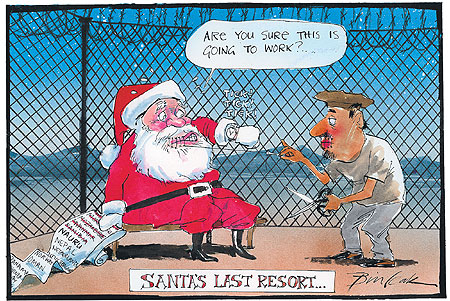
Bill Leak
But have a nice day everyone.
Enjoy the ritual.
Posted by Gary Sauer-Thompson at 5:19 AM | Comments (0) | TrackBack
December 24, 2003
? over Queensland Greens
I have lifted this from the Crikey.com.au mailout. It is by Greg Barnes, who picks up on an earlier article in The Australian by Jamie Walker. Walker's article was about how Drew Hutton's Queensland Greens were closely tied to the Beattie ALP Government.
'Closely tied' means a question mark hovers over the relationship between the Australian Greens and the ALP.
Greg Barns argues that Drew Hutton's Queensland Greens are the new face of Beattie Labor, as they prepared to help the Beattie Government back into power despite its appalling environmental record. On this interpretation the Greens in Queensland are little more than the fifth faction of the ALP, as Drew Hutton has already offered the ALP the Greens preferences in next year's State and Federal poll. The Greens have a record of this: they directed their preferences to the ALP in 27 out of 31 seats they contested in the 2001 Queensland State Election (including 10 marginal seats) and 110 of the 150 seats they contested (including all 37 marginal seats) at the last Federal Election.
Barnes says that the Beattie Government does not deserve the support of the environment movement as it has failed to keep most of its promises on the environment, including promises made by Federal Leader Kim Beazley at the 2001 election. He says that the Beattie Government has:
..."* dithered on land clearing, resulting in five years of panic clearing by landholders ahead of its long delayed legislation;
* failed to match the $15 million offered by the Federal Government ...for protecting the Great Barrier Reef;
* cut funding to the Environmental Protection Agency this year by $10 million (or 4%);
* opposed the ratification of the Kyoto Protocol and continued to build coal fired power stations despite their greenhouse impact;
* failed to stop inappropriate coastal developments such as Trinity Inlet in Cairns and Eastpoint in Mackay;
* insisted on building the environmentally destructive Paradise Dam on the Burnett River and failed to increase environmental flows into the Murray-Darling."
I concur with Barnes judgement that this is hardly an environmental record worthy of rewarding with Green preferences, and that in these circumstances a vote for the Greens is, at the end of the day, simply a vote for Beattie Labor!
Posted by Gary Sauer-Thompson at 3:30 PM | Comments (10) | TrackBack
Israel: upping the ante
Even if Ariel Sharon, the Israeli Prime Minister, has succeded in making Israel the regional power in the Middle East, he has has failed to find a military solution to the political problem posed by the Palestinians.
So where to now?
Amin Saikal suggests he will embrace a unilateral action mooted here. He says that Sharon's suggestion of unilateral action comes:
"...against a backdrop of the failure of his strategy to secure a military solution to the Palestinian problem. Sharon's reliance on the legitimacy of the US-led war on terrorism to suppress the Palestinian resistance and to stamp out Palestinian suicide bombings has finally run out of steam. It has neither destroyed the Palestinian leader, Yasser Arafat, as a potent symbol of the Palestinian cause, nor prevented more and more Palestinians from joining the ranks of those militant groups that have viewed violent actions as legitimate responses to Israel's repressive occupation."
Amin says that Sharon's unilateral action is not:
"....a pull-out to the pre-1967 borders, the dismantling of all Israeli settlements in the West Bank and Gaza and the creation of a viable independent Palestinian, with East Jerusalem as its capital...[That] would be an option worthy of consideration by the Palestinians and the international community. But this is not what Sharon has in mind. His objective is to redeploy Israeli forces away from Gaza and a number of West Bank cities, and to cordon off Israel, with the help of the "apartheid wall" that he has already started to construct to grab more Palestinian land."
And the implications of that action? Amin says:
"This may involve the removal of some insignificant settlements, but will not allow the Palestinians to live within other than a set of isolated condominiums, deprived of all the territorial and resource attributes to help them build a viable state of their own. It will sideline the demands of the Palestinians for negotiating the status of East Jerusalem, final boundaries, sharing of resources (especially water) and the future of the Palestinian refugees."
It will be intereseting to see if the US supports this unilateral action by the Israelly right.
Posted by Gary Sauer-Thompson at 9:30 AM | Comments (1) | TrackBack
December 23, 2003
An Xmas thought: porn is hip
 I've noticed this too. Porn has sneaked into everyday life. Porn culture is what is cool in the fashion, advertising media world. Porno chic is now.
And I've also noticed the silence about the increasing acceptance of what was once condemned. I've posted some provocative images and the reaction has been silence.
The silence is what is strange.
It is strange because we are talking about a (often perverted) form of sexuality. We are not relaxed and comfortable about the pervasiveness of porn images of sexuality. There is a public unease and anxiety that is only glossed over. The glossing over is all surface. The anxiety rules.
There was some commentary over at DogsfightAtBankstown. (The comments and discussion seem to have disappeared.) Most public commentary is based on experiences of being revolted or enticed, shocked or titillated. So it either condemns porn, or it defends it in the name of freedom that refuses to make judgements (in postmodern versions as pure textual play that “means” nothing at all.)
Pornography is not just a successful Internet business. It is central to our culture because it has meanings and a narrative, exposes our liberal patriarchical culture to itself and is the royal road to the cultural unconscious.
More is going on here than sexual relations under late consumer capitalism being commodified: all that is intimate and personal about our sexuality being sold in exchange for celebrity and money. Conservatives (Richard Alston and Brian Harradine) say that all that is being expressed is misogyny, social decay and emptiness, and they then say that they want to shield the public from the porn images that the libertarians say undermine society's prim social decorum.
The effect of this kind of this conservatism to keep our secret shames and grubby secrets veiled.
Porn is more than an expression of the nihilism at the heart of consumer culture. Laura Kipnis observes that:
"... pornography is best understood as a form of cultural expression. It is a fictional, fantastical, even allegorical realm; it neither reflects the real world, nor is it some hypnotizing call to action. The world of pornography is mythological and hyperbolic, peopled by fictional characters. It doesn't and never will exist. But what it does do is to insist on a sanctioned space for fantasy. And this is the basis of so much of the controversy it engenders, because pornography has a talent for making its particular fantasies look like dangerous, socially destabilizing things."
It is the excess in liberal capitalist society; the excess desire that is not contained by consumer capitalism. An excess of desire in which the sexual and aggressive fantasies unfolding in the circulating porn images relate to the conscious or unconscious sexual and aggressive fantasies we carry round with us in our daily lives. We respond to porn because it hits us where we many of us secretly live.
Many struggle with the shame of that.
Posted by Gary Sauer-Thompson at 8:02 AM | Comments (2) | TrackBack
December 22, 2003
Lefty magazines need to lift their game
Both John Quiggin and Chris Sheil have been reflecting on the left magazines they subscribe to and read. They mention Australian Options (Adelaide) Dissent, (Canberra) Eureka Street, and Arena (Melbourne).
Nothing from the Emerald City. Is it still all froth and bubble there?
I used to read those little magazines too. I considered them to be a vital part of a critical public sphere; even more so with the death of the liberal university.
And now? I've changed my mind. Some are not worthwhile. Australian Options has not published since Issue no 31 in November 2002.
These lefty little magazines may still be crucial to a criitcal public sphere but I do not read them anymore. They are either not online at all (Dissent); minimally (Arena); or partially (Eureka Street). What is online at Eureka Street is thin pickings indeed. It is little more than a shopfront. It should be following the mainstream media and be online---well, the back issues at least. Why not the back issues?
The literary/political magazines are not much better. Meanjin is not online at all as what is online has not advanced beyond being a homepage. Similarly with Overland Both have fallen way behind the Australian Book Review.
And Arena Magazine? Chris waxes lyrical about the flagship of the postmodern left and Guy Rundle as an essayist. To give them their due, they do understand the effect of the globalisation of the economy on Australia, on its class structure and culture, and the impact this is having on our different modes of life. We are living in a network society in postmodernity.
There is content here in Rundle's editorial to Issue 67. The ALP in NSW (and SA) has become a right-wing, openly authoritarian party tapping into the worst of its historical traditions and this Bataillian observation on culture:
"Shows such as Australian Idol have none of the bumbling amateurishness of earlier talent shows such as New Faces. This makes them more watchable, but it also dedicates them to turning music from a Dionysian spirit of release and celebration to one of disciplined, individualised career obsessiveness, half protestant ethic, half New Age pop psychology. It does not succeed — the realm of excess will always escape attempts to govern it — but it does its work in transforming the personality and behaviour of those who like music, the young."
Then we have some advice to the ALP.It should begin
talking about society again about and weather the increasingly worn-out baiting of the tabloids, to promote a new social vision — one that recognises the joys and advances of a network society, but also reminds people that it is cast on a bedrock of common life. It needs to talk not about ‘social capital’ — often a term used for ‘society’ by people who don’t believe it exists — but about ‘social plant’: the investment in hospitals, schools and services that have been run down as a deliberate attempt by the Coalition to create a privatised society."
That's good philosophically informed commentary.
And that's it. The lefty magazines do not offer much to sustain a critical public culture in a postmodern network society do they?
Posted by Gary Sauer-Thompson at 6:32 AM | Comments (0) | TrackBack
December 21, 2003
Selling the imperial presidency

The sell is by the New York Times. The journalism piece attached was positively supportive. It celebrates mission accomplished without a touch of irony.
This is the liberal media in the US.
I know that Fox Television is the unofficial media arm of the Republican Party. But the NYT licking the boots of the imperial presidency?
I thought that the NYT was the bastion of American liberalism that Republicans love to hate.
On the other hand, we can read the image critically. It shows the staged nature of the whole media performance thus disclosing how much of politics is theatre.
Posted by Gary Sauer-Thompson at 9:31 PM | Comments (0) | TrackBack
Sunday's Cartoon

The Last Saddam Tape. (Omayya, Alhayat Aljadedah, 12/15/03).
Saddam Hussein's regime in Iraq was a regime of the mass graves.
Hussein was deluded as he thought that only Saddam spoke in the name of the Iraqi people. There were many disconnects between his rhetoric and reality. In the west Saddam was demonized beyond the human by the conservative agitprop machine.
The reality of Iraq was one of the people living under the authoritarian jackboot of the tyrananical regime Saddam's Baathism for a long time; a regime supported by the West for a long.
If you acknowledge this, then one must also acknowledge that Iraq has an extremely thin experience of political parties, debate and above-ground, civilian political organizing. That means its going to be tough going to create a democratic Iraq.
Especially when the people who are undergoing the transition to a democratic Iraq continue to live under a military rule administered by a foreign military organization.
And if the transition to a democratic Iraq is handled in a democratic way that reflects the will of the Iraqi people, then the new regime that would result in Baghdad would be fairly anti-American.
And the imperial presidencies exit strategy from Iraq? A Hollywood scenario of identify an individual Iraqi to whom they would hand over power----eg., Chalabi---- with all the flag, flagpoles and bands etc with the US troops sailing off into the sunset for Xmas. The lucky Mr. X (Chalabi) would then deal with all ensuing problems in Iraq--its fracturing--- as best he sees fit. Democracy in Iraq would have to wait until things got sorted.
Posted by Gary Sauer-Thompson at 4:53 PM | Comments (0) | TrackBack
December 20, 2003
Saturday Cartoon
Cracks a smile:

Bill Leak
Here is an assessment of Hussein. It says that "the destiny of the country is more important than the destiny of the man, and because the messages sent from Iraq arouse anxiety not happiness." The text then says:
...."is there anything more dangerous than Saddam and his regime on Iraq and the region? The answer is yes. Some of what is happening in the presence of the bloody chaos warns with an Iraq more dangerous than the Iraq of Saddam.The Lebanese learnt from their bad luck that much rhetoric on burying the hatchet confirm its presence, and maybe, its roots and the danger of its increase."
The spectre raised is that of Lebanon:
"What is happening in Iraq should ring the alarm bell. Iraq's fire is more dangerous than the Lebanese one. The explosion of the Iraqi volcano will disturb the atmosphere of the region with lava, ashes, and tremor. The most dangerous thing that might happen is that we wake up and see confrontation lines in Iraq or an Arab-Kurdish brush, without forgetting the danger of the transformation of Iraq into an academy that graduates suiciders in preparation of the formation of the returnees' conflict from Iraq."
The capture of Saddam is the sideshow. Central for Bush's re-election but still a sideshow.
Posted by Gary Sauer-Thompson at 8:44 AM | Comments (0) | TrackBack
December 19, 2003
SA health politics: The Advertiser
In an earlier post on the ongoing health crisis in South Australia I briefly described the politics of the Murdoch-owned Advertiser as being gullable for the swallowing the Minster's line. I also said that it's journalists were content to recycle media releases instead of doing investigations.
There is a long tradition of this in Australia. Did not Bjelke Peterson, the ex-Premier in Queensland, call it feeding the chooks? From memory, Paul Keating, the ex Federal Treasurer, called it putting the journalists on the drip feed.
I've changed my mind about my representation of the politics of The Advertiser. It is more than bootlicking by media whores. It's management has decided to use the recent symptons of the systemic crisis of the public health system to bash the bureaucrats. That is politics of the Murdoch media in Adelaide.
The Advertiser holds that the bureaucrats in the Human Services Department cannot balance their budget. The Department is run bytoo many over paid fat cats. The inference? The budget is in the red because of overpayment of highflying executives. The conclusion? We have six years of budgetary mismanagement. Those highflying executive fat cats need to to be taken out.
That --"bash the bureaucrats"---is the frame they put around the Rann Government's crisis management flowing from years of budget cuts. And the media hacks running the Rann media machine would be pulling out the champagne corks.
The reality is otherwise.
The decades of budgetary cuts have seen the hospitals being run down. Their normal condition is no capital works, outdated equipment, decaying buildings. The public hospitals are out of date and run down.
Of course, the Rann Government's spin is that it is doing all can. It was the previous Liberal Government who let things slip. But the state budget is tight.
The line is not even questioned by the media whores at The Advertiser.
Posted by Gary Sauer-Thompson at 2:16 PM | Comments (2) | TrackBack
Cuts through the hype
I have an enormous amount of respect for cartoonists in politics and political life. They can grasp the core of an issue, make succinct comments on our political discourse, or pull us up short:

Leunig
aah, the oil. Remember the oil? Dictators in the Middle East may come and go. What remains is the oil.
It's the energy that drives the free market prosperity machine. Where would that machine be without the oil?
Oil in the desert sands of the Middle East. It has long been a source of western dreaming, has it not?
Oh, and we are not meant to talk about the black stuff are we. It's too crude and vulgar. Our minds should be on more noble things, such as spreading democracy and free markets through the Middle East, not on the empire of capital.
Posted by Gary Sauer-Thompson at 8:00 AM | Comments (4) | TrackBack
December 18, 2003
SA politics: health crisis
After all the cuts, restructuring and reorganization made to the SA Department of Human Services over the last decade, a financial black hole has been discovered by the Rann Government along with the financial irregularities. The Department has been overspending and is need of a bailout, says a senior Government source drip feeding a gullable Advertiser, It's journalists recycle media releases instead of doing investigations.
Chris Sheil over at Backpages puts it well:
"I've seen it many times. Decades of re-organisation and rationalisation will eventually catch some sucker; the one who's sitting in the chair when the thing falls over. Under the longstanding neo-liberal policy influence, just about the only definitive way that governments can discover their services are stuffed, is by default. It's not uncommon to find a minister's portfolio predecessors joining in the scalp hunt, despite being equally, and sometimes even more, culpable."
Well things have fallen over at the Department Human Services with "emergency" funding needing to put in to keep things ticking over.
Emergency means that there is a systematic crisis here, due to a couple of decades or more of cutbacks to health by both Liberal and Labor Governments.
The solution? For the Rann Government it is to restructure the Human Services Department yet again. Thus the Treasurer, Kevin Foley, says:
"This Government is smashing a large, unwieldy bureaucracy and making two leaner workplaces that will be more service-focused.... We decided to split it in half so we can have an agency looking after health specifically and an agency looking after family and community services and protection of our children and the ageing."
That imagery of "smash" and "lean" about the health bureaucracy is neo-liberal imagery. It means more cut backs, more job cuts, less services, doing more with less. The "more service focused" image is the human face that says we are still a Labor Government and we care. Both together means that no attempt is to be made to deal with the systemic crisis in health.
How do you deal with the systemic crisis? Chris Sheil has one solution. He says:
"The first thing you do is reverse the present Australian government responsibilities. Hospitals should be directly funded by the national government, just like universities. The closer people come to dying, the more health-monies are consumed. Hospitals are the deep end of the system; the big health factories; the catastrophic centres; the places where the real big bucks go, just before people go off to meet their maker. The Australian federation has a pronounced vertical fiscal imbalance, which should dictate the distribution of government responsibilities, and this rule says that there should be direct national hospital funding."
Sounds more like aged care to me. Why not more aged care facilities for the dying than using hospitals for this purpose? The Commonwealth already pays for aged care and primary health care. Why not give the states a bundle of money and allow them to spend it as they see fit within specific criteria to ensure they are accountable?
The states have the money as the GST is now flowing to their coffers. SA is getting more than it expected from the GST ($230 million) and it is expected to be GST positive before 2006-7. The Rann Government has the money to spend on health, but it refuses to do so. It stands for "prudent management" as defined by the criteria of the money market.
Posted by Gary Sauer-Thompson at 1:30 PM | Comments (2) | TrackBack
Kyoto: achieving little?
Another round of Global Warming negotiations have finished with Russia still unwilling to ratify the Kyoto Protocol. Australia rejected the Protocol some time back, and has not put forward any alternative global plan to reduce greenhouse emissions. The aluminium industry continues to keep a very close watch on the Howard Government, to ensure that there is no moving away from its opposition to Kyoto.
Australia continues to have a real greenhouse problems. The prolonged period of economic growth from the 1980s was premised on an increasing supply of energy. That has meant an increasing reliance on coal-sourced energy, which then increases greenhouse emissions.
So we are left with emerging regional carbon trading markets, an emerging Australian renewable energy industry, and the underfunding of the Australian Greenhouse Office. That's probably not enough to prevent the expected 1.6-2.0 degree increase in global average temperatures over the coming decades.
Nor are these enough to prevent the expected damage to Kakadu wetlands, the Great Barrier Reef, Queensland's tropical rainforests and Australia's tropical vertebrates.
The Australia government still talks in terms of reducing its greenhouse emissions. However, it is not clear how this is going to happen. There is very little talk about the ecological sustainability of the national electricity market.
Posted by Gary Sauer-Thompson at 1:01 PM | Comments (0) | TrackBack
Free Trade Agreement: PBS
It's gone pretty quiet lately with talks in Washington this week. But a report has surfaced in The Australian (no link) that indicates the US negotiators are continuing to push the US drug company interests. Those interests want to undermine Australia's Pharmaceutical Benefits Scheme (PBS) to increase their profits.
They are using intellectual property rights as a backdoor way to do it. One suggestion is for an alert system for any plan by generic drug makers to bring a competing drug to market. This alert would then allow the big drug companies, who market expensive brand name drugs, to take early defensive action against the generic opposition and so prolong the patent life of their own drugs.
At the moment generic drug makers may apply for approvals prior to a patent expiring, and can only hit the button for their manufacture when the patent lapses.
The consequence would be a blowout of the Australia's PBS. Since it delays the the introducion of generic drugs to the Australian market, consumer's ability to choose between the cheaper generic drugs and the expensive brand name drugs is delayed.
Posted by Gary Sauer-Thompson at 9:39 AM | Comments (0) | TrackBack
December 17, 2003
SA politics: more spin
Now for something more substantial than reading about lifestyle in the regions. It is a story that has similarities to what has been happening in NSW recently.
The Rann Labor Government announces that it will split the super department of Human Services put together under the former Olsen Liberal Government into two:---a health department and a welfare department. More restructuring. This is a department that undergoes constant restructuring----that is all head office does these days.
This time the restructuring is because the two ministers involved Stevens and Keys, cannot get along and work together. They want their own territory. So how is this to be presented and sold when the idea of human services department was widely accepted as a good idea?
We find the answer in the newspaper this morning. Blame the Department. It needs to be made more accountable. The reason?
The Rann Government says that the Health Services Department was riddled with mismanagement. The gist of what Kevin Foley, the Treasurer, said was that:
'...officers in the Human Services Department routinely had shifted money among health, housing, child protection and community services to "plug holes" in the budget....There are issues of money being misallocated, misdirected, money underspent, money overspent, money meant for housing spent in health, money meant for kids spent in health, money meant for health spent in family and community services...evidence of "a culture of mismanagement" was detected earlier this year following the resignation of senior financial officers and the appointment of a new executive director of corporate services and a new chief financial officer. They uncovered some financial mismanagement issues and highlighted a culture within the department that allowed internal transfers to occur that compounded the financial problems of the agency.'
Then we have the standard bad guys good guys spin. The problem can be sourced back to the former Liberal Government. They created the mess. The AlP will clean it up by being tough.
The spinners and advisors must think we citizens are fools. We know that shifting money around is done under the authority of the Ministers: the underperforming Stevens and Keys. They did so because there was not enough to fund the day to day emergencies. So the emergencies are dealt with by shifting money around: hence money meant for housing was spent in health, and money meant for health was spent in family and community services. That is what public adminstration amounts to these days.
Why the budget shortfall? Because the Rann Government has been making large cuts to the Human Services Department budget in order to please the money market. It is committed to small government and budget surpluses.
The Rann Government deals with the political fallout of a dysfunctional health system---symbolized by the dreadful delivery of health services in Mt Gambier---by making the officers in the Human Services department the scapegoat. The Ministers evade all responsibility for the consequences of the Rann Government's own actions in underfunding heath and welfare whilst talking in terms of defending Labor values.
Even The Advertiser can see the cheap political ploy.
Posted by Gary Sauer-Thompson at 11:58 AM | Comments (5) | TrackBack
it's much ado about nothing
Some off the beat comments.
Digital TV is just around the corner. The regulatory hurdles on digital transmission have been cleared. Consumers are going to be offered a veritable suite of services. And the new digital electronic guide is going to be oh so user -friendly. Everybody is bubbling over with optimism.
As I understand it from the various sound bites Foxtel is still not making money. for Telstra, News Corp. and PBL. Foxtel has a low market penetration in Australia and has been running at a loss since its inception in 1995.
Meanwhile the free-to-air television continues to decline in quality.
Why these comments about nothing in particular?
I'm plain tired of the media flows about the capture of Saddam Hussein. It's a media spectacle. Pages after page is devoted to nothing much in particular. The much ado about nothing is little more than publicity designed to boost the electoral stocks of Bush, Blair and Howard. It's the security card being played from the White House.
Maybe I should have written about optimism and the stock market. That too would be much ado about nothing.
Posted by Gary Sauer-Thompson at 10:33 AM | Comments (1) | TrackBack
its red tape not free markets
The Howard Government is supposed to stand on the libertarian ground of free men free markets. Their rhetoric says they embrace these ascendent ideas of American free enterprise that says rationality wins out and progress happens.
That economic rationalist sign points to the road of deregulation, introducing market principles and price signals. It is a pathway where public institutions become private institutions run as business corporations, becoming entrepreneurial, more private investment in universities, enormous executive salaries for the CEO (Vice-Chancellor), a cost squeeze on academic labor, and efficiency gains from competition. That sort of stuff is what free men free market is about.
That ethos was not evident with Nelson educaitonal reforms just passed. That indicated micro-control by the federal bureaucracy rather than easing off the heavy handed statism and regulation and allowing the market to exert its discipline through its invisible hand. The univerisities are still public institutions that are run by the Minister of Education with a dislike for surfing studies. He dismisses these and similar courses, as cappuccino courses.
It is the market that given rise to a demand for cappucino courses. Aren't the coastal universities showing themselves to be competitive and entrepreneurial in introducing surfing studing studies? Isn't surfing studies a product of the market competition the Howard Government seeks to foster?
So I cannot see much in the way of commitment to the ethos of free men free markets by the Howard Government. What a disappointment it must be for the free marketeers. They must be starting to feel embarrased by now.
Posted by Gary Sauer-Thompson at 9:23 AM | Comments (14) | TrackBack
raises a smile

Yoy could say that The Australian Democrats have a credibility problem. They are no longer a tight professional outfit that uses their power in the Senate to ensure better outcomes for Australian citizens.
What we have is a political soap opera. It's a bit like the soapie of that American heavy metal rock star. What's his name? Ozzie something?
Posted by Gary Sauer-Thompson at 7:46 AM | Comments (0) | TrackBack
It's not economics, its ideology
Ross Gittens says it well. The Howard Government is willing to increase spending on defence and tax cuts but says there is no money to spend on bulkbilling or funding public education. Gittens says that the federal Treasurer,
"Peter Costello has made it clear there's another increase in defence spending coming in next year's budget, and his long-promised tax cut will come out of whatever money's left. But how much spending on defence is enough? We have unending debates about spending on Medicare and education, but when it comes to defence, it's all a black box. We're expected to pay up and shut up."
The conservatives in Canberra love a strong state that can flex its military muscle and make the Indonesians uneasy. In doing so they make a fetish of strong leadership.
He then goes through an account of what the current $15.4 billion for the Australian Defence Force gives; what we would get when it is increased to $16.7 billion, to $20.3 billion a year by the end of this decade and $24.9 billion a year. He concludes:
"Don't forget this is a Government that, while being the highest-taxing in our history, is desperately trying to keep the lid on health-care spending, can no longer afford bulk-billing, is spending far less than it should on unis and palming more and more of the cost on to students."
That is what a small state means for neo-liberals. Doing away with the welfare state.
By ideology I mean that the Howard Government is hostile to the universality of the welfare state. So it will squeeze these public institutions of funds to reduce the welfare state to a safety net for the poor. The justification will be that it has no money.
The money is there. So is public support for spending it on health, education and the environment. It is politically dififcult to kill off the welfare state. So it will be ringbarked whilst claiming otherwise.
Posted by Gary Sauer-Thompson at 7:25 AM | Comments (4) | TrackBack
December 16, 2003
caring for our forests
It is extremely hot in Adelaide today. Tis another one of those 40 degree plus days when the hot north wind blows down from the desert, turning the city streets into a furnace. Power bills will soar. More blackouts. No doubt ETSA will blame the weather for the power cuts.
It's another day in an Adelaide summer. That means the bush fire season is on us again.
Extremely hot & dry conditions means that it is a fire danger day. Red alert. Total fire bans across most of the state. Police patrols out looking for arsonists.

Remember the Canberra fires last year?
I remembered reading this a week or so ago by Alan Oxley, a director of ITS Global, a strategic consultant on international issues. Oxley is also acting as consultant for the Sustainable Timber Industry Coalition.
From what I remember the article was about the logging industry's case for greater access to our forests to prevent a repeat of last summer's tragic bushfire season. Commercial loggers are the good guys because they practice forest management, whereas environmentalists are the bad guys as they just lock up the forests and do not practice the active management of the noble loggers.
A moral is drawn from the Californian experience:
"California's timber industry has pointed out for years that unmanaged forests not only create fire hazards, but get sick and die. Insect infestation and dead wood are killing the Sierra Nevada range. California environmentalists want it preserved as a wilderness "biosphere" to protect the spotted owl. But foresters warn that if nothing is done to restore the health of the range, it is increasingly at risk of being destroyed by super wildfires.
The moral? Wilderness is no good. Plantations are good. Oxley's conclusion? "Our forests do need protecting. But not from the timber industry. They need to be protected from bad environment policy."
That's how the Timber Industry understands sustainability. Unmanaged forests are a firebomb waiting to explode. They need to be logged and burnt regularly to make them less fire-prone.
Unlock the forests is the subtext. Let foresters manage forests. As Gavan McFadzean, a Victorian campaigns manager for the Wilderness Society, says:
...."letting the loggers into Victoria's precious and protected old-growth and native forests to be managed by foresters is like giving Dracula a key to the blood bank."
So true. So very true.
Posted by Gary Sauer-Thompson at 1:36 PM | Comments (6) | TrackBack
December 15, 2003
Iraq: a chapter ends
I came in from watering trees in the morning dew at Victor Harbor to hear the news reports saying that Saddam Hussein has been captured by the Americans. He'd been trapped like a rat in a farm house near his home town of Tikrit.
It's good news. It closes a very bloody and nightmarish chapter in Iraq's history. The horror of a brutal tyrannical regime has finally come to an end as there is no way that Saddam will come back to power in Iraq after the Americans leave.
The media whores in the corporate media will gloat and the spin machine will spring into action. here's a suggestion: do a Roman thing and march Saddam through New York in chains? Hollywood will handle it.
Seriously though. Will Saddam be brought to justice before an internationally legitimate court of law? Will it be a real trial with a real discovery process, full accountability and lots of public testimony. Or will it be a show trial that goes along with the current whitewash of the West's historical relationship to Iraq. Thus John Howard says:
"I read articles that are critical of the Americans and critical of my government and the implication of those is that Iraq would probably still be better off with Saddam Hussein.You can't have it both ways, you can't say that he was a loathsome dictator and murdered his people and then criticise the people who remove him."
Yes you can. And you can do so and support a democratic Iraq.
The Iraqi regime was brutal terrorist state; but it was supported to the hilt by the West during the Cold War as a defense against the Soviet Union. Paul McGeough in the Sydney Morning Herald reminds us of the details:
"The US Central Intelligence Agency masterminded the 1963 coup that gave the Baathists their first, brief taste of power. And it is said to have provided the lists of communist sympathisers that the young Saddam helped liquidate by the hundred afterwards.
Saddam signed a defence and co-operation treaty with Moscow, greatly troubling Washington and neighbouring Iran. He toured Provence with Jaques Chirac, successfully negotiating the purchase of Mirage fighter jets and a nuclear reactor. In the early 1980s the Italians sold him an entire navy. Jimmy Carter saw him as a bulwark against the Iranian ayatollahs and Soviet expansion, and sold him five Boeing jets. Ronald Reagan sold him Hughes helicopters readily adapted to fire anti-tank missiles. He also sent a young Donald Rumsfeld to curry favour in Baghdad and teams of military advisers to help Baghdad in its war against Iran.
Even after Saddam started using chemical weapons against the Iranians, Margaret Thatcher allowed the sale of sophisticated weapons. Kofi Annan pitched in with advice on how the dictator should dress to be better received in the West."
The Cold War complicity with terror does away with the black and white scenarios of today.
Will the US allow Saddam to reveal all about U.S. complicity in his crimes? It's doubtful.
Reconstruction, state building, security are the themes of the new chapter that is being written. The narrative is about the US being bogged down, yet on a colllision course with Syria. The judgement is the Iraqi resistance to American occuaption will continue. Saddam's capture will not lessen the resistance to the pacification of the Sunni triangle since many other motivations are in play.
Posted by Gary Sauer-Thompson at 8:13 AM | Comments (2) | TrackBack
December 14, 2003
Sunday Cartoon
The week that was in Australian federal politics:

Allan Moir
The atmosphere of federal politics has changed. Michelle Grattan is quite right about that.
Atmospherics change perceptions. Perceptions count for a lot in parliamentary politics. Perceptions say a shift has taken place.
Margo Kingston over at the Sydney Morning Herald thinks that the shift is one of moving away from spin to the real thing. She adds "We're tired of spin politics. We're ready for the real thing."
I'm more sceptical. Latham is spin. Just look at the pinstrip suit. The ALP spin machine is hard at work.
The real thing is long gone. It is all about spinning illusions in the postmodern mediascape.
The real thing is the spin machine.
Posted by Gary Sauer-Thompson at 2:46 PM | Comments (0) | TrackBack
December 13, 2003
Saturday Cartoon

What's missing in the Geneva Accord? The right of return of the Palestinian refugee ... The key represents the rights of Palestinian refugees to return to their property, villages, and cities. (Omayya, Alhayat Aljadedah, 12/2/03).
There is an article in The Weekend Australian (no link) about what sort of state Israel could become. Three possibilities exist:
1.----a two state solution;
2.----an ethnically cleansed greater Israel;
3.-----a bi national state with a Jewish minority.
The two state solution is the one currently on the table. It is deemed to be the only realistic and sensible option given the failure of the peace process.
I suspect that Sharon favours option 2. From what I can make out, Israel would go it alone---take unilateral steps---- and impose a military solution on the Palestinians. Since most Palestinians would not be living under Israeli rule, this option involves new settlements and the migration of Palestinians. This religious ethno-Israel is not a fantasy of the Zionist far Right.
If this is the option being followed by the Sharon Government, then it has little interest in the peace process.
Posted by Gary Sauer-Thompson at 4:35 PM | Comments (0) | TrackBack
December 12, 2003
Energy: the future is market competition
According to an editorial in The Australian national competition policy (NCP) in Australia has been one of the great success stories of the last two decades. It says:
"Deregulating state government-protected industries is one of Australia's great economic success stories. Since the middle 1990s the National Competition Council has worked with the states to end government-inspired monopolies and anti-consumer behaviour in industries ranging from power pricing to dairy farming.
The states win with incentive payments from the federal Government when they co-operate and all Australians benefit from a more productive economy. According to the OECD, household incomes in Australia are $7000 higher thanks to the work of the NCC. But reform is never painless and industries that profitably shelter behind state laws, often generations old, are always ready with warnings of the disasters change will bring."
Such a line conveniently ignores the disaster that is the national electricity market. There is no need for doom and gloom critics to warn of the disastater that pro-market economic change will bring. It is a disaster. Instead of cheaper consumer prices and a more efficient electricity industry, the National Electricity Market has failed the fair and reasonable power price and public accountability test. And the Rann Labor Government has found that it is relatively powerless to deal with the energy price crisis in South Australia.
Writing in The Adelaide Review Bruce Dinham, the former general manager of the former public utility (ETSA) says that:
"The cause of our electricity problems is clear---so is the answer. We need to restore public ownership and control under a single State authority. It is well within the authority of the State to resume the electricity assets at whatever price it deems reasosnable (it has been done before) and to recover controls abdicated under Commonwealth pressure."
The Rann Government's solution is to blame the previous Olsen Liberal Government for privatisation of ETSA, whilst embracing national competition policy with ever more gusto. It says that it is in favour of generating renewable energy programs (solar power and wind farms). Yet it continues to draw ever more energy from the coal fired power stations in the eastern states. Then it says that it is favour of Australia signing the Kyoto agreement and is favour of reeducing global warming.
Kevin Foley, the Treasurer and Deputy Premier is reported by Allan Wood, the neo-liberal commentator in The Australian, as saying that "A lot of the hard stuff has been done - now we're getting to the really hard stuff".
The really hard stuff is not enabling SA to become a key Green energy provider in SA, nor the social or economic effects of deregulation. It is managing the political backlash from pushing for more market competition to allow the energy companies to continue screwing the customer.
The Third Way on energy is a bundle of unsorted contradictions.
Posted by Gary Sauer-Thompson at 9:47 AM | Comments (0) | TrackBack
December 11, 2003
ecological vandalism
From the 1950s-to the 1970s Tasmania was once ruled by a Hydro Commission that wanted to dam its wild rivers to generate electricity. Today Tasmania is ruled by the Forestry industry backed by Forestry Tasmania. As with the Styx Valley, over 90% of the Tarkine forest logged by Gunns Limited ends up as woodchips, and is exported to Japanese paper companies including Oji, Nippon and Mitsubishi.
The public in the Island state have shown consistent and overwhelming opposition to the clearfelling of native forests and to the desecration of giant trees such as El Grande and those in the Styx. Public opinion holds that Tasmania’s forest resource is being sold short, with far too much being exported unprocessed as either woodchips or whole logs.
Despite this clear felling of native rain forest is out of control. The pro-business Bacon Labour Government is complicit in the ecological destruction of native forest by the woodchipping industry.
Why ecological destruction? Two thirds of the area logged is clearfelled and burnt - usually for conversion to plantations---from napalming.
 This photo is of a regeneration burn following clearfell logging in north-western Tasmania’s Tarkine area. You can see the helicopter in the centre of the photo with the “heli-torch”, an incendiary device that drops thousands of ping-pong balls of napalm on the mangled remains of the forest. Approximately 15,000 ha of forest is treated this way in Tasmania every year.
The monoculture (radiata pine or Eucalptus nitens) is sustained by a heavy program of fertilisers and pesticides that contaminates the island's water resources, and kills possums, wallabies, kangaroos, wombats, bettongs and potaroos.
Writing in The Bulletin (subscription required) Richard Flanagan says that:
"The battle for the forests in Tasmania is as much about free speech and democracy---about a people's right to exercise some control over their destiny, about their desire to have a better, freer society---as it is about wild lands. The fate of the forests long ago ceased to be a green issue in Tasmania, and has come to be seen as an issue about Tasmania's future; an issue that has joined in opposition a myriad of ordinary Tasmanians of all political persuasions and backgrounds."
Why so? Because the woodschippers are not only destroying Tasmania's natural heritage.Their contempt for liberal democracy has seen them corrupt the political process, distort the process of state parliament, deform the polity, cowed the media and stunted Tasmanian society.
This is what happens in the Third World. The destruction in Tasmania is probably worse than what is happening in Third World.
Posted by Gary Sauer-Thompson at 2:33 PM | Comments (0) | TrackBack
After the interest rate rises
I see that there are tensions between Peter Costello, the federal Treasurer, and the Ian McFarlane, the Reserve Bank governor. It is all about "spiking the bubble" of runaway growth in housing credit. Costello and the Howard government are facing an election at a time when the Reserve Bank is raising interest rates. There may be more interest rates rises next year to help the "correction in the property market" along.
You can feel the cool winds blowing across the market.
Election time means we are seeing attempts to brow beat the Reserve Bank by Government Ministers. That tightening monetary policy to keep inflation in check means a slowing Australian economy, a slump in the property market, and more people being left behind. Hence the political interference from the Prime Minister down.
The tide is running out on the Howard Government. They want to spend bags of cash in a big election splurge. You can bet there won't be that much spent on infrastructure renewal. It's all about tax cuts to boost consumer spending. They are hoping for a big high tide from the American economic recovery to carry them home.
And the Americans? Economic recovery looms but the US dollar continues to fall because of their ballooning current account deficit. That deficit just keeps growing larger and larger.
It is more than normal election tensions. It is about a housing bubble fueled by the boom in lending for investment property, that is driven along by negative gearing. Negative gearing provides the shelter from the high taxes on tax-payer incomes. It's a tricky one. Negative gearing will be placed to one side.
As homeowners are hit with extra mortgage payments----"adverse shocks"----propety speculators wil come unstuck with falling prices, especially those who use deposit bonds (no need to pay a deposit) with the intention of quickly selling their investment before settlement.
Posted by Gary Sauer-Thompson at 12:14 PM | Comments (6) | TrackBack
December 10, 2003
some light reading
I will be out for the day visiting Adelaide's Samphire Coast (between Gawler and Port Wakefield) so posting will be light at public opinion.
In the light of the recent election of Mark "Will to Power" Latham to the leadership of the ALP I have made a number of posts on The Third Way over at philosophy.com around the issue of unemployment, citizenship and the Third Way.
The posts grow out of my concern about the negatives effect of globalization on our cities. They are about ladders, opportunities and the ethics of care:

Enjoy the read, if you have the time to explore philosophy in political life.
Mark Latham clearly marks a break from the rights without duties liberalism. His ethos is located in the moral obligations of civil society: in self-help and self-improvment; aspiration and ambition; mutual responsibility and reciprocity. This is the philosophy behind the political warrior, with a larrikan streak and a touch of mongrel.
Posted by Gary Sauer-Thompson at 6:25 AM | Comments (0) | TrackBack
December 9, 2003
there's evil in that big place on the hill
By all accounts this article by Greg Barnes is pretty accurate in terms of its descriptions of the working environment of Federal Parliament. Barnes says:
"Parliament House is a brutal and unrelenting work environment. It warps people's judgement. Issues and information that bear little or no consequence to reality suddenly become important. The media, staff members and politicians feed off this poisonous atmosphere in a building that contains some fine art and architecture but no soul and no warmth.
To expect people to work 16-hour days day in and day out in such a place is unfair and downright cruel. And to expect them to do it in a city such as Canberra, where there are few support networks, little sense of community and no capacity to escape, means that the mental health of those who work in the House is put under such intense pressure that drugs, alcohol, sex and workaholism often come to be seen as the only means for survival."
This political hothouse is a place for those young singles who love the nomadic, homeless existence and find the throb of political power orgasmic. It is hell on relationships and families, as you can well imagine. You survive by leaving.
Barnes describes the way the atmosphere of Parliament is determined by the nature of politics as an existential conflict between friend and foe:
"The game of politics as it is played in Australia is needlessly cruel and primitive. People's foibles, misjudgements and handicaps are not the subject of empathy or sympathy but of derision....Perhaps most importantly, it is virtually impossible for MPs and staff members to find a shoulder to cry on, to talk frankly to someone else simply as one vulnerable human being to another."
All of this is well known. The stories I've heard suggest that Old Parliament House had a more collegial atmosphere. By contrast the new building has an:
"....an environment that takes no prisoners, that refuses to change its work hours to make them less stressful and, above all, that has no regard for the mental health of individuals who are often fragile but ambitious and narcissistic by disposition, in any event."
Senator Brian Harradine had it right. It is a place with evil in it. There is an intensity of experience there that is brutally destructive. You end up in paranoic snarling mode that cannot be controlled.
Tim Blair and his cohort of callous readers can only mock those staffers who suffer from the brutal work conditions. Mocking the misfortune of others is called humour by these mediocre snivellers, who are so envious of their masters for their rank, nobility and breeding.
Posted by Gary Sauer-Thompson at 10:37 AM | Comments (3) | TrackBack
December 8, 2003
It's never too late to say goodbye
The news and opinion pages have quietened down after the big splurge on politics inside Canberra last week by the Canberra Press Gallery. All that froth and bubble really was a case of information overload. I turned off the TV, gave up reading the newspapers, did some gardening and read some more Hegel on poverty for light relaxation. It's called thinking time.
I heard that the Australian Democrats are in crisis yet again. Their image becomes ever more tarnished. Are we watching a political party, well-known for its self-destructive tendencies, in a death throes?
Will they quietly fade away?
The Democracts no longer seem capable of playing a constructive role in the Senate other than saying no. The Australian Democrats have lost a lot of respect and credibility as a radical centre. The radical centre would seem to have been occupied, and claimed by, the Latham-led ALP, as the political momentum on the left of the centre increasingly shifts to the Australian Greens.
The Australian Democrats are being left stranded, as the tide rolls out; or they are being squeezed in the middle between the Coalition and the ALP. There is not much wriggle room in the middle. With Howard now beginning to do his softshoe shuffle to retirement under the sign of "generational change", I guess we will have a very different Senate after June 2005 to the one we have now.
I do remember hearing something on the news about Australia signing up to Star Wars. I caught a fraction of a sound bite from some American "expert" saying that missiles would be falling on Australia in the near future, hence the need for Canberra to sign up to the US ballistic global shield. I translated that bit of spin as paranoia that we could well do without.
Who is going to be firing the missiles at us? Pakistan? India? China? North Korea? For what reason? The scenarios sound far fetched.
It's publicity to justify Australia becoming ever more an extension of the US military machine. Going behind the defensive shield is the other side of the Free Trade Agreement. A big picture sits beneath both.
Oh, I did see a shot of that American flag in the ALP caucus room.

Apparently, the US flag was on display alongside the podium - along with TV crews and reporters for a press conference and a courtesy visit that morning by the US Ambassador, Tom Schieffer. The press conference did not include Schieffer. The US flag was mistake it is said. The actions of an eager staffer.
Yet the rhetoric of the Stars and Strips, which was used as a prop, was about wrapping it around a defensive ALP. My my. How the tables turn. A U turn so quick too. Howard really had them spooked.
Is it also the ALP Right speaking about how they love Star Wars? Public obeisance to Washington does appear to turn these birds of prey on.
What can be said about the mistake? Tim Blair reads the messages right, and it gives him great satisfaction.
Latham deserved this introduction to an interview for the grovel. Allan Ramsay makes the right call.
Does that mean the ALP folds under the US pressure for Australia to become part of their Star Wars?
Posted by Gary Sauer-Thompson at 10:01 AM | Comments (3) | TrackBack
December 7, 2003
Sunday Cartoon

The big news is the recent Geneva Initiative or Accord, with its extensive background of negotiations. Though unofficial, it has European backing, with most of the funding and groundwork being done by the Brussels-based International Crisis Group (ICG) –headed by Gareth Evans. Evans is a former foreign minister of an Australian Labor government, who advocated the distancing of Canberra from Washington and its transformation into a regional Asian power.
Charles Krauthammer over at the Washington Post is utterly negative. He takes a negative stance to the proposal. This involves the creation of a Palestinian state encompassing 97.5 percent of the West Bank with shared sovereignty over occupied Jerusalem. And in return the Palestinians will waive the right of return for some 3.8 million refugees. More commentary can be found here.
So what to do with the 3.8 million Palestinain refugees? Jim Henley has an interesting suggestion: buy off the actual dispossessed of '48 and '56, or their first-generation survivors.
"Pay the actual people who lost actual homes and businesses and land. Pay them real money - value plus interest..... Pay it - my libertarian brothers will be aghast - out of the United States Treasury. We are already sinking billions annually into the Middle East with no end in sight unless the Israeli-Palestinian issue somehow settles. If buying out the right of return can end our enmeshment, it will be a bargain - a hell of a lot cheaper than invading and reconstructing "six or seven" different countries."
The idea is a circuit breaker.
Posted by Gary Sauer-Thompson at 10:03 AM | Comments (0) | TrackBack
December 6, 2003
Saturday Cartoon
It is impossible to ignore. The print media has screeds and screeds on it. The election of Mark Latham to the leadership of the ALP is seen as a political circuit breaker by the Canberra Press Gallery.
We have a race on our hands. The race is on in earnest means that the election has started.
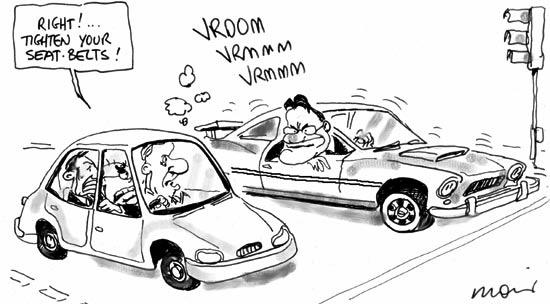
Moir
Shouldn't the Government boys have a bigger and grander car?
A Mercedes?
Or is that what the elites drive? And the Government boys only drive a battler's car because they are fighting the elites?
The Government boys do look old and boring though. Guess that's the generational thing.
Though the cartoon captures the way the corporate media enframes politics as a two horse race, it is overly optimistic about the ALP, given the proposed tax cuts by the Coalition and its strength on national security.
The political philosopher over at philosophy.com sees the political differently: as an existential conflict between friends and enemies.
Update
The commentary on the issue is floating the view that the Howard Government is fearful. If not fearful, then running scared.
Posted by Gary Sauer-Thompson at 4:03 PM | Comments (0) | TrackBack
December 5, 2003
Iraq: democratic elections
I came across this Lehrer transcript, about the struggle over democracy in Iraq.(Link courtesy of Abu Aardvark.) The transcript offers more detail to this earlier post on the intervention of the Grand Ayatollah Ali Sistani and his emphasis on the importance of democratic elections in the creation of a sovereign Iraqi government as it gives central political power, decentralized/regional political power based on ethnicity and a way to structure the relationship between centre and region.
John Quiggin has recently considered this issue. He favours a two-state solution, in which a Shiite majority ruled Iraq as a whole, while the Kurds maintained the effective autonomy they have now. I think that federalism is preferable.
Abu Aardvark and Juan Cole say that Sistani endorses a democratic political system (ie., sovereignty derives from the people and one person one vote) with limits; a limit to democracy is that the people must not legislate or adopt policy that directly contradicts Islamic law. An Iraqi democracy would be stuck with the "constitutional" principles of shari`ah or Islamic law.
Update
The discussion has ben picked and taken further by Andy over at Baghdad Skies. Go read.
Posted by Gary Sauer-Thompson at 8:40 AM | Comments (0) | TrackBack
December 4, 2003
Free trade: Two Comments
In todays Australian Financial Review John Quiggin has an article on the proposed Free Trade Agreement with the USA. (subscription required, 4 12 03, p. 62). He says:
'As far as the US side of the negotiation is concerned, the proposed free-trade agreement has little to do with free trade. From parallel importing to copyright to pharmaceuticals, the key demands are all about increasing monopoly profits and strengthening monopoly protection for "intellectual property." On the other hand, there will be no change in the basic structure of US agriculture subsidies, centred on the Farm Bill. The most we can hope for is concessional access to those markets that are protected by quotas as well as subsidies. Even here we may be in for a long wait.'
These are also the sentiments of public opinion.
The other comment refers to cultural nationalism and the opposition to the proposed Free Trade Agreement by the film and television industry. According to an editorial in the Australian Financial Review (subscription required, 24 11 03, p. 62) seems to have missed the target. Their remarks are directed to a defence of the existing local-content rules for free-to-air and pay TV. These do not seem to be a point of issue. They will remain in place.
What is at issue is the local content rules for the delivery platforms of the further----digital content on demand over broadband networks. What will these platforms look like? I have no idea. But it does mean that, in a global world, Australian cultural producers will need to improve the quality of their product. The sagging music industry is a case in point.
What does seem likely to happen is that the easier access to the personal details of internet service providers (ISP) and carrier customers by copyright owners (eg., the American music industry).This will one of the first chips that Australia tosses onto the table in Washington as a sweetener for an agricultural deals. (No court order needed?)
Australia is going to have to provide lots of sweetners.
I do not see any reason why Australia would be treated differently to Singapore or Chile on this issue. They adopted legislation similar to the US's Digital Millenium Copyright Act under their respective trade negotiations with the US.
Posted by Gary Sauer-Thompson at 12:58 PM | Comments (0) | TrackBack
Watching the Senate
I'm now watching the Senate debate on Nelson's Higher Education Bill. I'm taken back by what I see. Shocked even, at the minimal kind of legislative review taking place. The background is one in which the core public funding of universities has been decreasing with the costs of education increasingly being shifted onto the students.
The Government's legislation and policies are currently being defended by the Independent Senator's; defended by (Senator Harris) and not by the Government Senator---Senator Vanstone---who is currently doing point duty.
How come? Why has the task fallen to them? Why have the Independents allowed themselves to be boxed into the corner where they will take the flak for this legislation? Why are they allowing the Government to get away with rejecting the ALP or Democrat amendments without providing any public reasons for doing so?
Democrat amendments distinquishing between universities and other commerical educational providers and then linking different regulations and funding to these different providers are automatically knocked out. They are not even considered. It's a charade that is being played out as the amendments of the ALP, Greens and Democrats will be rejected no matter how worthy they are in defending the autonomy of the liberal university (teaching, research and community responsibility) This is not about passing legislation for the good of the country or on the merit of the argument in the Senate. It is just about passing the government legislation whilst saying they are acting on the advice of the Vice-Chancellors. The Vice-Chancellor have made a shoddy deal.
To the Senate debate. The defences being made about the definitions of the basic object of the Act--what is a university---are poor. The traditional liberal principles that embody the ethos of university institutions (free thinking, quality, excellence, research, enlightened inquiry) are being ignored in favour of money and fee paying. The failure to say in the Act what public universities do, and what their obligations are as independent and autonomous institutions, means that the institutions of higher education have become money making institutions.
Now we shift to the ALP amendments that spell out what the financial viability of a university is. These are rejected without debate. No defence is made for the reasons why the Independent Senators or the Government reject the amendments that are being made by the Australian Greens, ALP and Australian Democrats. There is no public reason here at all. It is just machinery.
What do we glean from this. A backroom deal? It appears that it is vote for all government amendments and reject all the opposition ones. Since the Government is not even bothering to argue its case there is no reasoned argument. The deal has nothing to do with improving the legislation. Nothing by way of argument is being placed on the public record. It is just political machinery without even bothering to keep up the charade of debate and review.
Two of the Independent Senators Murphy and Harradine are testy. They gesture to the written advice they have from the Government about particular amendments, and they criticise the refusal of the government to provide reasons for rejecting the Opposition amendments.
However, Senator Vanstone can only huff and puff. She has little knowledge of the legislation and cannot, or will not, provide a defence.
What is even worse is that the Government does not seem to care that it is just the political machinery of a deal on show. It is actually indifferent to the process of public reason in our political institutions.
Update
7pm. I'm due to go out to dinner at a local Indian restaurant. The Industrial Relations amendments have been put on one side to allow for a deal to be struck between Nelson and Murphy. It's more of the same: all government amendments pass; all the ALP, Green and Democrat amendments fail. It's depressing.
11pm. After dinner. The "debate" is still going. Carr, Nettle and Stott Despoja are plugging away. The deal between Nelson and Murphy has been struck. The bill will be passed tonight.
I'm stunned. I thought that the 4 Independent Senators would have postponed the legislation until next year? Why the rush? The universities had enough money for next year. Postponement would have allowed let cooler heads to prevail.
Posted by Gary Sauer-Thompson at 11:42 AM | Comments (4) | TrackBack
Senate deal making
The news reports this morning say that Nelson's big shake-up of higher education will pass into legislation today. The Federal Government has pretty much got what it wanted, even though it had to make some concessions to get the legislation through. We have a bit of pruning here and there with the heart of the deregulatory reforms remaining in place.
The roadblock is Senator Shane Murphy. He is the only one standing firm in his opposition. He opposes the Howard Government's demands that universities offer staff individual Australian Workplace Agreements (AWA). The link between the $404 million as the promised new funding and the AWA agreement have to be broken.
Lets hope Senator Murphy does stand firm. There is little in this package for those public universities who cannot raise the price of their courses to increase their cash flow because their customer base cannot afford the cost. These universities need the indexation of commonwealth funding to enable them to grow in the marketplace.
That capacity has been not been secured in the deal making. There is to be a review of funding indexation in the future (2007) but the government is only committed to implementing its response to the review; it is not locked into accepting any recommendation arising from the review.
It is definitely a two tiered university system that has been created; and one increasingly ruled by the dynamics of the market. In such a market the public universities will suffer and the private ones will prosper. On this issue the Howard Government has got its way. Further reforms will continue the deregulation, provide more incentives to commercialized education, and starve public universities. Effective growth in education will come from the private funding of courses.
Posted by Gary Sauer-Thompson at 7:42 AM | Comments (0) | TrackBack
December 3, 2003
Deals on higher education
The Higher Education Support Bill 2003---the Nelson Reforms --- is now before the Senate. At the moment the legislation or the higher education reform package---Our Universities: Backing Australia’s Future--- is currently being debated within the committee stage. It is quite different from the earlier bill due to the negotiations between Brendon Nelson and the 4 Independent Senators.
Nelson has made concessions in an attempt to win Senate support before Xmas. He needed to because this bill is not that much of an improvement on the 1999 Kemp reforms, apart from additional funds for teaching and programs in education and nursing and a regional loading.
In the early debate the ALP (Senator Carr,) Australian Democrats (Senator Stott Despoja) and the Australian Greens (Senator Nettle) were concerned to defend public university education and to condemn the sweatheart deals. Though deal making was acknowledged as a legitimate activity the deal was seen as a bad deal, even though the Vice-Chancellors are signed off on the Nelson reforms.
The early amendments of the Bill that were debated deal the nature of the university-(there are provisions for the public funding for small private educational providers) and university autonomy (there are limitations on the academic freedom to teach any subject matter). These amendments passed, 35 to 33.
My immediate reaction was that the liberal university that was recognized as providing a criticism of society has gone. It has been replaced by educational providers who need not be universities. So we now have educational businesses providing vocational education on the cheap. What was once education is now a creditionalling for the marketplace. The aim of profit overrides the aim of education, whilst commercial success replaces academic integrity.
Will the 4 Independent Senators stand firm for those of our public universities (the gumtree ones) that cannot raise course fees and will continue to rely on public funding for their income? Will they support indexation of the Commonwealth funding of universities?
Or will they allow a two tiered university system to develop with the public tier being starved of funds?
Judging from this press release the answer is no: the Independents are not planning to hang tough and support the indexation of the Commonwealth funding of universities. It does not appear to be an issue of contention.
These reforms will favour the status seeking sandstones and wil allow them to go from market strength to market strength. University prestige is now up for sale. This is a world where the profit-seeking university invests and moves beyond tacitly endorses commercial firms and conduct to creating firms that sell intellectual property.
I caught a little bit of the debate just before the Senate closed at 6pm. Senator Harris was talking. It was a most unsual speech. I don't remember the content on the specific amendment. I recall its style: it was as if it had been written by someone in the Minister's office! Surely not?
It all looks as if a deal had been done. Sign sealed and delivered. The legislation will be passed tomorrow. Are there any hicupps? Stumbling blocks? Obstacles?
Posted by Gary Sauer-Thompson at 10:42 AM | Comments (2) | TrackBack
Free Trade
A break from the current obsessions of national politics to something more far reaching. There is an article in the Sydney Morning Herald by Jonathan Edwards, a financial economist for the ANZ bank. He is saying somethign important:
"Australia is today negotiating a free trade pact with the United States, which could well be useful. But a trade pact with the US is no kind of substitute for trade pacts with Asia. Australia exports more than five times as much to Asia as to the US, and while exports to Asia have been rising exports to the US have been falling....A region-wide trade agreement would certainly be in Australia's interests, because the more widespread and comprehensive the agreement the greater the probability that Australia could talk its way into it, and the bigger the gain to our trade. But it is not yet part of Australian policy to encourage the creation of such a wide and comprehensive pact in the Asia-Pacific region. It should be."
Makes you wonder doesn't it? What are our political masters up to? Do they think that the US is the future? That the US will always be the engine room of capitalism? Just how useful will that free trade pact be for Australia?
Edwards then points out something that is pretty crucial:
"Australia has already been excluded from the ASEAN+3 discussions, it has already been refused trade pact negotiations with ASEAN and with Japan, and the schedule with China means that the game will be well into the second half by the time Australia turns up to play. More importantly, the Howard Government has no grand plan to take advantage of the trade forces now reshaping East Asia, no vision of what outcome it would wish to encourage and no willingness to deploy the means to achieve it."
Trade policy in Canberra is all about cutting deals with the US that is going ever more protectionist. Just what are the politicians up to?
Posted by Gary Sauer-Thompson at 7:25 AM | Comments (0) | TrackBack
December 2, 2003
And then there was one
I've have been caught up with things to do with the society of the spectacle for most of the morning.
So I've just just caught the news that has got Canberra excited and in a twizz.

Who won the ballot for the ALP leadership? That was the big drama. Well, it's Mark Latham as Leader of the ALP by one vote. That's the news. The wires are now running hot. The copy is being written fast and furious.
Yawn.
Bomber Beazley never got the numbers and his game is now over. Maybe he'll become the new Foreign/Defence Minister. It's now Mark Latham for PM. The pollsters will get their electoral number machines out to help answer the big question: Will the Tory working class return to the ALP?
Expect more of this though. The new boy is a neo-liberal at heart. For all his street smarts and tough talk he just loves the theorems of neo-classical economics. Just like Paul Keating. Under Latham the primacy of the market has again been embraced.
The Latham imagery is about working people climbing the ladder of success rather than trickle down. His own roots are in impoverished suburbs with decript public housing and dustbowl back gardens and people wanting a better life for themselves. He speaks about the outsiders and the forgotten ones in the suburbs and talks the language of self-enabling strategies that is understood by most suburban Australians. It is not the old language of public welfare, public housing and charity. Latham says:
"I believe in an upwardly mobile society where people can climb the rungs of opportunity to a better life for themselves and their family. I believe in hard work and reward for effort. I believe in a Government that is there to help the people who are doing the right thing - the people who are getting stuck in, doing things the fair dinkum Australian way."
It's aspirational voterland suburban talk. That's the future says Mark. We can get there by taking The Third Way. The Howard Government knocks out the rungs in the ladder, and so places obstacles in the path of those aspiring to a better life. Hence the Coalition is against the fair go.
We are going to hear a lot about the aspirations of those living in the mortagage belt seats of the western Sydney suburbs.
It is with joy in my heart that I can report that Boilermaker Bill over at Crikey.com.au got it all wrong:
"And Latham? Sorry Mark, but recognising you need to tone down the angry pose three days before you want to win a leadership ballot is just leaving it a little too late. No-one believes that your so called voter friendly vernacular has charmed anyone outside an Outlaw Motorcycle Gang. You should have learnt from your mentor, Gough Whitlam. He could come across like he was born with a silver spoon in his mouth, and a bookshelf up his backside: but he still won over the punters. Forget Civilising Global Capital - start with Civilising Mark Latham...
....Latham's trouble is that he has played the outsider for so long he's forgotten how to be a team player. Remember back to his semi self imposed exile after the 1998 Election when he claimed that Beazley's office had gutted his election policy. That's the problem in a nutshell: Latham thought it was his policy not Labor's policy. And every idea, every policy since then smacks of being Latham's policy not Labor's policy: nest eggs, tax cuts for the high earners, you name it - it's Latham's not Labor's."
Boilermaker Bill is out of touch with his own party. He's got lots of bile. And he's obssessed with putting the acid on Bob Brown and the Australian Greens.
It is time to return to the habits of everyday life----to take the dogs for a walk in the Adelaide Parklands and then make dinner. The media flows into our homes will be full of commentary about the boy from the suburbs made good but I will try and write a post on Bataille and eroticism.
Posted by Gary Sauer-Thompson at 4:05 PM | Comments (2) | TrackBack
December 1, 2003
And then there were two

From my perspective no matter who wins the power struggle for the leadership of the ALP, Australian political culture will continue its drift to the right. As Graham Young over at Ambit Gambit says the problem with the ALP has been the product, not the salesman.
The ALP is a party deeply divided, full of distrust and riven with resentment. It has been an ineffective opposition defending the common wealth, the common good and public spaces. Graham over at Ambit Gambit says that "if Latham were to win there is a percentage of the party who would not accept that win and who would set out to destabilize him."
Two decades of macro-economic reform (privatisation, corporatisation, deregulation and globalisation) has seen Australia become a less egalitarian society.
But little is said about that by the ALP. It remains obssessed by pulling the levers of the economic machine to achieve greater efficiency, increased productivity, competitive markets and high rates of economic growth. Economic rationalism rules supreme in the ALP, which is deeply penetrated by a populist, cultural conservatism. The ALP is not a disciplined opposition trying to shift the policy agenda of national political life. There is little sign of the hard work Influencing policy from opposition requires a lot of hard work being done to a develop a viable strategy and long term policy.
I find it all depressing. Tweddledum and Tweddledee recycled yet again are the choices facing a troubled and disenchanted electorate.
And it's not even good political theatre. The only bright spot is that the power of the factions appears to be crumbling.
Maybe the ALP will rediscover democracy as opposed to being a brand name for competing factional interests with the lowest common denominator policies?
Maybe. I doubt it.
The best result may be for the ALP to be trounced by Howard again. Then it may get serious about internal reform, substantive policy and being an effective opposition.
Posted by Gary Sauer-Thompson at 4:34 PM | Comments (0) | TrackBack