« June 2011 | Main | August 2011 »
July 31, 2011
Rann Government: goodby Mike?
The Labor Government in South Australia is trying to renew itself whilst in office. It has internal problems and its standing in the electorate has sunk to an all time low. It is addressing this through removing Kevin Foley, the Treasurer, and Mike Rann, the Premier. The plan is to remove the dead weight, rebuild the Government and the Cabinet, and present a fresh image to the voters.
 Gary Sauer-Thompson, graffiti, Port Adelaide, South Australia, 2011
Foley is now the ex-Treasurer, but he is still hanging around in cabinet, whilst Rann, by all accounts, has been told that his time is up. Labor's right faction has informed Rann that he either stands down or is removed.
Though Rann has had 17 years as state Labor leader and 9 as premier, and it's only a question of time before he realizes his time is up, he doesn't plan to go quietly. Even so, he is a dead man walking as the ALP realizes that generational change is necessary.
However, the SA Labor government needs to do more than present a fresh image to the voters for the next state election that is due in March 2014. The current Education Minister Jay Weatherill is to be the ALP's next state leader and SA's new premier. That kind of renewal strategy didn't save the NSW Labor Government. Voters there wanted a change of government not leaders. Is this the case in South Australia?
The SA Labor Government is a a tired, jaded government run by a right wing faction with little talent or policy ideas. There is an infrastructure build happening and the talking up both the defence precinct and a future mining boom that never seems to arrive. They are waiting for BHP-Billiton to give the go-ahead for the Olympic Dam mine expansion. Despite the state's transition from manufacturing to mining the government appears to be directionless.
Secondly, state politics in SA has little philosophical or ideological substance. Labor basically offer: They are the best to manage the state and deliver reasonable services. It's politics as administration coupled with lots of media spin.The politics is buried in the way that the rightwing faction controls the government.
Posted by Gary Sauer-Thompson at 3:48 PM | Comments (10) | TrackBack
July 30, 2011
liberalism v community
David Runciman in a review in the London Review of Books of The Labour Tradition and the Politics of Paradox: The Oxford London Seminars 2010-11 (ed. Maurice Glasman et el) introduces the idea of Blue Labour, its antagonism to liberalism, and rescuing democracy from liberalism.
 Martin Rowson
For Glasman one of the problems with liberalism (understood in terms of intellectual heritage and political instincts) is:
the inability of liberal politics to resist the depredations of international finance capitalism. This is the real passion that motivates Blue Labour: a sense that the country has been raped by the bankers, and all on the watch of a Labour government. They want someone, or something, to stand up to what the editors call in their introduction ‘the destructive, itinerant power of capital’, and they are acutely conscious that New Labour barely even put up a fight. That’s because liberals never put up a fight: all they do is talk about individuals, with their rights and responsibilities, their choices and their freedoms, without noticing that individuals are like confetti in the face of the whirlwind power of money.
An example is the way that the Blair government was beholden to the City of London--finance capital. Obama rescuing Wall Street is another example.
The other problem for liberalism from Blue Labour's perspective is that liberals prefer concepts to concrete experiences. In the end, they prefer nice ideas----like justice, equality and fairness--- to real people and life as it is lived. Glasman thinks in terms of ordinary people, their disempowerment by the powerful forces of the global economy, local struggles and community organisation and reinvigorating democracy. The emphasis is on mutualism, organising from the bottom up and local communities participating directly in their own welfare provision---strong and united local communities looking after themselves.
The Labor Party in Australia, with its espousal of the neo-liberal policies and emphasis on ‘aspiration’ and consumer individualism, has too often neglected precious aspects of our identity and our relationships with one another, riding roughshod over popular attachment to the institutions, places and traditions that we hold dear. In the process, Labour has allowed the conservative side of politics to own too many symbols of national identity and belonging.
If some issues really can be effectively tackled at local level--heritage issues in a capital city, then some challenges are systemic and national--the challenge of bringing about a fairer distribution of resources and in dealing with the pressing environmental issues, and require coordinated national and international action.
Democracy can stand up to capitalism. It succeeded pretty well between the Great Depression of the 1930s and the oil crisis of the 1970s, but it requires politicians to harness the power of the democratic state to broadly redistributive ends, which command the general assent of the people they represent.
Will the social democratic parties of today be able to do this?
Posted by Gary Sauer-Thompson at 4:01 PM | Comments (7) | TrackBack
July 28, 2011
America today
Columbia University's Jeffrey Sachs has an excellent assessment of the role both political parties are playing in America's decline, along with their competition as to who can be more subservient to Wall Street.
 Martin Rowson
It is the background to the current political theatre in Washington over the politics of raising the debt ceiling; a background of economic decline that is not being addressed by the conflicts within the Republican Party and between the House Republicans and the Senate Democrats
Sachs says:
The truth is that we need more federal spending to create good jobs and remain globally competitive, not as some kind of short-term "stimulus" but as a long-term investment in education, job skills, science, technology, energy security, and modern infrastructure. I travel around the world as part of my job, and I can say without doubt that America has failed to modernize the economy and is steadily losing its international competitiveness. No wonder the good jobs are disappearing and the pay is stagnant.
In No end in sight for America's debt heatwave Michael Brissenden, travelling on a train, decribes the appearances of an economy with unemployment still hovering above 9 per cent, house prices in a never-ending slump and foreclosures still rolling up many streets at record speed.
The urban wasteland of the depressed neighbourhoods of Baltimore scroll by. Block after block of crumbling neglect. This is the real Wire. Black neighbourhoods hollowed out by drugs and crime where the unemployment rate is above 50 per cent.... Beyond Baltimore we flash through pretty clapboard towns with their houses all standing in neat manicured rows - American flags flying from the stoops..There are trailer parks and rusting car wreckers yards interspersed between pockets of lush green farmland; gas stations with petrol advertised for $US3.63 a gallon; a second-hand car yard that calls itself Mirage Auto Sales flashes by. The auto repair shops and tire yards are often the only signs of life in the old industrial suburbs of the bigger towns that like to remind us they were once important industrial centres in their own right. A sign on the bridge as we enter Trenton says 'Trenton makes - the world takes'. The old warehouses and factories are smashed up and empty.
This is a picture of a country in economic decline. A country with 9% unemployment, essentially no job growth, widening inequality, falling real wages, and an economy that’s almost dead in the water that is locked in a political battle over how to cut the budget deficit.
Sachs says that Obama's campaign promise to "change Washington" looks like pure bait and switch. There has been no change, but rather more of the same: the Wall-Street-owned Democratic Party as we have come to know it. The idea that the Republicans are for the billionaires and the Democrats are for the common man is quaint but outdated. It's more accurate to say that the Republicans are for Big Oil while the Democrats are for Big Banks.
He adds that:
at every crucial opportunity, Obama has failed to stand up for the poor and middle class. He refused to tax the banks and hedge funds properly on their outlandish profits; he refused to limit in a serious way the bankers' mega-bonuses even when the bonuses were financed by taxpayer bailouts; and he even refused to stand up against extending the Bush tax cuts for the rich last December, though 60 percent of the electorate repeatedly and consistently demanded that the Bush tax cuts at the top should be ended. It's not hard to understand why. Obama and Democratic Party politicians rely on Wall Street and the super-rich for campaign contributions the same way that the Republicans rely on oil and coal. In America today, only the rich have political power.
Obama is on the verge of abandoning the poor and middle class, by agreeing with the plutocrats in Congress to cut spending on Medicaid, Medicare, Social Security, and discretionary civilian spending, while protecting the military and the low tax rates on the rich.
It was only yesterday that one of the pillars of the global economy was that Americans were the consumers of the last resort and the dollar was the safe haven for the planet’s hoarded surplus value. Now the US is facing a future of a bloodbath in the public sector; an abrupt shutoff of unemployment benefits which will negatively multiply through the demand side of the economy; and joblessness reaching double digit figures. It is a future of a great increase in poverty and hardship for the American people.
The politics and theatre is all about re-election for Obama and a Republican takeover of the Senate.They both emphasize budget cuts over growth and investment. As things stand now the US administration
Posted by Gary Sauer-Thompson at 10:26 AM | Comments (10) | TrackBack
July 27, 2011
big whingeing retailers
Australian retailers are a tiresome lot. Sales are down in a two speed economy because consumers are not spending, even though national income is rising from the mining boom in iron ore, coal and gold. Savings are going up and consumer spending is subdued.
The retailers are blaming the high Australian dollar, the GST-free zone for Australians buying goods worth less than $1,000 on international websites; the carbon tax (its not even been introduced) and Julia Gillard herself. It's basically all the governments fault. Bash the Labor government and woe is me is the new corporate game. They're big whingers.
What the Australian retailers refuse to do is to look at themselves. They both missed the online retail opportunity, refused to re-invent the way they do business, and the tried to block it so they could continue with their bricks and mortar business of price gouging the Australian consumers with their huge markups. Australians shopping on overseas websites can be traced to the refusal of importers, distributors and retailers to pass reduced costs on.
The whingeing retailers turned their back on the Internet 10 years ago We are now starting to see the consequences of the internet becoming a shopping mall: the steady demise of the bricks and mortar retail chains with high priced goods (Borders, Angus and Roberston, the rag trade, eg. the Colorado chain). The big retailers--eg., Harvey Norman--- will eventually be forced online kicking and screaming.
Posted by Gary Sauer-Thompson at 1:01 PM | Comments (3) | TrackBack
July 26, 2011
Anders Behring Brevik's cultural conservatism
Peter Hartcher has a rather strange article in the Sydney Morning Herald about the complex relationship between ideology, Anders Behring Breivik's massacre of Norwegian citizens, Muslims, Islamophobia, extreme xenophobia and religious prejudice.
It is strange, not wing nut weird extreme of say a Jennifer Rubin in Murdoch's Washington Post or the multitude of “terror experts” and “homeland security” pundits who were so quick to blame Islamic terrorists with links to Al Qaeda.
 Steve Bell
Entitled Norwegian massacre is wrong, not far right Hartcher's argument about this form of right wing terrorism is that:
Much media reaction to the tragedy has conflated the incident with the rise of far-right parties in Europe. The coverage implies that Breivik's attack is an extension of the trend and a frightening portent.This is exactly wrong. His use of violence to pursue a "crusade" to halt the "Islamicisation [sic] of Europe" has discredited his cause, not advanced it. This is the worst thing that has happened to the far right in western Europe in years.
Hartcher's argument appears to be that Breivik is a mad butcher. Ideology --ie. ultra white conservatism --- has little to do with his actions, even though Breivik is, judging from his writings, politically, more or less a Scandinavian Tea Partyer, obsessed with the imagined threat of the Islamification of Europe; and an avowed opponent of both multiculturalism and Marxism (ie., leftism) which controls the universities and the media. Breivik styles himself in his writings as a Christian conservative, patriot and nationalist.
The European cultural conservatism is familiar to us in Australia. One strand is the antagonism to Marxism. Another is a resentment of the liberal defenders of diversity. These liberal "elites" are often described as "traitors", "sellouts" or just "naive multiculturalists". Another strand is the conviction that Islam is incompatible with the democratic values of the west. Cultural pluralism is seen as a threat to national cohesion.
 Martin Rowson
These are views of the anti-Islam conservatives gathered around Quadrant in Australia, resolute in their defence of Australian culture. Muslims are not biologically inferior (as the old racist discourse holds); they are culturally incompatible. They then argue that Leftists will happily allow Muslim to flood Australia under the guise of multiculturalism. Their clash of civilization view is one in which there is a struggle between political Islam and Western culture.
Update
Jennifer Rubin at The Washington Post is forced by facts to backtrack from her Islamic terrorist claim and acknowledge that it was a blond Norwegian.Then this:
that the suspect here is a blond Norwegian does not support the proposition that we can rest easy with regard to the panoply of threats we face or that homeland security, intelligence and traditional military can be pruned back. To the contrary, the world remains very dangerous because very bad people will do horrendous things. There are many more jihadists than blond Norwegians out to kill Americans, and we should keep our eye on the systemic and far more potent threats that stem from an ideological war with the West.
Rubin makes no mention of the conservative ethno-nationalist ideological war with the liberal, multicultural West. What we are offered is: "There are lone-wolf domestic terrorists, and there are organized jihadists."
Brevik's manifesto. The Brevik video manifesto. These call for a Christian war to defend Europe against Islam.
Posted by Gary Sauer-Thompson at 9:16 AM | Comments (18) | TrackBack
July 25, 2011
deficit hawks
According to the US Treasury America has to raise its $14.3tn debt ceiling by 2 August or risk defaulting for the first time. However, there is conflict between the Obama White House and the Republican House of Representatives over a 10-year-plan for reducing the country's burgeoning debt by cutting spending and raising taxes. If agreement is not reached it could trigger a US default on its debt payments. The US is a debtor nation like Greece, Portugal and Spain.
However the debt limit crisis in Washington does seem to be more about a political conflict with lots of theatrics posturing and playacting that plays into the American's love of Apocalypse. The end is nigh. The lights will go out. However, the US government will not default on its bonds, because the bonds, unlike those of Greece, Spain, and Ireland, are payable in its own currency and the Federal Reserve will continue to purchase the Treasury’s debt.
The debt ceiling has been raised many times since the mid-1970s in order to facilitate the drastic increases in military spending, the major tax breaks for the wealthy and, most importantly, the multi-trillion dollar bailouts of the Wall Street gamblers. So we have the ritual enactment of the fight over the budget--not the trade-- deficit. The debt ceiling is a purely artificial constraint.
The deficit hawks want to gut the welfare state (eg., social security, Medicare and Medicaid. Medicare) in order to get the hawks to agree to raise the debt limit. The global financial collapse, which brought on the worst recession since the Great Depression, crashed the government's tax revenue and generated a huge budget deficit. Given the loss of jobs, and stagnant incomes (at best) for most Americans, households are not going to spend, as they are heavily indebted.
This situation has provided the opportunity to to undermine the Rooseveltian New Deal on the grounds that “entitlements” (Roosevelt’s New Deal) will bankrupt the nation 25 to 50 years down the road. The deficit hawks want deficit reduction of non-military expenditure more-or-less immediately. Many of them hold the position that deficits are always bad because they always cause inflation and slow economic growth. The deficit hawk position is that with official unemployment above 9%, government spending should be reduced. It is the politics of fear mongering.
The deficit warriors insist that cutting government will induce faster growth of the private sector rather than reducing the budget deficit through faster economic growth. The Republicans would like to erode and ultimately privatize Social Security and Medicare. So would Wall Street. The Tea Party elements of the Republican Party are adamantly opposed any change in taxation--Obama wants to increase corporate taxation.
The Republicans have gone from emphasizing balanced budgets — or at least lower deficits — to what tax-cutting conservatives have called ‘starve the beast,’ ’that is, cut taxes and force government to shrink. Their ultimate goal, in the words of their guru Grover Norquist, is to take government down to “the size where we can drown it in the bathtub.” The best way to revive the American economy is to shrink the size of government. They want to shrink what the left sociologist Pierre Bourdieu called the left hand of the state – the parts of the public sector that serve the social and democratic needs of the non-affluent majority--not the giant increases in military spending for the national security state.
Posted by Gary Sauer-Thompson at 9:14 AM | Comments (7) | TrackBack
July 24, 2011
News Ltd: a bully boy culture
The corporate culture of News Corp is aggressive in furthering its own commercial interests and intimidatory towards its critics. An example from News International in the UK. An example from News Ltd in Australia.
Business as usual for News Corp means media dominance and a pattern of naked threats, bullying and intimidation to competitors, politicians, critics and staff.
 Martin Rowson
This is a long way from the fiction that Murdoch's tabloids are essential watchdogs that act on behalf of the working class.
Posted by Gary Sauer-Thompson at 12:50 PM | Comments (2) | TrackBack
July 23, 2011
orthodox + complementary healthcare
There is a debate over orthodox and complimentary health care at The Conversation. It doesn't get us very far from the tedious black and white (either/or) style of debate so common in Australia, even though pockets in the medical community seems to be growing more open to alternative medicine’s possibilities, not less, despite the lack of clinical evidence supporting the claims of alternative medicine.
According to David Freedman in The Triumph of New-Age Medicine in The Atlantic the primary reason is because mainstream medicine itself is failing.The reason is that:
Modern medicine was formed around successes in fighting infectious disease.Infectious agents were the big sources of disease and mortality, up until the last century. We could find out what the agent was in a sick patient and attack the agent medically.” To a large degree, the medical infrastructure we have today was designed with infectious agents in mind. Physician training and practices, hospitals, the pharmaceutical industry, and health insurance all were built around the model of running tests on sick patients to determine which drug or surgical procedure would best deal with some discrete offending agent. The system works very well for that original purpose.
However, the success of modern medicine has bought to the fore the chronic, complex diseases—heart disease, cancer, diabetes, Alzheimer’s, and other illnesses without a clear causal agent. Now that we live longer, these typically late-developing diseases have become by far our biggest killers. Heart disease, prostate cancer, breast cancer, diabetes, obesity, and other chronic diseases now account for three-quarters of our health-care spending.
The drugs the medical profession thrown at these complex illnesses are by and large inadequate or worse, as has been thoroughly documented in the medical literature. The heavily prescribed drugs that have failed to do much to combat complex diseases, while presenting a real risk of horrific side effects. Many healthy people each year are converted into long-term patients.
The medical profession knows perfectly well what sort of patient-care model would work better against complex diseases than the infectious-disease-inspired approach we’ve inherited. That is one that doesn’t wait for diseases to take firm hold and then vainly try to manage them with drugs, but rather is a preventive approach that focuses on lowering the risk that these diseases will take hold in the first place. This preventative primary careincludes the promotion of a healthy diet, encouragement of more exercise, and measures to reduce stress which impairs the immune system, rather than drugs and surgical procedures.
Freedman says that the latter involves a healing approach that is rooted in closer practitioner-patient interactions--a more caring practitioner who takes more time and bonds better with patients---focused on getting a patient to adopt healthier attitudes and behaviors interactions. This is not possible with the corporate approach to medicine in which GP's are paid for providing treatments, not for spending time talking to patients. Hence the shift to integrative health care--the conjunction of complementary with mainstream medicine.
This undercuts the either orthodox or complementary medicine approach since the middle ground is one of plugging the gaping holes in modern medicine and doing what is best for the patient. Alternative or complementary medicine is a legitimate response to mainstream medicine’s real shortcomings.
Posted by Gary Sauer-Thompson at 8:25 PM | Comments (4) | TrackBack
July 22, 2011
restructuring public education
John Bellamy Foster in analyzing the crisis in public education in the context of the ongoing crisis of capitalism refers back to the insights of Samuel Bowles and Herbert Gintis in Schooling in Capitalist America.
Foster says that their broad political-economic approach to public education allows us to perceive the underlying logic governing the development of capitalist schooling in the United States and elsewhere. He says, in summarizing the above text, that Bowles and Gintis argued that:
the forms of consciousness and behavior fostered by capitalist schooling are designed to reproduce existing classes and groupings, and thus are meant to reinforce and legitimize the social relations of production of capitalist society as a whole. Working-class students and those destined for working-class occupations are taught rule-following behavior, while those arising from the upper middle class and/or destined for the professional-managerial stratum are taught to internalize the values of the society. (Those between these two groups are mainly trained to be reliable, in addition to following rules.)
He adds that very little of the schooling at the elementary and secondary levels is oriented to developing actual skills, much less knowledge:
Schools are, then, less about education than a kind of behavioral modification, preparing the vast majority of students for a life of routinization and standardization, in which most will end up employed in essentially unskilled, dead-end jobs. Indeed, most jobs in the degraded work environment of monopoly capitalist society—even those set aside for college graduates—require precious little formal education.
The highest quality elementary and secondary education in the United States, meanwhile, lies outside of the public schools altogether in a very small number of extremely elite private schools devoted to the education of the children of the very rich, whose goal is to generate a governing class.
Capital has concluded that the schools had not been doing a good enough job giving employers what they now needed. Australia can no longer afford the unproductive waste embodied in our current public schools. Under a neo-liberal mode of governance we have the undermining of public education system in order to open it up for privatization. This restructuring of public education by the corporate education movement involves attacks on teachers’ unions, school choice, promoting alternatives to public education and placing the sole responsibility for “closing the achievement gap” on the schools themselves.
The inference is that the achievement gap is the fault of “failing (ie., under performing) schools" whilst the new standardized testing systems are aimed first and foremost at teachers, as they constitute the main weapon in the attempt to wrest control of the practice of education from teachers. These testing systems involve the reduction of schooling to test preparation and the use of student test scores to judge teachers affect all public schools, their students, and teachers.
In Australia the Gillard Government's education revolution has seen the ALP abandon social democracy for neoliberalism: control schools through tests, extensively fund private schools, and and replace long-term, often unionized, teachers with a steady parade of short-timers, particularly in urban, low-income areas. What the education revolution agenda appears to mean means is a relative dumbing down of schooling for working people and the narrowing of the capacities of managerial strata .
Posted by Gary Sauer-Thompson at 6:13 PM | Comments (4) | TrackBack
July 21, 2011
health inequalities
In Australia overweight and obesity have become increasingly more prevalent among socially disadvantaged groups, particularly in urban areas. Like most other risk factors for ill-health, excess body weight tends to be more prevalent among people further down the social and economic scale.

Gary Sauer-Thompson, Mill St, Adelaide, 2011
Encouraging healthy eating habits is difficult given the extensive array of convenience and pre-packaged foods high in fat, sugar and salt (so called junk foods) which are increasingly available across the world, often promoted in large or multiple serving sizes.
This has made eating healthily a challenge—for individuals personally, and for policymakers indirectly; and the challenge has been compounded by a bombardment of marketing and advertising that surreptitiously and adversely influences people’s food preferences and consumption patterns.
In Overfed, overgrazed and difficult to overcome in the Sydney Morning Herald Elizabeth Farrelly refers to Sydney's diabetes map. This:
map reveals a clear doughnut pattern with dark, congealed patches around the west and exurban fringes (Mt Druitt, Wollongong, Toongabbie) and pale bits in the old centre (north shore, city, Coogee). It's the direct inverse of how a rickets or tuberculosis map would have looked a century ago.It's not just fat. Maps of obesity, heart disease, renal failure, smoking, TV-watching and hypertension - diabesity, if you'll excuse the coinage - would show similar patterns...What's interesting is that this stuff is class-related. Diabesity is a poverty indicator.
The data provokes the question not only why the poorest of the poor and the most vulnerable and marginalised groups have bad health but why is there a socially graded relation between social position and health?
The Marmot Review highlights that there is a social gradient in health – the lower a person’s social position, the worse his or her health. Health inequalities result from social inequalities. Consequently, reducing health inequalities is a matter of fairness and social justice. Health equity then becomes a marker of successful development.
So why the social gradient in health? Farrelly says that (relatively) poor Australians, despite decades of education campaigns, still see conspicuous consumption - of land, leisure, energy, alcohol, food - as a norm, not a mortal danger. It's overconsumption that is driving obesity and diabetes.
The problem with Farrelly's argument is that obesity and diabetes doesn't come from overconsumption per se (the middle class also over consume as Farrelly acknowledges); it comes from overconsumption of cheap junk food. What, and how much, people eat, drink and smoke and how they expend energy are responses to their socio-political, socio-economic, socio-environmental and socio- cultural environments.
From another perspective that a significant proportion of the Australia population now eats large volumes of energy-dense nutrient-poor foods--junk food --- does not expend enough energy, smokes and consumes harmful quantities of alcohol is a sign of success –the commercial success of the corporate food industry. It's a lucrative business. Hence the intensive advertising.
Posted by Gary Sauer-Thompson at 9:32 AM | Comments (13) | TrackBack
July 20, 2011
blocking a media inquiry
Events have moved swiftly for News Corp. In a little over two weeks, News Corp has closed News of the World and shelved its $US12 billion ($A11.3 billion) takeover bid for British Sky Broadcasting. The company has come under sustained criticism from both sides of British politics. In the US, it is under investigation by the FBI on speculative allegations that newspaper reporters have targeted victims of the September 11 attacks. New Corp's shares have fallen more than 16 per cent since the scandal broke this month.
The irony is that Murdoch's papers have always feasted on scandals like this, picking over the bones of their victims. Now the Murdoch’s are the ones whose bones are being picked. Murdoch deserves his humiliation given the way he has treated others, exploiting fear and engaged in a “flourishing criminal conspiracy”.

Murdoch remains the most powerful media baron in Australia--- he has 70 per cent of the newspaper readership, plus operational control of monopoly pay TV provider Foxtel. News Ltd uses its corporate muscle for political and commercial advantage and to pursue its political agendas (NBN, carbon, mining tax, Iraq War, regime change etc) aggressively. Economic power is political power.
The standard defence of News Ltd in Australia takes the form of opposing any media inquiry on the grounds that News Ltd is entitled to its media bias because of the freedom of the press. Any attempt to regulate bias represents a stifling of critical comment and extensive scrutiny.
The inference. A media inquiry is an elitist attack on democracy and populism because it is designed to stifle Murdoch's populist challenge to the smug group-think of the anti-democratic Left.
The problem with this defence is that it ignores the extent of media concentration in Australia, which is the real issue; not political bias against the New Class, even if it is offering political propaganda services, disguised thinly as journalism. There are liberal and conservative media outlets and the right to build a noxious empire like Newscorp is an indispensable consequence of freedom of speech. The price that is paid is Murdoch's power being used to shape and empower the culture of tabloid journalism--- venal, voyeuristic, reality-show-obsessed premised on untruths, mass deceptions and blurring the lines between news and entertainment. Murdoch's corporate culture is one of bullying, conformity, manipulation and toadyism.
However the freedom of the press defence is an evasion, because it separates content from structure. Something does need to be done about that 70% print media concentration in Australia. What is of deep concern is the very fusion of politicians, journalists and media owners that govern us - the political class. The collaboration between the executive (ministers) unelected advisors, civil servants and privately owned media at the centre of the state is what needs to be prised open. Too often the political class work together in pursuit of the creation of public consent to policies which benefit them but are against the public interest.
Murdoch's standard business practice is to run roughshod over cross-ownership rules meant to prevent one man or company from having too much power — and then used his lobbying might to get those rules diluted. The Labor and Liberal parties in Australia allowed it to happen--ie, Murdoch fixing deals with government, permitting him a market advantage. As Anthony Barnett says at Open Democracy:
This was the malevolent dishonesty at the heart of Murdochism. He was a close ally of state power who advocated hostility towards it. Worse, he was an ally of the most baleful and threatening aspects of state power, its police and security and the database state, while he attacked its best aspects, regulation, welfare, investment in and defence of the public interest.
Though Murdoch is still a traditional press baron in Australia (unlike the US) his long term strategy is to increase his television interests via Foxtel. He requires considerable influence over the political elite that ultimately takes the decision to grant or withhold licences and concessions in order to do this. The loss making Australian is sustained because it is read by everyone 'whose opinion matters'.--ie., the political class (the fusion of politicians, journalists and media owners).
The hostility to a media inquiry can be seen as the political class not wanting a deep seated inquiry into itself. They are going to defend the integration of media and politics. Their politics consists of an economic agenda based on ‘opening up’ media markets, growth, innovation and promoting ‘light-touch’ regulation. It assumes that deregulation is the sole, or even preferred, route to ensuring growth and innovation whilst avoiding the fusion between politicians and the media.
Posted by Gary Sauer-Thompson at 11:29 AM | Comments (9) | TrackBack
July 19, 2011
the hacks defend the Murdochs
Here we have an editorial in the Wall Street Journal in the US defending Murdoch re the phone hacking scandal in the UK, which News International tried to contain. This crisis, which raises fundamental questions about the culture of collusion between politicians, the police and the press and reveals a deep malaise in British life about those opposed to democracy, is dismissed by the WST editorial as the political mob wanting to regulate how journalists gather the news.
In Australia, News Ltd is also wheeling out a defence of the News of the World's behaviour with Brendan O'Neill's Elite few spearhead the anti-Murdoch campaign over phone-hacking scandal in todays Australian.
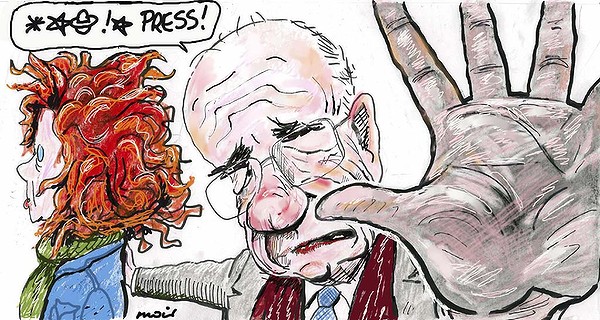
It's a pathetic defence as it doesn't address the issue of the unaccountability of the trashy hack journalism practiced by some of the Murdoch tabloid titles or some of their journalists breaking the law:
what we are witnessing in Britain is a media coup led by a tiny gaggle of illiberal liberals...These self-interested crusaders may pose as warriors against alleged criminality in the tabloid press, but their true target is the culture of the tabloid press, the age-old arts of muckraking and sabre-rattling, which they consider vulgar and offensive. Under the guise of ending illegal phone-hacking, they're really pursuing a culture war against what they view as the ugly, mass, populist media.
O'Neil, who is the editor of Spiked, says it's some celebs and politicians getting revenge on Murdoch and this intolerant cultural tide will result in the end of press freedom. There is no mention of the Murdoch's running something close to a protection racket in the UK.
ONeil's defence of Murdoch is a both a de facto defence of News Ltd having 70 per cent Australian newspaper market share and Murdoch's tabloids being above the law. Its a defence of the abuse of press freedom. It is corporate power posing as a defence of press freedom.
This is corporate power whose business as usual practices to make profits includes criminal acts by journalists and editors; interception of communications; payments to policemen; theft of medical data; hacking; illegal copying; maybe lying in court and parliament; theft and intimidation and threat.
Murdoch has too much power in Australia. Thomas Clarke says that Australia’s cross-media ownership regulation simply is not working to achieve the principles of media access, freedom and diversity that it is supposed to protect.
We need media reform in Australia, yet the best that Paul Keating could do on Lateline was call for tougher privacy laws and confirm the blindingly obvious that News Ltd was currently at war with the Gillard Government. Yet there is the News Corp managed Foxtel endeavouring to take over Austar for $2.7 billion thereby creating an Australian pay-TV monopoly---the ACCC is currently looking over the takeover.
What's more News Ltd ought to be broken up. Or the newspapers sold off. It is too dominant. The real battle that Murdoch must win is in the USA and News Corp may sell of the newspapers in the US and Australia to protect the centre of the Murdoch empire in the US.
Posted by Gary Sauer-Thompson at 2:54 PM | Comments (10) | TrackBack
July 18, 2011
EU: heading towards the rocks?
As is well known the EU dismissed the need for debt restructuring, preferring a bailout for Greece, Ireland and Portugal that piled new debt on top of an already unsustainable burden.
The bailouts were always primarily focused on protecting European banks from the effects of a default by borrowers such as Greece, Ireland and Portugal. The EU bailouts were a “get-out-of-jail” pass for poor lending decisions and they gave time to the weaker entities, be they countries or banks, to reduce their vulnerability.

There is no way that any of these nations would ever be able to service or repay current and projected levels of borrowing. Gross public debt in the most troubled economies will continue to increase as continued budget deficits will require financing and the service costs continue to increase.The countries have been losing the support of citizens who feel, rightly, that their sacrifices have done little to improve prospects for their country.
However, many Europeans are opposed to the eurozone becoming a “transfer union”.
Italy is now caught up in the politics of austerity, which means tax rises, higher health costs and lower pensions. This austerity package, like the others, is designed to keep the markets at bay. Will Italy be able to make both the sharp tightening and take measures to raise the productivity growth rate? Will Spain in the context of high interest rates?
It doesn't look likely. The regressive effects of the measures taken on the distribution of income and wealth; and the shrinking and weakening of the welfare state, while banks are bailed out at taxpayer expense advertises the clear rightwing agenda of the European authorities including the European Central Bank (ECB).
However, the risks to the banking sector arise from economic slowdown, rising unemployment and falling prices of commercial and residential property. It is the political right's determination to bail out private-sector banks, and to slash public spending to pay for it, that leaves the European Union navigating towards the rocks.
The debt burden for Greece, Ireland and Portugal looks unsustainable, rendering the countries insolvent. Maybe Italy as well. The pressure from the bond markets will build to ultimately restructure debt in some form at some stage. Default or restructuring of European debt, in all probability, will require State involvement in recapitalising these institutions. The political and economic attention will soon switch from bailouts of sovereign nations such as Greece to bailing out affected national banks.
It looks like crunch time is approaching for the EU--moving beyond debt relief to the creation of a Eurobond that will allow Greece, Portugal and Ireland to refinance their debt at low interest rates rather than at the high rates the market is charging (eg., over 17 percent for 10-year bonds for Greece).
Posted by Gary Sauer-Thompson at 12:19 PM | Comments (3) | TrackBack
July 17, 2011
Keating enters the carbon debate
Paul Keating on Lateline last week highlighted how a carbon pricing will enable the allocation of capital to the new growth industries that will emerge from the increased price on carbon. These represent Australia's future, whereas the coal fired power stations are part of the old industrial revolution.
Keating's argument is that it is prices and markets that shift the big things and that the new industries are the key new growth industries:
We won't have them here. I mean, the idea here that we turn our back on the new country, on the new transforming Australian economy, by not letting carbon be priced and therefore capital allocated properly is nonsense .... Manufacturing's moved to the east. It's the service industries are the new growth industries. So, to turn your back on the mechanism which allocates the capital out of the old industries and into the new ones is to turn your back on your future.
That is the big picture argument that keeps being forgotten and is rarely explored or evaluated in the media.
Keating also raises the issue of the media's poor performance in the analyzing this big reform with its "he said she said" style of reporting and adds that News Ltd is campaigning for regime change in Australia. Tony Jones avoids the issue of the media's poor performance in analyzing this reform to talk about Murdoch.
When is the media in Australia going to become self-critical about its obvious flaws? Apart from its "How much will you pay, and how much will you get back?" response to the carbon tax package a lot of of the media has more to do with mass deception of the public than with truth---isn't the media's motto the fearless advocacy of the truth?
It is true that the carbon package on its own will not bring big reductions in emissions in the short term, but it can be seen as the first step on the long road to a lower-carbon economy.This is a long term reform process.
Posted by Gary Sauer-Thompson at 1:33 PM | Comments (13) | TrackBack
July 16, 2011
News International: a trainwreck
Rupert Murdoch has been insisting that News International had made only "minor mistakes" in handling the phone hacking crisis, that the company has handled the crisis "extremely well in every possible way ", and that the MP's in the British Parliament were telling total lies with their allegations of corrupt practices at his newspapers in the UK.
Who believes Murdoch these days? He's endeavouring to contain the story. However, his senior executives are either resigning or are being ditched in order to save News Corp from the fallout. In the US the FBI has launched an investigation into accusations that News of the World journalists asked a former New York police officer for the phone records of relatives of 9/11 victims.

News International have handled the crisis, now swirling around the feet of News Corp, badly; and in not taking it seriously, their systematic lies have failed to limit the fallout from the corruption and criminal activity. This is an organisation that has now been found working with known criminals, bribing police, carrying out “industrial scale” criminal activity, and making payments to silence the victims. Contrition is now the order of the day in order to get a grip on a crisis.
As a consequence, the realities of a captured state and a crumbling democratic facade are being exposed. The situation is less a ‘regulatory capture’ and more a state capture. Murdoch wielded raw power and the political class of Britain bowed to it and then went down on its knees. They were then routinely humiliated by the bully boys and girls nurtured in the corporate culture of News International.
Will Murdoch be able to rebuild his power as the banks did after the global financial crisis?
In Australia the media and the carbon tax have become intertwined because the way the right wing media--News Ltd's newspapers and the radio shock jocks--- have been dishonest and engaged in fearmongering over the carbon tax. The spotlight needs to be placed on the media's role in the carbon tax debate and it needs to be made to be accountable for the mass deceptions it routinely practices.
The trainwreck of News International is an opportunity to reconsider the structure and regulation of the media in Australia since the degree of concentration of the print media in Australia by News Ltd is too high. It is necessary to design a structure of regulation of the media market that preserves freedom for the media, while curbing abuse, including the concentrations of unaccountable power.
News Ltd will continue to resist the push for greater accountability by thundering on about a free press being one of the pillars of the west; and that it is best to leave the question of ownership to the market and that of content to the rights of expression, subject only to the law on libel and on the intrusion into private life. The press must be free and the the role of the state should be very narrowly circumscribed.
News Ltd wants the freedom to use its power to intimidate, abuse and humiliate without any checks and balances on its power.
Posted by Gary Sauer-Thompson at 11:20 AM | Comments (19) | TrackBack
July 15, 2011
confession time at News Ltd
News Ltd frequently claims that its newspapers are an example of balance and objectivity and, they are quick to add, sound ethical journalism.
News Ltd's newspapers are well known for them providing a platform for the denial of climate change, opposition to a carbon tax, hostility to making the polluters pay for the greenhouse emissions that heat up the planet, and their antagonism to using renewal energy. They are also partly responsible for the low standard of public debate on the need for Australia to shift to a low carbon economy. News Ltd basically want the taxpayer to pay the polluters big money to keep on polluting.
 Gary Sauer-Thompson, solar panels, Victor Harbor, 2011
So it is a bit of surprise that Dennis Shanahan, their top political reporter who fronts News Ltd's war on The Greens confesses to having installed solar panels on his roof. Its confession time at News Ltd. How then does Shanahan embracing what The Australian rails against?
Well it has nothing to do with clean energy. Shanahan is anxious to inform us of this. He says:
For myself, the outlay, while sizeable, was more modest than many and was directed towards ameliorating my electricity bills in the years ahead when I become a self-funded retiree. Well, the truth of it is I wasn't acting to save the planet and it was arguably against the interests of my grandchildren, who have to have heating during Canberra's chill winters.
To make sure that you get the point Shanahan criticizes the mandatory renewable energy targets (MRET) for market distortion whilst he is taking advantage of the subsidies that enable him to install the photovoltaic solar panels on his roof and the gross (not net) feed-in-tariff offered by the Labor-Green government in the ACT. He adds that South Australia's achievement of a target of 20 per cent renewable energy raises questions about the extent of the sustainable contribution of renewable sources and where those sources can be concentrated in the national grid.
The valid reason for this [the MRET should be scrapped when an ETS comes into force] was that artificial or mandatory targets for renewable energy distort the carbon market and the ability of the national energy supply market to deliver an orderly and cost-effective system for power...What's more, I can afford PV cells to offset my electricity bills but, through the years, the little old lady across the street, the university students renting flats around the corner and my grandchildren's parents, none of whom could afford the cells, will be paying higher prices to offset my offset. That's why I feel grubby doing something legitimate, legal, encouraged, green-friendly and financially helpful for me. It distorts the market and is inequitable.
Shanahan, of course, makes no mention of the variety of government of the R&D and deployment subsidy programs that are to be consolidated under a new agency – the Australian Renewable Energy Agency (ARENA), the Renewable Energy Target (RET) and Small Scale Renewable Energy Scheme. Or that a carbon tax set at $23 is insufficient to drive investment in renewable energy.
He doesn't seem to realize that the state government subsidies have enables pensioners to install small scale solar photovoltaics on their roofs to cut their electricity bills in half ( eg., its very extensive in Victor Habor); or that rising electricity prices are changing his behaviour in that he has decided to decreasing the electricity that he uses from the fossil fuel industry.
Shanahan's objectivity and balance, and his commitment to ethical journalism, is such that it allows him to omit that he is benefiting from the gross feed-in-tariff in the ACT, when everyone else has to work within a net feed-in-tariff.
Posted by Gary Sauer-Thompson at 12:17 PM | Comments (10) | TrackBack
July 14, 2011
Murdoch's retreat
Rupert Murdoch has given up his bid for BSkyB in the face of bi partisan opposition from the British Parliament. The British political establishment is confronting its historical dread of Rupert Murdoch as his journalists, editors and executives now stand accused of widespread breaches of criminal law.
Scotland Yard have been exposed as engaging in forelock-tugging acceptance of anything News International told them whilst some of its members have been on the payroll of News International. There is to be a full investigation into the illegal conduct of the press and police, including the failure of the first police investigation into allegations of hacking.
 Martin Rowson
The first part of the inquiry will cover the "culture, practices and ethics of the press" generally and Cameron wants it to report within a year. It will have the power to summon witnesses, and Cameron said that he expected politicians and newspaper proprietors to be called to give evidence.
The second part will cover phone hacking and the bribery of police at News International and other news organisations, and the terms of reference say it will specifically look at "corporate governance and management failures at News International". The implications of this are quite profound. British newspapers have traditionally been resistant to having their working practices scrutinised by outsiders, but now they are going to be exposed to a Hutton-style inquiry.
Murdoch's retreat means that News Corp only has a series of print assets in the UK that are facing declining circulation and revenue. Some including The Times and Times on Sunday are loss making. Owning the whole of BSkyB would also have given Murdoch the opportunity to bundle satellite services with his newspapers services in a way which would have strengthened the position of the News International titles.
News Corporation is not selling its existing stake in BSkyB and there is nothing to stop Murdoch launching a fresh point at some point in the future. Will Murdoch's retreat from the UK include selling his British newspapers? That would make News Corp primarily a US company.
Posted by Gary Sauer-Thompson at 9:48 AM | Comments (9) | TrackBack
July 13, 2011
political hubris
Abbott is obliged to keep shifting his ground on the carbon tax as the carbon tax deal undercuts his "we will all be ruined" rhetoric. That campaign now looks to be one based on mass deception, misinformation and lies.

Abbott's current fall back position when the media bothers to confront his lies---eg., that the carbon tax would wipe steel towns such as Whyalla "off the map"--- is that the Gillard Government cannot be trusted. The deceptive claim doesn't carry the same weight.
So those on the right who are opposed to a carbon tax have to find new reasons to oppose it now that it is clear that the sky wont fall in. They are trying out over compensation.
As Peter van Onselen points out Abbott's own response to green gas emissions is a bundle of contradictions:
He'll have significant tax cuts of his own we are told, just without the carbon tax which pays for them. He scoffs at the value of a 5 per cent emissions reduction target by 2020, even though the target is bipartisan and underpins Coalition climate change policy. He won't cut emissions as part of his direct action alternative by purchasing abatements from overseas, even though, without doing so, hitting the 2020 target would be nigh impossible under direct action. And that means the costs of direct action will go sky high, or it will be a multi-billion dollar exercise in window dressing that is never expected to meet the reduction targets.
Abbott's policy is window dressing and cannot be taken seriously.
The Institute of Public Affairs (IPA) is still banging the old Chicken Little fear drum. They aim to stop the green juggernaut because it will suffocate the economy with economy killing measures that will result in economic stagnation. Stuff the shift to a low carbon economy. Let Big Coal rule. Ignore the negative externalities and market failure.
Posted by Gary Sauer-Thompson at 1:00 PM | Comments (2) | TrackBack
July 12, 2011
UK: corruption in public life
The unfolding consequences of News International's abuse of power keeps getting worse. Royal protection officers suborned! Gordon Brown's bank details and son's medical records allegedly blagged! Scandal spreads to the Sunday Times! News International is fighting a desperate battle as one by one another body is thrown to the pursuing wolves and hungry beasts.
The crisis in Britain---what is being uncovered is the systemic corruption between media, the political class and the police in British public life---is now damaging the wider Murdoch empire. Melanie Phillips is just not happy about some of the celebrity critics of this corruption.
 Martin Rowson
News Corp's current defence strategy is to say that it was very, very happy to have the BSkyB deal referred to the Competition Commission in order to keep the bid alive. The Cameron Government, which had done everything in its power to avoid the referral, said it would do so. Nick Clegg, the deputy prime Minister and leader of the Liberal Democrats, is urging News Corporation to drop its bid for BSkyB altogether. Labour calls for Murdoch to drop his bid for 100% of BSkyB.
The media does appear as the least accountable and most corrupt profession in the UK. In Australia journalists profess to hold commercial and political power to account, but the journalists, especially those who work for the concentrated power of News Ltd in the mediascape, are actually employed as the enforcers of corporate power. Their conservative commentary denounces those people who criticise the interests of corporate power, stamping on new ideas and bullying the powerless. Who would expose News Ltd if one of it's tabloid newspapers did engage in phone hacking in Australia?
Janet Daley in the Telegraph begins to lift the covers on the relationship between the media and politicians, and the way that politics works as a club in the UK.
The truth is that for all its adversarial and investigatory strengths – which are considerable – British political journalism is basically a club to which politicians and journalists both belong. There is a degree of cosy camaraderie between the press and the governing class in this country... It is considered part of my job to take politicians to lunch regularly, and to cultivate them in a way that encourages confidences – just as fraternisation with the media is regarded as an essential aspect of any ambitious politician’s game plan...
Like so many spheres of life in this country – the art world, certain areas of academia and the higher reaches of the legal profession are examples that spring to mind – it is almost impossible to survive in political journalism as an outsider. Which is not to say (as is sometimes thought) that you actually have to have been to school or university with the people you are trying to engage – although that can help – but that you must adopt the manners which prevail in any club: the coded vocabulary, the discreet understandings, the accepted attitudes.
When politics is run as a club, it is so much easier for them to escape challenge or genuine scrutiny of the kind that comes with critical distance: from the outsider’s eye and the voice that can speak without fear of being excluded. Daley adds:
It is this familiarity, this intimacy, this set of shared assumptions … which is the real corruptor of political life. The self-limiting spectrum of what can and cannot be said … the self-reinforcing cowardice which takes for granted that certain vested interests are too powerful to be worth confronting. All of these things are constant dangers in the political life of any democracy.
British journalism as a trade is at the crossroads. Will it be replaced by PR companies?
Posted by Gary Sauer-Thompson at 11:31 AM | Comments (11) | TrackBack
July 11, 2011
carbon tax: going slow
The various Australian industry lobby groups (Australian Chamber of Commerce and Industry or ACCI, the Australian Coal Association and the Australian Industry Group) some free market economists and conservative politicians have beaten up the carbon tax big time as a radical and painful measure that would lay waste to the economy.
Australia's media bears some responsibility for perpetrating this deception in that they failed to investigate and critique the cartoon doom and gloom images about economic ruin:

Despite Australia being the world's 10th biggest aggregate emitter, with the world's highest per capita emissions, our mitigation effort and short-term target (a cut of minus 5 per cent below 2000 levels by 2020) are among the weakest among all industrialised and major industrialising nations.
And there are heaps of subsidies and compensation to ease the political fallout on the Gillard Government by showing that Abbott’s big scare campaign about the cost of living has been wrong and to deprive him of the chance to offer his own tax cuts.
The economic reality is otherwise and the ground underneath the Australian industry lobby groups and the conservative politicians has been effectively undercut. Their lines of "a toxic tax ", "socialism masquerading as environmentalism", economic ruin, recklessly shooting our wealth-creating industries in the foot etc etc now sound decidedly hollow.
It is the free market economists who are quick of the mark to create doubt about this first step to a low carbonb economy. For instance, Sinclair Davidson says at The Drum that Treasury modelling relies very heavily on assumptions about technology. Consequently,
Electricity generation is expected to move from being predominately coal-generated to renewable energy with some coal being used in combination with carbon capture and storage technology. Right now that technology is not viable; Treasury assumes it will be viable after 2021. Renewables are expensive and unreliable. Treasury imagines the greatest growth will be in geothermal energy – again a technology that is unproven.
Davidson comments:
Of course technological improvements occur all the time and these technologies may well be viable in future. Yet the Government is betting our economic prosperity on these technologies becoming viable in the very near future. If those assumptions do not work out, electricity prices will be very high and very likely Australians will experience rolling black-outs. This is a policy that undermines our domestic energy certainty.
The message? It's too risky. The lights will go out. So the deal fails. What has happened to the Hayekian idea of markets and innovation? What has happened to an analysis of the public policy that addresses this risk--eg., the investment fund to facilitate innovation ion the renewable industry?
Judith Sloan's response is that to the target of a reduction of 5 per cent by 2020:
the wildly inefficient schemes – particularly the subsidisation of small-scale renewable energy and the appalling Mandatory Renewable Energy Target – will be required to do the heavy lifting in order for the target to be met..Indeed, it is a case of a major opportunity foregone – to replace the melange of inefficient schemes with a carbon tax...The explanation, of course, is politics. The only way to get the Greens across the line with a 'low and slow' approach to the introduction of a carbon tax was to continue, indeed bolster, the concoction of visible, feel-good but costly schemes.
Her judgment is that it is:
Better to feel you are doing good rather than actually do good, seems to be the message. And when billions of dollars of other people's money can be directed to your mates in the renewable energy industry and the research community, the package all of a sudden makes sense. Hence the creation of ARENA – the Australian Renewable Energy Agency – clinched the deal.
The inference? Corruption!
Sloan does not mention that Australian Renewable Energy Agency (ARENA) and the Clean Energy Finance Corporation with its $10 billion for innovation in renewable and clean energy--- will be placed out of the hands of politicians. They are independent and will sit beyond ministerial interference.
The unspoken assumption of Davidson and Sloan economics is that the governments have the ability to destroy economies and that interventionist politics undermine economic prosperity. There ought to be less not more regulation with respect to energy markets. Heavy-handed regulation by hands-on apparatchiks, undermines investment and the rewards for risk taking in business.
Posted by Gary Sauer-Thompson at 9:15 AM | Comments (7) | TrackBack
July 10, 2011
carbon tax: ALP's neck on line
The Gillard Government's carbon price deal was announced today. The $23 per tonne price er tonne price, which kicks in on July 1 next year, is a modest start to a "clean energy future" as it not a sufficient incentive for new investment in clean energy, which becomes competitive at $40 or more.
The 500 highest polluting businesses will pay the carbon price - which will increase by 2.5 per cent above inflation until July 1 2015 when a market-based emissions trading scheme will kick in.

There is compensation everywhere. There is $9.2 billion over three years for trade-exposed industry, with emissions-intensive industries such as aluminium, zinc and steel manufacturing getting more than 94 per cent of their carbon permits for free. There is a $300 million package to support jobs in steel manufacturing by encouraging innovation, and another $1.3 billion towards rewarding coal mines that reduce their emissions.
The burden of taxation is shifted from individuals, communities and jobs to dirty industries in order to encourage greater resource efficiency and minimise carbon pollution.
Some 90 per cent of households will get tax cuts and/or extra payments. Though the introduction of a carbon price will cost households an extra $9.90 per week on average, the average assistance will be $10.10 per week, according to the Federal Government's modelling. Gillard will use the carbon tax to usher in tax reform, tripling the tax-free threshold to encourage low and middle income Australians into work while shielding them from price rises.
There is no doubt that this plan will get through the Parliament.
Will it help Labor get re-elected? To survive the next election it will have to win seats. So it has to protect itself by avoiding consumers finding themselves out of pocket, coal mines and steel plants closing, and the lights going off if the generators shut down? To survive the next election it will have to win seats. So the scheme's design aims to counter Abbott's political scare and the alarm of industry facing pressures arising from the high dollar and weak domestic demand.
In The Australian Paul Kelly says:
Much of Labor's problem lies in the climate change lobby and Greens that define this issue: for too long they patronised people over climate change "virtue", championed schemes that were rip-offs and were contemptuous of legitimate public concerns about higher power costs, jobs and competitiveness. Seen in context the public backlash is completely understandable. Abbott was handed a political opening and he made the most of it. The backlash Abbott now cultivates is deeply embedded. It will not easily fade because it reflects underlying cultural and economic forces. It is by no means obvious that the public, when it sees the details, will say: "OK, we're now reassured."
Labor’s re-election will rely on its ability to sell the package and implement it. Abbott campaigns against Labor adopting the mode of a traditionalist Labor leader, his aim being to smash the post-Whitlam voting alliance that has made Labor successful in recent decades. So Abbott chases the blue-collar, manufacturing, resource industry and lower-middle-class ALP vote and his appeal stretches from an update of the Menzian "Forgotten People" to hip-pocket resistance to new taxes and hostility to green philosophy.
Posted by Gary Sauer-Thompson at 7:10 PM | Comments (5) | TrackBack
July 8, 2011
black, brown, green
Will we see the Greenhouse mafia starting to lose their grip on Canberra now that the Gillard Government starts to sell/market the carbon tax deal to the public? This reform is about changing our everyday practices and the structure of the country's fiscal and industrial systems. Do we want to change our lives? Or should we say no, which is what the Abbott led Coalition says we ought to do in the name of common sense?
From what we know from the leaks, the deal looks to be more of a political fix, rather than a substantive contribution designed to reduce Australia's contribution to climate change.

As is well known the solar and wind industries were given the run around by successive governments in Canberra as Ministers there and in the state capitals 'freezed out' renewables companies and caved into the coal industry, giving it everything it wanted.
This political corruption, whereby the fossil fuel industry had improper influence over the energy policy of both major parties and the public service, was exposed and termed the Greenhouse Mafia by Guy Pearce who highlights how Australia's coal export emissions keep on growing.
Australia is attempting to step towards a clean energy future with a modest scheme, imposing modest costs on households and businesses to achieve modest reductions in emissions. Will this carbon price policy turn around her government's low polling and restore public faith in her leadership?
Are things changing?
If Labor is saying that ticking the carbon price box constitutes an effective climate change response, then it only re-embraced climate change policy as part of the price of forming minority government. However, unlike the earlier attempt at an emissions trading scheme, the deal to get it through the Parliament has already been done.
On the other hand, Martin Ferguson, the Minister for Resources, remains captured by the coal industry. He runs down solar, spruiks for coal, and talks up nuclear. Australia for Ferguson is coal --both in terms of exports and in expanding production on other continents
Steadfast backing for coal exports, faith in ‘clean coal’ and increasingly bipartisan and bipolar flirtations with nuclear power block the way to a real renewable energy boom, instead of the pretend one we have now. While a carbon price is necessary for an effective climate change response, it doesn’t guarantee one.
Labor is still determined to protect the biggest-emitting industries from the effects of its carbon tax. It looks as if this another tentative, token and ineffective proposal tax; its a green wash designed to tarnish The Greens whilst renovating Labor's hollowed out environmental credentials.
Posted by Gary Sauer-Thompson at 2:36 PM | Comments (4) | TrackBack
July 7, 2011
Murdoch's ideology
The News of the World phone hacking scandal is being interpreted as one of the great scandals in modern British media history. It is scandal involving criminality, incompetence, misjudgment , deception and depravity coupled to systematic blustering denial and ruthless attack. That's the Murdoch way.
 Dave Brown
This raises questions about the role of the Murdoch media in a liberal democracy beyond that of the yellow of the British tabloid press given its media dominance, commercial and political power. As is well known, News Ltd uses its media power in the UK, the USA and Australia to defend, protect and fight for, and advance the conservative side of politics. It is unquestioningly accepted that a condition of success in British politics is to cosy up to and then please the world's most powerful media empire.
The politics of Murdoch's media is usually done in a black and white way that reduces political issues to a cartoon level, and in this the broadsheet, such as The Australian, is basically no different to the tabloids in Sydney and Melbourne.
Consider this commentary by Bernard Salt the demographer on the negativism around the issue of economic growth and development. Salt, who is well known for his articles in The Australian defending ‘Big Australia’, says:
All too often it seems that any form of urban growth is to be objected to or blocked, as is any form of property development. The reason being that to allow either is now popularly viewed as being tantamount to defiling the planet...And not only that, but the role and motive of property developers, let alone of a "shyster adviser" to the property industry, can only be to line their own pockets....It is therefore up to the citizenry, organised by often politically motivated propagandists, to block, stymie, and/or divert any form of property development. Don't you people get it? No development. At all. Anywhere. That's the only way we can avert environmental calamity and put the self-interested developers back in their box.
Salt stands for fact, reason and logic coupled to processes of the modern planning system against this irrationality of the anti-growth forces and the way that they use unfair and unreasonable tactics to block and stymie development projects.
Although there is anti-growth narrative--eg., the traditional anti-immigration, anti-globalization, and anti-growth greens who articulate a neo-Malthusianism-- that is not where the debates are about urban development. These are centred around placing limits to suburban development, infilling the older suburbs around public transport and restoring vibrancy and people to the inner city. The issues is how can development ensure the sustainability and liveability.b
What underpins Salt's ideology and that of the Australian and Murdoch is the Julian Simon/Matt Ridley techno-economic optimism + free markets that sees no limits to economic growth. This is a reduction of development, which involves sustainability and liveability (of the urban form), to economic growth or increased GDP. For the latter markets and technological innovation---without wise government bureaucrats guiding technological innovation---create prosperity.
Except that The Australian is opposed to technological innovation in renewable energy and opposed to using the market to address greenhouse gas emissions through an emissions trading scheme.
Update
The arrogant bully boy corporate culture of News Corp, with its tendency to deny and lie about the criminality, corruption, moral wrongness and civil liability of its journalistic practices at the News of the World would suggest that the overseas broadcasting contract should not be granted to Sky TV, which is run by and one-third owned by Murdoch interests. The part-Murdoch-owned Sky is trying to wrest the contract to run the Australia Network from the ABC.
It would be a great image for Australia if Murdoch gained the contract to run the Australia Network. This is a corporate culture that has been found to be characterized by criminality, incompetence, misjudgement and deception. There ought to be a ''fit and proper person'' test included in the Australia Network tender.
Posted by Gary Sauer-Thompson at 11:17 AM | Comments (14) | TrackBack
July 6, 2011
Murdoch's way
In Australia News Ltd is saying naught about the phone hacking scandal in the UK by New's International tabloid now toxic News of the World, the so called working mans paper. Even The Australian, which is so quick to point the figure for wrong doing by others, is silent.
This suggests that they think that a few celebrities and politicians who had their voicemails accessed by journalists was of little significance in the great scheme of things, even though it is actually a central story about the power and dominance of the media in liberal democracy. It has almost everything — royalty, police corruption, Downing Street complicity, celebrities by the cartload, Fleet Street at its most evil and disgusting.

The denial dam, which had been so carefully built by News International around the scandal caused by grub street's idea of "investigative journalism", has finally burst.
There is to be an emergency debate in the House of Commons, Labour is calling for Rebekah Brooks, the ex-News of the World editor to resign, advertisers are starting to pull their advertising, many are saying that an independent public inquiry into the whole affair is what is needed, whilst the credibility of the Press Complaints Commission is in tatters.
Murdoch's way is systematic deception and bully boy tactics on behalf of conservative politics. News International's style of news is to advance the specific interests of News Corp., not to inform citizens about public issues so they can make considered judgements. News International looks increasingly tarnished.
Murdoch will be forced to act shore up its defences and protect its key personnel to prevent the rest of the sprawling Murdoch media empire from becoming contaminated. What we have seen so far from Murdoch and his top executives is lies, obfuscation, pushback, bluster, dissembling, and generally the unedifying spectacle of extremely rich and powerful people doing their very best to never be called to account.
Will Murdoch be held accountable in the UK for decades of ethical bankruptcy, including not mere wiretapping and bribery, but three political generations of influence-peddling and who knows what else?
Update
The phone-hacking scandal at the News of the World continues to unfold as more out of control phone hacking is being revealed. At the centre of the storm is Rebekah Brooks, chief executive of News International, who was editor of the News of the World in 2002. News of the World is a newspaper that is still profitable and still selling north of 2.6m copies an issue.
The phone-hacking scandal and News International's attempts at covering up the way it routinely dug the dirt on people highlights how the police were dishonest and evasive; the press regulator was feeble and incompetent; Parliament was, ineffective, if not intimidated, and the fourth estate, apart from The Guardian, turned a blind eye. The series of checks and balances to prevent high-level corruption failed. A dominant global media empire was able to ride roughshod over the law and to become a power unto itself.
A proper, independent public inquiry into the phone hacking is what is needed in order to drag out a lot of hidden truths and make a lot of otherwise unaccountable people accountable. Murdoch, of course, is going to continue to use his power, influence and money to close down the affair. It has been making false statements, threatening critics, paying hush money to silence people it had wronged, and preventing embarrassing information entering the public domain.
Update 2
The Murdoch's protect themselves and their media empire by closing down the News of the World. It had screwed itself. It assumed that the media should not be answerable to law and regulation and it was an example of how bad the British media is. The brand has been trashed. It was toast.
Murdoch closed the title to ensure his £8bn bid to take full control of BSkyB goes through-- ie., the culture secretary, Jeremy Hunt, would deliver BSkyB into News Corp's hands. Murdoch is cutting his losses to increase his gains. It's the old story of Tory collusion and another example of how those in power have been courted and captured by the Murdoch's. The political pressure will be on to ensure that Murdoch full takeover of BSkyB is frozen, pending full judicial investigation of the hacking saga and until a proper inquiry into press law, ethics and enforcement has been conducted. Will that happen?
News of the World, with its formula of crime, sex and sensation, was his entry into, and the building block for his UK newspaper empire. This would in turn finance the expansion of News Corp into a global media conglomerate. A British institution--its launch was in 1843 and it made the switch to a sleazy tabloid in 1984 because sales were falling away--- has been consigned to the dustbin of media history.
Rebekah Brooks, the former News of the World editor and chief executive of News International stays as a firewall to protect James Murdoch. If she goes the spotlight will fall on to James Murdoch. It appears that the paper will be replaced by a Sunday edition of The Sun, which could be produced by staff at the daily. The $70bn (or so) BSkyB acquisition is the centre of his empire when the newspaper business finally withers and dies.
In a digital future there are great advantages to having one brand rather than two, especially when one has turned toxic through the use of illegal journalistic techniques.
Posted by Gary Sauer-Thompson at 9:59 AM | Comments (10) | TrackBack
July 5, 2011
energy politics
An official leak from the Gillard Government says that, as a result of the deliberations of it the multi-party climate change committee, it is putting together a $3 billion energy package. This aims to promote clean energy, pay for the closure of Australia's dirtiest brown coal-fired power plants in Victoria (Hazelwood?) and South Australia (Playford?) and avoid systemic failure of electricity supply in southeast Australia.

Gary Sauer-Thompson, Electricity Pylons, Port Adelaide, 2010
This energy package is the initial step away from the the political failure of 2009 to 2011 and is the beginning of an ongoing attempt to address the consequences of the market failure to price greenhouse gas emissions in order to reduce our reliance on fossil-energy based technologies. The energy package is a positive when the exclusion of petrol from a carbon price is a big negative.
It appears that there will be a clean energy finance corporation with a fund of $2bn to invest in renewables? Clean coal? There will an energy security package that will provide coal-fired power generators with a line of credit and loan guarantees to continue operating, since coal-fired power generators are faced with devaluation of assets, losses of equity for shareholders and an inability to borrow because of the carbon tax.
A large part of the debate has been about the main problems of electricity generators in losing asset values, being unable to borrow funds and avoiding financial risks and market failures (ie., limit the risks of power disruption).
Like the Greens I baulk at paying funds raised from the carbon tax to allow the brown coal industries to continue. They are the polluters and they should pay for their greenhouse gas emissions. The electricity market can handle the adjustments that have to be made without big handouts of taxpayers' money. However, the Latrobe Valley is under particular threat, with unemployment likely to rise significantly.
Rather than scarce funds being spent on compensating the shareholders (in Sydney or Hong Kong or Paris) it should be spent on supporting innovation to build the economy of the future, and providing tax cuts and improved benefits for Australian households.
If geosequestration, the capture and storage of carbon in geological structures, doesn't work and so brown coal cannot become a low emission energy source, then it will lead over time to reduction of brown coal in energy production. Will that lead to a closure of the coal -fired power stations?
Posted by Gary Sauer-Thompson at 10:41 AM | Comments (10) | TrackBack
July 4, 2011
political balance: a coalition
Moir's cartoon is misleading as Gillard's political tightrope in the current Parliament is one in which The Greens in the Senate are balanced by the country independents in the House of Representatives. It is not as one sided as Moir represents. What we have in effect is a coalition government between Labor, The Greens and the country independents.
Things will not necessarily return to normal at the next election for the ALP as coalition may well be the future for the Labor party, given that the pattern of it's primary vote ( around 38%) is just not enough for it to form Government in its own right.
The conservative response (ie., that of Liberal /National coalition) to this situation has been that the Gillard Government provides weak leadership because it is beholden to the Greens and to the Independents, and so the Labor government is always giving the appearance of constantly compromising.
Thus Kenneth Wiltshire in Appeasing minorities keeps Julia Gillard off message in The Australian says that he government and its governance:
is not assisted by ministers having to bend to demands from independents and Greens: witness the costly mess that is the NBN and the revival of a telecomminications (sic) monopoly in Australia, in part at least because of the independents' demands for instant broadband in every nook and cranny...how can voters know where Gillard stands, and trust her judgment, when they can see that she is constantly swayed to and fro by her partners in these pacts?...Gillard needs to form a true minority government, develop Labor policies with Labor politicians alone and stand by them, and take them forthrightly into the parliament.
The NBN is a Labor policy that is supported by the Country Independents and opposed by the Liberal/National Coalition.
Secondly, one of those leaks---upon which journalism thrives---about the details of the forthcoming agreement on the carbon tax within the multiparty party committee indicates that the Greens are having to give ground --eg., there is to be no carbon tax on petrol for households, tradies and small businesses. The Greens had wanted petrol covered because transport causes around 17% of Australia's greenhouse gas emissions. They lost. So they cannot be calling the policy shots.
Mungo McCallum at The Drum says that though the Greens have become the dominant minority group in the Senate, replacing the DLP and the Democrats, and look set to hold that position for some time, that's where it begins and ends. he adds:
The Greens are certainly an interesting and dynamic development and will have considerable influence on the future direction of politics in Australia. But under our present structure, within the formal process of government they will seldom have more than nuisance value.
They may be a genuine minority party - but they are a minority, for without the support of one of the major parties they can achieve precisely nothing.
McCallum assumes that Labor can govern on its own in the future. It is that assumption that is questionable.
Posted by Gary Sauer-Thompson at 8:50 AM | Comments (5) | TrackBack
July 3, 2011
An endless war on terror?
It appears that the US, after the death of Osama Bin Laden, is continuing with the Republicans global war on terror. It's business as usual on steroids by the national security state. That is in spite of Obama announcement last week to bring home the 33,000 so-called surge troops by the summer of 2012.
War fever may be subsiding in the US and there is a growing unhappiness over the Afghan War. Yet the US is still involved in multiple wars (eg., in Iraq, Afghanistan, Pakistan, Libya, Yemen, and more generally, the global war on terror).
Along with the now permanent state of war we have permanent declarations of "progress" ("we’re now well on our way to victory, the surge has worked”) and the continuation of the imperial presidency (the administration goes ahead with a war lacking any form of Congressional authorization.)
The US increasingly looks to be a garrison state that constantly girds itself for national security crises, exaggerating threats, defining all responses to those threats in military terms, dismissing dissenters as weak and deluded because they don't support the troops doing a heroic job. As Tom Engelhardt observes at Tom Dispatch:
Any potential act of terrorism simply feeds the system, creating new opportunities to add yet more layers to one bureaucracy or another, or to promote new programs of surveillance, control, and war-making -- and the technology that goes with them. Every minor deviation from terror safety, even involving plots that failed dismally or never had the slightest chance of success, is but an excuse for further funding.
The US launches attacks officially meant to put terrorists out of action, but that have the effect of creating them in the process. We have a terrorist-creating machine that requires repeated evidence of or signs of terrorism to survive and thrive.
Posted by Gary Sauer-Thompson at 4:09 PM | TrackBack
July 2, 2011
financial crises
In The Busts Keep Getting Bigger: Why in the New Review of Books Paul Krugman and Robin Wells describe a crisis in finance capitalism thus:
Suppose we describe the following situation: major US financial institutions have badly overreached. They created and sold new financial instruments without understanding the risk. They poured money into dubious loans in pursuit of short-term profits, dismissing clear warnings that the borrowers might not be able to repay those loans. When things went bad, they turned to the government for help, relying on emergency aid and federal guarantees—thereby putting large amounts of taxpayer money at risk—in order to get by. And then, once the crisis was past, they went right back to denouncing big government, and resumed the very practices that created the crisis.
That describes 2008-9. It also describes the 1991 crisis. And those of 1982–1983 and 1970.
Their argument is that the great financial crisis of 2008–2009 is the most recent installment in a recurrent pattern of financial overreach, taxpayer bailout, and subsequent Wall Street ingratitude. And all indications are that the pattern is set to continue. We’re seeing, they say, a repeating cycle of financial overreach, crisis, and bailout and the busts keep getting bigger.
The reason, they argue, is the abdication of regulatory oversight in the US. The regulators keep abdicating despite repeated financial disasters because they assumed that financial markets could do no wrong.They say that it’s hard to make sense of the growing ability of bankers to get the rules rewritten in their favor without talking about the role of money in politics, and how that role has metastasized over the past thirty years. They say:
Despite what some academics (primarily in business schools) claimed, the vast sums of money channeled through Wall Street did not improve America’s productive capacity by “efficiently allocating capital to its best use.” Instead, it diminished the country’s productivity by directing capital on the basis of financial chicanery, outrageous compensation packages, and bubble-infected stock price valuations.
The aftermath of the 2008–2009 crisis in the US is that the United States is on track to spending the better part of a decade experiencing high unemployment and sub-par growth blighting millions of lives—particularly the old, the young, and the economically vulnerable.
Greece shows that finance capitalism, with its new concentrations of wealth and income, is not American---it is global. With it comes, as Iceland, Ireland and Greece highlight, the incompatibility between global finance and fragmentation of political sovereignty at the national level.
Domestic finance could be tamed in the previous century through national institutions (regulation, legislation, central banks, and so on), but these cannot control global finance capital, and the possibility that global regulatory institutions can be created is nil in the near future.
Posted by Gary Sauer-Thompson at 6:26 PM | Comments (4) | TrackBack
July 1, 2011
IPA: slips up?
I've often wondered about some of the things that the Melbourne-based Institute of Public Affairs says in public; or what it leaves unsaid. These often give a hint on what lies behind its neo-liberal public face that speaks economic commonsense.
The IPA understands itself to be a centre right think tank, a staunch defender of individual liberty, and libertarian in both economic and social spheres. In public policy terms this cashes out as individuals being best placed to make decisions about their personal and economic affairs; and a deep scepticism of government power in all its forms, whether it is "socialist" planning from the left or social-engineering from the right. It claims to be politically independent, and to be offering impartial and disinterested expertise, and insists that its intellectual integrity and hence credibility is protected by their multiple sources of income.
It is good to have such a libertarian think tank--as distinct from a lobbyist-- and it is to its credit that it plays a strong role in both policy debates and public forums. Our democracy is much the better for the confrontation of opposing policy positions. And yet sometimes its advocates say things that jar. I don't mean those occasions when it obviously acting to as a paid publicist, or ideological mouthpiece, for its clients---eg., Big Tobacco or Big Irrigators---or its defence of climate change denialism because climate change represents a threat to freedom.
I mean those things that jar because they are odd; or strike you as odd; not it's staff defending the hegemony of neo-liberalism in public policy; an ideology that functions to ensure that its consensus across different institutions (media, government, think tanks, universities, public service etc) becomes a public common sense.
A recent example can be found in Asher Jordan's No shortage of land or food ... or hot air at The Drum. In defending the free flow of capital in a globalized world he says:
Put simply, even in the face of challenging climatic conditions, distorting trade rules and growing competition for land use, Australia's farmers still know how to grow success. Rather than imposing more control over their businesses, as proposed by Brown and Joyce, the Government should just butt out. If a NSW farmer wants to sell his land to a Chinese extraction company, it's his God-given right to do so. Now is not the time to start impinging on farmers' rights for the sake of political popularity.
It's that phrase "....it's his God-given right to do so." That implies individual liberty is rights based and the rights (eg., property rights) are grounded in God and are not a human creation within western history.
Jordan implicitly links back to Madison, Jefferson, Franklin, and Locke in the 18th century to the belief that individual rights were a fact of nature existing prior to, and independently of, any man-made laws. The purpose of the legislative process is not to create laws or additional rights of the legislators' own design, but merely to proclaim and enforce men's natural rights while taking none of these rights from them. The inference is that the only duty imposed on others by such rights is the negative duty of forbearance – of not interfering with that to which a person has a right. If a person has a right to perform a certain activity, then others have the obligation not to interfere with that activity.
So the foundational underpinning the IPA's defence of individual liberty is religion---in the sense that all humans are endowed with rights by God. Sovereignty, the source of rights, rests with the (Christian) Creator.
The second jarring note lies with what Asher doesn't say. His article is basically a celebration of Australian agriculture:
Our farmers are also ranked amongst the worlds most productive.....These amazing productivity gains have made our farmers one of our nation's greatest economic success stories, attracting solid foreign investment and sustaining thousands of jobs in regional areas.
Not mention that this has come at tremendous environmental damage in the Murray-Darling Basin, the lack of water from drying conditions, the poor land management, or the enormous public subsidies of agriculture by state government intervention.
The latter is agrarian socialism, which is something that the IPA is opposed to in principle. According to their economic principles their position is an economy based on free and competitive markets, and individual liberty and choice, including freedom of association, religion, speech, and the right to property. Definitely not heavy handed state intervention.
Posted by Gary Sauer-Thompson at 4:24 PM | Comments (3) | TrackBack