« May 2011 | Main | July 2011 »
June 30, 2011
Greece: a democratic deficit
The police are using tear gas to protect the Greek parliament from violent street protests in Athen's Syntagma Square as MPs approved the austerity measures to secure funds to help avoid the euro zone's first sovereign default. The plaza resembles a war zone.
There is massive and angry public opposition to the austerity measures--- a package of tax rises, cuts to benefits and public spending, and privatisations--- that was forced through the Greek parliament by Brussels. The EU is now largely dictating the terms of Greece's economic policy to the Greek government.
 Steve Bell
Papandreou's Government has failed to put Greece's own house in order by dealing with widespread tax evasion, an incompetent bureaucracy, corruption and cronyism. So the austerity measures demanded by the IMF/ECB had to be imposed. These will just drive the Greek economy into an even deeper recession and it will be less, not more likely that Greece will be able to pay back its creditors.
The premise of the whole Greek bailout exercise has rested on its economy improving, which it has not. So Brussels and the Greek "socialist" Government are in opposition to the Greek people, and the Greek Government has turned repressive towards its own people.
It is no surprise that many of the protests and movements in Greece have focused on the common theme of demanding more direct and local democracy. The EU suffers from a lack of popular legitimacy and the neutering of the democratic voice makes direct action the only feasible option for many Greek citizens.
Greece has a problem in the EU because it membership of the euro has tremendous costs attached to it, in terms of structural deterioration: originally seen as benefits (stronger currency, low real interest rates, higher market confidence in government bonds) these rapidly turned into weaker exports, increased imports and private sector debt, along with ill-considered increased government debt. The cost of remaining in the euro as currently constituted is high for Greece as it acts to stymie economic growth.
Posted by Gary Sauer-Thompson at 11:16 AM | Comments (2) | TrackBack
June 29, 2011
mass deception
One of the big deceptions currently circulating through the mainstream media is that the ongoing rise in the electricity prices is linked to a carbon tax. Prices are rising at a rapid rate, there are more increases in the pipeline (electricity prices are predicted to increase by at least 100% from 2008 levels by 2015), and the carbon tax will keep on being increased.
The inference is that the carbon tax is the reason for the increases in electricity prices even though the carbon tax is non-existent and the main cause of the price rises is a massive surge in electricity network investment. Others say that it is due to solar power (feed-in-tariffs) and the Federal government’s Renewable Energy Target (RET). Therein lies the mass deception of the public.

The grid of the national electricity market is being renovated and extended in order to increase the supply to meet the projected increase in consumer demand for electricity--"keeping the lights on." Peak demand is growing faster than baseload demand, and that is largely driven by increased purchases of airconditioners.
The public policy emphasis is on increasing supply---including goldplating (overinvestment in infrastructure by electricity network companies) --not on reducing demand by making our homes and building more energy-efficient and so reducing peak demand. More money is being spent on poles, wires and substations and not enough on demand-side initiatives like demand management and energy efficiency in homes and offices.
The regulatory structure of the National Energy market discourages cheaper and more reliable demand-side solutions like demand management and energy efficiency, while rewarding supply-side solutions like network augmentation and centralised supply.
Even though Australia's electricity system is the main cause of our excessive greenhouse emissions but there is no consideration of this, or the cost of greenhouse emissions to the economy, in the design of the market. Simply put the rules of the National Electricity Market (NEM) are inappropriately focused on the supply of coal-fired electricity at the expense of energy savings and renewable energy technologies.
The National Electricity Market Objective is set out in Schedule 7 of the National Electricity market law, and it states that the objective of this Law is to promote efficient investment in, and efficient operation and use of, electricity services for the long-term interests of consumers of electricity with respect to:
(a) price, quality, safety, reliability and security of supply of electricity; and
(b) the reliability, safety and security of the national electricity system.
the components of the objective are fundamentally about the supply of electricity itself, irrespective of other consequential impacts associated with the electricity market, such as emissions of pollutants, or any legal rights to levels of service; or the de-carbonisation of the electricity sector.
One of the major obstacles to energy reform continues to be a culture which favours traditional 'build' engineering solutions and which pays little more than lip service to alternative options and the lack of an environmental objective for the NEM. So we have market failure. Hence the need for a sufficient carbon price signal.
Posted by Gary Sauer-Thompson at 8:47 AM | Comments (3) | TrackBack
June 28, 2011
carbon tax deal: more brown than green?
The new greener Senate comes into play on July 1st with Parliament sitting next week. The Australian is not happy. Will a green Senate help to improve the capacity of the Gillard Government to govern more effectively? For one thing the Coalition will be in the position of being on the sidelines angrily watching. They have little interest in actually doing anything about climate change themselves.
The last session of Parliament suggested that Abbott's relentless attack attack strategy was running a bit flat. it came across as more anger and frustration than trying to persuade the independents to side with Coalition to bring the Gillard Government down. Labor may have tanked in the polls but it has found its feet in Parliament.

A carbon price mechanism could commence with a fixed price (through the issuance of fixed price units within an emissions trading scheme) before converting to a cap-and-trade emissions trading scheme. It does mean that when the carbon tax deal is done in the Multi-Party Climate Change Committee and is finalized by the Government it will pass Parliament.
Australia is still on track to increase its emissions in 2020 to 24 per cent above 2000 levels and we are having conferences on Australia in a hot world. Labor is currently at its low point: unable to spell out what its carbon tax will cost, what compensation will be given to households and industry, and what if anything will be invested to bring on low-emissions technologies; and what kind of independent committee would set emissions reduction targets.
I suspect that the points of conflict between Labor and the Greens would include compensation paid to the fossil fuel electricity producers and for a significant portion of carbon tax proceeds to be redirected into developing renewable sources of energy. The regional Independents---Windsor and Oakeshott---would side with The Greens on requiring substantial investment in renewables.
Judging from Labor's track record on this with the failed carbon pollution reduction scheme (CPRS) it will give a lot of money--compensation--- to the polluting power generators and very little money to developing renewable sources of energy. My guess is that there are still gaps" between the positions of the Greens and Labor and that the Greens will compromise. In what way? What happens to transport? Will it be included?
Labor dragging its heels reflects the politics of energy in Australia. Big Coal still rules, the ideologues are out in force and Big Business is acting as spoilers in the modest reform attempts to make Australia more sustainable. The economic and political forces operating against change are still far more powerful than the forces seeking transformation.
The price on carbon will come and it will start to change the behaviour of the power generators who will reduce their emissions. When will we start to see fast and cheap charging points (four hours) in our homes for electric cars? Or will we remain shackled to the petrol pump owned by the oil companies?
Posted by Gary Sauer-Thompson at 9:13 AM | Comments (10) | TrackBack
June 27, 2011
triangulation
The message from the Liberals is that Julia Gillard will be gone by Christmas if they keep their collective foot on her neck. In the cartoonish or soap opera version of politics fostered by the hard rightwing faction of the Liberal Party, and supported by the Canberra Press Gallery, Gillard is the bad ''girl'', the liar, the fool who doesn't deserve to be PM. The Liberals are only one vote from government.

Even though Gillard Labor has big problems---the polls say that if an election were held next week the Coalition would win with a thumping majority---- I cannot see the Gillard Government falling over in the short term. It will go full term, barring defections, resignations, or deaths. It will use up its political capital as it continues to plod on with an agenda that is basically the reform platform outlined to the Australian people in 2007.
What we do have is a knock down political fight over the introduction of a carbon tax. Its a fight to the death for the political right that is supported by Big Coal and its ideologues and the Gillard Government is under siege.
The carbon tax is the Right's chance to destroy what they see see as the bastion of social engineers on the left of the political spectrum who favour a high-taxing, big-government with nanny state tentacles that reaches into every aspect of our lives.
The political right's tactic is one of triangulation --- that is lifting the political gaze above the Left-Right battle zone to a target that can galvanise widespread support so that their anti-carbon tax politics is no longer seen as defending a rather nasty industry protecting its short term interests. Politics is about winning and warfare and any political weapon will do---including bumper sticker politics--- if it can harm the enemy.
The climate crisis conflict is a struggle over the identity of Australia---the old one powered by energy fossil fuel with its greenhouse gas pollution and the new low carbon one. It's a political struggle over decarbonizing the economy and society. For those representing the old order green policies are only ever a burden and never an opportunity, no matter how clearly Germany and China think otherwise.
Posted by Gary Sauer-Thompson at 8:50 AM | Comments (12) | TrackBack
June 26, 2011
Greece + the EU
As the EU prepares to lend more billions to Greece after an initial €110bn failed to do the trick, the mood in Europe is dark. It's all about the survival and stability of the Euro in the face of Greece's financial implosion and its possible default on its debt and/or exit from the single currency.
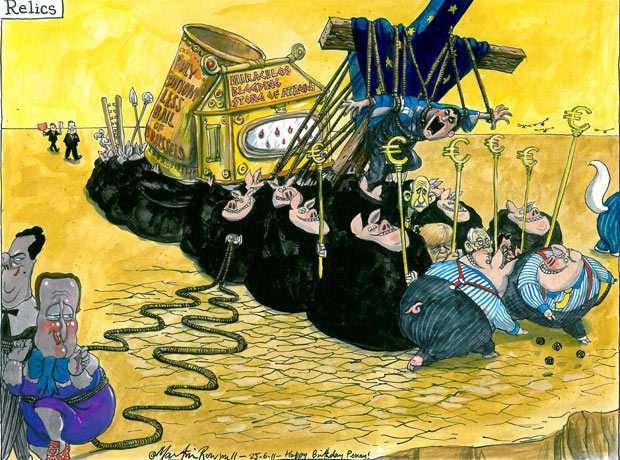 Martin Rowson
The steps from a single currency to a single economy remain a dream as the IMF, the European Commission and the European Central Bank (ECB)--the Troika--negotiate a new austerity package with the Greek government, in return for a new bailout deal. The neo-liberal austerity package--its akin to a debt hammer--- promises more suffering for the Greek people and involves the privatization of public assets--ie., sell off its water and sewer rights, ports, islands and other infrastructure.
The Greek government has already laid off 10% of its government workers, and the plan that they will vote on this Tuesday calls for layoffs of another 20%. It also provides for a total of 12% of GDP of fiscal tightening for 2011-2015, which is a recipe for never-ending recession. The whole point of the austerity package is to try to pay off an unpayable debt to bankers and bondholders.
The central concern for the Troika is that the banks must not lose money. Debts are sacrosanct--is the inference from the European Central Bank’s hard-money, anti-debt-relief rhetoric. The Greek Government under Papandreou side with the banks. The Greek people must pay up. If they resist, then the military and police are called out by the Greek Government.
As Paul Krugman says in reference to the US:
the policy prescriptions of the Pain Caucus all have one thing in common: They protect the interests of creditors, no matter the cost...the only real beneficiaries of Pain Caucus policies (aside from the Chinese government) are the rentiers: bankers and wealthy individuals with lots of bonds in their portfolios ... This is a negative-sum game, in which the attempt to protect the rentiers from any losses is inflicting much larger losses on everyone else. And the only way to get a real recovery is to stop playing that game.
Stop playing the game means Greece defaulting on the debt. Greece (and Ireland and Portugal) should be released from a substantial part of their debts since spending cuts and structural reforms alone will not enable the three countries to escape from their debt trap.
Update
Greek parliamentarians debate austerity measures imposed on them by eurozone partners. If the Greeks vote down these measures, Athens will not receive its second bailout, which could create an even worse crisis in Europe and the world. The source of the current sovereign debt crisis is the lack of political oversight over economic integration gone wrong.The Euro has made Greece (and other poorer countries) less competitive relative to richer European countries which have benefited greatly from the common currency. So there will be the a continued deterioration in Greece's trade balance -- thereby increasing Greece's indebtedness.
Update 2
The Greek Parliament has voted to pass the austerity measures to ensure the loan that it will enable it to pay its the debts that have fallen due. The MPs will vote on Thursday on laws to implement them. Greece is being pumped with cash so it can repay its debts to German and French banks.
Greece is flogging its assets in a fire sale to raise cash. The potential buyers, on the other hand, are very wary of investing in a country with a shaky political infrastructure alongside a track record of what one might call "structural hostility to business".
There is nothing in the IMF/ECB loan packages in the way of economic recovery. These packages actually destroy much of the retail sector while creating no productive activities, and focus on running a budget surplus through overtaxation simply to stabilise the European banking system. The German and French financiers are being bailed out, while the Greek economy spiral downwards into depression.
There is still the fiscal crisis of the Greek state to address, the structural problems of the real economy and democratic deficit in Greek politics.
Update 3
Membership of the euro for Greece has had tremendous costs attached to it, in terms of structural deterioration: originally seen as benefits (stronger currency, low real interest rates, higher market confidence in government bonds) these rapidly turned into weaker exports, increased imports and private sector debt, along with ill-considered increased government debt. This massive increase in consumption at both government and individual level was not matched by investment or growth in production: it was therefore completely unsustainable, inflationary and dangerous.
The cost of remaining in the euro as currently constituted is high for Greece. Greece's inability to devalue means that there is little hope of achieving economic competitiveness other than through slashing wages and overall standards of living. So the collapse of living standards is the price that Greece has to pay to stay in the euro --in the absence of any restructuring of the euro through large nett transfers to those nations on the periphery.
Posted by Gary Sauer-Thompson at 9:31 AM | Comments (5) | TrackBack
June 25, 2011
green growth
Those on the political right who both deny the science that informs us that the greenhouse emissions are produced by economic activity have caused global warming, and who oppose using market mechanism to help reduce greenhouse gas emissions, basically argue that saving the planet will destroy the economy.
It's a simple message or slogan, that is endlessly repeated in News Ltd's newspapers, and it overlooks, misrepresents, or refuses, to acknowledge the emergence of what the UN calls a green economy or the OECD calls green growth. This concept has moved into the mainstream of policy discourse.
As Michael Jacobs in An idea whose time has come at Inside Story observes:
these terms – green growth, low-carbon growth, the green economy, green development – are being used to convey a simple but potentially radical idea: that environmental protection and the reduction of carbon emissions need not be at the expense of economic growth but can actually contribute to it. ago ....At its most basic it derives from the recognition that a key route to protecting the environment is to use resources – energy, land, water or whatever – more efficiently. This is essentially a form of productivity improvement: getting more output for less input. So long as this is done at a relatively low cost – particularly by using market mechanisms to encourage firms and consumers to change their behaviour – it should help growth not hinder it. It’s true that the growth generated by raising resource productivity can lead to new emissions and more environmental impact, but the evidence shows that the total impact almost always remains environmentally beneficial.
The more informed business-as-usual News Ltd journalists basically argue that though green spending can stimulate growth, it just stimulates less growth than the brown alternative. Low-carbon energy is more expensive, so the costs will be higher and the returns less. More economic growth is better than less growth.
The problem here is with business-as-usual. What if there is no “business as usual”? Jacobs says that:
If – as is now widely expected, and indeed may already be happening – failure to take action on climate and the environment in practice leads to effects such as rising oil and fossil fuel prices, greater water scarcity, lower agricultural productivity, declining fish stocks, more frequent extreme weather events, and so on, then the base case against which the green growth path needs to be compared may be rather different from what has generally been assumed.
he says the modelling shows that the “green investment” scenario starts off generating slower growth than the base case. But by the second half of this decade this has reversed, as growth rates in the base case start to decline under the impact of environmental pressures. By 2030 and beyond, the “growth dividend” of the green investment scenario becomes quite marked.
Posted by Gary Sauer-Thompson at 11:01 AM | Comments (2) | TrackBack
June 24, 2011
The Canberra Press Gallery: one year on
The Canberra Press Gallery have been obsessed with the anniversary of Julie Gillard becoming PM through Kevin Rudd being dumped. The screeds of commentary involves the talking heads looking back to the knifing of Rudd, and looking forward to the ongoing leadership tensions between Rudd and Gillard.

In their focus on politics as personalities they make a judgment that the Gillard Government has achieved nothing after being a year in power, and that 'tear down' Tony Abbott 's negative campaign of no no no to everything plus stunts has been an astounding success. The Gillard Government is on the ropes because of Abbott's biffo; it is weak; and it is weak because it is a minority government. End of the story.
However, the Canberra Press Gallery is so caught up in their conception of politics as the clash of personalities that they are blind to their failure to realize where they are wrong with their judgement that the Gillard Government talks reform but achieves little.
The agreement with Telstra over the national broadband network is a watershed one not a sideshow. It corrects the failure of 20 years of policy to structurally separate Telstra (eg., its ownership of the copper wire network on which it and its telco competitors competed) and to provide substantive competition in the telecommunications market. Telstra will buy space on the wholesale NBN monopoly network, just as its competitors do.

Not only is this agreement of historic importance the NBN is the biggest infrastructure project that Australia has seen; and one that is designed to transform Australia.
At one level this failure to acknowledge the reform is derived from a hostility to the NBN. Thus Jennifer Hewitt in her Striking up Broadband in The Australian has little positive to say about the NBN. We don't need it; its uncompetitive; its too expensive; its picking technological winners and its a toll road. The conclusion is that there is no need for it since this government-owned monopoly will never be a structure associated with innovation, flexibility or efficiency.
Hewitt's core argument is that there is a more efficient, less costly way of producing similar results, which contradicts her central argument that the possible new services such as e-education don't deliver much in terms of basic knowledge; and that households will only use the faster speeds for downloading of high-definition movies or computer games and YouTube videos.
At a deeper level the media caught up in Canberra sideshow doesn't understand the policy--there are no opinion pieces in the Fairfax Press's National Times and those that have been written are in the business pages. They are about the business deal and how successful Telstra was.
Secondly, the media lacks the knowledge to comprehend what a shift to a digital economy actually means beyond sending emails or using Skype. Nor have they shown any interest in gaining that knowledge. Their assumption is that we are passive consumers of “stuff on the internet” that other people make--eg., Hewitt's households downloading of high-definition movies or computer games and YouTube videos---rather than a digital economy being one in which everyone is as much a producer as a consumer.
It appears to be very difficult for the Canberra Press Gallery to understand what is meant by “upload speed” compared to “download speed”. As far as most are concerned, it’s ALL download, like a TV receiving TV shows, in which us consumers receive the fabulous insights op-eds of the Canberra Press Gallery.
Update
Annabel Crabb in her Sorting the myth from the chaff on this silly Sackiversary at The Drum acknowledges that the Australian political debate has become almost entirely disengaged from the two chambers that are supposed to be its home. She adds:
The perception of an anxious, uncertain Prime Minister - shadowed perpetually by the man she deposed a year ago - now dogs everything the Government does..Even a Budget that waltzes through the parliament and a previously unimaginable agreement on the NBN that is signed with Telstra does not ease it.And of course, before you all remind me: Yes, the media has a massive role in all of this. Lindsay Tanner's argument that conflict always wins higher page placement than consensus is quite correct.
A glimmer of insight and self-reflection from the Canberra Press Gallery! But it is limited, as Crabb goes on to say as ye sow, so shall ye reap.
And one of the reasons that Julia Gillard cannot escape the pestilence of intrigue and instability that envelopes her is the brute truth of what she and her colleagues did one year ago. The unease at the core of the government is no media invention; anyone with a pair of eyes can spot it. Short-term measures, like the sudden disposal of a leader, carry long-term consequences; perpetual lack of peace is one of them.
Sure the assassination of Rudd is one of the reasons for federal Labor being seen negatively. What are the others? If one of them is the role of the media, then how is the media doing this?
The Canberra Gallery remains in its comfort zone --the politics of personality.
Posted by Gary Sauer-Thompson at 9:58 AM | Comments (15) | TrackBack
June 23, 2011
newspapers: decline and influence
Roy Greenslade has a good summary of the commercial woes that the newspaper industry is confronting at present due to the emergence of the internet. Given this decline we can ask does this mean that they will lose their political influence? The mainstream media certainly have lost their credibility amongst the digital publics.
On the print media's commercial woes Greenslade says:
Amid the worst economic downturn in recent history, advertising revenue is drying up. Classified advertising, once the bedrock for local weeklies, has largely migrated to internet sites that provide a free service...Meanwhile, the slow, relentless decline in circulations continues quarter upon quarter. That has had two effects: it has reduced income and it has decreased the likelihood of attracting advertisers or, at least, any that are willing to pay anything but a heavily discounted price for space.e result has been a whole range of cutbacks by companies desperate to save themselves from ruin in the hope of an eventual change of economic fortunes. Company pensions have all but vanished. Staffing has been pared back. Outsourcing has become familiar. Small offices are being closed in favour of larger, centralised "hubs".
As we have seen in a previous post The Guardian's response to this state of affairs has been to take the digital option. That major transformation involves building an audience and a secure advertising base, and it means developing skills in digital development as opposed to journalism.
The media constitute an important power in their own right and they are also intimately connected to other kinds of power, whether political, economic or social and in a liberal democracy the ability to shape public opinion is fundamental to power.
On the political influence of the media Greenslade says:
The material that appears most often in the main current affairs programmes on TV and radio, plus radio phone-in shows, is almost always based on follow-ups to stories in the national press. In such a way, papers still command the nation's central political narrative.This activity is hugely influential in the periods between elections, and much more important than the immediate pre-election calls for people to vote one way or another.The newspapers' daily drip-drip-drip of stories and commentaries - whether positive or negative - do influence the electorate, including those people who never read the papers. The repetition, and the influence over other media, are the key to creating a broad consensus.
If the slant of a newspaper comes from its audience (eg., The Australian is situated in the right of the centre in the marketplace) and it is the TV platform for news delivery which consumers now rely on most, then how much TV news is influenced by the national newspapers? Do they do what Greenslade says follow the agenda of The Australian?
A starting point here is that what we have are the talking heads on the various programs of the 24-hour news channels. As Malcolm Farnsworth points out in this media world the same faces dominate and their opinions are duplicated within and beyond their networks and organisations:
Whereas subscription television and new digital channels could be providing great diversity of programming, for the most part we get cheaply produced and predictable panel discussions with a movable but narrow cast of characters. Instead of providing platforms for divergent views and new voices, we mainly get journalists talking to journalists, lobbyists and pollsters touting their wares, and formats designed to encourage politicians to shout at each other...this week's nonsense coverage of The Anniversary serves to highlight how the plethora of programs devoted to news and politics generally remain stuck in a stultifyingly narrow frame of mind, dedicated more to covering politics as entertainment, eschewing depth for the day-to-day Punch and Judy show.
It is a very insular world--one big feedback loop in which the politicians and the media essentially fed mythology to themselves and to each other. The content inside the feedback loop has very little connection to thge everyday world in which citizens live.
Posted by Gary Sauer-Thompson at 10:02 AM | TrackBack
June 22, 2011
NBN: a long time coming
It's been a long time coming, but it does now look as if the $11 billion infrastructure-sharing agreement between the Gillard Government and Telstra is to be signed and announced very soon(probably this week). A Coalition government under Abbott would strongly consider throwing the NBN contracts out. They say no to a very significant economic reform.

Under the agreement, Telstra expects to receive $11 billion from taxpayers in return for gradually shutting down its copper wire network and sharing its underground ducts with NBN Co. Telstra expects to receive about $4.5 billion for transferring customers and about $4.5 billion for a long-term infrastructure leasing contract. By shutting down its copper and cable networks Telstra will effectively end its monopoly over the fixed communications network in Australia. NBN Co can now start speeding up its plans to roll out the NBN.
Creating a national high-speed broadband network and ending Telstra’s domination of fixed line telecommunications means that Telstra then runs a retail service only. Its management strategy is--and this has been so for a year or more -- to push better services, pricing and marketing to its contested retail customers. Its immediate strategy is to grab as many subscribers as possible in previously uneconomic areas by upgrading its copper wire street cabinets---remote integrated multiplexers (RIMs). It will then keep them as NBN customers as they are migrated to fibre.
This 'Top Hat ' project---the equipment upgrade sits atop the existing street cabinets--will enable Telstra to treble the number of available ADSL ports in the cabinets and so increase speeds from ADSL levels to ADSL2+ levels. The NBN will take ten years to be completed and the industry will still have to rely for a long time on these Telstra wholesale services.
Telstra's aim is to ensure that it is well placed in a digital future where Telstra, Internode, Optus, iiNet and others are all forced to buy their wholesale product at a uniform price, and to compete on customer service and the user experience.
As Paul Buddle highlights what we will see happen is a shift in the national economy towards a digital economy that will result in the development of e-health, digital media, e-education and so on. The NBN will create a new economic platform for a range of new businesses and indeed industries who can harness the enormous information processing power of the NBN.
Posted by Gary Sauer-Thompson at 1:15 PM | Comments (5) | TrackBack
June 21, 2011
addressing the energy problem
This is via Barry Brook's post at his Brave New Climate blog. It's a session addressing the energy problem on Steve Paikin's show The Agenda at the Equinox Summit at the University of Waterloo, Ontario, which Brook attended.
The Summit aimed to reboot the global conversation on energy and learn how cutting edge science and technology may advance an electrified and sustainable future. It was about what options are currently on the table that would allow us to decarbonize the economy by cutting emissions to ease the rise in world temperatures.

The Equinox Communique's recommendations centred on four key ideas: changing the baseload of the current energy system, smart urbanization, electrified transport, and rural electrification. The communique identified three alternative means of delivering baseload power: geothermal power; solar with storage and advanced nuclear.
The talk of nuclear as one option for baseload power recalls the destruction of the uranium nuclear power plants at Fukushima, which seems to have dropped off the radar in Australia. This update suggests that the problems are much worse than we have been led to believe. Brook favours the thorium nuclear reactor in an energy mix, but this technology is a long way off being commercially viable in Australia, but not China).
Australia is still planning to build more coal fired power stations to replace our aging generating plant despite Labor saying that its environmental policy would be on renewables – both wind and solar.
Posted by Gary Sauer-Thompson at 5:27 PM | Comments (3) | TrackBack
oceans in a bad way
A report from the International Programme on the State of the Oceans makes for sobering reading.

Gary Sauer-Thompson, sea abstract, Victor Harbor, 2010
Overfishing, pollution, run-off of fertilisers from farming and the acidification of the seas caused by increasing carbon dioxide emissions are combining to put marine creatures in extreme danger, Mass extinction of species will be "inevitable" if current trends continue due to the actions human beings. The report states that:
Although concealed beneath the waves, the evidence of wholesale degradation and destruction of the marine realm is clear, made manifest by the collapse of entire fisheries and the growth of deoxygenated dead zones, for example. The cumulative result of our actions is a serial decline in the ocean’s health and resilience; it is becoming demonstrably less able to survive the pressures exerted upon it, and this will become even more evident as the added pressures of climate change exacerbate the situation.
It adds that without significant changes in the policies that influence human interactions with the marine environment, the current rate of ecosystem change and collapse will accelerate and direct consequences will be felt by all societies.
On climate change the report says that:
The increase of anthropogenic co2 in the atmosphere represents a direct threat to all marine ecosystems through changes in ocean temperature, sea level rise, decreased sea ice cover, increased frequency of extreme events such as coral bleaching and storms, increased stratification of the ocean – altering patterns of ocean mixing, lowered oxygen levels and increased risks of eutrophication in coastal waters. The ocean naturally absorbs co2 from the atmosphere as one of its earth System services but the excess overload now being absorbed is altering the natural chemical balance of the sea and leading to an increase in its acidity. This is a direct threat to marine organisms that build their skeletons out of calcium carbonate, especially reef-forming corals (Scleractinia).
You can see why there is such an emphasis on The Great Barrier Reef in Australia. It is under threat from both global warming (it causes bleaching) and nutrient enrichment or eutrophication from the chemical pollutants in the fertilizer used by the coastal agriculture and waste treatment plants.
The reef is just not the marine ecosystem --its also a tourism and fishing industry that is worth billions to Australia’s economy -- and yet you rarely hear people like Paul Howes or Tony Abbott talking about protecting these jobs by making the polluters pay for the damage they have caused. Presumably their message is that there is no need to worry because the adaptive qualities of coral reefs would mitigate the effects of climate change.
Posted by Gary Sauer-Thompson at 9:43 AM | Comments (4) | TrackBack
June 20, 2011
Medicare locals + health care
The Federal Government has announced the final boundaries for an Australia-wide network of 62 Medicare Locals. The reform vision behind this was for:
less micromanagement by Canberra and the States, greater flexibility through block funding arrangements, local community led primary health care organisations that understood the needs of their constituency, determined the best method of delivering services and went about their business. The notion of Canberra’s ‘one size fits all’ approach where the funding arrangements gave much the same money and proposed the same model of care to deliver a mental health service to a middle class white patient in Penrith as it did to an Ngaanyatjarra Aboriginal patient from the Central Desert was meant to be dead in the water. Regional differences such as morbidity and mortality rates, access to resources, the cost of those resources, cultural differences, the need for outreach services, housing, education, employment – the social determinants of health - were to be the new approach.
As expected, this vision of primary health care resulted in professional tussles over the roles and influence of GPs, nurses and pharmacists and who would run the Medicare locals. The Australian Medical Association has been agitating loudly for a “leadership role” for GPs in opposition to those interested in developing a more community-centred approach.
Realistically the community approach was never going to get off the ground, but what was hoped was that there would be a greater inclusion of allied health professionals, a shift away from the medical model of disease to a wellness model; and a greater emphasis on illnesses such as diabetes, hypertension, obesity, mental health and trauma, violence and substance abuse.
It is unlikely that the Medicare Locals will generate anything like this approach to health care, and it may be that it only come if communities and health practitioners develop it themselves, independent of the formal structures in the health system. The formal structures are shaping the content of Medicare locals.
Firstly, it is increasingly apparent that the Federal Government has capitulated on the issue of level of primary health care funding and is leaving the States to run primary health care services through their existing community and population health organisations with no promise of reform in health care.
Secondly, the Medicare Locals have lost their independence to the top down approach. As Lohengrin highlights the:
forerunner Medicare Locals which were formerly autonomous of Government, as most were independent locally managed organisations, will be nationalized, becoming regional offices of the Department of Health and Ageing. Their former independence of Government, able to lobby vigorously of behalf of their constituency, influence health policy and help drive continuing health reform will be neutered and potentially replaced by a new set of overly regulated, unresponsive, frustrated minions of the Government in Canberra, albeit with an office in your town.
So it is going to be more of the same kind of health care even though community health requires so much more than providing medical services. It is community health that the social determinants of health and health inequality come to the fore.
Posted by Gary Sauer-Thompson at 10:54 AM | TrackBack
June 19, 2011
old King Coal
Australia has an incredible supply of sunshine, a host of technologies that could meet our needs, and the 5% emissions-cut target that we need to meet. So why, given all the rhetoric about a clean energy future, is Australia's commitment to solar so half-hearted? Why the stop and start state programmes for the small scale, decentralized rooftop solar (PV) for households? Why the failure to shift to large-scale solar to power regional cities?
 A concentrating solar power (CSP) plant in Spain that uses panels to reflect light on to a central tower to produce electricity.
What is ignored by those who attack the subsidies for solar power is the current economic subsidies to fossil fuels that amount to at least $10 billion per year nationally. So the issue is not one about government subsidies for the renewable industry versus no subsidies.
Mark Diesendorf, the deputy director, Institute of Environmental Studies at University of New South Wales, says:
There is really only one plausible explanation for Australia’s piecemeal and ineffective set of solar policies: the immense political power of Australia’s big greenhouse polluters.If you want to point a finger, point it at the coal industry.
The choice of new electricity generation technology is not between nuclear and coal, but instead is between nuclear and a combination of energy efficiency and renewable energy, with gas playing a transitional role as back-up. Given its very high capital costs the current economics of nuclear power make it an unattractive option for new generating capacity. Embarking upon a nuclear energy program entails very large economic risks and potential losses of billions of dollars per reactor compared with a mix of energy efficiency, renewable energy and gas.
That leaves renewable energy. Hence the attempts to strangle this new form of energy by the fossil fuel industry---solar is dismissed as cute, niche technology, there is a concerted campaign to scrap the Feed in Tariffs (FITS), and restrict the government funding to large-scale installations.
We shouldn't forget that the rarely acknowledged but irreconcilable conflict of interest when the mining industry on the one hand calls for expanded nuclear power to help reduce greenhouse gas emissions, while on the other hand the same companies producing uranium in Australia are even more rapidly expanding their coal mines in eastern Australia. That is, the two dominant uranium exporters, BHP Billiton from Olympic Dam and Rio Tinto through their majority (~68%) share of Energy Resources of Australia who operate the Ranger mine in the Northern Territory, both earn considerably more profits from coal than they do from uranium exports.
Secondly, the problem is that much of Australia’s, and especially Victoria’s, coal fired capacity is getting old---eg., Hazelwood and Yallourn stations provide 30% of the state’s capacity and are both past or nearing their use-by date. These old stations have essentially been paid for, and are now running on just operation and maintenance costs. If If Australia is to be serious about cutting its greenhouse emissions, then the existing brown-coal-fired power plants such as Hazelwood and Yallourn have to close as soon as possible.
Eventually the old plants like Hazelwood will be retired, new plants (either gas or renewable) will have to be built and financed, and financing costs money. So even without climate change and a carbon tax, as the old plants are retired and new infrastructure is built to replace the old, we will see a substantial increase in electricity prices.
Increased generating and distribution costs are the main drivers, due to an aging fleet of power plants and a change in the demand pattern---the demand is on the hottest summer days, and the increase is mainly due to increased use of air-conditioners. So it makes sense to invest in solar--both small and large scale since what it produces can match increased demand.
Update
The question then becomes: Will the Latrobe Valley necessarily remain an energy hub? Can it survive in a carbon-constrained world? What are the economic alternatives? If carbon capture proves viable 'it could make Gippsland the centre of a major national industry''. It is a big ''if'' and a huge gamble for Gippsland that may not pay off since carbon capture may never be viable. Clean coal will not save the Latrobe Valley.
So how does the Latrobe Valley reinvent itself?
Posted by Gary Sauer-Thompson at 11:14 AM | Comments (20) | TrackBack
June 18, 2011
AfPak: some background
The failure of the NATO occupation of Afghanistan has revived the Taliban as well as the trade in heroin and has destabilised north-western Pakistan. The US has intensified its drone attacks in Waziristan and is talking to the Taliban.
I have taken the following excerpts about the AFPak war from Tariq Ali's 2009 Diary in the London Review of Books about the war against the Tehrik-e-Taliban Pakistan (TTP) in the Pakistani areas of the North-West Frontier Province bordering Afghanistan; a war Pakistan has been pressured to fight by the US.
Ali says that this is now Obama’s war, as he campaigned to send more troops into Afghanistan and to extend the war, if necessary, into Pakistan. These pledges are now being fulfilled. He adds re the badlands of the Pakistan-Afghan frontier:
In May this year, Graham Fuller, a former CIA station chief in Kabul, published an assessment of the crisis in the region in the Huffington Post....not only did Fuller say that Obama was ‘pressing down the same path of failure in Pakistan marked out by George Bush’ and that military force would not win the day, he also explained to readers of the Huffington Post that the Taliban are all ethnic Pashtuns, that the Pashtuns ‘are among the most fiercely nationalist, tribalised and xenophobic peoples of the world, united only against the foreign invader’ and ‘in the end probably more Pashtun than they are Islamist’. ‘It is a fantasy,’ he said, ‘to think of ever sealing the Pakistan-Afghanistan border.’
Ali adds that the longer the war continues, the greater the possibility of serious cracks within the Pakistani army. Not at the level of the high command, but among majors and captains, as well as among the soldiers they command, who are far from happy with the tasks assigned to them.
Most of today’s jihadi groups, who the Western media see as bearded fanatics on the verge of taking over the country, are the mongrel offspring of Pakistani and Western intelligence outfits, born in the 1980s when General Zia was in power and waging the West’s war against the godless Russians, who were then occupying Afghanistan. That is when state patronage of Islamist groups began. It continued with support for the Taliban after the 1989 withdrawal of Soviet troops from Afghanistan up until 9/11. Ali says of this period:
The Bhutto government, made nervous by the increasing activity of Afghan jihadis in Pakistan, now decided to train and arm the children of Afghan refugees who had fled across the border in the 1980s, and use them, bulked out by Pakistani ‘volunteers’, to take the country. It was the most successful operation in the history of the Pakistan army. The Taliban took Kabul (murdering Najibullah) and ended the disorder by imposing a clerical dictatorship: women in burqas, rapists executed, poppy fields destroyed etc. Gradually, Mullah Omar’s government gained autonomy from its patrons in Islamabad and even engaged in friendly negotiations with US oil companies. But its Wahhabi connections proved fatal. The rest we know.
America’s local point-man Musharraf helped dismantle the Taliban government in Afghanistan-- the $10 billion in US money Pakistan has received since 9/11 for signing up to the ‘war on terror’. In the West's imaginary it is a jihadi finger finding Pakistan's nuclear trigger that is the big fear, even though the jihadis are not popular in most of Pakistan.
Pakistan is racked by social and economic inequality that denies schools for the children, medicines and clinics in the villages, clean water and electricity in the homes for the people. What guarantees Pakistan survival today is its nuclear capacity and Washington.
The current Zardari Government in Islamabad still wants to control Afghanistan. Some elements in Pakistani military intelligence feel that they will be able to take Afghanistan back once Operation Enduring Freedom has come to an end. More likely is that a stable settlement will have to include a regional guarantee of Afghan stability and the formation of a national government after NATO's withdrawal.
Posted by Gary Sauer-Thompson at 6:07 PM | Comments (1) | TrackBack
June 17, 2011
newspapers: a digital future?
Are newspapers on some journey to a digital future? Some say that the future doesn’t have room for paper or print -based newspapers at all.
It is the case that the older "mass print media" are losing ground in a marketplace fragmented by the multiplication of pay television channels and Web sites. Budgets are squeezed by the industry recession and by short term profit-taking pressure from investors; papers are losing vital classified ad revenue to online operations; and the decades-long slow constriction of circulation threatens to close the arteries unless newspapers can somehow snag the next generation of readers.
Rupert Murdoch reckons that newspapers will evolve onto a mobile, electronic platform that updates every hour or two and that consumers will pay for most online news content in future. It just seems inevitable that someday digital delivery of in-depth, personalized information -- including text, audio and video -- to electronic devices will supplant the trucking of heavy physical loads door-to-door.
That would mean stop listening to print people and putting the digital people in charge – of everything. Is that actually happening in the industry?
The Guardian has outlined a different media strategy to Murdoch's paywall approach to ensure the prestige, political influence and getting their own views across to the public.
The Guardian's major transformation programme is to de-emphasise print and become digital-first. In doing so it will, shrink the printed newspaper away from breaking news and into a smaller, less resource-intensive edition that instead leads on analysis. The intention for Guardian.co.uk to stay free on the web remains in place.
This is in contrast the newspapers in Australia where publishers have slowly balanced digital growth with print decline and where their eventual crossover appears distant. It appears that they see convergence with broadcast and online media as the shape of things to come for newspapers. That looks feasible, because the Internet is still dominated by text. But in a future dominated by video, newspapers will not translate so easily, since television and newsprint are oil and water.
Andrew Miller, the Guardian Media Group CEO, says that:
The financial pressure all newspapers are facing through the shift is such that our losses are increasing and I can’t see a way of those not decreasing without first making ourselves digital-first. All newspapers will ultimately exit print. But we’re putting no timeframe on that. This is about repositioning the business to be digital-first. I don’t know if anyone’s said that before at a major newspaper. It’s about finding the right format for newspapers in our portfolio.
One way Guardian.co.uk will endeavour to get there is to grow its U.S. audience from New York to significantly grow advertiser scale - something Miller hopes will mean Guardian.co.uk can charge higher ad prices.
Posted by Gary Sauer-Thompson at 2:18 PM | Comments (3) | TrackBack
"the will of the parliament"
I watched a live feed of Question Time in the House of Representatives yesterday. What an inverted world. The Liberals were defending their new kinder, gentler, good Nauru solution to the refugee boat problem in contrast to the ALP's evil, nasty, inhumane Malaysian solution. This is Tony Abbott talking about Nauru:
I have seen where boat people will be accommodated—and well accommodated. I have seen where boat people's children will be educated—and well educated. I have seen the police headquarters which will deal with security issues involving boat people in Nauru. And I can tell you this, Mr Speaker: there are no rattans in Nauru and there are no whipping posts in Nauru.
The traditional Liberal message of sending real tough messages to stop the boats was shelved. Abbott was positively welcoming the boats to sail to Nauru. We love you he cooed. It was an upside down moment.

Of course, none of this was genuine or honest. The hypocrisy on display was the result of the usual tactic to use Question Time to put pressure on the Gillard Government. This time the Coalition utilized both houses of Parliament supporting The Greens motion moved by Green’s MP Adam Bandt:
That this House:
(1) condemns the Gillard Government’s deal with Malaysia that would see 800 asylum seekers intercepted in Australian waters and sent to Malaysia; and
(2) calls on the Government to immediately abandon this proposal,
The motion passed 72-70 with the Libs voting with the Greens and of the independents MPs, Katter and Wilkie voted for and Oakeshott and Windsor voted against. It was reported thus.
This then became the tactical Liberal weapon to lay into the Gillard Government and keep them on the ropes. Question Time consisted of a mere five questions. Then we had the usual attempt to suspend standing orders, only this time, it was to move a motion to censure the Gillard Government for defying the will of Parliament, and defying the will of the people of Australia. So much for representative democracy!
It got worse. Julie Bishop contribution to the suspension motion consisted of calling Julia Gillard “this arrogant Prime Minister” again and again for defying the will of Parliament, and then this gem:
This is the type of behaviour we see in Third World dictatorships. This is the kind of behaviour, overriding the majority of both houses of parliament, overriding the will of the parliament, overriding the views of the majority of the elected members to this place.
So we now have a dictatorship--not a dictatorship of the executive when the Coalition had control of both houses of Parliament--- but a real dinky die third world dictatorship. Poor Australia. It has finally come to this under Gillard. Australia is like Burma. Or North Korea? Or Syria.
I guess the irony was lost on Julie Bishop---that Abbott and her were standing up in the House of Representatives with live internet and broadcast feeds full of mock outrage calling the Prime Minister arrogant and trying to censure the PM for her arrogance. That is a strange Third World dictatorship.
I appreciate that Question Time in the House of Representatives is merely political theatre, but we do judge the theatre in terms of the quality of the play and whether it says any meaningful within the traditions of the theater. On that criteria what were offered yesterday was political junk that trashed the liberal democratic conventions of Parliament. Not many watch the political theatre that is Question Time live, so what happened yesterday in Question Time doesn't actually matter in the electorate.
The Liberals don't care about trashing the liberal democratic conventions of Parliament. All that matters to them is getting Gillard on the ropes and punching her incessantly until she sinks to her knees in exhaustion and the Independents dump her. They reckon Gillard is staring into the political abyss and they will do and say anything to nudge her into that abyss. Power, not principle, is all that matters.
For the record, the Coalition's attempt to suspend standing orders to censure the PM was lost. They didn't have the numbers. The whole exercise was for the cameras. I couldn't be bothered watching the 7pm news headlines on TV.
Posted by Gary Sauer-Thompson at 12:01 PM | Comments (5) | TrackBack
June 16, 2011
`lost their way'?
There is little need to comment on Alan Moir's cartoon. It represents the state of play accurately. Labor is being looked at with a sceptical eye and for good reason, as the Gillard Government has delivered little after a year. Gillard herself is being treated badly, and is subject to condescension. News Ltd can smell blood in the water and is cranking up the pressure.

The ALP cannot help itself. It's in government, and yet it is going through an identity crisis as a social democratic party that civilizes neo-liberal capitalism. They talk of reform--- they refer to their history of reform a lot--- but they seem to offer little beyond the promise of making the tough decisions, turning to focus groups, doing party polling and being obsessed with themselves.
They do seem to have lost their way in understanding how to civilize neo-liberal capitalism to ensure the well being of the country. Or if they do know how to give global capitalism a human face, then they find themselves unable to carrying it out. They start then stop, giving the impression of buckling under pressure. The live cattle trade to Indonesia is a case in point. They've known about this for a long time, condemn it, but don't hold anyone responsible for doing nothing about it.
One explanation for this state of affairs is that the Labor Right, which controls the party through the factional grip of its party barons, actually has no real or genuine interest in civilizing neo-liberal capitalism, or in renewing social democracy. The point of gaining power is not to make things better for Australians, or to give global capitalism a human face; it's defining purpose now revolves around power and patronage. Gaining power, and keeping it for as long as possible, is what matters.
Ambitious reform has nothing to do with it. The tactics of Labor Right is to retain power by shunning policy risk, relying upon message mastery and spin, and carefully respect Australia's conservative political culture. So nothing really happens.
Posted by Gary Sauer-Thompson at 9:39 AM | Comments (13) | TrackBack
June 15, 2011
Greece: the crisis deepens
The Greek crisis appears to be getting worse. The austerity policy prescribed by the EU, IMF and ECB in exchange for €110bn of emergency loans last May, has resulted in a deeper than expected recession with further cost-cutting measures now seen as crucial if Greece is not only to rein in its debt but make it sustainable. This austerity has ramifications for the eurozone.
Athens has been told that without further austerity there can be no more aid from finance capital. The Greek economy appears to be stuck in a vicious cycle of being unable to decrease deficits while increasing competitiveness. The country may be heading towards a major crisis of ungovernability with unpredictable consequences.Takis S Pappas at Open Democracy says that:
After over a year of trial and error, Greece’s bailout of 110 billion euros has not worked since the tough austerity measures that were imposed upon Greeks have failed to significantly eliminate deficits; instead, budgets remain out of balance and spreads have continued to blow out causing a surge in borrowing costs .... As with the first bailout package, the new one is given to Greece on condition of yet another round of fiscal austerity measures and tax increases. Further tightening is however certain to deepen the recession and make it even harder for the government to cut deficits.
He adds that Greece’s chance of reviving its economy, and paying off its debts, looks nil. The country has to keep paying full interest and principal on a debt burden that now approaches 148 percent of GDP, and is rising. Debt restructuring, therefore, looks like a very likely outcome. He calls for using the crisis to initiate political reform.
His argument is that:
the crisis has its origins in grave pathologies of the political system over the last three decades, recovery will require much more than wise economic management. It will in fact require the remaking of Greece’s whole political and institutional system.
Pappas traces this in terms of the rise of irresponsible populism, unrestrained patronage politics, and a powerful culture of ethnocentrism that worked against the country’s full europeanization. The signs of law evasion, rioting, extreme social polarization, and generalized anomie indicate a seriously pathogenic political system.
If Greece is to exit the current crisis and reconstitute its political system the only way to do away with populism, patronage, and ethnocentrism, and enter the virtuous cycle of a state with an economy with balanced books, strong and working institutions, and a society fine-tuned to the common European norm. Greece brought debt problems on itself – this is the consequence of politicians using irresponsible fiscal policy to win elections.
If we come back to the economics, then creating a finance ministry for the European Union, that would issue debt and have responsibility for a unified financial sector, may be a good idea. It really is the eurozone as a whole that needs help, not just a couple of errant countries (Greece, Ireland, Portugal, and whoever might be next in line for market fears about its government debt and growth prospects).The eurozone has come to a crossroads:
Do they integrate more, including with generous fiscal transfers to poorer, less dynamic member countries, where people do not like to pay taxes; or do they ease some countries out of the integrated financial system, creating two tiers of participation in the euro currency area – in which some eurozone countries cannot borrow from the European Central Bank?
I suspect that the federalist intents and policies of the Brussels bureaucracy and executive will come to the fore.
Posted by Gary Sauer-Thompson at 2:43 PM | Comments (13) | TrackBack
June 14, 2011
global 'weirding'
The Guardian has an article on the "new normal" of the extreme weather in Europe that is being explained as the result of the adverse effects of climate change.The drier springs and hotter summers that are currently being experienced in Europe is what can be expected in a warming world due to rising concentrations of heat-trapping greenhouse gases in the atmosphere caused by human activities.
Sceptics argue that there have always been droughts and floods, freak weather, heatwaves and temperature extremes--it is just part of the natural order of things--and they discount the trend of record highs and record lows.
 Gary Sauer-Thompson, erosion, Victor Harbor, 2011
In my own local ecosystem in Victor Harbor I notice the sand dunes along a favourite beach on our poodlewalks increasingly being eroded from the rising tides. The sand comes and goes say the sceptics. It's no big deal. Nature works in cycles.
For climate scientists the extreme weather events---the climate is more dynamic and violent--- are occurring more frequently, their intensity is growing, and the trends all suggest long-term change as greenhouse gases steadily build in the atmosphere.
Posted by Gary Sauer-Thompson at 11:54 AM | Comments (11) | TrackBack
June 13, 2011
pokie reform
Powerful vested interests including state governments, powerful corporations like Crown, Woolworths, Tattersall’s, and Tabcorp, and the mega clubs of New South Wales are are opposed to pokie reform, even though the proportion of money lost by problem and at-risk gamblers is 60 per cent of total poker machine losses of around $12 billion per year.
 uncredited, Sunday Herald Sun, News Ltd, 2010
The proposed reforms to reduce harm are modest: the Joint Select Committee’s report proposes low-impact pokies, accessible without a pre-commitment card, with maximum bets of $1, and maximum prizes of $500.
Secondly, it proposes retro-fitting pokies to accept a smartcard-based system with player information stored on the card to permit users to nominate their pre-set limits well away from the gaming room.
Woolworths, who own 75% of Australian Leisure and Hospitality Group, are basically defending their profits over the public good to reduce the significant harms caused to individuals, families and the wider community through problem gambling. Many of the larger venues increasingly resemble mini casinos and big businesses. They bear little resemblance to the smaller, mostly regional and rural, community venues and it is disingenuous to claim otherwise.
The Coalition would appear to be opposed to a mandatory pre-commitment system as an effective policy response. Their strategy is to delay the introduction of a mandatory pre-commitment system:
the Coalition members support a well-designed, voluntary pre-commitment scheme, which is supported by appropriate evidence, including trials, and where there has been appropriate consultation with industry. We also believe that given the substantial cost of a mandatory scheme, particularly for smaller venues, a full cost-benefit analysis should be undertaken.
At least the Coalition members of the Joint Committee did not not go on about the nanny state crushing individual freedom.
Posted by Gary Sauer-Thompson at 11:29 AM | Comments (5) | TrackBack
June 12, 2011
IPA : say no to slow food
The Institute of Public Affairs can be a puzzling lot at times.The rationale of the think tank is a defence of capitalism and free market capitalism along the classic liberal lines individual freedom, small government and deregulated markets. In keeping an eye out for the threats to freedom they have ended up becoming climate change sceptics and deniers and an opposition to human rights over and above the right to own and acquire property.
Today, in an article in The Sunday Age we find Chris Berg defending industrial capitalism by attacking the slow food movement as nostalgia (Culinary Luddism) and celebrating processed industrial food.
 Gary Sauer-Thompson, junk food, 2011
Berg, in referencing Rachelle Audan's defence of fast, processed food, reduces slow food to natural food. He then says that in an industrial society food been cheap, plentiful and safe.
For the most part, when it comes to food and agriculture, industrial is good. Corporate farming is good. Even processed is good. Natural food is an illusion. We wouldn't want it if we had it. Our ancestors had natural food. It was awful.Consequently, for Berg, the nostalgia for a lost world of pure food is nostalgia for a world of nutritional poverty and he implies that those who are part of the slow food movement think any sort of processing of food is inherently bad. He ends his article by turning this backlash against the slow food movement into an argument in favour of agri-business (the industrialized food system) as opposed to the family farm.
Berg's slight of hand is that he runs together the industrial processing of canning tomatoes or making yogurt or cheese with processed food that is considered unhealthy , such as refined sugars, white flours, and store-bought foods that contain 20+ ingredients, such as partially hydrogenated vegetable oil, potassium sorbate, BHT.
Berg's sleight of hand enables him to ignore the inferior quality with extra additives in industrial food--eg., pink slime in the fast food industry. He skims over the quality of food: namely, that high-quality industrial foods is expensive, and that food history shows the cheapest food is the crap industrial food, processed to the point of zero or even negative nutritive value.
Posted by Gary Sauer-Thompson at 8:08 AM | Comments (7) | TrackBack
June 11, 2011
ALP: Faulkner's call for reform
Senator John Faulkner's recent Wran Lecture points the finger at a the a process of ALP decline. He says:
We have lost a generation of activists from Labor and, if we do not face the challenges and opportunities of reform in both structure and culture, we will risk losing a generation of voters as well.The Party has now become so reliant on focus groups that it listens more to those who don’t belong to it than to those who do. This makes membership a sacrifice of activism, not a part of it.
The history of the recent past indicates that the ALP is unwilling to reform its centralization of power and its culture that has a deep antipathy to democracy. It assumes that politics is just an arena, a profession, rather than a concern for things brought to the attention of the fluid and expansive constituency of the public. The only way it knows how to make things public is through spin and controlled messages.
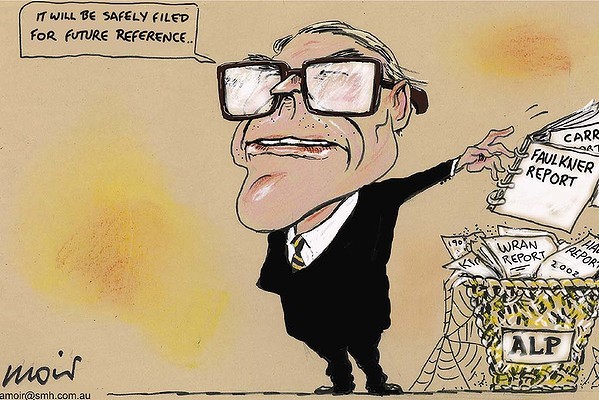 The factional warlords control the ALP and they give no indication of giving up their power in spite of the ALP's low primary vote in recent elections. We should make that more specific: it is the Right faction that is dominant and it is not interested in reviewing the undemocratic structure of the party that it controls.
Trevor Cooke says that the causes for the ALP spiral downwards are many, each reinforcing each other:
Membership decline solidifies the grip of factionalism; campaign professionalism with its emphasis on messages, safe candidates in neutral tone suits and centralised control all leave little role for individual members and supporters. As more members drift away, factions get more insidious, centralised control gets tighter – so it goes on.
Faulkner highlights the death grip of those who resist reform, but his appeal to reason is likely to fall on deaf ears.
I say to those who resist the opening up of our structures to more participation and more democracy because they see their control over managed and pre-negotiated outcomes slipping away - do not act like the ship's captain steering for an iceberg, refusing to turn over the wheel to a more competent navigator in determination to remain captain, even if only of a lifeboat.
The ALP, under the control of the Right faction, has become increasingly ossified. The Right factional warlords have cut off the ALP's progressive leg--the educated inner city professional. They have reduced the ALP to a political force of the working class, outer-suburban "battler" vote; one that is finding the hard edged conservatism of the Abbott Liberals increasingly attractive.
The writing is on the wall for federal Labor: it will be forced into a coalition with the Greens if it wants to retain or to gain political power.
Posted by Gary Sauer-Thompson at 5:49 PM | Comments (10) | TrackBack
June 10, 2011
grid parity for solar soon?
The Productivity Commission's Carbon Emission Policies in Key Economies, which is a snapshot of a moment in time, undercuts the ground of the fossil fuel industry and its allies who are opposed to both a price on carbon and the emergence of the solar power industry.
The Report shows that Australia is lying in the middle of the cohort of countries the Commission was asked to compare; and that an emissions trading scheme was the most efficient way of achieving abatement.

So the Gillard Government's position that a market-based carbon pricing system is the lowest cost way to decarbonise the economy has been vindicated. It stands on firm ground.
The Commission also found that the cost of the subsidies for renewables had a high abatement cost:
Emissions trading schemes were found to be relatively cost effective, while policies encouraging small-scale renewable generation and biofuels have generated little abatement for substantially higher cost.
Though some of the state tariffs for rooftop solar have been generous and badly coordinated, grid parity (without subsidy) is approaching as early as 2014-15, and so the cost of abatement from public policy for future systems will be zero.
In theory a carbon tax or emissions trading scheme raises the price of "dirtier" products, effectively subsidising "cleaner" alternatives. The key is that, in responding to this price signal, the multitude of consumers and businesses - that is, the market - makes its own assessments about the costs and benefits.
However, what we know is that the policy problem for the Gillard Government is that it cannot legislate a carbon price that's high enough to drive a major shift into non-carbon energy sources. So it will deliver a low carbon price of $20 to $30 a tonne and then try to drive a major shift into non-carbon energy sources through using tax dollars (subsidies in the form of feed-in tariffs and rebates) to bring down the price of renewable energy to levels that consumers find attractive.
The price of photovoltaics is falling rapidly because of technology improvements, economies of scale and, most importantly, the falling cost of polysilicon [the key raw material in solar cell manufacture].The boom in the global PV industry once grid paritywas achieved--and solar can stand on its own two feet---means that Australia could become a "significant player" in the industry because of its "world-class" research institutes.
Is encouraging the emergence of the sunrise industries a goal of the Gillard Government?
Posted by Gary Sauer-Thompson at 2:07 PM | Comments (8) | TrackBack
SA: 2011 Budget
Jack Snelling, the new SA Treasurer, delivered a steady as she goes neo-liberal budget designed to retain the AAA credit rating whilst lauding his right wing credentials about protecting families. He framed the rhetoric of state budget's looking after families in terms of the household budget--limited debt, credit cards, balancing---whilst taking from families by substantially increasing government charges (water charges increase by 40% for instance), getting rid of 400 more public servants and delaying key health and transport infrastructure projects.
It's called debt reduction ---paying off the credit card or mortgage in kitchen table economics --- thereby denying the Keynesian benefits of infrastructure spending when the economy shrinks and there is low population growth. It's neo-liberal economics. Snelling says he's restoring restoring the balance between social compassion and economic frugality, but that he could not provide cost-of-living relief for families because his priority was keeping the AAA rating.
And so the Catholic right continues its embrace of both neo-liberal economics and caring working class values that uses the spin of the human face of capitalism to cover up both the politics of austerity and the ongoing fracturing within the Rann Labor Government. They are pretty divided these days due to the factions and power brokers who have taken over in the party's structure and who are like a cancer in the party.
But the Rann's Government's future is full of hope because BHP's expansion of the Olympic Dam mine (the copper, uranium, silver and gold mine at Roxby Downs) is due next year. Forever hopeful. The mining boom is always just around the corner. This means that it is a "budget for the future of mums and dads who want to raise their families in SA".
Posted by Gary Sauer-Thompson at 12:20 PM | Comments (5) | TrackBack
June 9, 2011
Libya: roadmap for peace?
The civil war in Libya goes slowly in spite of the western-led NATO military campaign against Gaddafi. The various frontlines are all still some way from Tripoli, where the regime still has a tight grip on the population. Apparently it is just a matter of time before Gaddafi goes since there is a trend of the regime forces being pushed back, v
The latest news is that Gaddafi's forces responded to NATO's intensified aerial bombardment of Tripoli on Tuesday by launching a heavy attack on rebel positions outside the liberated city of Misrata, unleashing a barrage of Grad rockets and mortars against rebel positions to the east, west and south of Misrata early on Wednesday morning, and followed up with an infantry assault.
 Steve Bell
It would appear that Turkey's roadmap for peace--- an immediate ceasefire, establishing a humanitarian aid corridor, and starting a process for a new political order in Libya, which means Gaddafi leaving office-- has little traction. There is little indication of a peaceful transition to democracy.
The Arab revolution with its image of a crumbling old order has hit a roadblock in Libya. Gaddafi is proving hard to topple and the US and Europe cannot afford a protracted Libyan civil war, a Libya ruled by a spurned Qaddafi, or a return to the 1990s situation in which multilateral sanctions largely removed Libya from the world economy. Libya's oil is too important for the West and a ceasefire doesn't say geopolitical win.
Though the rebels talk the language of liberal democracy--civil liberties, the rule of law, and democracy---it is the distribution of oil revenues that matter. A state-dominated economy has failed to produce improvements in the standard of living from the 1980s onward.
Posted by Gary Sauer-Thompson at 12:45 PM | Comments (2) | TrackBack
June 8, 2011
The Australian to go behind a paywall
News Limited’s Richard Freudenstein announced that the company’s Australian newspapers will erect paywalls for some of their content online. As reported in The Australian News' Ltd's decision to adopt a "freemium" model -- a mix of free and paid content similar to The Wall Street Journal-- will begin in October with The Australian broadsheet, and then for certain parts of the Daily Telegraph and the Herald Sun tabloids after that.
The price of a digital subscription will be $2.95 a week, including an iPad and Android app, website and mobile site; and you will be able to get all this plus a print subscription for $7.95 a week. The argument is that there is a need for newspapers to migrate to a new business model; and that, if we want high-quality journalism, then we must support experimentation.
The old business model is broken beyond repair, given the accelerating erosion of circulation and advertising revenue to the free online environment. Journalists are under great stress, as their authority has vanished with the disruption caused by the new online media.
I presume this is an experiment in which News Ltd tries to keep most of its traffic and display advertising revenues while generating a new stream of income and a valuable database of engaged readers. Pay walls may save broadsheet newspapers such as The Australian, even if the number of readers plummets.
Charging for general material that was freely available on the ABC is pointless, but News Ltd is banking on the idea that readers of The Australian will pay for access to their beloved columnists to create digital revenues. Even if the quality is way better than that produced by the comic style columnists such as Piers Akerman or Andrew Bolt at News Ltd's tabloids I don't associate The Australian with high-quality journalism from a conservative perspective.
The Australian has broken with the he said, she said style journalism and the code of fact and objectivity, and the appropriate use of language and tone, that is the ethos of the professionalism of modern journalism. However, I increasingly associate the newspaper with partisan journalism:--eg., the campaigns against the ABC, NBN, climate change, The Greens, Muslims etc ---and columnists such as Janet Albrechtsen, Michael Stutchbury, Glenn Milne, Henry Ergas, Angela Shanahan, Dennnis Shanahan and Christopher Pearson. I find that I read the Australian's columnists less and less online at my workstation computer.
Even when the newspaper is free in my local coffee shop I generally skip it. It's strong editorial and political stance comes through in its general reporting on national affairs, business, media and higher education. All that you need to know is that it endeavours to set the political agenda and establish what that agenda is.
That narrative--Labor sucks, bash up the left, and the inner city elites hate ordinary Australians--- is its contribution to my need, as a citizen, to stay informed and participating in public life. So I won't really miss the lack of access by not paying a subscription.
But then I'm not an engaged conservative reader who hates the ALP. and thinks that they are wrecking the country. I'm someone who would like to see News Ltd broken up because its media power is too concentrated in Australia and its political power too great. That power is being used like a sledgehammer.
Posted by Gary Sauer-Thompson at 1:02 PM | Comments (28) | TrackBack
Murray-Darling Basin: communities first
The House of Representatives Standing Committee on Regional Australia has released a report entitled Inquiry into the impact of the Murray-Darling Basin Plan in Regional Australia. This will guide the Gillard Government's announced intention to water down the water reform in the Basin in the name of political pragmatism.

Gary Sauer-Thompson, the Chowilla floodplain, SA 2004
Basically, it is an inquiry into the assumptions of the Murray-Darling Basin Authority’s (MDBA) Guide to the proposed Basin Plan (the Guide), which set out proposals for reductions in the levels of diversions to irrigation that was necessary to ensure the Basin’s environmental health, and it questions the MDBA’s interpretation of the Water Act 2007.
The main point of the Inquiry is that the right approach to water reform is the:
water savings to be found through environmental works and measures and on-farm efficiency works. The report identifies some of these measures and recommends that they be fully explored prior to considering any reduction in productive water allocation.The report also recommends that all non-strategic water buyback must cease immediately.
The emphasis is on the need for community plans to ensure that communities remain resilient and vibrant places to live. These must be developed at the local level, to identify what communities need to continue to be thriving, vibrant places to live, addressing issues such as transport, infrastructure, and workforce development and training needs.
This is Big Ag's fightback against water buy backs to increase environmental flows. They have returned to the old Howard Government policy of subsidizing the investment in the irrigation system to reduce open channels and leakage. This is the Water for the Future program with its:
$5.8 billion to increase water use efficiency in rural Australia largely through projects that deliver lasting returns for the environment, increase productivity and secure a long term future for irrigation communities [and] an initial $3.1 billion to acquire water entitlements to allocate to the Basin’s rivers, wetlands and floodplains.
What is problematic about the $5.8 billion dollar investment in improving irrigation efficiency and productivity is that it amounts to a public subsidy for private irrigation infrastructure operators in NSW, Queensland, Victoria and South Australia and to improve the efficiency of irrigation infrastructure and to modernise and upgrade irrigation infrastructure.
The aim here is to increase the water for irrigators and to increase production. The case for the public subsidy-- the $5.8 billion dollar investment in improving irrigation efficiency and productivity--- is premised on Pareto optimality and Kaldor–Hicks efficiency.
Thankfully, what the irrigator's fightback against water reform was not able to achieve was to quarantine their region from the Basin Plan; the Water Act 2007 be amended or withdrawn; the Basin Plan be withdrawn; and the MDBA be disbanded. Big Ag has slowed down the transition to a sustainable levels of extraction through the buy back of over-allocated water entitlements. So the Murray-Darling river system remains an irrigator's channel.
The future is clearly written --some irrigation districts are going to be decommissioned because climate change in the southern basin means hotter conditions, less rain and less runoff. The pain is going to deepen from continued over-extraction, a degraded environment and the consequent decline of agricultural and other basin industries.
Sustainable agriculture---practices that improve profitability and the health of the environment---is the key to reform.
Posted by Gary Sauer-Thompson at 10:19 AM | Comments (21) | TrackBack
June 7, 2011
austerity economics
Trickle down economics is the implicit theory of economics held by the Coalition' underpinning its 'reduce the debt' rhetoric. This assumes that raising interest rates and slashing government spending in the face of unemployment will somehow make things better instead of worse.
The reason given for the above view is that austerity is actually about growth: ie., slashing spending will actually create jobs, because fiscal austerity will improve private-sector confidence.

The Coalition's response to objections that fiscal austerity would be self-defeating — not only would they impose large direct pain, but they also would, by worsening the economic slump, reduce revenues — is to wave them away. Austerity would actually be expansionary because it would improve confidence. Government deficits are assumed to crowd out private sector borrowing, thus discouraging business investment.
Underpinning this rhetoric are an anti-government assumptions that regards the dangers of deficit spending as an unimpeachable fact or axiom, and that all government spending is deadweight waste and only private investment is productive. It tries to justify these assumption by pointing to regulatory excess and the waste and inefficiency that exists with many government programs. To pretend that austerity helps economies rather than destroys them, bank lobbyists claim that shrinking markets will lower wage rates and “make the economy more competitive” by “squeezing out the fat.”
The economic reality is that an economic crisis is the method by which a capitalist economy partially purges itself of the effects of past mistakes while imposing pain and misery on ordinary people. Anything that stands in the way of profit maximization, whether unions, regulation, or taxes, has to be swept away. The stand is under the banner of “free markets”, defined as economies free from public price regulation and oversight, free from consumer and environmental protection, and free from taxes on the rich.
This is the economics advocated by the mining industry that, like the banks, has not shown much interest in economy-wide wellbeing.
Posted by Gary Sauer-Thompson at 8:32 AM | Comments (3) | TrackBack
June 6, 2011
a regional solution?
Illegal immigration and asylum seekers are a hot political issues in Australia with the latter becoming a defining, visceral issue that burns deep into the body politic.
In an earlier post I suggested that the Malaysian solution to the asylum seeker issue had possibilities of becoming a regional solution. That possibility looks increasingly remote.

The Gillard Government gives the appearance of struggling to finalise the deal with Malaysia, and there is little indication of other nations willing to engaging in such deals with it. Some are now accepting the Coalitions argument that the Pacific Solution is what is needed, as it would be better.
A detention centre on Nauru as a way to stop the boats means that w asylum seekers will end up in Indonesia and Malaysia. So it isn't a regional solution.
Any agreement with Malaysia can be s supported if it will lead to better protection, rights and resettlement outcomes for the thousands who are trapped inside the Malaysian borders. Will it? Labor will find that any arrangement that was not supported by UNHCR or by UNICEF Australia will be hard to sell. Australia is a signatory to the UN Convention on Refugees, has so a legal responsibility to respect the standards and principles of that Convention.
Posted by Gary Sauer-Thompson at 9:34 AM | Comments (7) | TrackBack
June 5, 2011
urban renewal
Margot Simons in Who should look after the cities? in Inside Story says that the current approach to urban renewal targets the retrofitting and regeneration of existing Australian suburbs--- what are called greyfields.
Brownfields are the industrial sites – docklands, old factories and warehouses – that were the main focus of the Building Better Cities program. Greenfields are the sprawling, easy-to-establish yet ecologically unsustainable developments on the edges of Australian cities.
In between are the greyfields: the middle suburbs lying within a radius of between five and twenty-five kilometres of city centres. Here, housing density is low – as few as eight homes to a hectare – and the houses, built after the war, are ageing as their occupants age. They fall a long way short of modern energy and water efficiency standards and yet, compared to the greenfields, they are rich in transport, services and access to jobs.
If Australian cities are to get better as they get bigger, it is the greyfields that have to be transformed. The plans are to increase the density of the middle-ring suburbs by building higher-density housing along public transport routes and in designated activity areas. The aim is generally to build more than half of new homes in existing suburbs.
In the urban planning documents all the big issues, from homelessness and the erosion of greenspace to the fate of people who have no access to public transport, are subsumed under headings like “strong communities” and “smart growth” that are overlain with urban photography of happy families and happy workers creating instant new communities. These are well-doctored planning glossies that don't tell us much.
Posted by Gary Sauer-Thompson at 11:21 PM | TrackBack
June 4, 2011
mental illness
In The Epidemic of Mental Illness: Why? in the New York Review of Books Marcia Angell refers to the raging epidemic of mental illness in the US. We could say the same for mental illness in Australia in that about 20% of adult Australians, will experience a mental illness at some stage in their lives: and that many will live with more than one mental illness at a time, such as anxiety and depression, which commonly occur together.
Angell highlights:
the shift from “talk therapy” to drugs as the dominant mode of treatment coincides with the emergence over the past four decades of the theory that mental illness is caused primarily by chemical imbalances in the brain that can be corrected by specific drugs. That theory became broadly accepted, by the media and the public as well as by the medical profession, after Prozac came to market in 1987 and was intensively promoted as a corrective for a deficiency of serotonin in the brain.
This diagnosis--that mental illness is caused by a chemical imbalance in the brain---has resulted in the pharmaceutical companies selling psychoactive drug through various forms of marketing, both legal and illegal, and what many people would describe as bribery—have come to determine what constitutes a mental illness and how the disorders should be diagnosed and treated.
He asks:
What is going on here? Is the prevalence of mental illness really that high and still climbing? Particularly if these disorders are biologically determined and not a result of environmental influences, is it plausible to suppose that such an increase is real? Or are we learning to recognize and diagnose mental disorders that were always there? On the other hand, are we simply expanding the criteria for mental illness so that nearly everyone has one? And what about the drugs that are now the mainstay of treatment? Do they work? If they do, shouldn’t we expect the prevalence of mental illness to be declining, not rising?
In his two part review of 3 recent books on mental illness Angell endeavours to answer these questions.
The first part of the article argues that psychoactive drugs are useless, or worse than useless because of their negative side effects. He then asks why are these drugs so widely prescribed by psychiatrists and regarded by the public and the profession as something akin to wonder drugs?
Posted by Gary Sauer-Thompson at 8:27 PM | Comments (2) | TrackBack
June 3, 2011
Afghanistan: graveyard of empires
There is a sense of déjà vu about the spin from Canberra around the deaths of the Australian troops in Afghanistan. The official line is that "we are making "progress" (against the Taliban insurgency); that the training of Afghan troops so that they can operate independently is on track.
These glowing reports are then coupled to claims that early withdrawal would not serve Australia's national interest. It would create a vacuum and become a have for international terrorism once again. The Australian presence is set in stone according to both Gillard and Abbott in federal parliament ---until the job is done. They remain silent about Pakistan giving covert support to the Taliban.

This rhetoric is drearily familiar isn't it. We heard this kind of rhetoric for the last decade. It's kinda never ending, eternally repeating itself, in a weird loop. It only gets sidelined when one of the Afghan soldiers we have trained turns his gums on our troops and kills them. Of course, the politicians are not going to interpret these regular events as the Afghans wanting the foreigners to get out of their country quick smart.
The politicians cannot think in terms of Afghanistan as the graveyard of empires, even though that is plausible interpretation of history. As in Washington, there is a refusal to believe that Afghanistan could actually be the "graveyard" for the American role as the dominant hegemon on this planet.
This time it will be different. The US empire, backed by its allies, under the rubric of the war on terrorism, would invade Afghanistan, build bases, occupy the country, install a government of its choice and knock off the rag tag terrorists. This time it would be different. Triumphalism ruled--the Greeks called it hubris. Did not the US win the Cold War? Unlike every other empire, the US empire would not end up on the ash heap of Afghan history.
The decade of the US empire in Afghanistan shows otherwise. It is a record of destruction, civil war, corruption and an inability to build anything of value. The politicians, in struggling to acknowledge this reality, realize that it is only a question of time before the US leaves Afghanistan. In continuing to talk about progress being made in the graveyard, they deny that the progress in graveyard is about death. What we are left with are the memories of death.
Posted by Gary Sauer-Thompson at 9:06 AM | Comments (6) | TrackBack
June 2, 2011
rumbles in the Eurozone
The politics of austerity in the Eurozone currently means that Germany has to bail out the periphery in order to save its own banking system. Greece is required to restructure its debts rather than pay them back in full through spending cuts and privatisations, which could leave the country with declining GDP and rising unemployment for more than a decade.
Instead of this old, destructive IMF playbook Greece could restructure its debts rather than pay them back in full. Greece is an embattled nation and its people are near revolt. Ireland and Portugal are also embattled.Martin Wolf in Intolerable choices for the eurozone in The Financial Times says:
The eurozone, as designed, has failed. It was based on a set of principles that have proved unworkable at the first contact with a financial and fiscal crisis. It has only two options: to go forwards towards a closer union or backwards towards at least partial dissolution. This is what is at stake. ...The eurozone confronts a choice between two intolerable options: either default and partial dissolution or open-ended official support. The existence of this choice proves that an enduring union will at the very least need deeper financial integration and greater fiscal support than was originally envisaged. How will the politics of these choices now play out? I truly have no idea. I wonder whether anybody does.
What we do know is that both the IMF and European Central Bank (ECB ) have imposed pro-cyclical policies that make recessions worse.
William K. Black in his post Bad Cop; Crazed Cop – the IMF and the ECB in New Economic Perspectives says:
A nation that gives up its sovereign currency by joining the euro gives up the three most effective means of responding to a recession. It cannot devalue its currency to make its exports more competitive. It cannot undertake an expansive monetary policy. It does not have any monetary policy and the EU periphery nations have no meaningful influence on the ECB’s monetary policies. It cannot mount an appropriately expansive fiscal policy because of the restrictions of the EU’s growth and stability pact.
Posted by Gary Sauer-Thompson at 2:27 PM | TrackBack
June 1, 2011
crunch time in energy
One of the significant events in energy politics in Europe is the decision by Angela Merkel, the German Chancellor, to close Germany's nuclear power stations by by 2022 and invest in renewables., grid infrastructure and storage capacity. Germany plans to double the share of renewable energy to 25% by 2020.
 Martin Rowson
Predictably, The Australian, in an editorial, condemns the decision as simply cosying up to the Greens, and it dismisses renewable energy as being impractical for an industrialized country. There was no argument for the last claim.
This kind of partisan politics----there there is no alternative to building new nuclear plants---- ignores what is happening in the energy world; namely that solar photovoltaic system costs have fallen steadily for decades. They are projected to fall even farther over the next 10 years. Meanwhile, projected costs for construction of new nuclear plants have risen steadily will be now cheaper than electricity from proposed new nuclear plants.
The Australian's proposal to develop a nuclear power industry in Australia looks more and more like whistling in the wind. Australian utilities are finding solar and wind energy to be profitable and preferable to risking investments in new nuclear facilities. Clean, efficient energy is the path forward; a pathway resisted by the mining industry.
Posted by Gary Sauer-Thompson at 12:43 PM | Comments (5) | TrackBack