|
May 15, 2011
One of the most entrenched positions amongst Australian conservatives is "Border security". The backlash amongst the conservative white population to asylum seekers coming from Afghanistan (eg., Hazaras fleeing the Taliban in Afghanistan) and other places takes the form of the "Stop the boats" slogan, as if Australia’s survival and suburban way of life were at stake.
That populist backlash is part of xenophobia as a political discourse, a set of ideological parameters within which solutions to our pressing problems are being conceived. We are being invaded by illegal immigrants who are a threat to national stability, our social services, and the very fabric of our society.
Three streams of refugees arrive on our shores: those chosen by us in UN refugee camps, those who arrive by plane and boat people. Boat people are the smallest group. The latter are the target of hostility (demonized) and they are also the only people that Australia locks up for an indefinite time. Therein lies the politics of fear--the “deluge” of illegals is responsible for the current crime wave, rising unemployment and even the spread of diseases’.
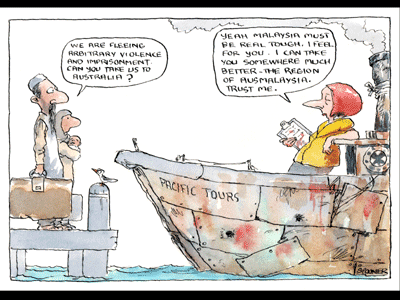
For Australian conservatives "national security" means controlling migration and a Fortress Australia with narrow portals whilst downplaying the right to seek asylum. For them the 1951 Refugee Convention is an inadequate instrument for dealing with the “global people movement”, mass refugee outflows or migratory movements, or “forced migration”.
As John Howard put it, “We have the right to decide who comes to this country, and the circumstances in which they come.” The obligations to help refugees under the 1951 Refugee Convention is seen as a substantial inroad on national sovereignty” and that is therefore unacceptable to conservative Australia.
Australia is built on immigration--ie., planned settler intake--- and its humanitarian intake is premised on a public expectation of a quid pro quo that the Government should and will control illegal migration. The Convention provides the sole legal basis for the protection of refugees worldwide. It codifies as a fundamental human right the right to seek asylum from persecution.
What appears to be happening since the 1990s is that Australia's asylum system has come under increasing strain through its use as a migration channel; and that the objectives of 'tightening up' and 'speeding up' processing determination of status procedures sufficiently to prevent asylum systems being a draw for migrants have not worked.
Maye, just maybe, the yet to be finalized refugee deal with Malaysia and Thailand may lead to the formation of a regional solution. At the moment it looks to be a quick political fix---political posturing as with the East Timor solution--- as it still has to be bedded down. It is a faint 'may' that Australia could take a leading role in pushing for the reform of the international asylum system.
Australia, like other Western governments, has been squeezed, between the pressures of a largely hostile public on the one hand, and their Convention obligations on the other, into awkward positions. Lip service is paid to honouring the 1951 Refugee Convention obligations and the right to seek asylum, while increasingly large amounts of money are spent on keeping asylum seekers out. The Convention has no mechanism for preventing mass migration outflows primarily caused by civil wars and ethnic, tribal and religious violence.
Currently, it is the countries in the developing world that have the bulk of the world's refugees. Australia could recommit to a sizeable annual offshore humanitarian refugee intake; and redirect resources currently spent on its onshore detention system to assist with the assessment of refugees in the camps within those developing countries (Malaysia and Thailand) who are the points of first asylum and transit centres.
|





the 1951 Un Refugee Convention has fostered simplistic and unfortunate characterisations of asylum seekers as either political and thus 'genuine' and deserving, or economic and thus 'abusive' and undeserving.