« June 2009 | Main | August 2009 »
July 31, 2009
polled publics and government
A report from the World Public Opinion people finds that majorities in 15 out of 19 countries surveyed want their governments to make climate change a higher priority. Germans think it's already high enough on the priority list, and Palestinians understandably have other things on their minds.
The naysayer campaign has had some success, in a roundabout way:
The poll also found that people tend to underestimate how high a priority their fellow citizens place on addressing climate change, with twice as many people saying they are above average than saying they are below average.
It's called the Lake Wobegon effect, believing that you care more than your fellow citizens. That must work in favour of governments looking to do as little as possible, if people think there's not much public enthusiasm for action. Clearly we need more opinion polls to counter the impression that the "debate" hasn't been settled.
Last night on Q and A, Anna Bligh was talking about abortion in Queensland, where a young couple are currently in trouble for an illegal termination. The transcript's not up yet. Even though it's well known that majority public opinion is pro-choice, Bligh said that any attempt at legislation would likely result in more pro-life legislation than we currently have.
What's with the huge disconnect between parliamentarians and the rest of us? Personally, I'd like to see a landmark electronic billboard, like the Coca Cola sign at Kings Cross, in every major population centre, constantly updating poll results on the issues of the day. We could get to know ourselves a lot better, and it would be harder for politicians to ignore a public that was more sure of itself.
Posted by Lyn Calcutt at 8:39 AM | TrackBack
the ugly side of the media
So we have a radio station 2DayFM owned by Austereo that has its FM's top-rating Sydney breakfast show hosted by Kyle Sandilands and Jackie O'Neil Henderson interviewing people with a lie detector test on air to help increase its ratings. This has been going for about six years and this regular stunt on the show of this celebrity shock jock radio is designed to shock and humiliate people to provide pleasure for Sydney's bogans.
In this case the girl's mother submitted her 14 year old teenage daughter to the test due to her concerns about her daughter's experiences with drugs and sex and wagging school. An initial question: why would a mother would do this to her child? Isn't this a form of public humiliation?
Before the actual test, the girl admitted on air to Sandilands, “I'm scared ... it's not fair”. Her mother asked her daughter: “Have you ever had sex?” The teen replied: “I've already told you the story about this ... and don't look at me and smile because it's not funny.” After a pause, she raised her voice with frustration and said: “Oh okay, I got raped when I was 12 years old.”
After a long pause, Sandilands then asked “Right ... is that the only experience you've had?" before the mother admitted she knew of the rape “a couple of months ago". Her daughter yelled, “Yet you still asked me the question!”
Sandilands implies that rape is a sexual experience as distinct from a violent experience of power over a woman.
So why was the teen strapped to a lie detector and asked about her sexual experiences in public in the first place? On Punch Sandilands says in his defence:
I’ve certainly pissed off a lot of journos over the years but I’m sad that they’re using the rape of a 12-year-old girl to have a go at me...As for what I said, it wasn’t intended to hurt. If people have found it appalling or offensive I’m sorry for them that feel that way, but I would ask people to put themselves into the situation where someone says to you during a live radio show that they have been raped.
Nothing about the more substantive issue why was the teen strapped to a lie detector and asked about her sexual experiences in public in the first place.
Isn't this a case of an underage child being asked personal questions about her sexuality for entertainment?
Posted by Gary Sauer-Thompson at 8:23 AM | Comments (16) | TrackBack
July 30, 2009
health reform: hospitals or primary care
A debate about health care is underway in Australia as a result of the National Health and Hospital Reform Commission's A healthier future for all Australians final report. It has organized its thinking around four issues: taking responsibility for health; connecting care; facing inequalities; and driving quality performance.
If the reform agenda is be a big part of the Rudd pitch for the 2010 election, then Ross Gittens warns that we should not expect too much from the Rudd Government, as it has a record of of over-promising and under-delivering. Our health culture is still one in which policies are driven by due process and authority and not by urgency or need.

Currently, the politics of health care is driven by access to hospitals----ie., waiting times for elective surgery and emergency services dominate discussion, the media and elections and ad hoc dab‟ reform aimed, , at one-off improvement rather than the creation of an adaptive, self correcting system, proactively seeking system improvement.
The ground is shifting. Even the AMA is acknowledging that general practice is not just about doctors any more. GPs, they say, must be supported by practice nurses, allied health and preventive health care providers to ensure we build on the strengths of Australia’s primary care network and developing effective e-health systems. How both of these happen is a bone of contention. The common ground is that the one issue that offers the greatest promise for health care reform is connecting care more effectively and that it is primary health care and prevention that provides the pathway for the much better connection of care that is needed for consumers across programs, services and governments.
This common ground is contested by Jeremy Sammut, a research fellow at the Overcrowded hospital system needs structural reform to end bed crisis op. ed. His position is that core concern in the health sector is the critical condition of the public hospital system throughout Australia. He says that the three-hundred page reform ‘blue print’ from the National Health and Hospital Reform Commission:
has identified the major problem. The reality is that Australia’s dangerously overcrowded public hospitals don’t have enough beds to provide a safe and timely standard of care even for emergency patients. Unfortunately, the NHHRC has strongly supported a range of non-solutions. The primary care reforms it proposes will not help our dysfunctional State-run public hospitals cope with an inexorable rise in demand from an ageing population...As more and more people live to older ages, a tsunami of demand will break in public hospitals. Increasing numbers of ‘very old’ patients will inevitably require emergency and bed-based hospital care due to the age-related onset of chronic conditions...
His argument is that the wrong-headed premise of the Rudd Government’s reform agenda is that the Commonwealth must spend billions on a national network of comprehensive general practice ‘Super Clinics’ to take pressure off hospitals.
What Sammut and the CIS are opposing is the argument that there are some structural changes that offer openings for long-term changes in the way health is delivered – away from the acute, hospital-centred model towards a system that puts more resources into prevention and care in the community.
Sammut's position is hospital centric. He argues in favour of rebuilding the hospital system with the Commonwealth taking full control of public hospital funding; introducing Medicare-issued, casemix-calculated hospital vouchers to pay for treatment in either public or private hospitals; state governments re-introducing local public hospital boards with full financial and administrative responsibility for their facilities; and closing down the area health services and use the money saved to fund vouchers and open and staff more hospital beds. It is a policy to reduce the health bureaucracy and put the savings into increasing beds in public hospitals.
Public hospitals need money to undertake reforms to become more efficient and safer for acute care. the case is compelling. It's now 15 years since the landmark Quality of Australian Health Care Study which found that 16.6 per cent of all hospital admissions were associated with an adverse event - half of which were considered "highly preventable". In March, Professor Jeff Richardson, of Monash University's Centre for Health Economics, updated those figures. He likens the number of such events today at approximately equivalent to one jumbo jet crashing every two weeks, each resulting in the deaths of 350 Australians. The cumulative unnecessary deaths since the publication of the QAHCS report would exceed the number of Australians killed in World War 1.
However, it is also the case that the health profile in our society has changed from episodic care to chronic health conditions (obesity, diabetes, mental illness, musculoskeletal conditions, ageing) and that the system is structured around hospitals providing relevant interventions for acute episodes. These chronic conditions are better managed within the primary care sector. Professor Hal Swerissen says:
The public hospital system should not be the first point of contact. It provides the backstop for the primary and community care system. If the first tier of the health system is not working well, then the hospital system will be put under stress.Not only will a stronger primary care system improve people’s quality of life by preventing disease, disability and distress, it should reduce pressure on the public hospital system
The better the comprehensive care plan (integrating many different specialities), then the fewer acute episodes that should occur is the argument. Better access to primary healthcare will mean reductions in obesity and smoking and earlier and better treatment of chronic diseases, such as diabetes. Hence the need to shift away from the acute, hospital-centred model towards a system that puts more resources into prevention and care in the community.
Posted by Gary Sauer-Thompson at 9:44 AM | Comments (3) | TrackBack
July 29, 2009
dodgy vocational education
Clearly there is something quite dodgy about Australia's vocational education export industry. The lid is being lifted on unscrupulous colleges, migration agents, education agents and businesses in which international students are treated as commodities in a marketplace that charges top dollar for low-grade education and training by private colleges that go bust. Some universities are part of the network.

Is it a government sanctioned racket about permanent-residency-seeking students for the export dollar? The state and commonwealth education authorities have failed to protect the welfare and interests of overseas students. Consequently, the bad press about Australia's overseas student program -- unscrupulous agents, violence, predatorial campuses --and the lack of industry regulation will dampen demand for vocational courses acting as immigration conduits.
The Australian Council for Private Education and Training says that it is just a few bad apples---a few shonky colleges ripping off international students. Julia Gillard says it is a world class sector with a good safety net to protect students from colleges going bust during a global economic recession. Etc etc.Both state and commonwealth governments continue to boost Australia's education industry as world class and as 3rd biggest export earner. It's all about money.
So should there be an "no automatic link" between study in Australia and access to permanent residency? Or should there be much tougher regulation?
It makes policy sense for the federal government to link Australia's growing international student program with the economic need for more qualified migrants to fill shortages. So the government smoothed the way for international students to gain permanent residency here once they had graduated with a qualification that was in short supply, provided they met other requirements such as English language proficiency. However, when the the scheme was expanded to include more students with vocational training (cooking and hairdressing) the door opened for operators to set up poor-quality colleges with the primary purpose of giving students permanent residency rather than an educational qualification.
Posted by Gary Sauer-Thompson at 8:20 AM | Comments (14) | TrackBack
July 28, 2009
Liberal Rule
I got back to Adelaide from a few days holiday in Broken Hill in NSW doing some photography just in time to watch the second episode of Liberal Rule on SBS. It was so much better than the ABC's The Howard Years, which was very wishy washy and lacked any sense of critique of the spin from the ministers in the Howard Government. There was no counter narration by agreement apparently. Silly ABC.

I'd missed the first episode Cycles of Power. The second episode, Hearts and Minds deals with issues (industrial relations, multiculturalism, education and indigenous affairs), the contrasting positions on these issues and the strategy behind the policies of the Howard Government. The episode is upfront about how determined the Liberals were about using the political power they had gained by winning the 1996 election to change Australia into their conservative conception of Australia.
SBS are dead right. A decade of Liberal rule did change Australia.
Howard may have won the battle of the waterfront in the end (reduced union power and membership, greater productivity), but he lost the war of ideas around unionism and the role of the government as umpire between employer and employee. He also definitely lost the battle of ideas around reconciliation, despite rolling back Mabo. Australia, to all intents and purposes, remains a multicultural nation whilst the views of the one nation conservatism are those of a conservative minority. Howard succeeded in creating a two tiered education system by squeezing the public system (school and university ) of funds.
Conservatives lost the battle of ideas---ideology---at the cultural level and a decade of Liberal governance of the capitalist system failed in key aim to make conservative Australia the majority, electorally speaking.
Posted by Gary Sauer-Thompson at 11:17 PM | Comments (9) | TrackBack
July 24, 2009
manufacturing or bust
Paul Howe, the anti-climate change unionist, is calling for an manufacturing policy to ensure that Australia continues to make things rather than just digs rocks. He says that in the middle of the worst global recession since World War II, Australia must do everything we can to support manufacturing and position the industry for the future.
The future, we should add, means adaption to global heating and an emissions trading scheme to deal with greenhouse gas emissions. Howe has run a campaign against an emissions trading scheme in the name of protecting jobs ( job security) from the extra costs of electricity under an an emissions trading scheme.

It is fair enough to defend manufacturing as opposed to Quarry Australia. However, what sort of things does Howe have in mind? Howe has come across as defending old Australia in the face of the new in the past.
Recently, Howe has been talking about a 21st century Steel Plan---a stratagem to save a key industry in the face of the global economic crisis. Howe is advocating motor vehicles, of course. And the steel industry. Howe says:
we need to build on the new steel plan launched earlier this year by the AWU. Steel's position as a strategic sector of the economy, with vital capability to meet infrastructure and defence requirements, should be recognised with greater accountability in the tender procurement process -- that is, if a project does not source Australian steel, it would need to explain why not -- to keep foundries busy supplying nation-building projects.
Buy Australian steel is the message here. It implies subsidies to encourage private sector buyers to take Australian steel over cut-price steel from global conglomerates. Does Howe's suggestion that a national manufacturing policy should build on progress in steel and automotives plus adding value to Australia's natural resources through investment in downstream processing mean something like an uranium enrichment plant? A national action plan, according to Howe, would build:
on progress in steel and automotives, elements include how best to add value to Australia's natural resources through investment in downstream processing; integrate trade and industry policy more effectively by getting the Industry Capability Network, Austrade and Enterprise Connect working together. We also could encourage the emergence of a new generation of global firms anchored in Australia, including in the $6 trillion environment and low-carbon industries; forge organisational design and skills formation into a competitive advantage; educate and inform so that manufacturing attracts the best and brightest students; and deal with the consequences of the next boom and an appreciating exchange rate to ensure the nation retains a viable manufacturing sector.
Now Howe does mention the $6 trillion environment and low-carbon industries. What does "green technology" mean in terms of manufacturing in new forms of renewable energy, a knowledge economy or sustainable cities, given Howe's antagonism to an emissions trading scheme, the shift to a low carbon economy, and greater use of renewable energy rather than coal?
Update
Howe's argument is that the impact of the economic crisis is starting to bite. Steel plant furnaces going offline from reduced demand from steel, and they may not be started up again, resulting in the loss of tens of thousands of jobs. Without significant government intervention, regional centres such as Wollongong and Newcastle would be devastated.
The AWU's steel plan for the 21st century does appear to be centred around production subsidies, guaranteed sales to government infrastructure projects and extra protection from foreign takeover bids under an industry "survival strategy".It is about helping struggling steel manufacturers to adjust and restructure from reduced demand.
Posted by Gary Sauer-Thompson at 9:28 AM | Comments (10) | TrackBack
July 23, 2009
bizarre
The Coalition continues to fight and squabble amongst itself in public over an emissions trading scheme even though they too took a proposal to the last election and acknowledge that they lost the election in part because of the resistance to doing anything significant about reducing global heating.

What next?
Why they could come out in support of the mining companies (eg. Rio Tinto) push for nuclear energy and express their hostility to renewable energy? This is the place to make a stand against Rudd on nuclear power. Make the differences clean and sharp.
The Coalition can show the electorate they are being positive since big subsidies for a domestic nuclear power industry is them being serious about reducing the nation's carbon emissions and base load power. High tech means that they can do away with all that girly stuff about renewable energy.
The free market liberals can make their stand for the free market, competition, prosperity and freedom by supporting the coal-fired electricity generator's demands for between $5 billion and $20bn in extra assistance from the Rudd government to avoid an "industry crisis" under the emissions trading scheme. The Coalition can show some political courage by making a big stand here, since the generators 130 million free permits worth at least $3.5bn over the first five years of the ETS is just not enough.
Posted by Gary Sauer-Thompson at 11:43 AM | Comments (5) | TrackBack
July 22, 2009
health reform?
By all accounts the National Health and Hospitals Reform Commission, which has been Commission to deliver the 'biggest health shake-up in decades', has avoided recommending a federal takeover of public hospital funding in spite of Rudd Government previous threat to take over public hospital funding if the states failed to sign on to hospital improvements.
Instead the Commission recommends a shift to better --more effective---primary care to ease the strain on emergency departments of public hospitals. This is more a systematic reform rather than a bandaid:

It would seem that what has been recommended by the Commission is that outpatient services and community health centres now run by states would transfer to federal funding. This would aim to ensure a better coordination of services for patients between federally-funded general practitioners, the state-financed community centres and hospital out-patient services and the GP super clinics.
Better community services ( primary care) would reduce demands on the over-stretched hospital emergency departments. So keeping people out of hospital by preventing disease, improving access to GPs, and overhauling the aged care sector is at the heart of reforms.
Posted by Gary Sauer-Thompson at 1:59 PM | Comments (2) | TrackBack
July 21, 2009
unemployed professionals
The newspapers are saying that the global economic recession won't be that bad, unemployment will not be severe in Australia, China's economic growth will ensure Australia's prosperity and Australia is on the road to recovery. So let us dig up more coal, build the new infrastructure to transport the coal more efficiently, ship it quick to China, and keep using coal to power the economic engine to produce unlimited growth and limitless freedom.
The other face of the economic recession is not the denial that the ecological crisis (eg., the Murray-Darling Basin and climate heating) has become the most distinctive expression of the crisis of capitalism and modernity. It is also a new situation wherein some laid off workers in Australia — professional and technical as well as industrial — are refusing to engage in wage and salary labour that does not meet the standard of a living wage.
As Stanley Aronowitz points out in Situations this trend is not being squarely looked in the eye. These people are not the working poor suffering from lack of skills, drug addiction and just plain laziness., which are the main historical ascriptions by politicians and many mainstream journalists of why men of prime working age refuse to take available jobs in the paid workforce.
For the most part these men were either long-time employees of large manufacturing corporations or highly skilled professionals including journalists. They are not willing to settle for low-paid employment (driving taxis) which, for men over fifty, is about all the work that is available.
These men, who have dropped out of the paid labor force, are a growing segment that is refusing to work, at least given their options. For these men in their prime of career life, they survive on their separation packages taking out second and third mortgages on their homes, drain their pensions and savings, depend on their wives’ income and accept occasional short-term work to keep their heads above water.
If they were prepared to go quietly into the night from paid work, many become web designers, photographers researchers, musicians, blogging etc---the world of self-determined work. This is a different kind of world to the world of communication and information of the new media, where the quantity of information and data has multiplied at
a geometric rate. The former provides possibilities for enriching lived experience, enlarging the new social spaces that have emerged with the internet and digital technology and producing new new languages in which to express lived experience.
The world market in information, data and news is characterised by the replacement of meaning by signs, the shift from positive knowledge to information, the replacement of philosophy by technology in that the technological fix becomes a substitute for critical reflection. The global media, reflecting the new social hierarchies where access to data bases and the internet, becomes a marker of whether you count and the knowledge contained therein defines what political and economic knowledge is. Hence the desire of media corporations such as News Ltd to gain control of the internet.
The new digital spaces that we are in the process of producing in the creative economy need to be defended from being appropriated by the media corporations opposed to 'the free'.
Posted by Gary Sauer-Thompson at 11:10 AM | Comments (5) | TrackBack
July 20, 2009
Two China's
David Sirota sums up his trip to China, which he published in OpenLeft.com, in terms of two China's at Salon.com. He says that on his trip he's seen America circa 1900: coastal metropolises of towering wealth hemming in a polluted and destitute heartland. Two Chinas, as John Edwards might say -- one you constantly hear about and another hidden from view.
The China we know in Australia is the China of the economic miracle, which Sirota describes in terms of:
the sleek office towers, fine restaurants and nouveaux riches -- the "miracle" endlessly celebrated by the New York Times' Tom Friedman (China is a place of "wide avenues, skyscrapers, green spaces, software parks and universities"), Newsweek's Fareed Zakaria ("China's growth has obvious and amazing benefits for the world") and most of America's Very Serious Commentators.
The other China is Guiyang, a coal-mining town of 3 million in China's poorest province, which is the darker side of the "miracle." Sirota says:
Here in the countryside is the soundstage of a post-apocalyptic sci-fi flick -- filth-covered tenements slapped together with crumbling cement and kitchen tile; limbless paupers with burned faces begging for food; an atmosphere choked by soot, exhaust and the stench of human excrement.
What Australia cares about is China returning to its furious economic growth since that means greater demand for natural resources. We are dependent on China, addicted to its growth.
Bring back the commodities boom say the spruikers for the miners and energy companies. It's our path to riches. If the next boom can't be rebuilt on coal and iron ore, then lets built it on natural gas (LNG). Australia is open for business. Gas promises much lower emissions when used instead of coal in power generation and China promises by far the most demand growth. Bonanza time folks.
Posted by Gary Sauer-Thompson at 11:53 AM | Comments (5) | TrackBack
both sides now media
One of the annoying aspects of the traditional media--newspapers, television and radio--is not its celebrity culture, which is bad enough. It is political journalism's conception of objectivity. Objectivity is understood as truth, and truth is gained from splitting the difference between the two sides. This implies that there is always truth to both sides of an issue. So we have "both-sides-are-equally-valid" journalism on climate change when natural science is clearly on one side of the debate.
I find this objectivity of political journalism amazing when a core problem with the traditional media is their closeness to political power. They are on the drip feed----access to the well known senior or anonymous resources that pop up everywhere in the media. So instead of journalism's ethos being one of telling truth to power, it is one of transmitting spin and deception to the powerless citizens by recycling their media releases. Journalism is presenting the media releases from both sides of an issue as news and commentary. It's manufactured news and the journalists become spokespersons, and advocates, for a political faction or the government of the day. They depend on these sources.
For them----and there are exceptions---it is often best to keep the lights off rather than turn them on about the media's dependance on, and closeness to, political power.
Posted by Gary Sauer-Thompson at 8:19 AM | TrackBack
July 19, 2009
limits on executive government
Jack Waterford's comments on the limits of executive government at the Canberra Times are interesting in the light of this argument about authoritarian capitalism.He says that there are those including me who:
would like to see some circumscription of a constantly expanding range of executive power as against the parliament. One might argue that parliament is the author of its own misfortunes in this regard, given that it has been prepared to hand over some of its most important functions to ministers, and to rubber-stamp whatever they do. Yet one might have expected that the judiciary, as the third arm of constitutional government, might be a little more willing to put some limits on the incestuous affair, if only on behalf of a citizenry increasingly being trampled by the descent into discretion, arbitrary power, and an effective power of dispensation from the rule of law.
Federalism, under the Australian Constitution, implies the distribution of powers between Commonwealth and States and between the three branches of government. That, in turn, implies limits on executive government.
There needs to be limits on executive power othrwise we are drifting towards authoritarian capitalism behind the veil of 'emergencies', 'crises', 'dangers' and 'intense difficulties', of 'scourges' and other problems that relate to things as diverse as terrorism, water shortages, drug abuse, child abuse, poverty, pandemics, obesity, and global warming, as well as global financial affairs and which require, so the public is endlessly told,that 'wars' must be waged, 'campaigns' conducted, 'strategies' devised and 'battles' fought.
Posted by Gary Sauer-Thompson at 5:01 PM | Comments (4) | TrackBack
July 18, 2009
Iran: authoritarian capitalism
Slavoj Žižek has an article on authoritarian capitalism at the London Review of Books. He interprets the recent events in Iran in terms of there being a genuinely liberatory potential in Islam. The street protest movement was an opening that unleashed altogether new forces of social transformation: a moment in which ‘everything seemed possible.’
What followed was a gradual closing-down of the democratic possibilities as the Islamic establishment took political control. To put it in Freudian terms, today’s protest movement is the ‘return of the repressed’ of the Khomeini revolution. Žižek adds:
The future is uncertain – the popular explosion has been contained, and the regime will regain ground. However, it will no longer be seen the same way: it will be just one more corrupt authoritarian government. Ayatollah Khamenei will lose whatever remained of his status as a principled spiritual leader elevated above the fray and appear as what he is – one opportunistic politician among many. But whatever the outcome, it is vital to keep in mind that we have witnessed a great emancipatory event which doesn’t fit within the frame of a struggle between pro-Western liberals and anti-Western fundamentalists.
What is in formation is an authoritarian capitalism with a religious face: a Middle Eastern version of Lee Kuan Yew, the Singaporean leader who thought up and put into practice a ‘capitalism with Asian values’.
Posted by Gary Sauer-Thompson at 9:00 PM | TrackBack
July 17, 2009
Afghanistan: the rhetoric
There is growing anger and bewilderment, and a developing political row, in Britain over the ongoing deaths of British servicemen in Afghanistan. The British military death toll in the country since October 2001 is now 184, five more than the lives lost by British forces in Iraq. In most cases, the deaths have been the result of improvised explosive devices and remote-controlled bombs, rather than guerrilla attacks. Britain's military presence in Afghanistan is becoming increasingly unpopular.
 Peter Brookes
The Taliban appear to be less interested in talking or negotiating and more interested in disrupting NATO's counter-insurgency efforts. If the guerrillas are facing a decent army, they are not going to stay and fight. They flee (melt away) and come back once the army has left.
For Gordon Brown, the British PM, the reason for the Afghan campaign is that it is a "patriotic duty" to keep the streets of Britain safe from the threat of terrorist attack.
This is a patriotic duty. Of course people want to know if the action we are taking is the right action. It comes back to terrorism on the streets of Britain. If we were to allow the Taliban to be back in power in Afghanistan and al-Qaeda then to have the freedom of manoeuvre it had before 2001, then we would be less safe as a country.There is a line of terror - what you might call a chain of terror - that links what's happening in Afghanistan and Pakistan to the streets of Britain.
He says that British troops are making progress as they attempt to make the area safe--Brown is referring to Operation Panther's Claw offensive to drive the Taliban from central Helmand province.
I guess that things have improved somewhat because the old imperial Bitish rhetoric ---the white man's burden --is not longer being used as justification.
Posted by Gary Sauer-Thompson at 2:35 PM | Comments (16) | TrackBack
July 16, 2009
the people's kevin
The Punch generously published Steve Fielding's climate change wisdom today. Apparently he does believe that climate change is happening, but there is no change in the climate according to his graph, so he can't support the legislation. How you can think climate change is happening if there's no climate change is probably one of those deep questions only engineers and Family First senators can get their heads around. As a fairly ordinary person, I'm having trouble.
160 comments and counting. Well scored, the Punch.
Not be outdone, our Kev has responded. Even better score, Punch.
Shorter Rudd, the rest of the world accepts that something needs to be done rather urgently, so it's best we hop to it. Kind of like the rest of the world agreeing it's best not to marry immediate members of your family. We wouldn't want to be seen stalling on something like that, would we? Or sending children into mines or eating one another or buying and selling one another. None of these things were good for the future of humanity, so we stopped doing them.
30 comments, early hours yet.
Fielding appears to be attracting the sort of attention he wants, which is nice for him.
Comments are interesting for what they say about the Punch readership.
Interesting choice of venue for Rudd, given his recent observations on newspapers.
Posted by Lyn Calcutt at 7:19 PM | Comments (3) | TrackBack
intrigue
I wonder what happened here?
AN ONLINE article about Opposition Leader Malcolm Turnbull's fund-raising was pulled shortly before publication yesterday.The editor of On Line Opinion, Susan Prior, had agreed to post the article by NSW Greens MP Lee Rhiannon and academic Norman Thompson yesterday morning.
But on Tuesday afternoon, Ms Prior told them the board of On Line Opinion's publisher, the National Forum, had ruled the article on Mr Turnbull's Wentworth Forum would be pulled.
I wonder whether Rhiannon and Thompson will try to publish elsewhere?
...
Graham Young responds
The Age published an article this morning which implies that On Line Opinion "pulled" an article by Greens MLC Lee Rhiannon for political reasons. This is completely incorrect.
Posted by Lyn Calcutt at 10:30 AM | Comments (11) | TrackBack
globalisation + book publishing
Globalisation is catching up with the book publishing industry in Australia and the current system restrictions on book imports that is designed to protect local publishers from the competition from low-cost imports. Import restrictions are used to protect local publishers and authors. Can Australia's cultural industries thrive without protectionism?
On Tuesday the Productivity Commission's report----Restrictions on the Parallel Importation of Books recommended removing restrictions on book imports to help make them cheaper, whilst acknowledging the changes would hurt the local publishing industry. It says that after examining the available quantitative and qualitative evidence:
the Commission has concluded that the PIRs place upward pressure on book prices and that, at times,the price effect is likely to be substantial. The magnitude of the effect will vary over time and across book genres. Most of the benefits of PIR protection accrue to publishers and authors, with demand for local printing also increased. Most of the costs are met by consumers, who fund these benefits in a nontransparent manner through higher book prices.
It says that reform of the current arrangements is necessary, to place downward pressure on book prices, remove constraints on the commercial activities of booksellers and overcome the poor targeting of assistance to the cultural externalities.
By cultural externalities the Commission is referring to consumers of culturally significant books directly benefiting from the cultural value of a vibrant national literature. They say that:
PIRs [Parallel Import Restrictions] are a poor means of promoting culturally significant Australian works. They do not differentiate between books of high and low cultural value.The bulk of the assistance leaks offshore, and some flows to the printing industry.
Hence the idea floating around that the Government could help promote the cultural value of Australian authors through direct subsidies, rather than by general import restrictions.
The Australian literary culture crowd are up in arms and they have been defending the value of high literature against those of the marketplace. My own situation is akin to Elizabeth Farrelly's. I do buy from Amazon whilst also trying to support the local bookshop. I have only been into Borders once and I look forward to a good battery charged- e-book reader so that I can read digital books.
I have dramatically cut back on buying books (they are expensive) and welcome the way that the internet has opened up the possibilities for self-publishing re my photography. Independent Australian publishers would not be interested in this kind of work.
Posted by Gary Sauer-Thompson at 9:27 AM | Comments (7) | TrackBack
July 15, 2009
surveillance: some questions
Are we “sleepwalking into” a surveillance society with the current emphasis on using surveillance in the form of closed circuit TV (CCTV) cameras, DNA databases, Radio Frequency Identification technology (RFID), and the collection and retention of purchasing behavior in corporate databases, that have been put in place to keep us "safe" and "secure" from disorder, crime and terrorism?
The surveillance society is very evident and upfront in Spooks currently showing on ABC TV. The spooks (MI5) have the technology to monitor everything in the name of national security.
How do we understand privacy in this context of ever increasing surveillance in the absence of human rights legislation in Australia, and the determination of conservatives in Australia to ensure that there is no human rights legislation passed by the commonwealth government to act as a counter to the coercive force of hegemonic power?
Does privacy in this context just mean “going about our business undisturbed"? Or does it mean, as N. Katherine Hayles points out:
the presumption of freedom from having our affairs overlooked by others, absent compelling reasons to the contrary; it means having access to data that has been collected on us by interested parties; it means having control over how data about our private lives is used and by whom; it means the right to establish boundaries between public and private spaces that are lawfully enforced and respected by everyone, including functionaries at every level of government, from town councils to national agencies, and at every level of corporate activity, from local stores to transnational databases.
The utilitarians would say that, since the benefits from surveillance outweigh the harms to privacy, increased surveillance whereby citizens are disciplined through a real time monitoring of their behaviors as they move with apparent freedom through space is in the public interest.
Posted by Gary Sauer-Thompson at 1:30 PM | Comments (15) | TrackBack
July 14, 2009
China: a rising power
There is a lot anti-China feeling circulating in Australia at the moment. These arise from the arrest of Rio Tinto's executive Stern Hu and others over the recent iron ore trade negotiations, in which an aggressive Rio has endeavoured to keep this year's iron ore contract price cuts to 33 per cent. The allegations are that the four Rio Tinto employees paid for detailed government trade and manufacturing data to give Rio Tinto executives an edge in iron ore negotiations with Chinese state-controlled steelmakers.
Michael Stutchbury in his column in The Australian:
Humiliated by rejection, Chinese state security has locked up one of Australia's top iron ore negotiators in its cells for the alleged theft of state secrets and taken possession of the computer hard drives from Rio Tinto's Shanghai offices. And it has refused to indulge in reasonable dialogue with the Rudd government over the matter. Talk about many ways to skin a cat!
Stutchbury's column is entitled Magic dragon grows into menacing bully even though China frames resource security in national security terms. China takes its resource security seriously and Chinese firms have encountered difficulties when trying to take large stakes in Western oil and mining companies.

Rowan Callick observes that China's arrest of Rio Tinto executive Stern Hu for stealing state secrets:
amounts to a strategic throw of the dice. Beijing is upping the stakes in its relationships with Australia and with the broader industrialised world. It is confident that the ball is in its court, that it is becoming the prime actor not only in the economic world but increasingly in the diplomatic world, too.
China and India are quickly becoming the world's new economic powerhouses and China’s state has a de facto monopoly on most of China’s outward investment for national security reasons.
Though China’s economy may have expanded over the last year ---China almost certainly produced a bigger stimulus program than any other major economy---that expansion clearly hasn’t fed through into more Chinese demand for US, European or Japanese goods. It is only in commodities, where Chinese demand — and Chinese stockpiling — has had an impact. However, China is the only country amongst those that relied heavily on exports for growth (Japan, Germany etc) to have avoided large economic downturns. China has reflated its domestic economy as world demand slowed.
China has the upper hand, given the increasing concern about the sustainability of the United States’ large external current account deficit. The globalization of finance which resulted in a world where the poor financed the rich, not one where the rich financed the poor. This “financing" flow was essentially a government flow. Despite the talk of the triumph of private markets over the state a few years back, the capital flow that defined the world’s true financial architecture over the past several years was the result of the enormous accumulation of foreign exchange reserves in the hands of the central banks of key Asian and oil-exporting economies, especially China.
China is now the largest of the U.S. creditors and its willingness to absorb U.S. Treasurys could be key to the success of the U.S. fiscal stimulus and banking sector rescues. China is worried that the US will deal with its unsustainable fiscal path via inflation and debasement of the value of the dollar via depreciation. Consequently, China is flexing its muscles on the question of the global reserve currency system dominated by the dollar.
Posted by Gary Sauer-Thompson at 8:34 AM | Comments (20) | TrackBack
July 13, 2009
moving out of the current crisis
We are currently living through a crisis of capitalism in that capitalism is running into serious environmental constraints, as well as market constraints and profitability constraints. The 3 per cent growth rate that capitalism requires to reproduce itself is going to exert tremendous environmental costs as well as pressure on our social situations and institutions.
In an interview at Democracy Now David Harvey usefully addresses this idea of 'crisis'. Harvey, a Marxist geographer, says:
You know, crises are terribly important in the history of capitalism. They are what I would call the kind of irrational rationalizers of the system. What happens is that capitalism develops in a certain way, has real problems, then it goes into crisis, and it comes phoenix-like out of it in another form. We went through a long crisis in the 1970s. There was a long crisis in the 1930s. So a crisis, then, is a moment of reconfiguration of what capitalism is going to be about. And right now, as I’ve said, the powers that be are more about trying to reconstruct the pre-existing power structure or save the pre-existing power structure without intervening in it in any way.
It appears that the US is going to have to bear the brunt of this financial and economic crisis and its global role will be diminished. This would leave the US as one powerful region alongside many others (eg., south east Asia, structured around China?) and without the power it has exercised over the global economy. Regionalisation is one process that we may well see.
What else?
My response to the various sessions on the city at the The Adelaide Festival of Ideas, which were dominated by exploring the mitigation and adaptation to the effects of climate heating, is that urbanisation is another central process.

The last 30 years have witnessed an immense amount of the capital surplus has been absorbed into urbanisation: urban restructuring, expansion and speculation. Our cities are huge building sites for capitalist surplus absorption.
Since the gentrification process was a kind of reconstructing urban environments our cities are also sites for household debt (mortgage and credit card) that helped the property developers who are building the houses in the process of gentrification of the urban fabric. With the collapse of credit from the global financial crisis we are now experiencing asset devaluations with the losses of asset value with the collapse of credit.
How the city develops is largely determined by state governments, their development boards and the developers and the financiers. Most of us in the local community don’t really have a very strong say.
So there is a need for the democratization of the city, of city decision making so that we can all actually not only have access to what exists in the city, but also be able to reshape the city in a different image, in a different way, which is more socially just, more environmentally sustainable and so on.
We do need a new pattern of urbanisation--a more local one concerned with the development of productive systems such as solar power, to create more decentralised employment apparatuses and possibilities.
Posted by Gary Sauer-Thompson at 9:03 AM | Comments (10) | TrackBack
July 12, 2009
more competition in the banking sector
One of the consequences of the Rudd Government protecting the Australian banks during the global financial crisis is that competition in the financial sector has been sacrificed. The balance sheet of the state was put behind the big banks. The non-bank financial institutions, which lent for home mortgages at cheaper rates, have been decimated or taken over. Time for a big inquiry into the finance industry to restore some form of competition.
 Bruce Petty
The big four banks are amongst the most profitable in the world, and they have set up a flow of money from a variety high charges and penalty fees that bear little relation to the actual cost. The banks, in short, are gouging customers who have little power to challenge the banks. It's called saving the banks and socking it to the people. As soon as the big guns get into trouble, the state bails them out. The inferred politics is that state power should protect financial institutions (bailing out the banks) at all costs.
In the words of Martin Wolf at the Financial Times:
What has emerged after the crisis is ...an even worse financial system than the one with which we began. The survivors are an oligopoly of “too-big-and-interconnected-to-fail” financial behemoths. They are the winners not because they are necessarily the best businesses, but because they are the best supported. It takes no imagination to realise what these institutions might now do, given the incentives for risk-taking.
The big four banks are deemed to be too big and interconnected to be allowed to fail, no neat structural solution can be identified, and the banking sector is vital to the UK economy. The the banks are using the money not to lend to anybody but to buy other banks. They are consolidating their power. We’re the ones who are paying and they are the ones who are benefiting.
What then of the costs imposed by the financial sector on us? What we know is that the financial sector will see off attempts to impose a more effective regulatory regime in the name of the “light touch” approach to regulation, the concentrated interests of the banks will overwhelm the general one, and the state is concerned with protecting the bankers, not with protecting the people.
We are going to hear a lot of special pleading from the industry mixed up with rhetoric about individual liberty personal responsibility, privatisation and freedom of markets and all those kinds of neo-liberal things.
Posted by Gary Sauer-Thompson at 9:27 AM | Comments (3) | TrackBack
July 11, 2009
G8 + climate change
The G8, which is being held in L'Aquila, Italy, has addressed the neo-liberal growth machine economy by saying that they have agreed to limit the global temperature rise to 2C, to cut world emissions 50% by 2050, and for the G8 to reduce its own pollution 80% by that date. Sounds good doesn't it.
Unfortunately India or China were not present. The developed rich countries no longer have the lion's share of emissions, and that any action they take is pointless without the co-operation of developing nations such as China and India. The G-8 summit was a funeral ceremony. The G-8 is dead, at least as a global leadership forum. It has now been reduced to a mere talking shop for certain heads of state and government. The important decisions are made elsewhere -- at the G-20, for example.
 Peter Brookes
The developing countries want the G8 nations to sign up to a 40% cut by 2020, but that figure is off the radar of the EU and, given the unwieldy legislation laboriously passing through the senate, not a possibility for the US. Australia is talking in terms of a 5% cut to its greenhouse emissions resulting from stoking the global carbon economy with cheap, dirty coal. Developing countries will commit once they have certainty that developed countries are committing themselves.
Update
What we can infer from the above is that all the signs indicate that the cut to emissions from cap and trade schemes, renewable energy and d energy efficiency will not be enough to prevent a 2% increase in temperature. Global heating is a reality. What happens then? What is going to be done after we have awoken from the neo-liberal dream of an eternal economic boom?
In a talk at the Adelaide Festival of Ideas entitled Climate Change is a crisis of overproduction not overconsumption Brendan Gleeson, the Director of the Urban Research programme at Griffith University, argued that the state will need to intervene big time.
The speed of climate change is interpreted by natural scientists in terms of them saying that that we have the next ten years to avoid a terrible tipping point, after which we face the unthinkable prospect of runaway climate change.
Gleeson's argument was that since capitalism is not able to fix its market failure of global heating so the state needs to step in to protect society from the consequences of global heating. As in World War 2 capitalism is suspended in order to deal with the crisis. 'Deal' means adapting to the negative effects of increased temperatures: a blast furnace of drought, heat and hurricanes. The 10 year drought, which may or may not be over, is a postcard from our future.
Hopefully this suspension of capitalism would result in an ecological modernisation that would decouple economic growth from environmental damage through careful institutional and technical transformation.
It was unclear from Gleeson'ss lecture how this decoupling would be achieved by the state.
Posted by Gary Sauer-Thompson at 1:37 PM | Comments (9) | TrackBack
July 10, 2009
Adelaide Festival Ideas 2009: health
One of the Sunday sessions at the Adelaide Festival Ideas is entitled Trick or Treatment? Alternative medicine on trial---It's a talk by Simon Singh, one of the authors of Trick or Treatment? Alternative Medicine on Trial. The session is in the form of a lecture not a debate.
The book is in the debunking tradition as the authors state in their introduction that "Our mission is to reveal the truth about the potions, lotions, pills, needles, pummeling and energizing that lie beyond the realms of conventional medicine."
The authors say their goal is to answer the question of whether alternative therapies provide any benefits — or only a placebo effect Truth’ is understood in the sense of the fundamental question: ‘is alternative medicine effective for treating disease?’ This article by Singh in The Guardian with respect to chiropractic care is an example of the approach.
The book evaluates the scientific evidence for acupuncture, homeopathy, herbal medicine and chiropractic, and briefly covers 36 other treatments. It finds that the scientific evidence for these alternative treatments is generally weak, but finds that the acupuncture, chiropractic and herbal remedies have some evidence of limited efficacy for certain ailments. Homeopathy is concluded to be completely ineffective.
Their judgement is that this book delivers the ultimate verdict on alternative medicine. What they call conventional medicine is not under scrutiny because that falls under science, knowledge and truth whereas alternative medicine falls under opinion, ignorance and superstition.
According to a review in Frontier Psychiatristthis standard Enlightenment duality is defended in the following way:
Any treatment which cannot stand up to the rigours of scientific enquiry, by which Singh and Ernst mean a well conducted controlled clinical trial, has no place calling itself medicine and is simply hocus-pocus with good PR. At best such therapy is simply no better than placebo, at worse it is positively dangerous. But even if it is harmless, it is far from costless, as the annual global spend on alternative medicine is in the region of £40 billion, money that could be spent on more fruitfully, should alternative therapies prove to be ineffective.
The position of the book is that anything that works and can be shown to do so in a properly conducted clinical trial is no longer actually alternative medicine, and anything which cannot pass these rigorous tests should be treated with great suspicion, since they are little more sugared placebo's.
Several quick points. The boundaries between orthodox and unconventional treatments are less precise than they suggest; complementary medicine has also become increasingly legitimised in the past decade; many people suffer from chronic illnesses that respond poorly to conventional treatments by orthodox medicine or from a constellation of symptoms that are not easily diagnosed or treated by mechanistic medicine; the randomized controlled trial is not the only way of gaining evidence in everyday clinical care, community health or building a knowledge base; no mention is made of the harm and deaths caused by orthodox medicine's interventions.
The appeal to well conducted controlled clinical trial is an appeal to the positivist, empiricist worldview that underpins the theory and practice of evidence-based medicine, and this overlooks the conflict within the long-standing “paradigm war” in the philosophy of science between positivist, interpretivist, and critical approaches.
Posted by Gary Sauer-Thompson at 3:04 PM | TrackBack
July 9, 2009
journalism, News Ltd style
In his 'bash the bloggers' speech last week at the Press Club, John Hartigan of News Limited called for less political spin and more inspiring stories in newspapers. Less focus on the "politics of politics" and more "that inspires, surprises and delights readers" as he marketed News Ltd vision of the future of newspapers in Australia's digital economy. Interesting he sad nothing about the drip feed.
Hartigan's vision stated that people will pay for "well researched, brilliantly written, perceptive and intelligent, professionally edited, accurate and reliable" information/news, with the inference that only News Limited was able to deliver. I'd' always puzzled about what "well researched " meant given the deceptions practised by the News Ltd tabloids, the way they stir the prejudices of their core readership, and the systematic prying into the lives of people in rather repellent ways. Or the example of Fox News in the USA, which is the media mouthpiece of the Republican party. This is the press that poses as the bastions of morality and champions of law and order in Australia whilst selling selling fear and hatred to make a profit.
Now, what has been happening in England----the phone hacking saga---gives us some idea of what "well researched " may mean. It is alleged that Murdoch's News of the World tabloid (and News Group Newspapers, part of News International) used criminal methods to get stories. The Guardian reports that "research " involved illegally hacked into the mobile phone messages of numerous public figures to gain unlawful access to confidential personal data, including tax records, social security files, bank statements and itemised phone bills.
It states:
Most of the work was subcontracted to private investigators. A senior Metropolitan police officer claimed to have evidence that thousands of people in public life had had their phones hacked by agents working on behalf of papers. The victims included MPs, cabinet ministers, minor celebrities and sportsmen. The Scotland Yard files mirror parallel evidence compiled by the information commissioner, who uncovered thousands of examples of activity which was "certainly or very probably" illegal.
It's more like the mongrels of the dumbed down yellow press being off the leash isn't it. I wonder how the News of the World and the News Group Newspapers will run the public interest defence argument for these kind of invasion of privacy practices.
Posted by Gary Sauer-Thompson at 12:02 PM | Comments (6) | TrackBack
Murray Darling Basin: sad news
The Murray-Darling Basin Authority reports that storages across the Murray-Darling Basin are low after nine dry years. Inflows for 2008-09 were the third-lowest in 118 years of records, with the soil so parched even the runoff from heavy rains in the northern basin have failed to make it south.
The effect in the lower lakes (Alexandrina and Albert) and the Murray Mouth region of the basin is this.
In The Australian Siobhain Ryan and Asa Wahlquist report that almost half the water entitlements purchased by the Rudd Government under the national Murray-Darling rescue plan last financial year will never reach the distressed Murray system except in times of flood. They say:
New figures reveal the Rudd government made NSW's Lachlan, Gwydir and Macquarie catchments the top targets for its big-spending buyback program in 2008-09, despite the fact that they all terminate in wetlands. About 182,000 of the 397,000 megalitres of water entitlements bought across the basin last financial year are now confined to catchments that rarely flow into the main Murray system, which has been devastated by drought and over-extraction.
It is true that the Gwydir and Lachlan catchments as in poor and very poor health with internationally important wetlands that provided homes for threatened or migratory species and they do need water. But why spin these buybacks as helping the Murray? Though we have a Basin Planin process -- ie., a strategic plan for the integrated and sustainable management of water resources in the Murray–Darling Basin---very little water has actually been returned to the River Murray's environment.
The plan's emphasis on the integrated and sustainable management of water resources in the Murray–Darling Basin is a joke, given the barriers to trade that have limited the purchase options of the the federal buyback push. Thus there is major resistance from the states, with NSW boycotting further sales to the commonwealth while Victoria's 4per cent limit on the trading of water out of individual irrigation areas remains in place. South Australia is pushing ahead with a High Court challenge to the Victorian policy or limiting trade.
I should qualify my remarks about the Basin Plan. It is stated by the Murray-Darling Basin Authority that:
The plan will provide a fundamental framework for future water-planning arrangements, and will be based on the best and latest scientific, social, cultural and economic knowledge, evidence and analysis. In preparing the plan, the Murray–Darling Basin Authority will consult extensively with Basin state and territory governments, key stakeholders, and rural and regional communities across the Basin.
However, all we have us is a concept statement about the Basin Plan, since the first Basin Plan is to be released in 2011. So all we have is the concept statement that explains in general terms the key elements and approach being taken in developing the Basin Plan, what it will contain, and when and how it is being developed.
Posted by Gary Sauer-Thompson at 9:14 AM | Comments (6) | TrackBack
July 8, 2009
Iran: within the corridors of power
Both President Ahmadinejad and Ayatollah Ali Khamenei have tightened their grip on power in Shi'ite Iran. They have succeeded in curbing the popular, peaceful challenge to the authenticity of the June presidential election and clamped down on the opposition with force to their rule with force, despite the opening of a rift within the ruling religious/clerical establishment. Iran’s key security forces — the élite Revolutionary Guards Corps and the Basij militia — remained, and continue to be, bastions of support for Ahmadinejad and Khamenei.
The conflict was a battle between rival---conservative and reformist---factions of the regime, with both factions defending The Islamic Revolution. The conflict battle is far from over, even though it’s no longer being fought primarily on the streets. Tony Karon at Rootless Cosmopolitan says:
The 1979 revolution created two sources of authority; the electorate and the clergy, and it sought to balance those to some extent. Ayatollah Khamenei may have begun to irretrievably alienate himself from both, making the office of Supreme Leader less about offering the regime moral and spiritual guidance than about being an extension of one faction.
One possiblity is the pursuit of some sort of compromise that allows the regime to back down to some extent, without necessarily surrendering and such a compromise may be shaped by the battles inside the corridors of power.
Posted by Gary Sauer-Thompson at 7:30 AM | TrackBack
July 7, 2009
banner
The Government 2.0 Taskforce site has been up for a while now, feeling its way slowly into this crowd sourcing thing. It hasn't had a spectacular start, but Nic Gruen's there which is a pretty good sign.
One of the very first things they did was launch a banner design competition. No prizes or rewards other than winning. It was a curious early step, but the whole thing is overtly experimental, so what the hey.
The entries are in and there's a voting gadget if you feel inclined to participate. Nic has asked for Troppodillian's views, but he didn't say it was exclusive.
There have been quick and numerous responses to comments, which is also a good sign. It's only realistic to expect that processes of more open engagement on meatier topics will happen more slowly.
...
In his launch speech Lindsay Tanner said:
The Taskforce will advise the Government on how to:make government information more accessible and usable;
establish a pro-disclosure culture around non-sensitive public sector information;
maximise the extent to which government utilises the views, knowledge and resources of the general community; and
build a culture of online innovation within Government to ensure that it is open to the possibilities created by new collaborative technologies, and uses them to advance its ambition to continually improve the way it operates.
The general idea is that if government made more of its warehoused information available to the public, it could utilise crowd sourcing. Or as Taskforce member Alan Noble puts it, information is more powerful when it's set free.
So far, it's largely discussion of the technicalities - how to improve navigation, what kind of software to use, whether to include simple voting mechanisms. Whether the blog will be used as some kind of gateway to newly released information doesn't seem to have been decided yet.
It's a very raw approach, starting with literally nothing and asking people to build the ideas for them. At the moment, IT types are probably the most useful contributors, but there are some interesting ideas on how to make the most of participation. Nic Gruen took a fancy to one called 'layered participation' which would allow people to participate according to preference and capacity. For example, on a given topic, you'd have a simple voting mechanism, a gadget for shorter comments, and another facility for complex contributions.
Nothing yet on whether the project will embed itself in the wider online discussion, or whether it will be a stand-alone structure. Will it include a blog roll, will taskforce members participate elsewhere, will they harvest info and ideas from other sites/blogs. There's a few full time jobs right there.
I would think there would be a limit to what could be done. Say, for instance, they release some raw data on school performance, and say Possum mashes it around with selections from his vast collection of variables, and publishes something interesting on his Crikey blog. Apart from all the copyright weirdness between government, Crikey, and Possum, you'd have a media outlet feeding directly into decision making. Personally, I wouldn't have a problem with it, but I'm not another media outlet.
Say they decide to release something about carbon pollution. Would it be ok for the usual suspects to have yet another screaming match on a government site? Or would it be better to just not talk about such things? Would it be better to avoid the controversial and risk being boring and obscure?
Those kinds of considerations are ages away yet, but somewhere, some bureaucrat is thinking about them.
Posted by Lyn Calcutt at 4:52 PM | Comments (3) | TrackBack
private greed reliably creates social good?
Big banks have failed, bailouts measured in hundreds of billions of dollars are not nearly enough, jobs are vanishing, mortgages and retirement savings have been savagely reduced. Didn’t economic theory promise us that markets would behave much better than this in delivering prosperity for all?
Didn't this promise invoke the imagery of the invisible hand and the notion that economic theory has demonstrated that market outcomes are optimal?Didn't this underpin the free-market fundamentalism and the neo-liberal push for deregulation over the last thirty years?
 Moir
Moir
Competitive markets, the economists kept telling us, offer a framework in which, in the memorable words of the movie Wall Street, “greed is good.” Adam Smith’s parable of the invisible hand, the founding metaphor of modern economics, explains why the attempt by butchers, bakers and the like to increase their own individual incomes should turn out to promote the common good.
The same notion, restated in mathematics, is enshrined in general equilibrium theory: free markets have been proved to allow an ideal outcome – meaning that the market outcome is “Pareto optimal,” i.e. there is no way to improve someone’s lot without making someone else worse off.
Conservatives repeated endlessly over the last two decades that government is the problem and the market is the solution–---until 2008. Then the roles the roles were reversed.The economics profession's traditional reliance on models, axioms and mathematics had been mugged by empirical reality. Markets are not efficient since free markets are wild markets.
Maybe we need to return to the political description of the individual as a “citizen” or a “voter” instead of the economic description of the individual as a “consumer”, as a way of questioning the traditional and neo-liberal economic way of thinking.
Posted by Gary Sauer-Thompson at 10:25 AM | Comments (5) | TrackBack
July 6, 2009
climate change: doing nothing
The politics of climate change is one in which the coal, mining and farming industries, a large part of the Liberal Party, all of the National Party, the free market think tanks and national newspaper, the Australian , are in favour of business as usual. This do nothing alliance has historically justified its stance in terms of denying that climate change is a man made problem.
As this justification increasingly lacks persuasive power in public debates, the denialists have turned to neoclassical economics for a justification for them doing nothing. This social science discipline has a stranglehold over public policy, and the acceptance of its utilitarian framework requires that policy is evaluated in terms of a cost-benefit analysis and discounting to justify the expenditure of scarce economic resources.
Neoclassical economics, which presents itself economics, presents itself as a self-sufficient mode of analysis, is primarily concerned with economic growth of GDP and it values the natural world only in terms of how much profit can be generated by its exploitation. It fails to grasp the ecological underpinnings of the economy, sees the economy as independent of the environment, and holds that there are no environmental constraints on economic growth. Environmental problems either do not really exist, or they can be solved by the free market plus technological fixes.
Even though climate change is the greatest and widest-ranging market failure ever seen, conventional neo-classical economists argue that saving the planet for its inhabitants may be all very well and good … but it is simply too expensive for the capitalist economy to afford. Stabilizing our future climate is too expensive. Conventional economic analysis typically recommends doing much less, and more slowly, in order to avoid dampening the prospects for economic growth. The inference is that it is better for society to bear the long-term costs of climate change than the short-run costs of climate stabilization.
Julian Simon in his book The Ultimate Resource published at the beginning of the 1980s, he insisted that there were no serious environmental problems, that there were no environmental constraints on economic or population growth, and that there would never be long-term resource shortages. Simon's mantle of firring salvos aimed at environmentalism was picked up by Bjørn Lomborg, now an adjunct professor at the Copenhagen Business School). In The Skeptical Environmentalist, (200) Lomborg argued that attempting to prevent climate change would cost more and cause more harm than letting it happen. His Copenhagen Consensus” (2003), which ranked the world’s leading problems, placed climate change at or near the bottom of the world’s agenda.
His 2007 book Cool It: The Skeptical Environmentalist’s Guide to Global Warming (2007) was primarily an extended attack on the Kyoto Protocol and all attempts to carry out substantial cuts in greenhouse gas emissions. Lomborg's essential point was that “all major peer-reviewed economic models agree that little emissions reduction is justified.” He relied particularly on the work of Yale economist William Nordhaus, a leading economic contributor to the economic discussion of global warming, who has opposed any drastic reductions in greenhouse gases, arguing instead for a slow process of emissions reduction, on the grounds that it would be more economically justifiable.
So the slow ‘policy ramp’, with meagre emission reductions over the next quarter of a century, is implicit in the arguments of Nordhaus and other neo-classical economists. The Stern Review stands in marked contrast to these arguments and so the issue was joined.
Posted by Gary Sauer-Thompson at 3:05 PM | Comments (11) | TrackBack
SA Liberals: leadership tussles
The bare facts. There was a leadership spill in the SA Liberal Party on Saturday between the current leader Martin Hamilton-Smith and contender Vicki Chapman, the deputy leader. Hamilton won with a 11-10 victory. He told the fractured Liberal partyroom he would stand aside. Then he changed his mind. He then said there would be another leadership spill on Wednesday to sort things out.
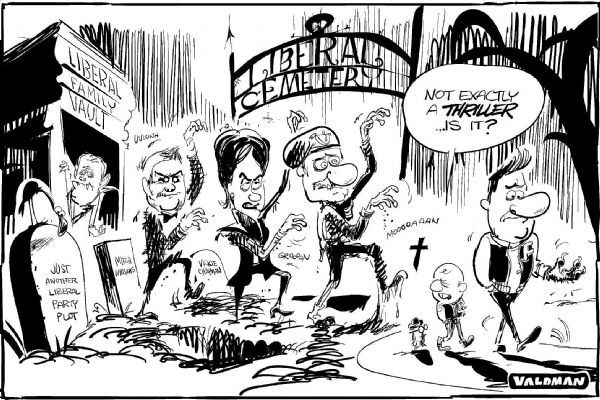
The leadership contenders now Vicki Chapman, Isobel Redmond who won the Deputy leadership on the Saturday, and former frontbencher Mitch Williams, who quit the shadow cabinet a week ago after failing to convince Hamilton-Smith to stand aside for the good of the party.
What a mess. Why didn't Hamilton Smith just stand aside for Chapman? Make it clean? The SA Liberals are in no position to take the fight to the Rann Government in 2010. In the 2006 election the two-party result in Adelaide was 62.6-37.4 in favour of the Rann Government, with the statewide Labor 2-party preferred vote was 56.8% The Liberals face electoral destruction, due to the ongoing infighting from bitter divisions along family and factional lines.
The Liberals look like a bunch of clowns in a rundown fleapit circus who spend so much of their time and energy fighting amongst each other that they have forgotten about the show. They have little chance of gaining any of Labor's marginal seats in Adelaide in 2010 and may even have to set aside hopes of returning to government in 2014.
I have no idea what the factional agendas are in this current leadership tussle. I suspect they have little to do with public policy, and much more to do with the settling of old political scores. They do need some form of circuit breaker to rupture this self-destructive cycle flowing from the baggage of the past.
Surely a badly wounded Hamilton-Smith is finished as leader. He has bought political disasters on himself and has little credibility, now that the political drama, from the fallout from the fake ALP documents Hamilton-Smith used in late April to try to discredit the Rann government, has become such a farce.
Hamilton-Smith was assured of a clear run to the state election in March 2010 by those he thought posed the greatest threat: deputy leader Vickie Chapman and the man he knifed to get the top job, Iain Evans. Hamilton-Smith had promised Chapman that he would stand aside if he lost the election, to ensure a smooth leadership transition. Then Hamilton-Smith destroyed himself with the dodgy ALP documents affair.
Update
Martin Hamilton-Smith, who seized the leadership of the troubled South Australian Liberal Party just over two years ago from Iain Evans in a bloody partyroom coup, has announced that he will not stand for the party leadership on Wednesday. He let loose at the ill-disciplined party and the moderate faction forces he blamed for his demise--- a "factional stitch-up" he called it.
That leaves Chapman (former deputy leader), Redmond (current deputy leader) and Williams in the contest, with Williams given little chance of victory. This will be the third Liberal Leader since the 2006 election. What will happen next is female leader of the Liberal Party--- the first since NSW's Kerry Chikarovski was deposed in 2002. No doubt, many male members of the party will be deeply worried about having a female leader.
All this leadership conflict has pushed the solid work the Liberals did on water issues in 2008. Work on policy issues have been forgotten in 2009. Apparently the leadership contest was not about policy differences but about who was the best person to sell the message.
What message? All I know is that the Liberals proposed a stadium ( to give the SANFL a city stadium of its own) as the centrepiece of a western CBD redevelopment plan to revitalise the city. They proposed this in opposition to the Rann Government's planned new Royal Adelaide Hospital on the same site (at the Port Rd-West Tce corner). But they were never committed to the stadium.
But they are right in that this precinct, is the undeveloped jewel in Adelaide’s crown and is blighted by ugly rail yards; and with Victoria Square no longer the centre of Adelaide. Increasingly community events and focus have moved to the banks of the Torrens. So we must “look to the river” for the future----it is a site for a Federation Square (as in Melbourne) or a Riverbank precinct (as in Brisbane and Melbourne). These are good ideas.
Posted by Gary Sauer-Thompson at 11:48 AM | Comments (14) | TrackBack
July 5, 2009
a wicked cartoon
Though Iraq was Bush’s most expensive mistake and the US withdrawal from Iraq cannot be considered a victory, Bush did provide his successor with a gift: the 2008 Status of Forces Agreement with Iraq, which negotiated a timetable for the orderly removal of U.S. forces. The lame-duck Bush had to retreat from occupation because there were only two major factions in Iraqi politics: those who want the United States out within a couple of years and those who want the United States out now.
 Dave Brown
The United States is no longer in a position to guide Iraq's political future.The task for the Iraq government is to end the civil war between the Shi'ites, Sunni's and Kurds and to keep the civil conflicts from becoming civil war. This is not going to easy in a corrupt Iraq.
Stephen M. Walt makes an acute observation on the military tactics and the much heralded surge:
Although often touted as a great success, the fate of the 2007 "surge" reveals the limits of U.S. influence clearly. Although it did lower sectarian violence, the surge did not lead to significant political reconciliation between the contending Sunni, Shiite, and Kurdish groups. The "surge" was thus a tactical success but a strategic failure, and that failure is instructive. If increased force levels, improved counterinsurgency tactics, and our best military leadership could not "turn the corner" politically in Iraq, then prolonging our occupation beyond the timetable outlined in the SOFA agreement makes no sense. No matter how long we stay, Iraq is likely to face similar centrifugal forces, and our presence is doing little to reduce them.
Continued Sunni Arab resistance to the Shiite-dominated Maliki Government and the Kurdish-Arab wrangling over Kirkuk and other disputed territories--can only be resolved politically, not by military force.
Posted by Gary Sauer-Thompson at 10:45 PM | Comments (4) | TrackBack
July 4, 2009
Indigenous well being
This week's Productivity Commission report---Overcoming Indigenous Disadvantage: Key Indicators 2009 showed that in most areas Aboriginal disadvantage is static or deteriorating. This is despite Australian governments committed themselves collectively to overcoming the disadvantage experienced by Indigenous Australians in 2002. The Report states:
Overall, Indigenous people have shared in Australia’s economic prosperity of the past decade or so, with improvements in employment, incomes and measures of wealth such as home ownership. However, in almost all cases, outcomes for non-Indigenous people have also improved, meaning the gaps in outcomes persist. The challenge for governments and Indigenous people will be to preserve these gains and close the gaps in a more difficult economic climate.
Gary Banks, the chairman of the Productivity Commission said that The most significant thing is that this report is happening at all. It is the first time governments have not only expressed a strong desire to do better but have created a reporting vehicle that will hold them accountable.
 Moir
Moir
The Commission adds that Governments acting alone are unable to overcome Indigenous disadvantage. Meaningful change will also require commitment and actions by Indigenous people themselves, with support from the private and non-profit sectors and the general community, as well as governments.
Under the Council of Australian Governments benchmarks of December 2007 and March last year all governments in this country pledged to: close the life expectancy gap between indigenous and non-indigenous Australians within a generation; halve the gap in the mortality rate for indigenous children under five within the decade; ensure all indigenous four-year-olds in remote communities have access to early childhood programs within five years; halve the gap in reading, writing and numeracy achievement for children within the decade; halve the gap in year 12 attainment with the decade; and halve the gap in employment outcomes within the decade.
Posted by Gary Sauer-Thompson at 11:00 AM | Comments (8) | TrackBack
July 3, 2009
economic policy re the recession
The battle lines drawn over economic policy in the context of the global financial crisis and recession are well known--its either the government or the market.The Washington Monthly's special report The Next Frontier addresses this conflict.
In the Introduction to the report Paul Kedrosky spells out the two polarized sides of the debate and offers another option. He says that on one side there are those who advocate that:
government stimulus spending will be the primary force in our eventual recovery. This view holds that the key to exiting economic downturns is countercyclical public spending to keep the U.S. economy closer to its optimal level of activity. You should deficit-spend when the economy is operating at less than its full capacity; you should shrink spending and manage debts when the economy is back to normal. It is, in short, the Keynesian view, named for economist John Maynard Keynes and widely held by congressional Democrats. And there’s some truth to it. Massive government spending can cushion the blow when an economy shrinks as severely and as quickly as this one [ie., the US] has. But imagining that a fiscal stimulus, however outsized, can compensate for indebted consumers hell-bent on saving their way back to (relative) solvency is high-definition dreaming.
This Keynesian position is the one adopted by the Rudd Government, which claims that it's stimulus softens the negative effects of the recession whilst the big spend on infrastructure gets things going again until China picks up its economic growth.
On the other hand there is the view that:
greater government spending only leads to higher tax rates, hence to declining incentives for investors to take risks. Better, in this view, to allow the economic crisis run its course, permit large firms to collapse, and let entrepreneurs pick up the pieces and create new companies, jobs, and wealth. This is the "Hayekian" view (à la Austrian economist Friedrich von Hayek), widely held by congressional Republicans, and there’s some truth in it, too. Higher tax rates will, at some point, undermine investment incentives (though the evidence suggests that we’re not very close to that point yet). Downturns—especially severe ones—do disrupt markets and provide opportunities for innovators. Microsoft, Allstate, Morgan Stanley, and many other companies rose from the wreckage of economic downturns. Small companies have been the primary source of job creation in the United States over the last few decades. Unless you expect that trend to change, start-ups and small companies must, by definition, play a major role in any meaningful recovery.
This laissez-faire overlooks the vital role government has played in opening up new entrepreneurial opportunities.
Kedrosky's argument is that if it is the case that growth is riding on entrepreneurs, then the best hope for entrepreneurs may be riding on government. Economic crises create the opportunities for new platforms on top of which entrepreneurs could generate economic growth. Energy provides one new platform in that economic growth can come from companies exploiting new technologies and from innovations that solve real-world problems.
It is this kind of economic policy that is missing from the Rudd Government as it has allowed itself to be locked into protecting the old fossil fuel industries and has done very little to provide a platform for energy entrepreneurs to generate economic growth by exploiting renewable energy technologies.
Posted by Gary Sauer-Thompson at 7:01 AM | Comments (2) | TrackBack
July 2, 2009
not news
There's plenty of comment today on John Hartigan's press club speech, where he came up with the unique idea that journalism is not blogging, and blogs are not good. And the other, somehow related in some people's minds, that Crikey and blogs should always be mentioned in the same sentence.
Journalist and blogger Tim Burrowes on the journalists versus blogger thing.
Crikey blogger Trevor Cook on the contribution newspapers have made to their own current circumstances.
ClarenceGirl figuring, almost Rudd-style, that all this consternation means bloggers must be doing something right.
Tobias Ziegler from Pure Poison on the hilarity of a News Ltd person criticising others for spouting nonsense.
Laurel Papworth pointing out these rants are actually attacks on their own readership, and therefore counter productive. In comments she makes a distinction between heritage and traditional media:
Heritage media = traditional media outlets opposed to community created media. Not traditional media that embraces it… and stays culturally relevant.News Ltd's own Andrew Bolt and George Megalogenis are traditional media in the middle of a heritage outfit.
Just for fun, an example of what can go wrong when you attempt to fit in with this internet thingy, but continue to take your audience for idiots. Jamie Briggs at The Punch doing truthiness on Labor's handing of the economy. And they published that with their own figures to hand.
Mark Bahnisch connects dots between Hartigan's speech and Rudd and Gillard's unusually overt response to News Ltd.
During the Utegate/Ozcar/Grechmail nonsense Rudd made a few sideways remarks about News Ltd media, which he continued to do in relation to the Courier Mail's typically News Ltd coverage of events. Bahnisch points out that:
Crikey correctly observes that it’s a recognition that the “power of the press” to shape political outcomes has become a paper tiger, though that should have been obvious from the complete lack of any discernible electoral impact of campaigns such as that of The Australian in favour of Howard in 2007, and of the Courier-Mail against Anna Bligh in this year’s Queensland election. Nor would Rudd and Gillard’s comments have been spontaneous musings – when such coordinated and complimentary comments are made, you can be 100% certain that a particular political strategy has been decided upon.
A few things appear to be going on at the same time that don't bode well for the heritage model, never mind the business model part, of the News Ltd version of news media.
They've gone the lifestyle and opinion route at the expense of 'proper' journalism, to the point where reportage can't be disentangled from partisanship. That might have worked, if the internet hadn't come along and made the voicing of public opinion available to the actual public, as opposed to media's symbolic public in the op ed pages.
At the moment, they're supporting the wrong side, and have been since Kevin Rudd appeared on the public radar. Rudd studiously avoided attacking Howard during 2007, which turned out to be very smart. The public obviously approves of their 2007 decision, so it's a bit silly to think they're going to favour a news outlet that habitually rubbishes their choice. They have, after all, made news a lifestyle choice, then failed to appeal to the market they created.
So much for the public sphere ideal and the Fourth Estate.
We now have a news market, public, electorate, whatever you want to call it, with a majority opinion at odds with News Ltd overt political preference. It's reasonable, logical, and timely, for popular people like Kevin Rudd and Julia Gillard to make the most of that. It may run contrary to everything we've assumed about Rupert Power and media influence, but if it turns out that the assumptions are wrong, as they appear to be, hard cheese. The public could very well choose to side with Kevin and Julia against media making the wrong political choices.
What, then, Hartigan and the empire?
Posted by Lyn Calcutt at 4:06 PM | Comments (16) | TrackBack
from Iraq to Afghanistan
Despite all the rhetoric about bringing democracy to Iraq, it was commonly seen as a bad war. There was the breaking of international law, the lies about weapons of mass destruction, the apparent corruption of contractors, the brutal anarchy in Baghdad, the torture at Abu Ghraib and CIA's torture playbook and the outsourced torture (and torture techniques) to foreign allies.
An Islamic society is emerging from an authoritarian state and it remains to be seen whether Iraqi's can create a functioning state. As the Americans start their withdrawal from Iraq they are convinced that Iraqi democracy will protect the United States against terror.
 Steve Bell
If Iraq was seen as a bad war, then Afghanistan is the good war. The US invasion was a response to 9/11, sanctioned by international law and a broad coalition; the objectives were those of self-defence and altruism. Al-Qaida has killed and continues to try to kill innocent citizens, and it is right to prevent them. Rory Stewart in The Irresistible Illusion in the London Review of Books quotes Obama as saying that the aim of the US intervention:
is to disrupt, dismantle and defeat al-Qaida in Pakistan and Afghanistan, and to prevent their return to either country in the future.A necessary condition of the defeat of al-Qaida is the defeat of the Taliban becauseif the Afghan government falls to the Taliban . . . that country will again be a base for terrorists who want to kill as many of our people as they possibly can.
The fundamental assumption is that an ungoverned or hostile Afghanistan is a threat to global security; that the West has the ability to address the threat and bring prosperity and security; and that this requires an expanded war that includes Pakistan and Afghanistan as a single battlefield.
That means a heavier U.S. military footprint in the Afghanistan-Pakistan region that sits next door to the energy heartlands of Eurasia and the sprawling mass of energy pipelines that will someday, somehow, link the Persian Gulf, Central Asia, South Asia, Russia, and China. The Af-Pak war has an geo-ecopolitics context.
Posted by Gary Sauer-Thompson at 10:45 AM | Comments (4) | TrackBack
July 1, 2009
Adelaide Festival of Ideas: 2009
The Adelaide Festival of Ideas says that it aims to be a sort of ‘over the horizon’ radar for public discussion. The object is to discern the ideas that will shape the coming decades, not just the coming months.

The context in Australia is not just the collapse of the economic boom, the global financial crisis, the global recession; it is also the effects of climate change and the need to shift to a more sustainable society and a low carbon economy because of natural limits.
The shift here is one of economic growth being decoupled from environmental harm, moving beyond constructing environmental issues as ‘jobs versus the environment’, and policies which accept that the switch to renewal energy is necessary to long term security and sustainability.
Interestingly, the 2009 Adelaide Festival of Ideas is about limits. The blurb says that:
On the one hand there is pushing the limits to each new ideas, experiences, products and plans.On the other hand, the limits push back. For example, the Murray Darling Basin and world financial markets have been pushed too far and the consequences are serious. And in public policy, the limits of tolerance are always a matter of passionate debate.
What is offered on the website is minimal: a programme and a biography of speakers, but, as in previous years, there is no material online about the sessions or links to online background material to the issues under discussion. As the format is still the traditional one of citizens going along to hear the experts inform them about the issues, and then asking a few questions at the end, we bloggers need to do our own research.
My own interest this year is in the shift to sustainable cities in the context of climate change. This is a moving beyond the ‘urban good, suburban bad’ (or vice versa) polarity that has marked Australia’s urban debates in the context of the culture wars, urban consolidation and growth-obsessed State Governments ever anxious to keep the building industry going. We need to look at our evolving cites from an more eco-urban system perspective-- the city embedded within its ecology--and the need to steer change and mould it to ensure urban sustainability and resilience.
There is a session on Friday entitled Limits of Cities with Ruth Fincher, Professor of Geography, and Interim Director of the Melbourne Sustainable Society Institute, Brendan Gleeson and Khalid Koser, Director of the New Issues in Security Course at the Geneva Centre for Security Policy.
This session appears to about the social aspects of cities (diversity, inequity, migrants). Only Gleeson, the Director of the Urban Research programme at Griffith University, has a background in both the sustainablity of cities and in ecological modernization, which refers back to the 1980s idea of sustainable development.
This is important since Australia has a big problem with ecological modernization. It has a poor record of technological innovation outside of the agricultural and mining sectors. A large part of its production and export earnings come from the extractive industries that mine and refine non-renewable resources, particularly coal, gold, alumina, and iron ore and ecologically modernising the Australian economy necessitates the creation of economic incentives to reduce the nation’s dependence on these commodities. As Gleeson says Australia does need to address:
by good design and planning the vulnerability of cities to resource shortages, notably water, coal [sic] and oil. The ambition is part mitigative – to slow the inevitable decline of key resources – and part adaptive, to heighten the resilience of urban landscapes in a context of rising resource finitude. In the fight against global warming, planning’s prime contribution is adaptation in search of climate resilient cities. This means the creation of urban environments that will withstand the vagaries of a harmed climate and rising resource shortages.
Neo-liberalism's ‘growth fetish’ needs to be replaced by an urban effort compelled by the immediate ecological and social imperatives facing Australia’s climate threatened cities.
Posted by Gary Sauer-Thompson at 9:13 AM | Comments (6) | TrackBack