« October 2011 | Main | December 2011 »
November 30, 2011
the media: a freedom to lie
It is obvious that the media consists of both a serious press that operates, broadly, in the public interest and a popular press with an agenda that is based around human interest (celebrity) or infotainment. Broadsheet and tabloid is the name we often used to describe this difference, and the standard case for ensuring press freedom usually refers to the serious press (liberal) whilst regulation refers to the curbing of the "toxic", bullying culture of the popular tabloid press (conservative). Yet press freedom also refers to the regulation-free, market-driven, anything-goes tabloid morality.
This distinction does not just apply to the press though. The same distinctions can be, and are, made about television--eg., the ABC and Channel 9's celebrity gossip come to mind. What often drives, and reinforces, the difference is the need to attract as many readers as possible to secure advertising----the commercial imperative to maximise sales with cheap content so as to make a profit.
So it is economically logical for the tabloid hacks in the press and television to produce stories that are often inaccurate, sensationalist and plagiarised. These are not motivated by truth seeking, a desire for accuracy, or a concern for democracy.
Yet the press is allowed to be self-regulated whilst TV is regulated, even though it is widely known that the press has little interest in self-regulation. Self-regulation by the Press Council was designed with the interests of the newspapers in mind.
The media, when they defend self-regulation in absolute terms of the checks and balances against untrammelled state authority, say little about the media's accountability; how people can get remedy for the smears, lies, abuse and intimidate by the feral beasts; or even the concentration of media ownership.
The distinction between a serious press that operates, broadly, in the public interest and a popular press are too black and white . Reporters rewrite press releases, churn the publicity industry's spin and are compliant to authority to ensure continued access. Their conception of press freedom is a freedom to lie and conception of the public interest is little no more than the sheer number of copies they can sell.
Posted by Gary Sauer-Thompson at 2:17 PM | Comments (5) | TrackBack
November 28, 2011
Murray-Darling Basin: environmental rollback
The claim of the recently released Murray-Darling Basin Authority's revised draft plan is that it aims to end decades of state squabbling over the management of Australia's biggest and most productive river system. Will it?

The proposal to return 2750 gigalitres a year to the river falls well short of the authority's recommendation in its "guide" to the basin plan last year, when it proposed the return of 3000 to 4000 billion litres a year. And the mechanism to claw back the water is coming from improving irrigation infrastructure rather than from water buybacks. The revision is Labor's political compromise of fix the irrigators win: they weakened the environmental proposals.
Is it too little too late?
From a South Australian perspective ("rivers die from the bottom up") the political fix or compromise does not protect the water quality of the river, nor does it addressed over-allocation by upstream irrigators who use 93 per cent of the river's water. It is deeply flawed and the intractable policy problems associated with reallocating water among users are not about to go away.
The irrigation lobby will still react negatively to this idea of increased environmental flows, arguing that they require certainty of water availability for production. In contrast the environmental lobby will point to the paucity of water to meet environmental needs and the resultant uncertain environmental gains.
It appears that the rain--the breaking of the drought---has helped to restore the river, but in the process it has washed away the reform momentum. However, the rain hasn't fixed the overallocation of Murray-Darling river system. It has not ended the prospect of future droughts. Nor does it tackle the long-term impacts of climate change on rainfall in the southern basin.
Ben Eltham points out that:
The Wentworth Group of Concerned Scientists estimates that pre-industrial water flows in the Murray Darling Basin were around 12,200 gigalitres. That sounds like a lot of water – and it is: one gigalitre is around 444 Olympic swimming pools. But irrigation, agriculture and other development has reduced this flow to approximately 4,700 gigalitres – just two-fifths of the pre-industrial total. This is not enough water to sustain a healthy river system, especially in times of sustained drought. Of the basin's 23 river valleys, 20 are in poor or very poor environmental health.
Climate change will only make matters worse: the CSIRO expects inland Australia to warm and dry as global temperatures rise. Future rainfalls across much of the southern Murray-Darling catchment are likely to be lower than present.
The current system is broken that the basin's rivers will dry up, the wetlands will die and many of the irrigation towns will die anyway, if the massive over allocation of irrigator's licences is not substantially addressed. In the meantime environmental degradation will be ongoing and continual.
Posted by Gary Sauer-Thompson at 6:56 PM | Comments (22) | TrackBack
November 26, 2011
nay saying
Gillard's people skills have helped in ticking off two of the three nominated priorities when she became prime minister - a price on carbon and the mining tax. In all, 254 pieces of legislation have been passed by what Abbott says is a Greens-led government and in a Parliament that doesn't work. Abbott says his fight is to say no to what he calls the Brown-Gillard socialist government.

If Abbott has done a powerfully effective job of highlighting Gillard as the problem, then the passage of the carbon pricing and mining tax highlight the policy limits of Abbott's strategy of nay saying in the form of conservative populism.that Increasingly this involves ever more huffing and puffing and angry bluster--eg.,the 34 attempts to bring a censure motion against the Gillard Government.
Still, the Gillard Government is an unpopular one and there is no sense of revival in the political landscape. It survives as a minority government. Malcolm Farnsworth is right: little has changed. It is still is an open question whether the Gillard Government can rescue their dire standing with the electorate---to lift the ALP's primary vote to the mid-30s early next year.
Posted by Gary Sauer-Thompson at 8:45 PM | Comments (4) | TrackBack
November 24, 2011
Nurses protest
Nurses are continuing to close beds and cancel elective surgery in Victoria and, this afternoon in Melbourne thousands of nurses dressed in red T-shirts marched through the city to rally outside Parliament house in their push for better pay and conditions.
In Changing nurses' working conditions risks an exodus Belinda Allen states that the Baillieu Government in Victoria is proposing to introduce low-skilled health care assistants in hospitals and "flexibility" into existing patient to nurse ratios to reduce labour costs.
 Gary Sauer-Thompson, nurses rally, Melbourne, 2011
The nurses dispute is before Fair Work Australia, the industrial umpire, which has required the nurses to stop their industrial action.
Allen says:
What is.... of concern is that this increased push for flexibility appears to be driven by a cost-cutting rather than a quality health care agenda. It would be dangerous to assume that low-skilled health care assistants could adequately compensate for the likely exodus of nurses if ratios were to be removed. Nursing work is highly skilled (most registered nurses have a minimum of a bachelor qualification) and carries with it high levels of responsibility. It is likely the introduction of low-skilled health care assistants would reinforce the perception from the study that the nursing profession is being further devalued. It is worth noting that it takes more than 1000 hours to train a fully qualified nurse and about 80 hours to train a semi-skilled health care assistant.
Judging from the protest I experienced in Melbourne today the nurses feel they are undervalued and under-appreciated and would be better off leaving the profession.
Posted by Gary Sauer-Thompson at 8:34 PM | Comments (1) | TrackBack
November 22, 2011
Tony Windsor's muscle
Now we can see one of the benefits of a minority government in the context of a capital intensive mining boom that is driving Australia's economic growth.

It was Tony Windsor, not the Greens, who used his political power with respect to the mining tax to negotiate on behalf of those farm groups and environmentalists who are worried about the potential impact of coal and coal-seam gas developments on precious but poorly understood underground water resources from the Darling Downs to the Liverpool Plains.
Windsor has said he won’t back the government’s Mineral Resources Rent Tax unless more is done to make coal seam gas mining sustainable.He also called for $200-400 million annually from the tax revenue to go toward bio-regional assessments. He also wants to see the Commonwealth have greater power over granting coal seam gas mining rights.
The Gillard Government has acted to address the concerns over:
• The competition posed to agriculture and the environment by the massive volumes of water required for mining;
• The potential damage to and contamination of underground aquifers; and
• The potential threat posed by millions of tonnes of super saline water brought to the surface with coal-seam gas.
The new Independent Expert Scientific Committee will provide scientific advice about coal-seam gas and large coalmining approvals where they have significant impacts on water. It will oversee research on the impacts on water resources from coal-seam gas and large coalmining projects. And it will commission and fund water resource assessments for priority regions.
Gillard gets what she wanted --the passage of the (much watered down) Mineral Resources Rent Tax (MRRT) in the House of Representatives---after negotiating with Andrew Wilkie to increase the $50 million profit threshhold at which the mining tax will apply to $75 million, phasing up to $125 million.
Then she can chalk up another significant piece of legislation passed. She just needs to negotiate with The Greens to find some of the revenue lost from raising the threshold.
Posted by Gary Sauer-Thompson at 9:51 PM | Comments (10) | TrackBack
a bumpy media road
The background to the media inquiry is ACMA's 2011 Broken concepts: The Australian communications legislative landscape. It argues that the majority of the legislative concepts in Australia's media legislation are either broken or under significant strain.
This is primarily due to digitalisation, which has broken the nexus between the shape of content and the container which carries it’ (that is, services are now independent of platforms). Technological change in the form of digital transmission systems means that service delivery is now largely independent of network technologies.
This results in convergence of of older technologies such as television and print media with the internet. Just about all platforms and devices in the convergent era are digital, which makes them able to converge to a common network that operates over a variety of infrastructure types. You can access the internet on your TV, listen to radio on your PC, and watch video on your mobile device. It looks as if News Ltd and Fairfax, will survive this period but with much diminished or no print businesses and diluted earnings.
So we have the Convergence Review to examine the policy and regulatory frameworks that apply to the converged media and communications landscape in Australia. It is no longer useful for policymakers to look at broadcasting, radiocommunications and telecommunications industries as separate and distinct industries with unique policy frameworks.
These then are serious issues arising from a deep seated transformation of the mediascape. Yet the Media Inquiry is represented as a political scape-goating exercise by News Ltd; Fairfax is saying that the future of journalism looks bright; and the ABC's journalists/commentators are not exploring or informing us about what the media inquiries are supposed to be doing.
Its media policy and the journalists are interested in politics not policy.
Posted by Gary Sauer-Thompson at 9:00 AM | Comments (1) | TrackBack
November 21, 2011
Labor's shrinking base
With the mainstream media backing off from their negative campaign against the Gillard Government we can begin to assess Labor's woes. Many argue for party reform by which they mean party renewal by which is meant both the recommendations of the review carried out after the last federal election by John Faulkner, Bob Carr and Steve Bracks; a reduction in union power so as to end union control of Labor; a significant effort to empower ordinary party members; better leadership; and opposing a close relationship with the Greens. The ALP can then rediscover its proper identity as the sole political party on the left/progressive side of politics
This is an insider's perspective, as it focuses on internal dynamics. This argument is structured around the loss of its intrinsic culture of strong, bold, and innovative leadership; and an identity crisis that has emerged because Labor has failed to refresh its values, philosophy, and purpose for the modern era. Consequently, Labor is seen to be beholden to The Green's political agenda.
This argument fails to address the demise of Labor's unionised blue-collar base or core from the decline in manufacturing industry. Paul Rodan puts it thus:
This loss of an ideologically committed, “rusted-on” element does not stop Labor winning elections, but it does mean that a larger proportion of its vote is conditional, liable to be withdrawn once people start to have doubts about the competence of Labor in government, or when it fails to present as a credible opposition....Put simply, the core has shrunk – not just because of a conscious reaction by individuals aggrieved at the party’s perceived loss of principle, but also because of the disappearance of those sections of manufacturing industry that delivered Labor-voting unionists in large numbers. Optimistic speculation that Labor would develop a replacement support base in the newer industries has proved fanciful. Boilermakers were always a better bet than IT nerds.
As Labor's core has shrunk the Greens have emerged as a viable party on the progressive side of politics. That means Labor increasingly needs and alliance with the Greens to gain, or to retain, power.
For many in the ALP such an alliance causes an identity crisis. What does Labor stand for? What are its core principles? They say that Gillard is a leader in name only as she is incapable of setting the political agenda, and lacks the respect of much of the ALP's most ardent support base.
Yet the political reality is that the vote of the left has been split, it will remain so, and Labor will be very dependent on Green preferences for the forseeable future.Labor's coherence as a political party will require it forming some sort of coalition with the Greens.
Posted by Gary Sauer-Thompson at 8:18 AM | Comments (5) | TrackBack
November 20, 2011
more Europe, not less Europe?
The policy of Europe's leaders policy of doing just enough, just in time, is not working. Beijing will not bail Europe out, nor will the IMF. The euro is likely to need a fiscal fund, or something that functions very much like one. You cannot have a single currency without a treasury, or a fully empowered central bank behind it.

Germany does say more Europe --German plans are for a revision of the Lisbon treaty to provide a legal basis for tough new fiscal rules for the eurozone. According to Angela Merkel this means that:
It is time for a breakthrough to a new Europe. The task of our generation is to complete economic and monetary union, and build political union in Europe, step-by-step … That does not mean less Europe, it means more Europe. If Europe is not doing well, Germany cannot do well, and Europe finds itself in perhaps its most difficult hour since world war two.
Germany should lead the way towards this "European domestic policy" with measures including automatic sanctions on eurozone members that cannot or will not keep their fiscal houses in order and a financial transactions tax at least in the euro area.
Posted by Gary Sauer-Thompson at 3:02 AM | Comments (7) | TrackBack
November 17, 2011
Obama's address to the Australian Parliament
The video and transcript of Obama's address to the House of Representatives is not online yet, but there is a video of the address. It was a plain speaking speech despite all the flattery and over-statement.
The core of Obama's speech was that the United States was “here to stay” in the Asia-Pacific, that it would be stepping up its role in the region, and that America’s fiscal problems will not be an opportunity for China's expansion at the expense of the United States.
Contrary to what Kim Beazley was saying on Radio National this morning that containment was a Cold War term that had no meaning in the current geopolitical context, Obama clearly signaled a determination by the US to counter a rising China. And Beazley is on board--like he always has been. The strengthening of military ties between America and Australia can be interpreted as the latest step in Washington’s coordination of Asia Pacific nations into a containment strategy aimed at limiting China’s growing influence in the Asia Pacific region.
Will the Australian Defence Force now become a fully-fledged subsidiary of the US Armed Forces? One that make "niche contributions" to US-led coalitions far beyond Australia’s immediate region, such as Afghanistan? That was John Howard's model. Will Gillard Labor tread the same path?
In The National Interest Stephen Walt says:
If China is like all previous great powers—including the United States—its definition of “vital” interests will grow as its power increases—and it will try to use its growing muscle to protect an expanding sphere of influence. Given its dependence on raw-material imports (especially energy) and export-led growth, prudent Chinese leaders will want to make sure that no one is in a position to deny them access to the resources and markets on which their future prosperity and political stability depend.
He adds that this situation will encourage Beijing to challenge the current U.S. role in Asia and that such ambitions should not be hard for Americans to understand, given that the United States has sought to exclude outside powers from its own neighborhood ever since the Monroe Doctrine. he continues:
By a similar logic, China is bound to feel uneasy if Washington maintains a network of Asian alliances and a sizable military presence in East Asia and the Indian Ocean. Over time, Beijing will try to convince other Asian states to abandon ties with America, and Washington will almost certainly resist these efforts. An intense security competition will follow.
The short-lived “unipolar moment” to an end, and the result will be either a bipolar Sino-American rivalry or a multipolar system containing several unequal great powers.
The US's grand strategy since the 1990s has been one of global dominance or global hegemony, which John J Mearsheimer in The National Interest describes thus:
Global dominance has two broad objectives: maintaining American primacy, which means making sure that the United States remains the most powerful state in the international system; and spreading democracy across the globe, in effect, making the world over in America’s image. The underlying belief is that new liberal democracies will be peacefully inclined and pro-American, so the more the better. Of course, this means that Washington must care a lot about every country’s politics. With global dominance, no serious attempt is made to prioritize U.S. interests, because they are virtually limitless.
He adds that this grand strategy is “imperial” at its core; its proponents believe that the United States has the right as well as the responsibility to interfere in the politics of other countries.
The Obama administration belongs to the liberal imperialists version of global dominance, and they hold that running the world requires the United States to work closely with allies and international institutions.
Judging from Gillard's action's Australia's defence and diplomatic interests are to remain dependent on US primacy remaining unchallenged-- Australia uncritically supports the Obama Administration's policy of global dominance.
Posted by Gary Sauer-Thompson at 12:26 PM | Comments (14) | TrackBack
November 16, 2011
the media: goodbye self-regulation?
In delivering the AN Smith Lecture in Journalism at the University of Melbourne last night Greg Haywood, Fairfax Media's chief executive, said:
The best defence we have to a free and rigorous press is not some government-funded regulatory regime that has the potential to be pushed and prodded and bullied into curtailing what we do … which is asking the questions people in power do not want to be asked. Our best defence is to have our publications edited and led by the sort of people who lead them now - experienced professionals who have spent a lifetime balancing out a cacophony of competing interests and defining a fair-minded news coverage and multifaceted commentary.
This is a similar argument to that in Fairfaqes submission to the Finkelstein Media Inquiry.
Since when have the Fairfax journalists been asking the questions people in power do not want to be asked? What is usually written are recycled press releases, publicity, horse race politics that has zilch to do with public policy, and speculation masquerading as analysis.
Remember all that guff about the ALP guillotining Gillard, Rudd making the big comeback, and it would all happen before Xmas? The media flows were full of it. After the carbon price legislation was passed, little has been said. It was junk journalism Junk, or crap, is what passes for political journalism these days.
It is an example that illustrates the continual spiral of decline, with content becoming less and less valued and less and less demanded. Consumers are being offered a slim-line product written by half trained reporters, and there is little investment in journalists and journalism happening by the corporate owners.
The media seem to think that press freedom is under threat from the Finklestein inquiry, and in expressing their fears (paranoia) about the shift away from self-regulation, they ignore the crisis in confidence in the commercial media. There is a reluctance and refusal to investigate why self-regulation has been such a disaster; why the media needs checking; or even why many citizens feel that the media is out of control.
Reform of the press is expected by the public. The media continue to dismiss the need for press reform, even when they know they regularly produce not just infotainment, but trash, in order to boost sales. They see the whole inquiry as a political stunt, a response to the hacking scandal in the UK.
Any suggestion that the media should be compelled - by law, by sanctions, by institutional pressure - to abide by its own ethical rules would be a gross assault on the freedom of the press. The press should not be held to account for its conduct, no matter how obnoxious, and the media barons, publishers and editors-in-chief are not going to cough up extra money to enable the Press Council to do a better job by having the power to insist on a ruling or a correction appearing on page 1.
A good example of trash with a nasty undertone is this post on Peter Roebuck on Andrew Bolt's blog at the Herald Sun. In it Bolt insinuates that Roebuck was a pedophile (he advances no evidence for the insinuation), and bashes the (lefty) ABC and Fairfax media for covering this up with their silence, and positions himself as speaking truth to power.
Posted by Gary Sauer-Thompson at 9:04 AM | Comments (8) | TrackBack
November 15, 2011
US interests are Australia's?
The Gillard Government is going to sell uranium to India, even though India hasn't and won't signed the Nuclear Non-Proliferation Treaty and will side with US in its conflicts and rivalry with China with the decision to give the US a significant new military presence in northern Australia.The former decision comes from pressure from the US and is primarily about the geo-political containment of China.
So there goes Australia's independence option out the window along with the option of a policy of “equidistance” between Beijing and Washington. Mungo McCullum nails it:
So we are not really treating China as a friend after all, but as a potential enemy. This is the only sensible interpretation of allowing Australia to be used as a forward base for a contingency operation aimed at China. And it is one that Beijing is unlikely to miss. Thus Australia, however keen it portrays itself to continue the trading relationship, will be seen as potentially unreliable, subject always to the larger context in which it has involved itself.
Australia's long history of subservience to Washington continues, even though the US is a declining global power facing an Asian century. The standard clichés about American global leadership, American exceptionalism, and that never-ending American Century become ever more hollowed out and shrill.
The “American Era”---the era when the United States could create and lead a political, economic and security order in virtually every part of the world---is nearing its end. The US is shifting its main strategic attention to Asia, both because its economic importance is rising rapidly and because China is the only potential peer competitor the US faces.
The US's long-term goal in the Asia-Pacific is to preserve American preeminence and prevent the emergence of a local hegemon--China. However, the US is kneecapped by its accumulated debt, eroding infrastructure and a sluggish economy, and so its options are limited. It cannot remain as Asia-Pacific's pre-eminent power and so it creates a hedge against a rising China---off shore balancing.
The US today is characterized not only by financial collapse, but more ominously by the decreasing ability to rally the globe toward the empire’s ends, and the corresponding need to pursue strategic goals via brute military force. The American century is no more.
Posted by Gary Sauer-Thompson at 7:13 AM | Comments (18) | TrackBack
November 13, 2011
Europe: defending the banks
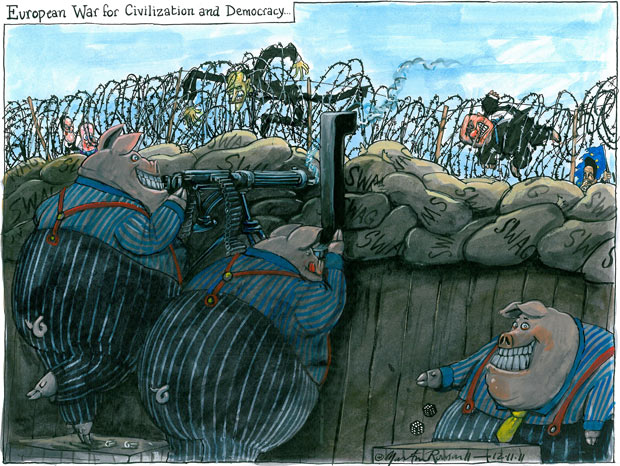
Greece and Italy have new leaders: Papandreou has gone, so has Berlusconi, for the moment. They've gone to ensure the financial and political stability, and to help prevent the Euro from imploding. New technocratic governments are being formed in both countries and the decisions about the austerity management of the debt crisis are being taken by a small group highlighting the democratic deficit.
 Martin Rowson
Defending the interests of the banks requires a democratic deficit. The political system and the “free market” are rigged to the advantage of the rich and powerful. There are attacks on the welfare state, the undermining of unions in both the public and private sectors, the cutting back of pension schemes, increasing unemployment.
Posted by Gary Sauer-Thompson at 3:54 PM | Comments (7) | TrackBack
questioning the hate campaign against the Gillard Govt
A questioning of the Canberra media's gallery entrenched narrative that Bob Brown is pulling the PM's string, Labor will almost certainly lose the next election, and that Julia Gillard will not be Prime Minister much longer.

In this start of an analysis of the hostility and negativity towards the Gillard Government by Paul Strangio says:
I suspect when we look back at the current era we may come to view it as another such interregnum, as the neo-liberal regime decays and its replacement is yet only dimly grasped...And even if this is not the case, there is a disjunction between the most extravagant criticisms of this government and Australia's relative economic prosperity and stability, especially when viewed in the context of the financial woes and political dysfunction in much of the rest of the world (look no further than the euro zone).
I suspect that Strangio is right---the neo-liberal regime that emerged in the 1980s, and is the cause of a massive upward redistribution of income over the last three decades, is in the process of decay.
That regime structured markets in such a way as to have the effect of redistributing income upward. The global financial crisis gives us an insight here: the government deregulated the finance industry which allowed the banks to make massive profits, then it socialized Wall Street's losses, and the public bears the cost of the bailout through the politics of austerity. That interference with the market is an example of the neo-liberal regime working to structure the free market for the corporate sector.
Dean Baker in his The End of Loser Liberalism has more examples. The political right then presents the imposition of rules that ensure that income flows upward as the natural result of unfettered market forces..
Posted by Gary Sauer-Thompson at 3:23 PM | Comments (4) | TrackBack
News Ltd: paranoia?
I suspect that the recent changes at News Ltd--John Hartigan being replaced by Kim Williams from Foxtel--- has to do Murdoch's need to find ways of monetising the digital platforms. This is the biggest challenge facing the print media in Australia, and elsewhere.
The changes have little to do with News Ltd's softening the hostility of its rolling anti-Labor campaign, or its unease and anxiety about the current Finkelstein media inquiry.

You can see the anxiety surfacing in Nicolas Rothwell's The media inquiry masks government's hidden agenda. Rothwell's language is emotionally charged and extreme, given Margaret Simon's interpretation of the first few days of the media inquiry.
Rothwell's language includes: 'the federal government's "independent" media inquiry; a kangaroo court; pre-ordain the result; state power must, in tactful fashion, conceal its grip; the new mood of moral correctness abroad in our age; an inquisition.' Rothwell says:
For an Australian government to countenance regulation of the media or intervention in its markets is to assault the fabric of the nation: doubly. It is plain that Western secular democracies have developed in tandem with a free press, and the removal of press freedom tends to result in the swift erosion of personal freedoms...Swirling about the margins of the present inquiry one can make out a set of half-veiled reform projects - for subsidising portions of the independent media, for limiting ownership, even for licensing media outlets, and all these schemes are justified on the grounds that they would improve the probity and health of the resultant information flow.
The paranoia about the state trampling all over press freedom obscures the excellent points that Rothwell makes about the transformation of the mediascape, namely that the modern media culture, sceptical, bullying and inquisitorial, is in great part a culture developed in response to the conduct of the state, and intertwined with it.
Much about today's media, especially the political coverage, is the result of a generation-long transformation in the nature of government and its propaganda. Roughly from the time of the Vietnam War and Watergate, all Western governments and their associated bureaucracies have armed themselves with the weapons of advertising and the techniques of persuasion, in a bid to cope with the inquisitorial pressures of the media realm.
This is one of the defining shifts in public life over the past four decades. The media no longer merely reports, and the government no longer informs. The media, rather, probes, and the government quietly throws them off the scent and seeks to entrench its own preferred lines.... For all today's governmental communication is in essence publicly funded propaganda, a panoply of sweetly scented, prepackaged spin, designed to sway the media, and wholly parasitic on the media's existence.
Rothwell says that today it is often hard to make out the policy for the chaff and rhetoric: the prevailing landscape is one of artifice and secrecy. He points every finger at the state for restricting the free flow of official information. The media are merely reacting to the state's communication regime of artifice and secrecy.
Rothwell goes so far as to say that:
At a further remove from governments, but under its influence, and dependent on state largesse, are the think tanks, expert groups and academic departments that generate reports for the bureaucracy, and lend a veneer of independent authority to new policy initiatives. The lines here, between research and advocacy, between public and private, are very hard to draw.
Only the commercial print media stand against resolutely the state's publicly funded propaganda, a panoply of sweetly scented, prepackaged spin.
It's paranoia surfacing here.
Posted by Gary Sauer-Thompson at 2:22 PM | Comments (7) | TrackBack
November 10, 2011
News Ltd: ideology takes over
The Nanny State meme is a favourite of the News Ltd media, and it stands for an opposition to governmental policies of protectionism, economic interventionism, or strong regulation of economic, social, environmental and health. They have winner take all ethos, a political agenda, and they use their concentrated media power to push that agenda which includes destabilising the Gillard government.
One of the frequent targets of those on the right are the public health interventions to improve population health, especially those around cigarettes, gambling and adult and childhood obesity.

Gary Johns in Middle class should stop picking on poor, fat kids in The Australian states that the obesity crisis is a confected "crisis", as with gambling, smoking and drinking, where the middle class declares war on the underclass. He states that childhood obesity is apparently most prevalent in the lower classes (working class?) and more so among Aborigines, islanders and those from the Middle East.
Johns, to his credit, acknowledges that obesity is apparent and increasing, that it carries considerable health risks and costs, and that a core question is whether the cost of individual eating choices should be regarded as an individual or collective problem. He adds that the prevalence of obesity is not in dispute but its spread and policy responses are.
So what is his argument about those policy responses? It's not much:
For those on the Left of politics intervention comes easily. No doubt, they would be keen on a mandatory pre-commitment scheme where a child nominates the number of times each day they poke their head in the fridge. Or, maybe as part of income management, welfare recipients should receive fruit packages....The public health lobby presses for fat taxes and bans on junk food advertising. But these are ineffective and, besides, why should everyone have to suffer for the sake of the few? Preventive measures are justified only when there is strong evidence they pay for themselves... for society at large, labelling food or taxing selectively or banning advertising is a step too far.
Consumers don't need better information. Positive messages of good eating from teachers, doctors, nurses and an array of allied health workers, including nutritionists, will suffice.
Johns vaguely understands the social model of health, health inequity, and consumer control of health. He has a glimmer of understanding that this model means community control over the environmental influences of health, and that this is central to the shift required in the health system if real change is to occur. But he then resorts to mocking primary care and health prevention because ideology takes over: positive messages from government wont work but positive messages from health professionals will .
Posted by Gary Sauer-Thompson at 6:37 AM | Comments (12) | TrackBack
November 8, 2011
Berlusconi next?
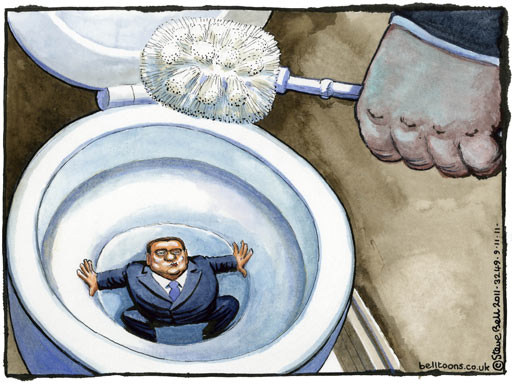
The euro's sovereign debt--really government debt--- crisis has different effects. With respect to Italy the key problem is not the government borrowing to cover current spending as with Greece. The Italian economy is not a shipwreck. Italy is indebted, but it isn’t insolvent.
The problems lies with the bond markets, which are essentially the trade in government debts and Italy's is among the largest at around €1.9tn. The yield on the price of government Italian bonds has risen sharply – this is equivalent to the interest rate charged to the Italian government to borrow money. The more the yield rises , the more likely Italy won't be able to refinance its loans and the more likely a default is.
The yield on Italy's ten year bonds has hit a record high of 6.74% despite intervention in the markets by the European Central Bank (ECB ) to buy the bonds. 7% the point at which the IMF moved in to bail out Ireland. hit a record high of 6.74%. German 10-year bonds now yield 1.82 percent. The gap is a reflection of the extra risk of holding Italian bonds.
 Steve Bell
This intense pressure from the bond market then causes political upheaval and crisis. Something has to give because Italy is too big to rescue. Unlike Ireland, Portugal, Greece the European authorities will not rescue Italy.
The Italian government debt is almost 120 percent of GDP, behind only Greece within the euro area, and the Europeans (France, Germany and the European Central Bank) are pushing Italy to undertake structural reform. This rationale for this fiscal austerity is that this budget tightening will restore the confidence of financial markets.
But the Italian government has been unable to make these reforms. The Berlusconi government is weak, and in all likelihood, it will collapse from being unable to push through the austerity measures being demanded. This fall will happen sooner than latter.
Update
Silvio Berlusconi goes, but the right stays in power. The country's debts threaten to take down stock markets around the world, as the yield, or effective interest rate, on 10-year Italian bonds reached a record 7.5% on Wednesday. The surge in Italian bond yields was eventually capped by the European Central Bank (ECB), but it has limited fire power to act as a lender of last resort to bring interest rates down to pre-crisis levels.
This indicates that the removal of Berlusconi as Italy's prime minister provides little by way of solution. The bond markets are calling for the implementation of structural reform it has has promised to undertake. The passage of the legislation has become a litmus test of Italy's credibility in the markets.
The medicine is the same as it was for Greece. The formula is to force budget tightening on an economy that is already shrinking or on the edge of recession. This shrinks the economy further, causing government revenue to fall and making still further tightening necessary to meet the target budget deficit. The government's borrowing costs rise because markets see where this is going. This makes it even more difficult to meet the targets, and the whole mess can spiral out of control.
Posted by Gary Sauer-Thompson at 9:50 PM | Comments (3) | TrackBack
November 6, 2011
dismantling the future
Life should become a bit easier for the Gillard Government when the Senate passes the 18 clean energy bills tomorrow. The Clean Energy Future package means that there is going to be a (low) price on greenhouse gas emissions thanks to the Greens. They dragged the ALP back to what it had turned away from when it went weak at the knees from the political pressure of no no no.
The recent lift in the ALP's primary vote in the polls should continue to slowly rise as the Coalition positions itself to dismantle the reforms and the Gillard Government begins to be defined by what it has achieved.
The battle to shift the Australian economy to a low carbon one has barely begun. The old energy companies will continue resisting the need to reduce their emissions and to demand a ransom for close down their coal-fired power plants.
Surprisingly, we hear little from them about investing in carbon capture and storage (CCS), or geosequestration; nor any talk about Australia's natural advantages in fossil energy providing an opportunity for Australia needs to be at the international forefront of research and development in this technology. Innovation is not their business.
This energy sector and the carbon-intensive sectors isn't even working to reduce their emissions; nor investing in emission reduction activities such as energy efficiency in buildings and operations. Nor are they prepared for carbon markets.
Update
The Senate passed the carbon legislation Tuesday afternoon. It will soon be law. The Opposition has lost the carbon debate. They are now on the wrong side of history. It's a historic day. The public debate now moves on.
he ALP continued its modest gains in its primary vote in Newspollwhilst dissatisfaction with Abbott is increasing. Is the political tide starting to flow the other way? The ALP can just slug it out over the mining tax and carbon pricing as the Coalition starts to bleed votes from its strategy based on complete and total negativity.
Posted by Gary Sauer-Thompson at 10:00 PM | Comments (2) | TrackBack
November 5, 2011
kicking the democratic can down the road
The Greek prime minister, who has backtracked on plans for a referendum on his country's euro bailout, survived a confidence vote in the Greek parliament on Friday. So the steps to address the Eurozone's democratic deficit has been let slip. Will the Greek people rebel through civil disobedience to prevent them from being ground into a decade-long depression through an imposed austerity to save the banks?
It appears that democracy is incompatible with collecting debts, and when indebted Greece can’t pay, there is a foreclosing on the public domain and privatizing the country. A neo-liberal mode of governance means the abandonment of any pretence to democratic, collective control over the conditions of life: politics is reduced to technocratic rule.

What also was let slip was the opportunity by the European financial elite and political class to get a stronger grip on both the European sovereign debt crisis and low economic growth at the Cannes G20 summit. There was no extra money for the IMF and Europe got short shrift from China when it rattled the tin for contributions to its bailout fund.
Michael Hudson highlights what is happening behind the scenes at the G20. President Obama, for instance, is:
making the threat that Europe has to cut its own throat in order to save the United States hedge funds and banks from taking a loss on the Greek bonds that they’ve insured. One of the reasons that people have been willing to buy Greek bonds is they bought credit insurance. And the European banks, mostly—maybe not Barclays or Deutsche Bank, but most banks—are not willing to write credit insurance, because everybody at the Böckler Foundation conference here in Berlin, every single economist says there is no conceivable way in which Greece can pay its debts. But the American hedge funds and bankers have come in and said, “We’ll write a guarantee.” Then they lean on President Obama and Tim Geithner to tell the Europeans: “You have to make Greece pay, so that we win the bets that we’ve made, because if we lose the bets, then we go under and the stock market crashes, and a lot of people can’t collect on their money market funds.”
Obama is basically telling Europe, “Don’t go the democratic route. Support Wall Street.” So Europe, like the US is a society in which money is increasingly concentrated in the hands of a few people, and in which that concentration of income and wealth threatens to make both a democracy in name only.
The consequences in Greece is increasing political instability, a very fluid political situation, and rising public anger over the austerity measures that have seen ordinary Greeks' purchasing power halved. Italy is next in the front line in the Eurozone crisis.
Posted by Gary Sauer-Thompson at 11:33 AM | Comments (6) | TrackBack
November 3, 2011
Euro Crisis: three scenarios
As Greece fights over how to put the Eurozone bail-out to a referendum, the nation is slowly accepting that it is broke; that it is only keeping the lights on with regular injections of cash from its wealthier European neighbours, principally Germany and France; and that the Papandreou government is on the point of collapse.
 Martin Rowson
A paper published by the UK based National Institute of Economic and Social Research's National Institute Economic Review, no. 218, October 2011 explored three alternative scenarios with respect to the euro crisis.
- under scenario 1 "muddling through", risk premia remain elevated for a further year. This has a negative effect on growth, not just in Greece and other peripheral eurozone countries, but elsewhere. Recession becomes a near certainty in Italy and Spain, while the probability of a recession in the UK rises to about 70%.
- under scenario 2 "default contagion", default on Greece raises the probability of default in Portugal and (possibly) Ireland and Italy. Such a cascade of defaults would make a more generalised banking crisis likely ; in order to avert such a damaging outcome, the ECB might need to commit to acting as lender of last resort for vulnerable governments
- under scenario 3, Greece exits the euro. In such circumstances, devaluation is certain, and explicit default is also likely. This would lead to lower interest payments on government debt, and lower asset prices could also result in capital inflows. Under such a benign scenario, output would rise, perhaps quite sharply, much as it did in similar circumstances in Argentina in 2001-02. On the other hand, there are very large downside risks (in particular, the difficulties of full currency redenomination, and the possibility of forced EU exit) that were not present for Argentina.
The Organisation for Economic Co-operation and Development and the International Monetary Fund have now being forced to model what would happen in the event of a disorderly Greek exit from the euro, with the inevitable knock-on effects that would have. The question becomes how will the Greek default be handled?
The EU is preparing for the possibility of Greece leaving the euro and looking at ways ensuring that this could be done without harm to the region. Greece leaving the euro is now being openly discussed.
Posted by Gary Sauer-Thompson at 9:14 PM | Comments (4) | TrackBack
November 2, 2011
the more you emit, the more subsidies you get.
We have a "climate denial machine": a network of organizations, many backed by energy interests, that work to create doubt about the science of human-caused global warming, opposition to the renewable energy industry on behalf of fossil fuel interests and green jobs, repelling the environmentalist movement and targeting academics.
A second obstacle that stands in the way of clean energy development that will emerge when the Senate passes the package of 19 "clean energy" bills next week is the opposition from a hostile Coalition that vows to roll them back when they regain power. The Victorian government has brought the local wind energy industry to a halt, and NSW has taken this action with solar.
Another obstacle is the fossil fuel subsidies such as the diesel fuel rebates and infrastructure subsidies to the coal mining industry. What is now coming into the foreground in NSW is the subsidies taking the form of supplying coal to the fossil fuel generators at a vastly lower price. The coal-fired power stations in NSW are unable to compete with other power sources unless their coal is supplied at around one quarter of the cost of export coal. So the state government gives a $4 billion subsidy to state’s coal fired power plants.
The inference?
One is that Australia cannot afford to consume its own fossil fuels at export prices. Another is that whilst the NSW government is cracking down on subsidies for renewable energy generation such as rooftop solar, it is ramping up the level of subsidies provided to its coal-fired power stations by ensuring the cheap supply of coal for the next few decades. The third inference is that the more you emit, the more subsidies you get.
Australia is hopelessly behind the rest of the developed world in key energy criteria – productivity, emissions, renewable power installation, demand management and energy efficiency. A major reason is the “regulatory capture” of energy policy by the fossil fuel energy industry in Australia.
The reality is that the energy industry --and the national electricity market--will have to grapple with how to cope with tyhe new technologies and regulatory changes designed to recognise the value of new energy sources, and the value of saving energy rather than simply trying to produce more of it.
Posted by Gary Sauer-Thompson at 1:55 PM | Comments (4) | TrackBack
November 1, 2011
goodbye Qantas hello OneAsia
Question Time in the House of Representatives yesterday was very Qantas-focused with the Coalition not being able to make much headway with its 'why didn't you pick up the phone to Joyce earlier' questions to Gillard. Gillard was able to brush them off with ease and the ALP appeared to find its mojo.
What was ignored in the blame game in the political/media hothouse was the way that the competitive pressures of the global market are impacting on Australian businesses and forcing Qantas to restructure. That means the Australian character of Qantas will be hollowed out as Qantas is turned into a low-cost Asian-based carrier.

The long-term strategy for Qantas under Joyce is to move the private airline offshore--that is, to run the Qantas of old down, and to replace it with low cost offshore-based airlines. It appears that Qantas will be reduced to a legacy business carrier that flies a few remaining profitable routes.
The low cost offshore-based airlines will take a joint venture form, technically operating as local airlines, to get around the provisions of the 1992 Qantas Sale Act that prevents Qantas from conducting international operations under another name and from moving its ''principal operating centre''.
The low cost subsidiaries Qantas plans to set up in Asia (initially Singapore, Vietnam, Japan) are designed to seek a bigger share of Asia's leisure travel market, get a toehold in the China market, and to grab a share of the premium well heeled Asian executives.
At this stage Qantas wants to establish a low-cost carrier in Japan in partnership with Japan Airlines and invest in a premium airline based in either Singapore or Malaysia, likely to be called RedQ or OneAsia. The latter will have a separate identity from Qantas and its low-cost Jetstar. The implication is that the principal operational centre for Qantas international services will not be in Australia.
In Australia Qantas, under Leigh Clifford the Qantas’ chairman, is pursuing a premeditated strategy of open warfare with its unions in order to drive down wages, reduce conditions and grow profits.
Posted by Gary Sauer-Thompson at 12:32 PM | Comments (12) | TrackBack