« November 2011 | Main | January 2012 »
December 31, 2011
China: a new epi-centre
Europe is an economic and political mess, and it is China's main export market. China's exports have slowed due to the economic downturn in the US and the debt crisis in the Eurozone.
Is China becoming the new epi-centre of the economic crisis in the global economy? Paul Krugman raises the question. As we know China's economic growth rested on a few simple foundations such as, keep credit cheap (and investment levels high), wages down, and the currency’s value low against the dollar. Then export your way into double-digit GDP growth. This is the East Asian "model" of development and it is based on the over-dependence on export markets with its consequences of environmental degradation.
During the global financial crisis in order to maintain high employment, China poured money into infrastructure and real estate projects through its stimulus packages.This decoupled China from the problems of the rest of the world for a couple of years.
Krugman's analysis is that behind China increasingly relying on its trade surpluses to keep manufacturing afloat is the domestic danger spot of the economy over heating.
Recent growth has relied on a huge construction boom fueled by surging real estate prices, and exhibiting all the classic signs of a bubble. There was rapid growth in credit — with much of that growth taking place not through traditional banking but rather through unregulated “shadow banking” neither subject to government supervision nor backed by government guarantees. Now the bubble is bursting...
China’s economy is a bubble economy. And bubbles do not deflate; they pop. That means an unexpected shock to the global economy.
As the central government cools the economy, China's property prices are declining with property developers slashing prices to attract customers and maintain cash flows. The vast majority of the newly constructed apartment blocks in the major cities are nearly empty.
What happens then? The current combination of the international and domestic situation is not conducive to China's growth, which will then affect other parts of the world. Obviously China will have less demand for raw materials and heavy equipment—cranes, bulldozers, factory machinery---at a time when many Australian and Brazilian mines have undertaken massive capacity expansions. There will be rising unemployment in the construction industry and contraction in the manufacturing industry.
Posted by Gary Sauer-Thompson at 1:55 PM | TrackBack
December 30, 2011
Pokies reform + social change
Will the Gillard Government retain its commitment to pokies reform? Recall that it is concerned over both the extent of a gambling problem (116,000 people with one and and another 279,000 on the path to one), and the consequences on themselves and their families in the form of broken homes, suicides, neglected kids and ruined lives.
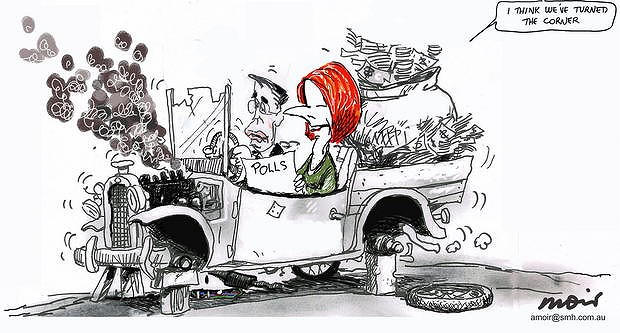
Or has the Gillard Government and its shaky coalition been spooked by the campaign run by Clubs Australia? Do we have a minority Labor government that has lost its beliefs in social justice? Is it the case that Gillard had to agree to things she had ruled out beforehand to secure the support of the independent?
Will Abbott be able to use the issue to annihilate Labor? From a marketing perspective Abbott has succeeded in trashing the Labor brand and its countered by Labor painting Abbott as negative. However it is hard to paint pokies reform as yet more in the way of deficiencies, mistakes and incompetence.
The ALP clings to power at a time when the when the social and political ground is shifting beneath it. Guy Rundle puts the shift in terms of the break up of the old Whitlam coalition based around the ''inner-city professionals '' and the suburban working and middle classes. Previously, former subordinated some of their social demands to the conservatism of the latter, who formed the larger part of the party. The shift takes the form of the ''inner-city trendies'' ceasing to be marginal and have become central to the economy as the knowledge/cultural production class:
Yet as that class - designers, content creators, teachers, policymakers, social professions, students - has detached from Labor, something else has happened to its working/middle class suburban base. In the years of the Whitlam coalition, they were as interested in collective social change as were the ''trendies'', and so the two bases of the party could work together.Now, as Greens voters grow keener for collective action - on climate change, for example - Labor's base has gone in the other direction. They have become increasingly interested in managing their lives on an individual basis. The Whitlam coalition has been torn apart by class divergence. Thus, the more Labor tries to ''rebrand'', by defining itself against the Greens, the more it defines itself against its own broad values, those of actively extending equality and rights to larger sections of society.
The result is a party that has nothing to say to its potential supporters about how it might change their lives for the better. Everything that once comprised the business of progressive politics - how people will live, be cared for when sick, educate their children - Labor has declared a no-go zone for debate, discussion, and radical innovation, limiting itself to small fixes.
The consequences is that Labor subscribes to the right-wing fantasy of a ''mainstream'' with a stable set of conservative values, in part because the failure to see what is really going on makes it susceptible to easy mythologies.
Posted by Gary Sauer-Thompson at 9:51 PM | Comments (1) | TrackBack
December 27, 2011
Boxing Day consumption
Apparently Xmas sales have been sluggishthis year. There has has been none of the mad frenzy of crowds of eager shoppers elbowing one another to grab a bargain. Retail is doing it tough but the sector remains optimistic that the consumers will dig deep.
Why bother to rush into the sales when 'the sales' are the new normal; when everything is discounted all year round to counter the low consumer confidence:

This is the biggest shopping weekend of the year and it will be make or break time for many retailers. The challenge for the store chains is to turn browsers into buyers at a time when the bricks and mortar retailers are in economic trouble.
It's worse in Europe, of course, with the increase in unemployment, a squeeze on family budgets and government spending cuts as the euro crisis deepens. There its economies and institutions that are crumbling.
No doubt the neo-classical economists will continue to posit that market economies efficiently work towards equilibrium and harmony at a time in Europe when where no such harmony exists ie., the "Market" looks to be inherently destabilising. So the market, contrary to neoliberal belief in the superior power of The Market to efficiently fix any problem, may actually be incapable of fixing every problem. The reason? Capitalism is inherently unstable and lacking in equilibrium.
If you recall, the economic profession's response to the great financial crisis in 2008 was that it was a rabid outbreak of ‘irrational exuberance’. What happened to the economic assumption of rationality (maximization of a utility function) of ‘rational’ economic agents? Apparently they were caught up in their 'animal spirits', meaning that people get a little irrational from time to time. The inference in that irrational decision-making helped cause the housing bubble in the US not market failures in financial markets, externalities or disinformation to consumers.
As Philip Mirowski points out:
The problems with the financial system in 2007 had nothing to do with participants lacking correct incentives to purchase enough ‘information’ which would have revealed the dodgy nature of the collateralized debt obligations (CDOs) and other baroque assets which clogged the balance sheets of the financial sector. Rather, the reams of information that they did purchase, from ratings agency evaluations to accounting audits to investment advice, was all deeply corrupted by being consciously skewed to mislead hapless clients and evade the letter of the law.
What resulted was financial system collapse and so any economic analysis based on equilibrium and harmony is inherently flawed.
Posted by Gary Sauer-Thompson at 9:28 PM | Comments (1) | TrackBack
December 23, 2011
off shore processing centres?
I reckon Australian citizens must be becoming tired of the point scoring and political nitpicking in Canberra over the asylum issue. They rant and rave over the differences between Nauru, PNG, Malaysia in order to ensure the polarization increases. That's the black and white political game being played around border control and protection, even though the two major parties are both deeply committed to pushing asylum seekers away and assume that deterrence will stop the boats.

What has been lost sight of is the policy needed to create a regional solution---regional processing centres in different countries designed to help stop asylum seekers from being ripped off by the people smugglers and making the dangerous boat trip to Australia.
Regional processing centres, more efficient processing within them, locked in resettlement programs and places, and it works under the UNHCR umbrella, are the basics of a regional approach to the flow of refugees within the Asia Pacific region. It requires regional co-operation.
This is pretty much the argument of Susan Metcalfe and she highlights a major flaw with the regional approach: there are not enough esettlement programs and places to take more refugees. So we have permanent camps of refugees. So Australia could increase its refugee intake.
Resettlement is a last resort as some refugees would eventually return to their own country, if they could.
Posted by Gary Sauer-Thompson at 1:28 PM | Comments (12) | TrackBack
December 22, 2011
Europe: mass migration
My argument has been that brought on by the global economic recession, the eurocrisis has been exacerbated by serious faults built into the institutional structure of the monetary union. The non-existence of centralized political control over the European economy combined with lack of democratic legitimacy sets in motion processes that are undermining European solidarity.
This is sobering. One response to the economic crisis and the politics of austerity in Europe is mass migration. Melbourne, Australia is a favourite destination for Greeks.

They--the highly educated young Europeans have realized that Europe is headed for a long, dark tunnel of economic hardship--two decades or generations. In economic terms, Europe is not going to have the weight it used to. So they have little choice but to go aboard.
The collapse of the European Union is possible.The signs are there in the turn to nationality--the Eurosceptics are defenders of the nation state-- as opposed to federalism; a federalism that is increasingly understood in terms of centralization, a European super-state.
Posted by Gary Sauer-Thompson at 7:19 PM | Comments (4) | TrackBack
December 21, 2011
political impasse
Another boatload of asylum seekers. More deaths from capsized boats----several hundred this time. More money for the Indonesian smuggler syndicates. More political gridlock in Canberra on the issue. It's a political impasse.
The political rhetoric from both political parties is about deterrence and off offshore processing. If the risk of drowning at sea is not a deterrent to the spontaneous arrival of asylum seeker boats, then shipping the asylum seekers off to Malaysia or Nauru won’t be. Neither will temporary protection visas.
It is a political impasse because the negative media reporting and political discourse, and the public rhetoric surrounding asylum seekers, imply that their claims are not legitimate, that they pose a threat to Australian identity and security, and are in some way engaging in illegal behaviour by not following formal refugee processes. This perception of illegality is reinforced by the use of mandatory detention of asylum seekers who arrive without a valid visa.
The undercurrent is the asylum seekers from Iraq and Afghanistan appear to be both visibly different from white Australians, and are surrounded by a political rhetoric of danger and threat because of a perceived link with terrorism. We have the overwhelmingly negative discourse which links asylum seekers, Islam and terrorism
Posted by Gary Sauer-Thompson at 1:34 PM | Comments (8) | TrackBack
December 19, 2011
Iraq: What was achieved?
The U.S. military formally handed over its largest base in Iraq, the ill-name “Camp Victory,” to the government of Prime Minister Nouri al-Maliki. The base sits at the edge of Baghdad International Airport and it was one that the US was never going to leave.
What was achieved by the Iraq war and its military invasion and occupation of a sovereign country in the Middle East?
All I can see is the U.S. military bogged itself down in two disastrous wars in the Greater Middle East in pursuit of global supremacy and its political ties to the Middle Eastern oil states.The US failed to impose its will on the Greater Middle East. It failed to dominate the Middle East or to erect a new order conducive to U.S. interests.
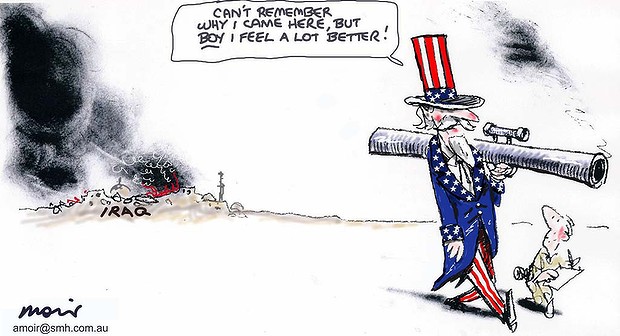
A decade later, a major redistribution of global power is underway. The U.S. is economically weaker, a battered former “sole superpower” still in need of an enemy, still thinking about global energy supplies, and, if anything, more reliant than ever on a military-first policy in the world. Oh, it has a new enemy---China of course--- so the US is beefing up its presence (military and diplomatic) in the Asia Pacific.
Though Washington still speaks in terms of merican global leadership, American exceptionalism, and that never-ending American Century, reality will soon hi the political class in the face--the US is a declining power.
Posted by Gary Sauer-Thompson at 8:33 AM | Comments (7) | TrackBack
December 18, 2011
an ignorant media?
As we know the mainstream media didn't do a good job of informing citizens about the global financial crisis. More often than not they acted as cheerleaders of the boom, free markets and neo-liberalism; and they failed to see what was coming, or even to realize its significance when it happened. When the crunch came the media failed its democratic function and didn't live up to its self-professed liberal ethos.
Many of us weren't surprised as they see the loss of advertising revenue resulting in the media by and large given up its fourth estate role and collapsed into opinion and infotainment in a digital world of online media convergence. As Malcolm Turnbull points out, whilst it is quality journalism that holds the government to account and shines a light on the dark corners of power, it is now a threatened species.
One of those journalists who continues to understand the media in terms of its fourth estate function is Roy Greenslade, and he spells out this function in this way:
We, the media, are the window into the arcane world of finance and economics, and what we report, and how we report it, is hugely influential. People may have all sorts of opinions garnered from their own experiences but when it comes to the esoteric topic of high finance, the vast majority rely on what they are told by journalists, politicians and a variety of talking heads granted either airtime or newspaper space.
For those journalists who are still interested in practising this form of journalism the key question becomes: 'why did the media fail citizens so badly with respect to the global financial crisis?
Greenslade says:
To be frank, most journalists were as ignorant as their readers and viewers of the range of financial products used to sustain the boom. When it was reported that the American investor Warren Buffett described derivatives as "financial weapons of mass destruction" in 2003, it made little impact. Why? Because it ran counter to the ongoing "good news" story, which was the major narrative of the decade. House prices were on the up. Retailers were raking in profits. Obtaining credit from banks was easy. The media itself was enjoying seemingly unlimited advertising revenue.It did not then appear necessary for journalists to get to grips with the credit markets, with their sophisticated instruments such as credit default swaps.
Well, we know that journalists are ignorant about most policy issues (eg., carbon pricing) and they generally cover up this ignorance by just writing about the politics of the policy from a partisan perspective or writing about Kevin Rudd vs Julia Gillard.
Greenslade basically offers a 'we were duped by the market' defence. What Greenslade should say, and doesn't , is that irrespective of the platform many journalists are lazy (they simply recycle media releases and publicity handouts); that many are basically ideologues acting on behalf of corporate interests (eg.,The Australian); and that some are happy to paid to be intense propagandists (eg., the tabloids on climate change). He also ignores the way that owners of the media (in Australia the Packers, Murdochs and Fairfaxes) have all used their media to run political agendas.
Posted by Gary Sauer-Thompson at 8:10 AM | Comments (4) | TrackBack
December 16, 2011
Canberra gaze
The media commentators are back to their favourite theme: a dysfunctional Gillard Government and the Rudd-Gillard leadership conflict tearing federal Labor apart. They see deficiencies everywhere, and a disunited government that is incapable of governing in a 24 hour news cycle.
That is their narrative and it is locked in:

Every momentary event is interpreted in order to foster this narrative of a hopeless Gillard Government continually shooting itself in the foot. And the argument for this position? We need an argument to distinguish it from personal opinion or herd group think. Let us turn to Paul Kelly in The Australian and his Beleaguered Labor caught in a perfect storm.
In this op-ed Kelly focuses in on energy politics- and he is referring to the recently released draft energy white paper:
Resources Minister Martin Ferguson put the issue on the line: household electricity prices had risen 40 per cent in the past three years and will continue to rise given the investment required.The point, Ferguson argued, was the imperative for a market-based approach to energy, greater efficiency, privatisation of assets and no pre-determined views about the best clean energy options. The politics are apparent: if Labor imposes unnecessarily high costs on households it will be penalised by a ballot box revolt.Ferguson knows that for too long Labor governments chose high-cost options in the cause of being green and assuming that Labor-voting low-income workers were too dumb to realise they were being played for mugs. That game is up.
So the reason for federal Labor's woes are being green. Australia's comparative advantage of cheap energy is eroding and Australia's locked-in $23 a tonne carbon price is "way out in front of the pack". Kelly adds:
With global action stalled for much of the decade this prompts the question: was Gillard's new passion for pricing carbon driven by Australia's national interest or Labor's political interest in making minority government work?
The answer for Kelly is obvious. It is Labor's political interest in making minority government work--staying in power--- not the national interest. The inference is that a damaged Labor government isn't capable of addressing the competitiveness and productivity hole into which Australia is sinking. They are incompetent.
It's the same old narrative of the 'carbon-tax-will-ruin-the-economy'. What lies beneath the surface here is energy politics. The conservative position is that the Gillard Government shouldn't make the transition to a low carbon economy the Greens are demanding, as it is obvious that Australia's future lays with coal: Australia will continue to be largely dependent on fossil fuels, it will need to embrace uranium and it needs to expand its existing deregulation and privatisation of energy markets (in Queensland and NSW).
The energy right policy is to phase out renewable energy targets because these are expensive and superfluous and not use public funds to pick technological winners (through the $10 billion clean energy investment fund). These green policies need to be removed as they are not the path to economic growth. The carbon pricing will slug Australian businesses at a time when the European economic crisis will hurt Australia's growth prospects. These are the standard talking points of the big energy industry (coal fired generators) who hate solar.
Therefore, as the AFR's weekend editorial puts it we don't have a clear -headed government with a commitment to bolstering Australia's economic defences and prosecuting reforms that increase the economy's flexibility and productiveness.
Yet coal-fired power stations will be retired over the next few years, the cost of solar power is rapidly decreasing, and Australia is well on track to reach its renewable energy target of having 20% of its national electricity generated from renewable sources (using wind and solar) by 2020.
Posted by Gary Sauer-Thompson at 8:19 PM | Comments (9) | TrackBack
December 15, 2011
'the market'
Isn't it strange how an abstract entity (the market) is personalised (the market feels) and that this person is driven by a desire for confidence -or ephemeral intensities. If there is no confidence there is chaos. What is supposed to be stable and self-regulating becomes chaotic. "The market" we are reliably informed doesn't like chaos, even though the stock market is chaotic.

Governments must intervene to prevent the descent into chaos, yet we are also told that "the market" has a deep antipathy to government intervention, since it represents the road to serfdom. "The market" expects that further fiscal belt-tightening to address the structural deficit is needed in order to better enable the economy to meet any future economic challenges, whatever they may be.
Media commentators just repeat the lines without bothering to think about what they are saying, and that is a good illustration of t the hegemony of neoliberalism and its axioms of self-regulated and efficient markets. Neoclassical economics then plays the role of a meta-ideology as it legitimized, mathematically and "scientifically," neoliberal ideology and deregulation.
Behind this sits the political coalition of capitalist rentiers and financists who mostly benefited from the neoliberal hegemony and from the process of financialization in which the financial system finances speculation not productive investments.
Posted by Gary Sauer-Thompson at 3:59 PM | TrackBack
December 14, 2011
UK: standing alone
David Cameron, the UK Prime Minister, has been pleading for months with the eurozone countries to increase their fiscal disciple, then he says no to the EU's fiscal compact". The position of the UK Cameron government is that it requires a form of "exemption" for the City of London from the existing machinery for EU financial regulation.
 Schrank
Britain's position is that it wants to enjoy the benefits of being part of a European single market for financial services but not subject to EU oversight or regulation. Currently it is now Britain vs the Rest on the fundamental issues of the survival of the euro and the EU itself.
On Europe the Liberal Democrats, Cameron's coalition partners are united. They are pro Europe wheres as the Conservatives are Eurosceptics. So where does that lead the Liberal Democrats?
Posted by Gary Sauer-Thompson at 1:44 PM | Comments (2) | TrackBack
December 13, 2011
Lessig: corruption of the US political system
Lawrence Lessig argues in his new book, "Republic, Lost: How Money Corrupts Congress -- and a Plan to Stop It", that Congress's overwhelming addiction to special interest money is at the root of the problems facing the country and the unprecedented levels of disillusionment with government. Members of the US Congress are dependent upon funding from large donors. This dependency affects the ability of Congress to govern.
Corporate money in the form of lobbying and campaign financing has bought Congress enough that Congress couldn't even respond to the financial crisis. The democratic process is a charade it's clear that what's driving both parties is whatever is the thing that's going to maximize the money. Congress is the problem.
Congress is the problem, not the solution.The corrupt power of corporate money is what blocks reform legislation by Congress eg., copyright infringement, health care, environment, regulating Wall Street, and climate change. Wealth is power.
In this blog post at Huffington Post Lessig says:
ours is not a Congress "dependent upon the People alone" -- or even mainly. It has instead allowed a different dependency to grow within its midst: a dependency upon the Funders of its campaigns. And so great is that different and conflicting dependency that even the worst financial crisis in three generations can't break their obsession with the fix. Neither party dares to cross Wall Street, since both parties know they could not win control of Congress or the White House without Wall Street's money. So they feed the addiction, and ignore the real work that they should be doing.
Lessig's idea of reform is to reverse the corrupt power of money through the public funding of political campaigns.
Posted by Gary Sauer-Thompson at 10:46 AM | Comments (1) | TrackBack
December 12, 2011
financial instability
Public discussion of the roots of the financial crisis has faded into the background whilst the political moment for restructuring the financial system and its institutions has passed. However, it is important to remember that the global financial emerged in the US, and that its form of capitalism has changed: greater financialization, declining manufacturing (Americans stopped making the products they continued to buy: clothing, computers, consumer electronics, flat-screen TVs, household items, and millions of automobiles.) rising inequality and stagnant wages. This has transformed its economy.
The financialization phenomenon, which has lead to the dominance of the financial capital in the economy, came about because of the financial deregulation wave that started in the 1980s.This financial deregulation stimulated the emergence and/or growth of more sophisticated financial instruments and institutions. It enlarged both the maneuvering power of private financial agents and the magnitude of the money multipliers, in such a way that total liquidity ended up being basically independent of the monetary base.
So we have debt piled upon debt, more and more complex linkages between financial institutions, and an explosion of financial layering in which financial institutions borrow from one another to lend. So we have a stage or form of capitalism that is marked by the potential for deep instability, with massive pools of funds, directed by professionals seeking the highest possible returns, generating successive speculative bubbles in stocks, real estate, and commodities. Examples include pension funds, sovereign wealth funds, mutual funds, and insurance funds.
These large pools of managed money were (1) for the most part unregulated and (2) able to compete with regulated banks. Speculative trading became the norm and a debt financial bubble ensured.
Hyman P. Minsky argued that the transformation of the economy and its financial structure from robust to fragile is due, not to external market factors like government intervention and regulation, but to the “normal” operations and incentives of financial capitalism. Minsky argued that the very “success” of this financial economy—its upward euphoric booms—accounts for its dangerous instability.
The instability emerges when the banks had an insufficient supply of good assets to offer as collateral against loans—just trashy real estate derivatives plus loans to one another, all backed by nothing other than a fog of deceit. As default rates rose, banks realized not only that they held shoddy mortgage products but that other banks and financial institutions did as well.
It was a house of cards. After the crash -the debt-financed bubble burst--asset prices collapse while liabilities remain, leaving millions of private sector balance sheets underwater. In order to regain their financial health and credit ratings, households and businesses are forced to repair their balance sheets by increasing savings or paying down debt. This act of deleveraging reduces aggregate demand and throws the economy into a very special type of recession.
Borrowers are disappearing, banks are reluctant to lend, and governments in the US and Europe have adopted a policy fiscal consolidation when a sick private sector is minimizing debt. A lost decade looms.
Posted by Gary Sauer-Thompson at 9:10 PM | Comments (3) | TrackBack
December 11, 2011
Europe: technocratic rule means?
What implications can be drawn from the democratic deficit in a Europe moving towards greater integration as a response to the euro crisis?I have argued in previous posts that under the political umbrella of financial emergency, wages and living standards are to be scaled back and political power shifted from elected government to technocrats governing on behalf of large banks and financial institutions. Public-sector labour is to be privatized – and de-unionized, while Social Security, pension plans and health insurance are scaled back.
Robert Fisk concurs. In Bankers are the dictators of the West in The Independent says:
The protest movements are indeed against Big Business – a perfectly justified cause – and against "governments". What they have really divined, however, albeit a bit late in the day, is that they have for decades bought into a fraudulent democracy: they dutifully vote for political parties – which then hand their democratic mandate and people's power to the banks and the derivative traders and the rating agencies, all three backed up by the slovenly and dishonest coterie of "experts" from America's top universities and "think tanks", who maintain the fiction that this is a crisis of globalisation rather than a massive financial con trick foisted on the voters.
The banks believed – and still believe – they are owners of their countries. The ratings agencies and the US banks are interchangeable, that their personnel move seamlessly between agency, bank and US government.
The ratings lads (almost always lads, of course) who AAA-rated sub-prime loans and derivatives in America are now – via their poisonous influence on the markets – clawing down the people of Europe by threatening to lower or withdraw the very same ratings from European nations which they lavished upon criminals before the financial crash in the US. I believe that understatement tends to win argumentsIt is a neo-liberal roll back of social democracy. From the financial sector’s vantage point, the right solution to the Eurozone crisis is to reverse the regime of social democracy that had been begun to be put into place a century ago. Whereas the latter regime subordinated the banking system to serve the economy, the bankers versions of a neo-liberal regime subordinates the economy to serve finance capital.
Posted by Gary Sauer-Thompson at 9:27 PM | TrackBack
December 10, 2011
UK says no to Europe
David Cameron vetoed the EU's shift to a fiscal union as part of the the eurozone bailout in order to protect the City of London from a proposed Tobin tax. The Europeans are fighting to defend their currency. So the UK says no to Europe and the British state looks to be in thrall to the casino driven financial markets that caused the global financial crisis. Britain wants to enjoy the benefits of being part of a European single market for financial services but not subject to EU oversight or regulation.
Cameron turned his back on negotiating a deal with the rest of Europe for a new treaty that began to move Europe away from the era of unchallenged, unregulated finance capitalism that brought about the crash of 2008, and provoked the subsequent recession. He rejected German demands tough enforceable controls on public borrowing and spending.
 Martin Rowson
The Tory Right may well detest the EU: they represent Europe as a foreign leviathan aiming to rob free-born Englishmen of their liberties. However, the immediate consequence of Britain being anti-Europe is it's isolation. There is little point in Britain being in the EU as all the key decisions will be taken by the 17 eurozone nations, plus the six which want to join the euro.
Yet Britain's economic fortunes are closely intertwined with Europe---it is Britians most important export market yet Cameron, in saying no to fashioning a new regime for the eurozone, has undermined British influence over negotiations vital to its future.
Posted by Gary Sauer-Thompson at 7:47 PM | Comments (1) | TrackBack
December 9, 2011
UN climate change negotiations: Durban
Will there be a deal on climate change at the United Nations Climate Change Conference, (COP17) in Durban, South Africa, to reduce the rising greenhouse emissions and to replace the Kyoto protocol?
The European Union's roadmap towards a new global agreement is on the table: under the plan all the world's major emitters – both developed and developing countries – would negotiate a new pact or treaty in 2015 to cut emissions substantially from 2020. A new international legally binding treaty, would come into force in 2020.
If there is no roadmap, and the EU withdraws its support, the Kyoto protocol would effectively be dead. Without a clear timetable and the end result of a legal treaty, there is a fear that any deal at Durban would amount only to a commitment to keep talking. In the absence of legally binding commitments and a strategy to raise ambition, we can kiss 2C warming above pre-industrial levels goodbye as we will be on a pathway to 3.5C warming or worse.
Australia has said that it would sign up if the major emitters did--ie. the US, Russia China, Japan and India. India is opposed to a roadmap whils tyhe US and China are in their familiar standoff. The the US came to Durban with a mission to prevent any new commitments before 2020. The US's dysfunctional political system will almost surely keep them from being part of the eventual new agreement. They haven't even ratified the Kyoto Protocol.
Posted by Gary Sauer-Thompson at 3:34 PM | TrackBack
December 8, 2011
EU reform + German leadership
As a result of the neo-liberal euro crisis Germany is emerging, for the first time in the EU’s history, as the unquestioned leader. France is having to adjust to a subordinate role, Britain is moving to the margins, and the European Commission is losing powerr as it has failed to lead Europe’s response to these problems of the euro crisis. Public opinion has become more nationalist in much of the Union, weakening those – like the Commission – who favour European solutions.
 Martin Rowson
Richard Wolff, the author of Capitalism Hits the Fan: The Global Economic Meltdown and What to Do About It, has commmented that the politics of the current crisis:
is a struggle to take a crisis, caused by the business community and the governments they support, and make the mass of people pay for it. That’s what austerity means. And the test here is whether the mass of people will absorb it and accept it. And I think what’s happening is that they didn’t accept it in Greece, they’re not accepting it in Italy, and so they’re trying to make it a continental austerity program, led by the powerful countries.
France and Germany are pushing for changes to the eurozone treaty, including centralized oversight of national budgets and tighter reins on debt. It is spreading Germany's stability culture towards fiscal union.
In The curious case of German leadership Katinka Barysch says:
Merkel’s government ...wants to construct new eurozone rules and institutions – but in a way that spreads and enforces a German vision of a ‘stability union’. ....the government’s vision for Europe is limited so far: a few ‘surgical’ amendments to the EU treaty to introduce automatic sanctions, take fiscal rule-breakers to the European Court of Justice and allow Brussels to intervene in the budgets of countries that ask for bail-outs.
The immediate questions are: which eurozone states are prepared to agree to what political steps to oversee the fiscal union? If strict budget discipline is to be imposed on eurozone member states like Italy or Spain, what institutions will supervise and legitimate this intrusion into the core competences of a nation state and the lives of its citizens?
Will the new rules to establish a stability culture to be agreed to at the summit in Brussels on 8-9 December begin the process to create a post-Maastricht treat?. Is the fiscal union a hesitant step towards a federal Europe-- a united states or a federation of Europe? Is that "more Europe" is the solution rather than the problem?
What is certain is that the democracy deficit within the EU, now evident from Athens to Berlin, looks set to continue. European citizens, have felt a growing sense of distance between themselves and those at the helm of European unification as Brussels became increasingly remote and out of touch with the everyday concerns of people.
Posted by Gary Sauer-Thompson at 7:37 AM | Comments (7) | TrackBack
December 6, 2011
academic capitalism
As is well known during the last decade Australian universities under a neo-liberal mode of governance have become corporate educational institutions driven by the profit motive and a managerial culture. The latter refers to management revolution in the academy, which has involved academic managers exercising greater strategic control over the direction of colleges and universities. A similar process is happening to universities in the UK.
A major characteristic of this academic capitalism is the situation of casual academic staff in universities, where exploitation is rife and examples of under-paid or even unpaid labour are abundant. As Melissa Greg says:
Between a third and a half of teaching is now performed by casual staff, which means universities actually save the significant costs of leave entitlements and full superannuation for these "sessional" employees...As is the case in many industries, the budget bottom line is used to justify cost-cutting of all kinds but the global financial crisis rings particularly hollow as a rationale for ingrained problems, such as the fact that most tutors aren’t paid to attend lectures or mark essays. Most don’t have access to an office to meet with their students even though tutors perform the bulk of undergraduate teaching.
The corporate logic emphasizes practical, shovel ready knowledge, the brand power of elite institutions, and discourages attempts to reflect on the wider purpose of higher education for the nation as a whole--ie., the broad liberal educational mission of a university in the form of teaching, research, and public service.
This was premised on preparing students for freedom and self-government: self-reliant and independent people, who would know how to work hard and use their leisure well, and be citizens capable of thinking for themselves and managing their private and public affairs.
Today the university management use funding scarcity to control and shape their institutions as can be seen with Sydney University. For example, the corporate logic is that lower wages are better for staff, the union is just one interest group among many, workers need the "choice" to have fewer holidays, and academics and general staff need the "flexibility" to negotiate their work conditions away. It's education on the cheap: increased students at a lower cost and a lower-quality degree programs, means more revenue. The aim is profit maximising.
Secondly, as universities become more entrepreneurial in a post-industrial economy, they focus on knowledge less as a public good than as a commodity to be capitalized on in profit-oriented activities. Faced with a major loss in state support higher education institutions are seeking to generate revenue from their core educational, research and service functions.
Rather than the university being taken over by the corporations, the university has become a corporation in an international education market. The future of higher education in Australia is more privatization of public institutions, more emphasis on higher education as a private good, and less movement toward colleges and universities as places of public discourse or initiative.
Posted by Gary Sauer-Thompson at 10:06 AM | Comments (2) | TrackBack
December 5, 2011
British riots revisited
Below is a video based on the Guardian/London School of Economics Reading the Riots study (co-funded by the Joseph Rowntree and the Open Society Foundations) in which some of those involved in the summer protests in Britain are speaking.
The Cameron government's rhetoric was that the summer riots were the work of criminals---young hooligans and black street gangs running amok--- and they needed to be punished. This rhetoric was used to justify using the stick instead of the carrot as an answer.
What comes through the interviews is the intense dislike of the police for their petty harassment, abuse, humiliation, as well as the concern for justice in the form of their poverty due to not having a job or any prospect of a job.
The downturn in the British economy and the politics of austerity will increase the inequality in the UK and deepen the poverty. Conditions are going to worsen as the cuts bite in even further, social problems will grow, and the response by the Cameron Government will be a law and order one and greater police repression.
Posted by Gary Sauer-Thompson at 7:58 PM | Comments (1) | TrackBack
December 4, 2011
ALP: business-as-usual
I didn't really pay that much attention to the ALP conference, or bother to dig around the media to see if the ALP was interested in reforming itself to become a more democratic political party. I was taking photographs instead.
I've just assumed that the ALP's factional system means that it has no real interest in becoming a broad -based political party. I've also assumed that its progressive social democratic credentials have gone, due to its embrace of same-sex marriage, uranium sales to India, Tasmanian forests, and offshore processing of asylum seekers along factional lines. The Australian ought to be happy with the conference outcomes.

The ALP knows that its members are leaving in droves because they have no say in its decision making or its major turn to the right, but the organization is not prepared to change its structure or culture. It's business-as-usual. What I got from the headlines in the media is that the leader must be supported. Nothing new there.
So it is still the much hated carbon price legislation that stands out as an example of Labor's reform credentials. What looms on the policy horizon is still the effects of the slow down in the growth of the global economy sliding into recession, and the economic crisis in Europe on Australia. More than three years after the Lehman bankruptcy – the only thing that had changed is that the centre of the problem is no longer the US but Europe.The banks are kept alive by gigantic quantities of electronically generated cash but do not lend; last week's co-ordinated action by six of the world's leading central banks was prompted by evidence that Wall Street was no longer prepared to lend money to European banks.
That crisis means reduced revenue and increased cuts to public sector spending and more belt tightening by the Gillard Government---but not cutting fossil fuel subsidies or reducing the private health insurance rebate. The budget surplus has to be protected through fiscal conservatism.
Posted by Gary Sauer-Thompson at 9:49 PM | Comments (15) | TrackBack
December 2, 2011
it's more than Euro wobbles
The financial and economic crisis in Europe is getting worse. The eurozone appears to be unravelling under the weight of sovereign debt and many eurozone banks are now too weak to function. There is a need for both debt restructuring and bank recapitalisation.
Britain faces a decade of austerity due to the Cameron Government's politics of austerity to enforce fiscal discipline. Italy's debt is unsustainable and the policy to reduce it will make matters worse. Both countries face a future of minimal economic growth, as does Europe with the more vulnerable countries facing a downward spiral of fiscal austerity, weakening demand, higher unemployment, poor fiscal outcomes and then even more austerity.
 Martin Rowson
Waynne Godley in Maastricht and All That in the London Review of Books provides us with a historical perspective on the why of this crisis.
Martin Rowson
Waynne Godley in Maastricht and All That in the London Review of Books provides us with a historical perspective on the why of this crisis.
In this article, which was written in 1992, he says:
The central idea of the Maastricht Treaty is that the EC countries should move towards an economic and monetary union, with a single currency managed by an independent central bank. But how is the rest of economic policy to be run? As the treaty proposes no new institutions other than a European bank, its sponsors must suppose that nothing more is needed. But this could only be correct if modern economies were self-adjusting systems that didn’t need any management at all.
As a Keynesian, Godley didn’t believe in self-adjustment. He took it as axiomatic that what had prevented another Great Depression was the worldwide adoption of counter-cyclical policies. Faced with the onset of a recession, governments typically relaxed fiscal policy and devalued their currencies to make their exports more competitive, he pointed out. But inside a monetary union, policymakers wouldn’t have either option available, and the outcome could well be disastrous.
Godley ended his essay with these prophetic words:
If a country or region has no power to devalue, and if it is not the beneficiary of a system of fiscal equalisation, then there is nothing to stop it suffering a process of cumulative and terminal decline leading, in the end, to emigration as the only alternative to poverty or starvation. I sympathise with the position of those (like Margaret Thatcher) who, faced with the loss of sovereignty, wish to get off the EMU train altogether. I also sympathise with those who seek integration under the jurisdiction of some kind of federal constitution with a federal budget very much larger than that of the Community budget. What I find totally baffling is the position of those who are aiming for economic and monetary union without the creation of new political institutions (apart from a new central bank), and who raise their hands in horror at the words ‘federal’ or ‘federalism’. This is the position currently adopted by the Government and by most of those who take part in the public discussion.
Te euro-project is flawed yet Germany continues to insist that fiscal discipline is all that matters; and the European Central Bank (ECB) continues to affirm its belief that budget cuts in a depressed economy will actually promote expansion, by raising business and consumer confidence.
Posted by Gary Sauer-Thompson at 7:23 AM | Comments (8) | TrackBack
December 1, 2011
Regulating the mining of coal seam gas
The Senate's Rural Affairs and Transport References Committee has published an interim report into the impact of mining of coal seam gas in the Murray-Darling Basin. It is part of its inquiry into the management of the Murray-Darling Basin and it was handed down yesterday.
It recommends that coal seam gas exploration be suspended in Queensland and New South Wales "in that part of the Murray-Darling Basin overlying the Great Artesian Basin". There was tripartisan support---the Coalition, Labor and the Greens---for the suspension, and by implication a criticism of the pro-development ethos in Queensland and the Queensland Government’s policy of "adaptive management", which primarily means approving exploration until it can be proven that it is a danger to the environment.
Coal seam gas is a form of gas mining in which coal deposits under the earth are hydraulically fractured, using a dirty mixture of water and chemicals, allowing the methane gas to bubble up and be captured. The danger in this case is de-watered aquifers, millions of tons of salt piled up, polluted water from the chemicals used in fracking, as well as the despoilation of prime agricultural land.
Both the NSW and Queensland state governments want the mining tax revenues and they sided with the cowboy exploration mining companies, who pretty much demanded that the farmers get out of the way. The federal government is eying a billion dollar project, and it has come firmly down on the side of the miners.
Apparently it is now a violation of neo-classical economics principles to require miners to internalize the cost of negative externalities. That is contrary to economics and would lead to a poisoned world in which firms that spent money to restrict harmful externalities who would be driven out of business by their competitors who avoided such expenses and obtained a decisive cost advantage. Policy uncertainty is choking development.
Parliament, in contrast, has taken the opposite stance to a neo-liberal mode of governance (ie., markets are self-correcting, bubbles are impossible, and economic crises are impossible). Parliament is concerned to limit the market for social and environmental objectives. The Committee says that:
it has seen examples of land degradation caused by seepage from extracted water storage ponds, leaking gas pipes, untreated water seeping into watercourses and erosion caused by poorly installed pipelines. It has heard from landholders who felt bullied or patronised by gas company representatives seeking access to their land. ....In addition many submissions to the committee have suggested that the regulatory framework is not sufficiently robust, and particularly that the regulatory authorities lack the resources to monitor such a dispersed and complex industry.
It is going to be interesting to see how the state and federal governments will respond to this report, especially with respect to the Great Artesian Basin and the revision of the Environment Protection and Biodiversity Conservation Act 1999 to include the ground water that forms part of the Great Artesian Basin.
The miners will act to prevent effective regulation. Their attacks on regulatory policy reform become “policy uncertainty,” which becomes a purported empirical basis for preventing effective regulation.
Posted by Gary Sauer-Thompson at 1:49 PM | Comments (1) | TrackBack