« March 2011 | Main | May 2011 »
April 30, 2011
Tanner on gotcha
I have yet to read Lindsay Tanner's Sideshow: Dumbing down democracy. This text, from what I gather, describes contemporary politics in terms how the media and the politicians and even the electorate have caused the dumbing of down politics to a series of sound bites and robotic performances, where focus groups set the direction. Politics is a carnival sideshow.
In an interview with The Age Tanner says:
When I got into Parliament and throughout most of the '80s and into the '90s, right across the political spectrum, people were on about big issues, big ideas, big battles. That era seems to have passed and we have descended into this world of announceables and gimmicks and stunts and I really believe the two prevailing rules of political behaviour now are: one, look like you're doing something; and, two, don't offend anyone who matters.So you end up in this kind of faux politics, where basically people are pretending, or they're actually acting out roles in many areas and the content of the challenge is sidestepped because the price that would be paid for tackling a serious challenge is just too high...
Tanner's central thesis is that the media-politician relationship has become a damaging vicious circle: the media turns politics into entertainment, the politicians, knowing what's good for them, give in kind, and the results are public cynicism and often bad decisions. Politics defaults to politics as a sport and it has drifted into a really tawdry, low-rent space.
His argument is that political habits have been modified and attuned to a changing media environment, and that the gotcha mentality (with its loaded questions) results in politicians always being backed into corners where they play it safe and defensive to avoid the media talk of gaffes, splits, person x attacks person y etc. So they are forced to play the media's game.
In conversation with Andrew Jaspan Tanner says that the media are the oxygen of politics and politicians, without that oxygen politicians die, they do not exist. Politicians have a very limited choice in the new media landscape:
Politicians live or die by access to those media, but the terms on which they get access are not within their control and therefore inevitably they make choices, and some try to shape how it works more than others and inevitably they make choices designed to maximize their appearance in that media and their positive image in that media.
This media dumbing down is why politicians behave the way they do. Politicians are unavoidably captive to the media because without the media they don’t exist and nobody knows who they are and what they’re on about.
The political is ceasing to be about the content of big issues and big arguments and different points of view about the future of the country, and it is becoming this game where you have this toxic interaction between media and politicians.It's an accurate account, even if a little light on the way the politicians have acted to hollow the political over and above their response to media as entertainment.
The Canberra Press Gallery, who just want Tanner to do a kiss and tell, ain't going to like the criticism but they will find it harder to dismiss Tanner than Latham.
Posted by Gary Sauer-Thompson at 11:47 PM | Comments (13) | TrackBack
April 29, 2011
a media spectacle
Bell's cartoon is crude in the context of the glamour and celebrity culture of a British royal wedding that pulls out all the stops in terms of tradition, ritual and mysticism of the Anglican religion and the Crown. This media spectacle of Prince William and Kate Middleton's wedding was impossible to avoid. So some satire of the extravagance of these global celebrities is necessary. It was unfortunate that the Chaser was banned by Clarence House.
 Steve Bell
If the Gothic architectural space of Westminster Abbey was impressive, then the music was certainly less so. It failed to soar and, on occasions, came close to background muzak. The sermon by Richard Chartres, Bishop of London, sounded philosophically muddled.
Often the event appeared to be more about the Anglican Church than a royal wedding. Or was it the mysticism of the Anglican religion and the Crown?
Notwithstanding that it was a pretty impressive spectacle, and a fun occasion for the British, especially conservative Britain. Royal occasions are something which Britain does well. The hats worn by the female guests (eg., Princess Beatrice of York ) were suitably outrageous for this pageantry. London celebrated, forgetting that poverty in British households will rise from the politics of austerity. Middleton's elegant retro wedding dress, designed by Sarah Burton, was seen as a triumph for British fashion.
Was it about patriotism or national pride? Is this dynasty the symbol of British nationhood?
Posted by Gary Sauer-Thompson at 10:22 PM | Comments (1) | TrackBack
April 28, 2011
journalism's future
Once upon a time, the media performed a critical role in the political life of democracies: in its fourth estate function, the news media served as the (self-appointed) guardian of the public interest. On this model regulations, from the “fairness doctrine” to a requirement for “public service” programming, affected radio and TV coverage to help ensure clear, objective reporting. This is the liberal model of the media in a parliamentary democracy.
This is no longer the case in that the news media more often than note fails to deliver on much of its promise, given the relentless focus on scandal, spectacle, celebrity and the “game” of politics. We sense the inevitability of the shift away from the fourth estate function to the infotainment world carnival barkers in sideshow alley with the destruction of the “bundled” business model for newspapers, which allowed classified ads in the real estate section to underwrite a bureau in Baghdad or Cairo.
The new model---the infotainment one--is giving readers what they want; a market-minded approach to gossip, technology, sex talk, and so on. This is the Gawker.com model with its web metrics of where journalism is heading.
There is little public appetite for hard political journalism and the size of the audience for political news in the old formats is quite small.
We understand that the media will probably become more and more market-minded, and that imposed civic obligations in the form of legal requirements or traditional publishing norms is having, and will probably continue to have less and less effect. Murdoch's Fox News, for instance, is understood be a political rather than a journalistic operation.
We are entering, or rather have entered, a new media landscape; one in which a new culture of journalism is in formation. This is one in which deception and lies become the norm instead of truth and facts; the media becomes more politically partisan and polarized; fake interviews replace real ones;
Posted by Gary Sauer-Thompson at 3:17 PM | Comments (4) | TrackBack
April 27, 2011
a personal IT moan
There was a minor outage at Telstra's Victor Harbor exchange early this morning which looks like it took out the weekender's modem. Or so it appears. According to Internode, our local ISP, all their local customers have been reconnected except us.
The household has been operating on wireless broadband throughout the day and it is definitely not the best way to future-proof telecommunications in Australia for the next 50 years, especially if you want to work from home. Wireless broadband is slow, frustratingly slow. We have been tearing our hair out all day, and we are utterly sick of computers.
Malcolm Turnbull was in Victor Harbor recently telling all and sundry that "the Internet is becoming a wireless internet". This claim is disingenuous, as Turnbull, of all people, knows the limits of wireless technology. Bandwidth is limited, and what works today for a few users will become the Internet equivalent of road gridlock in just a few years. At least Turnbull didn't repeat the falsehood that the NBN will require massive rewiring in the home.
The media background is 'Where did the NBN go wrong?", then we have - "roadblocks" , "derail", "unravel", "NBN soap opera" etc, etc.. The standard narrative is a tale of woe and disaster.
People may be well be utterly sick of the myths surrounding the national broadband network. It has become such a political football. But it is necessary.
Though mobile broadband is excellent when travelling (it worked a treat in Tasmania), but it is no dam good for the day to day grind of daily usage. It's a living hell worse than the broadband that we have in Victor Harbor---it is just ADSL (1.5Mbps) not ADSL2+ because of Telstra's recalcitrance.
Australia's broadband is pathetically slow in comparison to most developed – and a host of developing – countries worldwide and what we actually need for our day to day work. ADSL 2+ is the minimum for working from home in the regions.
A fast broadband network – at this moment the NBN – is absolutely vital for this country. Health, education and utilities will benefit. What we need is a national network capable of supplying fast broadband to us. Nothing more, nothing less. Then we can have a viable form of decentralization.
So we either buy a new modem (it's out of warranty) --or wait for Telstra to fix the glitches in the local exchange properly. We then wait patiently for Nextgen Networks recently completed regional fibre backhaul link to Adelaide to be connected to the Telstra exchanges, and then hope that this allows Internode to offer us ADSL 2+ in Victor Harbor.
The NBN Co plan to backhaul all traffic to capital cities is a sensible approach rather thanjust doing the last mile from exchange to premises. The first NBN services in South Australia will be coming on line in Willunga in the next few months.
Update
It was the ongoing glitches at the Victor Harbor exchange that rendered the modem useless. A decade of failure to deliver reforms to bring the goal of providing at least 12 Mbps universal broadband access at the lowest possible fixed price was due to Telstra lawyering up and opposing the reforms. The result is around 70% of Australians unable to get even 2 Mbps, and 30% with no broadband available to them at all.
As more of us work from home we'll be looking for neutral space to meet our professional peers. We might be using technology more and more, but there will always be a need for face-to-face interaction — and a decent coffee. So the coffee shops with free wireless will do alright.
Posted by Gary Sauer-Thompson at 10:00 PM | Comments (7) | TrackBack
April 26, 2011
Guantánamo Bay
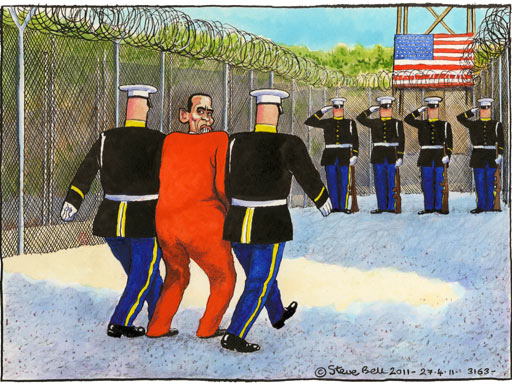
Barack Obama has been unable, and unwilling, to shut Guantánamo Bay more than two years after he ordered its closure. The continued existence of the extrajudicial prison camp has become a symbol to many of the gap between the promise and rhetoric of his early presidency.
 Steve Bell
Early moves by the White House to transfer these detainees to a facility in the US, while it figured out what to do with them, foundered after the Senate voted down a budget for it amid rising public resistance in the US to the idea of allowing potentially dangerous terrorists on to US soil.
With the Guantánamo files---750 leaked US military files containing secret assessments of Guantánamo detainees--- we have an insight into the extraordinarily thin material presented as "evidence" in the assessments. This evidence must be treated with scepticism as a number of files contain information known to have been extracted under torture, which has in several cases subsequently been found unreliable. It is a Kafkaesque world of the national security state.
The files spell out the extent of involvement US authorities believe each detainee has had with al-Qaida, the Taliban or other terror groups, an assessment of their intelligence value and the threat they are considered to pose if released. In each case they also make a recommendation for the future detention, release or transfer of the detainee.
Many had no connection to al-Qaida or the Taliban leader. Some were uneducated farmers who were in the wrong place at the wrong time. No matter. The myth that the prison held "the worst of the worst" terrorists, picked up on the battlefields of Afghanistan, was what was important.
The Conservative's big concern is to use military tribunals to extract intelligence and to try terrorists because of their distrust of the ordinary judicial system to fulfill the goals of criminal justice system, which for them, is to send people to prison and to execute them. The shift from criminal to enemy is cloaked in law.
This gives the national security state greater freedom to deal with its enemies, including people who have no link to a war in any normal sense of the term on the ground of protecting a liberal democratic society and the rule of law. Hence the examples of the miscarriage of justice at Guantánamo Bay.
This is not a concern for conservatives because their political agenda is one of rights curtailment; a systematic attack on human liberties; a displacement of peace by war, and a displacement of the rule of law by the state of exception.
So the surreal system of Guantanamo Bay remains open for business despite the fact that over half the remaining 172 prisoners have been cleared for release by Obama's own task force. Guantánamo will remain active in all its forms: indefinite detention; military commissions; and transfers.
Guantánamo embodies the failure of America, Britain and Australia's Afghan war, which began amid bombast in 2001, and has since collapsed into yet another quagmire. Retreat under the cover of spin is the only viable option.
Posted by Gary Sauer-Thompson at 9:59 AM | Comments (12) | TrackBack
April 25, 2011
Anzac
There is a lot that is right about ANZAC Day --- putting aside a day to remember those who have died in war. That is the kernel within the myth and it gives authenticity to a national day.
Unfortunately, a myth has been woven around the "Lest we Forget"; a myth about mateship & sacrifice for the sake of the nation's freedom and way of life. King and Country no longer resonates as it once did. These days its western democracies.
Anzac Spirit (mateship & sacrifice) need to be decoded, because Gallipoi stands for sending young Australian's to fight wars that have little to do with defending Australia's national interest.
Paul Kelly in The Australian says:
World War I engaged Australia's direct national interests. It was not somebody else's war. On the contrary, it was our war because victory or defeat would profoundly affect Australia's future.
It was Australian colonials fighting the wars of Britain. The Turks at Gallipoli did not constituted a real threat to the Australian nation, nor were they threatening to destroy the Australian way of life. The Turks were defending their homeland from an invasion by the imperial British.
Like Gallipoi, Vietnam, Iraq and Afghanistan are recent examples where Australia's national interest has been mythically equated with that of empire; an identity that is wrapped around the flag and nation building mythic heroes.
Posted by Gary Sauer-Thompson at 2:09 PM | Comments (5) | TrackBack
April 24, 2011
Easter
Judging by all the holiday activity during the warm weather of this Easter at Victor Harbor, the seaside resort town for Adelaide, Easter is about holidays and having fun. It has very little to do with Christianity's moral landscape, or its claims that moral truths are handed down from on high.

It is true that Christian religion has, for millennia, been thought the primary source of morality, but the reality is that the new morality is that of the consumer market capitalism. Pleasure is the now core good, self-interest the central ethos and holiday activity is about maximizing happiness. The moral landscape of advertising is the Romantic ethic of self-expression, uniqueness and self-discovery through sensual excess.
Christianity is a minority culture. It is utilitarianism--the greatest happiness for the greatest number --- that primarily shapes our moral landscape now.
The new symbols and images in our public life are those of consumerism not Christian myths, legends, symbols, heritage, narratives or collective memories. Christians say that a Christian Easter fosters community, identity, and continuity, and in the end makes possible history itself, since it embodies the collective memories of the Australian people. By means of it we tell ourselves who we are, where we came from, and to what we belong.
That may have been the case once. It is no longer. Christianity is now an emotion-laden memory, in spite of the attempts by Christians to ensure that Christianity is the core of our culture.
Posted by Gary Sauer-Thompson at 2:46 PM | Comments (8) | TrackBack
April 23, 2011
Rann Government: dying days?
The SA Labor Government that has been led by Rann and Foley is on the skids. It slowly sinks ever further in the polls---a primary vote of 24 per cent. Kevin Foley is increasingly out of control attacking nervous back bench MP's as “immature political novices who run around pretending to be political geniuses” and stating that he has more political genius in his left toe than most Labor backbenchers.
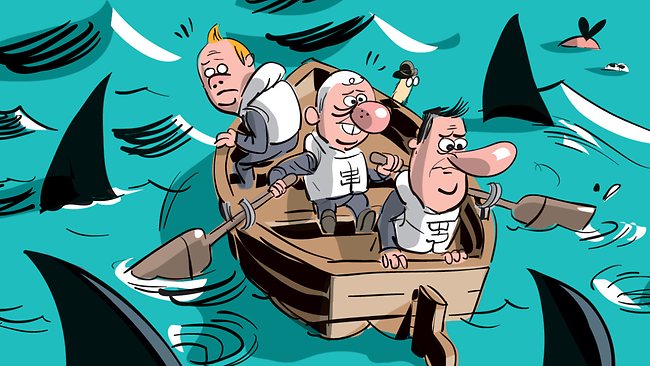
If Foley is proving to be very successful at inflaming tensions in government ranks, then Rann increasingly looking to be a prisoner of the Right Wing faction of the state ALP with its inner core of hard Catholic Right. As is well known, Senator Farrell has been the power behind the throne in the SA branch in recent years, including the make-up of the ministry and the preferment of Right faction acolytes.
This is destablizing, as it undercuts the liberal ideals of the openness or publicity of parliamentary discussion. It indicates that Parliament has become, a mere antechamber to party rooms, committees and caucuses and that it is behind their closed doors that the factional deals and decision-making gets done. This, in turn, gives rise to the electorate's lack of trust or interest in parliamentary politics.
People are now beginning to asking: 'Is the Labor Government of South Australia controlled by the Catholic Right?' The standard answer is generally no, because Catholic Conservatism is seen as declining. With the demise of the DLP and the Catholic ghetto, with Australian Catholicism conservatism means little more than a nostalgic evocation of Santamaria’s name.
We do have the irruption of religious discourse into the apparently settled secularity of public discourse as in the Government encouraging or enforcing what the Catholic Right consider to be traditional values or behaviors as indicated in their opposition to feminism, birth control, homosexual marriage, euthanasia and stem cell research.
Underneath that surface they talk in terms of "permissiveness", "nihilism" and "moral relativism" while impugning modernity, thereby merging theological with political conservatism. Any increase in individual liberty is seen as a rebellion against order and legitimate authority (dissent is equated with disloyalty); the liberal idea of the separation of church and state and the freedom of conscience should be abolished.
Catholic Conservatism prefers a society where the Church and the state would exist in different, but still mutually reliant spheres in that both church and state both maintain an institutional authority in which the moral consensus they define is the glue that maintains order in society--as if it were a quasi-governmental institution itself.
So we have a conservatism that is grounded on a critique of liberalism.
So asking, 'Is the Labor Government of South Australia controlled by the Catholic Right', is a destablizing question, since it goes beyond raising the spectre of the DLP, Catholic Labor and the Movement inside the SA Labor Party. It introduces the idea of a law and order agenda opposed to political correctness that comes from the top down in the form of a politically strengthened State that regards enmity, and potentially violent opposition, as the normal and desirable state. This is a conservatism that actively propounds the political need for an enemy, in order to secure anything like political order.
Posted by Gary Sauer-Thompson at 11:37 AM | Comments (7) | TrackBack
April 21, 2011
The ALP turns right
We are increasingly seeing federal Labor shift to the right and to make increasing use of conservative talking points in its rhetoric. In contrast to a committed politician like Andrew Wilkie Labor looks to be working from the NSW Right's focus group playbook. Some think that this is a U-turn.
The demonisation of the idle poor, the Greens and the lifestyle of the trendy inner city progressives; the attacks on WikiLeaks and Julian Assange; the affirmation of cultural traditionalism and the Bible are those memes we are accustomed to hearing from conservatives political figures when they engage in their core values rhetoric.

Gillard is a cultural conservative and the ALP is taking poll-driven conservative positions as a political strategy to appeal to what's left of Labor's blue collar base, to drive The Liberal Party further to the right, and to prepare the ground for picking a fight with The Greens over the huge subsidies for big business (the steel industry, the LNG industry, the coal miners) with respect to the carbon tax.
As Ben Eltham points out the underlying rhetoric is pretty crude:
By contrasting Green voters with the hard-working decent folk who vote Labor, Gillard is constructing a distasteful morality tale about good and bad people. Good people set their alarm clock early and love their nation and family. Bad people stay out late socialising and don't believe in the dignity of work.
Who buys that kind of nonsense?
It is increasingly impossible to go back to support the Labor Party - let alone vote for it or return to the fold. Work---ie., labouring for wages---- for Gillard appears to be an end in itself, with little connection to a meaningful life or wellbeing. The inference is that Gillard Labor is not really interested in there being more to life than setting alarm clocks early and working in a blue collar job with unpaid overtime.
Another implication is that Gillard Labor appears to be unaware that many of Labor's base in the unskilled working class are perpetually at risk of being unemployed in a global market economy because manufacturing continues to decline and the large factories, warehouses and call-centres that used to be employers of school leavers are closing. Many fast-growing sections of the economy demand sophisticated computer literacy and people skills.
Yet Gillard Labor is blaming jobless Australians for their own misfortune (they are dumb and lazy)!
I suspect that we are seeing the influence of the Labor Right in Gillard's explicit shift to the right; a right that has deep roots in a Catholic conservatism that detests, and is opposed to, liberalism.
Posted by Gary Sauer-Thompson at 10:19 AM | Comments (7) | TrackBack
April 20, 2011
bringing the media to heel
In Rupert Murdoch's calculated bet he can end hacking saga Roy Greenslade outlines
News International's strategy to bring the News of the World phone-hacking scandal in the UK to an end.

They have decided to throw a lot of money at claimants who make out a decent case. Money will talk and close things down by gagging the claimants. Greenslade outlines the legal strategy to halt the series of damaging revelations.
If this strategy is successful, then it is up to the politicians to find the political courage to use the powers of Parliament to stand up to Murdoch by setting up a wide ranging public inquiry into phone hacking and the newspaper culture that would lead to the replacement of the current system of self-regulation.
You can imagine the traditional media's response to that--they'd fight greater regulation tooth and nail in the name of the freedom of the media. In many respects this is a looking backwards move because the media landscape is rapidly changing because the internet (a platform ln the same way that paper is) and streaming content online are resulting in a digital media world. The shift from print to web-only publication is well under way.
Newspapers, films, TV, music, radio are all produced and distributed in a tightly controlled way and with restricted access. The internet blows the doors off that concept because it's an environment where everyone can distribute with maximum efficiency to everyone else and to any platform. There is a space in this landscape in Australia for a consumer product/services/packages based around content, connectivity, and social TV---the Netflix recipe.
Posted by Gary Sauer-Thompson at 1:24 PM | Comments (3) | TrackBack
April 19, 2011
the re-emergence of ‘assimilation’
I missed the Q+ A programme on the intervention into the NT indigenous communities when I was in Tasmania but I have just read the transcript. There was little debate about the breaking up of Aboriginal control and Aboriginal culture, moving people off their lands and forcing assimilation into "mainstream" Australia.
What we did have in Q+A was Bess Price, a central Australian Aboriginal leader, saying:
I am for the intervention because I've seen progress. I've seen women who now have voices. They can speak for themselves and they are standing up for their rights. Children are being fed and young people more or less know how to manage their lives. That's what's happened since the intervention.
I find that a puzzling statement because, as Graeme Innes the Human Rights Commissioner observes, notwithstanding the huge amount of work that needs to be done amongst remote Aboriginal communities, it also:
seems to me counter intuitive to empower people to improve their communities by taking away their rights. That just seems to me totally counter intuitive to do that and that's what was done when the Racial Discrimination Act was suspended and rights to complain were taken away from Aboriginal people.
Price's response is that at the time it needed to take place the Intervention was an emergency because her people were suffering and it was so bad out there. She also said that she didn't think the commonwealth government is racist.
However, Price failed to mention the community opposition to SIHIP's design to further break up community control of township land, push people out of remote areas, and entrench the NT intervention; or thge community opposition to Income Management; or the suspension of the Racial Discrimination Act. Nor did Price refer to the deep resentment of the Intervention amongst aboriginal people.
If aboriginal women are standing up for their rights as Price claims, then it is as a form of resistance to the equivalent of working for rations and to the Strategic Indigenous Housing and Infrastructure Program (SIHIP) in which a select number of aboriginal communities are required to sign away leases over their land for between 40-90 years for new housing.
The core problem that I have with the Intervention (under Howard, Rudd and now Gillard) is that it is not based on a partnership with aboriginal people as is claimed. It is being imposed on aboriginal communities whether they want it or not. Income management increasingly looks more like the old welfare rationing system that disempowers individuals and communities in order to control and socially engineer aboriginal people in the Northern Territory throughout the 20th century before the advent of the 'self-determination' era in the early 1970s.
I see the NT Intervention as the culmination of the re-emergence of ‘assimilation’ as a dominant philosophy guiding government policy in Aboriginal affairs. We have, in effect, a re- introduction of "rationing" policies in the form of Income Management through the Centrelink bureaucracy. The effect of this paternalism over whole communities is the aboriginal people's loss of autonomy and voice.
So liberalism has been dumped in the name of protecting woman and children. The rhetoric is based around the stereotypes of abusive men, pitted against women, needing strong controls for their own protection in order to protect the children. The women are battling the men to retain the Intervention. We have the construction of Aboriginal women as hapless victims needing government controls to protect them from abusive men so they can be safe.
Posted by Gary Sauer-Thompson at 12:24 PM | Comments (9) | TrackBack
April 18, 2011
NSW: environmental rollback
When the NSW Parliament resumes on May 3, the Shooters and Fishers Party in the NSW upper house will begin its push for legislative changes to enhance the activities of licensed shooters, hunters, anglers and 4WD owners.
They want the right to shoot feral animals - deer, wild pigs, goats, foxes and rabbits - in national parks; the restoration of duck shooting all year round; the establishment of game parks on privately owned rural properties; the rewriting of the Firearms Act to roll back regulations on gun ownership, licensing and control; and the review the protected status of the state’s marine parks.

O’Farrell, the new premier, has a choice: deal with the Christian Democrats (Fred Nile) and the Shooters and Fishers or deal with the Greens.
The allies of the Shooters and Fishers Party is the National Party and their aim is to degut environmental regulation and policy; ie., a dramatic weakening of environmental protection standards and laws. The Shooters and Fishers Party, which - as in the previous parliament - finds itself holding a share of the balance of power with Fred Nile's Christian Democrats, meaning that O'Farrell's Liberals will need its support to pass legislation opposed by Labor and the Greens.
Posted by Gary Sauer-Thompson at 2:22 PM | Comments (5) | TrackBack
April 17, 2011
Libya: regime change
The liberal internationalist's humanitarian case for intervention in Libya does look like a continuation of America's self-ordained role as global policeman that has seen the US fight several genuine wars (Korea, Vietnam, Iraq, Afghanistan etc) and engage in countless military interventions. Libya is about regime change at the point of a gun.
 Martin Rowson
America, as Chalmers Johnson pointed out, acquired an empire as it expanded its military bases during the Cold War, and it now appears after the Cold War to be engaged in a war without end to advance global peace and freedom. The "American Century" has been only 70 years (from 1940-2010). The key to this empire is hard power of the hammer:--whatever needs to be done is to be done by the military.
More often than not the tools of American foreign policy are those of force and hard power, especially with respect to the core US response to events in the regional politics of the Islamic world. Congress now plays no role in deciding on wars and military interventions within the the changes sweeping through the Middle East. The President calls the shots. Congress agrees. America is not the beacon of democracy anymore.
This time round in the greater Middle East the US empire intervenes into a civil war in Libya. We hear "humanitarian intervention" and understand that to mean "regime change" and we do it without blinking even though we know that the only way that solves America's fiscal problems is by sensibly cutting both defense spending as well as increasing revenues.
Posted by Gary Sauer-Thompson at 11:11 PM | Comments (9) | TrackBack
April 16, 2011
seeking power for its own sake
In A Lesson for Social Democrats in the London Review of Books blog Ross McKibbin comments on the New South Wales Labor government's shattering defeat in the state elections. He says:
In New South Wales, the decline of the industrial working class was accompanied by the collapse of the Labor-reformist ideology, which was a product of the old demography. In the best neo-liberal way, Labor governments became obsessed by budget surpluses, refused to borrow for infrastructure projects and became notorious for cancelling programmes once thought to be indispensable. In other words, the government became incapable of working the old patronage networks because it had nothing to give its clients.The decay of reformism also opened the Labor Party to a destructive factionalism.
We are looking at a wreckage of the Labor Party in its historic base: Sydney’s sprawling western suburbs and the industrial constituencies to the north and south of the city.
McKibbin says that the parliamentary party and the government became the right wing faction's playthings: premiers were made and unmade by it.The point of politics became not policy but politics, and most of its practitioners were men and women who had done nothing else since university, if not before.
Since all that mattered was winning elections, the role of the machine was to monitor every movement, however slight, of public opinion. NSW government was focus-group politics par excellence. In order to win elections you had to have money, and raising money was the obsessive concern of the machine. That is how the Labor Party became the party of the property developer, which divorced it from much of its traditional electorate and undermined its once strong ethnic minority vote – ever more important in Australian politics. It also divorced the party from the Greens.
The NSW Right is still at it. The new leader of the state parliamentary party was elected by his little band unopposed, having been chosen before the election was lost and before the Labor premier had resigned.
Posted by Gary Sauer-Thompson at 10:33 PM | Comments (5) | TrackBack
April 15, 2011
a truce in the timber wars?
If you recall one of the striking images of the forestry wars in Tasmania was the forestry workers cheering on the anti-union John Howard during the 2004 federal elections. Another was the online footage of timber workers aggressively attacking forest activists who were trying to prevent the logging of the native forests in the Florentine Valley.
 Gary Sauer-Thompson blockade, Still Wild Still Threatened, 2011
Tasmanian forestry signifies the ethical decline and political corruption of the Australian Labor movement. There was, and still is, something rotten at the core of Tasmanian corporatist politics. The cravenness of successive Tasmanian governments and their unwillingness to make any decisions contrary to Gunns’ wishes shows how beholden Labor (and the Liberals) were, and still are, to its corporate agenda.
The Labor Government has, until now, shown little interest in forest peace talks aimed at a transition out of native forests to a plantation-based industry. Lara Giddings, the Premier of Tasmania, is claiming that you cannot have a sustainable timber industry without a pulp mill.
There has been a kind of truce and a deal in the making in the forestry wars in Tasmania. The deal is to end large scale native forest logging in Tasmania that has been undertaken by Gunns and is still being undertaken by the state government-owned Forestry Tasmania, which supplies Gunns with most of its wood.
My understanding was that a part of the December the deal involved a full moratorium on further logging and road construction in high conservation value forest reserve areas in three months and a shift to sustainable forest industry.
As I understood it the interim arrangement brokered by forest peace talks facilitator Bill Kelty will see all logging halted in nominated high-conservation-value (HCV) public forests by September 11. Key points of the agreement are that:
• The agreement is for a six-month period beginning immediately.
• The ENGOs have identified the boundaries of their claimed High Conservation Value (HCV) areas.
• Logging will not occur in that area, unless it is necessary to meet existing timber contracts or for the assurance of wood supply for existing industry, and
• There will be a transition period while the arrangements for the moratorium are finalised between the panel subcommittee and Forestry Tasmania.
A final peace agreement---the Kelty forest deal, which amounts to a forests-for-the-pulp-mill swap---- is to be signed by June 30.
As I said on junk for code the truce does not seem to be holding re the moratorium. 15 March 2011 was the deadline day for a full moratorium on logging in all Tasmania’s high conservation value forests.
The State Government failed to implement this promised moratorium Forestry Tasmania appears to be reneging, if they were ever seriously interested in the moratorium on logging. So I was informed by the activists in the Still Wild Still Threatened (SWST) group blockading the logging road into the Florentine Valley.
Update
According to Sue Neales in The Mercury unless Gunns gives up its wood supply rights to 220,000 cubic metres of this annual native timber allocation obtained from Forestry Tasmania, FT will not be able to set aside the 572,000 hectares of high-conservation forests for protection desired by green groups, because there would simply not be enough forest "left" for FT to meet its wood supply obligations to customers such as Gunns.
Gunns has made it plain that it will only give up its native wood entitlements if its plantation-only pulp mill gets the green light. They have also made it plain that there is only one pulp mill around, and that is Gunns' amended project in the Tamar Valley.
Posted by Gary Sauer-Thompson at 7:40 AM | Comments (2) | TrackBack
April 14, 2011
mandatory limits on gambling
I have been watching the debate around the introduction of mandatory limits on gambling in the pub-clubs sector and I applaud Andrew Wilkies' attempts to ensure that this happens at pokies' venues in order to curb problem gambling.
He says that he will withdraw his support for, and hence collapse, the Gillard government by this time next year if it has not passed legislation giving the Commonwealth the power to force the states to comply with the betting limits.
Some hotels, from what I can gather, rely on poker machines for 70 to 80 per cent of their earnings whilst several Victorian AFL clubs (eg., Collingwood, Essendon and Hawthorn) have pinned their financial security to growth in the gaming machine sector. The clubs, continue to present themselves as supporting the communities in which they do so much damage.

Labor has promised to introduce laws requiring poker machine players to commit on how much they will spend by 2014 in exchange for independent MP Andrew Wilkie's support in forming its minority government. The pub-clubs sector is outraged at the proposed Wilkie-Xenophon legislative reforms, and it is committed to preventing the introduction of the legislation.
Wilkie faces an uphill battle with his legislative reforms in terns of finding support in the House of Representatives. The Liberals are opposed as is the NSW state government. That leaves the Independents who currently look as if they have cold feet, even though the proposed reforms are reasonable.
As Tim Costello points out in The Age the proposed reforms are not a ban:
The government's proposal is to require players to set loss limits before they start playing. Once over that limit, they are locked out of further play from all machines. It gives them back control by forcing them to not just chase their losses or believe they are just one win away from not having a problem. Clubs and pubs know that 40 per cent of their revenue comes from problem gamblers (the finding of the Productivity Commission) and do not want their revenues affected by giving players more control.
Innocent people are being hurt by the pokies from the ripple effects of crime and family suffering. A card curtails the damage as it locks players out once they cross their own set limits.
The Clubs and Hotel sector sound like the Tobacco industry.
Posted by Gary Sauer-Thompson at 7:18 AM | Comments (7) | TrackBack
April 12, 2011
News Ltd goes on the defensive
News Ltd is definitely on the back foot with the hacking into the phones of cabinet ministers and other high-profile figures in the UK. It has admitted the illegal practice, apologized to eight victims of the phone hacking and is preparing to pay compensation to victims of the phone hacking.
 Martin Rowson
News Ltd doesn't have a leg to stand on as there is no public interest defence of its actions. Its recent move is a clear attempt to stop the multiple civil actions in their track before the torrent of discovered documents and emails is exposed to the public eye. The high court has been resolutely demanding that claimants are given access to police files, phone records, notebooks and internal emails.
The episode indicates indicates a failure by the state to control the corporate media sector represented by News Corp and its modern American style conservatism that combines a belief in the possibility of endless economic expansion and that of settled small town values with an imperial foreign policy.
Posted by Gary Sauer-Thompson at 7:36 PM | Comments (4) | TrackBack
April 11, 2011
whither the ALP?
Mike Pearce in Should the ALP labour on, or is the party over? in The Age offers a realistic assessment of the ALP. It's one of the better accounts I've read and its well worth reading closely and engaging with.
His argument is that both Hawke, with his emphasis on consensus politics, and Keating, with his notion of inclusiveness, took steps towards reconciling Labor's traditions [ie., improve the lot of working Australians by redistributing wealth to them] with its free market reorientation.
Had that direction continued, Labor might have produced a coherent ideology for the 21st century, based on the idea that the market is a good servant but a bad master and reserving sufficient scope for government intervention to underwrite basic living standards.
This is a capitalism with a heart. However,
first under Mark (''ladder of opportunity'') Latham and now under Julia (''alarm clocks'') Gillard, and in response to John Howard's wedge politics, Labor has instead hardened its attitudes. In competing with the Liberals for the aspirational vote, it has abandoned its social welfare traditions, maintained high levels of public funding for wealthy private schools and turned its back on human rights.
He argues that shrinking domain of genuine debate goes a long way to explaining the poverty of contemporary politics.
If the right has won the economic debate (the role of government was to regulate lightly to ensure the efficient function of the market), then the left has just as surely won the social debate. The left's agenda on racial equality, women's liberation and gay rights has largely been implemented throughout the West.
Labor has embraced the managerial task of contemporary government and it struggles to articulate a coherent set of policies relevant to contemporary issues. Gillard's emphasis on value of a good education and the dignity of (manual) work is thin gruel.
Whither the ALP? Pearce says that:
The dilemma for Labor is that to move outside the consensus makes it unelectable, while it denies its history and its raison d'etre by staying within it. As a result, this once great party has become little more than a vehicle for political careerists, drawn mainly from the trade union movement.
The modern Labor Party, for Pearce, is a hollowed-out institution lacking any coherent and relevant ideology, propped up by the increasingly marginalised trade union movement with a dwindling active membership.
It's a realistic account. So can anything be salvaged from the wreckage? Is there anyone willing to do the salvaging?
Posted by Gary Sauer-Thompson at 7:45 AM | Comments (3) | TrackBack
April 9, 2011
a toxic culture
Well, the military are losing the war in Afghanistan and the publicity war about the sexist culture in its ranks in the navy, the Royal Military College and the Australian Defence Force Academy.
Few believe that the culture of predatory sexual behaviour is the isolated actions of rogue elements, which is the standard spin from the military hierarchy in the Defence establishment. So why bother with the spin?

The military has form in terms of the sexual assault and harassment of woman in its ranks (its called male bonding" or mateship), a tendency to let the offenders off lightly and to victimize the women. They instinctively refuse to confront the cultural issue of sexism and turn a blind eye to rape in its ranks.
This is a culture that closes ranks: it groups together, it look after its own, and it thumbs its nose at everyone else including ministers who want to reform Defence. They are defending the country by putting their bodies on line so back off.
Defence have consistently managed to block reform and to get rid of reforming ministers. Will Stephen Smith, the current Defence Minister, succeed where others have failed? Or will they bring down Smith as they did Fitzgibbon?
The Defence establishment give the impression that they do not see themselves as under the authority of a democratically elected Minister, only the authority of the Governor General as the representative of the Queen. It's still an old style ethos of 'king and country'. So they just don't do what the Minister of the day tells them.
Posted by Gary Sauer-Thompson at 8:08 AM | Comments (7) | TrackBack
April 8, 2011
US: not again
History is repeating itself in the US as the US government is on the edge of shutdown once again. Remember Newt Gingrich, his Contract with America in 1994 and the government shutdown in 1995?
Currently, there is a spending fight between Republicans and the Obama administration over both budget cuts and disputes over policy issues like environmental regulations and abortion. The Republican House and the Democratic Senate cannot come to an agreement about how to fund federal operations for the next six months.
The current situation is that the Republicans want a cut in the federal deficit of $40bn. The Democrats made a compromise offer of $34.5bn on Wednesday. The new sticking points are mainly the areas where the Republicans want cuts – abortion programmes and environmental protection, on which the Democrats refuse to give way. Shutdown threatens and its not just political theatre.
The problem for the Republicans is that the Republican tea party members are not controlled by the Republican leadership and the former are quite hawkish: they are will push harder to get what they want and are probably willing to go in guns blazing threatening the functioning of the country to get what they want. They want a debt limit and they are prepared to put social issues on the front burner of future series of budget battles.
Ever since the Supreme Court affirmed women’s abortion rights, Congress has worked to chip away at them. Those efforts have largely been led by Republicans.
Update
A deal was cut and shut down avoided. However, Republicans have signaled that they will again demand fundamental changes in policy on health care, the environment, abortion rights and more, as the price of their support for raising the debt ceiling.
The Republicans regularly trot out new members to offer proposals to hack away at the federal budget that are couched as the boldest and most ambitious deficit-reduction plans ever seen. Each time the Republicans actually come into power, federal deficit spending explodes and the Republicans somehow never get around to touching Social Security, Medicare or Medicaid. As Matt Taibbi observes:
The problem, of course, is that to actually make significant cuts in what is left of the “welfare state,” one has to cut Medicare and Medicaid, programs overwhelmingly patronized by white people, and particularly white seniors. So when the time comes to actually pull the trigger on the proposed reductions, the whippersnappers are quietly removed from the stage and life goes on as usual, i.e. with massive deficit spending on defense, upper-class tax cuts, bailouts, corporate subsidies, and big handouts to Pharma and the insurance industries.
This is a political game that gets played out in the media over and over again, and everyone in Washington knows how it works.
Posted by Gary Sauer-Thompson at 1:19 PM | TrackBack
April 7, 2011
The Australian's conservatism
I see that News Ltd's plan to destroy The Greens is continuing to target their criticisms of Israel and support for the Palestinian people. The extremist Greens are anti-Israel effectively providing succour to extremist, Iranian-sponsored groups such as Hamas, even though the Greens policy is support for a two state solution.
The problem with this use of conventional political weaponry in the attack on the "red Greens" from the conservatives is that their compassionate conservatism is no where to be seen. The red Greens are seen to stand for social justice and they are as much a moral project as well as a political party. In contrast, The Australian's style of conservatism is one of travelling carelessly down the laissez-faire road to free markets and hacking into the supply of government services for those being excluded by the market.
Yet most Australian voters aren't anti-government libertarians. They don't want to be left alone. They want government to care for the weak. They want government to be there when adversity strikes. They want government to work better, not to disappear. They want the welfare state. So the Australian's laissez-faire conservatism is seen to be morally inferior to the ethos of social justice. Those excluded by the market and left behind should stand on their own two feet and receive an occasional helping hand from charity.
Christian-based charities dependent on volunteer donations, greater school choice, and welfare-to-work are the dominant response to poverty and social exclusion.Oh, and strong families. Is that the strand of compassionate conservatism? If so, then compassionate conservatism is less a governing philosophy and more a mildly useful bolt-on to laissez-faire economics (cut government and unleash enterprise) + law and order + strong defence + carefully-policed immigration.
Posted by Gary Sauer-Thompson at 1:40 PM | Comments (5) | TrackBack
April 6, 2011
spilling the beans?
I missed Q+A on Monday night where Kevin Rudd publicly acknowledged that he was wrong to pull the plug on the carbon pollution reduction scheme (CPRS) Well, not pulling the plug, it was delaying the CPRS two years until 2012.
One of the reasons he says that:
was alive in our mind at the time was we need a new senate. Following the next election there was no way the Coalition was going to maintain dominance in the senate, as it's proven. The Greens now control the senate as of 1 July this year. So a basis for delaying the implementation two years was mindful of the fact the senate would change.
Well, we knew that. So why didn't the ALP stand and fight? Differentiate itself from an Abbott-led Coalition?
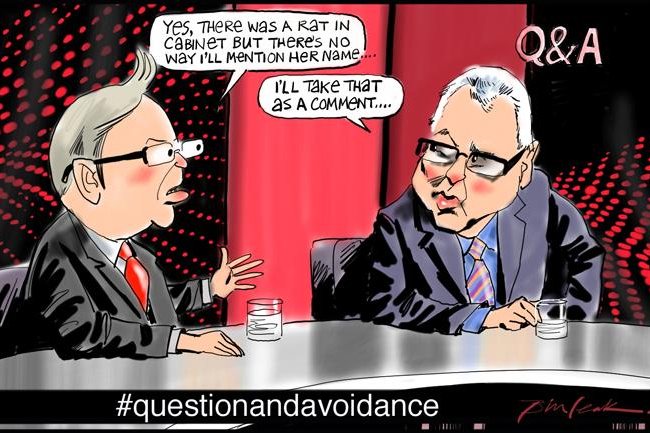
Rudd acknowledges that there were other factors at play----the diversity of views within the Labor Party and in the cabinet at the time.
He says:
And so you had some folk who wanted to get rid of it altogether. That is kill the ETS as a future proposition for the country. I couldn't abide that. There were others who said we should stick to the existing timetable, apart from the fact that the senate couldn't deliver it. So I tried to find a way up the middle of all that. Preserve the unity of the government. On balance it was the wrong call because we should have simply tried to sail straight ahead. But you make mistakes in public life. That was a big one. I made it and I'm responsible for it.
What Rudd hinted at is that there was a big split in the cabinet---"a massive conflict of views within the government" which he describes thus:
People were concerned, to be fair to view that with the global financial crisis the ability and the uncertain employment prospects - we're talking about early 2010 where we still didn't know how far out of the woods we had come, that people were quite concerned about putting a price on carbon and its effect on family incomes at a time when a whole lot of people were under financial stress. So to be fair to that argument, that's what they were putting forward but, as I said, there are some who wanted to junk it. There were others who wanted to sail straight ahead, notwithstanding the fact we didn't control the senate. I tried to find a path up the middle of that. It didn't work. It failed.
He also stated that the ALP organisation is one where there still are are factional leaders who intimidate a lot of the rest of the party from getting on with the business of being an effective political force in the country--factional leaders who operate as factional thugsters who put themselves first.
It really was a 'show and tell.' The really sensitive issue for the ALP is not the past, but Rudd's factional thugsters claim.
The line will be that the ALP is not ruled by factions and that all political parties have factions.
Posted by Gary Sauer-Thompson at 12:35 PM | Comments (12) | TrackBack
April 5, 2011
kinds of development
One conception of development is giving the property developers in the capital cities what they want, even if that means the state government overriding the wishers of residents and a lower quality of life in the city.

Another kind of development is the long terms one of making the transformation from an industrial economy to an information one. The National Broadband Network signifies such a transformation, as it means opening up regional communities (eg., in Queenstown, Tasmania) to high-speed internet access.
The old world shock jocks in NSW have their heads in the sand with respect to the NBN, as this allows many business people and other professionals, who were facing the prospect of having to move into bigger cities, to continue to live and work in regional communities.
Mobile broadband works. I'm typing this on my Apple MacBook in the caravan park in Queenstown using Telstra's pre-paid mobile broadband. It works a treat. However, it is far too expensive for long term use if you are a resident in this isolated community. You need fibre optics and low cost entry points, especially for those on struggle street. The NBN is coming to Queenstown.
This highlights the flaw in the standard argument that wireless broadband access is growing at such an alarming rate that there is no need for the NBN to be built using fibre and so who would want a fixed-line connection when you can have the flexibility of wireless access? So argues Malcolm Turnbull.
Turnbull is wrong as people want both fibre and wireless not wireless at the expense of fibre. Wireless is supplementary technology.
Posted by Gary Sauer-Thompson at 10:57 AM | Comments (4) | TrackBack
April 4, 2011
exclusion
My strongest impression from my brief time in Hobart was the unemployed youth hanging out in the central business district. Labor's promise of social mobility and opportunity looked as if it was being broken. The impression I gained was that the jobs were just not there in spite of Labor's talk about education, apprenticeships and trades. Why not?
Don Tapscott in The Guardian outlines the promise:
Today's society is failing to deliver on its promise to young people.We said that if they worked hard, stayed out of trouble, and attended school, they would have a prosperous and fulfilling life. It turns out we were inaccurate, if not dishonest
My response to why there is no jobs is that the period of industrial capitalism is coming to an end, and many young working class people who had been trained in the educational system of industrial capitalism have been left stranded with very limited futures. Tapscott again:
Widespread youth unemployment is one facet of a deeper failure. The society we are passing to today's young people is seriously damaged. Most of the institutions that have served us well for decades – even centuries – seem frozen and unable to move forward.....I'm convinced that the industrial age and its institutions are finally running out of gas.It is young people who are bearing the brunt of our failures.
That kind of failure is pretty much what I saw in Hobart. I've been puzzling about whilst travelling to Queenstown.
I saw jobs in Sheffield--- near Cradle Mountain----was teenage girls who'd left school early, working in a coffee shop for tourist, and who defined their future in terms of marriage with a local lad working in the resource industry. They had not been trained in the digital economy.
'Social exclusion' is Labor's word and they have set up social exclusion units to bring people 'in from the cold.' The social exclusion ethos has been taken from Tony Blair who stated that:
We had a poor record in this country in adapting to social and economic change. The result was sharp income inequality, a third of children growing up in poverty, a host of social problems such as homelessness and drug abuse, and divisions in society typified by deprived neighbourhoods that had become no go areas for some and no exit zones for others. All of us bore the cost of social breakdown – directly, or through the costs to society and the public finances. And we were never going to have a successful economy while we continued to waste the talents of so many.
Tasmania is struggling to adapt from a resource based economy to an information one.
If the conception of social exclusion includes low income and focuses on the link between problems such as, for example, unemployment, poor skills, high crime, poor housing and family breakdown, then the policy is not working.
Posted by Gary Sauer-Thompson at 11:11 PM | Comments (3) | TrackBack
April 1, 2011
Andrew Bolt + the right to free speech
I've been preparing for a two week holiday and photographic trip in Tasmania that starts tomorrow. Blogging will be light for the next two weeks even though I will be using Telstra's pre-paid mobile broadband.
I've been following the Andrew Bolt case--or more accurately, the race discrimination case taken by a group of indigenous Australians against the Herald and Weekly Times and its populist columnist for breaching the 'Racial Vilification Law in Australia.
The defence of Bolt from conservatives such as that by Ted Lapkin in The Age is that this political correctness gone mad:
The plaintiffs seek to exploit the coercive power of the state to impose a permanent ban on words that they find personally upsetting. Nothing could be more childishly solipsistic. Nothing could be more inimical to democracy...A regime of government coercion to enforce the protection of tender feelings must be antithetical to political liberty. There can be no right to be shielded from personal offence or insult in a truly free society. For freedom of expression to have any real meaning, we must guarantee it to those whose views we despise.
So how do you guarantee freedom of expression in a liberal society? According to Lapkin our freedoms depend on the anti-democratic Racial Hatred Act being repealed because our rights are endangered far more by human-rights bureaucrats who want to dictate what people can and cannot say than by the illiterate gibberish coming from the likes of Fredrick Tobin or left-wing anti-Zionists.
This defence of free speech is okay as far as it goes. There are also plausible arguments that there are grounds for amending the Racial Vilification Act (1975), as it currently stands; and for broadening freedom of speech since freedom political communication implied in the Constitution is not a broad freedom of speech as in other countries, but rather a freedom whose purpose is only to protect political free speech.
However, Lapkin does imply that anyone can say anything at any time. There are limits to, or restrictions on, free speech --eg., making grievous errors, vilification, obscenity, defamation etc --which Lapkin neglects to mention in his attack on political correctness. Justice Holmes, speaking for the US Supreme Court's rejection of unlimited freedom of speech in the US put it this way:
The question in every case is whether the words used are used in such circumstances and are of such a nature as to create a clear and present danger that they will bring about the substantive evils that Congress has a right to prevent.”
The right to freedom of expression does not protect statements that are uttered to provoke violence or incite illegal action. It is also well known in common law that some public interests----national security (eg., sedition) justice, or personal safety --override freedom of speech. Freedom of political free speech in Australia is a boundary which can be adjudged to be breached.
Secondly, Lapkin's defence of Bolt presupposes the principle of rights. The problem here, as Richard Ackland points out in the Sydney Morning Herald, is that:
The difficulty is we do not have a right to free speech, beyond the vagaries of the common law. If we had a charter of rights, Justice Mordecai Bromberg would be required in this case to balance Bolt's right of free speech with the rights of the applicants not to be racially picked upon and we'd have a better idea of where the line lies.
The irony of course, is that Bolt has campaigned furiously against a charter of rights. Poor Bolt. He's discovering the limits of a liberalism based on utilitarianism and the idea of harm; limits that would be overcome by a rights based liberalism.
Posted by Gary Sauer-Thompson at 8:55 AM | Comments (3) | TrackBack