|
March 22, 2011
The Canberra Press Gallery is starting to write the obituary of the Gillard Government and that of the ALP. Are there interpretations plausible?
For instance, Glenn Milne addresses the issue of the Gillard Government when he writes at the ABC's Unleashed that with 'Gillard battling on many fronts, Liberals dare to hope, for the first time since the Labor minority government was formed, that Julia Gillard's first term in her own right may be her last.' He adds:
This is not to say they now believe the Government will not go full term. To the contrary, there is a grudging recognition that the dreams of an early implosion between Gillard and the independents she relies on to govern were misplaced. It's just that senior Liberals now believe Gillard's prime ministership may be terminal, a fate that will become clear at the time of the next election.
There is a growing belief among senior Liberals, he concludes, that Gillard's eroded legitimacy may be fatal to her re-election chances.
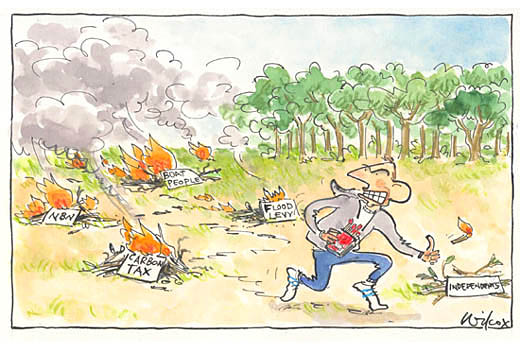
From my perspective Milne's columns on the ABC's Unleashed are basically him writing publicity for the Liberal Party. They tell us little more than what senior Liberals are thinking about the current state of play in politics. The content is mostly about hope.
Peter Hartcher prefers to make his own judgements. In the Sydney Morning Herald he says:
The Prime Minister is like someone under a death sentence, carrying on breezily as if everything is normal. Let's be realistic. As things stand, Labor cannot hope to govern in its own right any more.....As a party able to offer itself as a viable government, Labor is not just under existential threat. It is finished. Unless, of course, it can engineer an extraordinary resurgence. Labor's looming death as a stand-alone political entity is the biggest story in contemporary Australian politics.
His thesis is that the ALP has self-destructed as the party of the progressive vote. Even if Gillard can win passage of a carbon tax through the Parliament, it will not be enough to save her, and Labor, from oblivion.
Let us accept that Labor cannot govern in its right any more---the coalition of ALP and Greens in the ACT and Tasmania gives us the reasons for accepting this part of Hartcher's thesis. What then of his oblivion claim?
Hartcher doesn't address the possibility of a coalition between ALP and Greens at a federal level. Hasn't the ALP depended on Greens preferences to be competitive since the 1980s? If the ALP cannot win elections with a vote in the mid-30s, then it needs some sort of an alliance with the Greens.
Hartcher is ambivalent here. On the one hand, the alliance possibility is sidelined on the grounds that the Right faction is dominant within Labor and it has no interest in moving left to appeal to progressive voters. On the other hand, Hartcher acknowledges this possibility with his claim that Labor has yet to squarely confront the fact that it is on track to bring the two-party system to an end as Australia witnesses the rise of a three-party system.
We already three-party system---eg., Liberals, National and ALP. Nay, the political landscape has changed so that we actually have a four-party system: Liberals, National, ALP and Greens. How does that constitute Labor's oblivion--that Labor is finished? Nobody seriously claims that the Liberals are finished because they are required to form a coalition with the Nationals. Why the ALP then?
|





Glenn Milne, like Andrew Bolt, needs to stop pretending to be a journalist and just be honest about the nature of the spinning he is doing for the Coalition.