« February 2010 | Main | April 2010 »
March 31, 2010
Abbott on economics
Tony Abbott's economics speech is mostly a critique of the Rudd Government's home insulation programme, the pink batts programme, solar panels scheme, and hospital reform.These are used to argue that the Rudd Government has saddled Australia with government waste and years of higher interest rates, higher taxes and higher debt.
Abbott does spells out the Liberal Party's economic values:
The next Coalition government will reflect the Liberal Party’s abiding preference for smaller government, lower taxes and greater freedom not because we think that government is unimportant or that taxes are unnecessary but because we appreciate that individuals and businesses create wealth, not government.
How does that square with his climate action plan that gives billions to industry to maintain “business as usual” carbon emission, and the paid parental leave plan, which gives more money to people on $150,000 per annum than it’s giving to people on lower incomes? Or the Howard Government's high government spending to attract electoral support, via middle-class welfare and regional pork-barrelling?
Abbott's tacit argument is against government intervention and Keynesian economics: there was no economic crisis, or at least not one in Australia; even if there was, counter-cyclical fiscal policy won’t work; and in any case the stimulus packages had no effect.
His argument against this is done in terms of the global financial crisis:
Mr Rudd wants people to believe that he is responsible for this. He wants them to think that he’s the economic genius who saved Australia. In fact, he’s saddled us with years of higher interest rates, higher taxes and higher debt to avert a disaster that never was....Australia has survived the global financial crisis thanks much more to the reforms of previous governments than to the spending spree of the current one...The Prime Minister justifies everything as necessary to avoid a recession. In fact, the Global Financial Crisis has been a convenient justification for Mr Rudd’s instinct to spend more.. The economic stimulus wasn’t necessary to strengthen Australia’s economy at a time of global recession and the consequent increase in interest rates is almost certainly weakening it now that recovery is under way...... The Asian financial crisis in 1997 was more threatening than this one for Australia.
The conclusion is that countries can’t spend their way out of recessions but they could reform their way through them, and that Governments that live within their means would not need to increase taxes or drive up interest rates.
Where do you start with this kind of denial that willfully ignores the judgement of the Reserve Bank and Treasury and most governments in the western world that there was a global financial crisis and that Australia avoided a downturn last year because of government spending? Around the world stock markets had fallen, large financial institutions have collapsed or been bought out, and governments in even the wealthiest nations have had to come up with rescue packages to bail out their financial systems.
A good place to start is the lack of economic understanding on Abbott's part about the increasing levels of leverage for financial institutions, the asset bubble, the subprime mortgage crisis with the default of a large portion of subprime loans in August 2007, the massive flight to liquidity by investors and the crash of financial markets in March 2009.
Abbott then adds that:
Good government, though, is much more than an exercise in book-keeping. The national accounts, after all, are only a reflection of what’s happening in the economy. Government’s biggest challenge is to try to ensure that change makes people and organisations more productive. ... The next Coalition government will maintain the tightest fiscal discipline but it will also aim to maximise Australia’s economic growth.
Nothing about the well-being of the population--the Treasury's framework-- in Abbott's account.
Posted by Gary Sauer-Thompson at 1:18 PM | Comments (4) | TrackBack
March 30, 2010
broadband blues
Internode, my ISP, has had service difficulties since last night at several exchanges across Adelaide, including the Waymouth exchange in the CBD that I am linked to. I've been without service since last night.
It's an uncharacteristic and lengthy outage for Internode. It's not a general outage as it is impacting a small number of customers distributed over a number of Internode's DSLAM infrastructure in Telstra's exchanges and requires some sort of software upgrade I have resorted to using my 3 mobile broadband as backup, for without an internet connection I'm lost: I cannot read online or post.
So it surprises me to read in The Australian that the Coalition has said that it would honour national broadband network contracts already in place, but that it would stop short of rolling out the Labor government's ambitious $43 billion fibre plan. Tony Smith, the Opposition communications spokesman, said that:
The solution is to focus a lot of government attention on areas of market failure where it’s not commercial and to step in and try to lift that service. That’s what the Opel contract was about and in many respects. I’m not saying that we would exactly revive OPEL but certainly the principles and priority that underpinned it... The other critical thing to consider is the take-up of wireless broadband. People argue it will never be as fast as fibre but I think while that’s true, it’s getting better all the time. The trade off in speed for a lot of people is in mobility. Small business in areas where I represent many of them would happily trade off capacity and a little bit of extra speed for mobility.
So we have the market solution approach in the city that leaves us in the tender clutches of Telstra, with its poor service, its expensive plans, capped speeds, anti-competition ethos, poor backhaul infrastructure and quotas. If you don't like that kind of gouging, then go mobile.
In other words the Coalition has no communications policy other than the targeted approach of the $1.9bn rural and regional broadband Opel network using wireless and wired technology and defending Telstra without structural separation. This is at a time when Internode is reducing its prices whilst retaining speed and increasing the quota allowances and so making ADSL2+ broadband cheaper.
Secondly, a market-driven process with a dominant Telstra would create two nations: one digitally privileged, one digitally deprived as the superfast broadband coverage would be determined not by need or social justice, or by the national interest but by profitability alone.
Posted by Gary Sauer-Thompson at 3:10 PM | Comments (4) | TrackBack
March 29, 2010
Ken Henry on water
Unlike the state Treasurys that are into slash and burn, budget surpluses and GDP as a measurement of population wellbeing the Australian Treasury under Ken Henry, the Federal Treasury Secretary, has a progressive tendency, especially when it comes to wellbeing, the value of the environment and water issues and the plundering of natural resources by Australians. The core argument is that development that did not respect conservation was not development at all because it denied freedoms to future generations.

At a forum staged by the Weereewa festival based at Lake George near Canberra Henry at the Winds of Change forum told the truth: that water management on this driest inhabited continent on earth has been a disgrace, and that there had 'massive environmental destruction'' as a consequence of fishing, hunting, forestry and farming practices.
In his speech entitled “Sustainable development - implications for human activity” (not online yet) Henry said that water extraction from the Murray-Darling Basin this year amounted to 93 per cent of the average natural flow to the sea. In the past decade, inflows into the Murray-Darling had been below average. ''In three of these 10 years, water extraction actually exceeded inflows.''
There we have it. It is not just the drought. It is bad water management by the states, irrigators taking all the water they get, free riders and the resistance of the national party to water reform. Thus the opposition's new spokesman on water, Barnaby Joyce, is saying that he did not accept it was necessary to return the Murray-Darling Basin to health by buying back water entitlements. Joyce's politics are to support the irrigators whose conception of restoring health to the Murray-Darling Basin is the increased profitability of the irrigation industry.
Posted by Gary Sauer-Thompson at 9:18 AM | Comments (4) | TrackBack
March 28, 2010
Obama: at war
Tarig Ali in President of Cant in the New Left Review offers some hard hitting comments on President Obama's foreign policy in the context of the US's permanent state of war. He says:
There was no fundamental break in foreign policy, as opposed to diplomatic mood music, between the Bush 1, Clinton and Bush 2 Administrations; there has been none between the Bush and Obama regimes. The strategic goals and imperatives of the US imperium remain the same, as do its principal theatres and means of operation. Since the collapse of the USSR, the Carter Doctrine—the construction of another democratic pillar of human rights—has defined the greater Middle East as the central battlefield for the imposition of American power around the world. It is enough to look at each of its sectors to see that Obama is the offspring of Bush, as Bush was of Clinton and Clinton of Bush the father...
If a textbook illustration were needed of the continuity of American foreign policy across administrations, and the futility of so many soft-headed attempts to treat the Bush–Cheney years as exceptional rather than essentially conventional, Obama’s conduct has provided it with his promising peace and delivering war.
Ali says that from Palestine through Iraq to Iran, Obama has acted as just another steward of the American empire, pursuing the same aims as his predecessors, with the same means but with a more emollient rhetoric.
In Afghanistan, where the US has been at war for 30 years, Ali says that Obama has gone further in counterinsurgency warfare, widening the front of imperial aggression with a major escalation of violence, both technological and territorial. What passes for government in Kabul is a Western implant that would disintegrate overnight without the NATO praetorians dispatched to protect it. Afghanistan is a disaster area. ye the US's military and civilian leaders are confident that, after nine years of occupying the world’s leading narco-state, nine years of reconstruction boondoggles and military failure, they suddenly have the key, the formula, to solve the Afghan mess.
With respect to Pakistan Ali says:
What is clear is that in forcing the Pakistani Army to turn its guns on its own tribes, with whom it used to be on fairly good terms, Obama is de-stabilizing yet another society in the interests of the American empire...Its [Pakistan's] subservience to the United States is structural, without ever being total. Dependent on massive infusions of American cash and equipment, it cannot afford to defy Washington openly, even when obliged to act against its own interests; covertly, it always seeks to retain a margin of autonomy, so long as confrontation with India persists. It will harry its own citizens at US behest, but not to the point of setting the tribal areas irretrievably on fire, or helping to extirpate all resistance across the border.
These are not the kind of comments that you you would read int he Australian mainstream press.
Posted by Gary Sauer-Thompson at 8:03 AM | Comments (4) | TrackBack
March 27, 2010
Murdoch's retreat
I see that Murdoch's The Times and the Sunday Times in the UK are to start charging for content online in June 2010. Users will be charged £1 for a day's access and £2 for a week's subscription for access to both papers' website. They are the first UK papers to fully charge for digital content. I'm an occasional visitor --"passing traffic"---but I'm not impressed by the content offered.
So I will just avoid them and increasingly turn to The Guardian, which is a better newspaper in that it avoids the slide in quality.

The principle is if people find it valuable they will pay it. If they don't find it valuable they won't pay it. News International has implied that its other titles, the Sun and the News of the World, would follow. Who cares. Not me. They are tabloid junk that indulges in mass deception.
Jeff Jarvis comments:
By building his paywall around Times Newspapers, he has said that he has no new ideas to build advertising. He has no new ideas to build deeper and more valuable relationships with readers and will send them away if they do not pay. Even he has no new ideas to find the efficiencies the internet can bring in content creation, marketing, and delivery....Murdoch is a stranger in a strange land. All he has left to do is build a wall around himself and shrink away, a vestige of his old, bold self. Who would have thought that we'd end up feeling pity for the man?
I guess that the BBC's news website is likely to be the greatest beneficiary in the UK if papers charge for access. And the ABC in Australia.Much of the newspaper industry is falling behind Murdoch on paywalls. News Corp has made every mistake you can possibly make about the internet: they under-invested in technology, they imposed their own top-down culture on this, they saw this as an extension of their fundamental content business, the media business ... instead of thinking that this was an entirely different business with new norms and new behaviours. News Corp is not really an interesting digital company.
Paper is passé. This battle is over cyberspace. Murdoch has as good as given in.
Posted by Gary Sauer-Thompson at 7:56 PM | Comments (19) | TrackBack
March 26, 2010
Catholic Church + sexual abuse
The Catholic Church sure has a ongoing problem with the sexual abuse of children by its priests since the 1960s. The stories just keep coming in Australia, North America, Ireland and Europe along with the history of cover ups by the bishops.
The Church was unwilling to wash its laundry in public. It preferred secrecy not accountability. They did not report the crimes to legal authorities and reassigned the offenders to other locations where they continued to have contact with minors, giving them the opportunity to continue their sexual abuse.

In Ireland for instance, The Commission to Inquire into Child Abuse (CICA commonly known as the Ryan Commission), which was set by the Irish Government to investigate the extent and effects of abuse on children from 1936 onwards.
The Commission stated that testimony had demonstrated beyond a doubt that the entire system treated children more like prison inmates and slaves than people with legal rights and human potential, that some religious officials encouraged ritual beatings and consistently shielded their orders amid a "culture of self-serving secrecy", and that government inspectors failed to stop the abuses.Abuse was not a failure of the system. It was the system.
The culture of deference and obedience expected of lay people towards priests bred a preoccupation with maintaining the prestige and authority of church institutions. Any threat to that priority – regardless of the cost to the welfare of individuals - had to be stifled. These are the characteristics--along with stone-walling, silence and frequent refusals for information---which have made the Catholic church morally bankrupt.
Fergus O'Donoghue, SJ, the editor of Studies: an Irish Quarterly Review, puts it this way on his blog:
Why did so many Catholic institutions fail so appallingly? A hundred reasons can be suggested, but three come to mind: undue respect for authority (which was self-justifying and rarely self-critical); religious authoritarianism (government of communities by self-perpetuating cliques, who rarely saw the need for fresh thinking); and a rancid clericalism (product of a religious culture that increasingly turned in on itself).
The Catholic Church, since Vatican 11 has been ruled by a resurgent conservatism that holds "secularism" and the reforms of the Second Vatican Council of the 1960s, as being responsible in part for the abuse scandals.
Posted by Gary Sauer-Thompson at 7:46 AM | Comments (6) | TrackBack
March 25, 2010
a novel idea for SA
Some really big sets of investments and social changes are needed to meet the country's energy needs in the coming decades, while cutting greenhouse gas emissions. The changes include a transformation of our energy inefficient homes (retrofitting), cuts in how far people commute to work, as well as a vast expansion of wind and solar power. It increasingly looks as if the existing level of political will and the market-led approach to energy planning cannot deliver the fundamental restructuring needed to create the low-carbon economy and a sustainability culture.
Here's a good idea to help SA develop its renewable energy infrastructure and move beyond the fossil fuel age --community windfarms. George Monbiot in The Guardian describes one way to do this:
though the local windfarm was built by a commercial developer, the firm had done a deal with them, pledging a proportion of the profits to the community. Every year the village received between £100,000 and £150,000 and was able to finance its entire wishlist of community projects, without any of the usual struggles for lottery money or council grants. The money could be spent one year on building a youth club, the next on refurbishing the library, the year after that on rescuing the public toilets. His village had, in effect, been insulated from the budget cuts blighting so many rural communities. The villagers decided between them how the money should be spent.
Another way is for communities to own their own wind farms.They raise the capital required in loans and grants. Once the bank has been paid off, they'll have an annual income stream.
If there was partial community or full community ownership wherever a windfarm is proposed a lot more would approved and there would be less resistance. Whilst we are on clean-tech why not community owned solar farms---in Australia, just like southern California, where air conditioning guzzles electricity and peak demand coincides with peak solar radiation, why not invest in solar farms and community based solar photovoltaic (PV) panels on rooftops.
Posted by Gary Sauer-Thompson at 10:14 AM | Comments (1) | TrackBack
March 24, 2010
The Australian: the voice of the nation?
The Australian newspaper, like other corporate media, is divided between news and commentary with the news operations increasingly becoming an adjunct to opinion and analysis. The news portion is becoming small whilst the opinion portion very large. The model appears to be some news, a lot of opinion, and a theatrical presentation of it all. More space and writing is spent assessing news than reporting it.
It assesses the news from a conservative perspective---from free-market economics, lower taxes, faster economic growth and socially conservative values. Though it presents itself as the broadsheet of the nation, it is increasingly positioning itself as the newspaper for the unrepresented --- for Howard's battlers, or contemporary populist conservatives. It's sharp opinions do not necessarily offend a broad audience because there is no broad audience to start with anymore. The overheated talk is mobilizing supporters –to make them more enraged and more frustrated about Rudd Labor.
It is increasingly the voice of the Liberal Party; one that has has shrunk to a narrow base with no apparent agenda other than to oppose everything the Rudd Government proposes, even to opposing policies the Liberals once supported. Their strategy under Abbott is no deal with Rudd: no negotiations, no compromise.
This bottom line of this strategy is that The Australian, like the other Murdoch newspapers, is in the business of getting audience and advertisers, and to that end uses the tactics of sensationalism and deception, though less than the screeching tabloids.
Posted by Gary Sauer-Thompson at 11:59 AM | Comments (8) | TrackBack
March 23, 2010
the politics of health
A health debate will take place between Rudd and Abbott today at the National Press Club, and it will be broadcast on national free-to-air television and Sky. The Canberra Press Gallery is delighted. More grist for their standard political frame of a Rudd v Abbott contest and they hope that there will be fireworks so they have something to write about other than who won.
So far it it has been less of a debate about health and more of a debate about public hospitals and the states. Rudd has provided increased funding for the hospitals, proposes to link the hospitals into local area networks and to fund them by taking 60% of the GST revenue from the states and introduce casemix hospital funding. Abbott's policy is local control of hospitals, more beds and, probably, federal funding for the local hospital boards.
So the "health " debate has been about who runs/funds the hospital system: the states, the commonwealth government, or local communities. It is hospital centric (more beds etc) despite the importance of community based services for mental health and aged care. Hospital centric is also how the Canberra Press Gallery frame the health debate.

What is not being addressed in the policy debate is the issue of how do we keep people health and out of hospital in the first place. These would include initiatives that will contribute to the prevention of chronic disease; better integrated, more flexible and comprehensive primary healthcare services; initiatives to enable health consumers to become better informed about how to stay or become healthy; integration of mental health into heal care and the modernization of health work force roles.
It is unlikely that these issues will be considered in the " great health debate" since Abbott is primarily interested in scoring points off Rudd---Rudd a policy ''fraud, fake and phoney'' etc -- than exploring how to address largely preventable chronic diseases associated with smoking, obesity and alcohol abuse – diseases such as cancer, heart disease, stroke, diabetes and kidney disease.
Posted by Gary Sauer-Thompson at 8:56 AM | Comments (12) | TrackBack
March 22, 2010
paying nurses to play doctor?
Jeremy Sammut from the Centre for Independent Studies is a long term critic of the central thrust of health reforms under the Rudd Government towards prevention and primary care. He's a hospitals man. Health is about hospitals and acute care, not prevention.
His political philosophy contests the view that the state has a particular duty to help people lead a healthy life and to reduce inequalities. Sammut argues that the great lesson of the 20th century is that central-plan bureaucracies defeat any attempt at reform and streamlining. The only way is to replace them with independent, competing producers. This means freeing local hospitals from the stifling sameness of bureaucratic interference and mobilising the power of grass-roots problem solvers, with the hospital boards being held financially accountable for performance, as well as directly responsible to local communities.
So it is no surprise to find Sammut arguing against nurse practitioners being allowed to bill the Medical Benefits Scheme for treating patients with minor illnesses and prescribe certain medications on the Pharmaceutical Benefits Scheme in The Australian.
The basic argument is that spending too much money on treating the 'worried well' rather than patients who are actually sick--someone who spends years being treated for high blood pressure and high cholesterol - only to die of a rapidly invasive thyroid cancer. He says:
what Medicare has produced is an irrational and immoral rationing in the form of an inverse care law. People with no or relatively minor health problems can see the doctor free of charge and virtually on demand an unlimited number of times at taxpayers’ expense, while people with serious illnesses are denied timely access to care and are forced to wait and suffer in the long queues for essential treatment in overcrowded hospitals. Paying nurses to substitute for doctors so the ‘worried well’ don’t have to wait is the wrong priority. This will simply pour more money into the part of the system that will do the least to improve health.
He adds that paying nurses to play doctor will see taxpayers money subsidise a new class of health entrepreneurs. It will not do what all good health reform should promote: the efficient use of scarce resources to ensure the truly sick receive better care.
Sammut's concept of the ‘worried well’---ie., people with no or relatively minor health problems---- ignores that with an ageing population and the increased prevalence of lifestyle diseases, preventing illness and keeping people healthy is Australia's best long-term insurance policy for the nation's health and managing the financial challenges ahead. Instead he says that:
the nurses union has flexed its considerable political muscle and convinced the government to use taxpayers’ money to pay nurses to do the kind of community-based clinical work that many university-trained nurses now prefer to do.
This political argument ignores the argument that the prevention of chronic diseases argument: that good nutrition, exercise, and maintaining a healthy weight and regular health screenings for high blood pressure and high cholesterol can reduce the risk of stroke and heart disease. Healthy lifestyles may prevent a large proportion of mortality from chronic diseases in that they aim at modifying the conditions that make disease possible, or likely.
The 'worried well' scenario with its implication of disease mongering ignores the argument that, as the burden of chronic diseases increases, and as societal expectations in terms of quality of life and longevity also increase, prevention may offer an increasingly valuable alternative to treatment--- a focus on prevention rather than cure.
Posted by Gary Sauer-Thompson at 12:38 PM | Comments (12) | TrackBack
March 21, 2010
Obama + health reform
The House of Representatives in the US is expected to cast its final votes on health care reform in the next few days. It is considered to be the most important piece of domestic health legislation since the enactment of Medicare in 1965, and it is really needed.
Michael Tomasky has an interesting article on the impediments to health reform in the US in the New York Review of Books entitled The Money Fighting Health Care Reform. It makes for depressing reading as it shows how big money has increasingly dominated politics from the 1980s on. The result is that Congress has not passed a piece of major progressive social legislation for many years and a question mark is placed over whether Congress is capable of passing major, progressive domestic legislation anymore.
Tomasky says that on the big health reform question, the private health insurers won: if a health care bill is passed, it would contain no public option, no federal alternative that might compete with them.
The bill is still progressive in that it is fundamentally, an effort to address the the plight of the nation's 50 million uninsured. Ezra Klein says:
Once it's up and running, it spends $200 billion a year to help low-income and working-class Americans afford health-care coverage. About 15 million of those people will become eligible for Medicaid, which is public insurance. Another 15 or so million will get private insurance.
Tomasky does qualify his judgment that the institutional pressures of big money have effectively and quietly deformed central parts of the bill and continue to loom over any attempt by Congress to write and pass major domestic legislation. He says:
In fairness, the bill's many positive features should be recognized. It ends discrimination based on preexisting conditions and development of catastrophic illnesses. It eliminates price discrimination based on health status and offers subsidies for up to 30 million currently uninsured people. It establishes a host of other precedents concerning cost control and new services that would, taken together, still be a major, even astonishing, step forward. As big a victory as that would be, it will remain the case that it could have been a considerably better bill, in both providing medical care and controlling costs.
The bill would significantly change the way healthcare is paid for and delivered in the United States, and it would represent an enormous expansion of access to medical care for those who are uninsured or under-insured.
Update
It does look as if the Democrats will have the votes they need to pass the health reform bill. Obama has spent political capital, trading popularity for health care reform, and has succeeded by the narrowest of margins. Obama is now one of the handful of presidents who found a way to reshape the nation’s social welfare system.
The Republicans strategy was to throw everything into killing the bill instead of working with it, and to hope that this would result in the bill's defeat. The entire strategy was predicated on killing the bill by arguing that big government was intruding into the lives of citizens.The bill is now passed, and it means that the US health care system has been fundamentally changed, and there will not be the votes to repeal it. The Republicans echo chamber is now talking about the healthcare wars.
Posted by Gary Sauer-Thompson at 3:00 PM | Comments (8) | TrackBack
March 20, 2010
state elections + Canberra Press Gallery
After voting 1 Green this morning in the South Australian state election I bought the AFR and browsed it over morning coffee curious to see what the informed commentators from the Canberra Press Gallery were saying about the state elections in Tasmania and South Australia.
Commentary means some kind of analysis over and above the news style reportage from the last day on the hustings that could provide some insight for democratic citizens.

There was such an article. It was entitled "Tempting you to be independent" in the Perspective section of the AFR. It was written by Louse Dodson, Mathew Dunkley and Mark Sculley and they offer their informed insights about the role of independents in Australian politics.
In doing so they comment about the changes under way in Tasmania where the Greens have been the main beneficiary of Labor's dramatic fall in recent months:
In Tasmania, voters could elect Australia's first Greens government and if not, the Greens are likely to determine who leads a minority government, although there is a chance of a majority Liberal government. The result might not be known for some time.
In other words they haven't the slightest idea what will happen in Tasmania and they have little knowledge of what is likely to happen in Tasmania's 5 electorates-- Braddon, Lyons, Franklin, Bass, Dennison. Nor are they interested, as the next 12 paragraphs are about the outcomes in the Senate given the possibility of the Rudd Government calling a double dissolution this year.
They then turn their attention to the political changes happening South Australia and say:
With Labor struggling, independents in South Australia could determine which party runs the state if there is no late swing back to Rann in the election on Saturday. Rann is preparing to down to the wire --mainly because it is tough going for a third term...Negotiating with independents is certainly on the cards for Rann once again in South Australia.
That doesn't tell us what we already know--the swing to the rejuvenated Liberals is such that a demoralised Labor Party now hopes for little more than to hang on as a minority government. It may well just sneak back in depending on how evenly spread the swing to the Liberals is across the suburbs, and so it is the role of the independents in the Legislative Council. There is nothing about this.
Though Dodson, Dunkley and Sculley devote 19 paragraphs to the possible independents in the lower house in South Australia, we do not learn what the independent's policies are, what they want to negotiate about, or what they will stand firm on--ie.,what policy issues on which they cannot compromise without upsetting their base. Nothing. There is even no reference to the history of the various charters of agreement signed by Independents in with minority governments in Tasmania, Victoria, SA, Queensland and NSW.
The inference?There is little point in reading the mainstream press. It is better to go the blogs. They are more informed. In Tasmania they predict an end to 12 years of majority Labor Government and the Greens holding the balance of power.
Posted by Gary Sauer-Thompson at 2:18 PM | Comments (25) | TrackBack
March 18, 2010
the tensions between the US + Israel surface
I see that the Obama administration in the US is beginning to put some pressure on Israel. The Netanyahu Government's strategy is that Israel can, in fact, count on US support without concluding a two-state peace – it simply must go through the motions of a “peace process”, even though expanding Israeli colonization of Palestinian land has been a major sticking point:
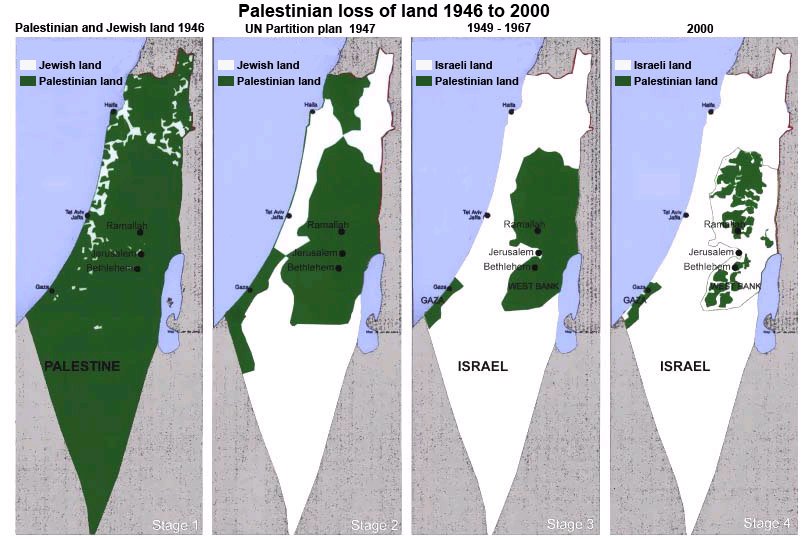 map courtesy of Juan Cole
The Obama administration's position is that Israel should stop building new settlements in occupied Palestinian territory including East Jerusalem. Israel refuses. So what happens to the Palestinians in the near and medium future, given that the Likud-led government has no intention of allowing a Palestinian state--the Israeli right, whether religious or secular, has no interest in a two-state peace---and there is now no place to put one?
John Mearsheimer in the London Review Blog observes that the:
Netanyahu government is filled with hard-line opponents of a two-state solution, many of whom also believe that East Jerusalem is an integral part of Israel, and it is hard to see how Netanyahu’s coalition could survive if he agreed not to build those 1600 housing units...In the end, there is likely to be a rather muted, protracted dispute between the two sides over those housing units and the many others that the Netanyahu government plans to build in East Jerusalem. This ongoing conflict will be a constant reminder to Americans that Israel and the United States have conflicting interests on a very important issue.
Mearsheimer says that Israel’s supporters in the United States have long defended the special relationship between the two countries on the grounds that their interests are virtually the same and therefore it makes sense to back Israel no matter what policies it adopts. However, in the recent dispute almost all of the mainstream organisations of the lobby will back Israel to the hilt and blame the Obama administration for the crisis. Their tendency is to defend Israel no matter what it does. He adds:
Therefore, it will be difficult to disguise the fact that most pro-Israel groups are siding with Israel against the US president, and defending policies that respected military leaders now openly question. This is an awful situation for the lobby to find itself in, because it raises legitimate questions about whether it has the best interests of the United States at heart or whether it cares more about Israel’s interests. Again, this matters more than ever, because key figures in the administration have let it be known that Israel is acting in ways that at best complicate US diplomacy, and at worst could get Americans killed.
Israel’s policies are putting American troops at risk.That raises issues for America's relationship with Israel and Australia's for that matter. Is the special relationship with Israel is slowly coming to an end?
Is a two-state solution is impossible at this point? Is a ‘greater Israel’ is going to end up an apartheid state? Is that the trajectory of the Netanyahu government with its Avigdor Lieberman's far-right party, Yisrael Beiteinu, and Eli Yishai's fundamentalist Shas Party? The latter seems to think it is okay for Israel to keep expanding its control over Palestinian lands and that the United States should back Israel's actions no matter what it does. If the two-state solution fails, then the Palestinians will be occupied forever, and a greater Israel will become an apartheid state.
Posted by Gary Sauer-Thompson at 1:21 PM | Comments (7) | TrackBack
March 17, 2010
The NBN rolls on
As expected the Coalition has declared its automatic opposition to any move to split Telstra using legislation that functionally separates a non-co-operative Telstra into wholesale and retail businesses, deny it new wireless spectrum and force it to sell its half-share of Australia's dominant pay TV operator, Foxtel. The Opposition's is a futile bid to preserve the Telstra status quo.
Though this opposition gives more bargaining power to the cross-bench senators, Senator Steve Fielding continues to oppose the reform, the legislation, which was rejected by the Senate, has been withdrawn until ---when?
The NBN Co has begun its network rollout in Tasmania and is on its way to become the dominant 'access' network provider. However, as expected, the negotiations with Telstra on the question of how much Telstra should be paid to co-operate with the network's construction are going b nowhere---as expected. Malcolm Maiden says that:
The commercial equation is unchanged: there is a maximum price NBN Co can commercially justify paying Telstra in return for access to Telstra ducts and pipes down which the new broadband fibre will run, and for the progressive adoption of Telstra customers as Telstra's existing network is overrun. That price is significantly less than Telstra says it can accept.
Stalemate as expected as they are billions apart and it is becoming less and less likely that Telstra and the NBN Co will agree on a deal.
Where to now? It's either the structural separation of Telstra, as the dominant incumbent, and/or the transfer of it's wholesale customers (which would include making the dominant incumbent a wholesale customer). Telstra could go it alone even though a stand-alone copper network would have little point once the NBN is built without Telstra. The NBN is going to be built and it will displace Telstra’s fixed line network – which means that network has already been substantially devalued even as the NBN is being built.
Posted by Gary Sauer-Thompson at 5:42 PM | Comments (8) | TrackBack
SA election: city forgotten
The state government planning documents of our cities that aim to direct or shape growth usually talk in terms of “strong communities” and “smart growth” to build a successful city. Peter Spearritt in Trouble in the city at Inside Story says that:
If you want to find out what is happening in Australia’s cities today, don’t go to the well-doctored planning glossies. You would be much better advised to attend a major railway station at peak hour, sit in a freeway traffic jam thirty kilometres out of town, bid at a house auction or inspect the abandoned excavation for a failed inner-city office block or apartment tower. Thank goodness the “Rudd Bank” never got up, otherwise we’d have an even greater rash of energy-intensive buildings that require us to burn coal merely to allow their occupants to move from floor to floor.
Fair comment. But you also need to go and look at the state of our rivers since cities require water to function.
In South Australia water is an issue in the forthcoming state election. The current catchcry is “waterproofing” our city, which means cutting Adelaide's dependence on the dying River Murray. The Rann Government's water proofing strategy is desalinisation plants whilst the Liberal's waterproofing strategy is storm water retention. And so they fight and squabble over which is the best plan.
Don't we need both if Adelaide is going to become a sustainable city?
We do not hear much about creating more public spaces for reflection, for gathering, for contemplation; more trees and greenery in Adelaide's inner city; Victoria Square being better used as a public space; less cars in the city; or making the city area the vibrant cultural heart of the city. The future of Adelaide is a green economy hub – with renewable energy and good public transport at the centre.
Update
The most plausible scenario is still that there is a strong statewide swing to the Liberals, Labor will lose seats (possibly 5), that it will lose its majority and face a hung parliament and the independents will hold the balance of power. If the independents do end up holding the balance of power, then they decide whether Labor or the Liberals govern the state for the next four years. William Bowie differs--he tips a one-seat Labor majority for the third state election in a row.
It is disappointing that I see no desire amongst the independents to change South Australia's electoral system to a Hare-Clark one which is far more democratic. Democracy is not really an issue in SA.
Posted by Gary Sauer-Thompson at 10:28 AM | Comments (4) | TrackBack
March 16, 2010
Border protection recycled
With the increase in boats carrying asylum seekers arriving in Australian waters without prior authorisation the opposition has been sniping away on border protection and boat arrivals. They are claiming that the Rudd Government is "soft on border protection" and that this supposed softness is encouraging greater numbers of illegal arrivals, particularly by boats facilitated by the organized people smugglers.
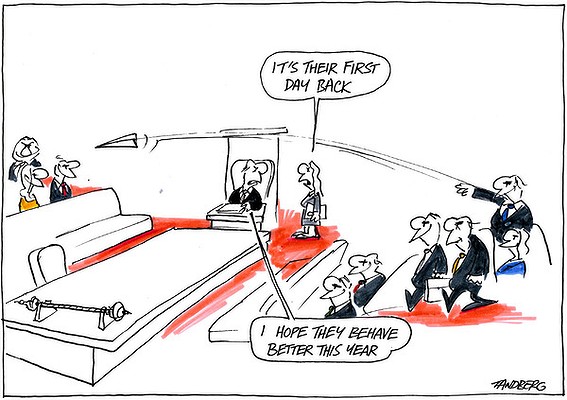
The argument is that policy reforms instituted by the Rudd Government (dismantling border protection) are operating as a “pull factor”. The rhetoric is one of creating an image of an “invasion” by the world’s dispossessed, attracted towards us by a perceived weakening in our determination to keep them out, and that some unauthorised arrivals could possibly pose a threat to the security of the Australian community.
It's border security in the context of the war on terrorism.
The soft touch argument not much of one, given both the rise in the international movement of people from war torn areas (Sri Lanka and Afghanistan) the minor differences between the Rudd Government and the Howard government in border protection policy or practice, and Australia's low rank down the United Nations High Commissioner for Refugees table.
It's all about being tough on border protection, given the public anxiety this issue has historically had in middle Australia, but there appears to be little indication of public groundswell for a harsher border security regime in a liberal society. Australia does not have refugee “crisis” or a border protection “crisis” and so we have experienced a sterile political debate about whether the recent increase in boat numbers is the result of pull factors or push factors rather than both.
Mandatory detention remains the default position for adult asylum seekers who reach Australian territory without a valid entry visa with mandatory detention being located on the offshore Christmas Island.What Labor has done is make processing of asylum claims far more efficient. A core problem is that people smugglers run a business and that business will expand where there are opportunities to make money. Peter Mares observes that today:
sovereignty is expressed more than ever in controlling the flow of people across borders. The primary organisational system in the world today remains the nation state, and in liberal democracies like Australia it is the citizens of those bounded territories who elect governments and shape policies. This makes the call for open borders a political impossibility. The citizens of an individual state have the power, through their elected representatives, to determine who comes into their country and the circumstances under which they come – though this power is not absolute [as it is] constrained by international agreements freely entered into – the Refugee Convention and the Universal Declaration of Human Rights
The best way forward, Mare says, is for Australia improve its cooperation with Indonesia and other countries in Southeast Asia with the aim of disrupting smuggling networks and intercepting asylum seekers before they embark on a boat journey.
What then? Where do the intercepted refugees go?
Posted by Gary Sauer-Thompson at 4:07 PM | Comments (10) | TrackBack
March 15, 2010
Tasmania: happy and bleeding?
A week out from the Tasmanian election former Labor and Liberal Premiers Michael Field + Paul Lennon and Robin Gray + Tony Rundle made a combined public statement urging Tasmanians to vote for Labor or Liberal, thus avoiding a Green power sharing government. They told the electorate to focus on the façade of “stability” of the status quo, to preserve “democracy”, rather than to look at where Tasmania’s future direction should lie.
In Tasmanian Election 2010: Cynicism as Virtue in the Tasmanian Times Peter Henning comments about the latest scare campaigns against the Greens from the corrupt Lib-Lab alliance:
Certainly, the unity of the four former Labor-Liberal Tasmanian premiers is telling in one way, for it shows the electoral contest between Labor and Liberal is a hollow confection, with no basis in real differences in policy. In other words, the election itself is a deception, both parties exaggerating the minor differences they have to appeal as real alternatives to each other, when they are merely rivals for power within the same committee. The only thing that separates Labor from Liberal is the matter of personal self-interest, of competition for the perks of office. Nothing else.
This does suggest a bipartisan Labor-Liberal accord about the massive use of Tasmania’s natural resources of land and water for pulp mills (wood chipping and pulping), monocultural plantations, and irrigation agriculture.
Kevin Bonham in Demolition row in the Tasmania Times says in the context of the latest polling:
the Bartlett Labor Government is set for a very serious trashing at the state election next Saturday. It will do well to keep the swing below double figures, is struggling to hold any of its four most vulnerable seats, and could even do so badly that others come into play.....One way of looking at it is to see the pre-2006 Labor government of Bacon and Lennon as a broadly centrist regime capturing both centre-left and centre-right votes. With the many failures and scandals of the last four years, and deliberate repositioning of both the other parties towards the centre, both wings seem to have fallen off the Labor aeroplane at once.
Does it matter that much if the Liberals return to power in Tasmania? It's just a different hue of corporatism; one that is being challenged by The Greens who want to end sourcing timber from high-conservation forests or even native forests entirely and abandon the proposed pulp mill and associated wood-fired power station.
The good news is that Gunns are in a bad way these days.
Posted by Gary Sauer-Thompson at 4:55 PM | Comments (9) | TrackBack
retiring early?
Retirement and superannuation are pressing political realities for many Australians, with pensioners doing it tough. As Jennifer Hewett reminds us in The great superannuation delusion in The Australian the vast majority of Australians are going to retire on less money than they can live on. She says:
For most individuals, their superannuation simply won't be enough, particularly for all those baby boomers closing in on the end of their working lives. All the dire warnings about this haven't changed a result that is about to become obvious.Forget all those images of relaxed, sprightly grey-haired couples strolling around shops and golf courses and cruise ships, figuring out how to enjoy their tax-free, carefree money. To sustain even a modest lifestyle, about 80 per cent of people over 65 are still reliant on a part or full aged pension to supplement their super savings, and that percentage is not expected to drop much during the next several decades.
Te the 9 per cent compulsory contribution rate introduced by the Hawke/Keating government to help reduce reliance on the pension needs to be lifted to around 15%. Will the Rudd Government make reform moves in this direction?
It doesn't form part of the debate in the theatre of question time in Parliament, and is on the policy fringe of the various tax reviews that lie in the background.
Posted by Gary Sauer-Thompson at 12:35 PM | Comments (5) | TrackBack
March 12, 2010
political spin + media
Finally, some critical commentary about in the mainstream media about political spin that has its roots in Madison Avenue. As we know spin operations that manipulate the news agenda in order to gain either positive or negative coverage, has become part of the routine modus operandi of party apparatchiks.
Many say that spin is here to stay on the basis that it's a fact of political life.Tony Blair, for instance, observed that one cannot be a modern day politician without being versed in the black arts of spin---not to have a proper press operation nowadays is like asking a batsman to face bodyline bowling without pads or headgear.
Sushi Das in Political spin undermines democracy in The Sydney Morning Herald says that:
spin takes various forms. Bad news is released late in the day or on a heavy news day to reduce the negative fallout. Chosen journalists are given information exclusively to secure a positive slant. Unattributable background briefings are used to fabricate allegations or smear people. Exclusive stories are released as part of ''official leaks'' to set the agenda.
Das states that these tactics by the various spin doctors succeed in an environment in which spin doctors outnumber journalists, underfunded newsrooms rob journalists of time to do their jobs properly, and reporters are judged on the number of exclusives they churn out rather than the depth of their reporting.
The Canberra Press Gallery rely on the patronage of Canberra insiders, many of whom depend on the spin masters for their stories. The problem is that despite their intense dislike for spin, these journalists depend on the spinners for information. This chummy media/government relationship explains why news management has been so successful for so long.
The techniques and tactics of intensive media manipulation could be one reason why some members of the Canberra press gallery report that black is white. Another reason is that they have spin doctors themselves, as they re-engineering democracy and help to create a culture of public cynicism.
When spin becomes a matter of public comment, its usefulness is thereby reduced.This requires its exposure by a press that fights back against the manipulation from within government (state and commonwealth). Those journalists who desire to be watchdogs for democracy can ensure that spin gradually becomes most loathed and help public opinion identify politics as media management as nothing more than spin.
Once exposed, as Peta Duke spectacularly was in Melbourne, the public grows more cynical about politics.They perceive politics as a shadowy exercise in which truth is concealed and deception is practiced.
Posted by Gary Sauer-Thompson at 7:46 AM | Comments (4) | TrackBack
March 11, 2010
health debate: #2
As noted in an earlier post, the health reform debate in Australia takes place behind a closed shop and it needs to be bought out into the public sphere. Arthur Sinodinos in his King Kong health plan threatens the PM in The Australian says that:
Health and hospitals policy is Kevin Rudd's King Kong and it could cause him as much damage as Kong did to the Empire State Building... These complex health changes will be a slow burn politically. The electorate has at least six months to pore over them and uncover any defects. The dearth of new money up-front will not help the medicine go down. When does the system start to improve? Paradise postponed yet again.
He contrasts this scenario with the good things the Howard Government did for health ---adding significantly to Medicare, particularly through its extension of the safety net--- and rescuing private health insurance. Sinodinos is contesting the view that health is Labor's home ground.
Subsidizing private health insurance is a classic example of the neo-liberal policy of the diverting of public funds to private industry, but Sinodinos talks in terms of "choice". Patrick Brownlee in Politics is a messyanic business in the Australian Review of Public Affairs digs beneath "choice" between public and private sectors. He says that subsidisation of private health (and education) should be recognised as part of the desiccation of the social contract that is transforming a collectivist to an individual incentive model of service delivery and created or pandered to a faux middle class sensibility.
Brownlee adds that:
The privatisation of education and health are dear to a neoliberal heart, where quality service is provided to those who have; while the idea that funds be collectively held and distributed by government for any such service causes at least mild reflux in your average neoliberal stomach.
Neoliberalism is a political ideology which extends market relations into social, economic and political spheres and it represents governance through the market.
Posted by Gary Sauer-Thompson at 8:53 AM | Comments (2) | TrackBack
March 10, 2010
Canberra gaze: a "political debate"
I watched Question Time in Parliament yesterday to check out what was going on in the political debate and I was taken back by the Coalition's tactics. There were lots of questions about paid-parental leave that highlighted how generous the Coalition's scheme to give up to $75,000 to parents who stay at home for six months was in contrast with the Rudd Government's stingy and mealy mouthed one. The questions probing the limits of the health and hospitals reform plan and the national educational curriculum were minimal.

So the Coalition's strategy messing with the system by throwing anything at the Rudd Government that comes to hand continues. It doesn't matter about the contradictions --introducing a big tax when the promise is no new taxes---as it is about getting noticed and destabilisation with whatever-it-takes to oppose the Rudd Government on everything.
The strategy is to wedge Labor---''supporting big business over working families'' is the new talking point--- and to win back female voters who have been deserting the Coalition.
Posted by Gary Sauer-Thompson at 5:55 AM | Comments (14) | TrackBack
March 9, 2010
the health debate
The health debate has been dominated by the media reducing health and well-being to hospitals and the state's resistance to the Rudd Government's reforms in the form of taking control of the funding of public hospitals. Their concern is for more money not that hospital care is integrated with primary care. John Menadue in his comments on this debate at the Centre for Policy Development that:
The [commonwealth] government is challenging, quite correctly, the special interests of state governments and their health bureaucracies. What is needed next is for the government to find the political will to challenge other stronger special interest groups, particularly among the providers - the AMA, the Australian Pharmacy Guild, pharmacy companies and the private health insurance funds. They have legions of lobbyists who dominate the public debate at the expense of a community that is effectively excluded and disenfranchised.
The current debate is still between the government (commonwealth and state) and the well-funded and well-organised special interest groups, and the community and its concerns is pushed aside.

Menadue's solution to the closed shop that excludes the community is for our health system to have its own independent body - a Reserve Bank for health--- an independent health commission with strong economic capabilities is necessary to facilitate informed public discussion, counter the power of special interests and determine programs and distribute Commonwealth health funds across the country.
Posted by Gary Sauer-Thompson at 8:45 AM | Comments (4) | TrackBack
March 8, 2010
bubble-driven economic growth?
In his How They Killed the Economy in the New York Review of Books Roger E. Alcaly states that almost everyone agrees that the global financial crisis developed in part because of failures of regulation—principally of banks, mortgage brokers, and derivatives markets—and much effort is currently being devoted to revamping and shoring up the regulatory system.He adds:
By any measure, the crisis was a consequence of extraordinarily reckless behavior—by banks and other financial institutions, by governments and their financial regulators, and by consumers—behavior that continued even in the face of a widely shared sense that serious trouble was brewing...The failure of central bankers and regulators to rein in leverage—the practice of borrowing as much as thirty or more times one's equity capital to increase investment potential —and excessive risk-taking owes much to complacency that had developed over the preceding twenty to twenty-five years.
This crisis was part of a series of crises, which were contained, including the stock market crash of 1987, the junk bond collapse of 1989–1990, the Asian crisis of 1997, the Russian default in 1998, the failure of Long Term Capital Management—a large and hugely leveraged hedge fund—later that year, and the collapse of technology stocks in 2000–2001.
Quick and effective responses to these and other dangers by Alan Greenspan's Federal Reserve (FDA) appear to have induced banks and investors to rely unduly on its ability to stave off collapses that threaten the system, and to ignore the serious malfunctioning of the financial markets.
The central argument is that the FDA' s monetary policy of keeping interest rates low for so long encouraged the housing bubble and the explosion of borrowing throughout the economy. This helped to create a false sense of security and stability that enticed financial institutions and investors to leverage their investments enormously, borrowing sums that dwarfed the capital they committed. The second argument is that the regulatory mechanism failed to mitigate boom/bust cycles of the “casino economy” and only tinkered around the edges. Hence the need for reform of the international financial system.
The implication is that financial firms faced crises largely of their own creation and that government's needed to protect major financial institutions from system-threatening disasters. This insurance to keep the whole game going encouraged the financial firms to ever more risk-taking to enhance their profitability. Because of the benefits the big banks have accrued from a number of government programs/subsidies, the big banks are profitable again and now dictating the terms of financial “reform”. We have “asset price driven recovery", attempts to reinstate financial institutions as the motor force of the economic system, and bubble-driven economic growth.
What we have is the emergence of an unprecedentedly huge and fragile financial superstructure subject to stresses and strains (ie., financial bubbles that threatened to burst) that increasingly threaten the stability of the economy as a whole. If what has emerged since the 1980s is the shift in the center of dynamic core of the capitalist economy from production to speculative finance, then the normal economic situation is going to be an unstable one of more financial crises
Posted by Gary Sauer-Thompson at 12:28 PM | Comments (3) | TrackBack
March 6, 2010
SA: health versus sport
I returned from photographing in Tasmania to discover that the SA state election in full swing. We are about halfway through the campaign, the posters are everywhere, the issues no where, and nobody is paying much of attention to what is being said by twiddly dee and twiddly dum during the festival season about "keeping the state moving". The destination is never mentioned.
There is not much enthusiasm for the politicians because they are not offering much in terms of policies and vision. Nothing about rejuvenating the inner city, nothing about mental health in South Australia or aged care; not much on climate change and rising sea levels. The only excitement is the sad faced, bully boy Treasurer (Kevin Foley) getting all hairy chested about his budget surpluses and eagerness to slash and burn the state bureaucracy to protect the state's AAA ratings.
What is offered so far is a worn out version of the same old policies and lots of heated bickering over nothing in particular (costings and dirty deals). The big issue, from what I can make out, is whether to spend $1.7 billion on a new hospital (the ALP on old railway yards in the city and return the present site to parklands); or to do up the old public hospital (Royal Adelaide Hospital) on the cheap ($700 million) and spend the rest ($1 billion) on a new sports stadium (the Liberals) on the site the Rann Government wants to use for the hospital.
Why anybody would want to retain the dilapidated Royal Adelaide Hospital (RAH) ----and, surprisingly many medical professionals do---is beyond me. The RAH is just too run down to rebuild whilst the clinical facilities are far from world class. I have never really understood the politics of those who want to retain the old RAH. Nostalgia?
The Labor Party will not gain seats at the 2010 election--it will lose some, but not enough to lose power. Some hope for a hung parliament, with independents holding the balance of power, as a way to bring some excitement to politics as management. Or maybe Tony Abbott can fly in and juice things up. Some political chaos is desired/.
Mike Rann has given the federal government’s health plans enthusiastic support saying he was “prepared to strongly support the direction of these reforms”. On the other hand, Isobel Redmond said she “would not be interested in handing over our health system to a federal Labor Government that has so badly mismanaged the home insulation scheme”.
Posted by Gary Sauer-Thompson at 2:06 PM | Comments (10) | TrackBack
March 4, 2010
local control of health
The authors of Putting Health in Local Hands at the Centre for Policy Development rightly argue that the health care system is more fragmented and duplicative, inequitable and less efficient than it might be.
They then suggest that "shifting health care governance and funding to regional agencies that are more responsive to the needs of communities would improve both equity and effectiveness in Australian health care."

They propose that all current health care funding from local, state and federal governments be pooled within a national agency and equitably distributed to local Regional Health Organisations (RHOs ) on the basis of evidence about health care needs.
They argue that the current emphasis on hospital care, rather than primary and preventive care, is increasingly recognised as inefficient and that there is broad agreement that effective primary care reduces health care costs and that improved access to primary health care services in the community would reduce unnecessary admissions to hospitals. However, our current system of primary care does not deal well with chronic diseases, nor does it work effectively with the acute sector.
To achieve more efficient and equitable outcomes it is not enough simply to shift resources from hospitals to health centres; we must address the social determinants of health and the inequalities of health in that the rich, urban, and healthy access more health care resources and services than the poor, rural, and sick.
Posted by Gary Sauer-Thompson at 5:06 PM | Comments (4) | TrackBack
March 3, 2010
finally, some movement on health reform
I see that Rudd has agreed with the common criticism of his government:--that the government has not progressed enough on delivering on its promises and Labor has not managed its issues - in particular the emissions trading scheme - effectively. Acknowledgment and acceptance of criticism is the first step.
Is it a tactical move---a circuit-breaker? Maybe. Maybe not. Stephen Leeder gives Rudd credit.
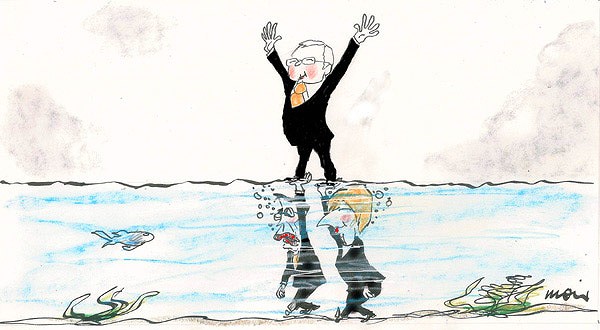
At least the criticism has resulted in steps taken towards health reform--- to get back to shaping the political agenda again shift. The reforms aim to shift away from Australia's heavy dependency on hospitals; to establish a new "independent umpire" at arm's lengths from government; to set "efficient national prices" of health services to be paid for by federal and state governments; the federal government taking over full funding responsibility for primary health care outside the hospital system; and new "Local Hospital Networks" paying for services, replacing the traditional model of Commonwealth grants to the states and territories.
An optimistic interpretation is that the Rudd Government is seeking to reduce not increase use of public hospitals, thus easing the strain, by putting in place a more efficient, integrated arrangement which, it is hoped, will spur people to be treated by less expensive primary health, (ie outside hospital) services.
However, what has been tabled in the reform agenda is two systems of government talking to one another with the commonwealth saying its gonna be xyz. Will the states concur? Will they reject it? No doubt more bribes (extra money as bait says Michelle Grattan) will be required to get them to accept national performance standards and the historic shift of power to Canberra on health care.
Update
I've re-read Rudd's Better health, better hospitals speech more closely. The core emphasis is that this fundamental reform is about improving hospitals. Rudd says this is:
Reform that for the first time enables eight state-run systems to become part of a single national network, using consistent national standards to drive and deliver better hospital services. Funded nationally. Run locally.The National Health and Hospitals Network contains seven major reforms. For the first time, the Australian Government will take on the dominant funding responsibility for all Australia's public hospitals from the states because the states simply cannot afford to fund the future growth of the system.
The Australian Government's funding share will almost double, from 35 per cent today to 60 per cent into the future - equating to an additional $11 billion per year from next year.The Australian Government will take clear financial leadership in the hospital system, permanently funding 60 per cent of the efficient price of every public hospital service provided to public patients.We will fund 60 per cent of recurrent expenditure on research and training functions undertaken in public hospitals.We will fund 60 per cent of capital expenditure - both operating and planned new capital investment - to maintain and improve public hospital infrastructure.
No previous Australian Government has accepted any responsibility for the funding of hospital infrastructure - let alone 60 per cent.Over time, we will also pay up to 100 per cent of the efficient price of 'primary care equivalent' outpatient services provided to public hospital patients.These reforms will permanently reverse the decline in the Australian Government funding contribution for public hospital services over the last decade.They will put an end to the tiresome cycle of the blame game between the Australian Government and the states over hospital funding.
There really wasn't that much on primary care and nothing about health inequalities. During questions after the speech Rudd suggested that it’s hard for governments to invest in prevention because the benefits won’t be seen for 10 years or more. Therein lies the limits of this fundamental reform.
Posted by Gary Sauer-Thompson at 5:51 PM | Comments (17) | TrackBack
March 2, 2010
a draft national curriculum
Finally a national curriculum in maths, science, history and English from kindergarten to year 10.The argument is that Australia should have one curriculum for school students, rather than the eight different arrangements that exist at the moment. It's a persuasive argument and the reform is long overdue.
The rhetoric is that this world class national curriculum is critical to maintaining Australia's productivity and quality of life. This set of educational goals and actions aims to better prepare young people for their participation in a changing and increasingly globalised world. Though it places Aboriginal and Asian ways of seeing the world into almost every subject, this is a ''back to basics'' approach with an emphasis on grammar and phonics on spelling, on sounding out letters, on counting, on adding up, on taking away.
Despite the three cross-curriculum dimensions of Indigenous history and culture, Asia and Australia's engagement with Asia and sustainability the "Australian Curriculum" is hardly an education revolution in a digital world, information society, and a visual world. The back to basics rhetoric is at odds with the 10 general capabilities of literacy, numeracy, information communication technology, thinking skills, ethical behaviour, creativity, self-management, teamwork, intercultural understanding and social competence.
Though history is the current area of controversy ---is it black armband, white blindfold or balanced view of history?--it does develop a comprehensive history of Australia that includes the histories of First Australians, colonisation of Australia and its subsequent effects upon all groups of people, Australian government, Australia’s place within the British Empire, Australia’s place within the Asia-Pacific region and immigration to Australia.
However, the back to basic building blocks don't give much space to critical thinking in the sense of developing the knowledge and skills to be active and informed citizens who know how to think critically about contemporary issues of public concern. History is not the same as economics, the other social sciences, or ethics. Why should sustainability be taught in history?
This is not a world-class curriculum.
Posted by Gary Sauer-Thompson at 6:37 AM | Comments (8) | TrackBack