|
March 6, 2010
When I was passing through the Georgian village of Evandale in Tasmania last week, there were street posters advertising the Glover Prize for 2010, named after John Glover the Tasmanian colonial painter.
This is a landscape prize, and it is awarded each year for the best new (previously unexhibited and less than a year old) painting depicting the Tasmanian landscape. The work of the previous winners of the prize is varied. However, the images of the 2010 finalists are not up.
John Glover is known for his contribution to the early development of the colonial picturesque in settler landscape art in Australia, due to his depiction of the Tasmanian light as bright and clear. Glover also did commissioned works for the proud landowners of the Colony and he contributed to the development of tourism promoting ‘places to see’ using the natural local scenery in perfect picturesque post cards’.
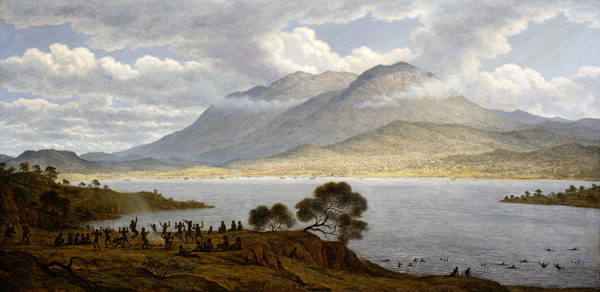 John Glover, Mount Wellington and Hobart Town from Kangaroo Point 1831-33, oil on canvas
Tourists in Europe in the early 19th century sought to locate places described in works by poets, romantic novelists and painters of the time which would accord with the ‘beautiful’, ‘sublime ’ ,‘ picturesque’ and ‘romantic ’. For Glover this was English Lake District .The touring artist often carried special items designed to assist in `aesthetic response’, such as a camera lucida.
Photography, print ma king and drawing has assumed a pivotal role in the presentation of contemporary Tasmanian
landscapes. It would appear that photographers--such as the Westbury based John Temple--- have inherited the mantle of the 18th century touring artists. It is they who represent scenes of wilderness and iconic sites and some of them sell their picture perfect images of Australian landscape as postcards that are then bought by tourists.
 Gary Sauer-Thompson cottage, Tunbridge, Tasmania
I couldn't resist this reference to Glover's A view of the artist's house and garden, in Mills Plains, Van Diemen's Land (1835) when I was in staying in Tunbridge.
Update
The 2010 finalists are now online and they are very diverse in their approach to the landscape. The 2010 winner is Ian Waldron's Walach Dhaarr (Cockle Creek)
|


Glover adapted his painting style to embrace the new realities of the Australian landscape, moving away from the ordered Picturesque and from the Romanticism of his early English works.