June 30, 2010
Walker Evans: Polaroid work
I didn't know about Walker Evans' body of SX-70 Polaroid work auto-focus camera done in the last years of his life. I am surprised by this work given Evans' aversion to colour photography, which he characterized as 'garish,'and 'vulgar' --a bebop of electric blues, furious reds and poison greens.
The Polaroids are part of the Walker Evans Archive at the Metropolitan Museum of Art and they made made between September 1973 and November 1974 just before Evans’ death in April 1975.
I'm attracted to the snapshots of the ordinary weathered advertising signs and notices that are enhanced by the peculiar and subdued color palette of Polaroid SX-70 film:
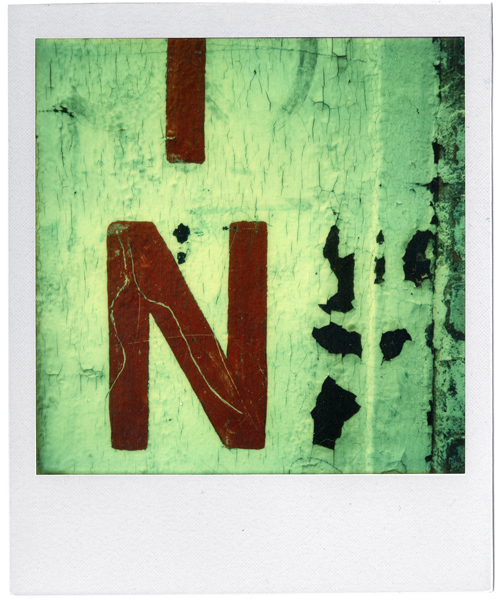 Walker Evans, Untitled, 1974 Unique Polaroid
These are very direct and concise, and they strip photography to its bare core, refined composition, limited technique and photographic seeing that are freed from the “tornado of color”. They are simple compositions of ordinary objects---empty buildings, discreet portraits, signs, found language----that indicate a mastery of composition. They appear to be Evans' equivalent of the scissors and paper for the older Matisse.
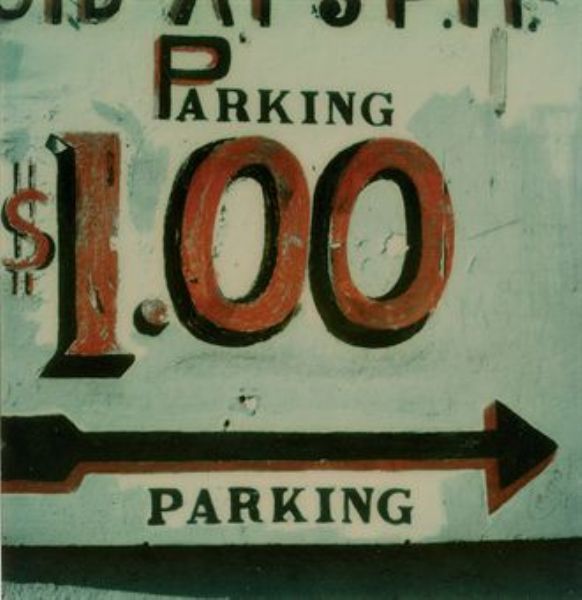 Walker Evans, Untitled, 1974 Unique Polaroid
The Polaroids are published in a book Walker Evans: Polaroids From what I understand Evans started taking color pictures as early as 1946 for Fortune Magazine and the majority of his work from that point on was color.
Outside of this collaboration with Fortune, the Polaroids from 1973 and 1974 are the next largest body of work in color. They take on an added resonance with the discontinuation of Polaroid’s consumer films and they serve as an important reference point for colour photography.
June 29, 2010
NEA Photography Surveys of the 1970s
In the previous post on Joe Deal I mentioned that he participated in the largely forgotten NEA Photography Surveys of the 1970s---a civic orientated photographic bicentennial project that centred on a desire to explore, document and interpret the nation through photography.
Another participant was Grant Mudford, the modernist Australian photographer who had been living in Los Angeles since 1977. He had a Photographers Fellowship from the National Endowment for the Arts Long Beach Documentary Survey Project:
 Grant Mudford, From Terminal Island, Looking East, 1979, from the Long Beach Documentary Survey Project
From 1976 to 1981 the National Endowment for the Arts Photography Surveys granted money to photograph American cities (including Atlanta, Buffalo, Durham, East Baltimore, Galveston, Long Beach, Los Angeles) and it supported more than seventy projects that examined a wide range of people and places in America, which had undergone rapid transformation in the 1960s and 1970s.
This survey was a historical narrative or portrait of America as well as an exploration of photography-as-art and photography-as-document; or as John Szarkowski had put it photographs that are mirrors of the individual photographers aesthetic perceptions and photographs as windows that provide traces of the real world. the 1970s was a transitional decade in which photographic realism and modernism increasingly gave way to postmodernist approaches to making photography and to understanding photographic representations.
 Grant Mudford, Mexico, 1976, Gelatin Silver Print
Mudford is an example of photography-as-modernist art. In the Long Beach series (1979), as well as in his early black and white views of North American cities such as Los Angeles, Las Vegas, and New Orleans, Mudford photographs the mundane -- a Ferris wheel, a nondescript corner of sidewalk, a view of telephone poles and tire tracks -- and transforms these ordinary structures into strikingly abstract compositions in which the play of textures and lines creates a highly patterned surface.
Update
The largest of the surveys was The Los Angeles Documentary Project which explored the American Dream, the visual diversity and the grimmer realities of contemporary urban life. Mark Rice points to a central problem with documentary photography:
Because representation is so entwined with cultural values, as a culture changes, its preferred forms of cultural representation will likewise change. That a photographic style could so easily shift from being viewed as a mark of objectivity to being written off as clichéd vividly illustrates the contingent nature of photographic representation.
The New Topographics was the new aesthetic style for the 1970s.
June 27, 2010
Joe Deal: The Fault Zone
Along with Robert Adams, Stephen Shore, and Lewis Baltz, Deal spent the nineteen-seventies practicing a distinct sort of human altered landscape photography in which they examined the modern American landscape and its degradation at the hands of developers, corporations and suburban colonizers.
After “New Topographics,” Deal, who recently died from bladder cancer, explored the suburban sprawl in California and the uneasy coexistence of human beings and nature along the San Andreas Fault in Southern California.
He produced a portfolio of images, “The Fault Zone,” that juxtaposed the hasty activity of human beings with the inexorable, drawn-out processes of geology:
 Joe Deal, Model Home, Phillips Ranch, California, 1984, from Subdividing the Inland Basin
What we have here is a kind of of tabula rasa that is provides Deal with the “beginnings of an altered landscape.”
The Fault Zone & Other Work 1976-1986 exhibition is a series of 19 square black-and-white pictures of suburban homes, rocky hills, dirt roads, construction sites and other nondescript scenes, all taken from 1978 to 1980 along the San Andreas Fault Line in Southern California. Underlying the immediate subject matter is the irony of the population and construction boom in a fragile desert ecosystem with an active fault line:
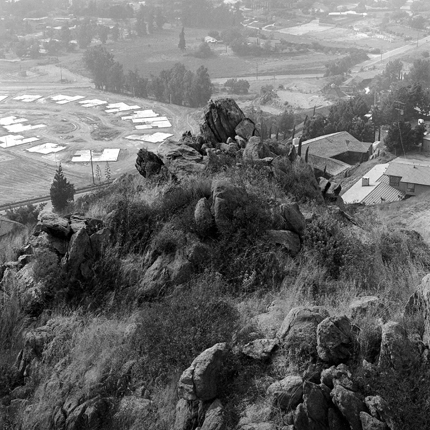 Joe Deal, Colton, California, 1978, from The Fault Zone
Other works in the exhibition survey suburban backyards in Diamond Bar, California, and coastal communities like Laguna Beach and Malibu.The survey suburban backyards in Diamond Bar were part of the Los Angeles Documentary Project, which was part of the NEA Photography Surveys of the 1970s
June 25, 2010
Leon Levinstein: street photography
I don't know much about the street photography of Leon Levinstein. He is now recognized as part of the canon of 1960s street photographers, which includes names like Diane Arbus, Garry Winogrand and Robert Frank.
He photographed hookers, housewives, businessmen, cross-dressers, and the permanently down-and-out in a very raw style between the early nineteen-fifties until a few years before his death, in 1988.
 Leon Levinstein, Young Man Fixing Hair in Window, New York City, 1970s
His work reminds me of the photographs of Lisette Model in that it is sneaky, direct and uncompromising.
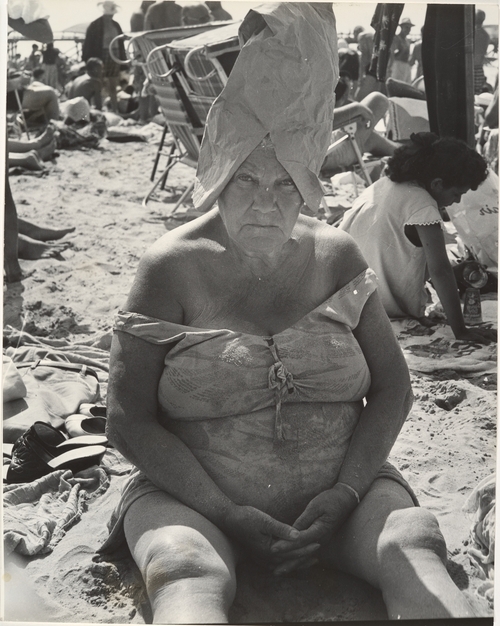 Leon Levinstein, Woman Wearing Paper Bag Hat, Coney Island, New York, 1950s
It would be hard to photograph like this today given the greater hostility to photographers taking photos of people.
June 22, 2010
Laurie Anderson: Homeland
From Laurie Anderson's new Homeland album--a concert poem. This is Anderson's first proper album in nearly a decade.
The track is entitled 'Only an Expert':
The album is considered to be a 21st century extension of her 1983 multimedia project United States I-IV, and makes an uncompromising look at post-9/11 America.
June 21, 2010
Fotofest 2010: Todd Hido
Aaron Schuman, the editor of the online photography magazine, SeeSaw Magazine has curated an exhibition in the FotoFest 2010 entitled Whatever was Splendid: New American PhotographsThe Curatorial statement says:
The exhibition Whatever Was Splendid explores the parallels that exist--both in America and in photography--between our own time and that of Evans, and the enduring power of American Photographs as discerned through contemporary U.S. photographic practice....At its heart, Whatever Was Splendid is centrally informed by the legacy of American Photographs, and by Evans' vital contributions to the nation's photographic language and traditions. That said, it is by no means intended as a nostalgic update or sentimental plea for photography (or, for that matter, America) to return to its past. As much as Evans' precedent has provided both the inspiration and reinforcing framework for this exhibition, Whatever Was Splendid is first and foremost the manifestation of the intelligence, ingenuity, and multiplicity of voices and visions that can be found within current U.S. photographic practice
We have previously one of the exhibitors is Richard Mosse and his project Nomands that represented to wrecked cars in the primeval desert landscapes of Iraq.
Another exhibitor is Todd Hido and the work that caught my eye are the night images of suburban dwellings:
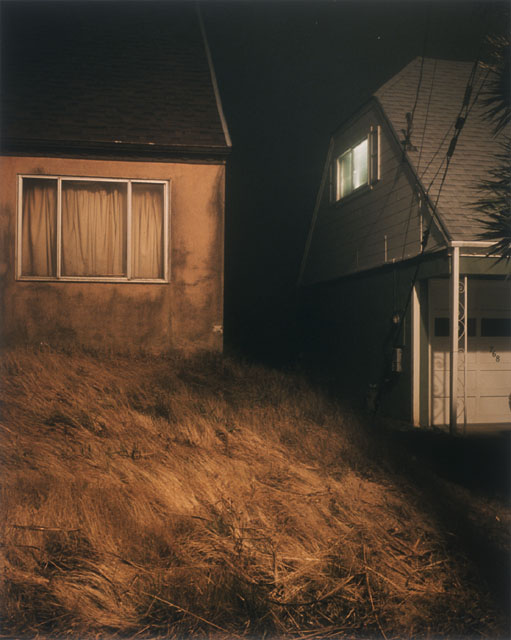 Todd Hidio, Untitled #2736, Pacifica, CA, 2000, from House Hunting
 There is a haunting quality to these images that have been taken at night that is coupled to a sense of unease. these are Californian houses expressing isolation associated with a mood of something strange. Something has gone wrong here.
June 20, 2010
Clay Shirky on weblogs
Junk for code is but one example of creative people who make their work available for free as the digital revolution works it way through everyday life. I'm investing my time without being paid back. Often I wonder why do I keep doing this voluntarily subsidized content?
 Gary Sauer-Thompson, boat shed, Mt Martha, Melbourne, 2010
Clay Shirky addresses the significance of weblogs by tackling the money issue: "How can we make money doing this?" His answer is similar to mine: this is the world of free content and the trend towards freely offered content is an epochal change.
Shirkey says that most of us webloggers cannot make money. The reason is that
Weblogs are not a new kind of publishing that requires a new system of financial reward. Instead, weblogs mark a radical break. They are such an efficient tool for distributing the written word that they make publishing a financially worthless activity. It's intuitively appealing to believe that by making the connection between writer and reader more direct, weblogs will improve the environment for direct payments as well, but the opposite is true. By removing the barriers to publishing, weblogs ensure that the few people who earn anything from their weblogs will make their money indirectly
He adds that the search for direct fees is driven by the belief that, since weblogs make publishing easy, they should lower the barriers to becoming a professional writer. This assumption, he says, has it backwards, because mass professionalization is an oxymoron; a professional class implies a minority of members. The principal effect of weblogs is instead mass amateurization.
Prior to the web, people paid for most of the words they read. Now, for a large and growing number of us, most of the words we read cost us nothing.
Weblogs aren't a form of micropublishing that now needs micropayments. By removing both costs and the barriers, weblogs have drained publishing of its financial value, making a coin of the realm unnecessary..the vast majority of weblogs are amateur and will stay amateur, because a medium where someone can publish globally for no cost is ideal for those who do it for the love of the thing. Rather than spawning a million micro-publishing empires, weblogs are becoming a vast and diffuse cocktail party, where most address not "the masses" but a small circle of readers, usually friends and colleagues. This is mass amateurization, and it points to a world where participating in the conversation is its own reward.
Does it come to fame rather than fortune? Whether it does or not, the digital revolution and the amateurization of photography is cutting the ground from under the legs of professional photography.
June 18, 2010
photography + tourism
Seth Mydans has a post on tourism at Lens, the New York Times blog on photography, video and visual journalism blog. He says:
For many travelers, the goal of tourism now seems as much to be recording the trip as living the experience...the spread of cameras has made tourism — from museums to mountains — a less passive pursuit than in the past, for travelers and subjects alike.
He adds that with cameras everywhere, one of the challenges photojournalists face is finding new ways to present familiar scenes.
 Gary Sauer-Thompson, tourism, Freycinet National Park, 2010
So why not make mass tourism and camera-carrying tourists taking photos of natural beauty the subject of photography? Martin Parr comes to mind.
As expected Susan Sontag has something to say on this kind of tourism in On Photography:
The very activity of taking pictures is soothing, and assuages general feelings of disorientation that are likely to be exacerbated by travel. Most tourists feel compelled to put the camera between themselves and whatever is remarkable that they encounter. Unsure of other responses, they take a picture. This gives shape to experience: stop, take a photograph, and move on. The method especially appeals to people handicapped by a ruthless work ethic - Germans, Japanese, and Americans. Using a camera appeases the anxiety which the work-driven feel about not working when they are on vacation and supposed to be having fun. They have something to do that is like a friendly imitation of work: they can take pictures.
Isn't the story the effects of tourism on locals?
June 17, 2010
Eugène Atget: photography of place
Atget's photography was a photography of the city of Paris, which he carried out for over 30 years producing in that time over 10,000 photographs. If Charles Marville, his predecessor, first made images of those districts and streets about to be destroyed to make way for Haussmann’s boulevards, then Agtet's photography of place was doing something with light, space and time that Marville does not.
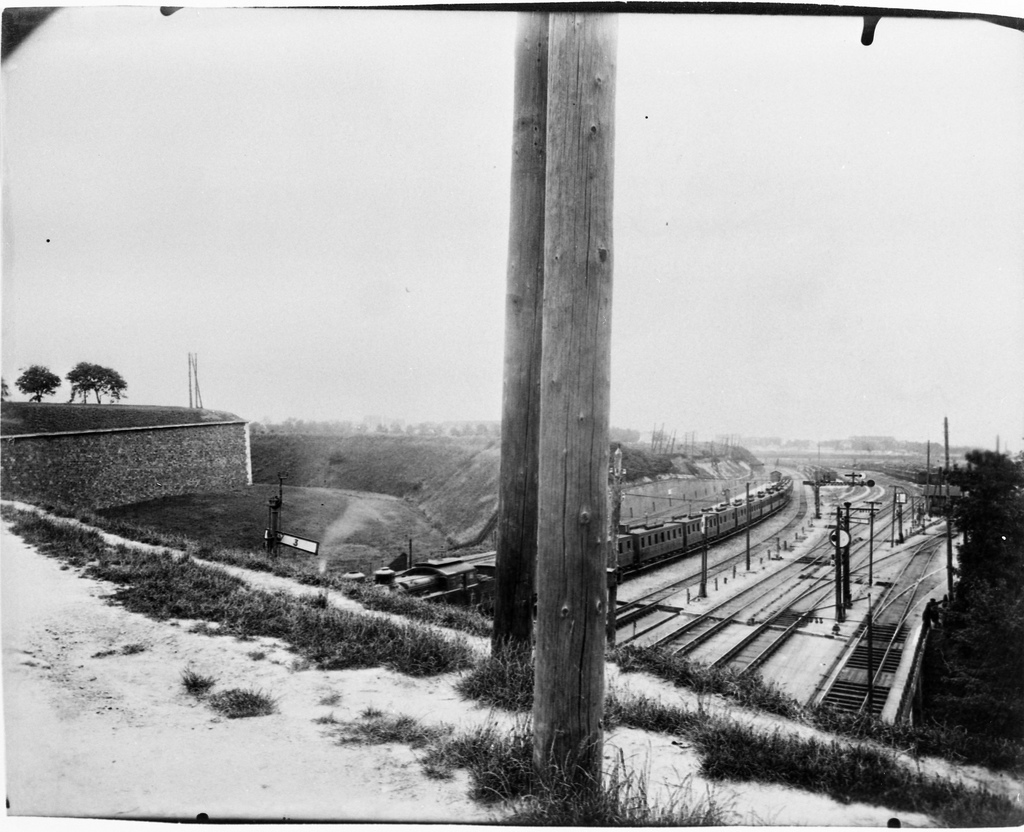 Eugène Atget, Porte de Bercy - Sortie de Paris du P.L.M. Bd. Poniatowski - 1910, 12 e arr t.
Atget has become a very ‘authored’ photographer – there are a number of ‘Atgets’. The surrealists appropriation of Atget's work constructed him as a primitive in touch with his unconscious self. Atget has since come to serve as the unconscious of documentary photograph--- a product of his reception in the history of photography in the United States--- the forebear to the generation of documentary art photographers --photographers like Walker Evans, Robert Adams, Diane Arbus, William Eggleston, Robert Frank, Lee Friedlander and Garry Winogrand.
Atget is part of the canon of photography because of the work of Szarkowski and the Museum of Modern Art in New York, who produced am romantic ‘Atget’ of their own with the four volume---Old France, The Art of Old Paris, The Ancien Regime and Modern Times----selected from his photographic archive ---the Seven Albums into which Atget had placed selected prints ( eg., ‘Zoniers’, Fortifications). Szarkowsk Atget is a late Atget, one freed from commercial considerations, who strives for artistic effect and for personal expression.
Atget is a photographer who delimits the essence of ‘place’ in the way of the passing of place into memory.
June 16, 2010
documentary photography: a note
Whilst a photography student in the 1980s I realized that numerous American photographers of the early 20th century had been pushed into the background. In the postwar period the socio-critical work of Lewis Hine or Dorothea Lange, some of which was state-commissioned during the New Deal, was sidelined with lasting effect as part of an equally state-sponsored campaign of anti-communism.
What was handed down to us was a process of canonization that gave preference to, for example, Paul Strand’s images of the Modernist sublime from the same period. This process seemed guided not by criteria of quality but by the dictates of cultural policy, and the Museum of Modern Art played no small part in it.
In traditional documentary photography the photograph has been seen is as a re-presentation of nature, an unmediated transcription of reality onto film. This notion of photography as veracity endows the photograph with the capacity to prove, to either present factual evidence or stand as a fact itself.to an unquestioned acceptance that the photograph presents us with a faithful reproduction of what "has been there."
The very act of photography as interpretive (the photographer chooses what to photograph, the camera is controlled), and necessarily selective (the photograph is limited by the camera's field of vision--the frame), is denied in favor of the photograph's construction as presence, truth, fact, and proof.
Most philosophies or reflections on photography argue that the photograph is a means of communication, rather than a piece of factual evidence. That the photograph communicates arises only from the meaning we ascribe to it; meaning does not inhere in the photograph itself. The photograph, then, can only verify the meaning we simultaneously invest in, and extract from, it. Rather than presenting an evidential and singular Truth, the photograph invites the speculation of multiple meanings.
June 15, 2010
Photography and critical realism
As I mentioned in an earlier post the University of Michigan recently had a History of Art Symposium on "Contemporary Strategies in Documentary Photography" part 1 and part 11 where the issue of image and text is raised.
One of the lectures in part is by Allan Sekula's exploration of what photography can accomplish by depicting social realitiesRealism in a Time of Lies. Sekula took up photography in the early 1970s. His formative influences included Marxist theory, documentary photography, and the Conceptual art movement of the late 1960s. One of his most important early works is Aerospace Folktales (1973).
In this work, which originally consisted of three separate narrative elements (photographs, a spoken sound track, and a written commentary), he documented the impact of unemployment in a working-class family.This project and the ones that followed exemplify Sekula's conception of "critical realism.
He says in the introduction to his book Photography Against the Grain (1984)
I wanted to construct works from within concrete life situations, situations within which there was either an overt or active clash of interests and representations. Any interest I had in artifice and constructed dialogue was part of a search for a certain “realism”, a realism not of appearances or social facts but of everyday experience and against the grip of advanced capitalism.
This works with a refusal of a liberal, humanist documentary mode and a critique of that tradition. Critiques of photo-documentary traditions, particularly those that concern "victims" of social injustice, are by now familiar, having been prominently published and widely circulated since the late 1970s.
Traditional "concerned" documentary has been faulted for rendering human tragedy a personal failing outside the realm of politics, for substituting empathy in place of activism, compassion in place of struggle, and thus obscuring the political sphere where determinations, actions and instrumentalities are not in themselves visual.
Hence the idea of a critical realism. Monika Szewczyk describes this in relation to Sekula's This Ain't China:A Photonovel in
Negation Notes (while working on an exhibition with Allan Sekula featuring This Ain’t China: A Photonovel) in the e-flux journal.
June 13, 2010
a strawberry stall
I'm often travelling up and down the main road between Adelaide and Victor Harbor and I have begun to take photos along the way. This quirky picture was taken early Sunday morning, around 7.30 am:

The pictures taken with a prosumer digital camera are little visual sketches that are shot to see how the objects and scenes look photographed. If they work as photographs, then I'll return with a large format camera to re-shoot them in the appropriate conditions.
I've concentrated on the local because I cannot for the life of me represent the disorientated feeling of living in postmodernity, and in particular, the problems of positioning within and resistance to the world space and flows of transnational capital. We do not have the equivalent of a Bonaventure Hotel in Los Angeles in Adelaide to be able to walking around and within in order to make the theoretical movement from the architectural space of the hotel to the political space of late capitalism.
What I do know is that it is not possible to view the global economic system with critical distance because we immersed “up to our eyes and our body” in the “hyperspace” of this abstract world order. The global financial crisis taught us that.
Hell, I wouldn't even know what a full blown postmodern building looks like. Is it one that aspires to be a total space, a complete world? A huge shopping mall turned in on itself? One where the sign language of consumerism that screams buy buy buy has been learned from Las Vegas?
I avoid shopping malls because the timeless present of consumption makes me depressed.
June 10, 2010
Contemporary Strategies in Documentary Photography
The University of Michigan recently had a History of Art Symposium on "Contemporary Strategies in Documentary Photography" part 1 and part 11. The issue of image and text is raised.
The first part of the symposium, which does not appear to be online, is an Alec Soth lecture entitled The Democratic Jungle: Making Pictures in the Information Age, which plays off Eggleston’s idea of a “democratic forest,” in which everything can be made a subject of meaningful photography. He says:
In the ’60s and ’70s, photographers were realizing that the most mundane street corner could hold rich cultural information. In the digital age, these fragments, to me, mean less and less. The forest is overgrown — it’s tangled with images and information. So, jokingly, I say that photography should provide a narrative machete. It’s like cutting away the story to find your way through.
Soth's way out way out of the overgrown forest is the narrative, or storytelling, and he advocates a personalized documentary that he equates to the:
New Journalism of the 1970s — Tom Wolfe and people like that who were creating this new first-person journalism, where they are getting rid of that authoritative voice, that sort of all-knowing voice, and saying, ‘this is my experience,’
One example a personalized documentary is the photo book preferably without text---a fragmented narrative that allows viewers to connect the dots and fill in the blanks.
Why no text? Is this a left over from modernism?
June 9, 2010
Massimo Vitali: landscape with figures
Massimo Vitali's images of bleached-out bathers in the sea at Italian resortsare taken with a wooden Deardorff from the 1950’s and then enlarged digitally are a welcome contrast to the convention of photographs of empty petrol station in the US desert:
 Massimo Vital, Plumb Beach, from Landscape with Figures
This bird's eye view of people taking time off to relax on long, hot summer days are taken with an 8 x 10 camera on a podium:
Vitali has been doing this for a few years now, and has perfected his technique. He sets up his custom-made perch 20 to 30 feet in the air, frames the landscape background he plans to capture with his 8 x 10 or 11 x 14 camera, and then waits for the landscape to fill up with people and their individual dramas. While he waits, he becomes invisible and very attentive. When the moment is right — when the field is filled with complexity and a multitude of interactions — he releases the shutter.
He has an ability to show masses of people in landscape surroundings with a balance of formal and narrative details
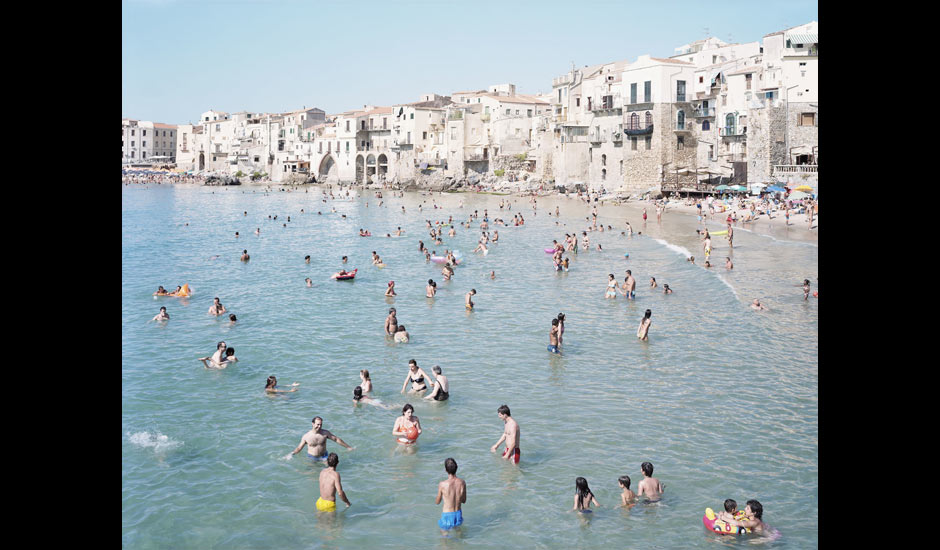 Massimo Vital, Cefai
Vitali approaches mass leisure and tourism the way the Bechers approached water towers and pitheads and his work is allows the photographic gaze to be invisible.
June 8, 2010
dam tech stuff
I've got the Epson V700 photo scanner assembled and connected to the 27 inch iMac yesterday only to discover that I am unable to upload Adobe's Lightroom 2 (a photo organizing and editing software) onto the iMac. After several tries I suspect that there is an incompatibility between Lightroom 2 and the Mac OS X 10.6 operating system.
No doubt the incompatibility will be fixed with Lightroom 3, which, I understand, is still in its beta phase. So begins my walk on the Adobe software upgrade treadmill with its high upgrade prices.
The context for this incompatibility is the current antagonism between Adobe and Apple over flash on the iPhone and iPad. Behind this stands this history. So we are basically waiting for Adobe to get up to speed on its software development.
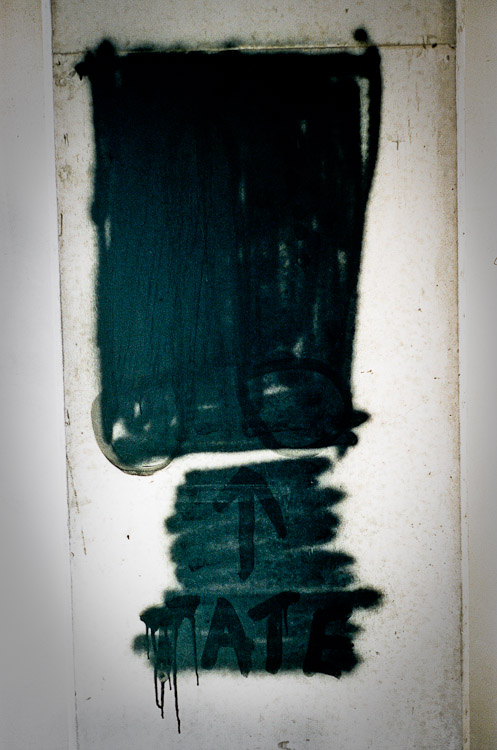 Gary Sauer-Thompson, Young Street carpark, Adelaide, 2010
I uploaded Adobe Photoshop Elements 6 that came with the Epson scanner to process some old film negatives shot on medium format cameras. But I have no idea how to use this software, and the few tutorials online that I came across are not much help. It looks like another steep learning curve for me.
I hesitate to step into the advanced graphics space of Adobe's professional designer world of Creative Suite (to use Photoshop and Indesign). In this space Adobe's Photoshop is king. My hesitation is due to the expense of the software and its complexity, especially when Lightroom caters specifically to a photographer's needs in terms of image manipulation.
Update
According to this review Adobe Lightroom 3 has just been released. It is confirmed here in Wired. It's official. I forget to mention the competition in photo management and editing software between Apple's Aperture and Adobe's Lightroom.
June 7, 2010
Carolyn Cole: pictures of BP oil spill
Below is Carolyn Cole's picture of a heavily oiled pelican floundering on the beach at East Grand Terre Island in Barataria Bay, along the Louisiana coast.
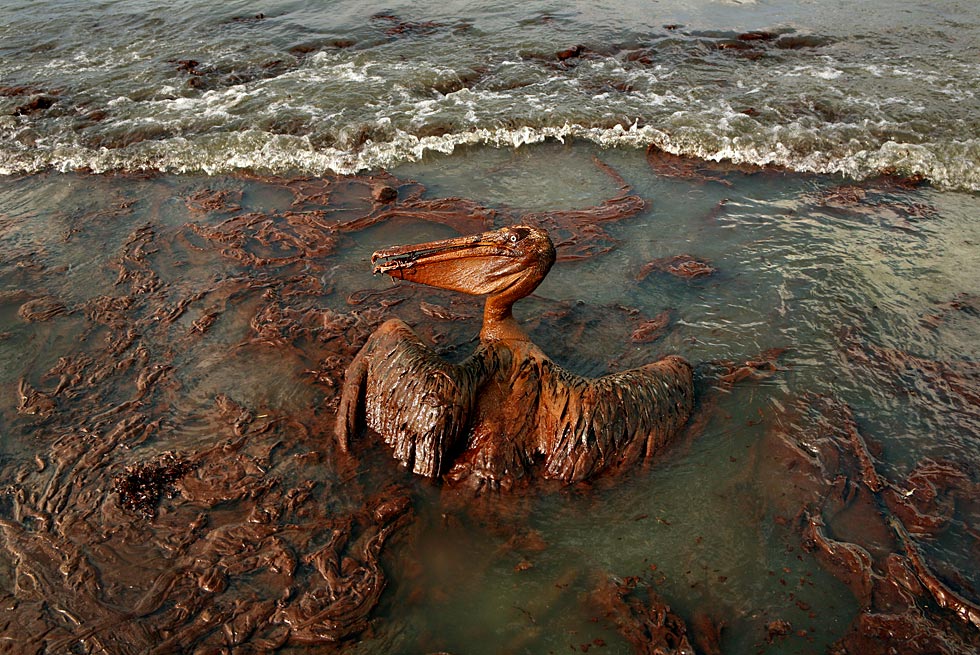 Carolyn Cole, pelican, Los Angeles Times, June 4, 2010
Cole is a Los Angeles Times staff photographer who has covered war, starvation, and brutality in the Middle East, Haiti, Kosovo, and Afghanistan.
 Carolyn Cole, oil spill, Louisiana's Chandeleur Islands, Gulf of Mexico, 2010
The Los Angeles Times has good coverage.
June 6, 2010
Bauhaus + photography
In a review of some recent books on the Bauhaus at the New York Review of Books by Martin Filler makes some comments about photography in relation to Moholy-Nagy:
Since the inception of photography, artists had been attempting to use this archetypically modern medium to achieve effects that would validate it as the equal of painting, a quest epitomized by Edward Steichen’s heavily handworked Imagist landscape photos of the early 1900s. Conversely, Moholy rejected prevalent pictorial conventions in photography and began to use the as yet underexploited mechanical po- tential of the medium to “paint” abstractions directly on film, instead of trying to capture nature through a lens at a distance. In doing so he extended the nineteenth-century practice of photographing objects on flat surfaces, as William Henry Fox Talbot did with pieces of lace and Anna Atkins with botanical specimens, a cameraless method in which objects were placed on light-sensitive paper and exposed in silhouette.
Filler adds that Moholy’s innovative photograms were often printed in the white-on-black tones of a negative and thus evinced the ghostly aura and scientific exactitude of the X-ray. Along with a great many silhouetted everyday objects, both instantly recognizable and puzzlingly abstract, human hands figure in several of Moholy’s photograms. But rather than summoning up medical associations they strike an atavistic note not unlike handprints in prehistoric cave paintings.
The expressive manipulation of photographic imagery—including the composite photomontages—opened up new worlds of abstraction— nonrepresentational---photography. In viewing all mediums with fresh eyes, the Bauhaus made the old new again.
June 5, 2010
tourism
The economies of coastal towns on the Fleurieu Peninsula of South Australia, such as Victor Harbor and Goolwa, are increasingly dependent on tourism. But little tourism promotion is being done by the various state government bodies to promote tourism. So people on the Fleurieu Peninsula are frustrated.
 Gary Sauer-Thompson, Whalers, Encounter Bay, 2010
The tourism that is promoted on the road signs or billboards is pretty bland--we offered horse drawn carriages and old steam trains. Victor Harbor stands for yesteryear not today, let alone tomorrow. The exception to the old is whales cruising along the southern Fleurieu Peninsula on their way to Antarctica during the winter.
There is very little about the knowledge economy and a lack of interest in providing internet hotspots apart from the public library. The old people run the town
June 4, 2010
Australian Photography: Stephen Best
I'm not sure whether Stephen Best is based in Braidwood near Canberra or Adelaide. At the time the series below was shot he was living in Adelaide. My guess is that he left Adelaide around 2007 and he currently runs Macquarie Editions near Canberra in Braidwood, NSW. I presume that his website has not been upgraded.
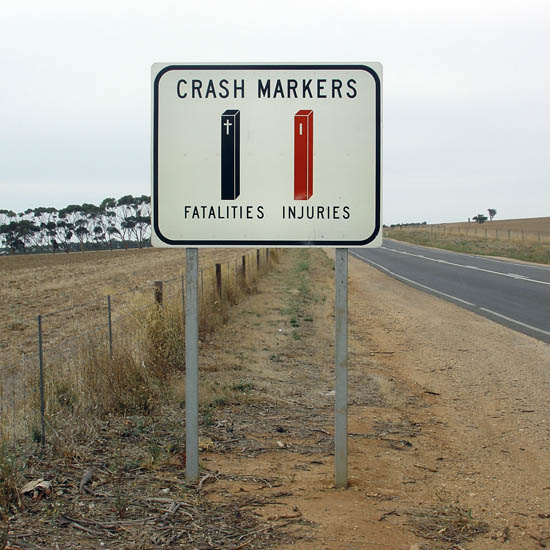 Stephen Best, near Strathalbyn 2006, from the series Highway of Death
He has left us with two projects done in SA. The Highway of Death one from 2006 and the architectural City of Churches one done in 2004-6. The one that I find the most interesting is the Highway of Death.
June 3, 2010
DIY photo publishing
In his review of Sylvia Wolf’s The Digital Eye: Photographic Art in the Electronic Age at Conscientious Joel Colberg says:
It is fair to say that digital technologies have changed photography. What is less obvious - and much more interesting to explore - is what exactly these changes are or, even more interesting, which of these changes will have lasting impact and which ones will make us cringe - or maybe smile - in ten or twenty years.
Colberg says that Wolf's text is concerned with what these changes are through surveying the use of digital technologies in the contemporary fine-art context. The assumption is the best way to explore the image of digital technologies on photography is through image making and style. This is standard practice in the art historical context.
If we stand back a bit we can see that one big impact is the independent photobook where photography sings its loudest and most complex song. It is the current boom in self-publishing or the DIY photo book. This is one area of publishing that is flourishing.
Writing in the British Journal of Photography Gerry Badger (via Harvey Benge) says:
As with everything else, the digital revolution has made an enormous impact though. Thanks to online print to order companies such as Blurb, making a photobook is now within everyone's reach. We haven't seen the first online classic but we soon will, and at the very least online printing allows photographers to make great calling cards for regular publishers.In the last ten years some extraordinary photobooks have been published.
Martin Parr agrees:
We need and require mainstream publishers, but their books tend to be a lot more conservative. So the real workshop, and the place where people can experiment with ideas, is small publishers, or indeed self-publishing. The quality and variety of print-on-demand books is improving. When people like Blurb first appeared they too were very conservative, but they are constantly improving. In another 10 years time, you'll find many more photographers self-publishing their own Blurb books.
June 2, 2010
Marzena Wasikowska: Forensic Landscapes
I've always struggled to represent the Australian bush. I find it difficult to translate the 3 dimensional messiness into a concise two dimensional form. I have enormous respect for those who are able to do so.
Once such person is Marzena Wasikowska, a Polish born and Canberra-based visual artist who works with the photographic medium in portraiture and in the landscape both in Australia and Europe.
 Marzena Wasikowska, archive 41, from Forensic Landscapes
Forensic Landscapes refers to landscapes from the scene of the crime. The observer is located in the Australian landscape at the scene and he/she look for signs, evidence, evidence in Intimate nooks that suggest the presence of human activity.
 Marzena Wasikowska, Forensic Landscape 3
What remains unstated is evidence of what? What are we looking for? Remains of the colonial past? Past crimes? Indifference to the environment? Ecological trashing? I cannot tell.
June 1, 2010
The Wire: Season 5
I've been watching the fifth season of The Wire. This views Baltimore through the lens of the Baltimore Sun, which is going through a difficult period of newsroom cutbacks due to the collapse of the business case of print newspapers. The vision of Baltimore of David Simon, the creator of the Wire was shaped by his work as a crime reporter.
There is a good review of The Wire by Mark Bowden in The Atlantic. It is structured around David Simon, was written before the fifth season went to air. This season deals with how Simon addresses the decline in journalism marked by racism. It doesn't pay attention to the problems happening in the city. There is no quality journalism anymore.

Simon has created a ‘junkyard landscape’ of deindustrialised and deproletarianised US black ‘inner cities’, whose ‘districts of dereliction’ are plagued by drugs, violence, and poverty.
In this "interview in Slate Simon says that The Wire is about?
Thematically, it's about the very simple idea that, in this Postmodern world of ours, human beings—all of us—are worth less. We're worth less every day, despite the fact that some of us are achieving more and more. It's the triumph of capitalism...hether you're a corner boy in West Baltimore, or a cop who knows his beat, or an Eastern European brought here for sex, your life is worth less. It's the triumph of capitalism over human value. This country has embraced the idea that this is a viable domestic policy. It is. It's viable for the few. But I don't live in Westwood, L.A., or on the Upper West Side of New York. I live in Baltimore.
It seems likely that Simon's anger about capitalism and the devaluation of human life is rooted in his unhappy experience at The Sun.What comes through is a Greek tragedy.