May 31, 2010
Stanley Greenberg: architectural photography
I've often worked past construction sites and wondered at their skeletal structured and thought--that would make a good photo. But the hassle--getting permission, safety gear etc--- puts me off and I never do it. The firms don't really want you on site. So I respect those who do it.
Stanley Greenberg has focused on the infrastructure of buildings and New York city. Greenberg's earlier 2003 book Waterworks was about New York City’s water system. The infrastructure of buildings is explored in his Architecture under Construction:
 Stanley Greenberg, Untitled,
A lot of buildings are more interesting when under construction than they are when complete. The finished piece of architecture by 'star architects' – eg.,Holl, Hadid, Gehry, Libeskind, Foster etc--look all shiny and smooth, often looks as seamlessly abstract as the computer rendering from whence it came. Greenberg's explores the avant-garde structures in the process of being built.
May 29, 2010
Sally Mann: Deep South
Sally Mann's early series of photographs of her three children and husband resulted in a series called Immediate Family made with a large-format 8x10 camera. She has continued the portrait work with a series on her husband entitled Proud Flesh.
In her recent series of landscapes of Alabama, Mississippi, Virginia, and Georgia, Mann has used damaged lenses and a camera that requires the artist to use her hand as a shutter, these photographs are marked by the scratches, light leaks, and shifts in focus that were part of the photographic process as it developed during the 19th century.
 Sally Mann, Untitled (Deep South #1), Tea-toned gelatin silver print; Deep South series, 1996-1998
Mann began to experiment with the wet collodian process in the 1990s to create the Deep South photographic series of Mississippi and Louisiana that recall a forgotten past.
May 28, 2010
Shizuka Yokomizo: urban loneliness
Shizuka Yokomizo's 'Dear Stranger' body of work is a series of photographic portraits done between 1998-2000 in which each photograph shows someone looking out through a window. It is premised on a non-existent relationship between subject and photographer.
They evoke Edward Hopper's images of urban loneliness: ---city-dwellers at night, alone in an overlit room, seen from the outside, through the frame of a window. Even if the window framing the object is not there the viewer is compelled to imagine an invisible immaterial frame separating him or her.
 Shizuka Yokomizo Stranger No. 2, 1999; photograph; chromogenic print,
The artist has never met any of these people. She selected their addresses and then wrote an anonymous letter asking if the recipient would stand at a particular window, alone, with the room lights on, at a specific time of night so that she could photograph them from the street. The artist simply promised to be there waiting. If they did not wish to participate they could close the curtains, while if they chose to open the door to meet her the photograph would not be used. If the subject wanted to meet Yokomizo she would immediately discard the portrait from her series.
The "Dear Stranger" letter that Shizuka Yokomizo sends to her potential subjects reads thus:
Dear Stranger, I am an artist working on a photographic project which involves people I do not know…I would like to take a photograph of you standing in your front room from the street in the evening. A camera will be set outside the window on the street. If you do not mind being photographed, please stand in the room and look into the camera through the window for 10 minutes on __-__-__ (date and time)…I will take your picture and then leave…we will remain strangers to each other…If you do not want to get involved, please simply draw your curtains to show your refusal…I really hope to see you from the window
signed "Artist".
Before she takes her photograph she waits for a feeling of equality and mutual observation to develop between her and the person she is photographing. The subject has to be watching her as much as she is watching them.
In a latter body of work the artist has placed herself on the other side of the window and, by collaborating with her friends, she replaces the sense of physical and emotional distance with a world of intimacy and interiority.
May 26, 2010
New York Photo Festival: 3D coverage
I mentioned the New York Photo Festival in a post on Marc Garanger's Femmes Algériennes at the Altfotonet blog. There I complained that the lack of links and the online exhibitions made it difficult to explore the world opened up by this festival.
I've since discovered the 3D coverage project by Martin Lenclos The 3D coverage, gives website visitors the chance to experience the festival “virtually” by offering photos and video interviews of the NYPH’s curators, attendees and exhibitors in an evocative rendering the festival’s actual environment.
It is fascinating to explore --but you need fast broadband for it to work effectively:
May 25, 2010
when the sun goes down
When the sun goes down, mythology surfaces in the rituals and anxieties of modern life – in beautiful sunsets no less than deepening shadows of despair. At night when the sun seems to travel below the earth, sleep, too, brings its tossing and turning as journey through strange continents of being.

This talk by Michael Taussig at Monash University in Melbourne as part of an interdisciplinary dialogue called Thinking Through Colour and Light addresses twilight, the witching hour when light transforms itself and the basis of the image, such that other worlds are possible.
All of this has something to do with mimesis.
Taussig's concern in Mimesis and Alterity is to reinstate in and against the myth of Enlightenment, with its universal, context-free reason, not merely the resistance of the concrete particular to abstraction, but what he deems critical to thought that moves and moves us-----namely, its sensuousness, its mimeticity.
The reference here is Adorno and Horkhimer's argument in the Dialectic of Enlightenment that the Enlightenment rationality (logical positivism) has become the dominant structure of rational thinking that has become synonymous with rationality itself is founded on a repression of alternative possibilities such as mimesis.
Adorno rejects the option of regressing back to mimetic forms of thought – predicated as they were on humanity’s objective powerlessness, these forms of thought would no longer be appropriate to a human community that had attained a level of genuine material mastery. Adorno suggests, there might be a potential to move forward – to preserve the “conceptual” elements within thought alongside a differentiated, heterogenous perception of nature.
Michael Taussig in Mimesis and Alterity suggests that these conceptual elements were mapped by Walter Benjamin's ideas of the optical unconscious associated with film cameras and the resurgence of the mimetic faculty. These conceptual elements are a two-layered notion of mimesis:----a copying or imitation, and a palpable, sensuous, connection between the very body of the perceiver and the perceived.
images
The University of Chicago has a useful keywords glossary of media terms--eg., photography by Ali Geiger. Towards the end of the entry, there is an interesting point made by Geiger, which relies on The Art of Photography: 1839-1989. (Museum of Fine Arts, Houston. Yale University Press, New Haven and London. 1989):
The medium of photography in the twenty-first century could be seen as having four primary estates: "fine art, advertising, amateur photography, and journalism." (The Art of Photography, p.8) The function of photography differs greatly in each of these estates. However, it can be argued that, "In present photography, as the museum culture becomes ever more commercial (no longer the mere preserver but the active creator of culture), the relations between these once separate orders of photography become increasingly interdependent." (The Art of Photography, p.8) There is no longer a clear line between photography as a fine art and photography as a functional art. Today we can see many photographs that would be considered fine art in advertising and journalism.
Rather that asking questions such as "Is Photography Over?” that don't really make sense, we say that the digital revolution has undermined these separate orders of photography even further. We know think in terms of pictures or images in the sense of a mediascape of signs in both our cities and on our computer screens.
This shift to 'image' loosens up our thinking since an image attracts, deceives, imitates, resembles, replaces and animates. It is precisely this unruly behavior that renders an image so difficult to grasp. 'Image' increasingly means digital image given the way that digital technologies have shifted our viewing of image away from the art gallery wall or the photographic book to the computer or tablet screen.
May 23, 2010
Andrew Moore: Detroit
I managed to catch Close-up: Photographers at Work: Portraits produced by Rebecca Dreyfus on the ABC's IView before it was taken down today. The film was originally produced for Ovation TV in the US by Maysles Films.
One of the photographers featured was Andrew Moore and It showed him photographing the New York skyline with an 8x10 field camera. In exploring his website I came across his Detroit work. It's Desolation Row I thought as I looked through the series.
 Andrew Moore, Couch in Trees, Detroit series 2008-2009
Detroit was once the centre and dynamo of industrial America; now it is a city of decay and ruins due to the since the decline of the American auto industry. It has not been replaced by anything else--eg., museums and cutting-edge art galleries. Detroit represents America's ruins.
The book of the series is entitled Detroit Disassembled. Detroit as America's Pompeii. The American reaction is defensive. It is ruins porn. For them the romanticism of decay is a tired cliche.
What is being rejected is the art tradition (eg., Giovanni Battista Piranesi’s 18th century engravings of the fallen civic monuments of ancient Rome and Greece; or Caspar David Friedrich’s 19th century paintings of fallen medieval cathedrals and castles) that uses ruins to remind their viewers of the fall of past great civilizations and to warn that contemporary American empire risks the same fate.
 Andrew Moore, Cass Tech Courtyard, Detroit series 2008-2009.
Deirdre Foley-Mendelssohn in the New Yorker is not so defensive. She says that as Moore himself says:
the city is filled with thousands of houses, libraries, factories, apartments, and hospitals “abandoned and mostly unguarded, barely salvageable, and slated for demolition that gets delayed year after year.” The pictures depict a ghost town, reminiscent of Robert Polidori’s images of Chernobyl, where everything was left entirely intact, abandoned in an instant but allowed to rot for decades. The primary signs of life in Moore’s photographs come not from humans, but from nature: mossy grass grows in buildings, trees crawl from warehouses, and houses are swallowed whole by reaching vines.
What the Americans desire are gestures of change; the new opportunities arising from the decaying shell of the auto-industry capital; the emergence of the entrepreneurial spirit.
These American industrial ruins are present day America--Detroit is now one-third empty land. It is a world of economic, physical and political insecurity. Presumably, there is also fear of change, fear of decline, fear of strangers and an unfamiliar world.
May 22, 2010
an image culture
The Ubiquity of the Image is the title of a dialogue between Joan Fontcuberta, Christian Caujolle and Radu Stern. They are a part of SCAN, and they invite us to reflect on the ubiquity of the image and its social, artistic, psychological and other implications.
Ubiquity means the state or capacity of being everywhere at the same time; omnipresent. The image in postmodernity is everywhere and omnipresent, and we live within a maelstrom of images that is all around us in the spaces of our urban landscape.
In this post Fontcuberta points to the implications of this in a digital age:
Vilém Flusser explained very graphically that images are screens charged with meaning that interpose themselves between us and the world. The reality remains remote and inaccessible, and we are left with no other option but to react and make do with the images, which constitute a metareality, but at least an accessible metareality. If the images in Plato’s cave were simply shadows, images have since become very complex ideological constructs: no longer the mere reflection of the world, they have now, as we have said, managed to supplant the world and leave us immersed in a state of ‘hallucination’
He says--and rightly---that the contemporary creative arts cannot ignore this state of affairs where everyone is producing and circulating images on a global scale. We are producers and consumers of digital media at the same time.
Alasdair Foster recently pointed out in Zone Zero that the world of art, of photography and visual communication in general the hierarchical separation between professionals and public is tending to diminish, even disappear altogether, with the result that their positions are becoming interchangeable. The image is ubiquitous today because we all make or deal with photographs, we all generate and receive graphic information, irrespective of the meaning that we invest it.
In spite of this emergence of user generated images we have no real means of acting on or intervening in the dominant vectors of the image, which are controlled by ever greater and more concentrated financial powers.
May 21, 2010
The end of photography as we know it?
One of the laments in the 1990s with the emergence and early flourishing of digital photography, with its post processing using computers and Photoshop instead of the darkroom, is the loss of photography's indexical nature and its connection to truth. Digital meant a shift towards representation and an emphasis on aesthetic and cultural codes.
 Gary Sauer-Thompson, Petrel Cove, near Victor Harbor, 2010
In Analog to digital: the indexical function of photographic images in Afterimage, Sept-Oct, 2009 Corey Dzenko says that:
the notion of the photograph as index relies on the physical and chemical processes that constitute the medium. In film-based photography, light bounces off an object and is recorded in the silver salts of the film's emulsion. This process depends on the presence of an object in front of the camera's lens in order to record its image through projected light.
This conception of photography----photographs are perceived to represent reality in their reference to a subject in time---is deeply entrenched in our culture.
Roland Barthes describes the relationship between object and image and time as "that-has-been" in Camera Lucida: Reflection on Photography. According to Barthes, this characteristic is unique to photography:
I call "photographic referent" not the optionally real thing to which an image or sign refers but the necessarily real thing which has been placed before the lens, without which there would be no photograph... In the daily flood of photographs, in the thousand forms of interest they seem to provoke, it may be that the noeme "That-has- been" is not repressed ... but experienced with indifference, as a feature that goes without saying. (pp 76-77).
As Barthes explains, "Show your photographs to someone--he will immediately show you his: 'Look, this is my brother; this is me as a child, etc."' Cory says that it was this physical, indexical connection to reality that resulted in photography's use as visual recorder in documentary contexts such as news imagery and photojournalism.
Digital photographs, it was held, present a challenge to the indexicality of photographic media. No longer does light bounce from an object and cause a physical and chemical reaction of silver on photographic emulsion; instead, the image is converted into intangible data.
This shift away from physicality caused some, such as Fred Ritchin, to respond that with digital technology, it is arguably easier to edit and create images of objects that never existed in reality thus casting doubt on the reliability of photography's connection to the real. So we have the end of photography as we know it.
The problem with this kind of realist position that reduces photography to a particular technology of image-making is that many digitally constructed or distributed images, such as the snapshot photograph of the two poodles at Petrel Cove above, "look like" analog photographs and are processed with, and used in, applications similar to their analog "predecessors." The picture of reeds at Port Philip Bay in the Romanticism: a note post is an analog photograph.
We read the digital photograph within the tradition of reading and understanding analog photographs. We do not say that the digital transcoding of images in the picture of the poodles results in the negation of photographs' indexical function on the practical level compared to the picture of the reeds at Port Philip Bay. The reaction to the poodle photograph is not one of mistrust of photographic "transparency" as was feared in the 1990s.
It is the notion of 'transparency' that needs questioning, given the constructive nature of photographic image making and the way that it is embedded in text in a digital world of computers and the Internet. The digital shift means that we have moved from the photograph to the image, in that the image has become one of the constitutive elements of the consumer society in which we live. The urban landscape with its images of billboards, shop signs and advertising is now a world of images; an ‘empire of signs’ in which a flow of images are produced, circulate and are consumed.
May 20, 2010
Romanticism: a note
Romanticism has been under siege in recent formulations of Anglo-American cultural history by modernism and postmodernism. The Romantic movement's overturning of the Enlightenment is now commonly reduced to emotionalism, sentimentality, idealism and pretty pictures in the style of National Geographic.
 Gary Sauer-Thompson, reeds, Port Philip Bay, Melbourne, 2010
WJ. T Mitchell in 'Romanticism and the Life of Things' in Critical Inquiry (vol.28, no.1, 2001) says that not so surprising that the romantic image should turn out to be a combination of fossilism and totemism, a dialectical figure of animation and a ruinous trace of and a "vital sign".
After all, he says, romanticism itself plays something like this double role in our sense of cultural and history:
Is not romanticism itself a fossil formation in the history of culture, not only because of its obsession with lost worlds, ruins, archaism, childhood, and idealistic notions of feeling and imagination, but because it is itself a lost world, swept away by the floods of modernity it attempted to criticize? And is not romanticism therefore itself a totem object, a figure of collective identification for a tribe of cultural historians called romanticists and, beyond that, for a structure of feeling more generally available to anyone who identifies him- or herself as a romantic?
And yet the grand modernizing narratives of endless progress through technical or instrumental rationality seem to collide visibly with the resurgence of the primitive, the irrational, and the archaic.
Update
Mitchell's account of the romantic image is a composite of two concrete concepts, the fossil and the totem.
Totemism is the figure of the longing for an intimate relationship with nature and the greeting of natural objects as "friends and companions"--the entire panoply of tutelary spirits from Wordsworth's daffodils to Coleridge's albatross to Shelley's west wind. It is also, as these examples should remind us, the figure of the kind of guilt, loss, and tragic transgression that only becomes imaginable when natural objects enter into a family romance with human consciousness. The totem animal must not be killed; the nightingale was not born for death, and so of course the albatross is killed, and everything that lives must die, even the nightingale.
If totemism adumbrates the romantic longing for a reunification with nature then fossilism expresses the ironic and catastrophic consciousness of modernity and revolution:
If the romantic desire for an image to secure an intimate communion with nature is itself a form of totemism, the inevitable defeat of this desire is named by the fossil, which turns out to be a name for the dead images that make up language as such.
Mitchell adds that among the many lessons we might learn from the simultaneous onset of fossilism and totemism in the romantic era is that:
when new objects appear in the world, they also bring with them new orders of temporality, new dialectical images that interfere with and com-plicate one another. Just when we think that things are safely dead, fossilzed, petrified, and consigned to the past, they rise from their graves of natural extinction and cultural obsolescence.
So Mitchell's romantic image is a dialectical figure of animation and petrification, a ruinous trace of catastrophe, and a "vital sign." He finishes by saying that the critique of modernity that runs through Marx, Nietzsche, and Freud to Benjamin and Adorno would be unthinkable without the special form of natural history bequeathed to us by the romantics, captured in its particularity by the figures of the fossil and the totem.
May 19, 2010
Christopher Thomas: evoking Atget
The German photographer Christopher Thomas, who graduated from the Bavarian State School for Photography in Munich, evokes and treads in the footsteps of Eugene Atget with his black and white images of his native Munich and then New York.
 Christopher Thomas, Gerner Brucke Schlosskanal, from Münchner Elegien
Thomas, who is a well known commercial photographer, picks up on the traditions of 19th century photography. He came an artist in the art institution with his Munich Elegies series done between 1995 and 2001. These images of Munich made between 5 + six in the morning refer back to the 19th: no cars, no people, classicist architecture, virgin landscapes, a derelict public pool, a thermal power station in the fog.
The same approach was adopted for the New York series--an absence that is the result of shooting in the early morning hours:
 Christopher Thomas, Colgate Clock, from America Sleeps, circa 2009, Archival pigment print on Arches paper
He used a custom-made large-format Linhof field camera and Polaroid film to make the nearly 80 images that appear in the book. Many of the images were shot in the predawn hours, with few people milling about and with landmarks looking strangely unfamiliar.
 Christopher Thomas, The Corner Deli, 2008, from America Sleeps, Archival pigment print on Arches paper
This is a New York devoid of people with empty streets and its parks bridges and waterways silent; a New York that often refers back to pre-modern Europe.
May 18, 2010
Olaf Otto Becker: Above Zero
This is the kind of photography I will never do: wilderness photography in very remote wild places with a large format 8″ x 10″ camera. It is far too difficult and expensive for someone in my position to be able to do.
Olaf Becker's earlier Broken Line series was based on photographs of the coast of Greenland. Between 2003 and 2006, Becker made a series of solo expeditions in an inflatable Zodiac boat along 2,500 miles of the west coast of Greenland. Can you imagine doing that around Antarctica? It's not feasible.
Becker's Broken Line photographs of icebergs, rock cliffs, scattered settlements, and the ocean waters that crash against it, were taken at night by midsummer light, with a large-format camera and exposures of up to several minutes. They are more than pretty/beautiful pictures of icebergs since the work explores the relationship humans have to nature.
Above Zero, Becker's second book, collects the photographs of the interior of the island made in trips in the summers of 2007 and 2008 the Arctic explorer Georg Sichelschmidt.
 Olaf Otto Becker, INLANDEIS 5, 08/2008, from Above Zero
The purpose of this photographic trip was to photograph a series of remote rivers that indicate how global warming is weakening Greenland's ice sheet and hastening its disintegration.
 Olaf Otto Becker, River 1, 07/2007, Position 4, from Above Zero
Of the first river he photographed, in July 2007 Becker writes in his Above Zero book:
At the time we were there, this river was seven and a half kilometers long and supplied by innumerable meltwater streams and rills. Lining its banks were millions of cylindrical holes full of water. On closer scrutiny, they turned out to contain black dust and soot that, having absorbed the warmth of the sun much faster than the reflective ice had, sunk through the ice, creating cylindrical holes. Far away from the coast and surrounded by inland ice, the fast-flowing river suddenly disappeared into a moulin [a glacial hole that can be hundreds of feet deep]. When approaching the moulin, we heard the ice creaking loudly beneath our feet, the meltwater having presumably carved huge cavities underneath the ice sheet, which here is about 700 meters thick.
This is an endangered landscape that is changing before our very eyes due to global warming.
Helen Levitt: colour photography
I've always admired the street photography of Helen Levitt, and the way that she was able to represent working class street life in New York with her Leica. I didn't realize that she passed away in 2009.
I'd always connected her work with Jane Jacobs The Death and Life of Great American Cities; a text that continues to resonate today with the ongoing gentrification of the inner city in a knowledge economy.
 Helen Levitt, New York. 1971. Chromogenic color print.
What I didn't know was Levitt's colour work in the 1970s and 1980s; nor that she was an early pioneer of color photography. based on two Guggenheim Foundation grants to take color photographs on the streets of New York inn 1959 and 1960. Much of her work in color from first decade’s was stolen in a 1970 burglary of her East 13th Street apartment. What we have are remaining photos, and others taken in the following years.
 Helen Levitt, New York. 1974. Chromogenic color print.
I also didn't know that in the late 1940s Levitt made two documentary films with Janice Loeb and James Agee: In the Street (1948) and The Quiet One (1948) and that she was active in film making for nearly 25 years; her final film credit is as an editor for John Cohen’s documentary The End of an Old Song (1972).
Levitt's street photographs represented the vitality of inner city life.For her it was the quality, not quantity, of street life that counts:
 Helen Levitt, New York. 1974. Chromogenic color print.
Jane Jacobs interest was in why certain city districts and cities thrived, while other city districts and cities stagnated and declined. She identified four general conditions for city diversity: mixed primary uses; small blocks (or plentiful streets); aged buildings (a diversity of building types); high-densities ("the need for concentration").
Diversity for Jacobs meant the whole diversity of a "great" city, including skyscrapers, department stores, highways (especially for trucking), big medical centers, etc. For Jacobs truly healthy cities had diverse districts as well as districts that were internally diverse.
May 17, 2010
digital technology + photography
The introduction of digital and computer technologies has meant the emergence of a reproducibility that has brought about a diminishing aura, and a “shattering of tradition”. Photographs have morphed from ritual high art objects in an industrial culture into “fragments of information that circulate in the high-speed networks of a digital culture that now ring the globe.
 Gary Sauer-Thompson, Blyth Street, Adelaide, 2010
The digital image loses the aura that the art photograph had retained because the copy is finally independent of the original; in fact there is no sense of an original at all. What is lost is the concept of photography as a finished art object tied to an auteur vision and created to be seen in a certain ritual way –as an “original”. The 'unfinish’ defines the aesthetic of digital media.
The idea of the original is tightly linked to the concept of the artist as creator. Digital technologies serve to undermine the status and authenticity of the artist, or more specifically unhinge the ties between artist, negative and original.
Roland Barthes in The Death of the Author in his Image, Music, Text sees the death of the author as the birth of the reader. He writes of how a text’s unity no longer lies in its origin but in its destination, which is the reader, who can hold all the different parts, viewpoints of a text together.
In this way, photography follows in the footsteps of text to become intertextual and interactive, requiring user-participation and user-interpretation. While film remained ephemeral and inaccessible, subject to a one-time reel-time viewing, it could retain its aura and reduce the mass audience to a single spectator, but as the cinema becomes subject to remix and review and user engagement, it becomes increasingly heterogeneous and hypertext
Digital technology can greatly empower Barthes’s reader who now has authorial capacity and is capable not only of interpreting texts, but interacting with them and changing them. Readers are increasingly becoming photographers using photographs as the “raw material that can be appropriated, manipulated and reshaped into another work of art” They re-edit images ; they put themselves and their friends into images; put still photos to music. The remix is endless.
May 13, 2010
CIBO Galleria
Cibio Expresso is a chain of coffee shops in Adelaide. They have a CIBO Galleria, which features four seasonal exhibitions and awards, each named after colours in Italian to reflect the seasons: Giallo (yellow for Summer), Arancio (orange for Autumn), Grigio (grey for Winter) and Verde (green for Spring).
The first exhibition was Giallo that was a part of the Fringe 2010 which featured a number of photographers. The current exhibition is Arancio and it features only one photographer---Tony Kearney who has a photostream on Flickr.
 Gary Sauer-Thompson, Strahan, Tasmania, 2010
I didn't know about this kind of support to emerging photographers. If I had, I would have submitted some images. It is something to work on after I finish the Tasmanian book. It appeals because Cibo's in Gouger Street is my favourite local coffee shop.
May 12, 2010
The Band: It makes no difference
I'm being driven insane doing the Tasmanian photography book. The software for page layout is not sophisticated enough to do text properly. It s okay for a book of photographs but not images and text. Though I thought I was doing something quite simple--some photos plus a bit of text ---I've bitten off more than I can chew.
More sophisticated software is need for this kind of desktop publishing so that I can obtain a more professional page layout. It looks as if I will have to invest in Adobe InDesign if I am to become a small publisher of e-books.
That means doing courses in learning how to use this software. Is that TAFE? This opens up possibilities of e-readers triggering a wave of innovation in books such as works that mix text and audiovisual content and short-form e-books.
This suggests that digital technology is strengthening, not weakening the book as we have new ways of distributing the printed book. . Books will also be more easily available -- and not just in digital form--because the new printing technology means that books can now be cheaply produced on demand. This printing on demand may well prove to more popular than titles produced by conventional printing.
May 11, 2010
political rhetoric
An example from the Liberal Party of Australia under its current leader Tony Abbott:
Note those red arrows pointing to Australia. They are very graphic. They refer back to the red invasion of the1950s. It is a complete re-run (arrows thrusting towards Australia and all) of the yellow/red peril ads the DLP used to run in the 1950s and 1960s. Only in the 21st century it is the Muslims, not aggressive communism, who are threatening to invade Australia and undermine its national sovereignty.
Of course, the reality is that 'Muslims' refers not to Mongols, but to asylum seekers from Afghanistan fleeing civil war in which Australia is involved as part of the NATO force fighting the Taliban. Asylum seekers are equated with an invading force (and terrorists) and so we have the politics of fear based on mass deception.
The implication of this visual rhetoric is that the Labor government could not be trusted to protect Australia's borders.
May 10, 2010
Bill Henson 2010
Bill Henson has a new show at the Roslyn Oxley9 in Paddington Sydney. From all counts the current exhibition builds on his earlier work: classical architectural ruins, romantic landscapes and sultry, pubescent girls and boys.
 Bill Henson, untitled, 2008
I'm mostly interested in the way that he handles ruins and statues in his twilight world. It is represented almost as an underworld in which we stumble about only dimly aware of what is going on but sensing the terror.
Henson's perspective is that of Romanticism, understood as rejecting the the rationality of an Enlightenment civilisation and yearning for an emphasis on the role of feeling, upon emotion, and upon imagination in the process of artistic creation. The Romantic artist shows us the way they imagine the world should be, how it might reflect the way we feel about the world rather than the mundane way it actually is. In Henson's imaginative world we have teenagers as primitives amidst ruined temples that express the inevitable decay and collapse of human creations.
In this poetic landscape we experience the melancholy overtones of classic ruins crumbling into decay ad being overrun by nature. In Henson's photographs we have heritage ruins rather than modern ruins of derelict factories, closed shopping malls, overgrown bunkers and redundant mining towns; a ghostly world of decaying modern debris normally left out of academic concerns and conventional histories.
In the former extraneous materials – plants, fauna, debris, modern materials – all pollutants, are to be expunged. Seemingly frozen in time, further decay is staved off through restoration and preservation. Arresting decay, of course, has always been the imperative of modern museums and heritage management. Modern ruins,
May 9, 2010
Stephen Shore: American Surfaces
There is an interesting interview with Stephen Shore conducted by Gil Blank at AmericanSuburbX about his American Surfaces photodiary project in early 1970s.
In this project Shore melded photography's capacity for factuality to the detritus of Pop art and culture in the form of a snap shot aesthetic in an art context.
 Stephen Shore, Pueblo Bonito New Mexico, American Surfaces, June 1972.
There is a matter-of-fact interpretation of American society as Shore finds it---television sets, TV dinners, Jesus, three logs bound with rope that oddly decorate a lobby, a red-velvet-piped throne toilet, the wishfully royal blues and golds of American motel coverlets.
In the interview Shore says:
I was interested in the snapshot, and in the natural quality that some few snapshots do contain...One of the thoughts behind the Conceptualist work was that there’s this world out there that we experience, and that making it into a photograph necessitates the mediation of an artist. Almost inevitably, visual conventions come into play, so that what I see in the photograph is tied as much to visual conventions as any opportunity to see the rest of the world...Although it’s important to say that it was not my intention to “be a machine.” If I can detect a difference between how I see things as I experience the world, and how I then see them in photographs, that difference interests me. Part of my intention with American Surfaces — and the entire terminology of “mediation” is something I’ve only begun to discuss in retrospect; at the time I don’t think I used that term — was simply to take pictures that looked natural to me, but that distinction is what I was after.
The Conceptualist art movement was about purposely deskilling approach to production with an intentionality to imitate “vernacular” photography: anonymous snapshots, newspaper photographs, accidental documents etc.
 Stephen Shore, Granite Oklahoma, American Surfaces, July 1972
Shore adds that the inheritance of artistic conventions determine how we “should” see or structure the world. If I do away with those trappings, it doesn’t mean that there isn’t still something else beneath it that’s me seeing:
the phrases and thoughts in my mind were taking “natural pictures,” and making a “visual diary.”..I’d open a door, and there would be this bed. I’d get up in the morning and open the bathroom door, and there would be this toilet. I’d go to the diner and there would be this food on this surface, on this table....In photographic terms, if you remove as much of the photographic convention as possible, what you’re left with is yourself, and how you see.
So we have the idea of pictorial vocabularies. Shores idea of "natural" or "unmediated" photographs utilizes the pictorial vocabulary of the snapshot to break through photographic conventions.
a touch of humour
I've spent most of the day working on my photography book--Image Fragments of Tasmania---- putting the images and text from the hard drive into the Picpress software. It's been done with the workshop this morning and then working on it tonight.
The book is more low grade commercial book than a garage band aesthetic, with its roots in the visual aesthetic of punk such as Daido Moriyama's Farewell Photography.
Time for some humour:
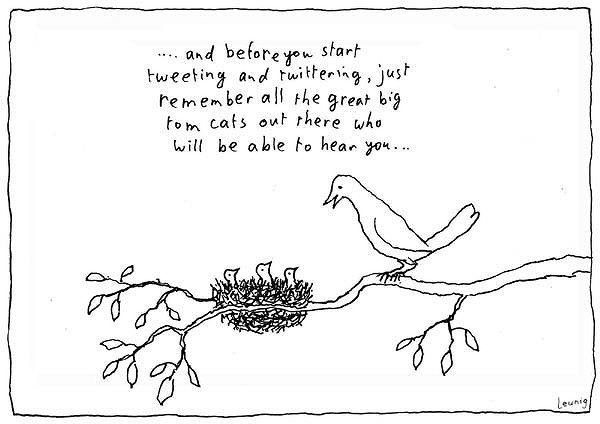
I just love Leunig's play around twitter and tweet and the dangers of twittering, especially in the context of Catherine Deveny's sacking by The Age for her Logie night Twitter comments.
May 6, 2010
Simon Roberts: We English
I've finished selecting the photos for the first draft of my Tasmanian book--tentatively entitled Image-Fragments of Tasmania: Photographs of Tasmania 2010--- and taken them to AtkinsTechnicolour for colour correcting. The workshop to design the book is on Saturday morning and I'm still writing still the text. The book is printed through Picpress utilizing their software.
In the meantime I've been keeping a lookout for photographers who are much further down this path in the tradition of the road trip in photography than me. One is Simon Roberts who published a collection of photographs taken over the course of a year traveling throughout Russia entitled Motherland.
His second project is We English, the result of travel the country in a motorhome photographing and researching subjects and locations.
 Simon Roberts, Skegness Beach, Lincolnshire, 12th August 2007
The photographs taken with an Ebony 45S camera are of the English people at play, relaxing and revelling and their attachment to England. So it is about belong and identity. Are the English having an identity crisis in contrast to the resurgence of Scottish or Welsh identity and nationality? What does it mean to be English – not British, but specifically English? Should it matter?
May 4, 2010
photographs as objects
In the Introduction: Photographs as Objects to their Photographs Objects Histories: On the Materiality of Images Elizabeth Edwards and Janice Hart draw a useful distinction between photographs as image and as material object.
 Gary Sauer-Thompson, advertising, Swansea, Tasmania, 2010
This distinction is not often made in our image-based culture and it indicates that a photograph can be seen as a more complex object than simply an image.
Edwards and Hart say that:
The central rationale of Photographs Objects Histories is that a photograph is a three- dimensional thing, not only a two-dimensional image. As such, photographs exist materially in the world, as chemical deposits on paper, as images mounted on a multitude of different sized, shaped, coloured and decorated cards, as subject to additions to their surface or as drawing their meanings from presentational forms such as frames and albums. Photographs are both images and physical objects that exist in time and space and thus in social and cultural experience. They have ‘volume, opacity, tactility and a physical presence in the world’ .... and are thus enmeshed with subjective, embodied and sensuous interactions. These characteristics cannot be reduced to an abstract status as a commodity, nor to a set of meanings or ideologies that take the image as their pretext. Instead, they occupy spaces, move into different spaces, following lines of passage and usage that project them through the world....
Despite the clear realisation of this physical presence, the way in which material and presentational forms of photographs project the image into the viewer’s space is usually overlooked.
This indicates that a photograph is a multilayered laminated object in which meaning is derived from a symbiotic relationship between materiality of the object, the content or image, and context or the discursive system in which the image is embedded.
May 3, 2010
to photograph is to frame
In his Picasso and Co book Bassai says that Picasso, on being shown some of Brassai's 1932-33 Paris underworld photographs, commented:
When you see what you express through photography, you realise all the things that can no longer be the objective of painting. Why should the artist persist in treating subjects that can be established so clearly with the lens of a camera? It would be absurd, wouldn't it? Photography has arrived at a point where it is capable of liberating painting from all literature, from the anecdote, and even from the subject. In any case, a certain aspect of the subject now belongs in the domain of photography. So shouldn't painters profit from their newly acquired liberty, and make use of it to do other things?
So what role for photography? To document or express the real in a world overloaded with imagery in which we surf on simulacra, as was suggested by the modernists?
 Gary Sauer-Thompson, Queenstown caravan park, Tasmania, 2010
However, the inbuilt deceits of photography, and its anecdotal, non-synthesising nature conflicts with its implicit claim to truth. Horror exists, it stares us in the face, and we should respond appropriately with harrowing images. So argued Susan Sontag in Regarding the Pain of Others, which was her follow-up to On Photography.
Well Mathew Brady visited the fields of carnage of the American Civil War when the battle was over. Presumably this represent the power of art to negate, which Sontag, the modernist, defends.
Sontag acknowledges that photography offers mere fragments of reality, since to photograph is to frame, and to frame is to exclude. Photographs are discrete, "neat" slices of time that starts from an intuitive response, and not analysis or intellectual considerations. Photography and works or art are not a text or commentary on the word, they are a thing in the world. In rejecting interpretation and meaning she advocates transparency, or experiencing things being what they are.
I would argue that Brady's photos are an interpretation of the American civil war not the luminousness of the thing in itself that is experienced. We "read" these photos in the context of American history not as a modernist thing in itself.
In this interview in 1975 in the Boston Review Sontag goes further when says:
I suppose the main tradition in photography is the one that implies that anything can be interesting if you take a photograph of it. It consists in discovering beauty, a beauty that can exist anywhere but is assumed to reside particularly in the random and the banal. Photography conflates the notions of the "beautiful" and the "interesting." It's a way of aestheticizing the whole world.
She adds that the Chinese take pictures of each other and of famous sites and monuments, as we do. But they're baffled by the foreigner who will rush to take a picture of an old, battered, peeling farmhouse door. They don't have our idea of the "picturesque." They don't understand photography as a method of appropriating and transforming reality—in pieces—which denies the very existence of inappropriate or unworthy subject matter.
Isn't the taking of a picture of an old, battered, peeling farmhouse door an expression of seeing art in daily life, as distinct from the photojourrnalist tradition?
Sontag adds that many people experience their lives as if they had cameras. But while they can see it, they can't say it. When they report an interesting event, their accounts frequently peter out in the statement, "I wish I had had my camera." There is a general breakdown in narrative skills, and few people tell stories well anymore. If narration is linear, then photography is anti-linear.
Sontag was anti-photography in the 1970s. Yet her charges of "mental pollution" and us being "image -junkies" would apply much more so to the moving image of television surely.
May 1, 2010
photography e-book
I've started work on the first draft of my Tasmanian book-----it is still untitled. I've been writing the preface and the introduction today and selecting and post processing the photographs. It looks as if it will combine photography and philosophy about the domination of nature, critiques of wilderness photography, plus bits and pieces of text on the modernist aesthetic and beauty.
I don't have enough photographs for the book. So more trips are needed to make the DIY book or self-publishing worthwhile and to justify the marketing.
 Gary Sauer-Thompson, Gormanston, Tasmania, 2010
The aim of this exercise in self-publishing is not just to have a printed book sitting on the coffee table (or the bookstore)--ie., vanity publishing. I do recognize that the old publishing paradigm, where gatekeepers (editors) restricted access to the means of publishing, is on its way down the toilet, but a bookstore would have no interest in my (unprofessional) photography book. I'm talking about a book that for whatever reason is not feasible to publish in print in the traditional sense.
Nor am I doing this for do it yourself publishing on demand (POD), in which you send a print-ready Adobe Acrobat PDF file for the book and its cover to a POD printing company, and let them print and mail individual copies as orders trickle in and send you your cut. I'm a nobody in the long tail and there would be few orders.
It is more an exploration of the possibilities offered by a digital or e-book. I presume that I will have a free ebook so that people can read the book on their computers…free because a present, they aren’t willing to pay for an e-book. My assumption here is that electronic books substitute for print books and that an e-book would help the sales of a printed book. The Cory Doctorow route is give away the e-books and offer the POD as, basically, a cheap printing service for those who want hard copies of my photography books.
I'm just groping my way here with few maps to guide me. Junk for code, my blog, has replaced my journal in my life and it is illustrated with lots of hyperlinks. There is the template:--- my blog already is a hyperlinked e-book. It could be wrapped up into a single file with photo-quality resolution that takes on more the quality of a photography/art book and it could be dipped into online by those interested.