April 29, 2010
the post photographic
Rosalind Krauss argues that while there are many spaces and contexts in which photographs live, the wall of the gallery is the primary discursive space of the photo. But the leap to digital form—indeed, how many of the world’s photos are even printed anymore?—prompts us to consider not only the vertical plane of the webpage as the new home of photographic media.
This is a copy-and- paste or web surfing culture in which images, sound files, videos, and even source code are lifted and repurposed in our visual culture. The representational practice upon which this work hinges—montage— borrows the techniques of collage—namely piecing together fragments, objects, and ideas in what Roland Barthes might call a “tissue of quotations”—to create new valences. This is not so much derivative as dialectical. Each “lifted” piece is put in conversation with each other, so that the combination creates a third (or fourth or fifth...) “term.”
Not many of the worlds photos are printed anymore--the large format crowd do. These are are photos for an exhibition and for sale. So they are high quality images and fine prints. We rarely see these prints on gallery walls -what we see are images on the net.
The rapid evolution of photo-sharing web sites-- Google Images, Flickr, Picasa, MySpace and Facebook --- means that images are accessible by anyone at anytime. This has profoundly modified the manipulations, and the exchange-value, of photographic works. These photo-sharing web sites are photographic archives---different archiving systems on the web--- in which the photographs are freed from their original moorings and “decontextualized” with regard to concrete situations. So we have a form of net art.
April 28, 2010
Mad Men
It was Season One Disc One tonight of Mad Men---we have just made contact with it. The location is an advertising agency on Madison Avenue in New York City in the 1960's consumer culture before the emergence of the women's movement.
Mad Men has an impressive visual style---at one level it is the sleek Kodachrome modernism of the offices of the towering Manhattan skyline in which the admen of the struggling advertising firm of Sterling and Cooper spend their days manipulating reality amidst smoke, alcohol and philandering. They understand the power of the image to create new realities.

At another level it's the animation accompanying the opening credits:--silhouettes of businessmen free-fall in slow motion past glass skyscrapers emblazoned with advertising slogans and images that veil the harsh sexist office environment.
It's self-reflexiveness and edginess refers back to the David Lynch of Twin Peaks and Mulholland Drive. Or maybe it is Edward Hopper for the lighting. Or is it to the Sopranos? The few images of suburbia suggest loneliness, the feminine mystique, alienation and the cracks in the facade. It is a satirical take on a time, place, and institution filtered with an eye on the fashions, cigarettes, and alcohol in which the modern world is dominated by appearances. Behind it lies anxiety and a quiet desperation.
April 27, 2010
Australian photography: Simon Obarzanek
One of the exhibitors at the core exhibitions at FotoFreo 2010 in Perth was Simon Obarzanek, who currently lives and works in Melbourne. His latest body of work is Untitled Movement No.2 (2010), which is a continuation of his series Untitled Movement no.1 (2008).
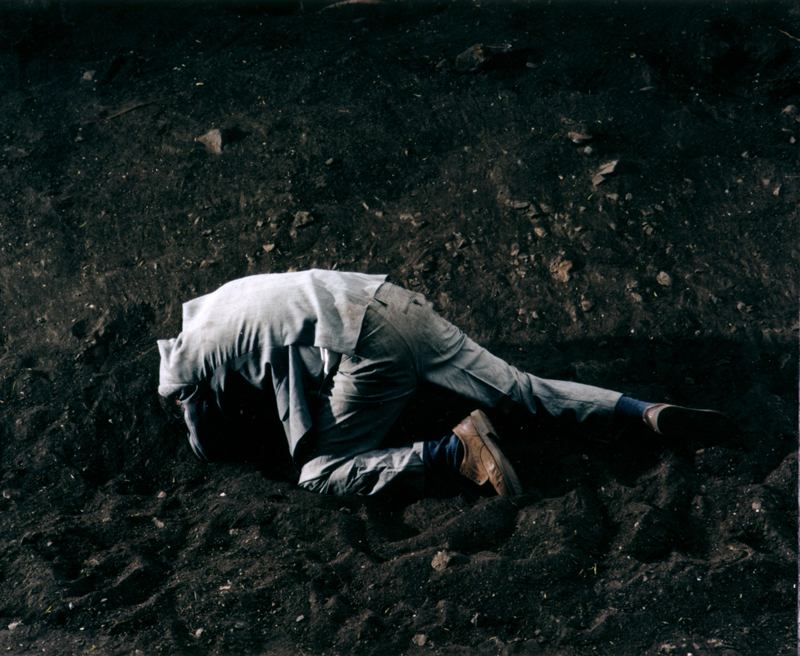 Simon Obarzanek, Untitled Movement No 2 #8, 2010, C-Type hand print
In this essay Natalie King describes the directed performance aspect of the staged photographs that highlight the theatricality of action. The set was purpose-built outside and then the studio lighting was mixed with the daylight.
April 26, 2010
Melissa Fleming: night seascapes
This post picks up on Megan Raven's post at her Salon du Schadenfreude on the work of photoartist Melissa Fleming. Megan was attracted by Fleming's intriguing Under the Glass series.
My interest lies with Fleming's recent Sentient series of night seascapes in which the horizon line between sky and sea is blurred so that become one:
 Melissa Fleming, sentient iv, from the Sentient series
Fleming is a New York based photographer/artist--ie., an interdisciplinary artist who does photo-based installations and sculptural work.
Fleming describes her Sentient series thus:
Although the ocean is physically the same at night as it is in the day, our perception of it changes in the dark. Unable to see the water at night, we feel uncertain of our surroundings. Even photography, a medium of light, captured only the white crash of waves, the lone visible sign of the water in the darkness. The white seemed sentient and in a sense was the mark by which we could know the ocean at night.
The reason this series caught my eye is my interest in exploring seascapes down at Victor Harbor with a large format camera. I've done a few initial sketches/explorations on smaller cameras to see how things look:
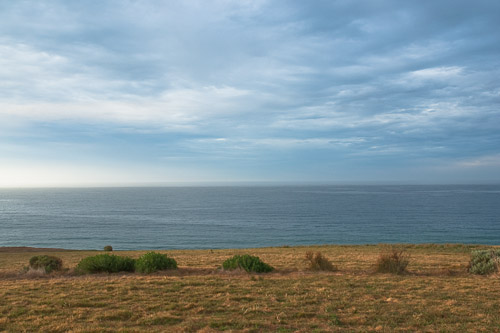 Gary Sauer-Thompson, seascape, Victor Harbor, 2010
As a result I've pulled my very old 8x10 Cambo monorail out the cupboard that I found lying in a box in a suburban photography shop a decade or so ago, ordered a new standard bellows from Custom Bellows in the UK, and bought some black and white film.
I plan to stand on the cliff tops and take seascape images in the low light--ie., early in the morning around dawn---for the atmospherics and the wind factor.There s little wind to move the bulky 8x10 at that time of the morning.
April 25, 2010
more rubbish
Our bright and shiny consumer society (we are what we wear) is a throwaway society. On the one hand, there is an ethos of abundance and over-consumption; on the other the rubbish is everywhere. It is a trash culture in more ways than one. Corporations are still indifferent to the ecological impact of their waste.
Though the direct environmental damage it causes--eg., plastic bags polluting waterways, harming wildlife--is decried, we are still throwing more of it away in spite of the turn to recycling. Just think of all the junked computers, televisions, washing machines, fridges, cookers and various electronic gadgets.
 Gary Sauer-Thompson, rubbish, Victor Harbor, 2010
We are recycling more, but we're also throwing away more. Landfill and incineration are still favoured over recycling and reuse. The reason is cost: landfill is by far the cheapest option, while recycling, especially of complex materials such as plastics and electronics, can be prohibitively expensive. It remains cheaper to bury or burn our waste than to recycle it.
It appears that we have become hooked on convenience, disposability, fashion, and constant technological change-the rise of mass consumption has led to waste on a previously unimaginable scale.
In Garbage and Recycling: From Literary Theme to Mode of Production in Other Voices (May 2007) Walter Moser says that garbage as:
an object always represents the intrusion of the past of a system into its present. It reminds us of a past state of things, pleasantly or unpleasantly. The garbage object is always endowed with pastness and thus becomes a vehicle or a trace of the past. Garbage therefore often supports the dialectic and drama of remembering and forgetting.
Jacques Derrida argued that a "deconstructive understanding of history" might be accomplished through the critic's work of returning to the repressed, rejected and expelled elements of historical memory and re-cycling these voices, genres, and histories.
Is this return to the repressed a return to tan economy of excess, overflow and unreason?
April 23, 2010
producing a book
I've started work on selecting and post processing the images from the Tasmanian shoot early this year for a course run by Atkins Technicolour in Adelaide that teaches me the basics in producing a digital photography book. It's a dummy run in self-publishing to see what is involved in producing an artist's print book, as distinct from a fine art photographer's print book. The digital future is already here and the publishers are no longer the gatekeeper.
 Gary Sauer-Thompson, lake, Tunbridge, Tasmania, 2010
The course requires 50 images ---which is too many for my purposes. I suspect the commercial basis of course is for people to produce a book of their weddings or holiday trip. I see a disruptive technology at work that changes the relationship between author and reader plus the virtues of the e-book.
My immediate purpose is to use the digital book as the basis for a submission for an exhibition at Landscape Art Research Queenstown [LARQ], which is a non-profit studio/gallery in 2006 set up by Raymond Arnold, a Tasmanian based Australian artist/printmaker.
Beyond that I have a digital book in draft form--an e-book--- since, as an author, I am producing the original work in digital form to begin with. So I can continue to work on and experiment with the digital form --eg., with hyperlinks---since this is writing/imaging for the web.
On a broader perspective the Google Book project, along with rapid developments in e-readers, has ensured that the book, as a digital file, will remain at the heart of our culture for the foreseeable future. Enhanced editions' and single-book apps where the author provides a wealth of extra digital material that is embedded in the text, from audio recordings of the author reading to music composed by the author, are already beginning to appear. This is pushing into new territory that takes a more interactive turn than books have allowed.
What is going to go is the dregs of the publishing world: disposable books produced to be consumed once and then tossed. With the iPad we have a platform for consuming rich-content in digital form and we are going to see new forms of story telling emerging from this device.
April 22, 2010
a personal note
I've driven down to the weekender at Victor Harbor for the Anzac weekend early so that I can continue with the never ending painting. This time it is to finish painting the balcony railings and the fascia boards which require several coats to protect them from the salty air.
The afternoon was spent picking up the film shots from Tasmania and asking the very helpful people at the Total Photographics shop in Adelaide to help me figure out what happened to the 5x4 shots done on transparencies in Tasmania with an antiquated Linhof 4x5Techika 111. I'm not happy with the results as both sides of the image are darker than the centre. I suspect that I have light leak in the bellows due to mostly due to age and care.
 Gary Sauer-Thompson, Ari, near Petrel Cove, 2010
I just managed to get down to the coast in time to walk the dogs along the clifftops and take a few snaps of people having a relaxing time in the unseasonal warm weather--- it's an unseasonably hot April. This afternoon was very still.
Currently I'm listening to an audience tape of a lackluster Grateful Dead concert --Live at Manor Downs on 1985-08-31. I hope things pick up in the second set--the musical spark happens on the longer pieces.
Whilst listening to the music I'm reconnecting with the digital photos I shot the last time I was down here, working my way through the Tasmanian photos for a portfolio to submit for an exhibition and drinking a glass of New Zealand sauvignon blanc.
The music is finally beginning to fire up on the Drums/Space section of the concert. The 5x4 transparencies from the Tasmanian shoot are proving to be bloody hard to correct in Lightroom. So I've being uploading, and looking at, the film images shot with a Leica and Rolleiflex from the Tasmanian shoot. The Melbourne beach hut series looks okay, but I have to begin sorting the images for the photography book course in a few weeks.
Update
The painting continues slowly between showers and visitors.
My 4x5 Linhof Technika 111 was introduced in 1946 and discontinued in 1956. Since the 5x4 field camera is devoid of the technological makeover and ignored by computerized takeover, the modern versions are very much like what the camera was a 60 years ago. Each of the newer model adds some movements and features that are useful.
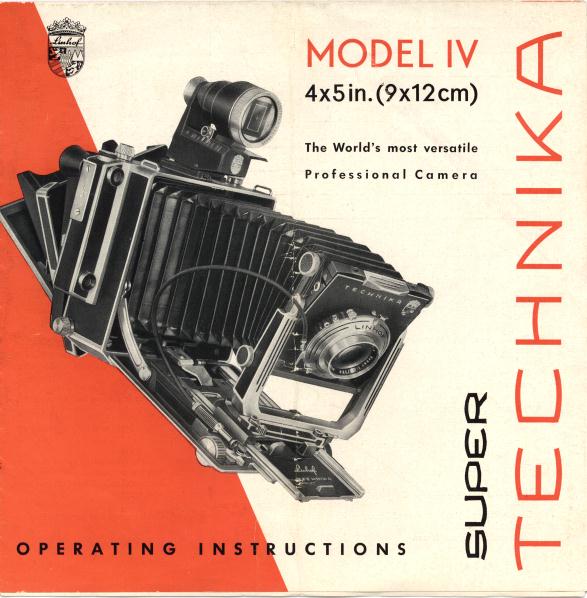
These cameras are about fine craftsmanship, extreme precision, sturdiness, and solidity, and as they are not obsoleted by the next model in two years or less and so are not trash. But the Linhof is just overpriced.
I do have a light leak in the bellows of the Linhof 5x4--a pinhole one that has formed in the fabric bellows. So now I need to cover the pinhole. Or have a new bellows made because more pinholes will appear. Dam.
April 21, 2010
junk
I'm taking photos of urban waste --- the emptied out, the used up, the broken, the outgrown, the obsolete; the dispossessed, the lost, the left behind, the rubbish, the mass produced throwaway. Our commodity culture is now a throwaway world and, if the remnant embodies a mode of ‘critical memory’ as Walter Benjamin claimed, then we have an aesthetics of decay.
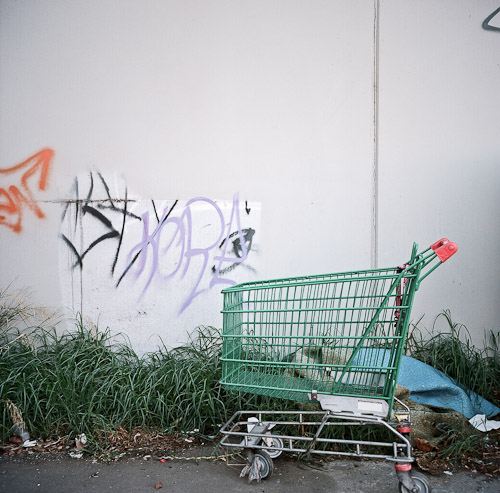 Gary Sauer-Thompson, trolley+ rubbish, Port Adelaide, 2009
Trash is especially evident with old technology. Not many of us would bother to repair a seriously malfunctioning television these days. If it was under warranty, we would return it; if not, it’s probably trash like old computers. Yet there was a time when television sets were taken to a shop to be repaired.
A shift in our technological economy that favors replacement over repair explains some part of technological trash. It is now trash because changes in everything to which it must connect have made it unusable, especially with the shift from analogue to digital television.They become unusable.
Same with digital cameras. Mechanical analogue cameras continue to be repaired. Digital cameras, like mobile phones are, become throwaways.They don't need to be malfunctioning, failed or burnt-out. They are obsolete.
Trash belongs with garbage, junk, rubbish, refuse, debris, and waste. ‘Trash’ refers to the inorganic (thus distinct from ‘garbage’) and the useless (thus different from ‘junk’) which is unwanted but usable) residue of global capitalism. It becomes trash the moment a person can no longer use it. What are you supposed to do with the paper cup your french fries come in after you have eaten?
Take it home and photograph it in the studio with an expensive Rolleiflex SLR camera and film?
April 20, 2010
iPad + puss
Simon Hackett points out that Microsoft have missed the boat in terms of becoming a vertically integrated 'computing experience' provider. He says that Apple:
have created (and with the iPad, are continuing to broaden) an integrated line of hardware and software into a consistent form of user experience that leverages deep integration between software and hardware to create something larger than the sum of its parts. That ecosystem (hardware, software, application delivery platform, content delivery platform) is so seamlessly tied together that the places where the pieces interconnect are almost invisible.
That is why I shifted to Apple---to a MacBook laptop and an iMac desktop ----and dumped Microsoft. They could not develop an integrated ecosystem. All my Microsoft gear has been shifted down to the weekender.
The shift from using the stylus on my old Windows based PDA to Apple's touch screen is a quantum leap. There is no going back. The iPad is not on sale in Australia yet, though a few have managed to get some when they were in the US.
Though dismissed as a fashion accessory by some, it is clear that the iPad is going to shake up the publishing industry. Magazines that cost $12 each will now cost $15-20 a year; coffee table books will cost $20 and books $10. It won't take the iPad long to pay for itself.
Nicholas Nixon: The Brown sisters
Nicholas Nixon's early work was part of the New Topographics in 1976. He moved on to do more portrait orientated work--eg., The Brown Sisters and people suffering from aids and in nursing homes.
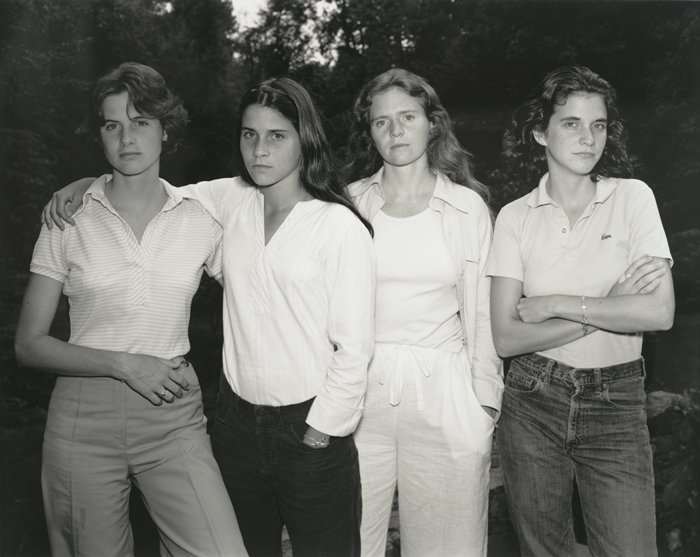 Nicholas Nixon, The Brown Sisters, 1975, Gelatin silver print
Beginning in 1975, Nixon has annually photographed his wife Bebe with her three sisters, creating a notable black and white series called "The Brown Sisters". These photographs depict the clear and inevitable passage of time on the beautiful faces of Heather, Mimi, Bebe, and Lauren as they mature from teenagers to adults.
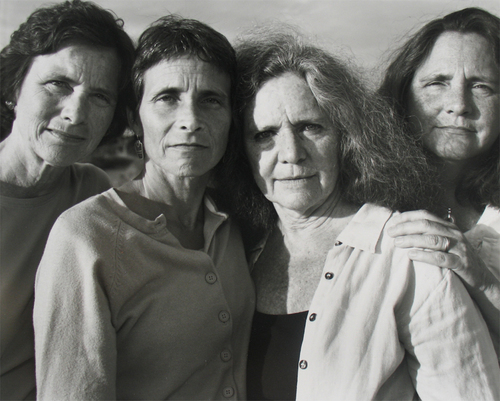 Nicholas Nixon, The Brown Sisters, 2007, Gelatin silver print
The sisters always line up in the same order, and primarily look directly at the camera, reflecting the presence of Nicholas himself, looking back.
April 17, 2010
the big plunge
I've taken the big plunge.
I've bought a 27 inch iMac (2.8GHz Intel Core i5) an Epson v700 flatbed film scanner, ordered a custom built bellows for my old monorail Cambo 8 x 10 which I plan to to use in the field for landscapes, bought a packet of 8x10 black and white Ilford film, enrolled in a course to learn how to produce photographic books, and joined the queue for the next Lecia M9 digital rangefinder with a 35mm Summicron lens that is shipped to Adelaide from the Leica dealers in Australia.
The big plunge-- this kind of financial investment with limited income--- means a transition from being an amateur to a professional photographer. This means that photography is the centre of my life, with everything else structured around it.
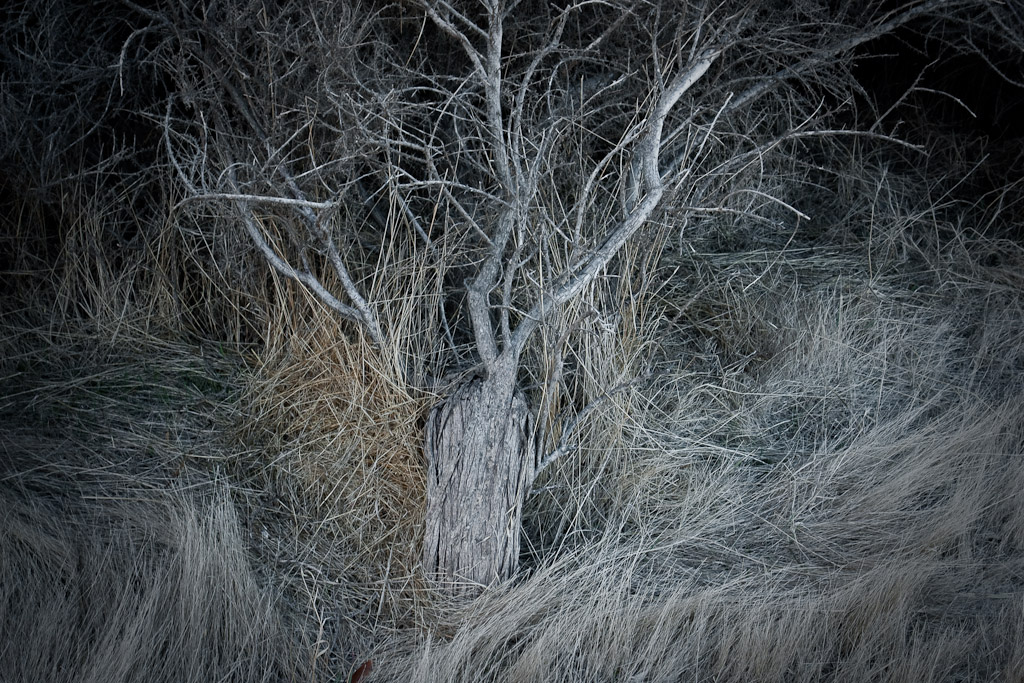 Gary Sauer-Thompson, drought, Victor Harbor, 2010
I've (h)ummed and (h)arrd about making this kind of financial investment for most of the year. Will I or wont I? Should I? Do I really need to do it? Shouldn't I put the money in stock and shares rather than even more camera gear and a new desktop computer. The former opens up possibilities to make some money, the latter will keep me poor.
Alas, a good computer, post processing, quality software, and excellent backup equipment is a necessary part of my photographic workflow these days, given my intense dislike of chemicals and the darkroom. Is the next stop Photoshop? Now that would be a very step learning curve indeed, for someone like me.
April 14, 2010
breaking with the art tradition
The fear is that art criticism be merely promotional writing, the art critic just a servant of the art market, and that art criticism is more than mere journalist reporting. Art criticism should make a difference.One example is Clement Greenberg, who following the politically conservative Eliot, argued that radically original painting built upon, without breaking with, tradition.
Greenberg claimed that the Abstract Expressionists grew out of modernist tradition; the coloured field painters were the natural heirs of the Abstract expressionists. Art is continuity for Greenberg and so he argued that the history of modernist painting is inaugurated by Manet's preserving-and-breaking-with old master tradition.
Though Pollock's paintings look very different from cubist works, in Greenberg's historical narrative they deal with essentially the same concerns:
The painter's first task had been to hollow out an illusion of three-dimensional space on a flat surface... . Modernism has rendered this stage shallower and shallower until now its backdrop has become the same as its curtain.
Beneath its apparent changes painting has an unchanging essence.Certain things, like art itself, or painting or sculpture, or the masterpiece, are universal, transhistorical forms.
Was there not a serious break or rupture in the 1960s? The name for the historical rupture is postmodernism. It is a rupture because the nature of art changes--eg., Warhol's Brillo Box. Claes Oldenberg's ray guns, Robert Morris's felt, and Ed Ruscha's photographs of city lots have become precious artifacts displayed in well-guarded museums.
Secondly, it is a rupture because the conventions defining art change with the times eg., through questioning the assumptions of modernism: the idea of art as self-expression, which lies behind biographical explanations; the belief in the unique artwork; the belief that an artist develops in a continuous way; and that painting has an unchanging essence amidst the constant flux.
That kind of questioning is the task of philosophy, or more accurately aesthetics.
April 12, 2010
working in a series: mise-en-abyme
I've become tired of just wandering the streets of the CBD taking photos of whatever catches my eye with a digital camera. My problem is the sheer amount of images I'm producing. Even as a pretty low-volume photographer I am still producing seemingly hundreds of images.
I am finding the massive numbers really alarming, since many of the photographs just sit on the hard disc untouched. All they get is a quick look. What's the point of taking them? What was the idea behind the photo? I have no idea. They seemed like a good idea at the time:
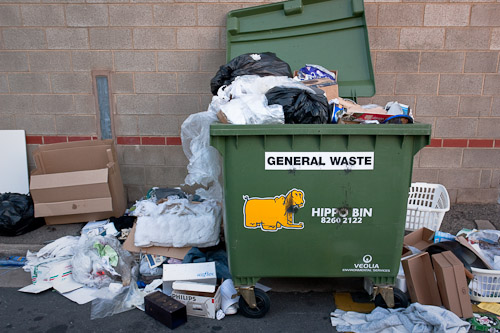 Gary Sauer-Thompson, Xmas rubbish, Adelaide 2010
But the isolated images don't add up to anything nor do they link to other images. So I've decided to work in and to a series so as to allow me to have some sense of purpose and direction and to slow down the rate of images. A series encourages a shift to a slower and more meditative photography.
So what kind of series for my urban photography? Well, it is not the experience of shock that is located in the expansion of the laws of the exchange of commodities to all aspects of metropolitan life. This characteristic of urban experience forms the background to our urban experience as is the 'upheavals of the market economy' or the experience of the destruction of older forms of communal and urban life by the market economy.
The only conceptual idea that I have is Mise-en-abyme, which I mentioned in this post, but it has not really come to much. The results so far are disappointing. It is reflection, self-reflection and mirrors rather than a formal technique in which an image contains a smaller copy of itself, the sequence appearing to recur infinitely.
I cannot seem to visually grasp the idea of the reduplication of images or concepts referring to the textual whole; or the play of signifiers within a text, of sub-texts mirroring each other; or the mirroring getting to the point where meaning can be rendered unstable.I get the general idea of language never quite reaching the foundation of reality because it refers in a frame-within-a-frame way to other language, which, in turn, refers to other language. This is the intertextual nature of language that emphasises that all texts are related to other texts and so leads to an an abyss of meaning.
I just cannot seem to hold this when I'm wandering the streets with a small camera. What I do hold onto is a 'self-referentially' of the photographer and an image that openly displays the codes of its construction.
April 11, 2010
White Stripes: Forever For Her (Is Over For Me)
Forever For Her (Is Over For Me) is from The White Stripes 2005 Get Behind Me Satan album. It marked marked a distinct musical change from the guitar-heavy 2003 predecessor, Elephant.
The instrumentation has generally shifted away from garage rock fuzz to an accessible set of songs within a conceptual art project. What that is I'm not really sure for this is a pretty strange album with its childhood narratives, Cole Porter allusions, white tees and Santa pants mixed up with garage-punk orthodoxy and the iconography of 50s-era B-movies and trashy pulp paperbacks.
April 9, 2010
the photographic inscription of contingency
Siegfried Kracauer in his essay Photography in his The Mass Ornament: Weimar Essays highlights the contingency of modernity whose dominance becomes most evident in photography.
He explores the prevailing conceptions of photography's relationship to instantaneity and to the photographic image as the record of a brief and transitory moment in time---what he calls the flow of life. The characteristics of photography are 'record and reveal physical reality', to lay stress on ' fragments rather than wholes', and its inevitable incompleteness.
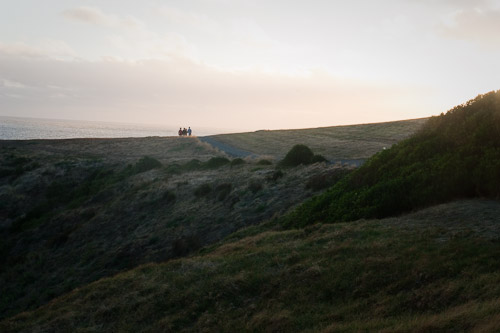 Gary Sauer-Thompson, Petrel Cove, Victor Harbor, 2010
Kracauer's argument is that in eschewing significance--- the fullness of a life lived in its proper history--- in favor of an adherence to a spatial or temporal continuum, photography attains "a mere surface coherence" . Its telos becomes that of sheer accumulation, coverage, the saturation of detail devoid of the coherent meaning associated with history itself. Photography simply captures a moment, a specific configuration in time and space which lacks necessity. The photograph can only offer a trace of what has been.
Kracauer sees the photographic inscription of contingency as the "go for broke game" of history. Photography provokes a confrontation with the meaninglessness of contemporary society; it is a "secretion of the capitalist mode of production." just as capitalism is haunted by the logic of its own self-destruction, photography is capable of flaunting the logic of a world deprived of meaning and thereby instigating a new organization of knowledge.
April 8, 2010
allegory
Craig Owen in The Allegorical Impulse: Toward a Theory of Postmodernism Part 2 in October (Vol. 13. Summer, 1980 pp. 58-80) says that:
In postmodernist art, nature is treated as wholly domesticated by culture; the "natural" can be approached only through its cultural representation. While this does indeed suggest a shift from nature to culture, what it in fact demonstrates is the impossibility of accepting their opposition. This is the point of a recent allegorical project by Sherrie Levine, who has selected, mounted, and framed Andreas Feininger's photographs of natural subjects. When Levine wants an image of nature, she does not produce one herself but appropriates another image, and this she does in order to expose the degree to which "nature" is always already implicated in a system of cultural values which assigns it a specific, culturally determined position. In this way she reinflects Duchamp's readymade strategy, utilizing it as an unsettling deconstructive instrument.
This links to an allegory, whose traditional terms are a fragment, a quotation, and the,meaning it engenders is supplementary, excessive, "parodic and disseminatory." It exposes the literal level of the image to be a fiction.
My own work does not approach this level of visual sophistication. I wish that it did.
April 7, 2010
photographic allegories
I kinda like the idea of artists who generate images through the reproduction of other images. The appropriated image may be a film still, a photograph, a drawing; it is often itself already a reproduction. Often I appropriate other photographs in shop windows or advertisements.
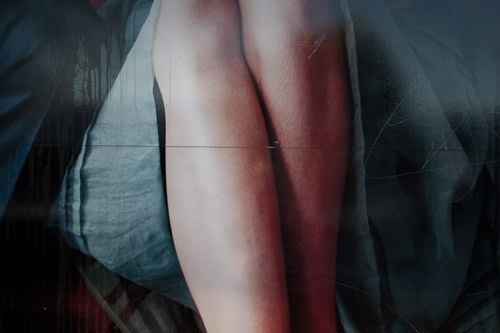
Allegory, for me is consistently attracted to the fragmentary, the imperfect, the incomplete---an affinity which finds its most comprehensive expression in the ruin. As an allegorical art photography would represent our desire to fix the transitory, the ephemeral, in a stable and stabilizing image.
In an allegorical structure one text or image is read through another, however fragmentary, intermittent, or chaotic their relationship may be----the paradigm for the allegorical work is the palimpsest.
Craig Owens in The Allegorical Impulse: Toward a Theory of Postmodernism in October, Vol. 12. (Spring, 1980), pp. 67-86 says:
Allegorical imagery is appropriated imagery; the allegorist does not invent images but confiscates them. He lays claim to the culturally significant, poses as its interpreter. And in his hands the image becomes something other (allos= other + agoreuei =to speak). He does not restore an original meaning that may have been lost or obscured; allegory is not hermeneutics. Rather, he adds another meaning to the image. If he adds, however, he does so only to replace: the allegorical meaning supplants an antecedent one; it is a supplement. This is why allegory is condemned, but it is also the source of its theoretical significance.
Owens connects allegory to appropriation, site specificity, impermanence, accumulation, discursivity, hybridization, and says that these diverse strategies characterize much of the art of the present and distinguish it from its modernist predecessors. They also form a whole when seen in relation to allegory, suggesting that postmodernist art may in fact be identified by a single, coherent impulse, and that criticism will remain incapable of accounting for that impulse as long as it continues to think of allegory as aesthetic error.
April 6, 2010
Hong Kong rooftops
Portraits from above Hong Kong's informal rooftop communities is a text by by Rufina Wu + Stefan Canham that explores the rooftop communities on five buildings located in older districts in the Kowloon Peninsula that are slated for redevelopment by the Urban Renewal Authority of Hong Kong. Canham's previous project was Bauwagen: Mobile Squatters.
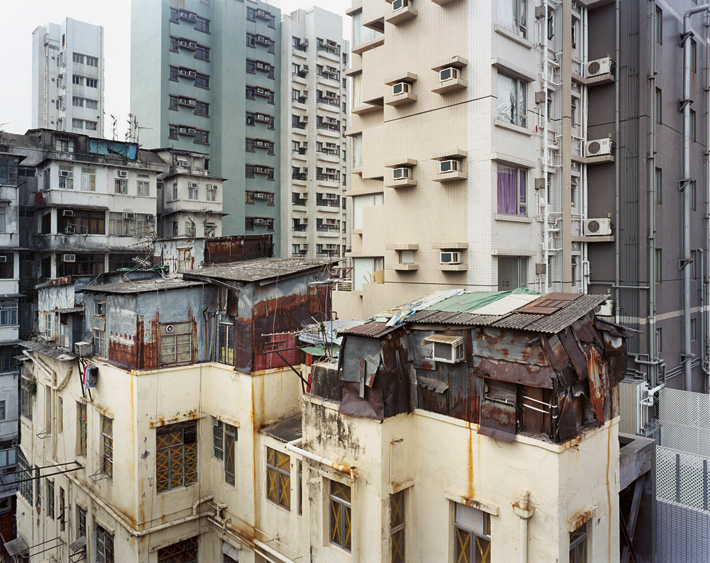 Stefan Canham + Rufina Wu, rooftops, Hong Kong, 2010
They say that the rise of rooftop communities is closely linked to the migration history from Chinese Mainland to Hong Kong. With each of China’s tumultuous political movements in the 20th century, like the Great Leap Forward and the Cultural Revolution, there was a corresponding wave of Mainland Chinese migrating to Hong Kong. These successive population influxes into a city notoriously short of flat land resulted in severe housing shortages and ultimately fostered the emergence of informal settlements. Flat roofs became attractive construction sites in the context of Hong Kong’s mountainous terrain and subtropical climate.
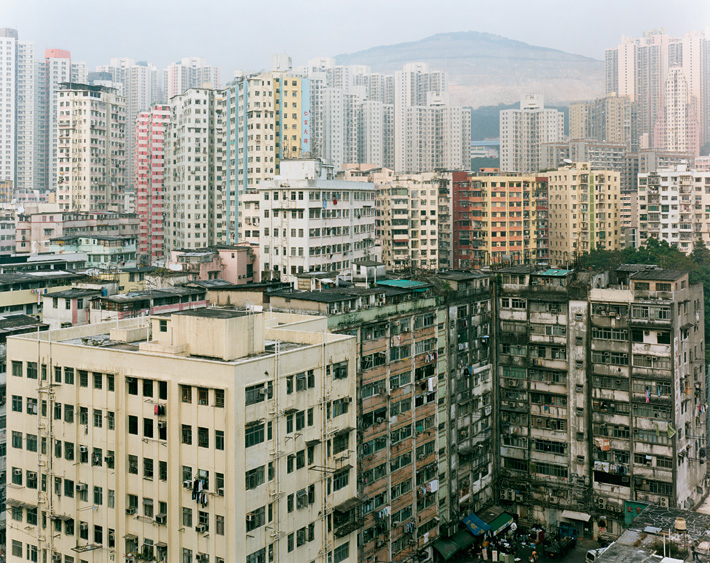 Stefan Canham + Rufina Wu, Hong Kong
Currently there is a seven-year residency requirement before one can claim eligibility for public housing and other social welfare. In effect, this stringent requirement denies migrants access to public housing. Those who cannot afford accommodations in the private sector but are also ineligible for public housing are left with very limited choices. The majority of current rooftop residents are Chinese immigrants—54,000 arrive in Hong Kong annually—although people from other parts of Asia and the Middle East are similarly enticed by Hong Kong's employment opportunities, higher wages, education, and health care.
Rooftop housing enables the underprivileged to live in the city by providing affordable housing where it is needed: in central urban areas, in the vicinity of employment opportunities, and in areas with well-established social networks.
April 4, 2010
Wynn Bullock
A.D. Coleman in The Photographs of Wynn Bullock written for an exhibition at the See Galley observes that the American version of modernist photography (he means the f64 group) had strict rules regarding photographic practice. It rejected all experimental darkroom procedures for film development and subsequent printmaking; for them, even such purely photographic techniques as photomontage and solarization were anathema.
He adds that:
Bullock, by contrast, had absorbed from Moholy-Nagy and Man Ray (and perhaps from his mentor Kaminsky) a more open-ended, European version of photographic modernism. He accepted photomontage, solarization, the photogram, light drawing, the negative print, the blur resulting from long time exposure, and even the creation of a synthetic negative for the production of prints as legitimate methods, seeing each as part of the medium's inherent and distinctive assortment of tools, materials, and processes. His ability to reconcile both these approaches to photographic praxis, the European and American versions of modernism, has few parallels in the field. The consequent breadth of his investigation of the medium makes him one of the most experimental photographers working in the U.S. in his time.
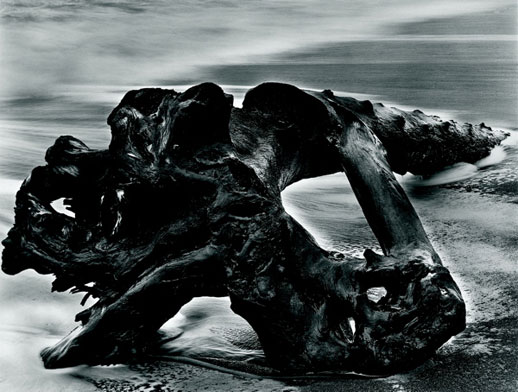 Wynn Bullock, Driftwood Tree Trunk, 1951
This is part of the elegant, romantic fine print tradition of the US landscape photography. It was taken on a 10 x 8 camera with a long exposure, and the dark contorted highlights of the smooth wet driftwood contrast heavily with the blurred waves in the background. The wood is rendered more like solidified lava.
 Wynn Bullock, half an apple.
I much prefer these kind of studio shots to all the passive female nudes in nature that he did and is well known for.
Paul Graham on artist photographers
Paul Graham, is a British photographer known for combining colour documentary and artistic aspects of photography and he has his roots in the work of Walker Evans, Robert Adams, William Eggleston, Stephen Shore, or Diane Arbus rather than the artists using photography tradition of Andreas Gursky, Rineke Djikstra, Thomas Struth Wall, Gregory Crewdson and Thomas Demand.
 Paul Graham, Troubled Land (1984-86)
He takes aim at the rhetoric of the latter in The Unreasonable Apple, where he states:
a sizeable part of the art world that simply does not get photography. They get artists who use photography to illustrate their ideas, installations, performances and concepts, who deploy the medium as one of a range of artistic strategies to complete their work. But photography for and of itself -photographs taken from the world as it is– are misunderstood as a collection of random observations and lucky moments, or muddled up with photojournalism, or tarred with a semi-derogatory ‘documentary’ tag.
He is not advocating a return to the photographic fundamentalism of Magnum style Leica reportage 35mm black & white work since we are clearly in a Post Documentary photographic world now. Nor does he reject the work of Cindy Sherman and Jeff Wall and Thomas Demand as he has zero problems with it. It is emphatically not an either/or situation.
Nor is the art world versus the photography world, because it is not apples or potatoes, anymore than it is sculpture or painting. Graham is taking aim at the narrowness and blindness of the art institution which affirms the artist photographer at the expense of the topographical one:
It means their work will almost never be considered for Documenta, or placed alongside other artists in a Biennale, or found for sale in major contemporary art galleries and art fairs. This does not just deprive the public of the work, and the work of its place, it denies these artists the self-confidence that enables them to grow, to feel appreciation and affirmation, not to mention some modest financial reward allowing them to continue to work. It is also, most importantly, seeing the world of visual art in narrow terms. It is seeing the apple as unreasonable.
April 2, 2010
NZ Photography: Mary McPherson
I have a copy of David Eggleston's Into the Light: A history of NZ Photography, which I bought when last in NZ. It's narrative is a traditional one as it is based on selecting the best photographers made by camera artists who are masters [sic] of the medium and who have established their own style and content.
The last chapter of the book is called "Seductive Puzzles The Age of Ambiguity", and it refers to the 1980s when new image makers in New Zealand challenged the conventions of traditional photography. Eggleston says:
These conceptual photographers used such strategies as parody, appropriation, and minimalism to expose photography's ambiguous, even contradictory meanings. By doing so they hoped to to discover new ways of looking at old familiar things.
One photographer mentioned is the Wellington based Mary McPherson.
McPherson is a poet as well as a photographer and has published two book of book of poems: The Inland Eye was published by Pemmican Press in 1998 and Millionaire’s Shortbread, University of Otago Press 2003 (joint collection).
Her 1992 Wild series photographed flyaway rubbish caught in undergrowth sounds intriguing, but I can find no images online for this series. Some of her 17 Days of Shopping (1998) is one line due to it being published in Sport (no 25, 2000), a literary periodical. It is a series of close photographs of the food and groceries bought over 17 days --- pictures of what comes home in the supermarket and takeout bags.
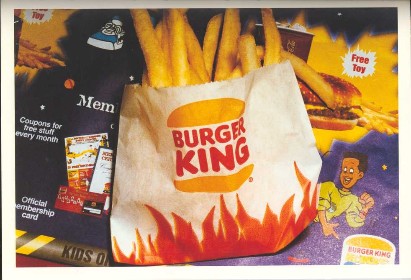 Mary McPherson, Burger King, from 17 days Shopping
The full 17 Days of Shopping work consists of 95 photographs and emphasises the procession of goods that flow in and out of her households lives. She says of this work:
As I worked I remembered how New Zealand was once a place of vegetable gardens and home baking, when takeouts or restaurant meals were special events. Now what's important is to have the money to buy groceries and food from the supermarket. Increasingly, the food is processed and packaged so we can heat and eat. Purchases are guided by brands, especially the pictures, text and design on packages. Curiously, these images often refer back to rural scenes, flowers or freshness as a guide for purchasing.
A recent series is Plant Life
April 1, 2010
photography: denotation and connotation
Roland Barthes's short book Camera Lucida: Reflections on Photography is one of the most influential books about the photographic experience.The concepts introduced by Barthes, such as studium and punctum have become part of the standard vocabulary of photographic debate, whilst his understanding of photographic time and photography's relationship to death and a certain narcissistic way of speaking have become very influential.
 Gary Sauer-Thompson, blue rock, Victor Harbor, 2010
In his earlier writings on photography, such as The Photographic Message, Barthes had argued that the photographic image was a message without a code. By this he meant that a photograph appears to have no form of its own; we automatically look through the surface of a photograph to see what it is of.
Other types of images, such as drawings or the cinema combine a denoted message (its analogical content, the thing the drawing depicts) and a connoted message (its style of representation plus the manner in the society communicates what it thinks of it, or symbolic meanings).
In a photograph Barthes argues the two qualities --denotation and connotation--- are inseparable; the photograph appears as the being exclusively constituted by a denoted message, thereby making the photograph both natural and cultural.
Though Barthes is primarily concerned with press photography or photojournalism he ignores the way that he photographer constructs the context and image to which their photograph represents.