|
April 12, 2010
I've become tired of just wandering the streets of the CBD taking photos of whatever catches my eye with a digital camera. My problem is the sheer amount of images I'm producing. Even as a pretty low-volume photographer I am still producing seemingly hundreds of images.
I am finding the massive numbers really alarming, since many of the photographs just sit on the hard disc untouched. All they get is a quick look. What's the point of taking them? What was the idea behind the photo? I have no idea. They seemed like a good idea at the time:
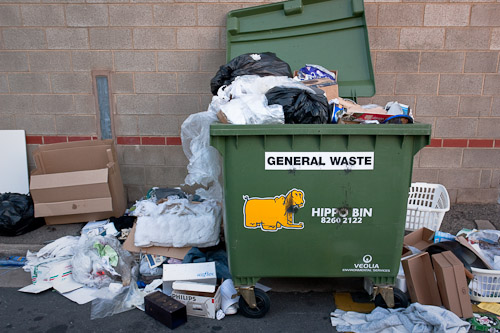 Gary Sauer-Thompson, Xmas rubbish, Adelaide 2010
But the isolated images don't add up to anything nor do they link to other images. So I've decided to work in and to a series so as to allow me to have some sense of purpose and direction and to slow down the rate of images. A series encourages a shift to a slower and more meditative photography.
So what kind of series for my urban photography? Well, it is not the experience of shock that is located in the expansion of the laws of the exchange of commodities to all aspects of metropolitan life. This characteristic of urban experience forms the background to our urban experience as is the 'upheavals of the market economy' or the experience of the destruction of older forms of communal and urban life by the market economy.
The only conceptual idea that I have is Mise-en-abyme, which I mentioned in this post, but it has not really come to much. The results so far are disappointing. It is reflection, self-reflection and mirrors rather than a formal technique in which an image contains a smaller copy of itself, the sequence appearing to recur infinitely.
I cannot seem to visually grasp the idea of the reduplication of images or concepts referring to the textual whole; or the play of signifiers within a text, of sub-texts mirroring each other; or the mirroring getting to the point where meaning can be rendered unstable.I get the general idea of language never quite reaching the foundation of reality because it refers in a frame-within-a-frame way to other language, which, in turn, refers to other language. This is the intertextual nature of language that emphasises that all texts are related to other texts and so leads to an an abyss of meaning.
I just cannot seem to hold this when I'm wandering the streets with a small camera. What I do hold onto is a 'self-referentially' of the photographer and an image that openly displays the codes of its construction.
|


The notion of intertextuality heralds a break with the traditional modernist supposition: that all images could be analysed as closed systems. Homage, pastiche and parody are all reflexive intertextual strategies, differing only in the reverence they show toward other texts.
We also have the notion of kitsch, or culture as waste. It is what has been excluded.