July 30, 2011
using images on the internet
Blake Edwards has an interesting post about the unauthorized use of images on the internet: ie., copyright infringement. The image below of mine, which was published in my Flickr stream, has a life of its own on Tumblr blogs, but they weren't commercially profiting from the reposting. It highlighted to me how much the internet is a network of circulating images.

Gary Sauer-Thompson Struthers Lane, Christchurch, New Zealand
At a recent discussion on blogs and websites hosted by Atkin's Technicolour a number of commercial photographers matter of factually said that they watermark all their public photos. Their desire was to manage use of their images online, as these images were what they depended on for their income.
The conversation was one sided, however, because Fair use in the public domain ----that is, the limited use of copyrighted material without acquiring permission from the rights holders (eg., commentary, criticism, news reporting, research, teaching, library archiving and scholarship), was not even mentioned. There was no consideration of images in the public domain helping to stimulate creativity for the enrichment of the general public. Photography was a commercial enterprise.
Amy Stein says that Blake's call to the blogosphere to help remove all unauthorized uses of the photograph in question, does seem a bit like spitting into the social wind, adding:
Don't get me wrong, I fully support the proper attribution of images and have done so on my blog since day one. In the age of Google Image Search, there is absolutely no excuse for not crediting an artist. But, I'm also a realist and long ago I fully embraced the idea that my images will travel and that's not necessarily a bad thing. In fact, it's mostly a very good thing. If someone is moved to share my work or inspired to use it to create something new, that's kind of cool. I know the free flow of my images has certainly helped my career and I often tell my students to swim with the current and make their work as shareable as possible.
Like Stein, I am happy with fair use but I'm strong on the proper attribution of the work when it is reposted or reused online.
July 28, 2011
Landscape Stories: The Lure of the Sea
This link to Landscape Stories is courtesy of the always excellent Mrs-Deane. It is an online photography magazine, four editions old, with each issue of the magazine having its own theme. It is an independent and free publication, based in Italy.
One issue that I found interesting was 01/2010 --The Lure of the Sea because of my landscape work in and around Victor Habor. There was no Australian work in the issue.
One body of work that appealed was Jonathan Smith's ongoing East/West project, which explores the diversity of the coastlines of the east and the west of the USA:
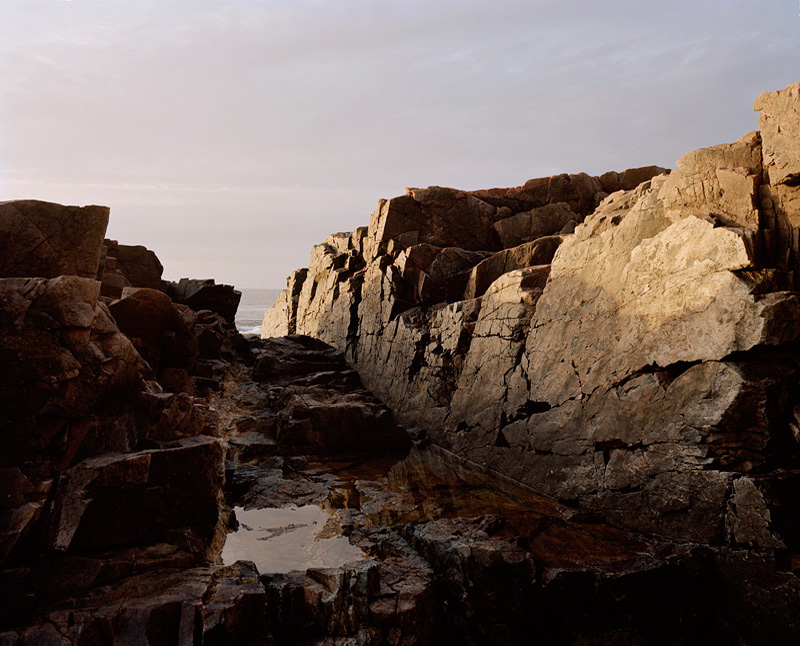 Jonathan Smith, untitled, from East/West
It's the relationship between the rocks and the sea that attracted my interest.
July 27, 2011
The Bechers + photographic grammar
The career of Bernd and Hilla Becher has been almost exclusively a function of the international art market and art publishing industry and the German art education system are best known for their extensive series of photographic images, or typologies, of industrial buildings and structures, such as blast furnaces, cooling towers, gasometers, water towers, lime kilns, compressors, factory halls, head-frames of mine shafts.
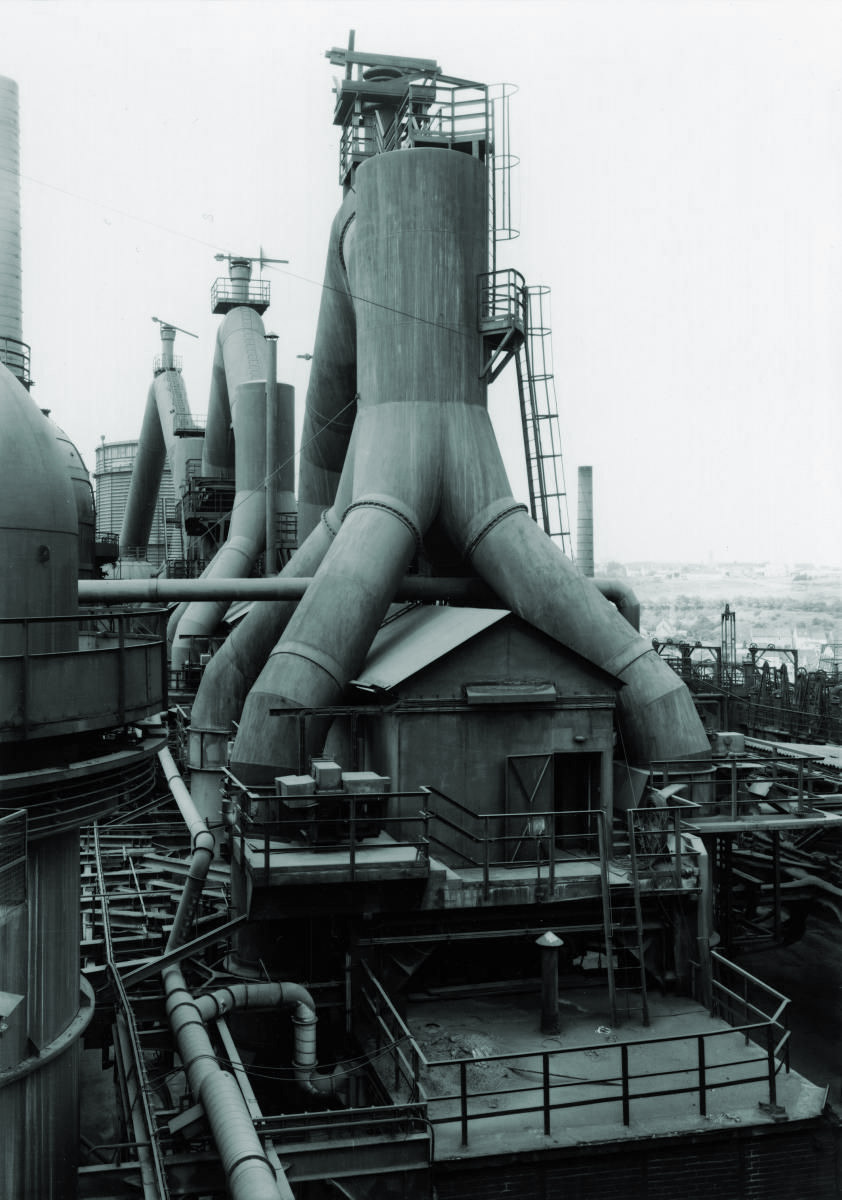 Bernd and Hilla Becher, Blast Furnace Volklingen, Saar, Germany, 1986
Their images transform these old industrial buildings into objects worthy of interest, in the character implicit in a façade. Their work, which was a return to the pre-war New Objectivity of Karl Blossfeldt, Albert Renger-Patzsch, and, August Sander, was a challenge to the expressive subjectivism of Robert Frank.
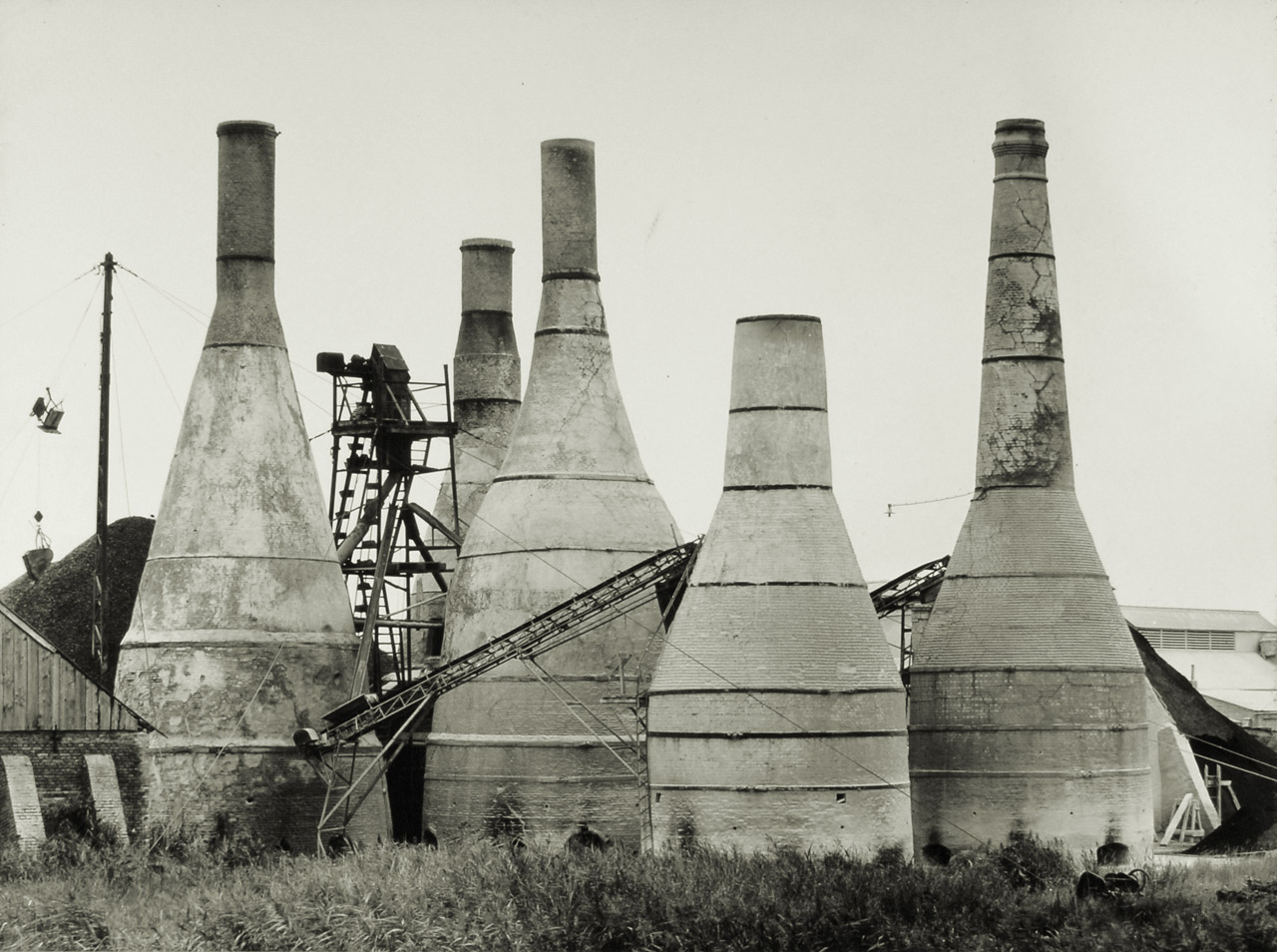 Bernd+ Hilla Becher, Lime Kilns, Kalköfen, Harlingen, 1968
Their method is akin to an archaeological analysis of industrial forms of a world recently lost. These were constructed with no consideration of so-called beauty and serve their functionality alone. When these structures lose their function they are no longer entitled to exist, so they are torn down.
Blake Stimson in a Tate Papers research paper says:
Their system is based on a rigorous set of procedural rules: a standardised format and ratio of figure to ground, a uniformly level, full-frontal view, near-identical flat lighting conditions or the approximation of such conditions in the photographic processing, a consistent lack of human presence, a consistent use of the restricted chromatic spectrum offered by black and white photography rather than the broad range given by colour, precise uniformity in print quality, sizing, framing and presentation, and a shared function for all the structures photographed for a given series.
Their objects are basic industrial forms, their method is ’typological' and they construct an archive in which single images gain a significance.
July 26, 2011
American photography: Mike Rebholz
Mike Rebholz is an architectural photographer living and working in Madison, Wisconsin.
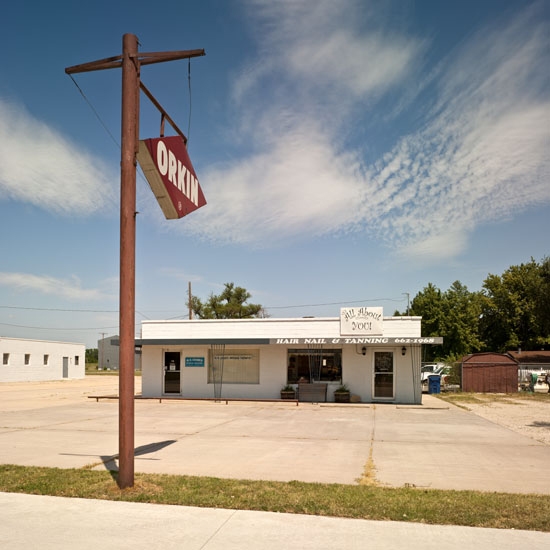 Mike Rebholz, 316 East Avenue A, Hutchinson KS, Summer 2009
Rebholz was one of 100 photographers invited to participate in Review Santa Fe 2011. This is a premier juried portfolio review event. Up to 100 photographers are selected to meet with some of today’s most relevant and esteemed curators, editors, publishers, gallerists and others.
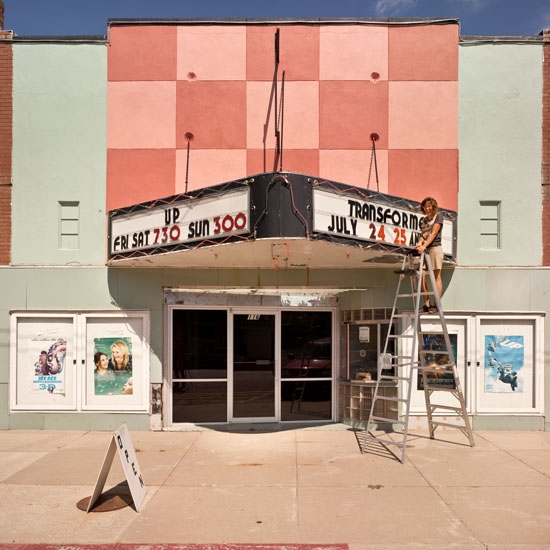 Mike Rebholz, The Stratford Theater, Stratford KS, Summer 2009
Rebholz submitted his 10 Weeks portfolio on ice fishing in Wisconsin, specifically on the local lakes that surround Madison.
July 24, 2011
European Photography: Jan Parik
The Polish-born Czech photographer Jan Parik studied cinematography at the Art Academy of Prague. He worked as a photographer for Czech journals and won recognition when his photographs were exhibited and appeared in poetry books. From 1960 - 1964 he photographed Prague in the spirit of Franz Kafka and these images were exhibited internationally as well as published in the book "Kafka and Prague" in 1965.
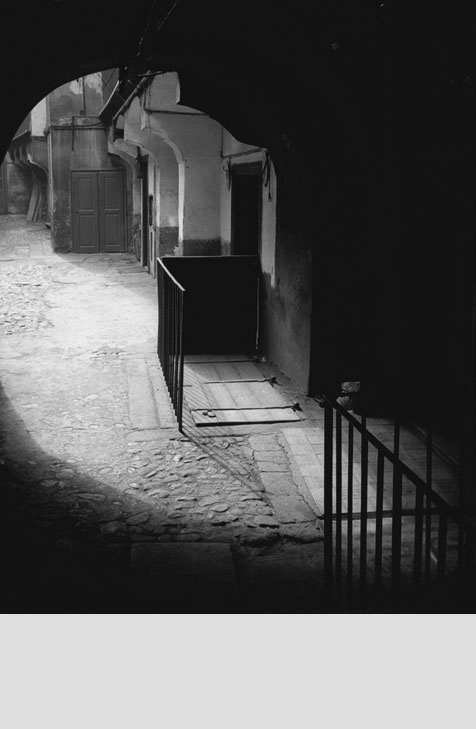 Jan Parik, street, Prague, 1960
The adjective “Kafkaesque” has a universal currency. We use it when we feel that the whole world is putting us on trial and that no one will tell us the charge. We use it we bureaucracy buries us alive. The quarter in which Kafka lived was one of towers, domes and steeples. Its streets were cobbled crevices : a world of dark corners, secret alleys, shuttered windows, squalid courtyards, rowdy pubs and sinister inns.
July 22, 2011
redesigning cities: place making
Fred Kent, the founder and president of Project for Public Spaces, for the Liveable Cities Forum that has its roots in the Integrated Design Strategy prepared by Professor Laura Lee whilst a Thinker in Residence.
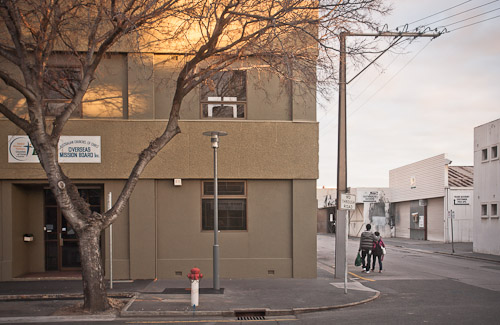 Gary Sauer-Thompson, cnr Sturt St + Myers St, Adelaide, 2011
The ethos of the 5000+ and the Integrated Design Strategy is reinventing or redesigning Adelaide as a liveable city, a vibrant city, a sustainable city.
It needs to become this kind of city because Adelaide’s youth are packing their bags and heading east, following promises of excitement and opportunity or people, and often they do not return. Why should they: the city is a place where you go outside your house and nobody's out there.
Adelaide needs to innovate and to become smarter. Will it? Well, we have an Integrated Design Commission That's a step.
5000+ is a postcode; a place; with the '+' referring to thinking beyond what Adelaide is to exploring what Adelaide could be. Singer argued that the possibilities existed for Adelaide to be transformed into a people place that it deserves to be. That means taking more of it away from the cars and giving it to the pedestrians. In turn that means making it difficult to move through in a car--- using the city as a throughway for inter-suburban traffic.
Adelaide as a city is at a tipping point: a once in a generational chance to plan and design for the future and effect real, and lasting change to put people at the centre of the city.
July 21, 2011
Lucian Freud
There is a strong empiricist current that runs through British art that goes back to John Locke. This current holds that western painting is the pursuit of reality – that in effect representational painting that tries to see things how they really are, even though what see is coloured by aesthetic convention.
Lucian Freud's paintings in showing us how he sees people and objects makes us aware of our own ways of looking:
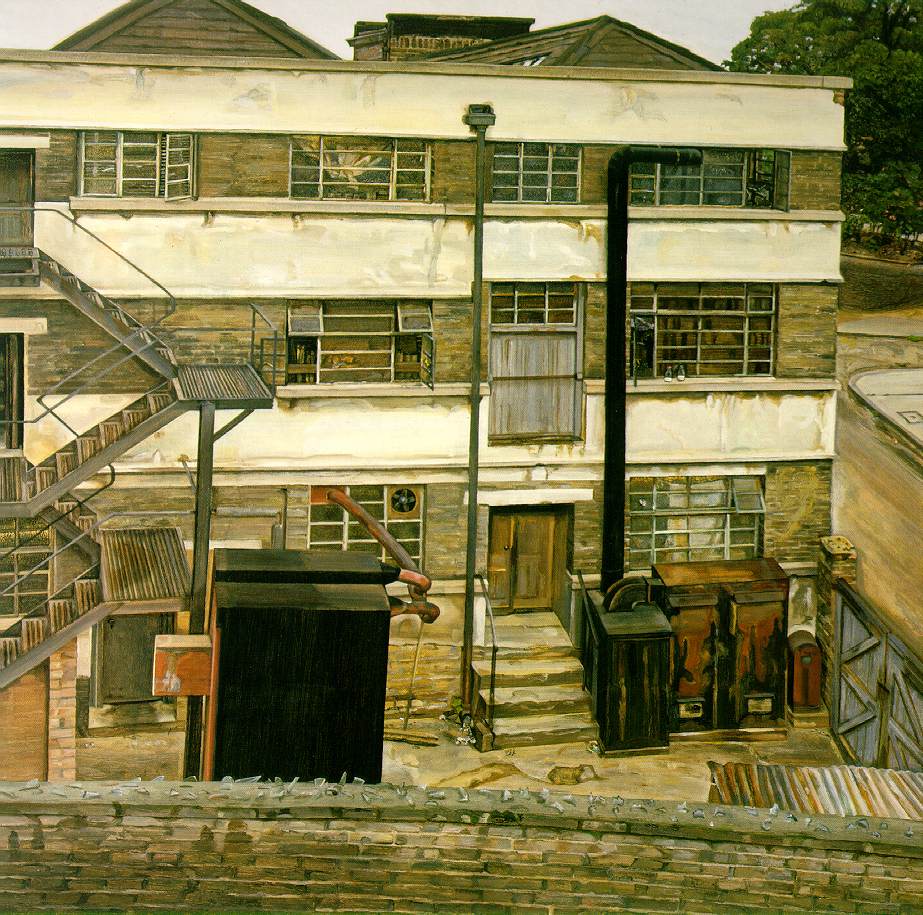 Lucian Freud, Factory in North London, 1962, oil on canvas.
Portraits and nudes were his specialities, often observed in arresting close-up. The models are almost always friends or lovers, and he paints them with deliberate parsimony. The finished painting is an accumulation of richly worked layers of pigment, as well as months of intense observation.
 Lucian Freud, portrait, Paddington, 1951, oil on canvas
This kind of representational work is akin to that done by large format photographers.
July 20, 2011
American Photography: Janelle Lynch
Janelle Lynch made a series of intriguing projects or series during her three-year stay in Mexico City between 2002-2005. The first one was El Jardín de Juegos, which was made with a ×5 inch camera, with the pictures devoid of people. It shows the relics of a children’s playground conquered by nature and neglect.
Another Mexico series is Donde Andaba and this appeals to me as it connects with my urban nature work in Adelaide:
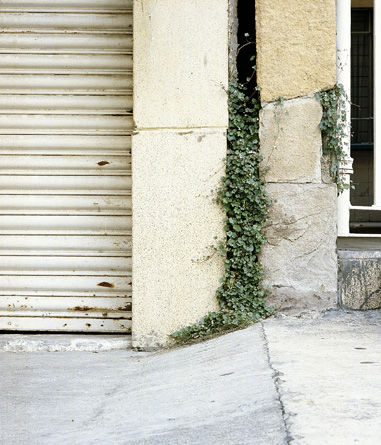 Janelle Lynch, untitled, 2002-05, from Donde Andaba series
Lynch says that the Donde Andaba series, which was made with a 6x7cm format camera, explores:
the streets of my neighborhood, La Condesa, and in a nearby park and playground. Using wild plant life juxtaposed with urban architecture as a vehicle, the photographs explore the theme of the persistence of life and growth despite its environmental conditions.
Her first monograph, Los Jardines de México (Radius Books), explore themes related to the life cycle and representations thereof in the urban and rural landscape.
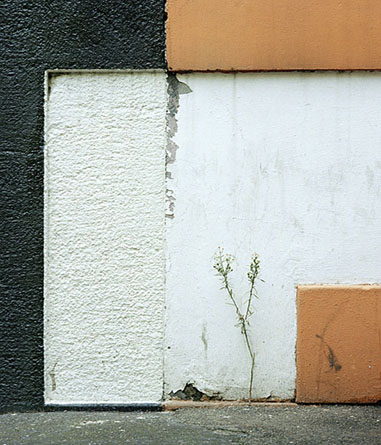 Janelle Lynch, untitled, 2002-05, from Donde Andaba series
The book is comprised of four series––three from Mexico City and one (Anka) from Chiapas. The latter, made with 8×10 inch camera, are portraits of anthropomorphized tree stumps in a nature reserve, which investigate the theme of regeneration.
July 19, 2011
Junk food advertising
Junk food advertising creates meanings for consumers through visual imagery. These meanings in turn, shape consciousness and behaviour subtly by sanctioning some forms of thought and behaviour while de-legitimising others.
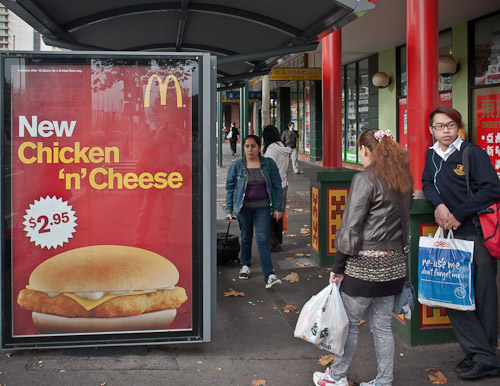 Gary Sauer-Thompson, Gouger St, Adelaide, 2011
Advertisements in fact place less emphasis on communicating specific product information and more on communicating the social and symbolic uses of products. Effectively, this means that in a consumer-oriented society, people define themselves as consumers and they are persuaded that they gain a fundamental gratification from consumption.
So advertisers generate systems of meaning, prestige and identity by associating their products with certain life-styles, symbolic values and pleasures.The subtle influence of advertising works in a variety of ways:
*Promotion of images that do not equate to the truth, but are presented in ways that appear to be ‘truthful’. So, people are convinced that buying product ‘A’ will make them happy or younger or more attractive—it must be so because the advertisements ‘prove’ it.
*Repetition of messages which stress minor differences between products, for example, Coca Cola and Pepsi Cola, can influence unconscious decisions on what becomes a preferred product.
*Even if consumers dislike some annoying advertisements, the constant repetition of messages can still influence their purchasing actions.
Junk food and drink marketing to children continues to be poorly regulated in Australia. It's mostly self-regulated and the food industry response to calls for changes has been minimal to date.
July 18, 2011
American Photography: William Clift
I have mentioned William Clift in an earlier post.
 William Clift, Shiprock, New Mexico,1998
I remember attending a workshop given by William Clift, an American landscape photographer, in Melbourne where I first saw a large format view camera. I was still at photography school and using a 35m camera and was rather taken back by meeting someone who took landscapes of New Mexico and could make a living selling their black and white landscapes.
I couldn't connect with either the large format style of photography or being a professional art photographer.
Clift is recognized for his New Mexico landscapes, of Mont Saint-Michel, France, for documentation of our nation’s courthouses, the New York State Capitol in Albany, and the Hudson River Valley. Past publications include Certain Places (1987), A Hudson Landscape (1993) and A Particular World (2008).
July 17, 2011
American Photography: William Rugen
I first stumbled across William Rugen on Flickr and was impressed by the way he used his photo-stream and the quality of his images. So I checked out his website:
 William Rugen, Hoover Dam NV, from the Western Dioromas series
Rugen says that his Western Dioromas portfolio is:
a snapshot of the American West after nearly two centuries of Manifest Destiny. My interest is in how we Americans have used, abused, discarded and rediscovered the overwhelming space and limited resources time and again and the wary line we draw between where we live and what surrounds us.
July 15, 2011
German Photography: Frank Thiel
Frank Thiel has been photographing and documenting Berlin, and its constant state of changing and flux. There in Berlin, ever since the fall of communism there has been constant reformation of the land and space that the city surrounds.
 Frank Thiel
His work is described as a sort of architecture in transition.
July 14, 2011
European Photography
I never see the print edition of European Photography here in Adelaide and I cannot afford to subscribe to it. Thanks to the internet I can access some of the archived material online just as I can with net photography. We are increasingly seeing photography produced for the prime aim of being presented and viewed on the Internet--net photography.
Andreas Müller-Pohle says that museum or gallery photography marks the highpoint in what is known as “fine art photography”. This
had set out to free photography of all sorts of ideologies (such as dogmatic documentarism) and broaden its aesthetic agenda or program. At some point in the 1990s however, that progressive impulse languished in aesthetic redundancy: it had all been done before. For aesthetic programs exhaust their potential if no new terrain is being opened by technical innovations. And as fine art photography had no other agenda but an aesthetic one, its decadence, its drift into the sleek and the decorative, was inevitable.
Photography on the net expands the classical discourse, that one-way communication, with myriad interfaces, for now everyone can play along, everyone has a chance to be seen, and what is more, everyone can vote and be voted on. Local examples include the Melboune based Altfotonet.org and Urban Photo Magazine
July 13, 2011
Murdoch on page 3
And so it has come to pass, finally:
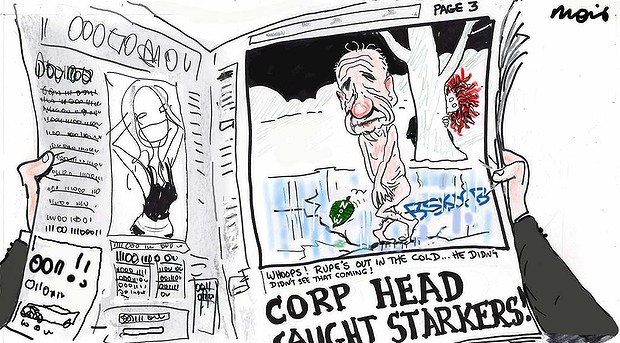
I love the way that Alan Moir's cartoon plays around with the page 3 conventions of Murdoch's sleazy tabloid journalism. Murdoch deserves the treatment.
July 12, 2011
Nine Inch Nails: And All That Could Have Been
I watched a DVD of Nine Inch Nails in concert---And All That Could Have Been from the 2000 Fragility 2.0 tour. The video is dark and smoky as it was shot by the bands crew and is quite intense and tightly packed.
I was kinda underwhelmed. The stage performance was atmospheric and dark, the music was industrial, but it lack any spark. It suggested that Nine Inch Nails are a powerful live group but they didn't deliver here. There there was grunge, melodramatic angst and bleakness; the band was animated and played the songs with high energy amongst intense lighting and background videos. There was no smashed keyboards and guitars littering the stage to end the show. This was about image.

I had come expecting expanded song structures, odd time signatures, shifting arrangements filled with novel sounds and tremendous textural variety. Layered soundcapes if you like as on The Downward Spiral. That's the studio I realized. Live is very different.
The musicality that underlies Reznor's most ear-shattering work was indicated by Disc 2 titled Still that includes additional songs ("The Fragile," "The Day the World Went Away") recorded "live in a deconstructed fashion."
This is a band that has their own Flickr stream has its videos banned, produces movie soundtrack --eg., for David Lynch's Lost Highway, conducted a viral marketing campaign for Year Zero, and writes their music on a laptop---jotting down down sounds and textures-- and recording on the road.
The band is Trent Reznor, as he is solely responsible for their musical direction and is supported by a regular backing band.
July 11, 2011
Rencontres d'Arles
The 40th Rencontres d'Arles, which is one of the world's leading photography festivals, recognises that digital photography has widened the photographer’s palette. The fast and loose approach by a new generation of digital artists is one of the dominant themes of this year's Rencontres.
It recognizes that the growth of the Internet and the proliferation of sites for searching out and/or sharing images online—Flickr, Photobucket, Facebook, Google Images--mean a plethora of visual resources that was inconceivable as little as ten years ago. It means image accessibility, an upgrading of the amateur at the expense of the auteur and the obsoleteness of the modernist criteria which were once the crucial factors in determining what was art and what wasn’t.
What this suggests is that Web 2.0 influencing contemporary photo culture around the world by connecting international audiences to art experiences, enabling the discovery of new work and presenting never-before-seen channels of expression and communication.” Blogs, webzines and now social networks have made photography far more accessible than before. We are no longer dependent on museums, galleries and books for photographic content. This not only makes it cheaper and easier to get our hands on photographs, but we can now see far more images than are available through these ‘traditional’ forms.
Eye Curious warns us of the danger of Web 2:
it can lead to a situation where we are constantly consuming and never digesting. The danger with the infinite accessibility of the web is that we can find ourselves only looking at photographs that are immediately seductive or simply popular in the networks around us. Work that might be deemed quiet, challenging or even just off-putting can get totally bypassed.
But, as is pointed out, we can se the participatory nature of the net for considered thought and conversation on what is happening in photography today and where this might be leading.
July 10, 2011
Facing Change
Facing Change: Documenting America is a non-profit collective that takes its inspiration from the Farm Security Administration's documentary programme of the 1930s.
 Debbie Fleming Caffery, Enterprise Sugar Mill
The stories archive is diverse. I find the work by Debbie Fleming Caffery on her native Louisana fascinating. Caffery has been working this vein for thirty years photographing workers from the sugarcane fields and sugar mills in rural Louisiana, where she was born, as well as the community and her three children.
Anthony Suau explained that the Facing Change collective is covering aspects of daily life that might ordinarily have slipped under the radar.
There is a huge frustration with traditional media. I hear it constantly when I'm working in the field. We felt we were going out and seeing things that were not being reported, or not being covered in the way that we felt was appropriate. More than that, it's no longer necessary to communicate down to the audience. Facing Change intends to communicate laterally.....The idea is not to go out on assignment and spend 10 days watching people and photographing them in their very hard times and misery and then move onto the next story. We aim to create contact. We will bring the work back to the people we were photographing, and allow them to have a voice in the production of that story. And then we'll go back again and again, and keep that line of communication open.
An interesting approach that breaks away from the traditional photojournalism.
July 9, 2011
change in America
The legendary Rouge plant in Dearborn, Michigan was for decades the captive steel producer for Ford, and still a big Ford supplier. Built in 1924 it is owned by the Russians--Severstal North America--- who invested over $1 billion to upgrade the plant.
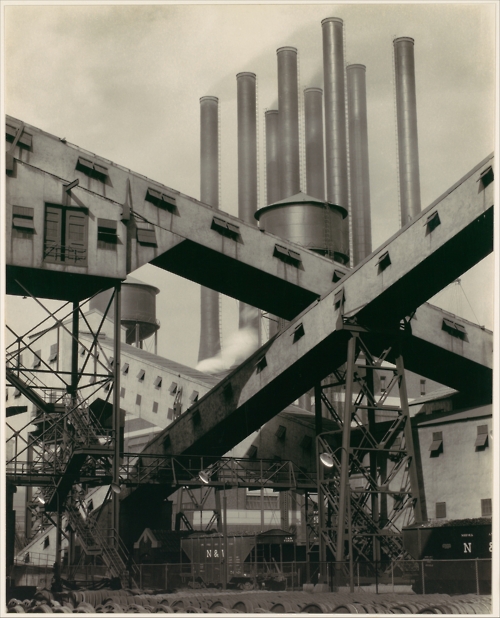 Charles Sheeler, Criss-Crossed Conveyors, River Rouge Plant, Ford Motor Company, 1927
Sheelers' image of technological utopia became a monument to the transcendant power of industrial production in the 20th century in the USA. Rouge Steel fell on hard times after the Ford Motor Company spun it off in 1989 into an independent steel company.
July 7, 2011
Hungarian Museum of Photography
The Hungarian Museum of Photography has a fascinating collection of photography that is rarely seen
July 6, 2011
Hungarian photography
The Royal Academy of Arts has an exhibition entitled Eyewitness: Hungarian Photography in the 20th Century. It is dedicated to the birth of modern Hungarian photography and features the work of Brassaï, Robert Capa, André Kertész, László Moholy-Nagy and Martin Munkácsi. These left their Hungarian homeland to make their names in Europe and the USA, and they profoundly influenced the course of modern photography.
The majority of the photographs on display in the exhibition focus on ‘Moving Away’. When Hungary lost 70% of its territory after the First World War, thousands fled abroad to escape an increasingly fascist anti-Semitic government. Brassaï, Capa, Kertész, Moholy-Nagy and Munkácsi are each known for the important changes they brought about in photojournalism, documentary, art and fashion photography.
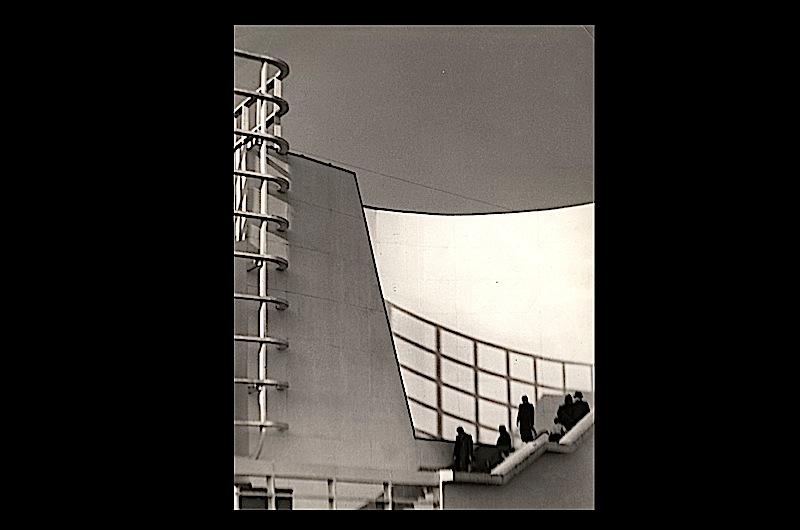 Angelo, Airport steps, Budapest, 1936. © Hungarian Museum of Photography, Kecskemét
The exhibition includes other photographers who remained in Hungary, such as Rudolf Balogh, Károly Escher and József Pécsi, to the more recent documentary and art photography of Péter Korniss and Gábor Kerekes are also represented.
After 1945, the Soviet regime encouraged a return to a new Magyar style of Socialist Realism which romanticised urban industry and labour; however, the fall of communism brought with it the globalisation of art, photography and much else besides.
Over 200 photographs from 1914 to 1989 will show how these world renowned photographers were at the forefront of stylistic developments and reveal their achievements in the context of the rich photographic tradition of Hungary.
Colin Ford's essay in the catalogue, is an attempt to explain the curious success of Hungarian photographers between about 1920 and 1950. Political events, wars, anti-semiticism and the pull of the west drew many Hungarian photographers out of their native land to Berlin, Paris and eventually New York, where they began to dominate the industry. However the Hungarian sensibility seems hard to explain in terms of imagery. The acute angles and artful composition dominated photography and other art-forms across Europe in the first half of the twentieth century.
Cy Twombly: extending abstract expressionism
CyTwombly, who recently died, came of age as an artist in the America of Jackson Pollock and the Abstract Expressionists.
Twombly's early work of the 1960s blurs the line between drawing and painting and the arabesques of Pollock's style evolved into expressive abstract canvases and then into marks of graffiti scratched onto a blackboard as some kind of pre-verbal expression.
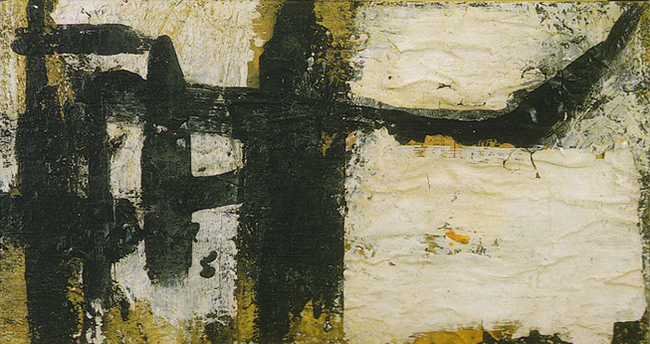 Cy Twombly, Landscape 1951
He was part of the movement away from Abstract Expressionism--a deconstructive coda--- and he became an American expatriate in Italy after his move to Rome and its landscape of ruins in 1957.
Some of the latter work is more of an extension of abstract expressionism with its subtle rhythmic patterns and muted colours:
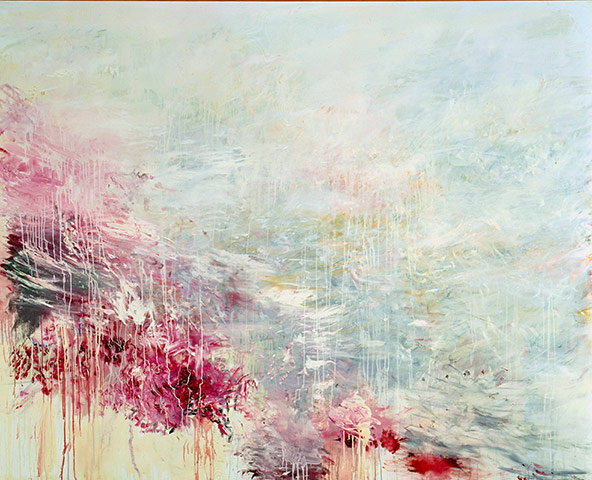 Cy Twombly, Hero and Leandro (for Christopher Marlowe), 1985
Italy--and the Mediterranean---was a world of crumbling ruins and memories, where it was still possible to imagine the sea stained with the blood of old battles. Often there is text scribbled into his canvases and tghe titles refer to hos paintings connections with poetry.
July 4, 2011
German photography: Thomas Struth
Thomas Struff is a German photographer who trained at the Düsseldorf’s Künstakademie from 1973 until 1980 where he initially studied painting with Peter Kleemann and Gerhard Richter before settling on Bernhard and Hilla Becher's photography studio.
Struth began his survey of cities in his native Düsseldorf, Germany:
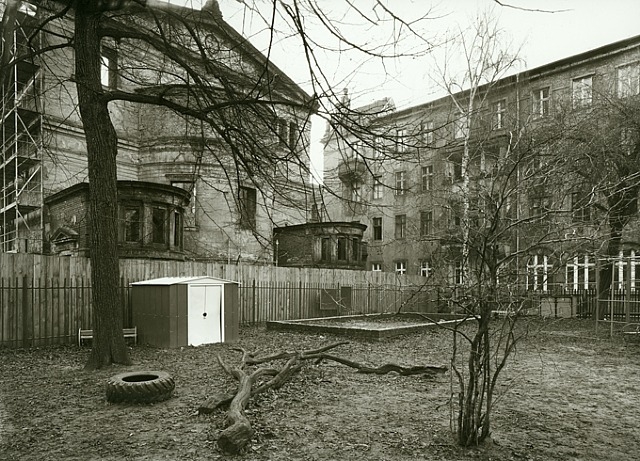 Thomas Struth, Elisabethkirchstrasse, Berlin, 1992
Avoiding subjectivity through a centralized viewpoint and comparative technique, Struth catalogued with clarity and dispassion the unselfconscious structures that characterize a culture—that irreducible mélange of textures, shapes, and the scale of its streets.
His German street work purposely does not focus on anything in the field of vision of the photograph, everything is sharp, nothing is blurred. These are views of views of banal buildings, prospects of streets without qualities, anonymous facades. Usually in black and white, they present a frontal, eye-height view, with no optical distortion to disrupt the impression that this is a neutral, objective recording of reality.
It was on a scholarship to New York in 1978 that the artist found an ideal combination of conceptual order and practical chaos to hone his rigorous vision. Over the next decade, Struth expanded his project geographically to include many other cities in Western Europe, America, and Asia. He also abandoned one-point perspective and serial comparison to locate meaning within individual images, rather than between them, creating distinctive portraits of place that chart the historical transformations affecting our urban environments.
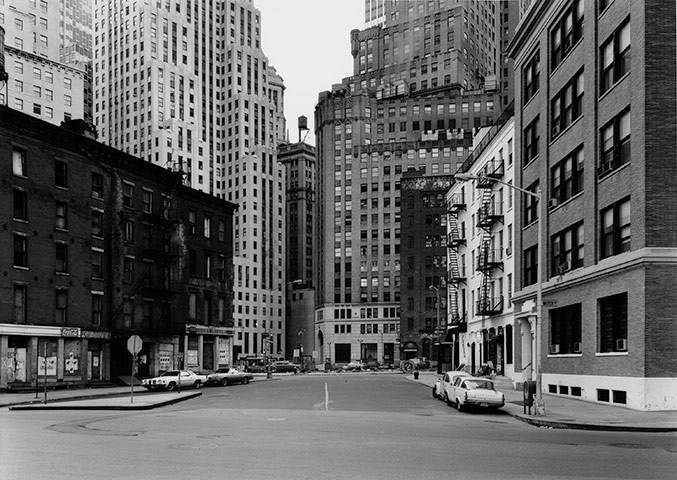 Thomas Struth, Coenties Slip, New York/Wall Street 1978
In this interview in The Guardian Struth says his photographs of Düsseldorf's streets and buildings, where the old and austere meets the modern and faceless, suggest:
a kind of embedded history of German power and identity that, in the long years of post-war silence, was not acknowledged either by those in power or by ordinary German citizens. For me, initially, the question was: how do you live with history? Then I began to ask: how is history embedded in the architecture of a city? How does a community represent itself in its architecture, truthfully or otherwise?
He adds:
Many people think that the impulse to take a photograph comes from the subject matter. But, for me, it comes from a wish to talk about certain things that fascinate or bother me, politically or socially. And then I choose the subject that will enable me to address that subject. Otherwise I would go around aimlessly photographing anything and everything.
July 3, 2011
junk food + overeating
Junk food for me is when corporate manufacturers create combinations of fat, sugar and salt that are so tasty many people cannot stop eating them even when full. Junk food is that food designed to make you want to eat more of it.
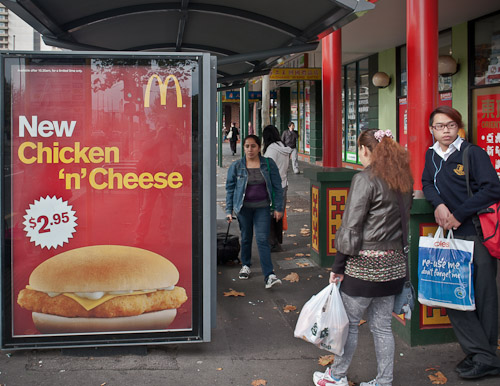 Gary Sauer-Thompson, junk food, Grote St, Adelaide, 2011
You know that addictive feeling when you begin munching on that first whatever and just can’t say no, when your body, once started, just doesn’t know how to stop. Does that help to account for the significant changes in Australian's weight over the last 20 to 30 years?
David Kessler, the author of The End of Overeating, says yes because our food is bloated or layered with fat, sugar, and salt,that stimulate intake so that people will come back for more.
Kessler argues that we need to understand how the cycle of consumption works: we get cued; our brains get activated; we get aroused; our attention gets focused; our attention gets locked in; we consume. It's a momentary pleasure, but it's ephemeral. We get cued again every time we reach for and eat foods. It's going straight into the neural circuits. We'll do it again and again.
Our brains are being hijacked by all the food cues:
The business plan of the modern American food company is to put their product on every corner, make it emotionally irresistible, make it entertaining, and make it socially acceptable to eat at any time. In fact, it's a food carnival. Who wouldn't want to get on the ride? We published this article called "Deconstructing the Vanilla Milkshake." What do you think it is in the vanilla milkshake that drives consumption? Sugar is the main driver, but when you study it closely, it's not any one ingredient. If I give you a package of sugar and say, "Go have a good time," you're going to look at me like I'm crazy. But add fat to that sugar, add texture, add temperature, add color, add mouth appeal. Then add the emotional gloss of advertising. Then add the social factor--you can do it with your friends, blow off steam, reduce stress. The food industry will say, "We're just giving the consumers what they want." But what do we end up with? A great public health epidemic.
So it should not be just the case of blaming individuals for being overweight or obese because they lack self-control and will power.
July 2, 2011
Hiroshima: Ground Zero 1945
After 1945 1,150 US military personnel and civilians, including photographers, were sent to record the destruction of Hiroshima as part of the United States Strategic Bombing Survey. The goal of the Survey's Physical Damage Division was to photograph and analyze methodically the impact of the atomic bomb on various building materials surrounding the blast site, the first "Ground Zero."
The U.S. government then restricted the circulation of images of the bomb's deadly effect.
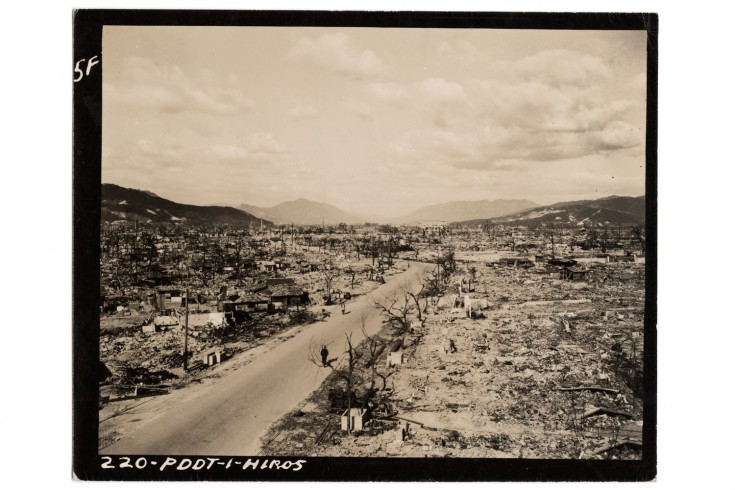 The landscape of Hiroshima, looking northeast, with the Hiroshima Telephone Company Western District Exchange visible in the distance.October 27, 1945
There is now an exhibition at the International Center of Photography. The photographs, which have been in the museum’s permanent collection since 2006, have been declassified for decades, but had been lost.