June 30, 2011
urban ugliness
The new colourists in American photography in the 1970s --Len Jenshel, Richard Misrach, Joel Sternfeld, Stephen Shore -- worked with a conception of beauty. I find that their embrace of beauty in color was a traditional one--art is about beauty, even if the photographs were supposedly about everyday life in the US.
I cannot really do beauty. The urban environment that I live in Adelaide is anything but beautiful. It's actually downright ugly. So what do I do. Ignore my local urban area? Go hunting for beauty in it?
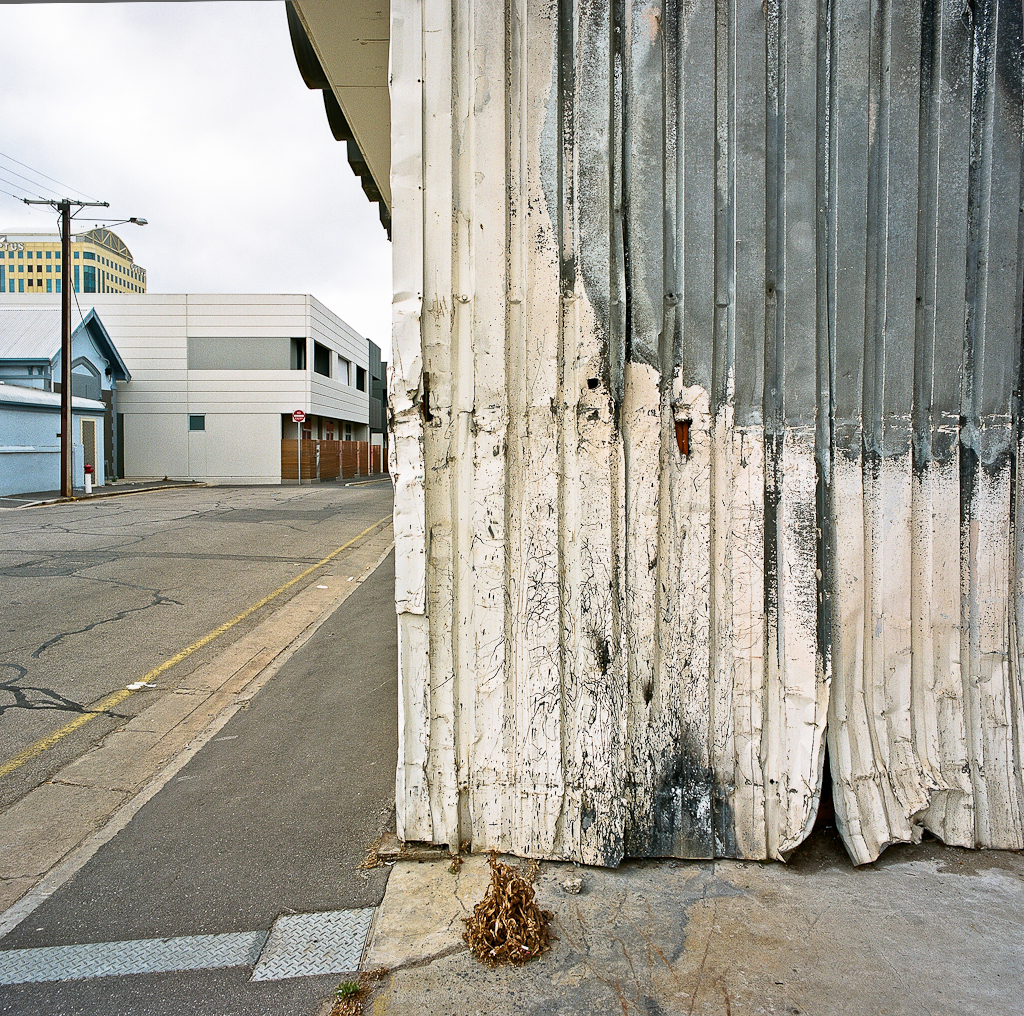 Gary Sauer-Thompson, Myers Lane, Adelaide, 2010
Don't we make pictures because of what stands in front of the camera? That is not necessarily the beautiful in the sense that Kant understood it:---“judgments of taste” that are based in an individual’s subjective feelings, they also claim universal validity. This is based on the “free play of our cognitive powers” that underlies our judgment of taste. Kant's appeal is to a sensus communis, the idea of a sense shared by us ie., --inter-subjectivity or what is common to different people in society.
Aesthetic communication is the universal communicability of a feeling we all know through the play of our faculties. It is a passage from “I” to”we”. We say you ought to feel the way I feel, you ought to agree with me”.
These days sensus communis is interpreted as common sense. The English term “common sense” has its own history, mainly through Berkeley, Hume, and the Scottish school. It already has a specific meaning: a healthy understanding that is opposed to skepticism or nonsense.This not at all what Kant has in mind when he speaks of the sensus communis. In fact, he wants to distance himself from such an understanding of the
sensus communis.
What the American new colourists did was to divorce beauty from ethics or the good. They dumped Kant in favour of Greenberg. Their “aesthetics” was a theory of beauty. They assumed that there is such a common feeling, or sense, that we share and that also decides about beauty in matters of taste. The beautiful object gives pleasure and the notion of taste contains an element of social commonality in it, and, with the presupposition of a common sense.
Contrary to Kant we do not possess the faculty of spontaneously empathizing with the human in us all. We cannot say that Our pleasuresand displeasures are universal since these are the outcomes of the processes of our cognitive faculties, which are the same in everyone.
June 29, 2011
Vivian Maier: colour work
I have posted on the work of Vivian Maier before ---on some of her street photography in Chicago. As we know Maier’s massive body of work came to light in 2007 when her work was discovered at a local thrift auction house on Chicago’s Northwest Side.
This body of work (100, 000 negatives and hundreds of rolls of film) is being archived and cataloged by John Maloof. There is now a website of her work up, and we can more clearly see the variety body of her work including the Chicago street work.
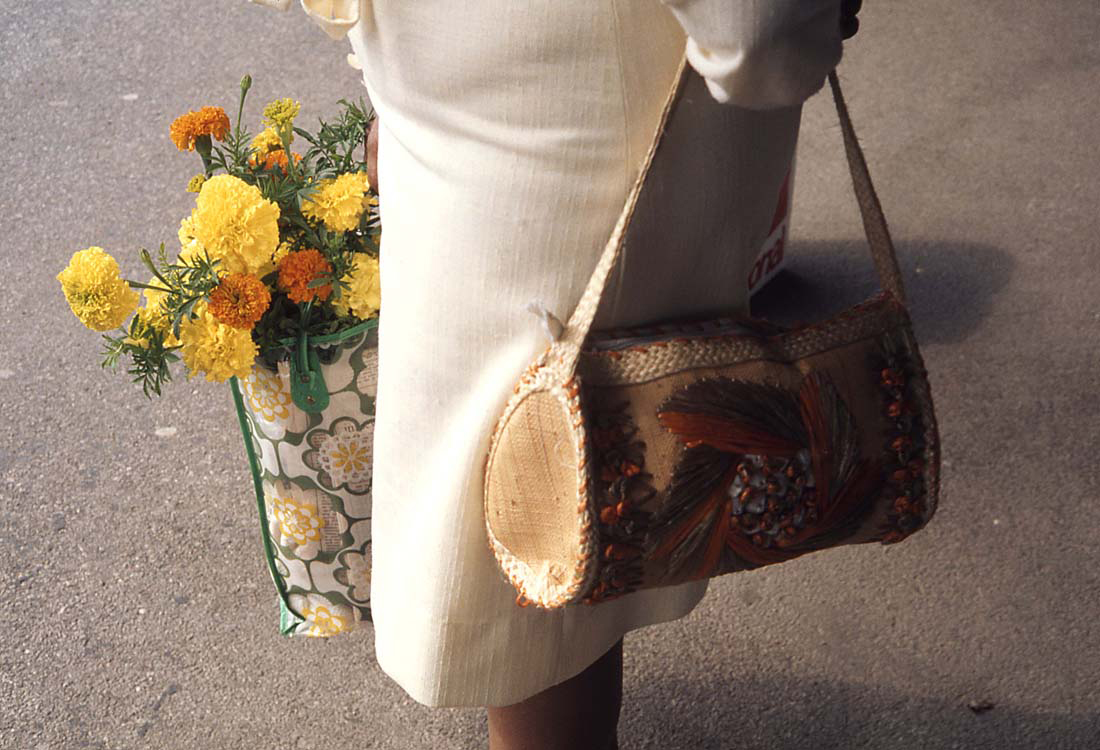 Vivian Maier, untitled, August, 1975
My eye this time was caught by the colour work shooting on mostly Kodak Ektachrome 35mm film using a Leica IIIc.
There is not much in the colour portfolio and what was there was mostly done in 1975. I understand that the color work became more abstract as time went on. People slowly crept out of her photos to be replaced with found objects, newspapers, and graffiti.
June 27, 2011
Australian photography: Frank Hurley
I've seen the odd photograph off and on of Frank Hurley's work as official war photographer in WW1. He was, as we would say now, embedded in the Australian Imperial Force (AIF), and his images of the battle field in Flanders--- especially around Ypres--- are stark and succeed in giving a visually coherent image of the war. I find those made whilst he was with the AIF in Palestine more mundane.
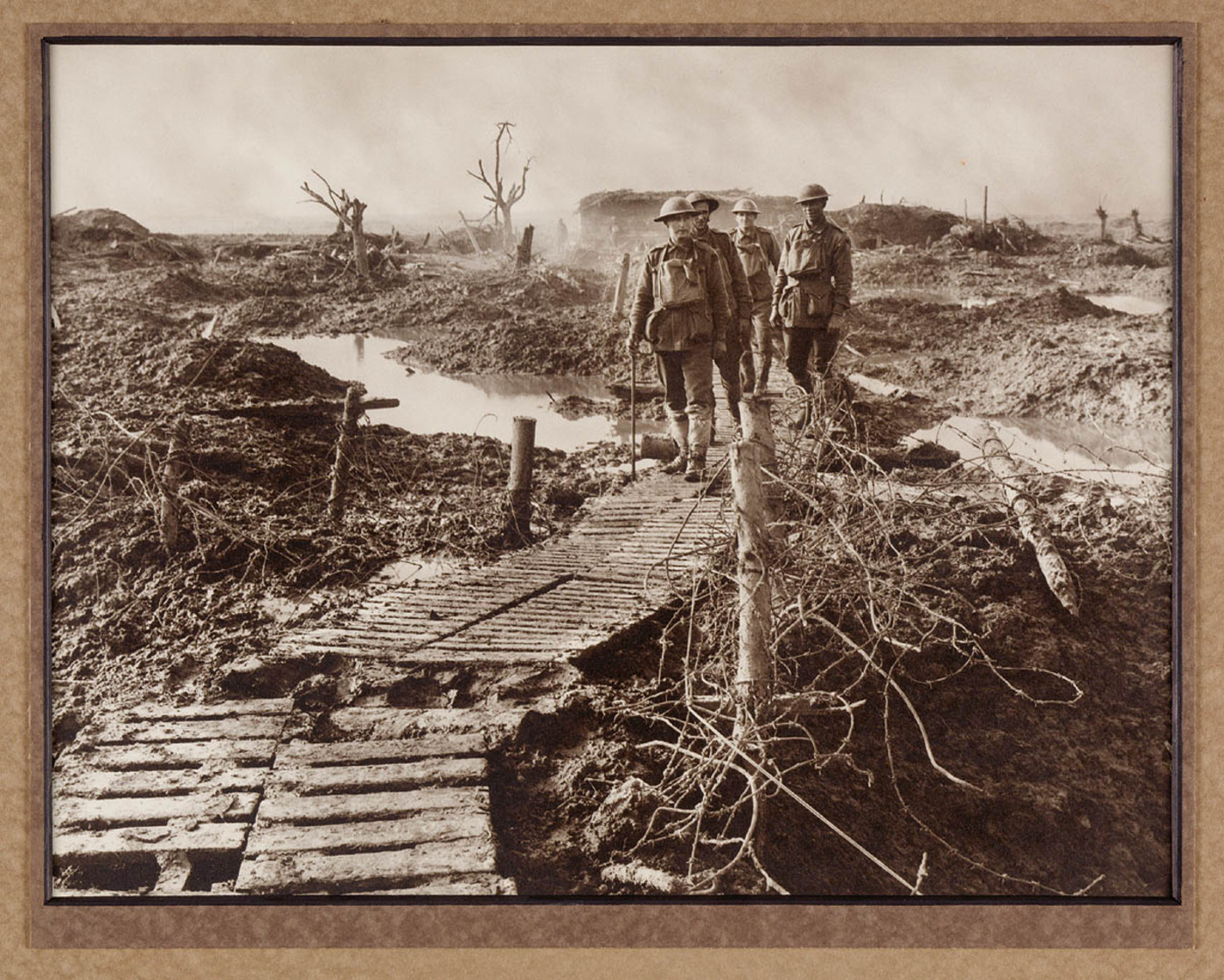 Frank Hurley, 'Just as it was', circa August 1917- August 1918, State Library of NSW
Thankfully we have fully digitalized archives of his work and it is Antarctic landscape work-- both Mawson's Australasian Antarctic Expedition 1911-1914 and Ernest Shackleton's Imperial Trans-Antarctic Expedition 1914--1916--- and his WW1 work that I find so impressive.
Less so is his work on Australia, which was an affirmation of the nations' post war prosperity. This Camera Studies work, undertaken when he was in sixties, was driven by commercial imperatives of needing to make a living, but they also express his patriotism and a pre -modernist aesthetic--especially when compared to the contemporaneous work being done by Wolfgang Sievers.
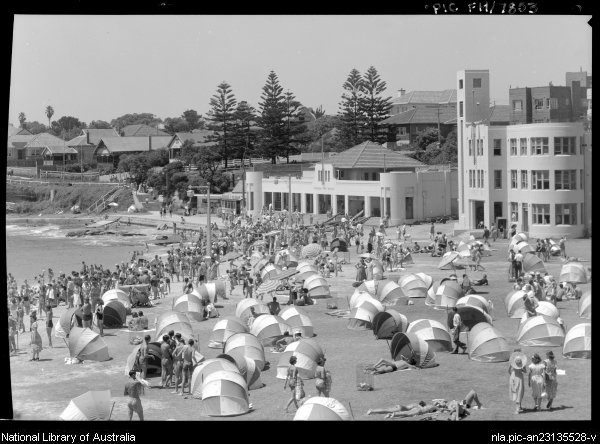 Frank Hurley, Cronulla Beach, NLA
In the Introduction to Hurley's Australia: Myth, Dream, Reality, John Thompson says that Hurley worked with a conservative view of a well ordered and affluent society that had successfully assimilated the postwave of immigrants in which everything was right and harmonious. These are images both of the Australian dream and Australia's image as a land of sheep and wool rather an image of a sophisticated industrial and manufacturing nation as in Siever's work.
His urban images--especially the aerial ones of Sydney--celebrate Australia as a modern and dynamic society. There is no dark side--no existential anguish, no fear, no inner city bohemianism reacting to a conformist, inward looking provincial and conservative society. The work is really a look back on pre-industrial Australia.
June 25, 2011
Gillian Welch: Hickory Wind
Dave Rawlings and Gillian Welch's interpret Gram Parson's classic 'Hickory Wind' here with help from Emmylou Harris on backup vocals.
Welch's voice is compelling in the center here and it doesn't need to surrounded with musical instruments. This is very spare, a haunting interpretation, almost.
It is bare-bones performance. It becomes a heartfelt song that speaks with a clear and undeniable honesty and captures the subtleties of the acoustic instruments and earthy harmonies. The spare style links back to the austere evocations of rural American folk culture.
Welch covered this song in Return of the Grievous Angel: A Tribute to Gram Parsons The doubters find Rawlings and Welch’s work to be a contrivance: roots music without the “real” country roots--eg., she's a California city girl, not an Appalachian coal miner's daughter.
This interpretation of Hickory Wind --akin to a slow heartbeat--- demonstrates Welch and Rawlings’s love and respect for the musical traditions they’ve immersed themselves in. Their musical style is at once innovative and obliquely reminiscent of past rural forms.
June 23, 2011
Australia's concentration camps
Australia, as many know, loves detention centres or internment camps. Since the early 1990s we have lived with immigration detention centers, mostly for asylum seekers. Australia has a policy and system of mandatory immigration detention.
These detention centres have an institutional past, namely the camps where Australian citizens of German origin were interned, and they are similar to the WWII Japanese Internment Camps in the U.S..
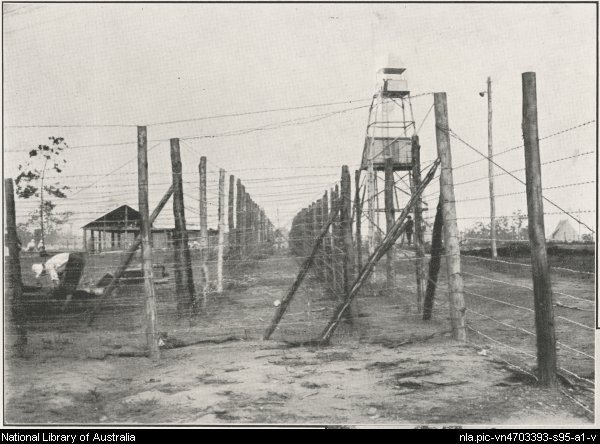 Barbed wire fence and watchtower, Holsworthy internment camp, New South Wales, ca.1917 [NLA].
They were similar to the WWII Japanese Internment Camps in the U.S., and they were built like the ones in Germany, with double fences, barbed wired and with watch towers.
There was a vitriolic hatred of all things German in Australia during 1914-8 by British Australians.
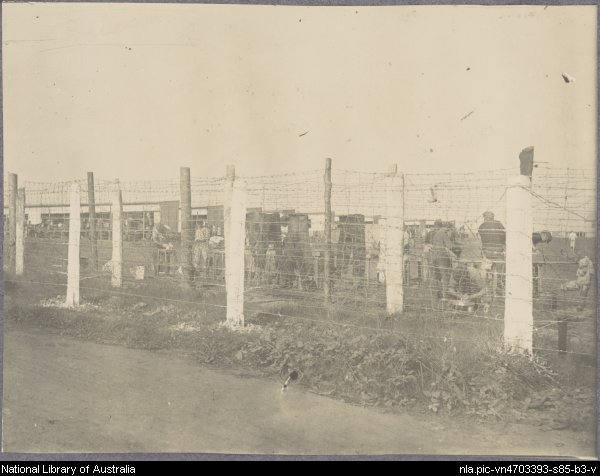 Barbed wire fence, Holsworthy internment camp, New South Wales, ca.1917 [NLA].
The camp absorbed prisoners from the famed Torrens Island Concentration Camp in 1915. Torrens Island, in the Port River, was the site of a concentration camp which earned a notorious reputation for brutality.
June 22, 2011
Richard Misrach: Destroy this Memory
I don't know what kind of photos will be done of the disaster of the Queensland floods earlier this year. I haven't really looked on Flickr. But one model is Richard Misrach's work in Destroy this Memory, which is a representation of post-Katrina New Orleans.
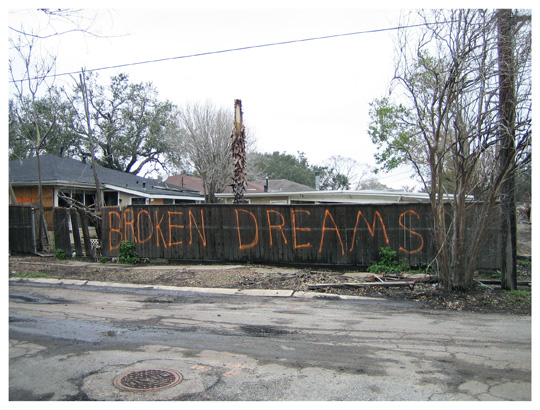 Richard Misrach, untitled, Broken Dreams
In the images of destroyed cars and homes and storefronts Misrach captures, among other things, the hurricane-inspired graffiti: messages scrawled in spray paint, crayons, chalk, or whatever materials happened to be on hand. At turns threatening, desperate, clinical, and even darkly humorous, the phrases he captured—the only text that appears in the book—offer revealing human perspectives on the devastation and shock left in the wake of this disaster.
All of the images are shot with a 4 MP pocket camera while the photographer was working on a separate archive of over 1,000 photographs with his 8 x 10 large-format camera. In this video Misrach talks about his work:
The back cover of Destroy this Memory depicts a boarded window posing that question acutely—“WHAT NOW?” And so we come to a quintessentially political question: What is to be done?
June 20, 2011
American photography: Rosalind Solomon
I've only come across Rosalind Solomon's work courtesy of Wood S Lot. Prior to that this photographic artist was completely unknown to me. And to others it would seem.
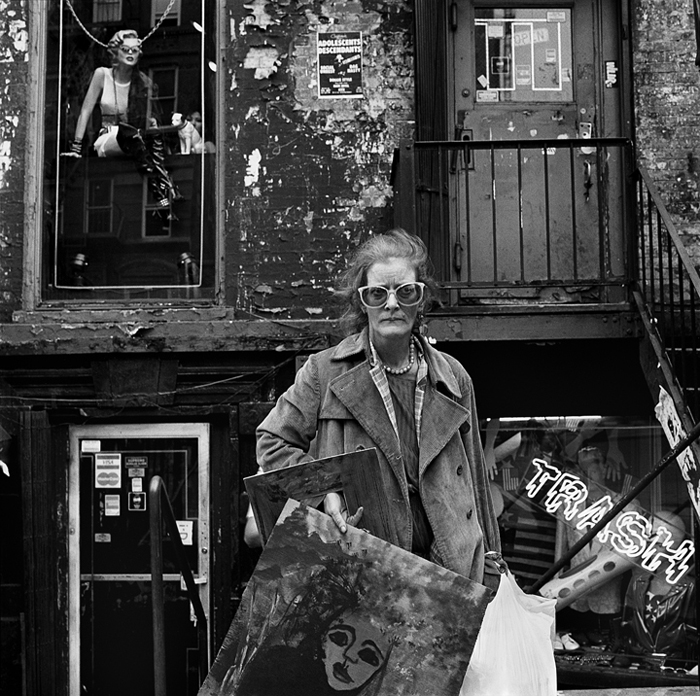 Rosalind Solomon, An East Village Painter, New York, USA, Gelatin Silver Print
In this interview at American Suburban X Soloman mentions the negative responses to her work in a New York art world in the 1970s that was dominated by conceptualism.
She says:
I was floating around in my own juice. I had no regular gallery representation and no advisors. I did not have a clue as to how to get my work published and better known. I did not know how to talk about my work or to write about it. I always wanted to hold it tight and to keep my experiences and personal impulses private. I had many bodies of work that could have been books along the way and occasionally, I tried to find publishers, but I never wanted to stop photographing to promote my photography.
So she travelled to Guatemala, Peru, Nepal, South Africa and Poland using her Hasselbald and has published two books Chapalingas, which too two years to edit and Polish Shadow.
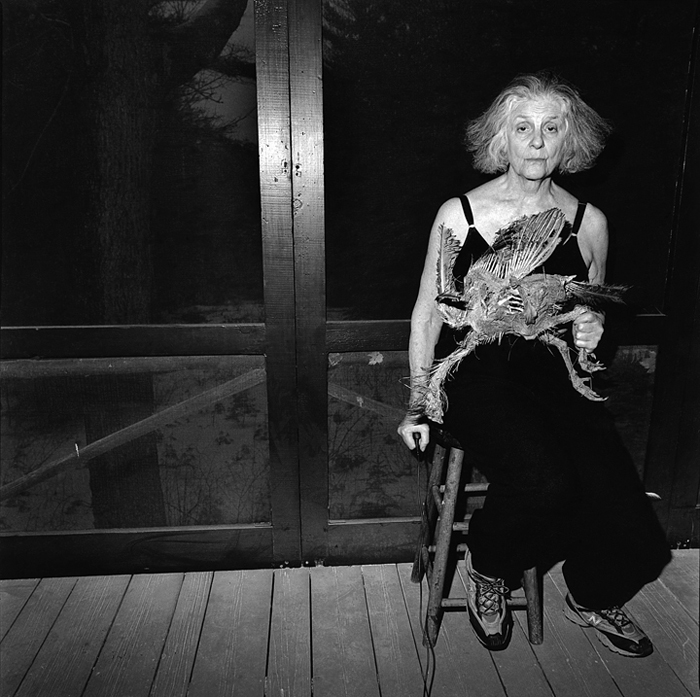 Rosalind Solomon, After 9/11, Self with frozen turkey, Macdowell, Peterborough, NH.
Now living and working in New York she says in this interview at 2point8 that:
The medium format camera satisfies me. It can be transported easily and is mechanically sound. My challenge is not format or color, but deepening my perception and range of ideas. I am interested in making expressive pictures. Black and white pictures work for me as poetry and metaphor in a way that color does not. I have tried color and I have tried digital. Neither gives me the sense of depth that I feel with black and white. Good images come slowly. 6 X 6 film is my “page”..
Like so many photographers working without the kind of champion that Dianne Arbus had in John Szarkowski at MOMA, Rosalind has pursued a relentlessly private vision, recognized by her colleagues but never achieving the public prominence that her work merits.
June 19, 2011
photography encultured
One of the core arguments in the academic photographic literature these days is that the digital revolution in photography has eroded the old belief in the light-based transparent nexus between a photography and reality. We call the pictures made with digital cameras digital photographs as if to ease the passage into a new regime of picturing the real world.

Gary Sauer-Thompson, Port River, Adelaide
William J. Mitchell in The Reconfigured Eye: Visual Truth in the Post-photographic Era (1992) says that though a digital photography may look the same as a traditional one, the former differs from the latter as does a photographic from a painting. They are computer generated images based on pixels and the product of computer programmes. We are in the era of post-photography.
So what? What hangs on this?
Alan Trachtenberg in his Through a Glass, Darkly: Photography and Cultural Memory says that the notion of photography as a form of memory unique among the visual arts became the groundwork conception of the medium.
Belief in photographs as true pictures of the past comes from apparent correspondence between them and images we hold in the mid and call "memory", traces of what our eyes once delivered to our brains. Collecting and preserving snapshots, making family albums, pinning pictures of loved ones on the wall, all are based on the the belief that photographs are remnants of past experience, image remnants of past feelings, associations, stories, the stuff of pictures we carry in our heads of our pasts, of the private history we have lived and the public history we share with overlapping communities.The camera was understood to be a machine for freezing time into recoverable images--eg., Roland Barthes in Camera Lucida.
The positivist assumption is that a photograph is not a rendering, an imitation or an interpretation of its subject, but actually a trace of it . Walter Benjamin's optical unconscious in his "Small History of Photography" (1931) essay refers to what appears in the image unintended, not the product of the photographers will, but a sign of the contingency involved in the making of the photograph. Here is a sign that matched a referent; an incontrovertible fact; that brings past histary into present tense.
Apple's new HQ
In the video below Steve Jobs presents plans for Apple's colossal new HQ--ie., campus--designed by Norman Foster to the Cupertino City Council in this clip on YouTube.
The Cupertino City councillor's lap it up. Job's sold the new HQ as the best office building in the world. It's what you'd expect from a company that has an industrial design team widely regarded as one of the world’s best. A grand design.
Apple's product platform goes from strength to strength --unlike, say Nokia, or Research in Motion who make Blackberry phones for the corporate market. Both of these companies are struggling to switch into the smart phone market currently dominated by Apple and Google's Android.
June 17, 2011

June 16, 2011
English photography: Ben Roberts
Ben Roberts project The Gathering Clouds explores the recent boom and bust in Spain that has affinities with what happened in Ireland and Greece.
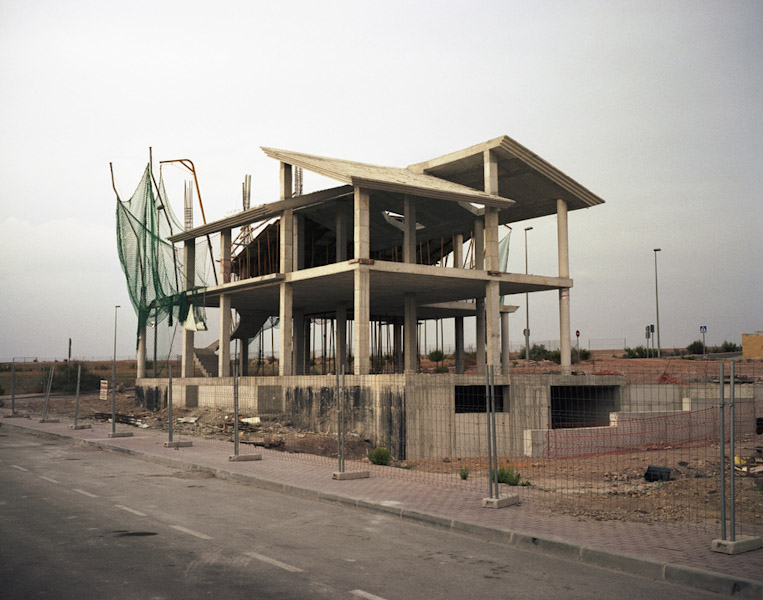 Ben Roberts, Partially constructed villa, Murcia, September 2009, from The Gathering Clouds
Spain as a country is now in the grip of a deep recession after the global financial crisis, and it has seen the emergence of young indignados ("angry ones") protesting against Spain's political establishment. They have occupied Madrid's Puerta del Sol square, in the 'tent city' as part of the growing discontent over the Socialist party's austerity measures.
June 15, 2011
the poetics of place
Although I admire, and have enormous respect, for the way that Wood S Lot successfully combines poetry and photography--- as some form of poetics?--- I have operated with an opposition between a literary and visual culture. Until I attended a book launch of New Poets 16 by some of the Friendly Street Poets in Adelaide last week.
Then the penny dropped. I could see the overlap. These guys were creating visual images with words and doing it successfully. I was creating creating visual images with a camera. We both think in pictures.
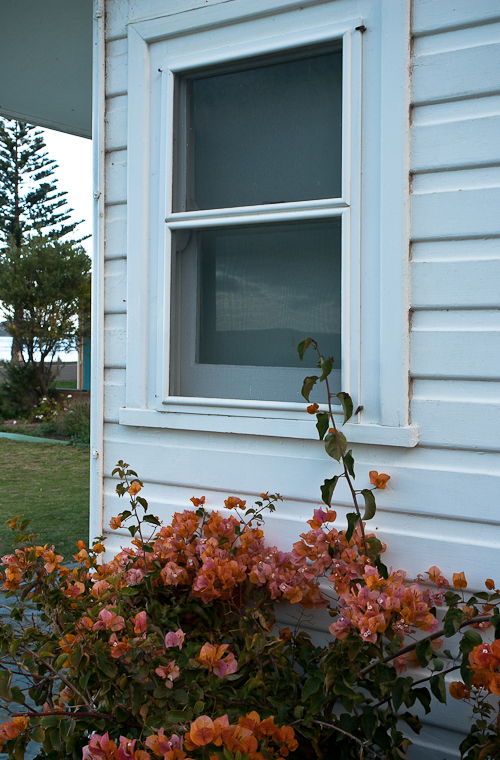 Gary Sauer-Thompson, Bougainvillea, Encounter Bay, Victor Harbor, 2011
I kept on thinking about some of the text that Straun Gray had placed next to his photographs, which I'd read earlier this week. The insights have been resonating whilst I've been down at Victor Harbor this week whilst Suzanne is in Italy.
He says in relation to his Sand Boils project that:
...indulging a personal nostalgia is not my goal when I say I want to make a meaningful photograph of the sand boils. Instead, I am interested in using poetic forms of photography to illustrate the mixture of memories and feelings this place invokes as part of the life of the present, as well as its continuing relationship with the cultural landscape in which it is embedded. I want to show the competing and contradictory aspects of the area, all together, and all at the same time, so they can be absorbed together as a complete, nuanced description.
Competing and contradictory is how I feel about Victor Harbor as a place I thought. It's having the confidence to see what is there.
Gray adds that his sort of poetics is common in photographs of people, but it is rare in landscapes.
Rare, at least, in landscapes made in the last fifty to sixty years, since the sixties sneered off the deadly serious post-war last gasp of modernism. Contemporary photographers will establish tension between their landscapes and their titles, or with concepts expressed in an accompanying essay, but they shy away from putting that tension into the work itself. It is usually easy to tell what we are looking at: the important question is why it is being shown to us, and the answers are given outside the frame in the form of context, venue and reputation.
He adds that such photographs are unpopular because they demand an informed response - or at least, an openhearted attempt at one - and they actively rebuke those who want simply to consume without engagement or effort.
When a photograph does not straightforwardly present information, but instead works by reference - and obliquely at that---t assumes a common body of knowledge between the photographer and the viewer. It prioritises certain sorts of experience, and publicly rewards those that know more than those that don't, which these days is just plain unacceptably rude.
June 14, 2011
Kazuna Taguchi: blurring the boundaries
Kazuna Taguchi blurs the border between photography and painting in that her work involves creating a monochrome acrylic painting that is then photographed to produce a finished image.
Taguchi begins by gathering a selection of the innumerable images flooding media such as fashion magazines and the internet. Disassembling them, she uses the resulting fragments to make montages, which she then renders in paint. The delicate canvases thus created are then photographed, taking on their final, completed form via a different medium again.
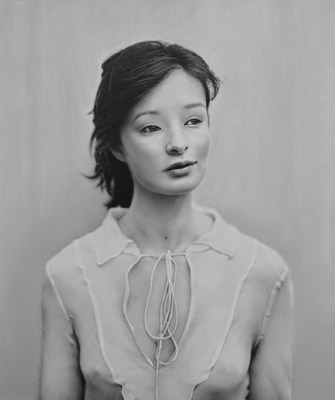 Kazuna Taguchi, Love is like the measles
2006, gelatine silver print
Kazuna Taguchi, Love is like the measles
2006, gelatine silver print
The person, or people, depicted are thus processed through montage, painting and then photograph, and at each stage their existence is made to change. The final photographs contain elements of our own everyday lives, and yet we have no experience of them.
June 13, 2011
Boris Mikhailov: Case History
Boris Mikhailov has used photography to document and to come to grips with the turmoil of life under the Soviets, and after the collapse of the Soviet Union. His Case History touches on such subjects as Ukraine under Soviet rule, the living conditions in post-communist Eastern Europe, and the fallen ideals of the Soviet Union.
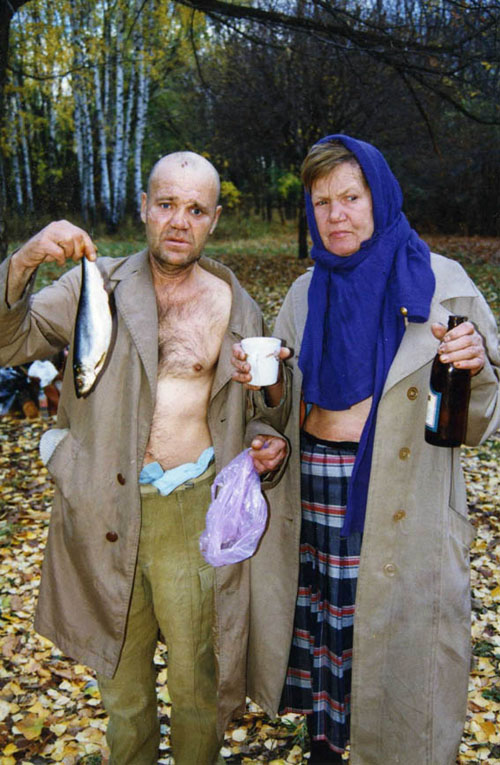 Boris Mikhailov, Untitled, from Case History, 1999
Mikhailov worked as an engineer in a camera factory until KGB agents discovered naked pictures he had taken of his wife. Suddenly jobless, he supported himself as an underground entrepreneur, enlarging and printing snapshots from customers’ family albums. He also exhibited his own work in small galleries and, after the fall of Communism, finally gained some attention for hand-coloured monochromes of everyday life.
In the intervening three decades, he has become, with llya Kabakov, one of the more important artists to have emerged from the former Soviet Union.In the Red Series (1968-75), Mikhailov documents the slogans and symbols of the Soviet era as heroic backdrops to the mundanities of everyday life. His interest in the personal is also evident in the Private Series (late 1950s), intimate black-and-white photographs of people dancing, socialising, or lying naked in their apartments - aspects of private lives which had no place in the official iconography of the Soviet Union.
In 1997 he returned to his home town of Kharkov after a year in Berlin and found this industrial city transitioning clumsily into capitalism. The rich paraded their fresh fortunes; the poor sank deeper into penury or fell into the new society’s chasms, or were spat out on to the street. The Soviets had managed to suppress homelessness, or hide it, but with the apparatchiks gone, the bomzhi (those of uncertain address) suddenly materialised in Mikhailov’s field of vision – and now he was free to capture them on film.
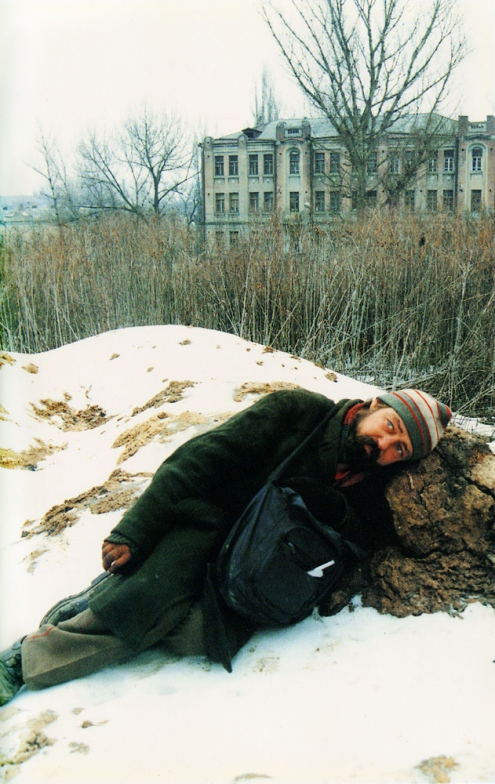 Boris Mikhailov, Untitled, from Case History, 1999
He concentrates on the homeless and orphans (the bomzhes) who are abandoned by the country’s social safety net and, in most instances, with no positive prospects for the future.While the subject matter may recall photojournalism, Mikhailov’s work diverges from it in at least one major way—Mikhailov paid his subjects to pose for him. Traditional photojournalists balk at the notion, believing that paid subjects will give them a performance instead of honesty.
June 12, 2011
Swedish Photography: Struan Gray
Struan Gray's commonplace book of ideas, musings and works in progress with lots links and photos is entitled Twiglog.
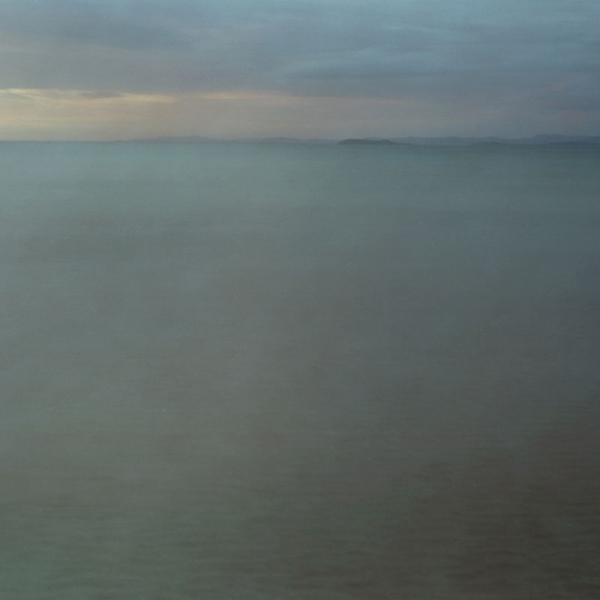 Struan Gray, Enard Bay, from the series Gaels
Gray says about his work:
it takes me time to apprehend the visual significance of things, and those of my photographs which move me the most are the ones taken over an extended period of time on repeated visits to the same small places.
He still dreams of travelling to take photographs of the remote and the exotic, but he knows himself well enough to be sure that the photographs would not be worth showing.
In this work he photographs in the long twilight and he accepts that the wind will take hold of the camera and add its own mark to the photographic process.
June 9, 2011
American photography: Clay Lipsky
Clay Lipsky says that photography is a passion not my profession. Graphic design is his trade. His Between Here and Nowhere series refers to a road between here & nowhere that cuts a path through a barren landscape that is inhospitable to most.
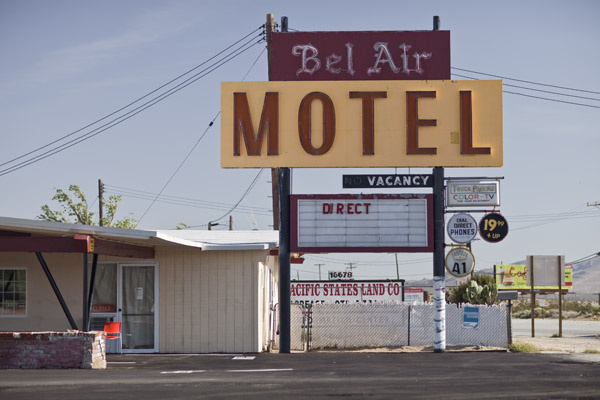 Clay Lipsky, Bel Air Motel, California
The series is about the rural decay scattered throughout the Mojave Desert to the toxic shores of the man-made Salton Sea and it focuses on documenting the ways mankind had altered this environment.
Lipsky says that:
I feel that my style is constantly evolving as skills and inspirations change. Although I follow a digital workflow, I generally do not use Photoshop to alter my works.The majority of my looks are derived in camera, with changes to color and tone coming out in the mix while developing the camera RAW files. Being a child of the analog era, I try to remain somewhat of a purist,meanwhile embracing the digital tools that are propelling the artform.
The ongoing Between Here and Nowhere series explores the reminders of civilized life here on the fringe of society along a road of broken dreams.
June 8, 2011
black + white photography today
An interesting point is made in this discussion between Michael Bühler-Rose and Matthew Gamber at Bombsite about black and white photography today.

Gary Sauer-Thompson, sauwastika?, Adelaide, 2010
I shoot a little bit of black and white but I do so without thinking much about it. Mostly I think when I'm looking at my digital archive, oh that would suit black and white, and I have a bit of play around.
Bühler-Rose is more reflective. He says that today we have:
an art world where large format and color photography is the norm. Now, if it isn’t in color, people assume it must be for some special effect, like you are trying to overemphasize that your photograph is fine art, or that you are trying to be a purist. However, if it is a special effect, then how can it be pure or essential? It’s an embellishment. If something is in black and white there must be a reason for it....Can you remember walking into a gallery and not seeing a huge C-print? Ten years ago, it was a novelty; twenty years ago it was a spectacle, and a rarity. Now, it is just the default.
Gamber agrees that this has become a normal thing to see and that people would say things like 30×40 is the new 8×10. He adds:
They had a point, in the sense that if you didn’t print at such a huge size, you weren’t taken seriously – you weren’t a professional. If you were still making contact prints in graduate school, you were living in the past and without a peer – because you were seen as anachronistic. Black and white seems to be forever locked into the look of mid-20th century, arguably the height of its use by both professionals and general consumers, at least in the industrialized world.
They both agree that black and white photography needs to be reinvented in that this mode of photography seems to be in a similar situation to painting having to re-establish its identity after photography.
Black and white photography is an obsolete media and users have the ability to revisit it with fresh ideas that were not really worked out before.This would focus on new uses, or rather, focus on how to recycle some old uses in new ways.
June 7, 2011
American photography: Mitch Epstein
Mitch Epstein is best known for his photographs of American life. From the demise of his father’s small business, to society’s recreational idiosyncrasies, to the face of a changing New York City, Epstein delivers a style classified somewhere between conceptual and documentary, showing the ordinary in its extraordinary state.
Between 2003 and 2009, Epstein explored how landscape and society intersect in the United States via energy production. He photographed energy production sites and their environs in twenty-five states and the resulting photographs have been published as a monograph (Steidl, 2009).
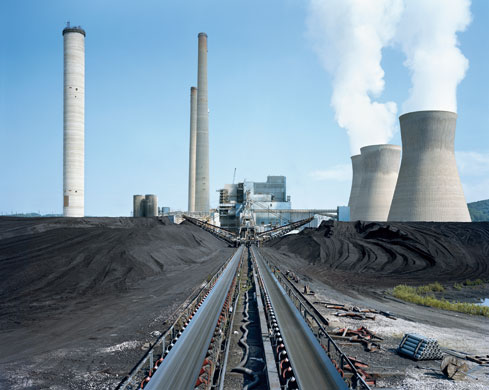 Mitch Epstein, Amos coal fired power station, Winfield, Virgina, USA , 2007, from the American Power series
American Power critiques the energy industry and its interventions in nature in much bolder gestures--cooling towers and oil refineries dominate the picture frame, riding roughshod over all rules of proportion and dwarfing anything in their vicinity.
Energy is the lynchpin in the relationship between American society and the American landscape.
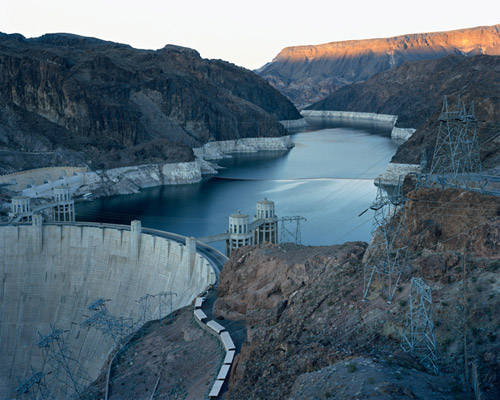 Mitch Epstein, , Hoover Dam and Lake Mead, Nevada 2007 (from American Power), 2007
He made these pictures on one to two-week forays near or at an energy source—what he calls “energy tourism.” The images implicate, but do not always directly reference fossil fuel, hydro-power, nuclear and wind power as they are used across the United States. Epstein has been stopped several times by the police and F.B.I. while photographing energy plants from a distance on a public sidewalk, and ordered to leave, although he was not trespassing.
The photographs were made on an 8×10 format because Epstein was photographing vast landscapes from a significant distance, from a half-mile or a mile-plus away and he wanted to make pictures that would be really information-rich and not fall apart as a large print. The 8x10 gave him the acuity, depth, and richness of information he was looking for.
In this interview in this Bombsite Epstein describes how he made the book:
Living in Berlin helped me detach from the adrenalin of being in the middle of making the work. I studied my prints (I’d brought a box of small ones) and made a list of things to hone in on to bring the project to a close. I started to think about how the photographs might work together as a whole—where each picture stands on its own but can also have a dialogue with the others. This goes to the heart of my bookmaking: figuring out a coherent structure that can contain many very different works without forfeiting their individual impact. The book’s coherence can’t be too obvious and it can’t be too obtuse.
American Power is kind of a testament to and investigation of the Bush-Cheney era with the project containing the themes of that administration.
June 6, 2011
romanticism, fragment, ruin
Photography, for me, has always been associated with representation as mimesis, rather than a Romanticism that spurns mimesis in the name of self-revelation. The key Romantic notions include subjectivity and experience, inspiration and imagination, irony and the sublime, the fragment and the total work, violence and revolution.
This Romanticism is not that of Wordsworth and Coleridge, and not even that of Byron, Shelley, and Keats; is that of German (Jena) Romanticism that sought not only to defend art, but to extend it to the entirety of life and merging art, philosophy, religion, politics.
Where mimesis reconnects with Romanticism is around the notion of the creative subject--- the 'I' that determines creativity and freedom. Though the centre of reality for Jena Romanticism was within the individual poet or artist and it expanded outward from the artist, the point of connection is the creative artist as genius following their natural impulses and an expressive subjectivity.
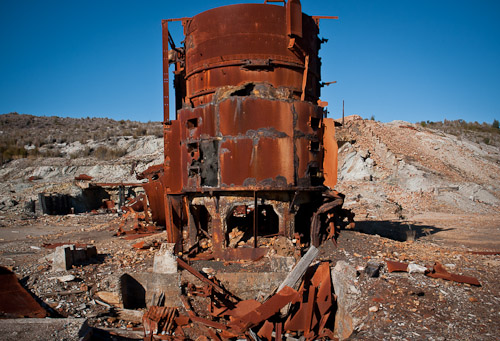 Gary Sauer-Thompson, mining ruins, Zeehan, Tasmania
Another way in which mimesis reconnects with Romanticism is the fragment conceived of as a hedgehog, rolled and close to the outside world, as in a solitary work of art or fine print. This is the artistic fragment as a radiant moment that reached beyond its own boundaries. Another form of the fragment is ruins.
Ruins suggest an absent whole; in their present of decay ruins signify loss and absence; their very presence as survival suggests endurance against the ravages of time and history.
June 5, 2011
American Photography: Richard Benson
Richard Benson is the former Dean of the Yale School of Art and an expert in photographic reproduction in book form. His resumé includes the monumental four volume The Work of Atget and many of Lee Friedlander's books. The Printed Picture is an erudite and witty survey of the entire history of pictorial printing processes, from 15th century woodcuts to the latest digital methods. Benson's organizing principle is that the physical and æsthetic characteristics of a given printing method constrain and modify the meaning of the image reproduced by it.
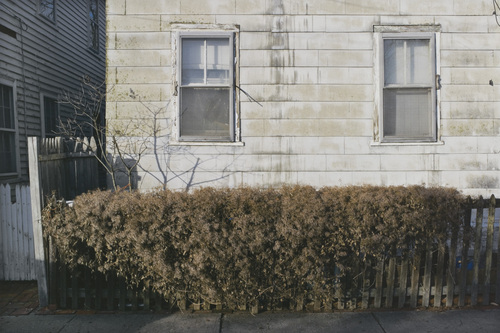 Richard Benson, Newport, Rhode Island, 2008, Pigmented inkjet print.
He is a large-format photographer and a master printer and he earned his money as a printer and teaching at Yale.
Though printing techniques have improved with digital improved techniques do not mean that people will make better pictures. There is still the matter of content, what a picture has to express, to give. In this interview he says:
If you get interested in the making more than in the thing you're making does then you're becoming a craftsman. And a craftsman is fine but an artist is a different creature.The worst possible thing you can do is to waste your energy trying to get all the little tiny bits and pieces right because when you get all those right the important things are wrong. So whenever I make something I just try to get the big issues roughly correct. I have no interest in getting the little things all precise. I don't really care if the thing is in register on press, I could care less. I don't care if there's a hickey. I care if they're not running enough ink because that's the thing that controls how the picture looks. I care if they plated it badly and it gets flat. So my notion about craft is it's a total waste of time to be chasing some notion of perfection when what we should be making is a roughly made object that serves its purpose well. I want it to carry out it's intent.
One of the things that happens in traditional ideas of craft is all the attention is paid to the wrong thing. It's paid to the detail. And to me the detail is never the thing that's hard to get right. The thing that's hard to get right is the big overall picture.
June 4, 2011
Hijacked 2: Australia/Germany
The Hijacked series from Big City Press has come to Adelaide in the form of an exhibition of Hijacked 2: Australia/Germany showing at the Anne & Gordon Samstag Museum, University of South Australia.
One of the Australian photographers is Andrew Cowen who has produced a self-published book entitled “Adelaide 1966 - 1999”. Cowen sees Adelaide as a quiet, conservative city where not much happens on the surface.
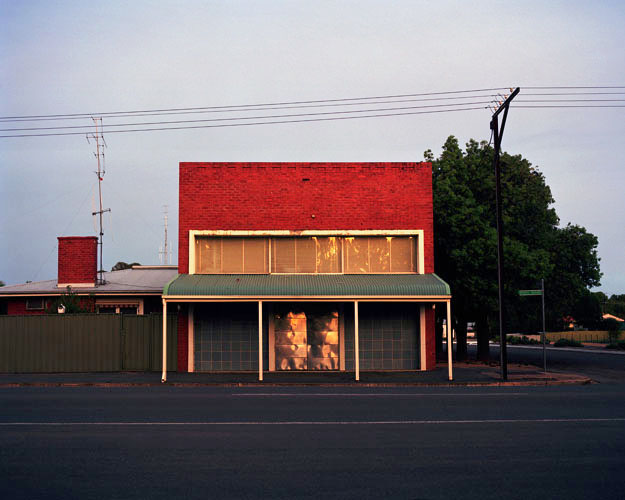 Andrew Cowen, Railway Tce, Snowtown, 1999, from the series Adelaide 1996-1999.
Cowen's thesis is that behind this peaceful façade there is a darker reputation: one of a macabre place where strange crimes routinely occur.
The photographs in this series are of places relating to the abductions and murders which have contributed to Adelaide’s infamy. The project covers a period of time commencing with the abduction of the Beaumont children in 1966 through to the discovery of barrels containing bodies in a bank vault in Snowtown in 1999.
I was disappointed in Hijacked 2 in terms of its claim to delineate the important artistic and socio-cultural relationship that exists between Australia and Germany. I couldn't see any from the way the exhibition was hung. It did not stimulate conversation, suggest connection and invite deconstruction.
June 3, 2011
architecture + place
Though we now live in a digital orientated future--eg., the national broadband network--- we are mesmerised by our analogue past---eg., the Hipstamatic-style apps for the iPhone. Or the Instagram. Both give snapshots the period look associated with the mass cameras and film from the 70s and 80s.
When I'm at Victor Harbor I've been focusing on the architecture of that specific place. Unlike the work of Mathilde Mestrallet it is nothing systematic, as its impetus is to document the old style beach architecture before it disappears and is replaced by ten apartments or a McMansion.
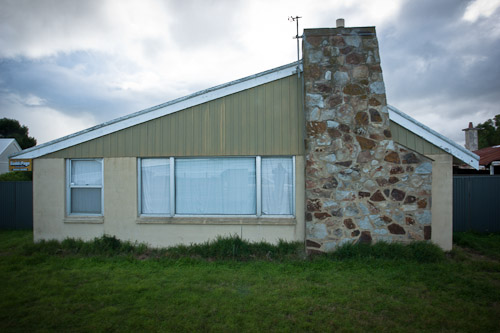 Gary Sauer-Thompson, beach architecture, Victor Harbor, 2011
Mathilde Mestrallet is far more systematic in the sense that her Résidences secondaires (2) project explores Sables-d'Or-les-Pins, a French resort town of Côtes-d'Armor, located in the communes of Frehel and Plurien.
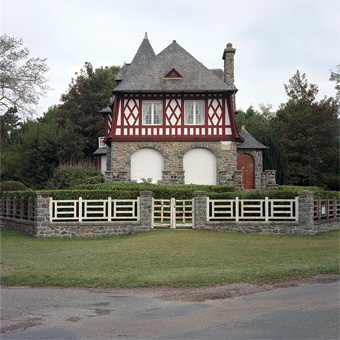 Mathilde Mestrallet, untitled, from Résidences secondaires (2)
This resort town was created from scratch in the 1920s. It had some glory years, especially with wealthy clients come to occupy the villas of Anglo-Breton pink granite, then the crisis of 1929, it was forgotten. This photographic series is the result of a wandering in the station emptied of its population, the houses mostly appear as closed theaters inanimate curtains remained closed, where it should open a window for him to play something, a moment.
In South Australia there is a nostalgia for the old. The place that the future once occupied in the imagination (eg., the 1960s) has been displaced by the past: that's where the romance now lies, with the idea of things that have been lost. The accent is not on discovery but on recovery. It's as if we want too transport to yesterday, or to shuffle and share architectural detritus from long ago .
June 2, 2011
photography in its expanded sense
In Infinite exchange: The social ontology of the photographic image in Philosophy of Photography (vol.1/ no.1) Peter Osborne refers to photography in its expanded (and still expanding) sense.
By this he means the historical totality of photographic forms, or types of images produced in one way or another by the inscription of light: predominantly, until recently, chemical photography, of course, but also film, television, video and now digital photography, as well as photocopying and scanning, and even microwave imaging, infra-red, ultra-violet and short-wave radio imagery. He adds that:
Given this historical diversity of technologies, there is no more reason to privilege the chemical basis of traditional photographic image-creation in the delimitation of the parameters of the concept of photography than there would be to constrict the parameters of ‘painting’ by the chemical composition of pigments used during the Renaissance. Photography, like art, is a historical concept, subject to the interacting developments of technologies and cultural forms (that is to say, forms of recognition); increasingly, developments within photography, along with digital-based image production more generally, are driving the historical development of art. This is so not just reactively, as was initially mainly the case in the second half of the nineteenth century and the first half of the twentieth century (in the transformation and internal retreat of other forms of representation), but affirmatively, in the use of photographic technologies to produce ‘art’ of a variety of kinds.
That sure shifts the ground of recent debates about digital v film doesn't it.