|
June 7, 2011
Mitch Epstein is best known for his photographs of American life. From the demise of his father’s small business, to society’s recreational idiosyncrasies, to the face of a changing New York City, Epstein delivers a style classified somewhere between conceptual and documentary, showing the ordinary in its extraordinary state.
Between 2003 and 2009, Epstein explored how landscape and society intersect in the United States via energy production. He photographed energy production sites and their environs in twenty-five states and the resulting photographs have been published as a monograph (Steidl, 2009).
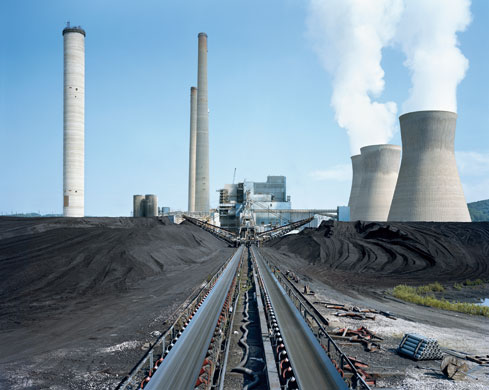 Mitch Epstein, Amos coal fired power station, Winfield, Virgina, USA , 2007, from the American Power series
American Power critiques the energy industry and its interventions in nature in much bolder gestures--cooling towers and oil refineries dominate the picture frame, riding roughshod over all rules of proportion and dwarfing anything in their vicinity.
Energy is the lynchpin in the relationship between American society and the American landscape.
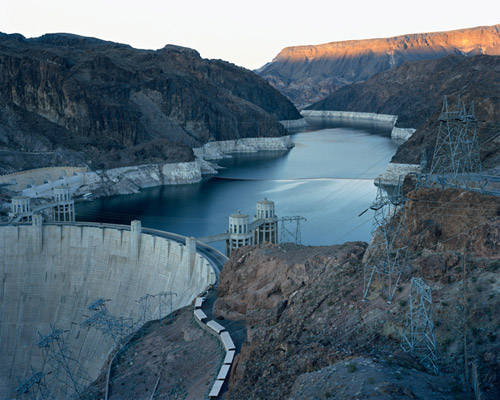 Mitch Epstein, , Hoover Dam and Lake Mead, Nevada 2007 (from American Power), 2007
He made these pictures on one to two-week forays near or at an energy source—what he calls “energy tourism.” The images implicate, but do not always directly reference fossil fuel, hydro-power, nuclear and wind power as they are used across the United States. Epstein has been stopped several times by the police and F.B.I. while photographing energy plants from a distance on a public sidewalk, and ordered to leave, although he was not trespassing.
The photographs were made on an 8×10 format because Epstein was photographing vast landscapes from a significant distance, from a half-mile or a mile-plus away and he wanted to make pictures that would be really information-rich and not fall apart as a large print. The 8x10 gave him the acuity, depth, and richness of information he was looking for.
In this interview in this Bombsite Epstein describes how he made the book:
Living in Berlin helped me detach from the adrenalin of being in the middle of making the work. I studied my prints (I’d brought a box of small ones) and made a list of things to hone in on to bring the project to a close. I started to think about how the photographs might work together as a whole—where each picture stands on its own but can also have a dialogue with the others. This goes to the heart of my bookmaking: figuring out a coherent structure that can contain many very different works without forfeiting their individual impact. The book’s coherence can’t be too obvious and it can’t be too obtuse.
American Power is kind of a testament to and investigation of the Bush-Cheney era with the project containing the themes of that administration.
|


