September 30, 2010
National Gallery of Australia: indigenous art
The National Gallery of Australia has finally had a face lift--a new entrance--and an extension of its gallery space. Finally its extensive collection of Indigenous Art in all its diversity----regional and media---can be displayed.
One region that I know little about is that around Broome:
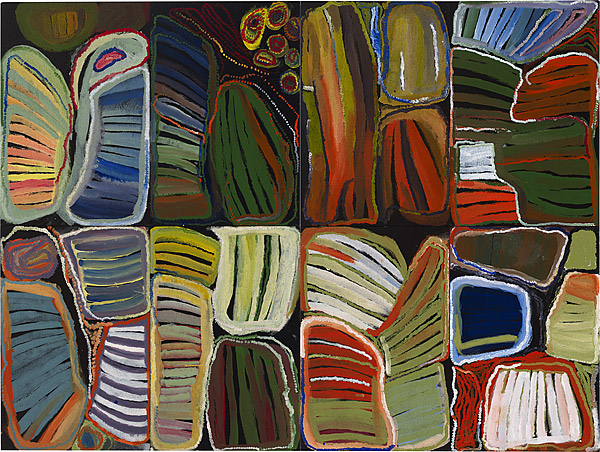 Jan (Djan Nanundie) Billycan, All the Jila, 2006, synthetic polymer binder with langridge dry pigment and marble dust on plyboard
The eight panels depict the Great Sandy Desert near Well 33 in Western Australia.Jila refers to waterhole.
The Yulparija people came to Bidyadanga, a coastal town situated 250km south of Broome, from their country which runs from Telfer in the south to Kintore in the east and to close to Fitzroy Crossing in the north. Most of the Bidyadanga artists are the Yulparija elders who have spent most of their lives in the desert living in the traditional bush way. Much of their work reflects this and depicts the country on the Canning stock route around well 33.
September 29, 2010
the desire for technological perfection
An interesting article by Kirk Tuck on the desire for technological perfection in photography. In this case it is a Leica M9 (digital) and a 35mm Summilux f1.4 lens which I did aspire to before settling for a new lens (35mm Summicron f2 on my old old M4-P rangefinder body.
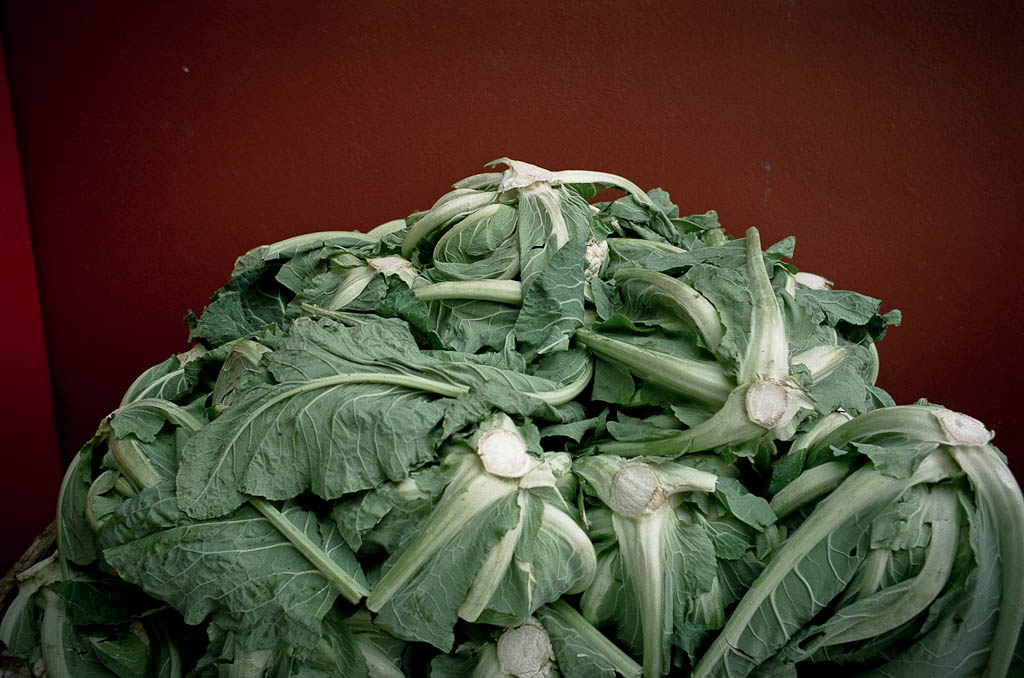 Gary Sauer-Thompson, Adelaide market, 2010
Tuck says:
So, would I buy it? Would I invest in the system? I'll admit I can't justify the $9000 for the camera and the $4900 for the lens at this point...If money were no object I'd own everything in the Leica catalog in a heartbeat ....when I look at my budget and then I look at the gear I want there is always a disconnect. Let's call it a chasm. I want the best stuff in the world but I'm only going to see the difference when I shoot in a way that I don't usually shoot. I love the look of the 35mm Summilux wide open but I rarely shoot that way. I love the way the Leica lens and a camera blow up. But my clients are looking for work that fills magazine pages and websites...I think I'm over an important hurdle.
Tuck says that he finds that he just doesn't care about sharpest and best any more. He's not rushing after the best technical gear, as he is pretty happy just looking for the images. For the emotion of the image. For the power of a connection.
If the Leica M rangefinder camera body is generally one of the few designs of the 20th century which industrial designers reckon is so perfect that they would never try to change, it is the Leica M series lenses that are the real lure of the M system for most available light shooters. Their optics are second to none---the emphasis is on high apparent sharpness and great rendering of micro fine detail---but the trade-off has always been the very high cost of those lenses.
September 28, 2010
Bowness Photography Prize 2010
The Monash Gallery of Art runs the William and Winifred Bowness Photography Prize. The blurb says:
The Bowness Photography Prize is also one of the country's most open prizes for photography. In the past, finalists have included established and emerging photographers, art and commercial photographers. All film-based and digital work from amateurs and professionals is accepted. There are no thematic restrictions.
The 34 finalists are here. There is some interesting work. My favourite is:
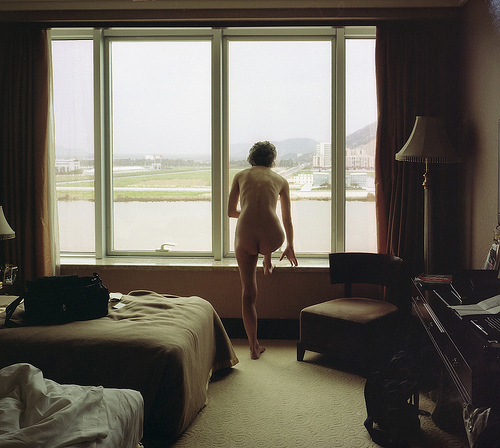 Janina Green, Untitled (Figure at window) from the series Macau 2010, chromogenic print
Janina Green an artist and lecturer in Photography at the Victorian College of the Arts will take up a short residency in the newly renovated Courtyard Studio Flat. Since her first solo exhibition in 1986 she has had an extensive exhibition record producing seven different bodies of work; Reproduction, Still Life, Figure Works, Manual Labour, Vacuum, Plantation and Scooping Up the Moon at Plum Creek, maid in Hong Kong.
art criticism
Reflecting on the debate on art criticism at Critical Failure on film, books, theatre, and the visual arts Ben Eltham says in Crikey that:
In the new world, armies of bloggers and online critics have diluted that power — but also democratised and decentralised critical culture globally. On the internet, everyone’s a critic — or can at least try. As a result, the old verities are being challenged, and print critics are increasingly finding themselves marginalised in their own publications.
Eltham adds that the old status distinctions are breaking down, and what’s replacing them is a rich ecosystem of amateur but often highly informed online critical writing.
The space in the mainstream press for art criticism continues to decline and a lot of art criticism in the mainstream press is puff pieces in the lifestyle pages that recycle media releases. These are essentially promotion.
September 26, 2010
water in Lake Alexandrina
We travelled around Lake Alexandrina from Victor Harbor yesterday to take some photos. The site had been planned along with the right conditions.
The recent rains in the Murray-Darling Basin have ensured that water is now flowing into the lower lakes with both Lake Alexandrina and Lake Albert filling up. I think that Alexandrina is full whilst Albert is still filling. Little water has been released into The Corrong. None has gone through the mouth.
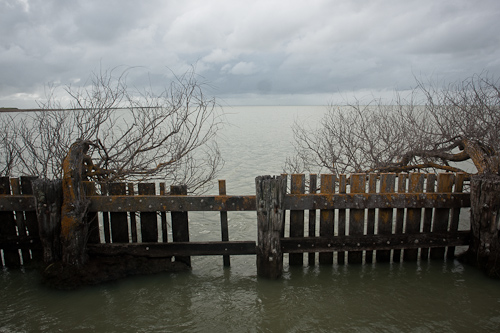 Gary Sauer-Thompson, Lake Alexandrina, The Narrows, 2010
The bird life is returning, the trees are recovering and the pumps and regulators between the lakes have been dismantled. So it is a cause of celebration.The flow of water is momentary, however due to the lack of progress by state and federal governments in cutting back on irrigator entitlements to water from the Murray-Darling river system.
My photography was not successful. The site (Point Malcolm) near The Narrows between the two lakes that I had planned to walk to with the Linhof 5x4 had been fenced off and was inaccessible. We ran out of time to scout for an alternative site on the southern edge of Lake Alexandrina because we had to get back to Victor Harbor. It was frustrating because I had chosen the right day.
The only way this part of the River Murray project can be done is to stay at one of the cottages at Poltalloch Station for 2-3 days.
September 23, 2010
a sour note
I see that the antagonism to photography in public places continues to gather momentum. This time it is Perth's Cottesloe Beach in Perth, Western Australia. Some of the proposed regulations make sense: a ban on ball games, alcohol, smoking, dogs, selling things, glass, flying kites and urination.
I appreciate the photography ban is on commercial photographers without a permit---ie., the photos you want to sell or make money from. You can still take photos of your friends and of the scenery while visiting the beach, but you couldn't setup and take you swim suit shoot for Maxim on the beach without getting approval. Fair enough.
However, overzealous police and council officers could take this further. It has happened to me. The camera is part of the profile of lurking pedophile. The police hassle you because you have a camera. Presumably, this results from the "threat of pedophiles" taking the photo of children at the beach--- a commonly waved red flag for cultural conservatives these days. I cannot see a pedophile ring being smashed because someone was caught by the police taking the photo of a child at the beach.
There is an underlying or unconscious hostility around photography, bodies and sex these days that sits just below the surface. I no longer even consider taking photos of people a the beach.
September 22, 2010
bitten off more than I can chew
I've spent the evening loading sheet film for both my 4x5 Linhof Technika field camera (colour film) and the 8x10 Cambo monorail view camera (black and white film). The 8x10 colour film has yet to arrive from the US. I plan to load up the 5x7 colour sheet film tomorrow night, once the bellows of the 5x7 Cambo has been checked for light leaks.
It is 15 years since I have used these large format camera and the bellows of the 5x4 and 8x10 have had to be replaced. My plan was to start using the 8x10Cambo view camera tomorrow morning to shoot some black and white studies of rock forms below the cliff tops.
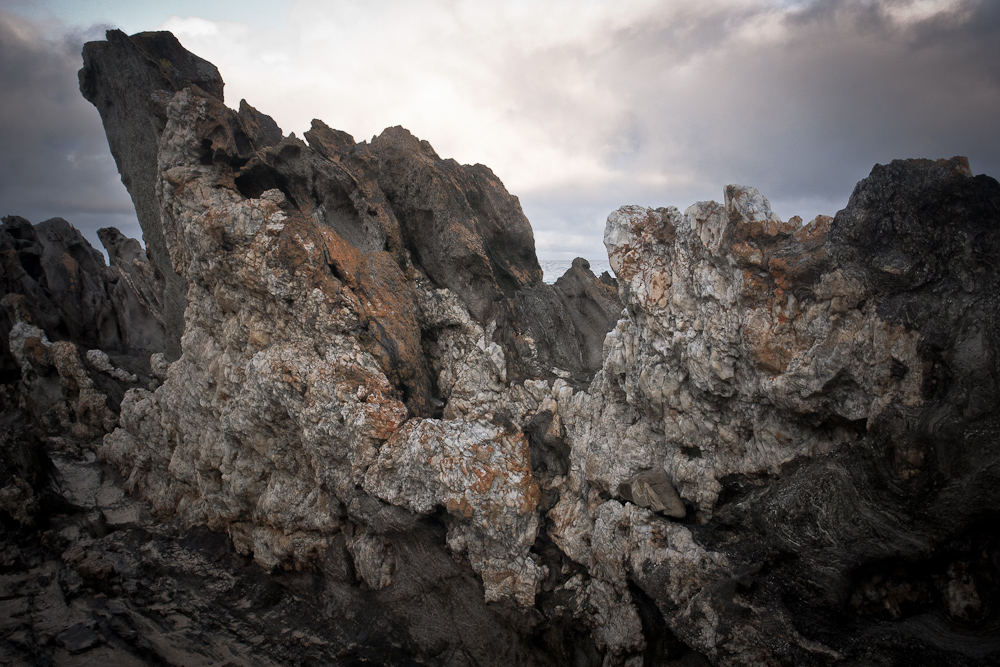 Gary Sauer-Thompson, Petrel Cove, Victor Harbor, 2010
After loading the 8x10 film I did a dummy run with the gear to see how things would work out. I loaded up the computer bag with the 6 dark slides, picked up the monorail camera in one hand and the Linhof Heavy Duty Pro tripod (with its geared centre post and Profi 3 pan tilt head) in the other hand, then started walking.
I only made it through the front door. It was too heavy, even though I've been doing weights and cardio at the gym 4 days a week for a year to built up my strength for this. The 8x10 view camera is so bulky that it won't fit in the Lowe Pro Trekker pack that I had bought. There is just no way that I can walk a couple of kilometers over rocks with this kind of camera gear balanced in each hand. An exercise in failure?
So no rocks. It's ten paces from the car for this kind of 8x10 equipment. So the 4x5 Linhof field camera is going to have to be the portable large format camera. It's what most people do, anyway.
Update.
The bellows of the 5x7 Cambo has light leaks and I need to order a new one from Custom Bellows in England.
I used the 4x5 Linhof field camera this morning. Suzanne and I walked up a path that ran along a fast flowing Currency Creek for 30 minutes or so to this location.
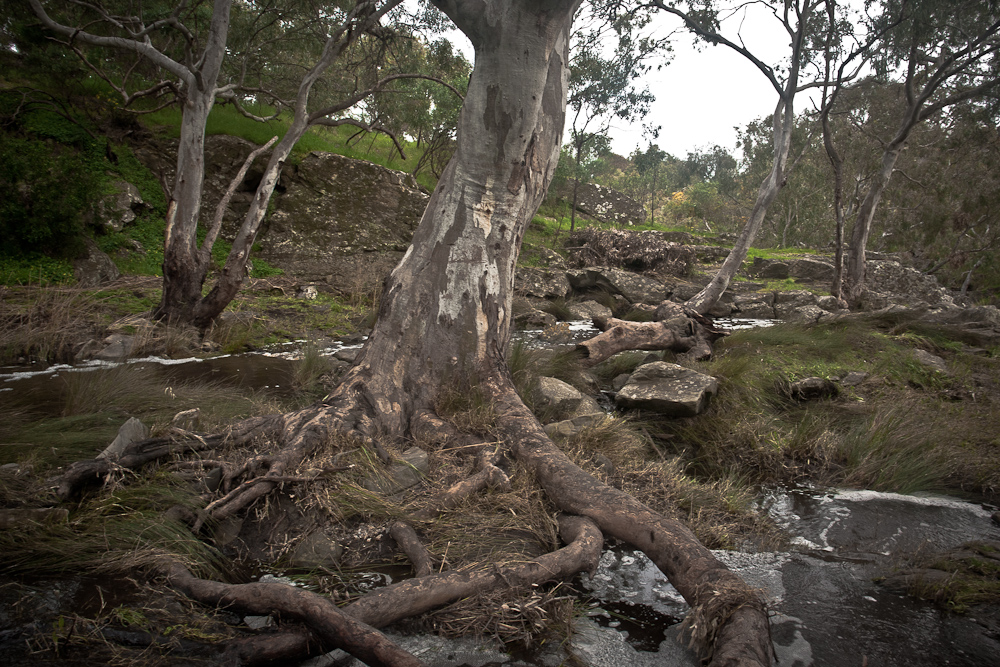
Suzanne carried the Pro Trekker pack with the 4x5 Linhof camera whilst I carried a medium sized Linhof tripod. I could not carry pack and tripod. I could only do so if I had a carbon fibre tripod that could be attached to the pack.
I also used the 8x10 Cambo this afternoon carrying the camera and tripod in each hand for half a kilometre along a boardwalk to the mouth of the Hindmarsh River in Victor Harbor. That was my limit. It's an exercise in self-punishment.
September 21, 2010
burnt rubbish bin
I'm down at Victor Harbor for the week. Suzanne has taken a week's holiday at the weekender and I'm doing some photography in the local area. I'm exploring sites that are easily accessible for an 8x10 view camera and are suitable for black and white.
I came across this scene early on Monday morning--the rubbish bin had been set alight by the local bogans using fuelant on Sunday morning. I had seen the bin smoking then when I parked the car and started to walk along the clifftops to take some shots of rocks. I thought little of it then, until I turned up on Monday morning.

On the weekends the bogans use their leisure time to knock over rubbish bins, ram them with their cars, spilling rubbish over the road, damage any cars left on the street, and burn the council rubbish bins. It's called fun.
This particular bin is in a car park above a tourist beach at the foot of Rosetta Head. The beach, which is well used by families, surfers, fisherman, whale watchers and others, is a particular target.
September 19, 2010
a voice from the past
The pope-- Benedict XVI-- has urged Catholic children to find happiness in God rather than model themselves on sport or entertainment stars. Benedict XV1 does go on with his lambasting of atheist extremism and aggressive secularism, ruing the damage the exclusion of God had done to public life in the last century, and that atheists and multiculturalists (for heavens sake) threaten the national celebration of Christmas.
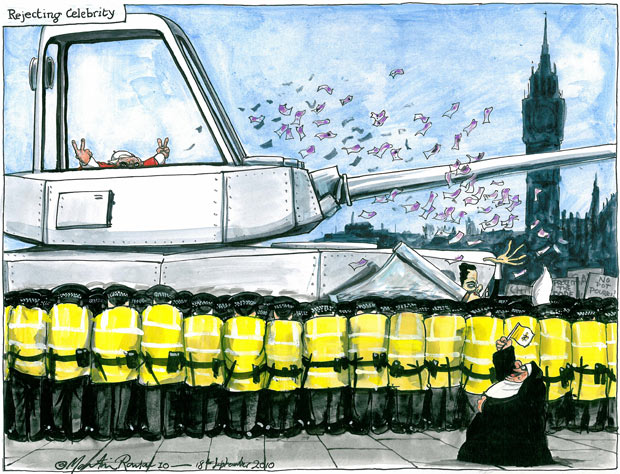 Martin Rowson
My reaction is that he pope- is an anachronistic curiosity. His church is one that covers up sex abuse scandals, whose teachings on contraception, remarriage and homosexuality are ignored, and who claims that religion must be the moral basis for everything.
September 18, 2010
Why Photography Matters
I'm down at Victor Harbor for this week to start the ball rolling on large format photography. Photography matters for me. But why? One attempt an answering is Michael Fried in his Why Photography Matters As Art As Never Before; a text concerned with exploring the importance of contemporary tableau photography—defined as large-scale photographs intended to be hung on walls and viewed as painting. It rejects the narrow view of photography – the idea that the camera is a recording device, not a creative tool, and that its product is strictly representational – not manipulated, not fabricated, not abstract …
The issue here is not that the photographs of Jeff Wall, Jean-Marc Bustamante, Thomas Struth, Thomas Ruff, Andreas Gursky, Hiroshi Sugimoto, Luc Delahaye, Beat Streuli, Philip-Lorca diCorcia, Rineke Dijkstra, Patrick Faigenbaum, Roland Fischer, Thomas Demand, Candida Höfer, James Welling and Berndt and Hilla Becher are necessarily better art than those of their predecessors, but that it is in these pictures that some of the most interesting critiques of representation of the last 30 or 40 years have taken place: that it is these artists’ engagement with certain artistic and philosophical ideas that distinguishes them.
The book begins at the point in the late 1970s when contemporary photography, moving away from its journalistic functions, and increasingly conscious of its size and subject matter, began to be made to hang in art galleries and on museum walls. These large-format canvases were usually ascribed to "artists using photography" rather than photographers (making art).Most viewers look at a large photograph on a gallery wall differently than they would look at it in a book, or as a small print. They prepare themselves for a lengthy, meditative relationship with the image. At this point, Fried argues, contemporary art photography inherited "the entire problematic of beholding".
According to this claim, because the photographic tableau emerges in the wake of Minimalism and of new concerns about voyeurism and the inherently contaminating effects of beholding, it must acknowledge what Fried terms “to-be-seenness” even as it must continue to resist theatricality. The antithesis of theatricality is absorption. In his usage of these terms, if a work acknowledges, addresses, or otherwise includes the beholder, it’s theatrical; if it’s self-contained and self-sufficient, it’s absorbed. The paramount aim of modernist painting in the 1960s, according to him, was to defeat theater.
Photography matters, Michael Fried argues , because it has become the place where a certain crisis of the picture inaugurated in the late 1960s has played out most meaningfully. This crisis was enunciated clearly in the title "Art and Objecthood." Is a certain thing art or an object? The ontological nature of photographic representation as it has been understood in the last thirty years or so--that it is indexical, baring the physical traces of the thing it represents means that it has become a medium uniquely charged with the task of overcoming its seeming belonging to the world of objects. Up until the mid-1970s, making art photography meant denying the indexical nature of the medium and prioritizing the pictorial surface, something that has come under enormous pressure for a variety of reasons.
To make art from photography today means instead to accept the indexical nature of the medium and to find ways of establishing photography as a properly pictorial, that is to say artistic, form of representation.
September 16, 2010
Photography now
An interesting online photographic site Photography Now ---International Fine Art Photography today that is centred around the (American) modernist canon of analogue photography in the 20th century.
What is left unsaid is that digital photography emerges from analog photography, which is slowly disappearing. As was pointed out in Salon.com people still shoot with single lens reflex (SLR) cameras and 35mm lenses and software means that there is no shortage of ways to make digital images seem as though they were shot on film.
September 15, 2010
'I was lovin' it'
An overweight, middle-aged man lies dead on a mortuary trolley, with a woman weeping over his body. The corpse's cold hand still clutches a half-eaten McDonald's hamburger. This provocative new fast-food commercial by the Physicians Committee for Responsible Medicine (PCRM) in the US draws attention to the link between heart disease deaths and fast food. Studies show that people who consume fast food-- the high-fat, high-sodium offerings at fast-food restaurants are at a higher risk for obesity, a factor contributing to heart disease.
I doubt that a similar commercial will be aired in Australia, even though unhealthy food is a major health problem in this country. Health professionals talk in terms of high cholesterol, high blood pressure, heart attacks; or an "epidemic of childhood obesity"; and supports public health campaigns that encourage physical fitness and improved diets. They support the fight against obesity induced by fast food.
However, there are no bans on advertising by the food industry that aims uses advertising strategies to get kids hooked on eating high-sugar, high-fat foods early in life. A non-regulatory approach to banning excessively fatty, sugary and salty food, is favoured. The argument is that there is no need for the nanny state because everyone just needs to be more responsible; those who aren't responsible are moral failures. This argument ignores how individuals' "free choices" are shaped by marketing and advertising.
It has a class dimension in that diets and diet-related disease are in fact a map of inequality. Those on lower incomes are more likely to suffer obesity, as children and as adults. They have higher rates of raised blood pressure thanks to excess salt in their processed diets. They are more likely to suffer diabetes and heart disease. They have more dental disease from excess sugar.
Just like the tobacco industry, the food industry has depended for its sales on this symbiotic relationship with the advertising industry. That's why tackling smoking required the states intervention to control tobacco advertising, to tax cigarette prices up, and to ban smoking in public places to help people quell the desires that had been so skillfully awakened by advertising.
There are no legal health and safety standards for food with respect to high levels of salt, transfats and saturated fats to tackle our unhealthy food culture.
September 14, 2010
rubbish
Walter Benjamin's work eloquently testifies that reading 'the rags, the refuse' of culture reveals much about the constitution of culture. What a culture does not value speaks as much about that culture as what it does value. In a consumer economy that fetishises the commodity and consumption the realm of waste, that which is left over or left behind, is politicised.
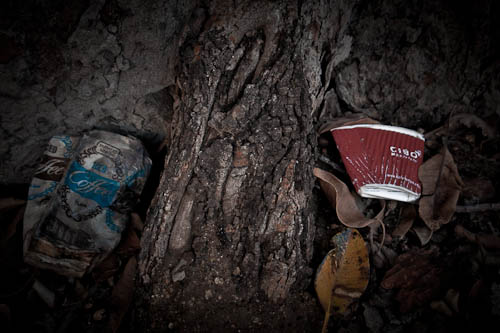 Gary Sauer-Thompson, Cibo + Iced Coffee, Adelaide Parklands, 2010
The politics of waste centres around waste as profligate or excess consumption, or as leftover material, or as something that has deteriorated through neglect or lack of effort. Whether it is rubbish, junk, clutter or other extravagance excess, and squander, waste is too much.
It also too little in the sense of ‘not making the best use of something’ (time, resources, opportunities). This gestures to another stream of waste that is associated with the Enlightenment idea of progress. Progress is movement away from scarcity, disorder and deficiency towards enlightened reason, discipline and mastery. The shadow is waste land that needs to be filled in.
It is anachronistic unused space that needs to be made useful by developers.
September 13, 2010
Wilderness: New South Wales Art Gallery
Wilderness, an exhibition at the New South Wales Art Gallery in March-May 2010 considers how nature and landscape continue to preoccupy contemporary painters. This is the first in a new series of biennial exhibitions supported by the Balnaves Foundation. These are called ‘Balnaves Contemporary’ and consist of three exhibitions in the series, which are planned for 2010, 2012 and 2014. The first considers painting, the second, photography and the third, contemporary sculpture and installation.
The title of the exhibition is misleading as it suggests the concept of ‘wilderness’, of a land and nature unspoilt by humankind. This contrasts urban life and cultivated nature from ‘untouched’ areas a landscape untouched by humans in which the pristine is held to be more valuable than land marked, shaped and cultivated by humans.
Wilderness is not about observed landscape, but about imagined regions, psychological landscapes, creatures both natural and unnatural, the importance that ideas of the 'wild' still play in our minds and lives, and how we inscribe nature with memory and meaning. Unfortunately there are no images online from the exhibition.
On the of the painters in the exhibition was Andrew Browne, whose paintings are based on his continuing observation of the natural world through photography to make strange the familiar.
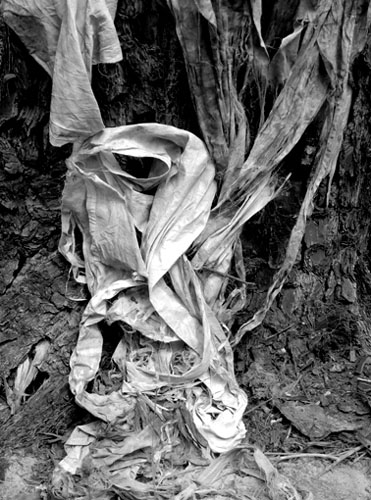 Andrew Browne From the Periphery #09, 2010, B&W photographs, on Harman Pro, Inkjet Warmtone
It is a very straightforward image that is then used as raw material to construct this:
 Andrew Browne, Periphery #11 (apparition) 2010, Oil on Linen
September 12, 2010
The Ecologies Project
In 2008 the Museum of Art at Monash University in Melbourne showed The Ecologies Project. Its concern is that as we globally seek a new balance with the ecological systems that sustain us will the endgame be an apocalyptic visions drive change, or can our wonder in the natural world inspire the creation of a brighter future?
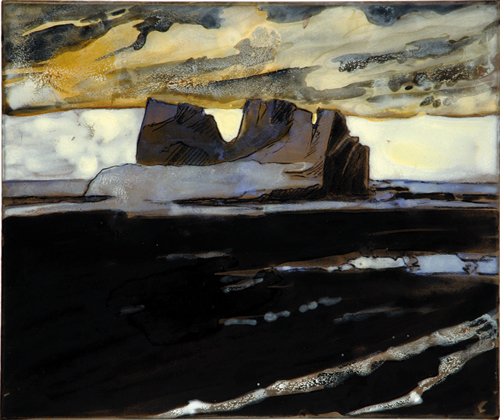 Mandy Martin, Iceberg, 2007 Epic Fatality Ochre, pigment and acrylic on arches paper
The exhibition blurb for The Ecologies Project says:
Artists have long drawn inspiration from nature, as well as being advocates for a sustainable relationship between humanity and the environment. Now that a need for change has become broadly accepted, what role for art? Even with this accepted impetus to action, the particular paths we might take are unclear. It is an exciting and unsettling time as we sit between the darkest and most hopeful of futures. We must grapple with a myriad of abstract and interconnected systems, economic, environmental, social and philosophical. At this moment in time, art offers a lens through which we can examine the world as well as a kind of metaphorical thinking that can sharpen our perception of the relation between these complex parts and their impact on a dynamic whole. The Ecologies Project includes work by 40 artists exploring issues of sustainability, climate change and the idea of ecology as both form and metaphor.
So we have art exploring the complex ways in which we shape and are shaped by our environment and the question raised is whether we are going to be active in creating the future, or merely passively subject to it
September 11, 2010
Stormy Weather: Contemporary Landscape Photography
The Ian Potter Gallery at the National Gallery of Victoria currently has an exhibition entitled Stormy Weather Contemporary Landscape Photography. The works shown are drawn entirely from the National Gallery of Victoria Collection, which has an extensive collection of Australian photographs.
This exhibition charts some contemporary approaches to the landscape featuring 24 photographs from the work of eleven Australian photographers including Rosemary Laing; Harry Nankin; David Stephenson; Richard Woldendorp; Nici Cumpston, Anne Ferran, Stephenie Valentin, Murray Fredericks, Jill Orr and Siri Hayes.
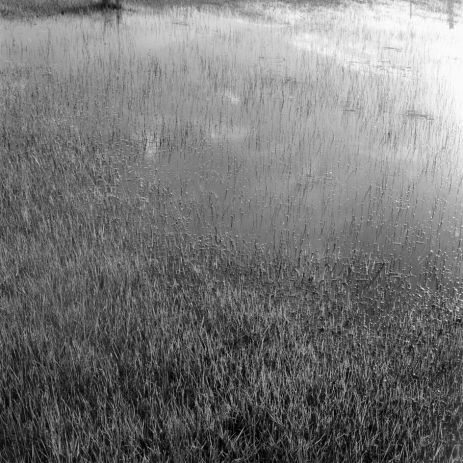 Anne Ferran, Untitled (Lost to Worlds 2 series) 2008-2009, Digital print on aluminium
The Potter Gallery's exhibition blurb, which is written by Dr Isobel Crombie, the Senior Curator, Photography, National Gallery of Victoria (NGV), Melbourne, says:
Photographers’ interest in the landscape has increased in the last few years. Perhaps as a result of heightened environmental awareness, or an evolution in our engagement with Australian history, practitioners are again turning to the natural world as a site for critical practice and inspiration...The artists displayed here reveal history in a landscape; provoke ecological concerns; use the landscape as a site of performance; or reveal the distinctive beauty of a place.
Crombie's catalogue of the exhibition, which explores the recent history of landscape photography, is not online. So I have no idea how Crombie, who has written extensively on Australian photography, interprets the Australian tradition of landscape photography from art historical perspective. I would assume that the tradition is divided into different stages--- starting from 19th photography in settler Australia --- that reflect the different styles and concerns in landscape photography.
I reckon that Jill Orr is the one who uses the landscape as a site of performance as I remember the site-specific works being staged on the banks of the Murray River and on the waterless salt-encrusted surface of Mitre Lake in Victoria’s arid Wimmera district in 2007. Here Orr addresses what psychoanalysts sometimes refer to as ‘trans-generational haunting’, that is the way in which repressed or unspoken secrets are passed, predominantly in the form of traumatic interactions, from one generation to the next.
The work of Siri Hayes is intriguing. The images of Lyric Theatre at Merri Creek shows an immense canopy of trees that dwarfs three tiny people standing on the banks of a creek in inner city Melbourne. On the one hand we have the beauty of nature--- of Merri Creek at the edge of the city of Melbourne:
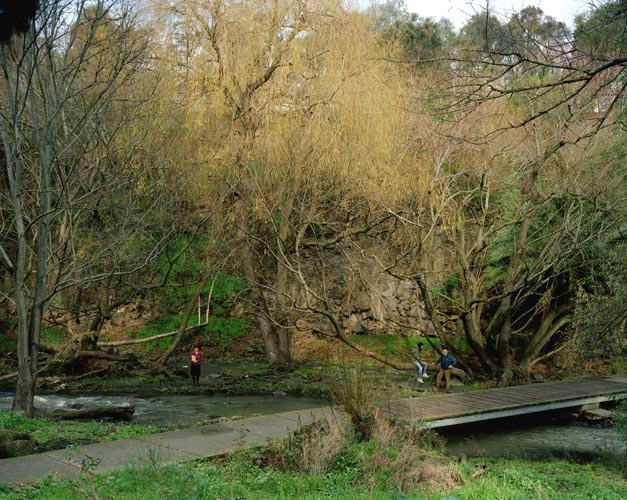 Siri Hayes, Untitled, Lyric Theatre at Merri Creek
On the other hand, the images in Hayes’ series also represent an ecosystem in a downward spiral, where the effluvia of modern life – the ubiquitous Coke cans, plastic bags and syringes – choke up waterways and spoil the picture-postcard view. People are then theatrically included in this damaged natural landscape in a seemingly unconnected way; there is a suggested narrative but we are unsure what the story is.
September 9, 2010
Kevin O’Faircheallaigh's jeremiad against photography
Here's another Susan Sontag inspired criticism of mass tourism and digital photography by Kevin O’Faircheallaigh that takes the form of "I hate mass photography".
says that loves Andreas Gursky and LaCahapelle O’Faircheallaigh, who writes for Crikey's travel blog, says that So I love photography in and of itself. This, however, is misleading. He is opposed to photography in itself.
I have however, never owned a camera. I’ve always felt that moments of visual beauty or happiness should be enjoyed, then allowed to become memory. I feel like while the photo may provide a more accurate record of something, it then takes over and the memory itself becomes what you see in the photo. I like the self adjusting function of the brain that lets you remember an experience as it felt, not just how it looked. Others will disagree, and I can’t deny the warm sense of nostalgia that you can get looking back over old photos. Overall though, I think photos lessen an experience rather than enhance it.
This is a familiar criticism and it is not linked to the art photography that O’Faircheallaigh judges to be worthwhile. So we are lefty with the familiar modernist duality of high and low, good and bad recycled by cultural conservatism to condemn the user generated work opened up by digital photography as documenting their holidays. Presumably, Gursky and LaCahapelle are not documenting.
Dan Miller, an Australian photographer, is the exception to O’Faircheallaigh's bad mass photography (half decent pictures) done with modern digital cameras. This suggests that those who buy expensive, top end digital camera are going beyond just recording their weekend full of happy slapping. They are, presumably, taking decent photographs.
September 8, 2010
Paris Photo 2010: Matt Wilson
Paris Photo 2010 is the yearly European venue to discover the most current happenings in art photography from around the world, bringing together, from November 18th to the 21st, one hundred international galleries and publishers showcasing work from more than 25 countries – with a special emphasis on photography from Central Europe.
One of those selected or exhibiting (I don't know how it works) is Matt Wilson:
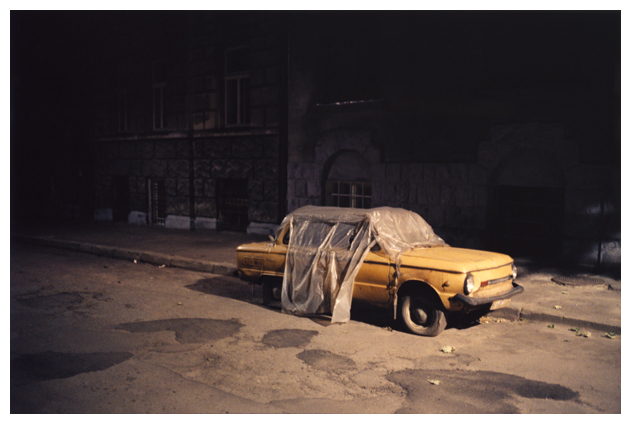 Matt Wilson, Untitled, Lviv #7 from Looking East
There is not that much information online about Wilson or his work. He is British born. I am interested in his work because be works within the tradition mapped by Simon Schama in his Landscape and Memory.
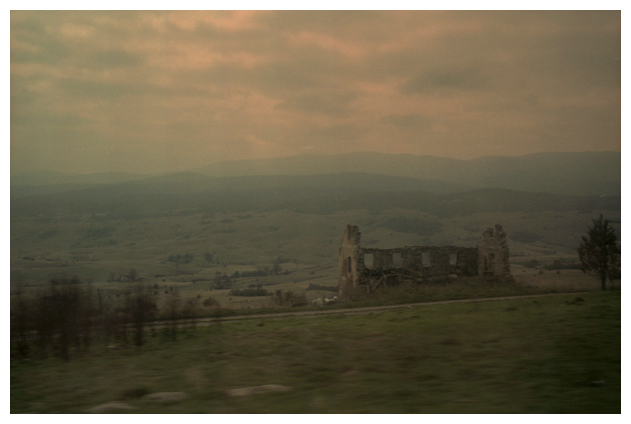 Matt Wilson, Untitled, Bosnia, from The Lamb and the Falcon
 We see the ghostly outline of the old landscape beneath the covering of the contemporary and become aware of the centuries of associations. Schama says:
Landscapes are culture before they are nature; constructs of the imagination projected…but it should also be acknowledged that once a certain idea of landscape, a myth, a vision, establishes itself in an actual place, it has a peculiar way of muddling categories, of making metaphors more real than their references; of becoming, in fact, part of the scenery.Hence the idea of both inherited ancient nature and landscape myths and traditions embodied in the landscape and landscape memory.
There are a lot of images online at Paris Photo 2010. According to the preview by Lens culture photography is one of Central Europe's richest forms of artistic expression:
From the very beginning of the 20th century, Bratislava, Budapest, Prague, Ljubljana and Warsaw were home to an intellectual avant-garde promoting a new vision of photography. Many artists from these cities revolutionized the history of photography, from André Kertész and Mohology-Nagy to František Drtikol, Josef Sudek, Brassaï and Robert Capa. Since the fall of the Berlin Wall, the countries of the former Eastern Bloc have undergone a political, social and cultural revival. Photography remains the preferred language through which Central European artists express a new political and social reality, borrowing from diverse practices ranging from the visual and performing arts to documentary and subjective forms.
I'll keep digging around the online gallery and see if what comes up can be built into a post on junk for code.
September 7, 2010
'A Small History of Photography': Walter Benjamin
In his "A Small History of Photography" in 1931 Walter Benjamin is still interested in the history of photography, which is to say in photography as a medium with its own traditions ie., ---- "the aesthetic discourse of photography, its institutions, its canons, its histories, its values, its investments, and its exclusions. In other words Benjamin assumes, rather than questions, photography's claim for the specificity of its own (technologically inflected) medium and he pictured the decay of the aura as a tendency---the destruction of an object's "aura" through its "reproducibility"---within photography's own history.
The point of Benjamin's "A Small History of Photography" is to welcome a contemporary return to the authenticity of photography's relation to the human subject after its collapse into artiness and pictorialism. This he sees occurring either in Soviet cinema's curiously intimate rendering of the anonymous subjects of a social collective or in August Sander's submission of the individual portrait to the archival pressures of serialisation.
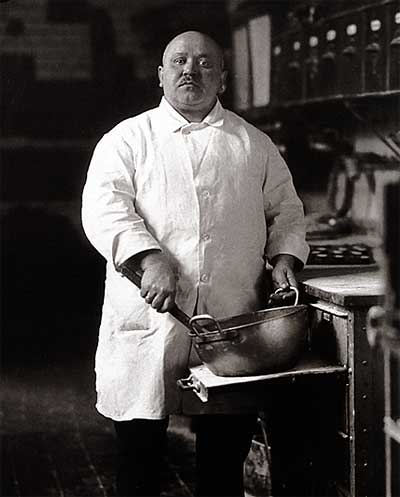
Atget's response to the artiness of pictorialism is to pull the plug on the portrait altogether and to produce the urban setting voided of human presence, thereby substituting, for the turn-of-the-century portrait's unconscious mise-en-seine of class murder, an eerily emptied "scene of a crime.
The critical edge to photography was the medium's assault on "cult value" and aura. Benjamin's definition of this aura is most often derived from "The Work of Art in the Age of Mechanical Reproduction" essay in which "aura" is described in reference to natural objects as "the unique appearance of a distance, however close it may be." Related to Benjamin's preoccupations with both memory and history, the "aura" of cultural objects is commonly understood to refer to the traditional mystique of the work of art as singular and enduring. In the essay Benjamin announces the dismantlement of "aura" by the processes of mechanical reproduction that are able to replicate artworks into infinity. But he also seems to mourn its passing as one of the last vestiges of habits of naturalized memory.
And yet photography's own aura seems to reside in its apparent artlessness - its ability to appear to place us closer to an original object of desire precisely on the basis of its claims to a wondrous verisimilitude, its ability to form a "glass coffin" around those people and places most dear to us, to shelter a core of mortality (and here is the contradiction again), even as it leaves behind nothing but dead matter. Photography provides the treasured keepsake. It also provides the image in the newspaper, here today, gone tomorrow.
September 6, 2010
Leunig: crossroads
A nice moment during bad weather.
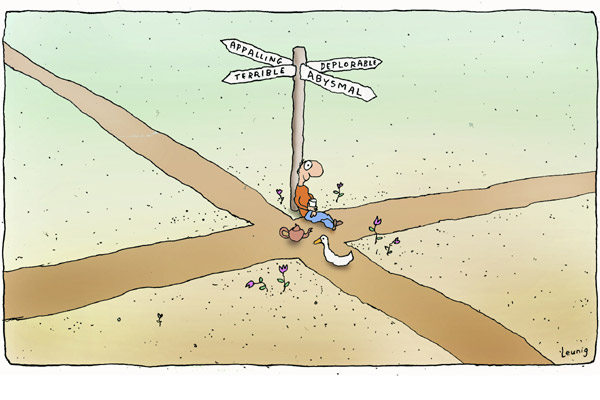
We have a few days of Spring sunshine, then more bad weather.
The sign posts in Leunig's cartoon --appalling, terrible, deplorable, abysmal--- are my reactions to free market economists, such as Stephen Kirchner at the Centre for Independent Studies, who write about a Big Australia enabling creativity and innovation to drive economic growth without mentioning Australia's finite natural resources, the damage to our ecosystems from past economic growth based on the exploitation of natural resources, or the effects of climate change.
Creativity and innovation is not linked to sustainability at all. There is no mention of sustainability. He's a Julian Simon fan and Simon argues in The Ultimate Resource that in the contest between resource scarcity and human ingenuity, Simon bets the farm on the ability of intelligent people to overcome their problems.
September 5, 2010
Christchurch--earthquake
Christchurch, New Zealand is my home town. Over the weekend an earthquake occurred 40 kilometres west of Christchurch with its epicentre 10km south-east of Darfield.
The earthquake caused damage to the city ---- it flattened buildings, opened giant chasms in roads, buckled roads and railway lines and left hundreds homeless. Water has been cut off, petrol stations are closed and farms are without power. My mother is safe and the family house undamaged.
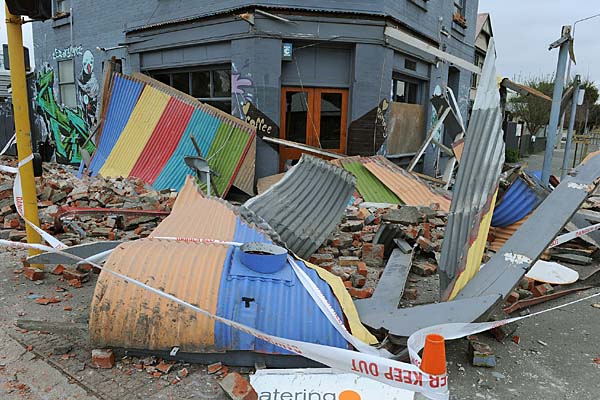
I didn't even know Christchurch was a major earthquake risk or that it was known to be particularly seismically active. Apparently, the earthquake triggered a release of pressure caused by the collision and locking together of the Pacific and Australian plates, which are moving in different directions. Apparently, Christchurch was lucky.
September 4, 2010
David Lynch: Wild at Heart
1990 was a notable year for David Lynch. In April of that year, Lynch's television series "Twin Peaks" hit the airwaves. Then in late summer he released Wild at Heart — a brutal road movie/love story/black comedy that combined violence, sex, Elvis, and The Wizard of Oz populated by bizarre characters, freaks and weirdos.
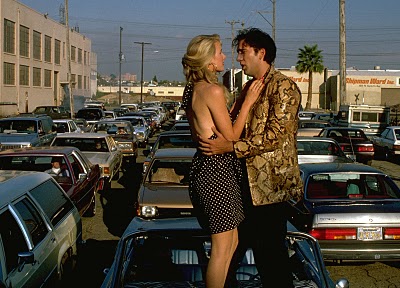
I saw this Lynch film on DVD. Despite this film having better linear sense than, say, Mulholland Drive, it feels more disjointed and strange. It is a pastiche of American iconography--- Elvis Presley, Marilyn Monroe, New Orleans and Texas, road movies, 1950s T-Bird convertible, pop culture, and a love story of youthful passion, individual freedom and hopes dashed by violence.
Lynch eschews the conventions of narrative and places the emphasis on painterly textures, light, moods and colour with tawdry scenarios and disconcerting tonal shifts. The strange and sad scene of a girl dying after a car accident, with Chris Isaak’s haunting “Wicked Game” on the soundtrack, is sad, dark, violent and beautiful. This is Lynch at his best.
Lynch endlessly vacillates between Hollywood conventions and avant-garde experimentation, placing viewers in the awkward position of not knowing when the image is serious and when it’s in jest, when meaning is lucid or when it’s lost. In this way, his style places form and content in a perpetually self-consuming dialogue whilst the sounds give us a sense of place.
September 2, 2010
Anish Kapoor + formlessness
I saw a BBC film about Anish Kapoor on SBS 2 last night. The film was structured around his exhibition at the Royal Academy. I was impressed by his use of colour (crimson, yellow) and form (voids, orifices and bulges) as well as the appearance of formlessness.
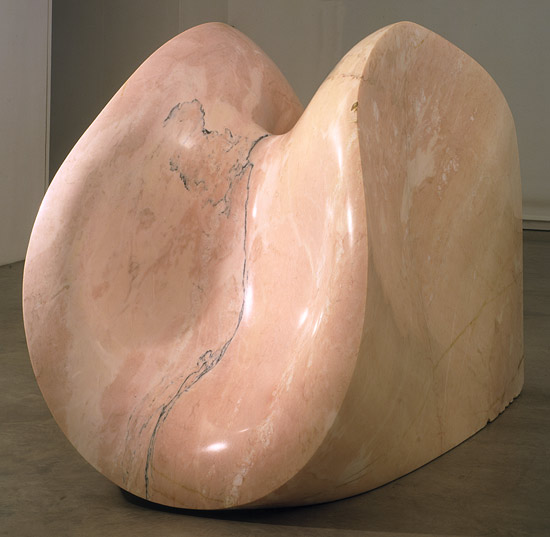 Anish Kapoor, Untitled, 2001 Pink marble
The seductive shapes, shiny surfaces, bright colours and mysterious voids invites the viewer to touch the surfaces and internal space, but we are forbidden to do so in an art galley. We can only look as we walk around the object.
The exhibition at the Royal Academy showed his roots in modernism, minimalism and the monumental sculpture of industrial production that invited climbing inside the void or black hole:
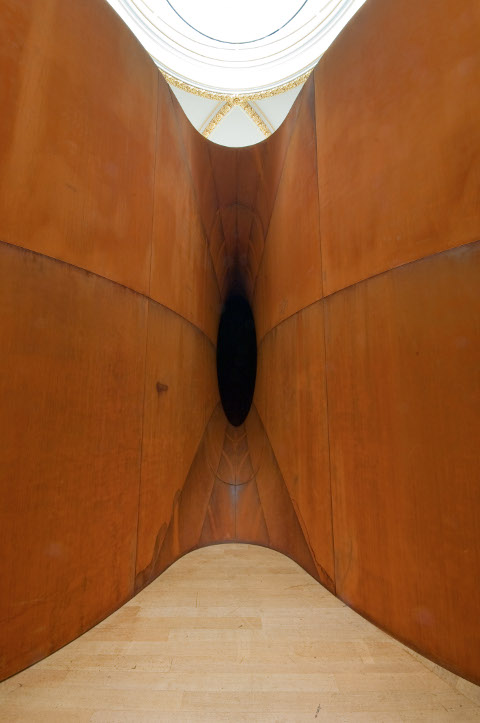 Anish Kapoor, Hive
There was a turn to formlessness which invoked the body --menstrual blood, wounds, violence, intestines--funnels and squirming nests, writhing columns of turds, lava-like puddles.
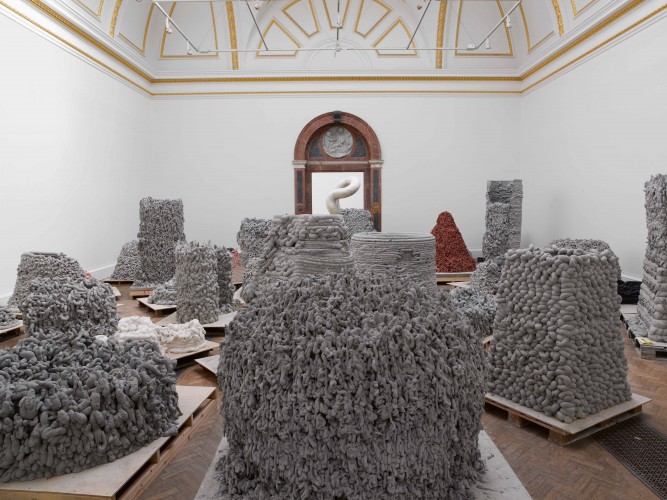 Anish Kapoor, Greyman Cries, Sharman Dies, Billowing Smoke, Beauty Evoked (2008-09)
This is art without the hand as it drawn and produced with the aid of a computer-assisted piping machine. It is a world of worm-cast mountains, intestinal tubing, funnels and squirming nests, tails and slugs, writhing columns of turds, lava-like puddles and drools, hollow cakes and all sorts towers and pyramids. It is formlessness because the material is often broken and coming apart over itself.
September 1, 2010
The Ipswich House: Heritage house portraits
The Ipswich Art Gallery in Queensland has an upcoming exhibition entitled The Ipswich House: Heritage house portraits. The blurb states that this exhibition is a:
picturesque and illuminating foray into the history and vision of Queensland’s early domestic architecture as seen through the eyes of 13 contemporary Queensland artists, The Ipswich House examines the city’s significant architectural heritage through a selection of commissioned ‘house portraits’ across a diverse range of mediums. These house portraits are more than mere pictorial representations of the city’s heritage-listed buildings, instead offering explorations into the architectural design, construction and fabrication methods while also exposing more than a hint of the personal histories and memories of their former residents.
At this stage there is only one image from the exhibition online --one by Jane Burton, who is Brisbane born, was educated at the Tasmanian School of Art, Hobart, and is a photographic artist who now lives in Melbourne. She has previously appeared on junk for code:
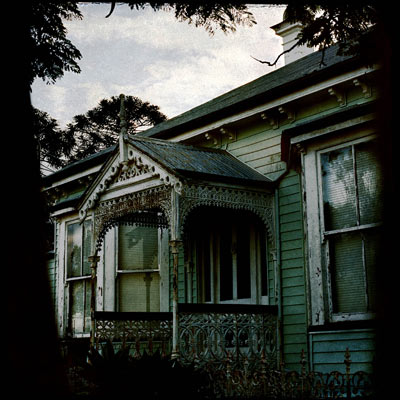 Jane Burton, MacFarlane's House #1, 2010, Pigment print
So we really have little idea of the content of the exhibition. Things won't change much when the exhibition is up and running since Ipswich Art Gallery has a limited online presence. So we have no idea how the various artists in the exhibition represent Queensland’s early domestic architecture, or the rationale for this exhibition.