|
September 4, 2010
1990 was a notable year for David Lynch. In April of that year, Lynch's television series "Twin Peaks" hit the airwaves. Then in late summer he released Wild at Heart — a brutal road movie/love story/black comedy that combined violence, sex, Elvis, and The Wizard of Oz populated by bizarre characters, freaks and weirdos.
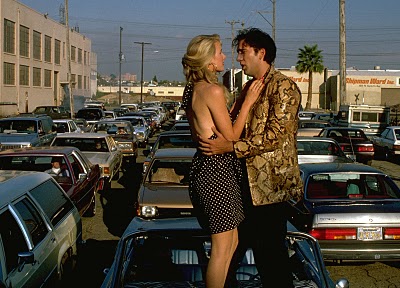
I saw this Lynch film on DVD. Despite this film having better linear sense than, say, Mulholland Drive, it feels more disjointed and strange. It is a pastiche of American iconography--- Elvis Presley, Marilyn Monroe, New Orleans and Texas, road movies, 1950s T-Bird convertible, pop culture, and a love story of youthful passion, individual freedom and hopes dashed by violence.
Lynch eschews the conventions of narrative and places the emphasis on painterly textures, light, moods and colour with tawdry scenarios and disconcerting tonal shifts. The strange and sad scene of a girl dying after a car accident, with Chris Isaak’s haunting “Wicked Game” on the soundtrack, is sad, dark, violent and beautiful. This is Lynch at his best.
Lynch endlessly vacillates between Hollywood conventions and avant-garde experimentation, placing viewers in the awkward position of not knowing when the image is serious and when it’s in jest, when meaning is lucid or when it’s lost. In this way, his style places form and content in a perpetually self-consuming dialogue whilst the sounds give us a sense of place.
|


