August 31, 2008
Vitamin: “Urban Differences”
Vitamin, which is a South Australian visual culture quarterly containing images and articles by include emerging and mid-career South Australian artists in local visual culture, has an online gallery. A recent online exhibition was “Urban Differences”, an exhibition of photography.
One of the local photographers exhibiting was Danielle Walpole. Another is Mark Kimber, a lecturer and Studio Head of Photography and New Media at the University of South Australia, whose recent project is Sun Pictures utilizing the ‘Diana’ camera; an unsophisticated plastic box:
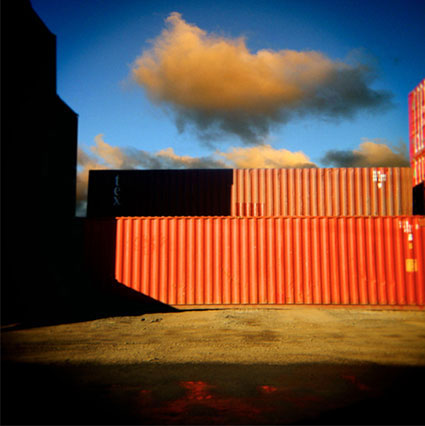 Mark Kimber, Sun Picture 2, Giclee print, 2007
Kimber is an established figure in art photography circles and Sun Pictures was shown at Stills Gallery, Sydney. He has maintained a dedicated artistic profile while at the same time, continuing his role as a full-time staff member of the SA School of Art, University of South Australia. Currently he is Studio Head of Photography and New Media.
Beverley Southcott, in the catalogue for the online “Urban Differences”exhibition, says the exhibition is a plethora of polarized perspectives:
on the urban environment with common elements of the darkly humorous to the joyful; or of everyday activities to a nocturnal otherness housed within narratives of contemporary desires and anxieties in the metropolis. Predominantly the images of ‘the nocturnal’ depict the unusual, the melancholy, a meditative reflectiveness combined with a sense of uneasiness as well. The whimsy and the hopeful, implied with evocations and redefinitions of industrial architecture, for example, or subtle undertakings in guerilla art, are seen in these photo media works.
This reference to anxiety and unease is a gesture to the uncanny or the sublime; in this case the urban sublime.
August 30, 2008
caring for water?
Water is very scarce in South Australia and the city of Adelaide is dependent on a River Murray, which is dying because too much water has been taken out by upstream irrigators in other states. Drought and drying conditions due to global warming caused by climate change means that there is less rainfall to flow into the river and to fill the city's reservoirs. So Adelaide faces a future of shortage of water.
Consequently, water must be conserved and recycled, and the water that is saved from the runoff must be cared for. So it was a surprise to see this:
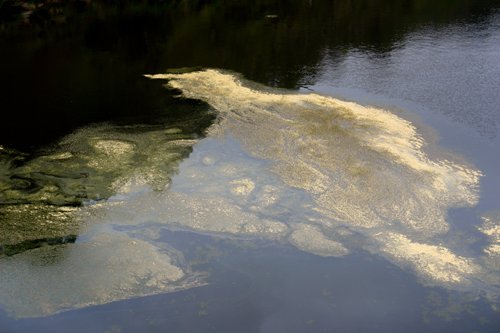 Gary Sauer-Thompson, algae, Myponga Reservoir, 2008
This is the reservoir for the Fleurieu Peninsula and the towns (Victor Harbor, Middleton, Goolwa) of the Fleurieu Peninsula, with the water increasingly reserved for the City of Adelaide. The algae indicates that the run off from the watershed surrounding the reservoir is contaminated by pesticides and the animal waste from the surrounding farms.
This is indicative of South Australia treats was previous water. Not only does it take too much from the rivers for irrigation, poorly treated sewerage is still pumped into its rivers that are used fro drinking water, storm water runs into the sea, and the waste from the dairy farms is dumped into the rivers and streams as if they are drains.
August 29, 2008
neo-classical politics
The stage on which Obama delivered his acceptance speech at the 2008 Democratic National Convertion looks like a Greek temple or Roman forum.
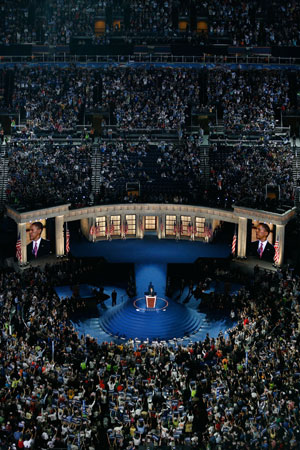
It is a very neo-classical political theatre for his oratory at Invesco Field. Some say that it also refers to the neoclassical colonnade in Chicago's Soldier Field part of an athletic stadium designed in 1919 by Holabird & Roche, which commemorated World War I soldiers.
A Modernist Office
Modernism's usual commitment is to progress, competition, creativity, technological liberty and the romantic urge to overcome the traditions and styles of the previous generation. In design the technical and social progressivism of those practicing the International Style; in the arts the isms stem from Baudelaire and include Dada and Surrealism. This pace, change, risk, and constant revision of knowledge results in a curious continuity and break, the swerve and the concealed repetition. Modernism attempted to build a better world with the aid of science and technology through rational mastery:
Late Modernism, which is the modernism in Adelaide, is tied to Late Capitalism. It refers to the proliferation of formalist movements, such as Op and Conceptual Art, and the exaggeration of abstract experiments in a Minimalist direction eschewing content. John Cage in music, Norman Foster in architecture, Frank Stella in painting, Clement Greenberg in art theory, Samuel Beckett in literature, and the Pax Americana in politics.

The most pervasive meta-narrative of the modernist is the teleological notion of progress. Art is healthy so long as it advances, so long as it conquers new territory, refines its technique, and breaks through barriers while never capitulating to the base tastes of the philistine masses.
Modernist architects and designers believed that new technology rendered old styles of building obsolete. Le Corbusier, for instance, thought that buildings should function as "machines for living in", analogous to cars, which he saw as machines for traveling in. Just as cars had replaced the horse, so modernist design should reject the old styles and structures inherited from the 19th century. Modernist design of houses, offices and furniture emphasized simplicity and clarity of form, open-plan interiors, and the absence of clutter.
Urban planning's well-documented progressive potential should be understood as being structurally accompanied by a more sinister dark side. The dark side of modernism is the freeway, the brutal architecture and the bleak, windswept public spaces in our cities. The unintended consequences of the modernist ethos of progress (modernization) are the destruction of our cities, death camps, nuclear war and global warming.
Ki'laueu Volcano
Ki'laueu Volcano is currently active and lazily adding to the landmass of the big island of Hawaii by dumping hot rock into the ocean through a lava tube. We hiked through the souther caldera but the northern caldera was closed to us as it was emitting large clouds of sulfuric gas.

We are both fit and experienced hikers and we were told that the hike through the crater floor would take about two hours. We pretty much ran through the hike in pretty short order. The longer hike was cut off by the active volcano so we were restricted where we could walk. This park actually had very few visually stunning walks, it was more geared to the bus-load of tourists, then again there are several volcanoes on Hawaii and this is the most easily accessed of them.
The volcanoes dominate the environment as well. They drag a chain of clouds from them which puts the southern part of the island constantly in cloud and fog cover. Especially as you go up the mountainside. It does leave the Kohala Coast in the north as one of the few areas to have sunny and unbroken sky.

The land is also scarred by the constant lava flows that seem to come in a geologically consistent manner. One scenic stop we did was on top of a lava flow from 1907 and the black lines of lava that cut the landscape can all be dated - often within the last 100 years.
Update: I am not happy with my new camera. It makes composition hard. It is a good camera but its screen is too light when in the full sun and there is no eye hole to compose with. I will have to buy another which is annoying.
August 28, 2008
Mars: early morning
A thin layer of water frost is visible on the ground around NASA's Phoenix Mars Lander. This image is taken by the Surface Stereo Imager at 6 a.m. on the 79th Martian day after landing.
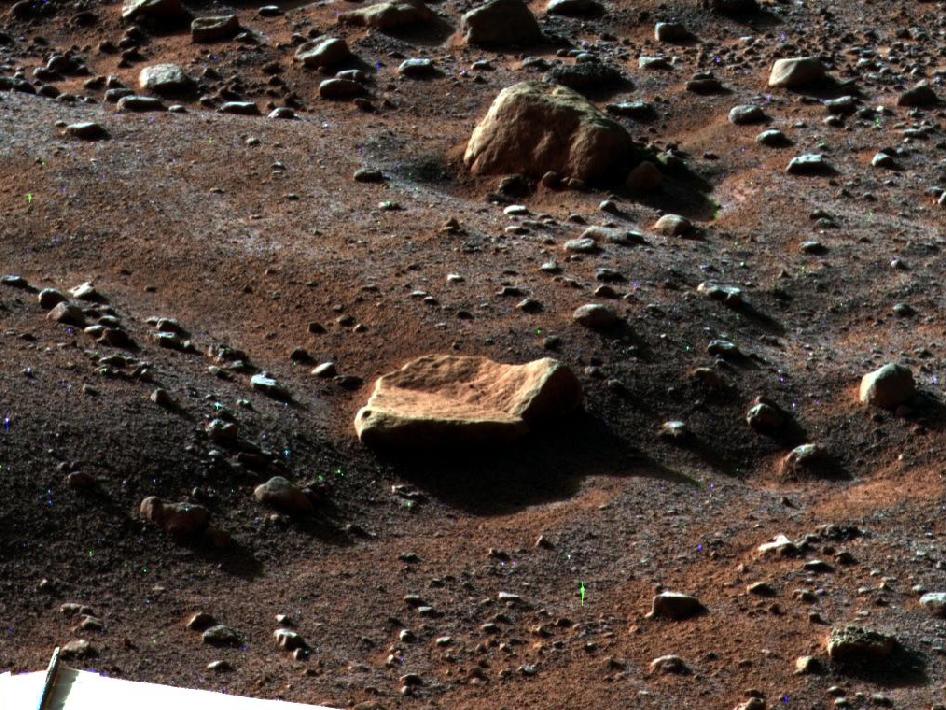 NASA, Mars, early morning frost
Does frost mean that there is water on Mars? Maybe. There has been some talk of this recently. The latest findings offer a scenario of how small channels appear on the planet's face despite what appears to be a complete lack of surface water.
August 27, 2008
saving the Corrong?
In spite of the opposition of the Rudd Governmentthe Senate will undertake an inquiry into the lack of water in the Murray-Darling Basin and into new ways to restore the devastated lower Murray River. The terms of reference are for the Senate's rural and regional committee to establish how more water could be found to alleviate the crisis in the lower lakes and Coorong wetlands at the Murray's mouth.
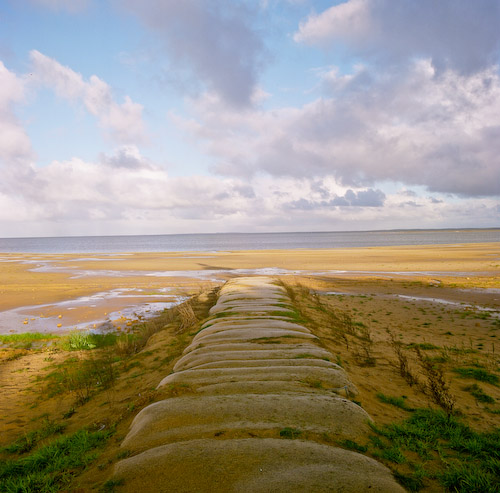 Gary Sauer-Thompson, Lake Alexandrina, 2008
The lack of water flowing into the lower lakes and the Corrong has meant that the Ramsar -listed Corrong wetlands have not received any freshwater for around six years and they are now so salty that the fish and vertebrae are dying in the southern lagoon.
Some sort of band aid is needed. What is currently being suggested is the following: sacrifice Lake Albert and use the water for the Coorong; create a freshwater reserve near the two creeks (Finness and Tookyarta) that flow into Lake Alexandrina; and pump salty water out of the southern lagoon of the Corrong.
The acquisition of the Toorale cotton station in NSW for around $25 million by the Commonwealth will see the dams across the Warrego River removed and around 90 gigalitres restored to the river. NSW authorities point out that as little as 20% of that water will reach the parched lower Murray lakes -----but that is an argument for buying more of the big cotton farms that are on the market and returning more water to the river.
August 26, 2008
restoring street art: Keith Haring
Whilst the City of Adelaide scrubs the dirty walls of the city clean of graffiti New York City, which was once the home of graffiti culture, is now engaged in graffiti restoration. Beth Gregory, assistant curator at Stolen Space, a London gallery specialising in graffiti and outsider art, says:
It's a shame that city councils and officials didn't have the vision to save original public pieces of art from the pop art and early graffiti era all of which are now distant memories preserved only in books.
Keith Haring, who died from Aids-related complications in 1990 whilst still 31 year, is seen as an innovator with regard to how art is made, distributed and discussed. One of his street murals is being restored. But his work goes beyond street murals:
 Ishai Goldstein, Keith Haring mural, old convent on West 108th Street, New York, circa 1980
Initially viewed simply as a graffiti artist who used vacant advertising boards in the New York subway as his canvas in the early 1980s, Keith Haring provoked debate on the street and within the exclusive art establishment with his radiant comic figures and increasingly political messages.
Update: 29 August
Keith Haring appears to have been deeply committed to a public art as well as producing work within the New York art Gallery system. Throughout his career Haring produced more than 50 public artworks between 1982 and 1989, in dozens of cities around the world, many of which were created for charities, hospitals, children’s day care centers and orphanages. The now famous Crack is Wack mural of 1986, which has become a landmark along New York’s FDR Drive, is a double-sided mural was painted in the mid-80s on a handball court:
It was just seen as another act of graffiti in East Harlem and it said so on Keith Haring's $25 summons.But when then-Parks Commissioner Henry Stern heard about Haring's strong anti-drug message - "Crack Is Wack" - he asked the artist to finish the mural, setting the stage for what is now a cultural landmark in New York City.
 Keith Haring, Crack is wack, East Harlem, 1986
The work arose out of Haring's sadness for a friend in the throes of crack addiction.The Parks Department maintains the mural with the help of funding from the Haring Foundation. It has been defaced a few times but there is respect on the street for works of art like this.
Haring's other public art projects include; a mural created for the 100th anniversary of the Statue of Liberty in 1986, on which Haring worked with 900 children; a mural on the exterior of Necker Children’s Hospital in Paris, France in 1987; and a mural painted on the western side of the Berlin Wall three years before its fall. Haring also held drawing workshops for children in schools and museums in New York, Amsterdam, London, Tokyo and Bordeaux, and produced imagery for many literacy programs and other public service campaigns.
August 25, 2008
Adelaide's Victoria Square redesign
There is a competition for the redesign of Victoria Square in Adelaide. It needs a redesign as it has been killed by north south and east west traffic. It is a space to move though, rather than a piazza.
From a people's perspective--workers, visitors and residents---Victoria Square is an inhospital wasteland. Numerous efforts to do something about it over the past 25 years have been blocked apart from more concrete and less vegetation. Both the City Council and State Government have committed to revamping this dead space.
 History Trust of SA, Victoria Square, Adelaide
The most recent source of opposition has been the combined Grote Business Precinct-Gouger St Traders Association, who along with the current mayor of Adelaide Michael Harbison have historically opposed closing Victoria Square to traffic so as to make it a proper pizza--a people's plaza. Harbison and the traders opposed a proposed $18 million redevelopment of Victoria Square in 2003. Their idea of urban design is that cars are needed for trade.
The Grote/Gouger St trader's design for Victoria Square:
would involve: excavating the entire square to a depth of at least two levels; re-directing some traffic; building an east-west road bridge; a 350-space underground car park; and a sunken public plaza.The proposed tower would be about the same height as the Adelaide GPO spire and it would house a cafe, restaurant and observation deck. The plans [are] designed by Loucas Zahos Architects,
This design is all about cars and it indicates that Adelaide has no urban design culture in the way Melbourne does. All traffic should be underground.
The culture that exists is one of the relatively secret processes of the big development, where the rights of property owner, developer and consultant team are seemingly pre-eminent, and the public interest is merely a nuisance rather than a resource to be harnessed for the good that may flow. So a European style piazza or a Federation Square is not an option for the property crowd. Much better to turn it a shopping centre.
August 24, 2008
Polixeni Papapetrou: Haunted Country series
Polixeni Papapetrou presents excerpts from her own lives through dramatized scenes of children playing not so innocent games, inspired from her childhood in Australia. Some of the images in series are expressions of hauntology.
The 2006 series Haunted Country,which takes as its subject children who have wandered into the bush and got lost, is good example:
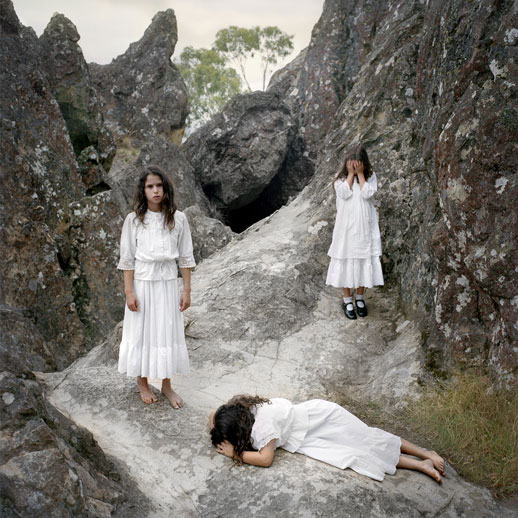 Polixeni Papapetrou, 'Hanging Rock 1900 #3', 2006, pigment ink print
Though Papapetrou's work is a form of personal remembering, her images are located within our cultural remembering about historical accounts of lost children in Australia’s rugged environment. They refer to the fear and folklore about being lost in the Australian Outback.
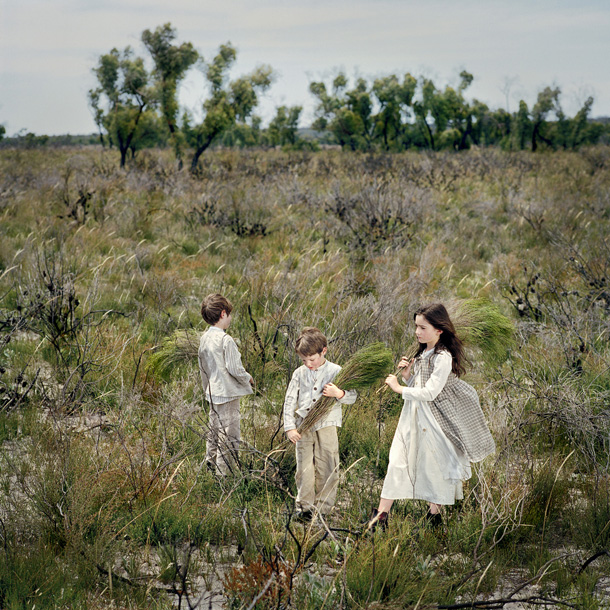
Polixeni Papapetrou, The Wimmera, 1864 #1, 2006
Papapetrou considers the landscape as a medium in which she can explore ideas about the contemporary social landscape of childhood. She comments about her Haunted Country series that:
The figure of the bush-lost child is one of the most poignant themes in Australia’s cultural remembering. My desire was to create photographs that embodied the harrowing psychological aspects of these stories. I wanted to draw the viewer into this emotional space, experience the undercurrent of the psychological drama unfolding, and make connections between past and present consciousness about land and country.
The metaphor of the bush-lost child is also a way to reflect upon other ways that children become lost to adults. The artist uses the landscape as a visual metaphor as a space without constraints and a place where children can test and define their individuality. The depth and complexity of the natural world, ranging from an Arcadian ideal to the darker haunts that children once frequented, provide a way of reflecting on the idyllic and shadowy aspects of growing up.
This aspect is explored in her 2008 series, Games of Consequence.
August 23, 2008
the bush + mobile broadband
I am typing this post whilst sitting in a cottage in the treed hills behind Clare Valley in South Australia. I am able to do so courtesy of a friend's computer and their Telstra mobile wireless broadband-- their Next G network. It is very impressive--market changing. Telstra claims its Next G network covers ‘over 99 percent of the population’, compared to some of the other networks which typically cover only major metropolitan areas.
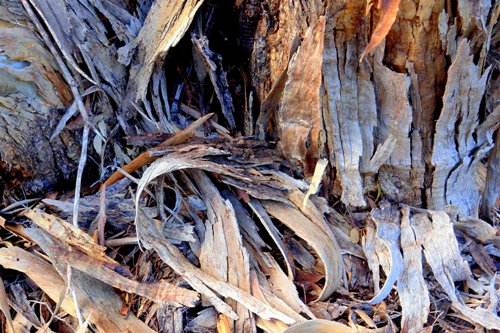 Gary Sauer-Thompson, bark, 2008
Mobile wireless broadband is the future as it offers more flexibility than fixed line broadband that is limited a specific location --a home or business. But the technology underpinning mobile broadband needs to be substantially upgraded in terms of speed if it is to be viable, since the Next G network is very slow in downloading newspapers due, no doubt, to the usual backhaul and capacity constraints.
Viable here means giving up a fixed line broadband and going mobile. At the moment Telstra is charging $129.95/month 10GB plan. Too much. Currently I am with Three, who are mainly a cap city mobile provider. Their roaming access to the Telstra 3G network is far too expensive as it is structured around a roaming penalty rate. I understand that Three are negotiating a wholesale agreement with Telstra so that Three customers can make use of the Next G network.
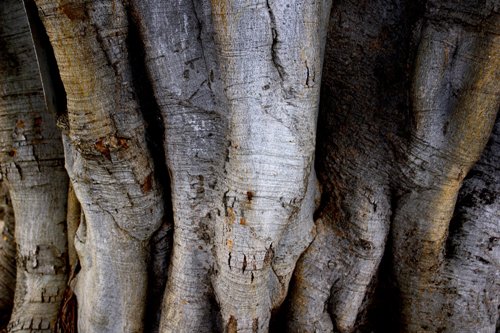 Gary Sauer-thompson, Morton Bay Fig, trunk, Kapunda, 2008
If this is the future then what surprised me was that Seven didn't use the Olympics in an effective broadband customer grab which could easily have used both online and offline channels to let us choose from dozens of simultaneous events to watch instead of the heavily edited highlights packages. Telstra's Next G Olympics offer was only the same highlight packs available through Yahoo's online site — and live, streaming video of Seven's TV on the phone for a flat AU$10 or AU$4 per day.
The delivery of live streaming video is the ISP's next step up the food chain and they follow the lead of SelectTV and begin bundling TV stations from around the world — compelling ones — as quota-free downloads. We can then plug in our Apple TV and funnel this content to our lounge room.
August 22, 2008
Queensland excess
The issue that provides the context:
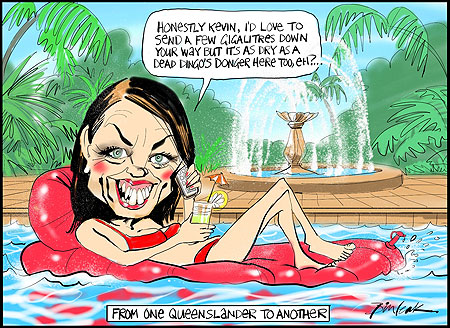 Bill Leak
The Coalition will join the Greens and South Australian independent Nick Xenophon to force a Senate inquiry into new ways to restore water to the devastated lower Murray River. The ALP is not pleased, despite their commitment to open, accountable and responsive government.
August 21, 2008
History of the River Murray's lower lakes
Like myself local photographer Michael Buddle is also photographing the decline in the River Murray's lower lakes. He has informed me that the Natural Resources Centre in Strathalbyn in South Australia has copies of Terry Sim and Kerri Muller's "A Fresh History of the Lakes: Wellington to the Murray Mouth, 1800s to 1935.
The Strathalbyn Natural Resources Centre originated from staff partnerships with groups such as River Murray Catchment Water Management Board, Landcare, Goolwa to Wellington Local Action Planning Association, Land Management Program and the Angas River Catchment Group, and the text was published by the now defunct River Murray Catchment Water Management Board. Defunct due to the introduction of integrated natural resource management across South Australia.
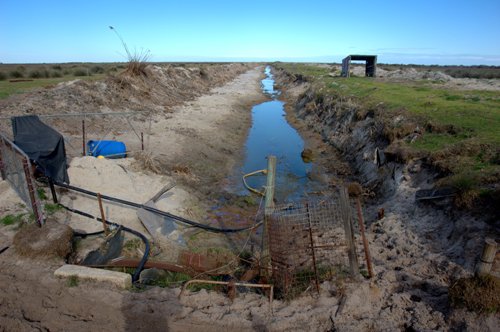 Gary Sauer-Thompson, irrigation channel, Lake Alexandrina, 2008
The argument of the text is that irrigation along the River Murray changed everything, since the extraction of water from the river for irrigation caused the lower River Murray to be filled with salt because river flows could no longer hold back the sea.
In the introduction to the text Sim and Muller say:
Prior to European settlement, Lakes Alexandrina and Albert at the terminus of the River Murray were predominately fresh, with river water discharging to sea and keeping the Mouth clear. Contrary to what many believe today, saltwater intrusions into the Lake environment were not common until after 1900 when significant water resource development had occurred in the River Murray system ..... Before large-scale extractions of water, the Lakes and lower Murray were rarely subjected to seawater invasions ... Short-lived intrusions of saltwater would occur during periods of low flow down river resulting in a lowered level of water in the lakes. Even in times of these low flows, it would appear that only small areas of the Lakes
It was irrigation that changed these natural conditions as the extraction of water reduced river flow down the Murray River:
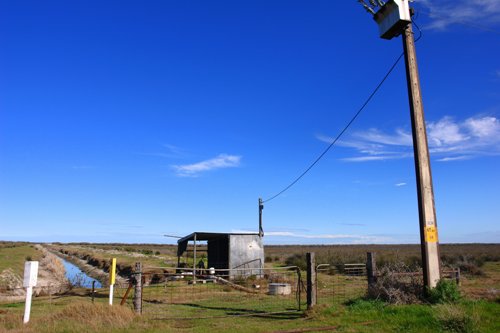 Gary Sauer-Thompson, irrigation infrastructure, Lake Alexandrina, 2008
Sim and Muller go to describe this transformation in the ecology of the region thus:
Saline invasions were more common after 1900 and the development of irrigation works because reduced river flows could not hold back the sea. Irrigation schemes began at the same time as a long lasting, widespread drought that further diminished the amount of water in the river system ... extractions of water from the system upstream in New South Wales, Victoria and South Australia, along with drought conditions, caused change to the Lakes ... as conditions in the river and Lakes changed the schemes were designed to prevent seawater from entering into the Lakes system and maintain a freshwater reservoir.What finally resulted were the five barrages, Goolwa, Mundoo, Boundary Creek, Ewe Island and Tauwitchere that are in place today.
This attempt to ensure a freshwater reservoir in the lower lakes for irrigators and towns has failed as there is not enough water to provide the water. The state governments in the basin have allowed this happen.
August 19, 2008
the media's Olympics
The Olympics is a spectacle that is constructed by the culture industry in terms of a television soapie that is used by the media apparatus to sell low rent advertising wrapped up in glitz and gloss. Channel Seven's Olympic coverage is bound hand and foot by drive to profit disguised by the endless replays of Stephanie Rice. Everything is for sale.
 Bill Leak
Then we have to listen to that nonsense about needing to fight the British because they are winning more medals than Australia, and this shames us as a nation. This crude attempt to stir national pride, with the images of bad non-white foreigners, is an attempt to soothe the pain from these Olympics being a disaster for Australia because of the low number of gold medals.
To the win-at-all-costs lobby, sport is about how many medals of victory we can produce.The "we don't do silver crowd" say that the gleaming gold medals are important because sport is central to national self-esteem. This demands not only talent, hard work and organisation, but also serious cash. Winning, national pride and profit is all that matters.
It's the jingoism buried in the spin about finding heroism in every winner and villains in every defeat that is disturbing.
August 18, 2008
Angelina George: Far Away Places
Angelina George has an exhibition at the Karen Brown Gallery in Darwin entitled Far Away Places.
Angelina George was the winner at the 2007Telstra National Aboriginal and Torres Strait Islander Art Awards organized by the Darwin Museum and Art Gallery with this image:
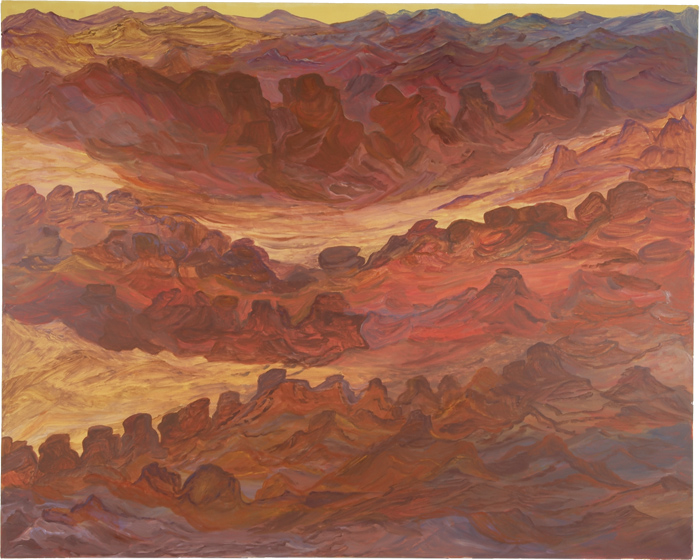 Angelina George, Near Ruined City, polymer paint, 2007
August 17, 2008
Beijing Olympics as metaphor
The image of fat cat banks that gouge customers never really goes away does it. It has resurfaced recently with the banks, bruised from the credit crunch in the US, intimating that they may not pass on cut in interest rates when the Reserve bank lowers them. Bad banks. They have record profits.
The old images of money power resurface and their forms are reinvented:
 Matt Golding
Money power all about making money. Follow the money. Go north to the once conservative backwater. of Queensland. Follow the boom says the Australian Financial Review. The coal-fired mining boom in the sunshine state Queensland they mean. A coal boom that is meant to last decades. China, with its breakneck economic growth, is the beacon of hope for the money makers.
August 16, 2008
Brisbane Powerhouse: Paolo Pellegrin
The Brisbane Powerhouse is showing the work of Magnum photographer Paolo Pellegrin in an exhibition about suffering, war and death. Entitled As I Was Dying it covers some of the great upheavals of recent times, including Darfur, Lebanon, Iraq, and the ongoing conflict in Afghanistan.
 Paolo Pellegrin , village near Nyala in South Darfur,
Pellegrin's photographs are historical snapshots (witness to history?) that have a poetic quality. Many of his images are blurred, appearing almost unfinished.The photos are often grainy, impressionistic images of figures under dark, threatening skies, which elicit a direct emotional response.
 Paolo Pelligrin, untitled,
Light features very strongly in Pellegrin’s work with a great deal of use of silhouetted and near-silhouette figures in his black and white. Pellegrin says:
I work a lot in low light so there are technical reasons for this. But there are also artistic motives. I see photography as a bridge between the subject and the viewer – like a hand that comes out, or the beginning of a conversation. I like leaving something unsaid so that the viewer can fill in the missing piece .... I think it works on a more symbolic level than can be achieved with colour. It allows pictures to carry greater meaning. A colour photo of refugees in Sudan shows what happened the day I was there. In black and white, I think the same photo has the capacity to be more than that – to speak about the condition of refugees at large.
 Paolo Pellegrin, A young victim of the violence, now a refugee in Nyala, 2005
He also makes use of techniques such as deliberate misframing, blur and tilted views to give a feeling of emergency and immediacy to his pictures. Often large areas of the image are black or nearly so, the photographer clearly seeking out scenes with both low and highly uneven light. Pellegrin says:
When I do my work and I am exposed to the suffering of others - their loss or, at times their death I feel I am serving as a witness; that is my role and responsibility to create a record for our collective memory. Part of this, I believe, has to do with notions of accountability. Perhaps it is only in their moment of suffering that these people will be noticed, and noticing erases our excuse of saying one day that we did not know. But I also feel that it is in this very delicate and fragile space that surrounds death, the space that I sometimes have both the privilege and the burden of entering, there exists the possibility of an encounter with the other in a way that goes beyond words and culture and differences. It is about being exposed for a moment in front of each other and in front of the act and mystery of dying. In that moment I feel I am looking at something that I can’t completely see but that is looking at me. It is in this exchange that something simultaneously universal and deeply intimate can be found; in the death of the other there is a loss that belongs to everyone.
He uses a wide-angle lens that forces him to get up close and personal with his subjects. He has published six books.
August 15, 2008
Jirrawun Arts: Rammey Ramsey
The artists of Jirrawun Arts --- situated at Wyndham in the East Kimberley of Western Australia ---- work in the distinctive Kimberley style made famous by Rover Thomas and Queenie McKenzie: sparse, flat expanses of natural ochres and minimal dotting to form bold, imposing images of country. Paintings depicting the often violent relations between white settlers and the local peoples are common; interestingly, many of the Jirrawun artists originally worked as stockmen for white-owned stations.
It is the home for painters such as Paddy Bedford, Rusty Peters, Freddie Timms, Peggy Patrick, Goody Barrett, Phyllis Thomas and Rammey Ramsey, currently exhibiting at the Darwin Festival:
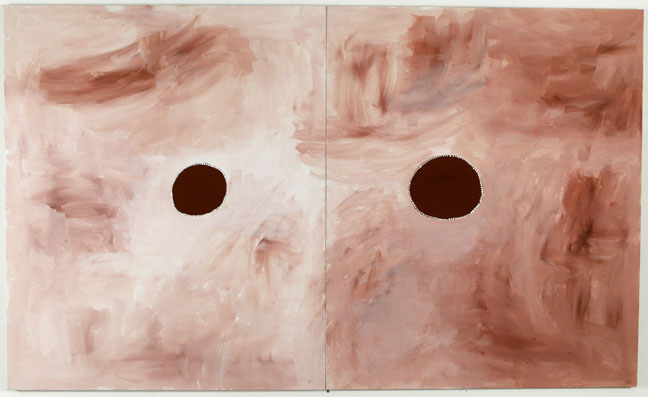 Rammey Ramsey, Warlawoon Country Waterholes, 2004
The image relates to the flat country in the area near Elgee Cliffs, south of Bedfod Downs in the East Kimberley. This was always Ramsey's family’s country. Both parents belonged there. They used to muster cattle there for the now abandoned Elgee Cliffs [cattle] Station and the artist spent a lifetime working as a stockman.
The senior Gija artists living in the Warmun community in the East Kimberley region of Western Australia--including Freddie Timms, Paddy Bedford, Rusty Peters, Phyllis Thomas and Goody Barrett - have taken control of their living conditions and artistic careers, setting up financial management systems and organising exhibitions of their work at major Australian and international museums and galleries.
The Jirrawun Arts would provide financial security and peace of mind to artists so that they could simply live to paint and the Jirrawun artists paint in a studio of innovative design at Wyndham WA.
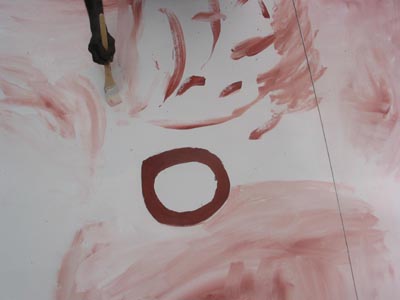 Rammey Ramsey, untitled, ?
Jirrawun Arts enables these painters to avoid the carpet- baggers who form a large greay area in the art market providing "name" painters with quick money for slapdash work that is often of poor quality and murky provenance. They are entrenched in Alice Springs and circulate through the Kimberley and Pilbara.
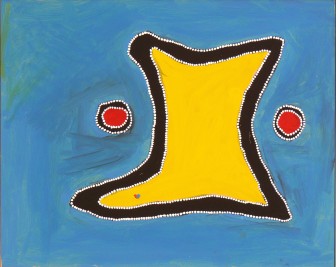 Rammey Ramsey, unttitled, 2008
If the style of Jirrawwun works have their roots in the visual language of the East Kimberley made famous by Rover Thomas, Paddy Jaminji, Jack Britton etc, then contemporary Jirrawun artists are breaking out of the tradition by using colour pigments instead of the locally sourced ochre.
August 14, 2008
Flickr, photography, video
I'm a big fan of Flickr as a digital archive that is all about sharing photos that we have taken. Flickr is based around the DIY ethic and the power of creative re-use and re-appropriation.
I am puzzled by the antagonism to Flickr's roll out of video. What's up with the photographic community? It destroys the increasing turn to quality content on Flickr? That YouTube is the place for low culture video? Photography stands for art whilst video stands for mass culture?
As art-school and exhibition photographers continue to shoot on film, embrace chiaroscuro and pastel tones and resist prettiness, a competing style of picture has been steadily refined online: the Flickr photograph, which is a digital images that “pop” with the signature tulip colors of Canon digital cameras, often heavily manipulated with digital tricks of Photoshop. Intense postproduction processing is necessary for the big popularity on Flickr---ie', HDR specific technology and tools (Photoshop >CS2 / Photomatix / Maya / HDR cameras). This Flickr tendency tends to deride mainstream art photographers.
The argument is that computer graphics has achieved the goal of photorealism. Now the goal is to go beyond simply matching paper and silver halide. One area of rapid development is in dynamic range and a new crop of technologies using High Dynamic Range imaging (HDR or HDRI) aim to extend the dynamic range of digital imaging technologies way beyond traditional media.
August 13, 2008
Barry Kosky
Kerry O'Brien interviewed Barry Kosky on the 7.30 Report last night. Kosky made some good points about Australian culture. One of them is this insight into how elitism is represented:
I also think that Australians are happy to accept the highest level of funding and standards in sport, but are quite happy if the arts somehow have to sort of fight for themselves. Elitism is okay in a sport, it's okay to send a handful of the most trained, skilled, perfect Olympic specimens to Canberra and to national sports institutes, but God help us if we did the same in ballet, or theatre or spent the same amount of money on a small group of people in the arts. There'd be outcry. So there's a sort of contradiction, the sport, arts. And you know, I have no problem with sport but I'm just saying that Australia has a, sometimes in its, what is "Australia"? But the Australia glance over everything sometimes is just full of just outrageous contradictions.
So true. The arts are there to be bashed up in the name of the common sense of the Australian people. I wonder what the art bashers----eg.,those who were so quick to attack Bill Henson--- think of Australian architects designing the Bird's Nest stadium in Beijing?
Another point Kosky made was this:
I'm suspicious of all Australian politicians in the arts, I think with very few exceptions, that Australian politicians, both Labor, Liberal, National, Democrats are on the whole ignorant when it comes to the arts. There's been exceptions, I won't name them, but there have been exceptions, great exceptions, but on the whole, I think it's still seen as an indulgence by most Australian politicians, it's still seen as something that is not as important as education and health and as important to the soul of the country....I am incredibly aware that Australian politicians tend use the arts when they need to as little footballs, to sort of kick around. They are very happy when we win an Oscar in Hollywood and they're very happy when whatever has a large media presence, but that's not the issue. The issue is do they really believe that without these things the soul of the country is diminished. That's what I want to know. And we need to look into these politicians'' eyes and say "If you let these theatre companies or dance companies, or if you don't make this cultural landscape rich, the soul of the country will be diminished and do you have a problem with this?"
Most Australian politicians are pre-modernist in their taste and they view the arts as decoration and not as part of the creative industries.
Tree at La Jolla, CA
La Jolla (pronounced La Hoya) is a seaside suburb north of San Diego in California. Australians would be familiar with the ocean front form of public space.

There were green parks on bluffs over looking sandy beaches. There were amenities, groups gathered to play, or make a fairy ring (I am not kidding), a swimming club doing laps out to buoys in the bay, Sea Lions on rocks, kayakers watching the Seal Lions, and there was a blow up movie screen in a park for a public showing of "Field of Dreams".
The tree in this picture is against the backdrop of the tall screen.
August 12, 2008
the culture of celebrity
The cult of celebrity refers to the way that fame has arguably eclipsed even money - with which it is so often paired - as the most desirable attribute to be pursued in an individualist culture based on excellence, performance and heroes.
The culture of celebrity has been constructed by the media for us in a society where the individual is the centre of the world. Morality and culture have been systematically privatised and relativised so that we are left with one's values or lifestyle.
The Olympic swimming stars are plugged into, and deepen, this culture of celebrity, since sport is seen as a vehicle for the media's apparatus to manufacture celebrity through a celebrity profile:
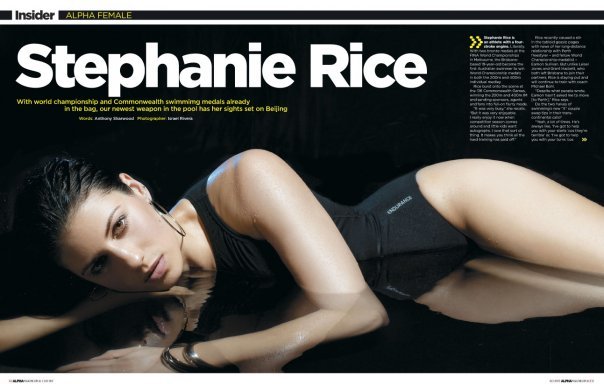
It is the culture that produces celebrity: they are picked as champions at an early age, then put under enormous pressure to perform, and then are hounded by the media. Some crack like a Wayne Carey or Ben Cousins in football and become constructed as the bad boys in the media.
August 11, 2008
winter in Adelaide
My holidays are over. It's back to policy work.Unfortuantely, I didn't get as much photography done as I had planned, which was disappointing. Two thirds was achieved.

I was unable to use the 5x4 Linhof Technika to explore the dried out parts of the River Murray, due to the continual rain throughout the fortnight. I had just managed to pull the 5x4 out of the cupboard and play with it. The film slides remained unloaded. So the return to landscape proper to explore the effects of the drought will have to wait.
I did manage to begin working with Adobe Lightroom---hesitantly on the Macbook. Heistantly is the operative word as I work withe manual in front of me.
August 10, 2008
the media's Olympics
I've had enough of the Australian's media's Olympics already. It's all about selling winners to boost viewers to boost advertising. I appreciate that sporting success is a source of nationalist pride, an avenue for jingoistic chest thumping and a big opportunity to make money. But the Australian media carry the chest thumping to excess.
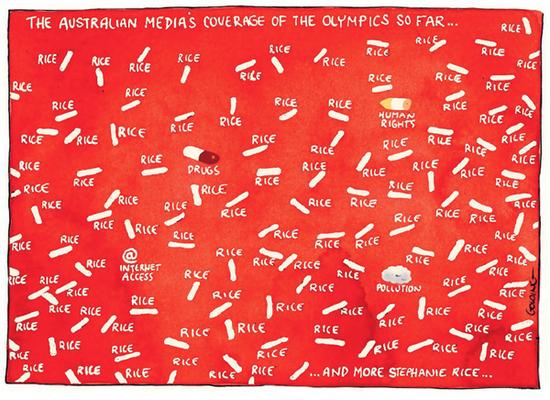 Matt Golding
The coverage illustrates how the modern Olympic spirit is all about money but I'm bored with the corporate branding. I'm not even sure that I care all that much about how many gold medals Australia wins. The concern about the ever more medals does seem to have something to do with national identity on a global stage.
August 9, 2008
Melbourne Photography: UNSENSORED08
UNSENSORED08 is the 2nd annual exhibition of analogue photography presented by the Flickr Melbourne Silver Mine Group at the Collingwood Gallery, Smith Street Fitzroy, featuring the work of 30 photographers each approaching the film medium in their own way
One of the images is by Jesse Swallow and is entitled Vagina Detanta:
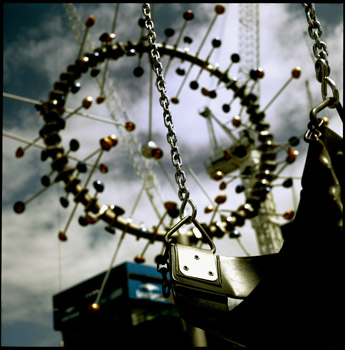 The exhibition features the work of Rhys Allen, Roberts Birze, Zaeem Burq, Geoff Burrows, Dave Chin, Diego DeNicola, Velco Dojcinovski, Barb Fischer, Pete Fritze, Daniel Giglia, David Harkin, Tim Heraud, Michael Holbrook, Hamish Innes-Brown, Luisa Jayme, Matthew Joseph, Michael LeFevre, Matthew Lew, Jaye Loring, Iain McLachlan, Piers Morgan, Stu Nimmo. Jodie Noonan, Karen Riley, Jesper Sidhu, Chris Smeaton, Cam Stephen, Jesse Swallow. Christian Were and Chris Zissiadis.
Many different cameras are used--- 35mm to large format, pinholes to Hasselblads, plastic toy cameras to antique collectibles. The photographers use many styles and techniques as well as blurring the line between old and new.
Beijing Olympics: aesthetics
I watched the opening ceremony of the Beijing Olympics last night that featured thousands of drummers, floating Olympic rings and a glowing globe around which ran runners who seemed to defy gravity. The design of the Opening Ceremony by Zhang Yimou and Zhang Jigang was brilliant. Around 15,000 performers were involved in the ceremony, 2008 of them in the opening minutes beating on "fou", traditional drums that flashed in time to the percussion. That set the tone for a series of tableaux evoking Chinese history, none of which involved fewer than 100 colour-coordinated dancers.

China's Olympics are as much about announcing China's place in the world as sport. China has arrived on the world stage---it is China's coming-out party as a world power. It looks a superpower and it is using the Olympics in successfully compete in the global competition to establish an image as a world power. China is celebrating civilizational progress and the way that the Confucian tradition has facilitated modernization. They are successfully carrying on their civilization in the march of progress.
They appear to be committed to a rather simple notion of evolutionary progress based on economic modernization and so accept fundamentalist Western ideas about what constitutes a prosperous, strong, and moral nation that still dominate in global politics and public opinion.
 National Stadium (Bird's Nest) Beijing, designed by Herzog and de Meuron and the Chinese architect Li Xinggang.
The Bird's Nest looks to be an aesthetic triumph that should make China's reputation as a place where bold, creative gambles can take place. The stadium has a monumental presence and its matrix of crisscrossing columns and beams appear as a gargantuan work of public sculpture that continues the rupture with the purity of late Modernism that had become a kind of authoritarianism.
This rupture is reinforced by the "Water Cube" , which sets next to the Beijing National Stadium in the Olympic Green.
 Beijing National Aquatics Centre, designed by PTW Architects, CSCEC International Design and Arup
The cube-shaped Aquatic Centre is a steel frame covered with a thin membrane composed of tiny ETFE (a plastic-like material) bubbles, which are more energy-efficient than traditional glass.
Both monuments express China’s muscle-flexing nationalism and cultural sophistication.
August 8, 2008
Blake Prize: aesthetics
Christopher Allen, one of the judges for the Blake Prize for Religious Art, has resigned from the judging panel over the inclusion of Adam Cullen's entry. Cullen's triptych shows Christ on the cross and the inscription "only woman bleed", a line inspired by a song by the shock-rocker Alice Cooper.
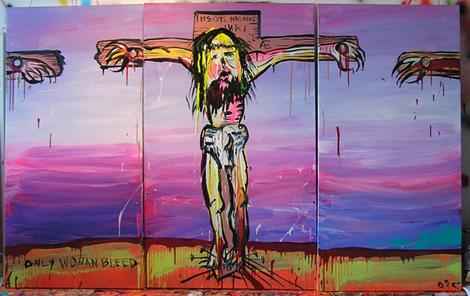 Adam Cullen, Corpus Christi (Women Only Bleed), 2008
Allen, who is the national art critic for The Australian, said that Cullen's work "has a kind of deliberate ugliness which has been exploited as a gimmick. This isn't a personal preference, it's a judgment." He adds that the artist's work is "clumsy", "boring" and that Cullen "deliberately takes ugliness to the point of provocation".That implies an aesthetic position that art should be beautiful and morally uplifting and that ugliness is not a part of art.
However, as Andrew Frost points out, the Blake is founded on the belief that it "embraces diversity in its entries and … remains open to the many styles through which artists engage with the subject area".
What this even highlights is that The Australian has conservative art critic whose view is that art's only role is to be beautiful while reinforcing conservative notions of good taste and decorum.
August 7, 2008
spinning ecological devastation: Lake Alexandrina
The Rann Government is spinning like crazy about the Murray River, which is dying from decades of mis-mangement by state governments. This week at local meetings this week on the shore of Lake Albert Karlene Maywald the SA Minister for Water, described the future of the Lakes in five years by saying that in her judgement they would be:
Hopefully improved, with lovely fresh water and looking absolutely pristine. It's my view that we will see a recovery and if we can get a fresh-water solution now, we will see a fresh-water system in years to come.
Now that will only happen if the overallocations are reduced and more water is restored to the river in the form of environmental flows. And that is not likely to happen within the next decade, despite Maywald talking in terms of adequate winter rains next year and freshwater solutions. Maywald is dreaming at a time when the tipping point in this region is about to be reached in June 2009 and the locals are protesting about the state of the river.
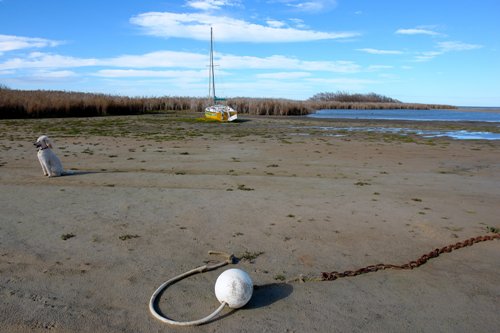 Gary Sauer-Thompson, at Milang, 2008
On the ground water is currently being pumped from Lake Alexandrina to Lake Albert to prevent it from drying out, but that option is only buying time. The options being discussed are pumping Corrong saltwater to Lake Albert through a channel and to build a weir at Wellington and introduce sea water through the Goolwa barrages.
The latter is the most realistic long-term solution. It is inevitable. The significance of the weir (in preparation) is that it will wall off the acidifying expanses of Lakes Alexandrina and Albert and the Coorong "wetlands" in order to safeguard the city of Adelaide's drinking water.
The weir could be so managed to allow river flows into the lower lakes, if and when, there is a reduction in the over-allocations of water licences in the Murray-Darling Basin. Will it? The increase in environmental flows is not happening in any significant way, as it is being resisted by the other states by a variety of devices.
So those local irrigators (mostly dairy farmers) who rely on fresh water from the Lakes will leave the land. The bigger irrigators (eg., the wineries) will be able to access fresh water from above the Wellington weir through a new pipeline that is currently being built.
We locals can counter the spin from the Rann Government by some placeblogging based on participating in the digital media to pressure the need for greater government transparency on this issue. This is made possible by the rapidly declining costs of information storage and retrieval, and the expanding powers of citizens to record, share and analyze raw information about the workings of our government on the River Murray.
August 6, 2008
heritage
It has been raining heavily all day in Adelaide, so I have being taking lessons in using a MacBook and Adobe Lightroom. I'm finding both a step learning curve and I'm struggling with the different way of working. Hence the lessons.

This image was my first attempt at using Adobe Lightroom instead of Picasa to photo manage my pictures and to post process my digital images.
August 5, 2008
Sala Festival
The Sala Festival (South Australian Living Artists) is probably quietly contributing to the higher profile of visual art in Adelaide produced by local artists. New galleries or artist run art spaces have opened and contributed to a critical mass. There is even a Centre for Creative Photography now.
Danielle Walpole is one of the artists at Gallery 139
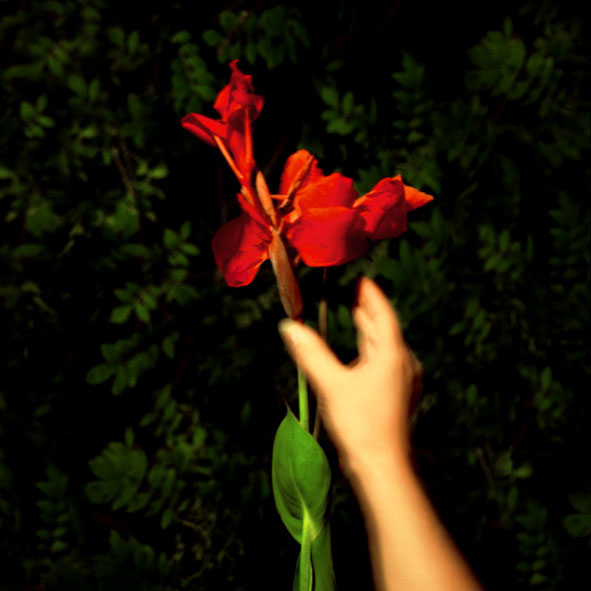 Danielle Walpole, Untitled, from The way I see it, 2007
Walpole is an Adelaide based photographic artist who is a co-founder and core member of the artist collective 'Shoot', whose philosophy is that art should be accessible to all people. Events as the Adelaide Fringe and SALA (South Australian Living Artists) Festivals providing opportunities to take art out of the gallery and bring it to new audiences.
August 4, 2008
Rhizomes1
Finally Rhizomes1, my photoblog, is up and running even though it has yet to be integrated into the Thoughtfactory's very minimal homepage. So, for the moment, Rhizomes1 can be accessed from the top of the weblog page, where it sits alongside the other weblogs. I'm not sure what to do about developing the homepage beyond being a shop front.
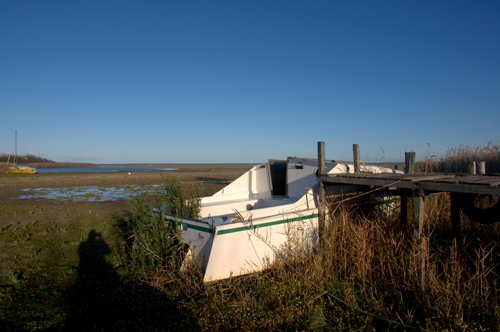 Gary Sauer-Thompson, Milang, Lake Alexandrina, 2008
I'm continuing my photography of the lower lakes in the southern Murray region when the weather permits--it has is raining a lot this last week. The lakes are definitely drying out from lack of fresh water coming down the river and, by all accounts, they will continue to do so. They already are below sea level.
The federal Government's $50 million water buyback is largely ineffective: it will return less than 10megalitres to the Murray River this year - the equivalent of just 10 Olympic swimming pools. Around 300 to 400GL of water by the end of spring is what is needed. I just cannot see that happening. So the Lakes will continue to dry out.
Polly Borland: The Babies
This is an earlier body of work by Polly Borland in which she compassionately explores the little understood world of infantilism:
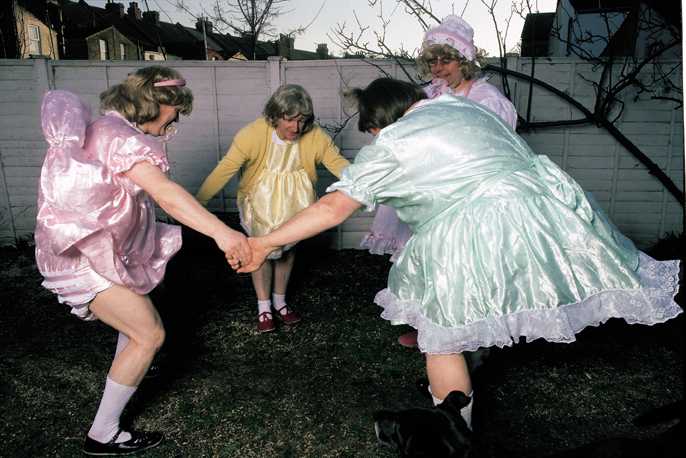 Polly Borland, untitled, from The Babies series, 2001
Borland had befriended several of the men who share a fetish for infantilism, embraced the role of helplessness and, as Susan Sontag points out, engaged in a kind of theatre.
 Polly Borland, untitled, from The Babies series, 2001
Borland photographed around 35 adult babies. Many say that their fascination stems from an unhappy childhood. Sontag says that:
What goes on in these depressing rooms is a kind of theatre. Play- time. But entirely unfeigned. And without manipulation by the camera. Nothing is digitalised. Borland's project depends on the photographs being - as of old - a trace or imprint of the real. There is an implicit contract: these are people who really are (part of the time) like this; they aren't putting on a show for the photographer. Indeed, she had to spend long periods of time with them, win their confidence, become friends, in order to take these pictures.... The force of these pictures depends on our trusting the photographer that nothing was devised for the camera. That something is being revealed.
Borland is currently working on a series of eccentric faces from her local town of Brighton entitled Carousel.
August 3, 2008
Penny Borland
The blurb says that Bunny is a series of images by Polly Borland that create a portrait of an extremely tall girl called Gwen. Combining surrealism with a forensic study of the subject’s femininity, Borland has successfully borrowed from the surrealist ideas of Claude Cahun, Hans Bellmer and Man Ray to produce an intimate, yet haunting photographic narrative.
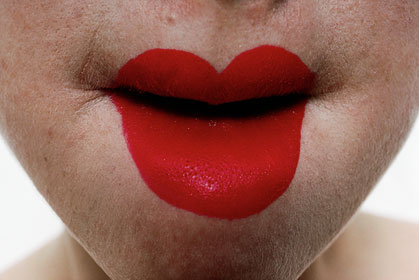 Penny Borland, untitled, Bunny
Borland was a successful portrait photographer before moving to the UK from her native Australia in 1989; she earned her reputation for specializing in stylized portraiture and off-beat reportage.
 Polly Borland, untitled, Bunny series,
August 2, 2008
Saturday humour
I'm on my way to Brisbane for the day. Fly in early fly out late. It's for a meeting. So posting will be limited to a bit of humour about pop culture and the economy.
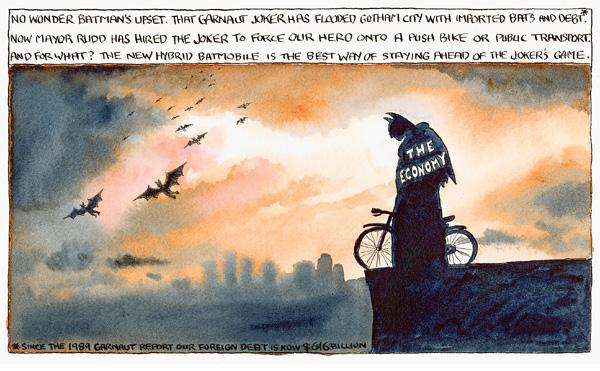 Spooner
Cartoonists have such freedom to weave different ideas together. No one seems to care about the national debt these days. The resource boom will take care of it, seems to be the common belief. For whatever reason no one talks about the growing national debt.
August 1, 2008
Milang jetty
I was down at the resort townships of Milang and Clayton on Lake Alexandrina yesterday taking photos of the receding water in the Lake as part of my River Murray series. The Lake is drying out is due to the lack of flow down the River Murray, and it is caused by the over allocation of water licences, the drought and global warming. So photography needs to do more than celebrate the natural beauty of the region.

I missed Brendon Nelson, the embattled opposition Liberal leader who, along with Jamie Briggs, the Liberal candidate Jamie Briggs for the seat of Mayo recently vacated by Alexander Downer, was campaigning for the upcoming by election. The politicians were at Clayton listening to the angry locals concern about the effects of the drought on the Clayton and Milang region.
I missed a local exhibition entitled High and Dry at Sails at Clayton, a local restaurant in Clayton, that is part of the SALA Festival in SA.The exhibition consisted of artworks in various media on the theme of drought, and particularly its effect on the Clayton Bay and Milang area Unfortunately, none of the images are online.
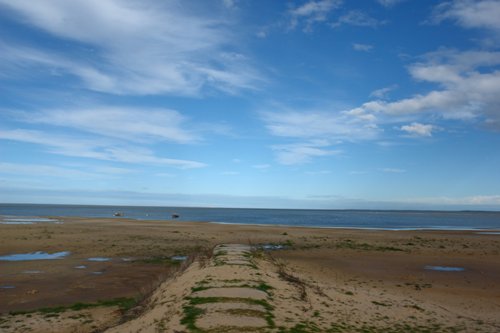 Gary Sauer-Thompson, Milang, Lake Alexandrina, South Australia, 2008
In the late 19th century Milang was a port where goods were unloaded onto bullock drays which made the slow journey across the Mount Lofty Ranges to Adelaide. The town was known as a ship building centre with a number of paddlesteamers being launched from its yards.The town's heyday was from the mid-1850s through to the 1880s.