September 30, 2008
metroblossom
Metroblossom is a collaborative online space for exploring the interaction between humans and the nonhuman world run by David Schalliol. He says that we humans have:
transformed our physical and cultural environments to suppress spontaneous, creative uses of space. The private and public, local and global, commercial and nonprofit -- our divisions and methods of discourse and action -- combine with the pickax and petrochemicals to impose our vision on the world around us. Nonhuman life bears the brunt of this domination. Unnecessary, illegible, invisible. If it cannot be harnessed, it is ignored or suppressed.
This is one of the themes I've been exploring in my photography and junk for code around empty urban spaces, urban nature and industrial wastelands:
Gary Sauer-Thompson, empty lot, Adelaide CBD, Australia
The name I have given to this is the aesthetics of decay or ruins. The decay or ruins stand in this tradition signify, or stand for human history understood as death, ruin, catastrophe. This is the aesthetics of the modern or neo-baroque.
Schalliol goes on to say that:
.. Herein lies a paradox -- what we do not see is as important, if not more important, than what we do see. In the superimposition of the gnarled grid of the city onto the even more twisted root structure of the earth, the unplanned, often nonhuman, world reacts to and acts on us.
I would add to this by saying that the aesthetics of the neo-baroque gives us a way to interpret the significance of the unseen 'twisted root structure of the earth'.
This aesthetic recovers the historical baroque's alternate, pre-Enlightenment modernity that is not reducible to the quantifying rationality that gained ascendancy in the eighteenth century. This alternative rationalityis understood by Walter Benjamin as a world of twists and folds, undulations, and fractured planes; a world in which the unexpected and multivalent has supplanted the predictable and repetitive. This disorderly and highly uncertain state of affairs is not without strains of the apocalyptic.
September 29, 2008
Josef Koudelka: romantic artist
Josef Koudelka is a key exponent of Czechoslovakian humanistic and documentary photography of the1960s and 1970s. He is seen to work with objective and open eye that captured a reality, which caused them trouble with the old communist regime. Koudelka's reputation was made internationally by the photographs he shot of the invasion of Prague by Warsaw Pact troops (in August 1968) So he emigrated and joined Magnum.
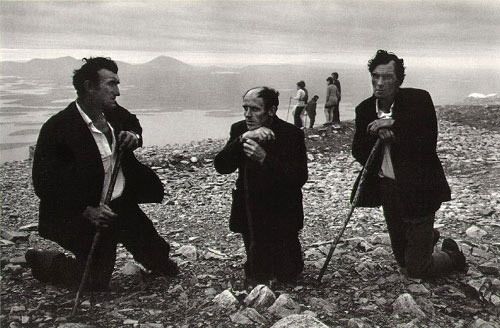 Josef Koudelka, Ireland,1972
Though Koudelka joined Magnum he became stateless, restless and rootless even though Paris was his adopted home. He defined his freedom as a nomad constantly on the move alone with this camera and sleeping bag. Until he returned from exile to Czechoslovakia in the 1990s with his semi-mythic status as a celebrated exponent of 20th century reportage by a romantic artist.
Sleeping under a desk the Magnum office or crashing in a mate's pad for several years in London, sleeping in sleeping bag in the open, walking away from one's kids and being just alone with one's camera is not a practical role for contemporary photographers.

September 28, 2008
dying camelia
This picture of decay taken with a digital camera would be a suitable raw material to play around with using Photoshop. (I don't have Photoshop--I'm still exploring Lightroom). This step to Photoshop opens up different forms of creative image construction or manipulation using still cameras.

There is a strong reaction against Photoshop and not just from traditional (film) photographers. Photoshop is seen as a form of bad manipulation that distorts and lies about reality and so is a form of untruth. Untruth is bad.
An example of this position is Christopher Scanlan's recent op-ed in The Age entitled At the altar of the digital age. Scanlan lists various examples of how those using photoshop can manipulate reality to create an untruth in fashion, politics and science. He then quotes from Daniel Boorstin's 1961 book on the graphics revolution, The Image, where Boorstin warned of "the menace of unreality". Boorstin warned that we:
risk being the first people in history to have been able to make their illusions so vivid, so persuasive, so 'realistic' that they can live in them. We are the most illusioned people on earth. Yet we dare not become disillusioned, because our illusions are the very house in which we live; they are our news, our heroes, our adventure, our forms of art, our very experience.
Scanlan says that while Boorstin's concerns might now seem quaint we are still capable of distinguishing illusion from reality. He then finishes with the comment that "how long we will continue to make this distinction - and whether we will attach any importance to it - is another matter."
Not once is photoshop considered to be developing a different kind of aesthetic that is linked to postmodernism. Photography for Scanlan is a window on reality with minor interpretation and minimal postproduction by the photographer. It is a mode of representation not a mode of expression that arose with Romanticism in the nineteenth century in a revolt against the empiricism, instrumental rationality and the scientism of the Enlightenment.
Art need not be the expression of the emotion of its creator (the artist) as it can be a form of social expression. This art functions showing the "falsity of our enlightenment reality by reminding us of the "memory of what has been vanquished or repressed."
September 27, 2008
US blues
The get-government-out-of-business brigade, who saw themselves as the masters of the universe, now want strings-free handouts to get them through their hard times resulting from all their gambling and speculation. They continue to extol the virtues of free open markets whilst they run to Uncle Sam for protection
 Reg Lynch
The chief executives who have amassed fortunes while driving the financial system into crisis and the US into even greater debt, whilst talking in terms of relaxing regulations, giving the banks more tax breaks and the free market sorting things out. Their orthodox economist friends continue to see the economy in general, and financial markets in particular, as effective, stable, and self-correcting mechanisms.
Sad, shameful times for the US really.
September 26, 2008
September 25, 2008
A Modernist office revisited
The original post is here. It is being revisited in the form of its incorpoation into The Glocal project.

I've just joined the glocal project ---an expansive digital artwork that has its roots in Canada. It was created by a collective of artists working at the Surrey Art Gallery, one of Canada’s leading public digital media galleries. It focuses on empowering local photographic communities by linking them to one another and to digital resources to encourage more experimental images. It's a version of “thinking globally and acting locally.”
Our project aims to understand digital art as part of the evolution of lens-based art, which has evolved in the face of rapidly changing technology, resulting in several aesthetic movements. The Glocal project is as much about science and technology as it is about art, examining the way the internet impacts the evolution of photography. Twenty years ago, an exhibition with millions of viewers was not possible, unless you were a photographer or artist whose work was exhibited in magazines or in art galleries.
They also run innovative weekly photochallenges that will allow members around the world to explore new ideas and come together to discuss art, photography, and culture.
September 23, 2008
camelias in Kingston
It is springtime in Canberra and I have been laid low with the flu for most of the fortnight that I've been here.

I have had little energy to do much. On Sunday afternoon I picked up. I took some photos of camelia's in Kingston to cheer me up. They are starting to fade as the cool weather goes.
September 22, 2008
Australian rock art: Arnheim Land
The "X-ray" tradition in Aboriginal rock art is thought to have developed around 2000 B.C. and continues to the present day. As its name implies, the X-ray style depicts animals or human figures in which the internal organs and bone structures are clearly visible.
X-ray art includes sacred images of ancestral supernatural beings as well as secular works depicting fish and animals that were important food sources. In many instances, the paintings show fish and game species from the local area.
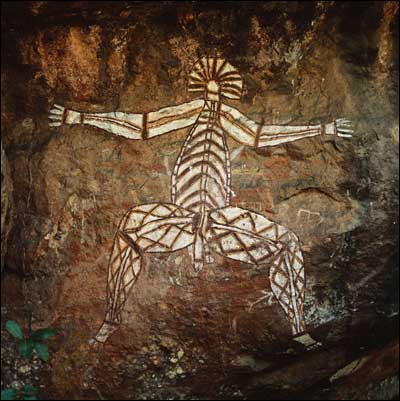 "X-ray style" figure,Rock painting, ca. 6000 B.C.E., Kakadu National Park, Northern Territory, Australia
X-ray paintings occur primarily in the shallow caves and rock shelters in the western part of Arnhem Land in northern Australia. Recently, a vast wall of more than 1500 Aboriginal rock art paintings has been found by archaeologists in north eastern Arnheim land.
The paintings in the Djulirri rock shelter in the Wellington Range chronicle Aboriginal contact with Maccassan traders from Sulawesi, and Europeans from the early sail ship days right through to WWII.
As James Woodford observes:
Contrary to the popular view that indigenous Australians were isolated on their island continent, waves of other seafaring visitors arrived long before British settlement. For hundreds of years there may have been an export economy in northern Australia driven by the Chinese appetite for trepang, or sea cucumber.While it has long been known that Macassans traded with Aboriginal people, the accepted date for this was in the early 18th century. The team of scientists believes it may have begun centuries earlier
This rock art dismantles the popular identity of Australia being a nation first visited by the British. It goes against the history of the Bicentennial and convicts.
September 21, 2008
the market as a fun fair
The cartoons of the financial crisis have been slow in coming in Australia:
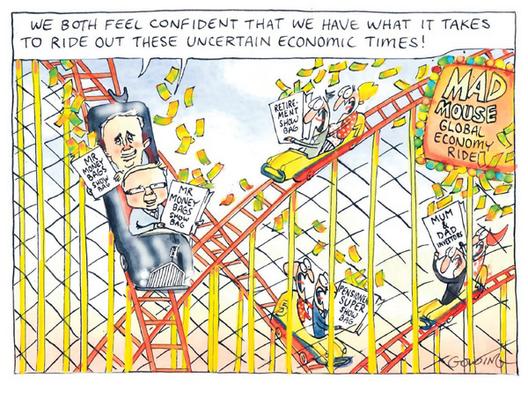 Matt Golding
It's just a little bit of humor for a quiet Sunday. No doubt the stock market will bounce back---due to a ban or short selling?---and everybody will go back to making money again.
Joel Sternfeld: Walking the Line
Joel Sternfeld has traditionally used the large format camera to document a beleaguered land: a polluted landscape invaded by concrete and real estate. His body of work deliberately avoids the picturesque. It doesn't just point the camera at the world. It is an interpretation. The landscape of the 20th century is often the destroyed landscape.
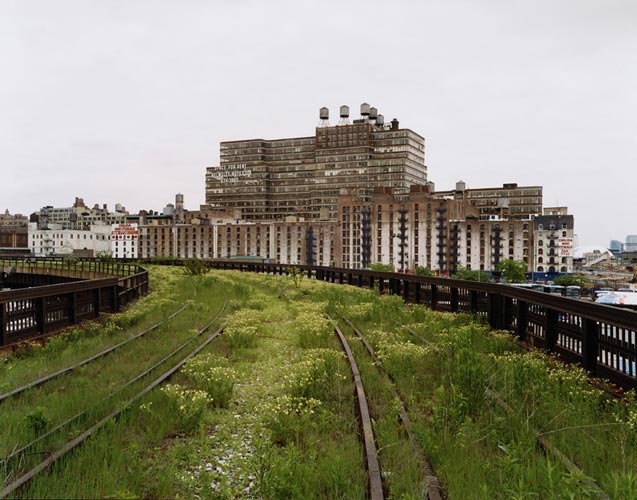 Joel Sternfeld, Looking East on 30th Street on a morning in May 2000, from Walking the Highway series, C-Print
This kind of work is in stark contrast with the digital Flickr aesthetic of dramatic colour and skies that places an emphasis on post-production of photoshop of the individual photo, rather than the picture structure or thinking of developing a form of our time.
Postmodernists, in contrast, often stage scenes for the camera. Postmodernism is the belief that in advanced societies reality is a secondhand experience, a slippery substance filtered through a ghostly scrim of media images. Movie stills, news pictures, advertising -- the world is a deck of pictures; the artist's job is to shuffle and deal, making images that comment upon images. We live in a house of mirrors.
September 20, 2008
Canberra: a smart city?
Every time I stay in Canberra I become uneasy. I see the lack of rain and fear the lack of water. The region has diminishing water resources and the university city does not seem to be able to address this issue or become an ecologically smart capitol city in renewable energy or urban water recycling.
The new commercial development around the airport appear to based on fossil-fuel energy rather than solar power, whilst the new suburbs in the Molonglo Valley are both car dependent and reliant on fossil fuel energy.
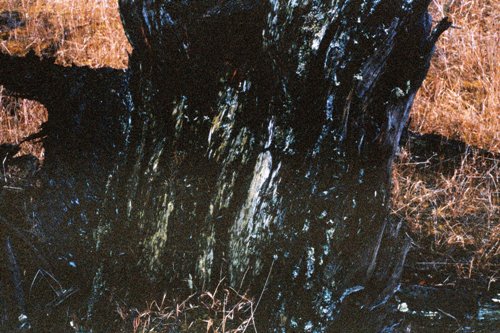 Gary Sauer-Thompson, burnt tree trunk,
An election is currently underway and there seems to little emphasis on these issues, despite climate change effecting Canberra's water supply. Nor is there much emphasis on light rail public transport as a way to get around this car based city.
September 19, 2008
Sculpture and Cactus

A large bronze sculpture which has cactus growing in it. The B&W doesn't show it, but the bronze is blue and the cactii green.
September 18, 2008
Tasmanian Museum + Art Gallery: redevelopment
The Tasmanian Museum and Art Gallery is undergoing redevelopment. It is part of a plan to redevelop and revitalise the Hobart wharf area.
The Museum/Art Gallery plan is by Sydney-based practice Johnson Pilton Walker (JPW), in partnership with Tasmanian architects, Terroir, and if it goes ahead as planned, then it will be an interesting piece of postmodern architecture in Australia.
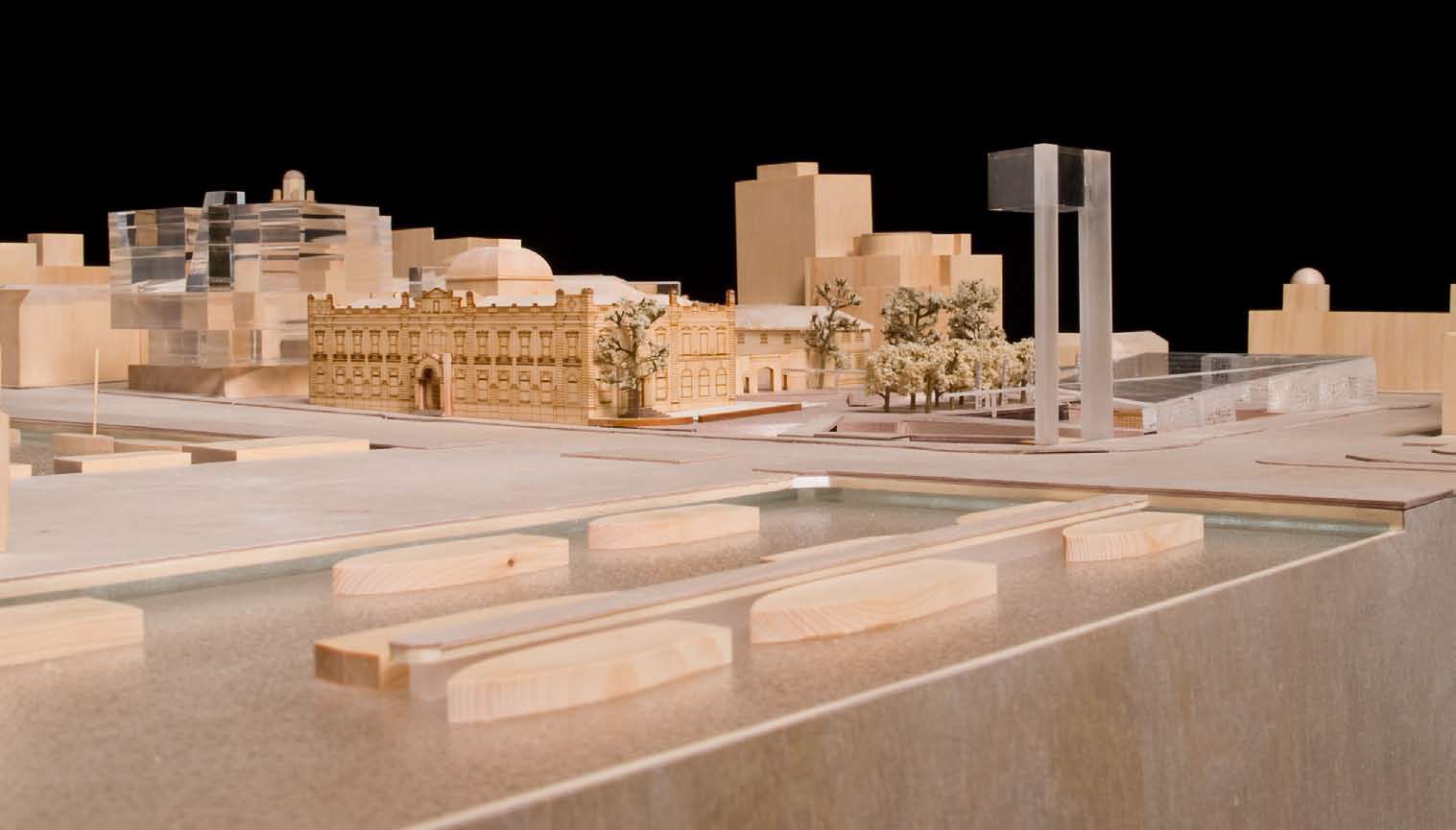
The architects approach has not been the modernist one of pulling everything down and building on ground zero; or trying to pull together the various components into some kind of visual unity. The plan sets the different buildings apart and emphasises their differences.
The result is a lively collection or ensemble of disparate architectural styles -- from the domesticity of the 1813 Private Secretary's Cottage to the grand Victoriana of the former Customs House -- arranged around a series of strikingly modern open plazas. The ensemble is designed to function coherently for the first time.
September 17, 2008
space photography
A study of star forming region W5 by the sun-orbiting Spitzer Space Telescope
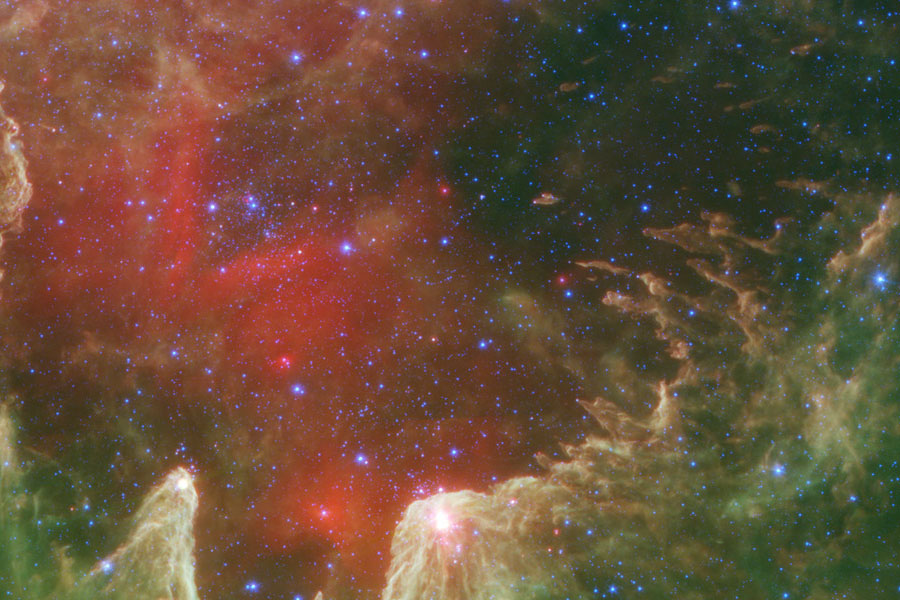 Astronomy Picture of the Day
The older stars in the center are actually triggering the formation of the younger edge stars.
in Canberra, Melbourne calling
When I'm in Canberra I yearn to go to Melbourne to take photographs. I find Canberra's CBD ---known as Civic--- shabby and tired. There are few buildings of any architectural merit---the Sydney and Melbourne buildings come to mind, but they were built 70 years ago. Civic centre has been given over to bleak malls that are dead public spaces--- and private shopping malls that are private spaces.
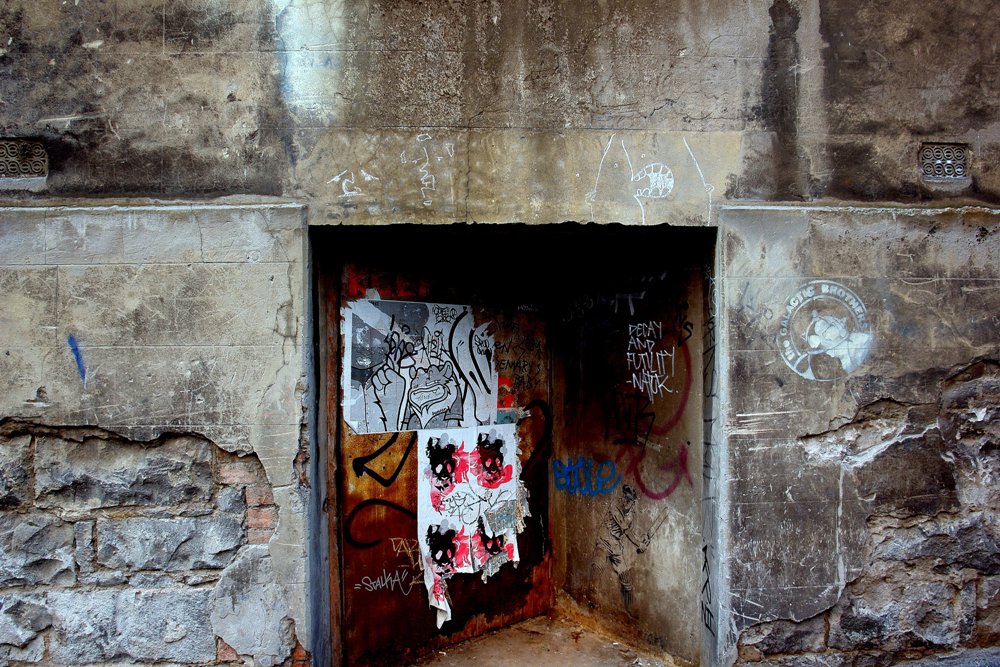 Gary Sauer-Thompson, wall, Higson lane, Melbourne CBD, 2008
Though Canberra is Australia's capital city built to a plan it is looking in need of some rejuvenation that goes beyond that of a city given over to private developers. It is unclear whether Canberra has a vision of itself as an urban centre. Whatever vision it did have seems to have been lost.
September 15, 2008
back in Canberra
I'm back in Canberra for a couple of weeks and all the political talk so far is about Costello, his book and the trials and tribulations of the Liberal party leadership. Yawn. I'm bored, so bored. Where is the considered reflection on our political culture and the role of the media in shaping it?
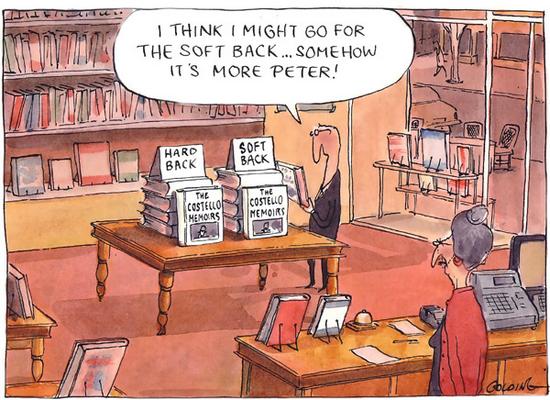 Matt Golding
I'm not going to rush down to the Paperchain bookshop in Manuka to buy a copy of Costello's memoirs for $55. Honestly, I'd rather spend the money on film for the Leica. The big promotion in the media over the weekend gives me all that I need to know about what Costello thinks of his colleagues and his party given the weeks of publicity about his memoirs.
Costello can become an important commentator on economic and media matters ----the ignorance of the press on economic issues, the obsession of press with leadership speculation and the 24 hour media circle. he has the opportunity to speak more freely now that he is on the backbench as the Member for Higgins.
Update:20 September
Things aren't going well for Costello's book sales are slow, despite all the publicity:
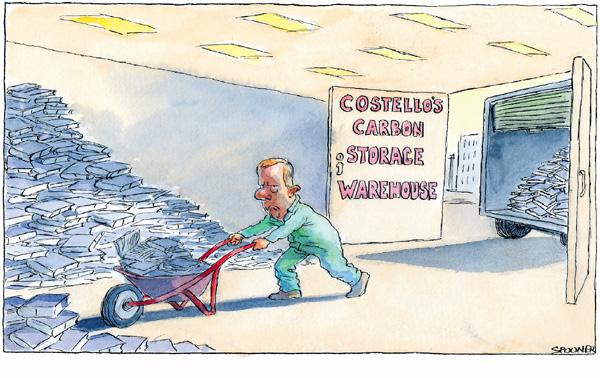 Spooner
September 14, 2008
classifying blogs
Margaret Simons in her Towards a taxonomy of blogs says that before we criticise bloggers we need to define our terms. The word “blog” is now manifestly inadequate to allow us to talk in sensible ways about the many different things that are happening in internet based publication by individuals and groups. My understanding is that 'the blog' is just a media technology (similar to 'the book' or 'the television'), which is then used in any number of different ways. So we have specific forms of blogging---public opinion, for instance, is different from junk for code or philosophy.com
Simons says:
I am going to make an attempt to invent some new words for different kinds of blog, in the hope that readers will dive in, add and improve. Where possible, I have tried to adapt the terminology of the past, including that which accompanied the invention of the printing press. I think historical resonances can be helpful in illuminating what is going on in new media, as well as reminding us that this is not the first time that technological innovation has changed almost everything about how we communicate. Certain human needs persist. The means of satisfying them alters.
Looking at her taxonomy we can put junk for code into the category of the exhibition blog or what some people have called vanity blogs. "Vanity" blogs kinda misses the point.
The Exhibition Blog. I could have called these blogs “vanity publishing”, but I don’t like the pejorative overtones. These are blogs maintained by writers, craftspeople, artists and artisans of many kinds in which they bring their creations to a wider audience, and sometimes discuss their methods and thought processes. Take, for example, the many blogs on quilting, such as AroundtheWorldIn20Quilts, which is a collaboration between quilters in the Netherlands, the United States, Britain and Australia. Sometimes Exhibition Blogs also serve as Diary BlogsThese are an example of the artistic prod users ( user-producers) who are active producers of content in a variety of open and collaborative environments. It is quite different from the citizen journalism form of blogging.
September 13, 2008
Damien Hirst
Art critic Robert Hughes has attacked BritArt star Damien Hirst as responsible for the decline in contemporary art.
Hughes branded Hirst's various works as "tacky" and "absurd" in a 2008 TV documentary called The Mona Lisa Curse made by Hughes for Channel 4 in Britain. Hughes said it was "a little miracle" that the value of £5 million was attached Hirst's Virgin Mother (a 35 foot bronze statue), which was made by someone "with so little facility".
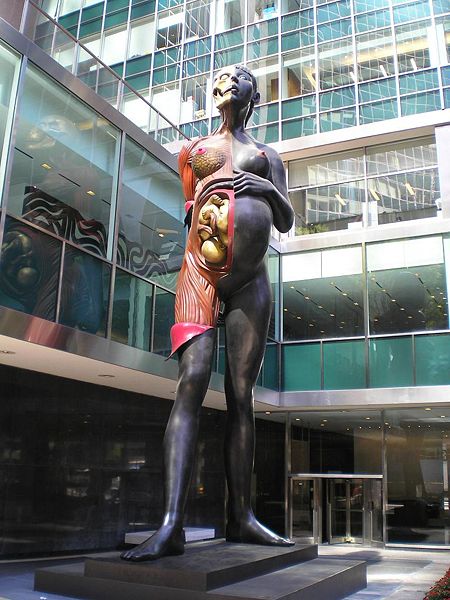 Damien Hirst, Virgin Mother, Lever House , New York, 2005
Hughes is not alone in his judgement. I am not sure what Hughes means by the decline in contemporary art. Art "functioning like a commercial brand"? Artists making the price tag of an artwork more important than its meaning? Art as spectacle? The elevation of minor artists into the limelight? Politically correct art that believes expressiveness, not quality, is enough? Contemporary art is decadence?
A period of artistic decline due to a bankruptcy of innovation (the search for the new)? Art's fall into a commodity culture and its becoming an icons of popular consumption? The bastardisation of Warhol's concepts and critique of popular culture?
Robert Adams
Adams work in The New West (1974) and Denver (1977), arose from the results of a project he had completed on a Guggenheim Fellowship in 1973 – 74 He continued to teach a full schedule of classes, but committing what spare hours
The work he produced of tract homes, shopping strips, and the concrete-block churches in the outer suburban American landscape is notable for its determination to avoid any type of pictorial effect in favor of a direct, matter-of-fact descriptiveness that just avoided triviality. Rather than failing through cleverness or excess or by straining for beauty, these photographs risked that possibility by appearing to be little more than the documentary snapshots
 Robert Adams' Untitled, from What We Bought: The New World (Scenes From the Denver Metropolitan Area),
In his 1970-74 series, What We Bought: The New World (Scenes From the Denver Metropolitan Area), Adams photographed vast factory floors filled with anonymous workers, retail mall architecture that dominated suburban vistas, dozens of different brands of bread crammed on unending supermarket shelves. The series offered a stark and yet non-judgemental view of Americas growing love of mass consumption.
September 11, 2008
medium format photography
As mentioned earlier Vitamin, is a South Australian visual culture quarterly, with an online gallery. Its current online exhibition is “Urban Differences”, an exhibition of photography, or more specifically read art photography---meaning art school trained photographers who exhibit their work in the local art galleries. At the other end of the photography world are the professional studio photographers producing images for the culture (fashion, design etc) industry who supported the vibrant medium format camera business. In between are the serious amateurs who also supported medium format because of the image quality.
Then along came digital. Between 2000 and 2006 the digital steamroller decimated medium format. Film was disappearing rapidly. With the ever-hastening demise of film, medium format camera makers had a difficult time, and many of them went out of the medium format business, including Contax, Bronica and to a large extent Fuji. Pentax soldered on, but without the ability to accept digital backs it was doomed. Rolleli's flagship medium format camera was the Rollei 6008 and Rollei got sideswiped.
With film in its final days there were four and a half companies making medium format digital backs for a small market that is probably less than 6,000 units a year world-wide. The companies included Hasselblad, Phase One, Leaf, Sinar (Jenoptic / Eyelike), and the half company, Mamiya. Phase One, Leaf, Sinar needed a camera to put their back on. It was not to be Hasselblad, who used the biennial show Photokina in 2006, to announce a new H3D with a dedicated, though removable digital back. Since no other company's backs would be able or be allowed to attach to a Hasselblad H3D, so Hasselblad became a closed system.
At the same show Leaf and Sinar moved to sell their backs on the Hy6 system, based on the Rollei platform made by Franke & Heideche. They built the body from ground zero with funding from Jenoptik and Sinar.
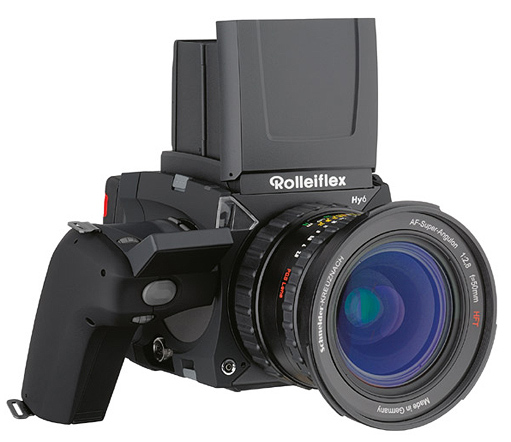
The Hy6 was designed as an open platform with an eye toward the future. The “Hy” stands for “hybrid,” since the camera can be used with both digital and conventional film backs. It can handle 120 and 220 film and digital backs from Sinar and Leaf and it employs the Rollei lens mount which accepts Sinaron, Schneider and Zeiss glass.
Phase One now has its own camera system available based on the Mamiya platform. A new Phase One designed / Mamiya built medium format (Phase One 6X45) camera appeared in the first quarter of 2008 as an open platform. This model is probably just the first of what will be a major new medium format camera and lens line.
Though the Hy6 is based in part on the Rollei 6008 it doesn't come cheap---it is between $US 25, 000 to $US45,000. So it is not going to bought by the typical amateur photographer/hobbyist. It is for the studio pro. The large studio centers who switched from medium format to DSLRs a while back are now switching to MF digital again, simply because of the superior image quality which it can produce. For the amateur/hobbyist it is back to using older medium format cameras and film, which is really returning the world once left behind.
September 10, 2008
water for Adelaide
The Senate's Rural and Regional Affairs Committee inquiry into finding water for the Lower Lakes and Corrong held hearings in Adelaide yesterday. It heard from CSIRO that Adelaide could wean itself off River Murray water through storm water harvesting, better demand management and improved catchments in the Mt Lofty Ranges.
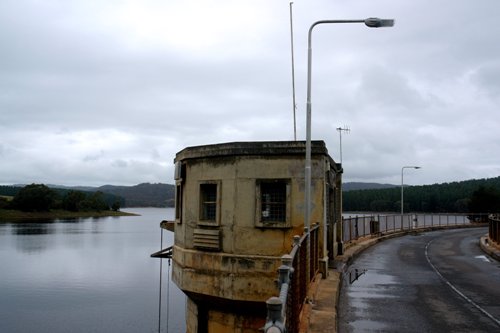 Gary Sauer-Thompson, Myponga Reservoir, 2008
Adelaide draws about 200 gigalitres from the River Murray each year. This requires an extra 600 gigalitres to cover evaporation. The CSIRO points out that around 160 gigalitres of storm water drained into from Adelaide into the sea each year and that it is feasible to capture a quarter to a third of this and store it in aquifers for reuse.
The Rann Government has dismissed this option in favour of a 100 gigalitre capacity desalinization plant. It's the centralised corporate water solution that is favoured.
September 9, 2008
orange abstract
A quick post as I'm tired from the days work.

it is very modernist in style and intent. I'm not sure what a postmodernist photograph would look like these days. Would this be an example? The emphasis is on post production and a shift from the mirroring of nature.
September 8, 2008
Victoria Square
The recent Community Ideas Competition for Victoria Square in Adelaide drew 115 entries from sources as diverse as local school children to architects and urban planners with the schemes divided into two categories, one that incorporated the existing features of the square and one that allowed competitors free rein. The designs were independently assessed by a team of professionals ranging from architects and urban planners to transport and major projects representatives.
Amanda Ward in The Adelaide Review says that:
The result is somewhat academic since guidelines of the competition clearly state there is no intention to put any of the plans into action. The whole process will form part of the ideas gathering process for the Adelaide City Council which is now working on a master plan for the precinct. The competition was not about finding a solution for Victoria Square but about gathering ideas and a sense of how the public felt about the space, such a pivotal part of Colonel William Light’s plan for our city and yet such a thorn in the side of modern administrators.
The assumption is that Light envisaged an open Italian style piazza when planning Victoria square. Ward says that it is the car which has caused most of the grief.
She says:
The corners of the square have been shaved off, creating useless triangles of earth surrounded on every side by traffic. Cars, buses and trams have right of passage through the heart of the space, relegating pedestrians to patches of grass in each of the four corners or the relatively narrow paved paths that skirt the carriageways.
She quotes Kirsty Kelly from the Planning Institute Australia was one of the judges on the shortlisting panel. She said that:
t
he competition certainly highlighted what some people saw as important in a city environment but she was surprised that the majority of the entrants still kept the focus on cars rather than people. Motorised transport was king in the debate, despite some elaborate schemes to include everything from community gardens to playgrounds and even soccer pitches.
Cars still have precedence over people.
September 7, 2008
Melbourne Festival: Anne Noble
Another exploration in the visual arts side of the Melbourne Festival during October 2008. An Australian photographer exhibiting is Mathew Sleeth. Another photographer is Anne Noble at the Centre for Contemporary Photography in Fitzroy:
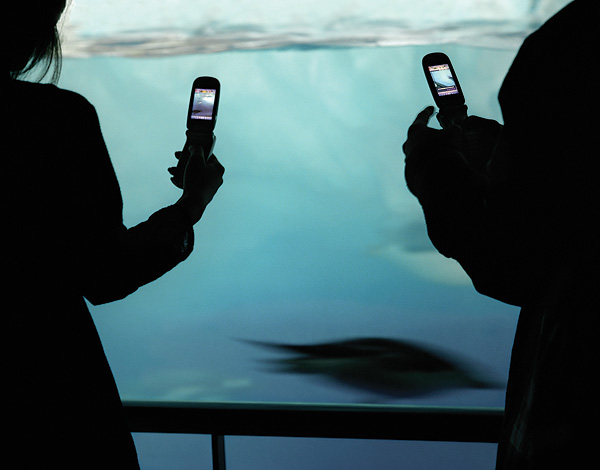 Anne Noble, Penguin in Japan, 2003
Noble is a Wellington-based New Zealand photographer, who is long recognised as a major figure in New Zealand photography. She has body of work that includes landscape photography, documentary photography, portraits and large-scale installations incorporating still and moving images
The publication States of Grace (2001) reveals the range and versatility of her work from the celebrated black and white Wanganui series of the 1980s to the dramatic and lusciously coloured Ruby's Room images.
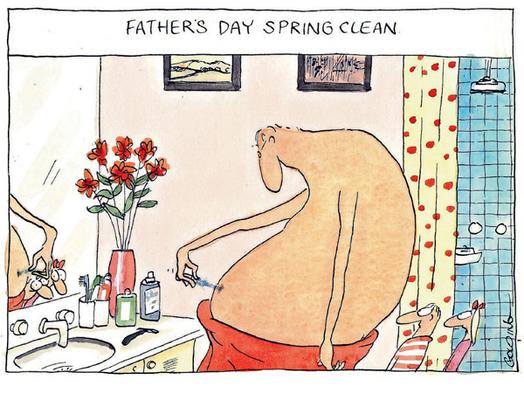
a clean up
There is little need for comment. Obesity is a big problem in Australia due to poor diet and lack of exercise:
 Matt Golding
Trouble is quality fruits and vegetables are becoming luxury goods as prices continue to increase. Junk for increases less, thereby making it more attractive to people with stretched budgets.
September 5, 2008
Hawaiian Shoreline
The lava flows in many areas of Hawaii touch the Pacific Ocean. The black rock gives strong contrast to both the blue of the ocean and the bleached coral which often washes up on the shoreline.

The lava flows scar the island and are often dated; 1907, 1924, 1968, etc. They are pretty much constant across the island and weave their way down from the volcanoes to the edge of the ocean.
Vivid in Canberra: Silvi Glattauer
Vivid ---National Photography Festival-- in Canberra. The Church Gallery has an exhibition of alternative photographic processes.
Silvi Glattauer for instance, has a particular interest in the 'fine print' produced by a contemporary photogravure technique for translating her imagery. A unique blend of digital with the hand made print, the photogravure encourages textures, tones, forms, light and shadows.
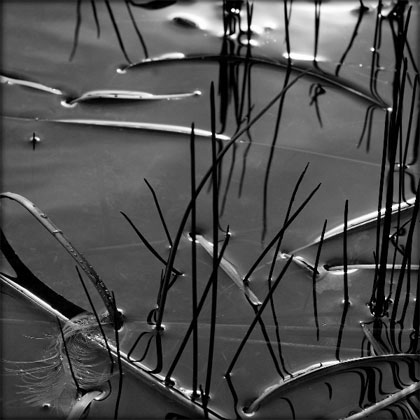 Silvi Glattauer, Bridgewater #1, Photogravure with rolled colour, 2008
Silvi works and teaches the photogravure process at The Baldessin Press, a unique bluestone etching studio in the bush setting of St Andrews, Victoria. Within Australia, The Baldessin Press stands alone in the specialisation of Photogravure printmaking, having been introduced by Silvi in 2002.
September 4, 2008
Richard Green: Wild Places
Richard Green uses a helicopter to access wilderness areas in Australia.
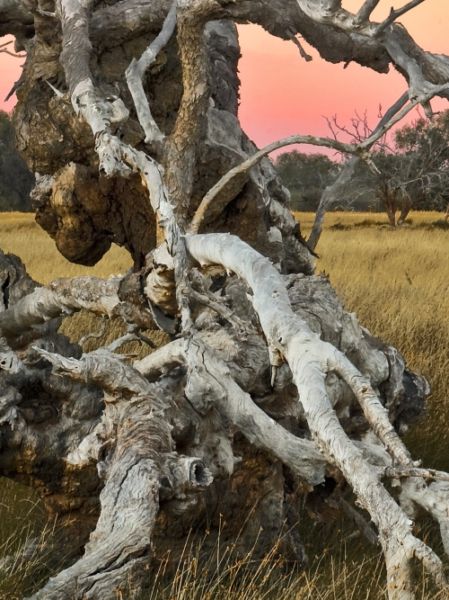 Richard Green, Gnarled Trees, Coongie Lake (detail), 2006
His Wild Places exhibition at the Byron McMahon Gallery --- a partnership between Sandra Byron Gallery Pty Ltd and Peter McMahon--- will be the last show presented under that name at George Street, Redfern. The partnership between Bryon and McMahon has dissolved.
September 3, 2008
Australian Photography: Charles Bayliss
Though Charles Bayliss is considered a leading figure in Australia’s photographic heritage in contemporary terms, Bayliss has not yet received his due.
 Charles Bayliss, Watson Bay, 1874
Bayliss is well known for his 19th century panoramas, notably of panoramas of Sydney taken from the 27-metre tower Holtermann had had specially constructed at his home at St Leonards on Sydney’s North Shore. Bayliss also photographed the city, leisure activities, and the landscape. His images recorded the impact of modernisation on the colonies of Victoria and New South Wales in the decades after the gold rushes. The landscapes he photographed (Three Sisters and the Grose Valley in the Blue Mountains and the Fitzroy Falls in the Southern Highlands) were generally within striking distance of Sydney and increasingly accessible to tourists eager for contact with nature as an antidote to city life.
 Charles Bayliss, Group of Aboriginals at Chowilla Station on the lower Murray River, South Australia, 1886 [NLA)
In 1886, Bayliss produced one of the most memorable photographic series of his career while working as the official photographer for the Lyne Royal Commission on Water Conservation. This had been set up by the Governor of New South Wales in 1884 to assess the situation along the Darling River, which had been suffering the crippling effects of drought. The irony was that the commissioners on the 1886 fact-finding expedition encountered extensive flooding of the Darling and Murray rivers.
The expedition set off from Bourke and travelled by paddle-steamer down the Darling, arriving at Wentworth three weeks later. The commissioners interviewed local residents along the way and assessed the condition of the land. Bayliss meanwhile took an extended series of photographs of the flooded Darling and surrounding landscape, and of the activities in what had rapidly become an important wool-growing area. Some of the events he photographed, such as the crossing of the Darling River by a huge mob of bullocks, were spontaneous occurrences, while others he constructed for the camera.
Helen Ennis in A Modern Vision: Charles Bayliss, Photographer, 1850–1897 says that:
His understanding—and use—of the photographic medium is, however, modern in another more profound way: its self-consciousness. Bayliss’s picture making displays a debt to prevailing pictorial conventions, such as the topographic view and the aesthetics of the picturesque and sublime, but it also confidently declares its innovatory nature. This can be seen, for example, in the choice of unexpected vantage points and the creation of complex compositional structures that have the effect of making the viewer conscious of the photograph as a purposefully constructed image, as artifice. Bayliss’s interest in narrative—which is evident in the production of series and carefully arranged sequences of images—also prefigures later developments in photography.
Other 19th century photographers in settler Australia include Charles Nettleton in Melbourne, J.W. Lindt in New South Wales and Townsend Duryea and Captain Samuel Sweet in Adelaide; Richard Daintree who had returned to England in 1872), N.J. Caire and J.W. Beattie,
September 2, 2008
doomed
It is a British cartoon about economics and politics in the UK, but it captures the feelings of those living in the lower lakes of the Murray Darling Basin. There is a pervasive sense that governments have failed, and badly.
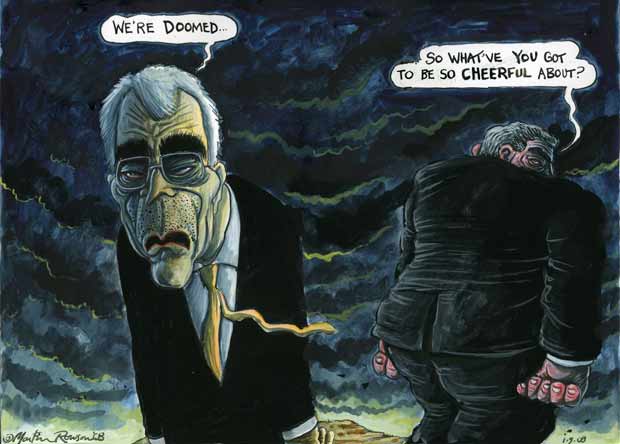 Martin Rowson
That feeling leads to despair and anger. Why do things continue to drift? Why is there so little action?There is a public mood of anger, cynicism and distrust of political and business leaders developing not just around water, but about climate change. It's a substantive mood shift that is sceptical about more ten point plans.