October 31, 2008
Australian architecture: avant garde
So we do have an avant garde architecture in Australia, judging by this winner of Robin Boyd Award for residential architecture at the Australian Institute of Architects’ National Architecture Awards:
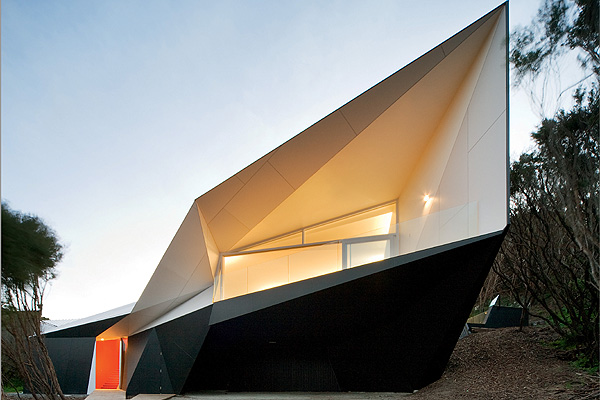 John Gossling, Klein Bottle House, designed by Rob McBride and Debbie Lynn Ryan of McBride Charles Ryan, Mornington Peninsula, Victoria
This is more than fashionable style. It signifies the ongoing strength of modernism in Australia architecture as cutting edge design that continues to push the boundaries of a tradition.
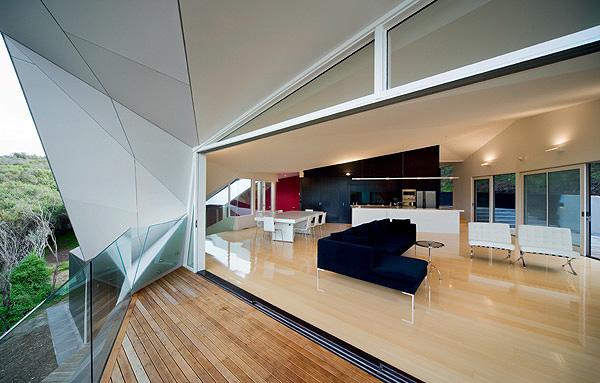 John Gossling, Klein Bottle House, designed by Rob McBride and Debbie Lynn Ryan of McBride Charles Ryan, Mornington Peninsula, Victoria
However, it is modernism revitalised by a splashes or palettes of rich colour that signifies the redness of the Australia desert:
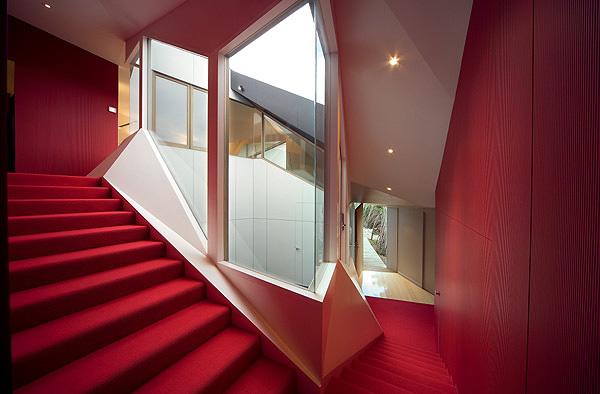 John Gossling, Klein Bottle House, designed by Rob McBride and Debbie Lynn Ryan of McBride Charles Ryan, Mornington Peninsula, Victoria
So we have a modernism that has become a form of regionalism. Suprisingly, avant garde, as an aesthetic category, is not used much to describe Australian architecture---avant garde is what happens overseas. With this work we need to accept that there is an Australian avant garde in architecture, though not architectural photography as Gossling's photographs here are very much in the modernist tradition of Max Dupain.
October 29, 2008
stumbling upon...hauntology
I've joined the B Square group on Flickr as I felt that it would be appropriate for some of my square format images. For some reason I do not utilize Utata, even though I am a member of the group and I find its ethos as a salon in the traditional sense attractive.

I stumbled up the group as a result of exploring this body of work, or set as it is called on Flickr by Incognita Nom de Plume. Shiralee (aka Cog) runs Curiosity Cabinet, is a content-sharing community for collectors to share their collections, discover community and trade information and, eventually, objects which is well worth exploring.
The B Square group on Flickr has interesting work if you dig around this hub in the visual network as I did with Terrorkitten or Phil Bebbington who lives in the city of Bath in England. Bebbington's website is here.
I just loved his Cretan Interiors portfolio--- a photographic exploration of hauntology.
The remote villages on Crete are gradually being deserted for urban life in the larger towns and cities and his photographs explore the ruins of past lives. These ghostly traces of past lives in a rural island economy express both a nostalgia for the past and an hauntology aesthetics.
Hauntology, with its roots in Derrida's Spectres of Marx, is not just melancholic mourning of a better times in ta non-reclaimable past; as it also includes a way of redeeming time and showing us the possible in our present socio-cultural economic situation.
October 27, 2008
reterritorialisation
A territory can be thought of as a space with boundaries. These boundaries are not permanent as they can be changed. Deterritorialisation reconfigures the boundaries of a territory. Reterritorialisation moves these boundaries and borders again - not to where they were originally, but often back in that direction.
Rather than teterritorialisation being a return to a primitive or older territoriality it refers to a coding that stands for lost territory such that a territory can defined through mutliple layers of de/reterritorialisation.
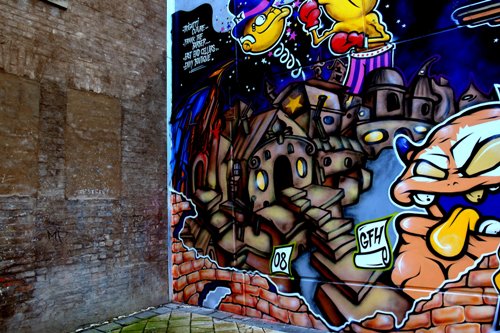 Gary Sauer-Thompson, street art, Everfresh, 2008
The wall to the left used be a blank grey wall on which street artists produced art and the Adelaide City City Council scubbed it off again. It was a contested public space. The Everfresh mural was commissioned by the developers of what was once the East End wholesale market.
October 25, 2008
disorientated
Deterritorialisation names the process whereby the very basis of one's identity, the proverbial ground beneath our feet, is eroded, washed away like the bank of a river swollen by the waves of globalisation. The process of change happens even as our society reproduces itself, and it is no longer seems possible to either de-link oneself from the network of relations we call globalisation or find a place out of the way enough not to have been penetrated by it.
Although most of us embrace the opportunities globalisation affords us, we nonetheless continue to sense and long for a past none of us has actually known when the connections were local not global. The local is the world that we have been evicted from by our own success in transforming our space and habitat through the process of globalisation.
 Gary Sauer-Thompson, Adelaide Electricity Company, 2008
We increasingly find that way of thinking about the world is at odds with the ever changing world. The longing underpinning this feeling of exile manifests itself in the form of disorientation, we can't seem to get our bearings in this brave new world without borders. Disorientation brought on by the disembedding process requires in its turn a compensating process of re embedding to accommodate us to the alienatingly 'faceless' world of late modernity/postmodernity.
Ours is now a world of rapid change and momentous shifts that we as increasingly mobile subjects are immersed in, and have have trouble in both getting our bearings in these historical shifts and making sense of the changes in the way that we now experience space.
Chain stores, like Starbuck's, but also Borders, combine global corporate trading practices with cornerstore ambience and tap into this feeling of strangeness (emptiness or placelessness) in which I find myself. It's a fakes and we willingly embrace the copy as the higher form of originality.
October 23, 2008
forest politics, Tasmanian style
An attack on protesters (from Still Wild, Still Threatened) in the Florentine Valley yesterday, trying to protect forests on the eastern edge of the World Heritage Area. Their car was in the middle of a forestry access road, peacefully but effectively blocking the ability of loggers to gain access and chop down the trees.
The loggers bashed the vehicle with a sledgehammer: eventually dragging one protester out and kicking him in the head. One protester caught it on a phone camera and the footage is below:
Forest activists attacked in the Upper Florentine Valley, Tassie
The Bartlett Tasmanian Government does not understand that standing old-growth native forests are far more valuable as carbon stores in a warmed up world than they are as woodchips.
October 22, 2008
a Baroque sensibility
During the late nineteenth century, photography established itself as a medium of great importance in collecting and securing visual information in various fields of research, such as anthropology, criminology, and medicine. Today, in the wake of the proliferation of digital media, photography is in a state of dispersion. Diverse applications of light-based picturing techniques are being enhanced digitally. Photographic archives are remodelled into databases.
Hybrid forms of photographic imagery mixing analogue and digital technologies have become the norm. The “photographic” is undergoing a transformation. We can speak of the “expanding field of photography” and standing on the threshold of the “post-photographic era.”

In this context, the old question, whether photographic imagery should be considered in terms of the technical qualities of the medium or in terms of cultural practices arises once again, and what is more, in a rather peculiarly polarised form. New digital technologies lend attention to material-technical questions, while, at the same time, visual literacy tends to be considered in equal terms with the ideal of literacy connected to writing.
The ways in which photography “makes sense” are not to be reduced to semiosis in that photography also produces sense by reconfiguring aesthesis, Walter Benjamin argued that photography displaces our nornavision by introducing new spatio-temporal configurations (temporal short cuts, arrested movements, inhuman scales, superimpositions, etc.). It thus undermines any notion of natural visibility, that is, the natural legibility of visual appearances.
At the same time, this discrepancy brings forth its reverse.It shows the “peculiar convergence” of different modes of experience, which, call for translation. The eye is likely to encounter images that exceed its capacities of reading. It has to learn how to read cultural fragments with floating meanings. Thus foreshadows the floating and aestheticised postmodern sensibility.
October 21, 2008
representing reality
An interesting mix of reality and simulation where what is real becomes a part of the simulation. If politics is theatre then politics is also a staged performance constructed for the visual culture.
Tina Fey's impersonation of Sarah Palin is a pop-culture event of the US Presidential campaign season. Saturday Night Live (SNL) is a long standing weekly late-night 90-minute American sketch comedy/variety show based in New York City that features a regular cast of typically up-and-coming comic actors, joined by a guest host and musical act.
October 20, 2008
dazzling blackholes
The screen of the spectacle of the meltdown of financial capitalism dazzles us and makes us feel numb with fear. We struggle to find the words to express our feelings and thoughts. We cannot comprehend the numbers of the bailout, the swiftness of the destructive flows and the astronomical quantities of value disappearing into a black hole.
Prior to the meltdown we lived the financial phantasmagoria of a credit bubble that seduced us into buying big houses, new cars, maxing the credit card, borrowing on the equity in the house to buy shares in the mining companies in a world marked by the end of ideology. We are winners. Greed is a wonderful passion.
 Gary Sauer-Thompson, newspapers, Canberra
We watch the massive destructive flows on the stockmarket in fascination and sense that its just not virtual numbers--- everything is going wrong, yet again, just like it did in the 1930s. The 'financial' crisis has spilt over into the real economy our political leaders say to show they are "ahead of the curve". Hang a mo---does that mean financial capitalism is unreal? How can it be unreal?
We realize that the last six months we had lived the fiction that the credit crunch was containable. That has been dispelled. Recession looms. Oh no. Not again. That means even more reduction is household wealth, as if the stockmarket collapse wasn't enough. Our life is going to even more damaged than it was before.
October 19, 2008
Kingston, Canberra
Canberra in spring is delightful, especially the street gardens in Kingston. Hobbling around the Kingston streets on the weekend with a bruised heel amidst the blooming flowers and their rich colour --the camellias have given away to Irises and roses-- it was impossible not to be seduced by the vibrant colour.
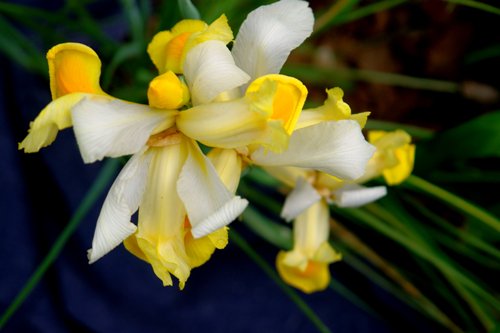 Gary Sauer-Thompson, Iris, Gosse St, Kingston, Canberra
I felt that daily existence in this safe, secure middle class world in the leafy suburb was a long way from the financial crisis in the headlines about "casino capitalism" that I was reading and writing about for public opinion. Even though an election was being held on Saturday there was little sense of the looming economic crisis. I felt oddly disconnected somehow.
I could not shake off the feeling that I was living in a fools paradise. And yet the suburb, its apartments and street gardens felt solid and real. So were the families in the parkland and retired couples gardening. What was I doing taking photos of flowers in suburban street gardens when I was living through financial capitalism undergoing a "systemic meltdown"?
The meltdown was also felt real despite the flux and it resembling one of those bad films concocted by the Hollywood factory for the production of pre-packaged blockbusters. The film is Nightmare on Wall Street and in it everything is collapsing, everything is collapsing... the flames of the firestorm are consuming everything that is solid.
The sources of hope---Kevin Rudd--say that it is only a question of time before the full impact of the global financial hits Australia in terms of deflation and unemployment. But not in Kingston. It felt immune, safe, secure. It was living in a bubble of affluence. How much of the affluence was an illusion?
How do you take photos of this?
October 18, 2008
the rulers of the universe
So much for the ideology of market self-sufficiency and the need for light regulation that allowed that the financial sector's market in derivatives to go unregulated,
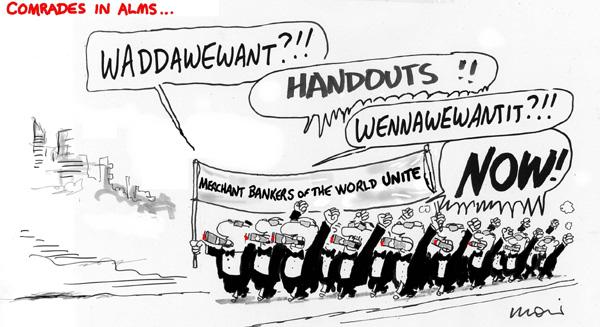 Moir
Moir
Warren Buffett and George Soros both likened that derivatives market to a nuclear bomb waiting to explode.
October 17, 2008
Canberra modernism
The Kingston Foreshore Development in Canberra aims to transform 37ha of under-utilised industrial land on the southern shore of Lake Burley Griffin into a vibrant, cosmopolitan place with a unique waterfront life style and supporting a community that will grow around the residential and leisure activities within the precinct. The site was occupied by numerous derelict buildings and contaminated with a range of materials reflecting its previous industrial use. The whole development is to be finished by 2010.

Apart from these Kingston Apartments modernism came late to Canberra's domestic architecture despite Walter Burley Griffin and the brutalist, concrete modernism of the High Court of Australia and the National Art Gallery. The above apartments on Lake Burley Griffin are part of the Kingston Foreshore Development in the "Bush Capitol."
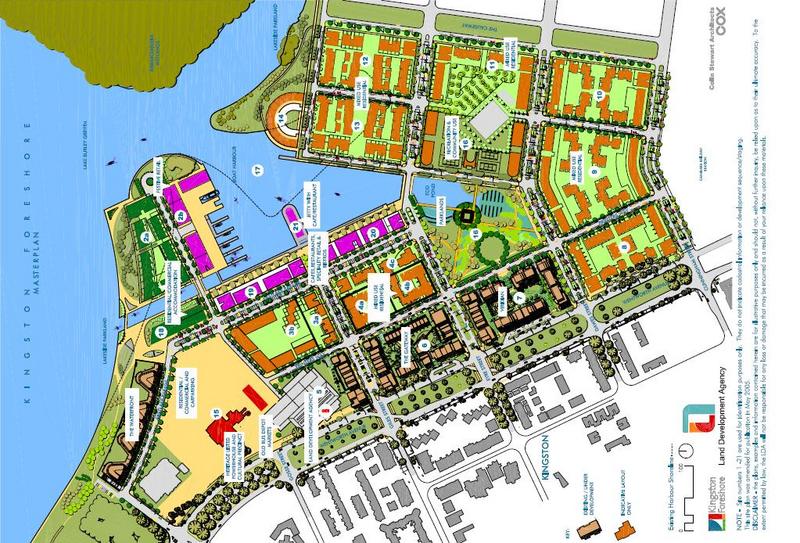
The development publicity around the landmark development of Kingston Foreshore celebrates it as bringing together the very best in living and lifestyle and the historical part of Canberra’s much-desired inner-south, rapidly becoming the city’s premier neighbourhood. Kingston ias achieving the right population density and is becoming a highly desirable place to live, because the small townhouse people to walk to the shops and walk to their recreation.
What is not mentioned so often is that suburban Canberra had become a city suspicious of change as planners fight for higher density and more housing choices in the city, suburbs and on the shores of Lake Burley Griffin. Over the past 20 years Canberra has changed from the glory days of abundant resources and professionals with good urban planning to a city with a tentative territory government struggling under the planning workload.There seems to be a resigned acceptance to sprawling suburbs.
October 16, 2008
rose, Gosse St, Kingston
I was taking some photographs in the front of the office after work on Tuesday when the wind came up, the front door slammed, and I was locked outside with no keys. I had to go next door and jump the back fence. I landed awkwardly, jarred and bruised my heel badly. I can only walk with difficulty.
Since I can but hobble around, all I can can do is take photos around the Kingston office.This photo is from the little garden in backyard, taken sitting in a chair:

It was taken in the backyard of the office in Kingston just before the storm came through and shredded most of the roses. A pity. I had planned to take shots of the roses just as they were beginning to decay.
It was to be a way of exploring the aesthetic as a mode of experience and a way of relating to the world. It is a way of contesting this position of Nonie Sharp in The Artistic and the Literary Imagination in Australia and Beyond in Colloquy Issue 12:
Poetry and painting are sisters in the evocation of feeling: ut pictura poesis, in the words of Horace. Poetry addresses the subjective. It is the expression of the poet’s feelings, and its power to touch the heart is a power to deepen and expand feeling as it gathers meaning. A poetry of place – poetry, lyric prose, music – could only thrive when people’s hearts were with Australian places in something of the way Aboriginal people feel about their place.
My problem is not the poetics of place but the interpretation of the aesthetic. The aesthetic is the expression of the artist's feelings. Why that rather than form, or cultural meaning? This is subjectivist expression of feeling is an interpretation of the romantic response to industrialism, rather than the aesthetic per se. Presumably photography belongs to the painting camp as many hold that it is expression of feeling.
Sharp continues by exploring the difference between painting and poetry:
Poetry about the experience of the landscape and nature can only be poetry if it can capture the spirit of the place. It may call out feelings that create and foster spiritual values, at times in exalted form. Here we are entering a realm where an aesthetic comes into being in a profound way, often resting at the edge of awareness.Painting concentrates on direct experience of the natural world; poetry and prose, especially lyric prose, as in nature writing, speak to and recreate the subjective. In this important sense, poetry – and the literary endeavour as a whole – and painting are reversals of each other. Importantly, they are also complementary to one another. In the first, nature talks back, or does the talking; in the second, she is (mainly) silent.
That is a pre-modernist conception of painting as It assumes a crude reflectionist theory of painting mirroring nature. That would not make sense of most painting.
Sharp argues that a contemporary literature of place (lyrical writing includes the novel) is a response to a new revolution symbolised in the nowhereness of cyberspace and a tendency toward the dissolution of embodied grassroots existence.The celebration of place today, particularly lyricism, is a sign of an awareness that nature exists within humanly created categories, not as an unmediated Other.
Referring to Australia, Changing Places: Reimagining Australia, a book of essays on changing places and their meanings edited by John Cameron Sharp says that Cameron introduces the site of a major paradox:
A sense of place presumes embodiment; it is local, the home of stories of persons tied by quite immediate but often invisible threads to one another and to locale. Yet, “cyberspace is a disembodied space that is no place at all.”
The emphasis is on a lyrical writing of place and the question of whether there can be an exploration of place by visual artists is lost despite the earlier emphasis on Louis Buvelot, John Glover, Russell Drysdale and the Heidelberg School. The visual arts stop at modernism for Sharpe. The Tasmanian photographers of wilderness are not mentioned in the 1970s and 1980s are not mentioned--only those who write and help the transform the lyrical into something more than a poetic genre.
October 15, 2008
from capitalism to socialism
Socialism was once a dirty word especially to do with banks. Now it's return in the form of bank nationalization is welcomed by Armani dressed free market finance capitalists and stock market traders. The finance capitalists (investment-bankers, venture capitalists, moneymen and corporate heads) are becoming convinced that a socialist turn would be best for business.
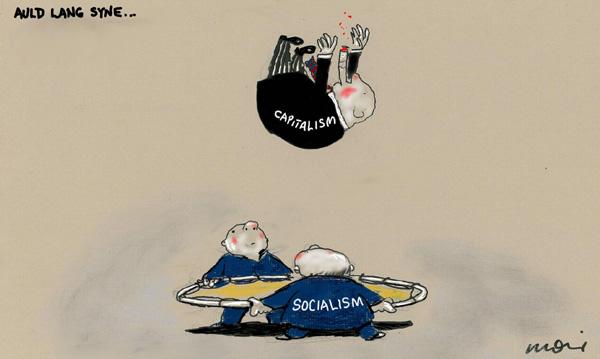 Moir
Moir
Unregulated markets certainly lead to economic disaster. It's simple really. How come that was forgotten? The lessons of the traumatic Depression were forgotten weren't they? The free market economists, libertarians and investment banks mocked those who remembered them.
October 14, 2008
the end is nigh
There is a lot of apocalyptic talk around these days due to the systematic financial crisis. Capitalism is going to collapse and we will--excluding the Chinese and Australians, of course --end up living some kind of barbaric medieval dark age where we would need to relearn to grow our own vegetables.
Alas the reality is rather more mundane:
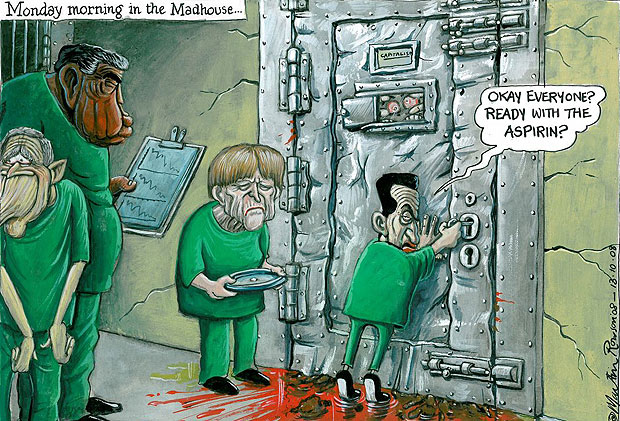 Martin Rowson
The talking heads on the plasma TVs are commenting on bad news about intoxicating consumption images created by photographers now appear as a dream nurtured by excess that we've woken up from. As Walter Benjamin wrote, Sometimes, on awakening we recall a dream. In this way rare shafts of insight illuminate the ruins of our energies that time has passed by.
If our intellectual history has mostly hitherto been divided between an Enlightenment scorn for the dream as mere mental detritus, and inversely, its unqualified celebration in the eyes of the Romantics, then we now live with a certain cross-contamination of categories between ‘dream’ and ‘waking reality’.
As Marx first diagnosed with his analysis of the commodity fetish in capitalist modernity, ‘ordinary’ commodities become invested with a magical, quasi-religious and dreamlike aura. If the arcades epitomized the dream houses of the collective in the nineteenth century, then today it is plasma TV that constructs a world where the everyday is saturated with the marvellous; a lyrically intense dream-world in which arises the basis for a ‘mythology of the modern’.
Our everyday life is permeated with qualities of fantasy and imagination in the form of a dream experience constructed by the culture industry. We have awoken from the bubble dream woven by finance capitalism and oar elooking for some form of “rescuing critique” that deciphers the history of culture.
October 13, 2008
MaxMara
MaxMara is one of the largest and most popular Italian fashion brands---a women's fashion house whose brand remains as one of the most influential in fashion world.It's roots lay in re interpreting American 1950s ready-to-wear as found in the US magazine Harper's Bazaar whilst taking its stylistic direction from Paris.

MaxMara, the Italian fashion label, is yet another example of an Italian family business gone global, in the way of Benetton, Prada and Versace. MaxMara is known for 'off the peg' designer clothes, or Italian ready-to-wear--as opposed to couture or boutique.
October 12, 2008
Adelaide: aerial view
An image of western Adelaide taken whilst flying out to Perth on Friday morning. It was an early morning flight and the light was soft as the plane flew over the coastal waters.

The area is the salt fields Boliva Treatment Plant and the Port River estuary. To the right are the clusters of grey mangroves (Avicennia marina var resinifera), the inlets that provide sanctuary for the bottlenose dolphins, and the Torrens Island Power Station that pumps heated water into one of the channels within the estuary.
The main obstacle to a reform of the river system has been the pumping of dangerous waste (sewerage and industrial from Bolivar WWTP and Penrice Soda Products respectively ) into a natural waterway, as this is the easiest, cheapest and most legal way to dispose of the toxic waste
This area has been a centre for heavy industry in South Australia and the Port River has been its drain. Historically, there has been a range of pollutants that have been discharged to the waterways, but it is he nutrients (nitrogen and phosphorus) that are of most concern in causing the loss of seagrass and mangroves.
For an on-the-ground view of this area, as interpreted by this earlier image, you can do no better than explore the Port River and Environs set of Gabriella S. Gabriella has extensive knowledge of the area --and its increasing industrialization- -from kayaking around the Port River estuary.
October 11, 2008
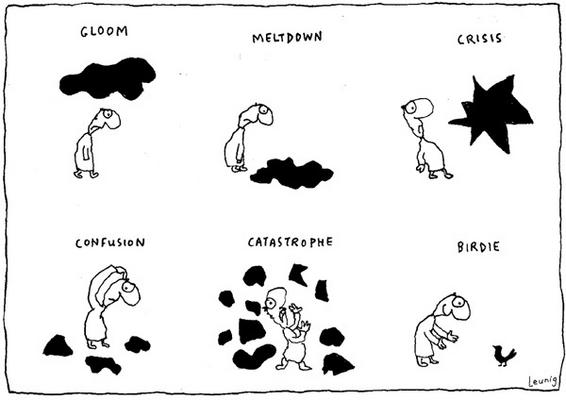
Leunig: gloom
I'm in Perth working from early in the morning to late at night. I've no chance of taking photos or even exploring Perth's CBD with a digital camera or smell the roses. So a bit of humor.
 Leunig
It is a little bit of light humor that expresses the upbeat mood of boom city. My own black humor is maybe they will need to cancel Xmas now that unbridled capitalism financial capitalism has gone bottoms up.
October 9, 2008
a text to a picture
The postmodern turn in the arts reacted against what was seen as both the decay of an institutionalized high modernism and a failed avant-garde. Against modernism and the avant-garde, however, postmodernism declares both the death of the author and of the work, replacing the former with the decentered self or bricoleur and the latter with the "text", which refers to any artistic or social creation that signifies and can be conceptually interpreted.
Consider this image of the low, relatively uncratered, plains of the northern hemisphere of Mars:
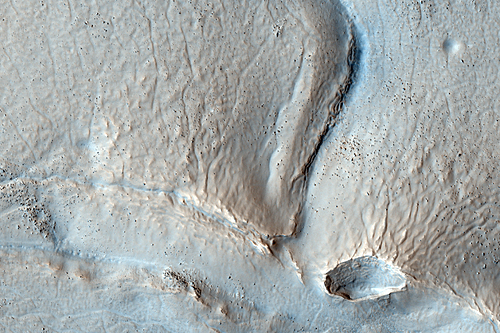 Mars, Merging Lobate Debris Aprons of Deuteronilus Mensae, Mars Reconnaissance Orbiter
This effectively does away with the artist creator of high modernism ----a creative genius, or an originary and unique self who produces the new in an authentic vision---who defended the autonomy of art, excoriates mass culture and expresses a self-reflexive criticality that violates the aesthetic conventions of a medium-specific art tradition. Though high modernism never managed to gain much power beyond the walls of the academy in Australia the idea of the author/creator did.
What we have above and below are formally good images produced by a camera machine that is part of an orbiting satellite. What is produced is not kitsch---ie., magazine covers, illustrations, ads, slick and pulp fictions, comics, Tin Pan Alley music, tap dancing, Hollywood movies etc. It is a good picture or image that requires interpretation by the viewer.
This deconstruction of the author subject, plus the idea of bricoleur (involving recycling and assemblage), opens the door to photography being fundamentally about communication and meaning rather than space or structure. This is turn leads to the the realization that the culture of the book has receded in that the book is simply not the dominant medium it once was. The conservative response is the declinist narrative in which contemporary culture is sliding towards a mass culture of immediate gratification and mindless entertainment. Big Brother.
What is replacing the book is digital media in which participants learn by doing — often through a collaborative learning network of peers, such as the online network that is Flickr. This is part of a much larger history of people's desire to take media in their own hands and to produce content that reflect their own perspective, their own experience. Blogging or uploading images on file- sharing such as Flickr are much more clearly continuous with professional functions in media production much as journalism, public relations and graphic design.The digital literacy blurs the roles of producer and consumer, and is demand led and generated by its uses, rather than by a fixed body of expert knowledge.
October 8, 2008
floor of lus Chasma, Mars
This image spans the floor of Ius Chasma's southern trench. Ius Chasma is located in the western region of Valles Marineris, the solar system's largest canyon. This canyon is well known for its fine stratigraphic layers modified by wind and water.
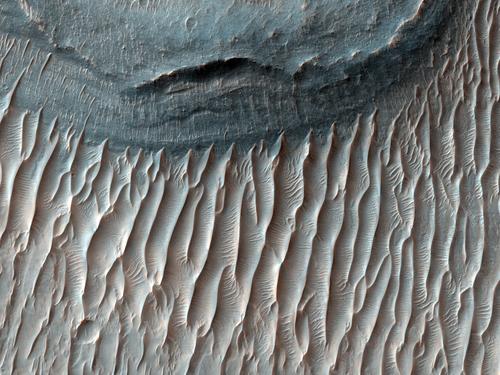 Mars, lus Chasma floor, Mars Reconnaissance Explorer, 2008
Ius Chasma is believed to have been shaped by a process called sapping when water seeped from the layers of the cliffs and evaporated before it reached the canyon floor.
October 7, 2008
winter in Adelaide
If modernism in photography is about purity of form (Greenberg) then postmodernism adds history and narrative. Does that snapshot hold up? I don't know. I do not know what the pre-modernist visual order or pictorial field in Australia was like. Gum tree paintings? The sentimental post-impression of the Heidelberg School?
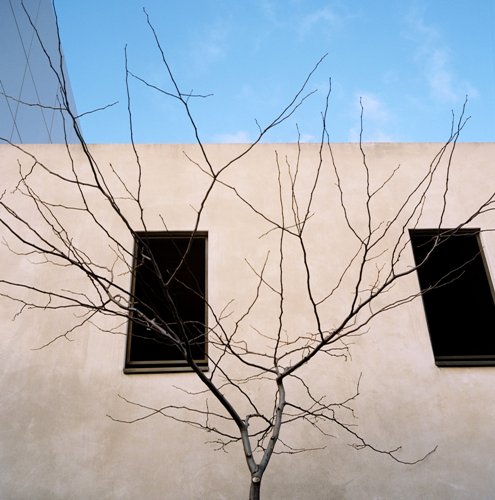 Gary Sauer-Thompson, winter in Adelaide, 2008
Purism (ie., the the qualities inherent to photography) was the American contribution to a range of 20th-century artistic practices grouped under the label of modernism. Like modernism in painting and sculpture straight photography was based on the idea that every artistic medium has its own distinct properties, which artists should seek to exploit. Or so argued John Szarkowski, thereby making photography a modernist medium in Clement Greenberg's sense of the term--an art form that can be distinguished in its essential qualities from all other art forms.
The US modernist photographers taught that by mastering technique, they would be freed to express their personal vision and they offered themselves as a model of how high art photographers could live and work outside the popular commercial realms of photojournalism, fashion, and advertising. In that way--ie., through aesthetic autonomy and subjectivity---that photographers could lay claim to the artists mantle (artist genius who invents at will) and downplay photography's (realist) connection to a world outside art. Photography, according to the formalist, was discovered to be art since the 1830s and the emphasis is on the artist's style of expression.
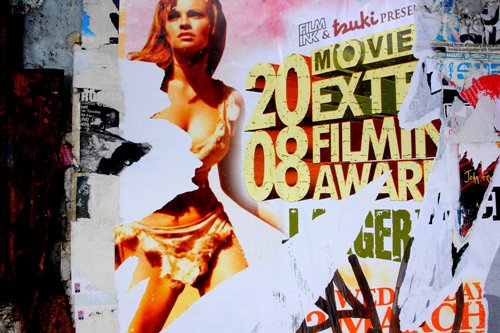 Gary Sauer-Thompson, a picture surface, Newton,
From a postmodern perspective aesthetic autonomy and subjectivity was an effect of the discourse of the art institution, and in terms of meaning of the art work we had the displacement of the artist subject by the spectator subject interpreting the work. This challenged the modernist assumption that the art object by itself had a fixed and transhistorical meaning. Since meaning was seen as specific to historical context and to a socially specific site, then it was the art institution that constructed art as autonomous, universal and timeless. Formalism was the method used to disconnect the art object from its social and political context.
Therefore it is the art institutions claims to represent art coherently that were questioned by postmodernism.
October 6, 2008
red cliffs on Mars
An image from Astronomy picture of the day--- formation of layers of red cliffs in the north polar region of Mars:
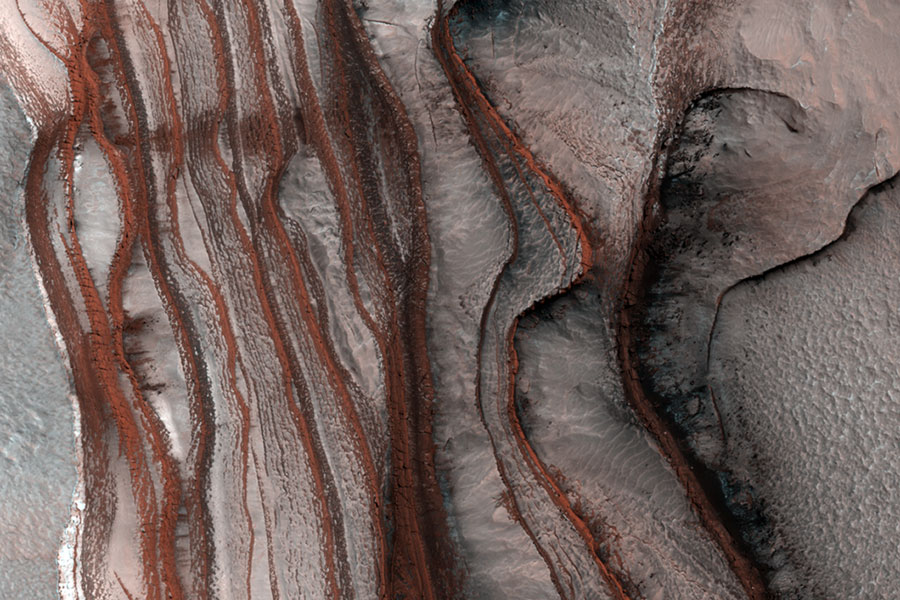 Mars, Layers of Red Cliffs, NASA's Mars Reconnaissance Orbiter
Many troughs and scarps cut through the deposits of dusty ice up to 3 kilometers (2 miles) thick. One of these scarp faces is shown here; it is situated at the head of a large canyon (named Chasma Boreale) that cuts through these polar layered deposits.
State Library of NSW on Flickr
I see that the State Library of NSW has been uploading some of its archival images onto Flickr. Good for them---the history of our visual culture is now entering the public domain for us to explore, interpret and situate ourselves in relation to this history.
My interest was caught by this set---First Australasian Antarctic Expedition (1911-1914) that was photographed by Frank Hurley amongst others, including Harold Hamilton and Xavier Mertz. Alas the images uploaded are small so I have turned to the National Library of Australia's extensive collection:
 Frank Hurley, [Slate formation at Cape Hunter?, Australasian Antarctic Expedition, 1911-1914] circa1911 and 1914], gelatin silver print.
I've been digging around a bit more on the NSW State Library's Flickr set and I stumbled on this and then discovered the larger images:
 Frank Hurley, [A cavern beneath the coastal ice-cliffs with Whetter standing near entrance, Australasian Antarctic Expedition, 1911-1914] circa 1911-14, gelatin silver print
These archival images are important because they provide us with the material to construct a history of Australian photography that is different from the US modernist one. The latter has been so influential in terms of shaping the practice of contemporary Australian photographers that we cannot see alternative to the modernist history of photography.
October 4, 2008
Henson as a paedophile
The conservatives at the The Australian do not give up on the culture wars do they. We have another beat up of Bill Henson, the Australian photographer, and by implication artists.
This time the impression given by the conservatives is that Henson is trawling school playgrounds look for children to pose nude for his photographs. The Weekend Australian states:
Revelations that photographer Bill Henson selected children to pose nude for him by scouring primary school playgrounds at lunchtime have sparked anger and alarm among parents' groups and principals.
So he's akin to paedophile---trawling to procure underaged models. The cultural context for the conservatives is that nude teenagers is porn, Henson creates porn under the guise of art, and that this is a symptom of moral decay and nihilism. Henson, in short, is a child pornographer.
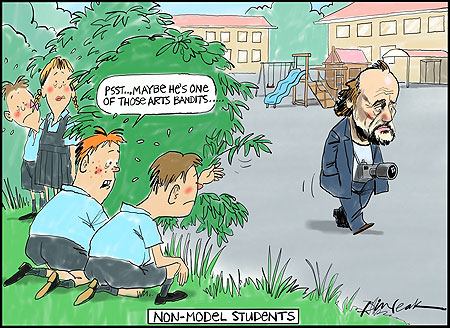 Bill Leak
The reality is quite different from the beatup. The principal of a Melbourne primary school and invited Henson to have a look around at lunchtime of the school, and then offered to contact the parents of two children Henson had seen.
In an editorial The Weekend Australian says:
Even many liberal-minded parents would feel chilled and angry that Henson was invited by a Melbourne primary school principal to scout for talent in the playground. In his own words, he "just wandered around while everyone was having their lunch", identifying two potential subjects. While he acted correctly in contacting the children's parents, many would object to his eyeing off their children as potential subjects without their knowledge.
The Weekend Australian says that it is an advocate of free expression and opposes unnecessary censorship and that the debate is not about the quality of Henson's art, but his methods. So if his work is art--as the Weekend Australian concedes--then his methods are exploitation since the eyeing is that of a paedophile gaze. This allows The Australian to reject David Marr's claim that Henson has become "a national punching bag, vilified as a child pornographer and denounced by political leaders" as self-serving and arrogant nonsense.
What is missing from this debate is the voice of the kids. Why cannot they speak?
October 2, 2008
Kudditji Kngwarreye
The Desert Mob 2008 Art Show in Alice Springs, which is held at the Araluen Arts Centre, is now in its eighteenth year. It is a survey of new work from central Australian art centres who form Desart. Though Desert Mob is all about buying and selling there is nothing online.
Via this link from Utopia region, with its I've picked up an artist from this culture who has broken with the traditional style:
 Kudditji Kngwarreye, My Country, Acrylic on Linen, Japinka
Kuddtji commenced painting in the early eighties, along with the best of the original Papunya Tula Artists is is a Traditional Custodian of his country situated approximately 230 kms north east of Alice Springs and is the brother of renowned artist Emily Kame Kngwarreye.
He broke from the traditional style, to work with abstract images constructed from broad strokes and a combination of vivid, bold colours that characterizes Emily Kame Kngwarreye's last series of work.
There is an exhibition> of Emily Kame Kngwarreye work (from 1988 until her death in late 1996) at the National Museum in Canberra.
October 1, 2008
modernism in Australia
The Powerhouse Museum has an exhibition on the development of modernism in Australia. The physical exhibition is closed, but there is some architectural work and photography online.
There is an associated Flickr group. This is one of the images I've contributed along with others:

The story the exhibition tells is an upbeat one. It is an affirmation and celebration of modernism, which is understood as the shock of the new.
The story is how:
modernism transformed life in Australia across five tumultuous decades from 1917 to 1967. The exhibition traces for the first time the impact of modernism on all aspects of Australian culture — from art, design and architecture to advertising, photography, film and fashion. Modernism sought to build a better future in the aftermath of World War I. An international movement, modernism encapsulated the possibilities of the 20th century. It celebrated the romance of cities, the healthy body and the ideals of abstraction and functionalism in design. Modern times looks at how modernism defined a new cosmopolitan culture in Australia, highlighting stories of avant-garde experiments. The exhibition also explores the city and its skyscrapers, milk bars and swimming pools, where modernism profoundly reshaped Australian life.
It features paintings by Grace Cossington Smith, Sidney Nolan and Margaret Preston; photographs by Max Dupain, Wolfgang Sievers and Jeff Carter; designs by Clement Meadmore, Douglas Annand, Robert Klippel, and Grant and Mary Featherston; as well as models and designs by architects Harry Seidler, Robin Boyd, Roy Grounds and Jorn Utzon.
it is all very upbeat as there is little indication about the negative aspects of modernism of making a better world through the domination and exploitation of nature. The domination of nature is even more the problem that seeing life in terms of a functional machine as it has lead to devastated river systems and other environmental problems.