November 30, 2008
Rosalie Gascoigne
Rosalie Gascoigne's work consists of a distinctive and poetic assemblages of found objects, such as wood, corrugated iron and road signs, and cut up and rearranged faded, naive lettering to create abstract yet evocative grids of letters and word fragments:
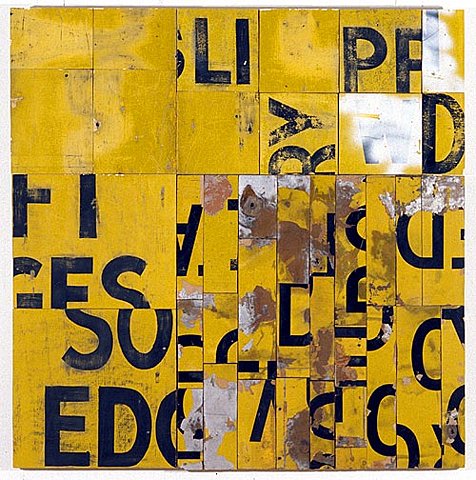 Rosalie Gascoigne, Southerly Buster, 1995, retro-reflective roadsign on craftboard
She worked exclusively with found objects, discarded or obsolete. Her art includes installations in bone, rusty farm iron, twigs, grasses or feathers, assemblages in old bee boxes, panels made from sawn up discarded soft-drink crates and road signs or old linoleum. Her initial skills in arranging were developed by years of training in the classical art of flower arranging (the modern Sogetsu school of Ikebana).
Her mature Ikebana works in the 1960s and early 1970s included arrangements and assemblages constructed from grasses, iron, driftwood and bleached bones. It was during Rosalie's phase of producing iron assemblages that she made the transition from Ikebana to producing art (or sculpture) as such.
Her last work is a series of 10 panels of sawn builders' form boards — the installation, Earth 1999.The boards sat around the Canberra home for years, Rosalie watching the light play on their surfaces, shining in the rain and drying in the sun. She liked the colours and the humble nature of the material, which she cut into rectangles and assembled into panels.
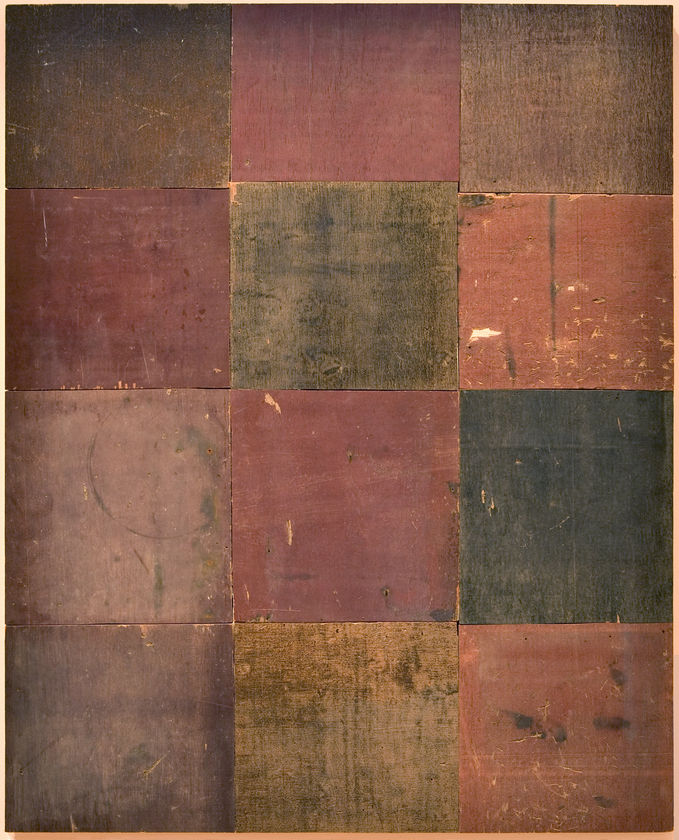 Rosalie Gascoigne, Earth 4, 1999, sawn builders form-board
This work has been interpreted in terms of uncovering the spirituality in her work, and connecting this with Australian spirituality and with spirituality in the wider Christian tradition. Australia on this interpretation is known as the land of the spirit (Terra spiritus).
What I see is largish panel consists of a grid of varying numbers of squares or rectangles. The colours are muted and subtle, ranging through browns to grey and purple, and its spareness and subtlety works on the observer, especially hung as it is around four sides of a square. Its effect is not dissimilar to the meditative presence of Rothko's Four Seasons panels at the Tate Modern, also hung this way.
Graffiti and the Digital Experience

Via flickr and ffffound. The blue screen of death [BSoD] has become part of the public space and raised to a level of technical performance.
November 28, 2008
digging around the internet
Words Without Pictures, was created by the Photography Department at the Los Angeles Country Museum of Art, as a way to expand dialogue about photography. The essays are seen as a prime stimulus for generating discussion about emergent issues for photography.
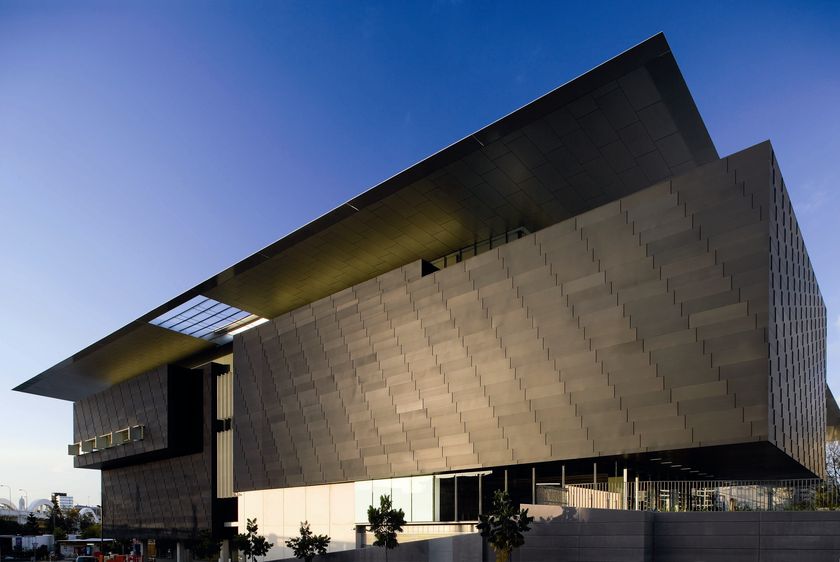 John Gollings, Gallery of Modern Art, Brisbane
John Gollings, best known for his architectural photographs, would appear to be grounded in 5x4 film based architectural photography and would be seen as a traditional type of photography: one where architectural photographers had interpreted their subject with the aid of various films, lenses, points of view and darkroom techniques. So how does this style of work and its ethos connect to the internet? Is there a different way of looking at photography due to the internet?
Gollings said that we are already living in the “post photographic era”. He meant that photographs may be digitally scanned and manipulated using personal computers and readily available software. In saying this Gollings was, flagging a new era of architectural photographs---and photography.
One of the essays is Jason Evans' Online Photographic Thinking, and he makes the following comment:
I guess it is simply a matter of time before a generation not weaned on paper and chemicals sees the manufactured bubble of “art photography” for what it is, and begins to explore the potential of an inclusive, affordable distribution network and its inherently interesting formal qualities.
An interesting online photographic site is run by Tim Barber and it shows the potential of the internet for photography. It indicates the issues of issues of form and aesthetics that are rightly serious ones for a photographer working in traditional craft print form and the art market become lightened and are more in the background when thinking and working in the internet and photography world.
 John Gollings, Gallery of Modern Art, Brisbane
An important shift in photography's history is taking place.
November 27, 2008
Trent Parke: The Christmas Tree Bucket
Trent Parke is the only Australian photographer to be a full member of Magnum --though I am not sure what that means these days.
A recent body of work --- online at the Stills Gallery----- is entitled Trent Parkes Xmas Family Album. This body of work is quite different to his earlier Minutes to Midnight about outback Australia. That, and the earlier work, was shot in black and white on a Leica, and was informed by the street photography of Robert Frank in The Americans.
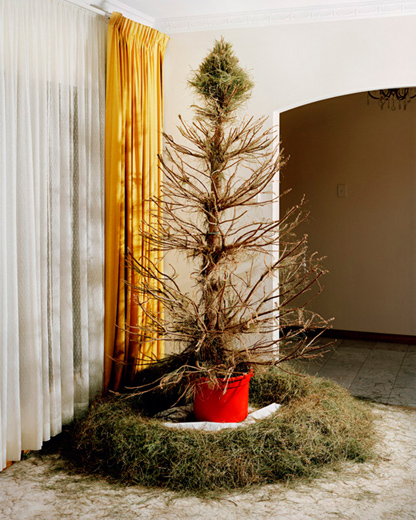 Trent Parke, Christmas Tree, 2008, from The Christmas Tree Bucket, Pigment print
The style of the work in the exhibition, which opened at the Australian Centre for Photography, in Paddington Sydney, on November 21, is that of Kodak family snaps (old kodachromes ) with an edge. After all this is Adelaide where the presence of the repressed exists in the suburban shadows sensed from the dark side of Xmas.
The shift from a Leica, Tri-X and contrasty development to colour and medium format seems to have come with the Coming soon body of work that explored the urban environment in Sydney.
November 26, 2008
Alec Soth: The Last Days of W
Alec Soth's The Last Days of W is a self-published artist book printed on newsprint. W, of course, refers to President Bush. It is an assemblage of photographs made over the last eight years the time that George W. Bush has occupied the White House.
I guess its kind of a book but not really as it is also kind of a newspaper --cheap and run down. But Soth still represents an old-fashioned kind of image-making who works in a tradition of the road photographer who goes out and documents real people and places and lets the decay of the world show.
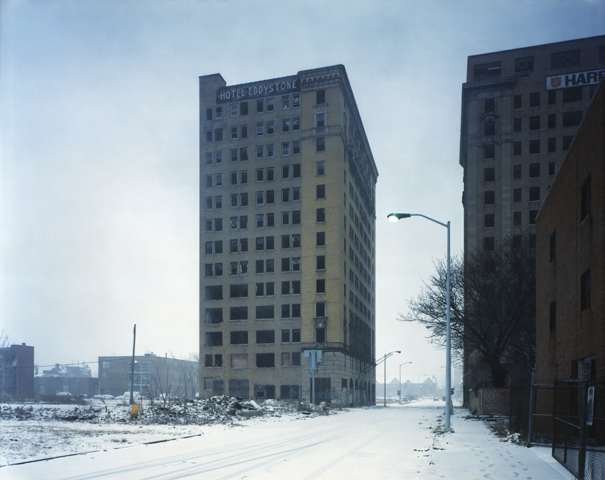 Alec Soth, Detroit, Michigan, from The Last Days of W, 2008
The 36 images are of America that is feeling the pinch land looking a bit worn out and exhausted. Soth is interested in the way 30 pictures relate to each other. Most are not going to be great pictures but they have a weight to them as a group.
He's a full time photographer with a studio manager and assistants who has the time and energy to breathe new life into the Magnum blog.
November 25, 2008
Douglas Sirk: Written on the Wind
I watched a Criterion Collection DVD of Douglas Sirk's 1956 tragic Written on the Wind the other night. It was the first film I'd seen of his as I knew very little about him. I came across his name via the critics of Cahiers du Cinéma in Paris, when they were writing seriously about directors whose personal style transcended the rigors of the old Hollywood studio system and knew that he had been influential for Rainer Fassbinder and the new generation of American directors (Martin Scorsese, Quentin Tarantino and others).
All I knew about Sirk--was that there was a critical re-evaluation, in which his entire body of work had been rediscovered and reappraised by successive generations of filmmakers and historians.
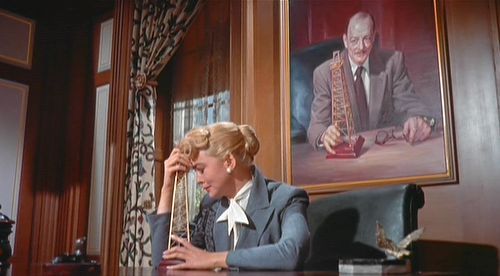
Written on the Wind was produced in an exaggerated Hollywood studio style with very stylish and richly saturated coloured interiors. It was visual excess with highly stylized performances that indicated a command of cinematic language ( the cinematographer was Russell Metty) over the seriousness of a plot, the acting, or the literary quality of the script about pent-up, unfulfilled sexuality, despair and hopelessness.
November 24, 2008
Andreas Gursky in Melbourne
There is an exhibition of the work of Andreas Gursky at the National Gallery of Victoria in Melbourne. I hoping to see it when I'm in Melbourne next weekend. This style of art photography has its roots in Bernd and Hilla Becher's style of documentary photography that gained a place in the art world through the serial character of their photography allowing a minimalist or conceptual reading. I want to judge how far this colourist, digital photography has moved towards emulating late 20th century American modernist painting.
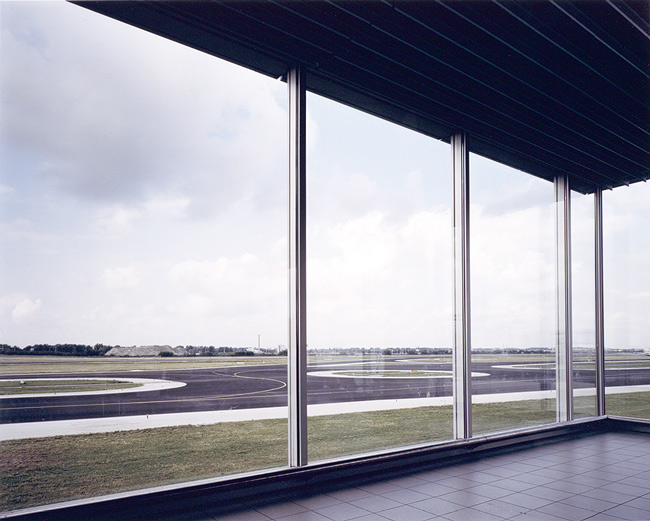 Andreas Gursky, Schiphol, 1994, Chromogenic print.
At one level we have a straightforward style of photography that works within the austere aesthetics of modernism---technically impeccable architectural photography without the documentary status of the "given". This de-romanticized" vision that gestures to a postmodern version of the sublime. His work of large-format color photographs depicts vast panoramic scenes: entire cityscapes, endless horizons, multi-floored office buildings, huge factory corridors and crowded public spaces usually taken from a distance that have the appearance of a bird's eye perspective.
However, all is not as it appears as Stefan Beyst points out. Gursky's representation of reality is frequently constructed from the combination of distinct shots in one image, and then digitally manipulated within a rigid geometric nature. This gives up the traditional Renaissance perspective that wanted to overlook the world from one single vantage point--the God's eye view.
 Andre Gursky, Kamiokande, 2007
As Beyst says Gursky does not penetrate into the essence of things behind the appearances, nor does he provide a 'global' or God's eye view of them. Rather, like an old fashioned modernist, we have a basic abstract geometric macrostructure, within which the micro-elements are subordinated. There is lots of detail, for sure, and it is often highly repetitive. But content appears to be downplayed in terms of mattering as content; only downplayed though since if Gursky's images were really abstract -they would be just coloured squares or circles. The detail matters.
November 23, 2008
doll + roses
I've got the Encounter Studio up and running using the Rolleiflex 6006 I bought. This image used a wide angle lens, natural light and long exposures. The latter shots of this roses shoot used close up rings on a normal 80mm lens.

It's still pretty rough working conditions but the set up, lighting and back drop will need to be refined over time as I get more into studio work. The Rolleiflex 6006 is definitely a studio camera.
November 22, 2008
U2: Rattle and Hum
I watched a DVD of U2's 1988 film Rattle and Hum the other night. The film was supported by a double-album soundtrack that was divided between live tracks and new material that embraced American roots music. The film incorporates live footage with studio outtakes and band interviews.
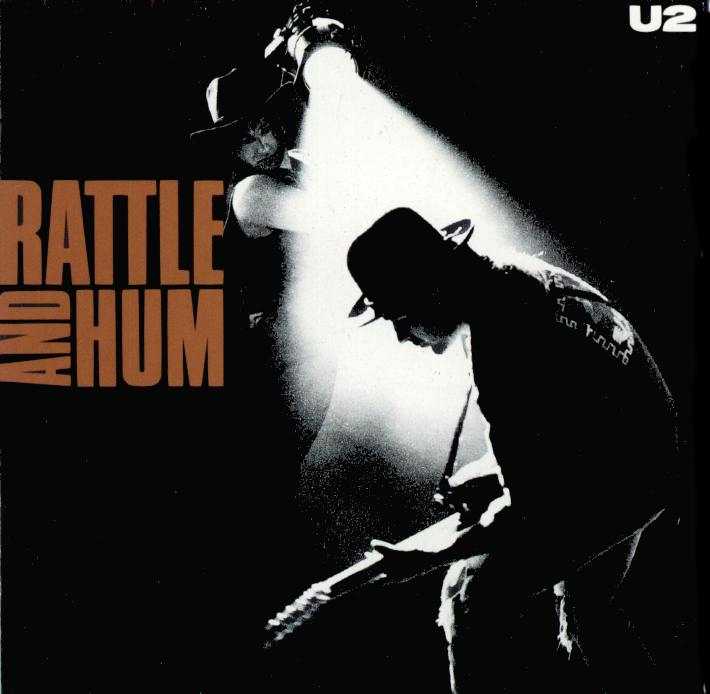
The interviews were boring and informative.The band members were posing as "rock's most important band", they were full of their self-importance, whilst their live music was leaden and heavy handed. The album was a decline from the earlier Joshua Tree. U2 looked like rock tourists in America making all the right moves as rock stars and going to the right sites to establish their rock credibility in the US.
The next album, Achtung Baby, completely changed U2's sound and style. The crashing, unrecognizable distorted guitars that open "Zoo Station" are a clear signal that U2 have traded their Americana pretensions for postmodern, contemporary European music.
The heavy dance beats,the multiple synthesizers, the dense soundscapes marked this '90s album.
November 20, 2008
Saturn:---aurora
An image from the Astronomy Picture of the Day----an infrared image by the robotic Cassini spacecraft. The aurora is shown in blue.
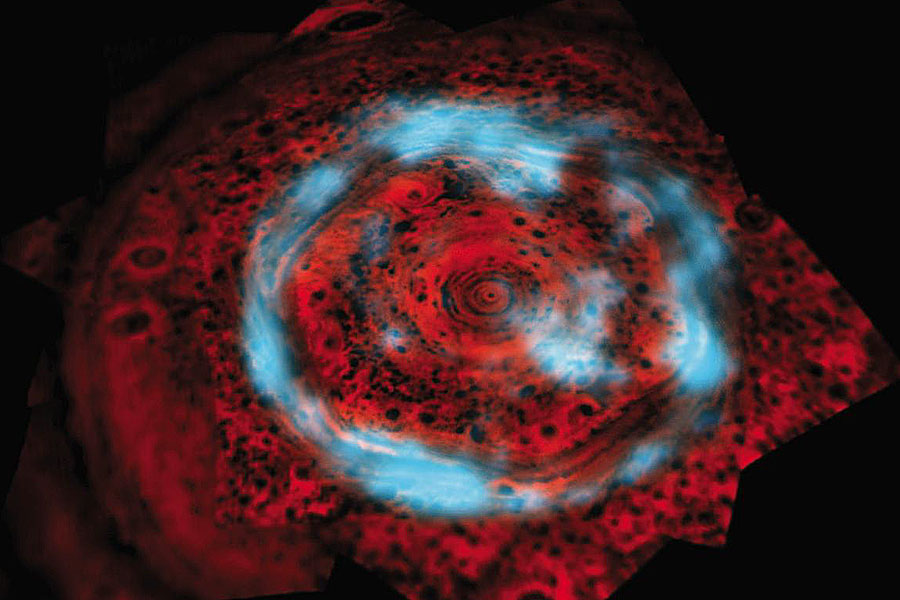 Auroras Over Saturn's North Pole
Aurora's are natural light displays in the sky that usually appear appear as a diffuse glow or as "curtains". The Saturnian aurora can cover the entire pole, while auroras around Earth and Jupiter are typically confined by magnetic fields to rings surrounding the magnetic poles.
November 19, 2008
Port River
I've been photographing around the Port River and Port Adelaide industrial environ During the last decade the area has undergone development in terms of disinvestment and urban decay--- eg., the old woolstores--- and urban renewal with the new residential housing around the Port River at Birkenhead.
 Gary Sauer-Thompson, Outer Harbor, Port River, Port Adelaide, South Australia, 2008
The renewal focuses on the waterfront and middle- income housing has aimed to re-make Port Adelaide as an imaginary place of harmony and prosperity. This is a counter to the postwar decline and devastation and it is different from the working class grassroots efforts to resist decay and disinvestment and craft alternative futures in the 1980s. That craft alternative future never took off.
The images of renewal are the standard ones of the good life---the sun-drenched marina from the balcony of our condominium, wine glass in hand, partner by our side.In this imaginary place of harmony and prosperity the working class past past, as a by gone historical era, is romanticised. It becomes a location for weddings and fashion shoots.
November 17, 2008
the abyss
I've been bogged down all day writing a paper. I saw this cartoon early this morning in The Times and it bought a smile to my face.
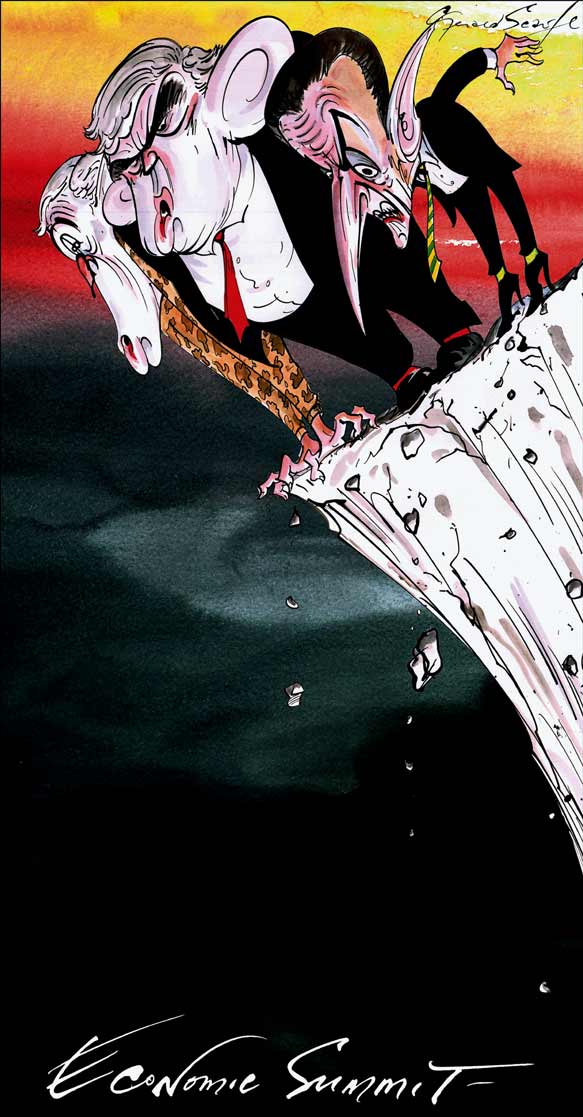 Gerald Scarfe
Great image huh? It represents what the leaders must have felt as the investment banks failed to the point where there was the very real possibility of systematic failure. The official line, of course, was very optimistic, almost to the point of denial of what was happening. Then the illusions faded---financial capitalism was having a major seizure.
November 16, 2008
Crary and regimes of visuality
Jonathan Crary has an interesting argument about photography in his Techniques of the Observer: On Vision and Modernity in the 19th Century ---- that what principally matters regarding vision is not its biological or physiological truth but the degree to which and ways that vision is located in history and historical processes. Vision is historically constructed. Crary places models of the spectator in the centre.
Crary suggests that the camera obscura was a dominant metaphor for human vision as well as a crucial and consistent representation of the relation of a perceiving subject to an external world. In this visual paradigm or regime Subject and world were understood to be pre-given, separate, and distinct entities. As a consequence the act of seeing was regarded as both passive and transparent to the world being seen, and was in that sense an act sundered from the physical body of the observer. The Lockean account to ideas imprinting themselves on passive minds is reworked in terms of photography offering a mechanical and mass-produced form of exchangeable truth.
According to Crary around 1800 one finds a 'vast systematic rupture' in the history of vision which marked the end of the reign of the camera obscura as the dominant paradigm of knowledge and truth in the nineteenth century, in which the observer and camera obscurer are bound together by a single point of view; the camera is an apparatus fundamentally independent of the spectator and the camera a transparent intermediary between observer and world. Documentary photography works within this visual regime.
Crary argues that there was a simultaneous development of a modern and radically different type of optical and epistemological figuring and he insists that optical devices are 'embedded in a much larger assemblage of events and powers'. The advent of photography was one technological development that altered the entire episteme for viewing art and images. It commensurately altered human consciousness.He argues tha the meaning of subject-object relations in general has been totally transformed during the shift from Classical to modern. If the meaning is different, then it follows that the objects must be equally different.
November 15, 2008
in reason's shadow
What in Australia is called the global financial crisis subverts our assumption of rational progress based on economic reason+technology+ free markets. That constellation--called neo-liberalism--- has bequeathed to us a legacy of destruction which looks set to increase into the rest of this decade.
The wake of destruction caused by the wrecking ball of finance capitalism calls into question the sovereignty of instrumental reason. This sovereignty is typically defended by denouncing irrationality, by which is meant anti-intellectual emotionalism, vague intuitionism and prejudice.
How do we explore the other side of reason--the darkness in a mutable world that it fails to lighten? This other space is often referred to as the aesthetic of decay associated with Dylan Trigg. I've begun to explore this space this way:
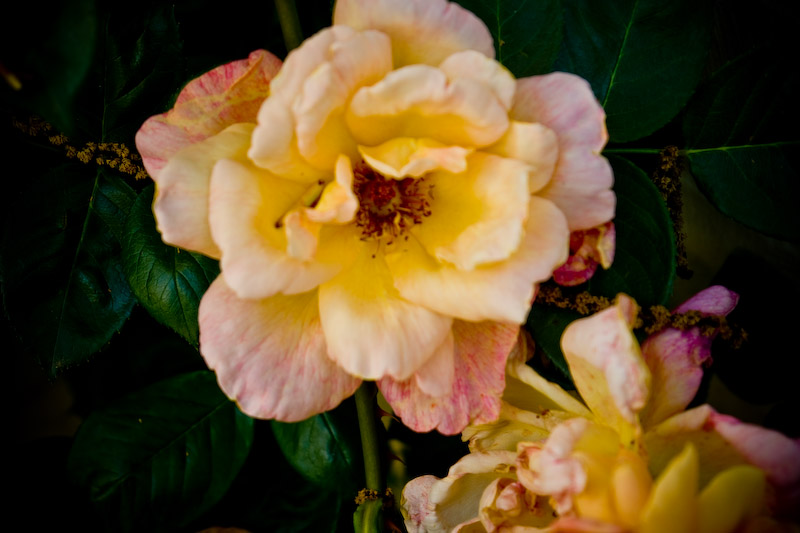 Gary Sauer-Thompson, roses, Canberra, 2008
Others, such as Lynn Smith, explore it in terms of ruins in urban spaces. Usually ruins photographed are abandoned asylums, derelict factories, and decayed piers
Trigg says that these have:
been reduced to aesthetic artifacts and that alone, Roman, Grecian, and other such ancient ruins can no longer serve as objects which subvert our philosophical assumptions concerning rational progress. This is not to say that their aesthetic merits perish with this absence of discordance. Instead, it means that they have been entrenched, so domesticated, in the sphere of the heritage trail.
So we have to turn to modern ruins in urban wastelands--the architectural ruin of derelict buildings and empty building sites.
November 14, 2008
Lucinda Williams: 'Rarity'
'Rarity' is from Lucinda Williams 2008 album Little Honey. I think that the album is another step down from 1998's Car Wheels on a Gravel Road, but Rarity is one of the better tracks.
It has the designed feel of a loose, casual album with a number of bluesy, boozy rocker– but some of songwriting material is tossed off, uninspired and cliched---eg., "Honey Bee" It's a step down--decline?---- in terms of Williams the songwriter.
November 13, 2008
urban reinvention
I've been digging around in the archive of the Urban Re/inventors and exploring their image gallery. There is Flickr stream for the photographers working in the field, whilst Alessandro Busà, the editor of the journal, has his own Flickr stream.
November 12, 2008
German photography: Rut Blees Luxemberg
Rut Blees Luxemburg is well known for her investigations into the urbanscape. She takes photographs at night on the edge of the centre of the city with a 5x4, and the long exposures allow her to use the light emanating from the street only – from office blocks and street lights. She seeks out hidden spaces, and overlooked, abandoned or even threatening areas of otherwise familiar cities.
If the city by day is a crowded and lively place by night, empty corners and dark shadows can suggest sinister possibilities and create a highly charged atmosphere that suggests an urban dystopia.
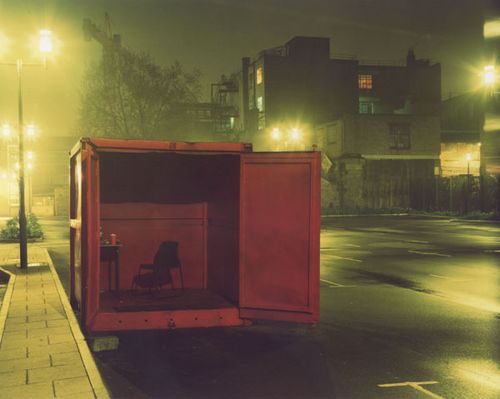 Rut Blees Luxemburg, Enges Bretterhaus/Narrow Stage 1998, C-print
Rut Blees Luxemburg A Modern Project was a series of photographs of gritty night-time views of a depopulated London, illuminated only by the eerie glow of streetlamps. Each image in the series depicts an area of the city as a site of menace and as an arena for potential encounter. All transitory events are removed from the images. There are no people, and no moving cars.
So the normally experienced flow of time in modernity is removed from the city and we are left with spaces. The images have a markedly architectural quality.
Blees Luxemburg followed A Modern Project with Liebeslied, a series of fourteen photographs taken between 1997 and 2000. These images, subtly influenced by the work of the German poet Friedrich Hölderlin (1770-1843), are more lyrical and abstract; yet still take the forgotten corners of night-time London as their main subject.
 Rut Blees Luxemburg, Liebeslied, 1997, C-Print on aluminium
The Liebeslied is the elusive writing on the wall which seemed always more than just graffiti or some quick communication. Rut says:
It looks like a very private form of communication, the opposite of most graffiti or street writing which might tend to be a disenfranchised citizen announcing something to the world in general....It is very considered. The scale is intimate. It is writing at the scale of the body. Or a page.So I came and photographed it. It seems private. I’m attracted to the heimlichkeit of a space in the public. A space that allows for a moment of repose.
She adds that the idea of the Liebeslied suggests that intimacy of communication. An attention to another experience of the public. Not the great, grand declamation but the small theatrical spaces and gestures.
November 11, 2008
Beyond Reasonable Drought
Beyond Reasonable Drought is an Old Parliament House travelling exhibition in association with the MAP Group of photographers. The exhibition is at the Horsham Regional Art Gallery from 4 Nov 2008 – 14 Jan 2009 and the images are on Flickr.
Since the images are copyright to the individual photographers I will post one of mine from the River Murray series:

This is my contribution to the project as it were.
Robert McFarlane, in a catalogue essay, says that there has not been a tradition of documentary photographers in Australia have not explored social or environmental issues in depth by using a collective of skilled documentary photographers – such as America’s Farm Security Administration did in the 1930s. The formation of MAP (the Many Australian Photographers Group) in Australia has as its goal documenting the effects caused by Australia’s current environmental extreme – drought.
November 10, 2008
Jennifer Joseph
A Melbourne artist, whom I know little about.
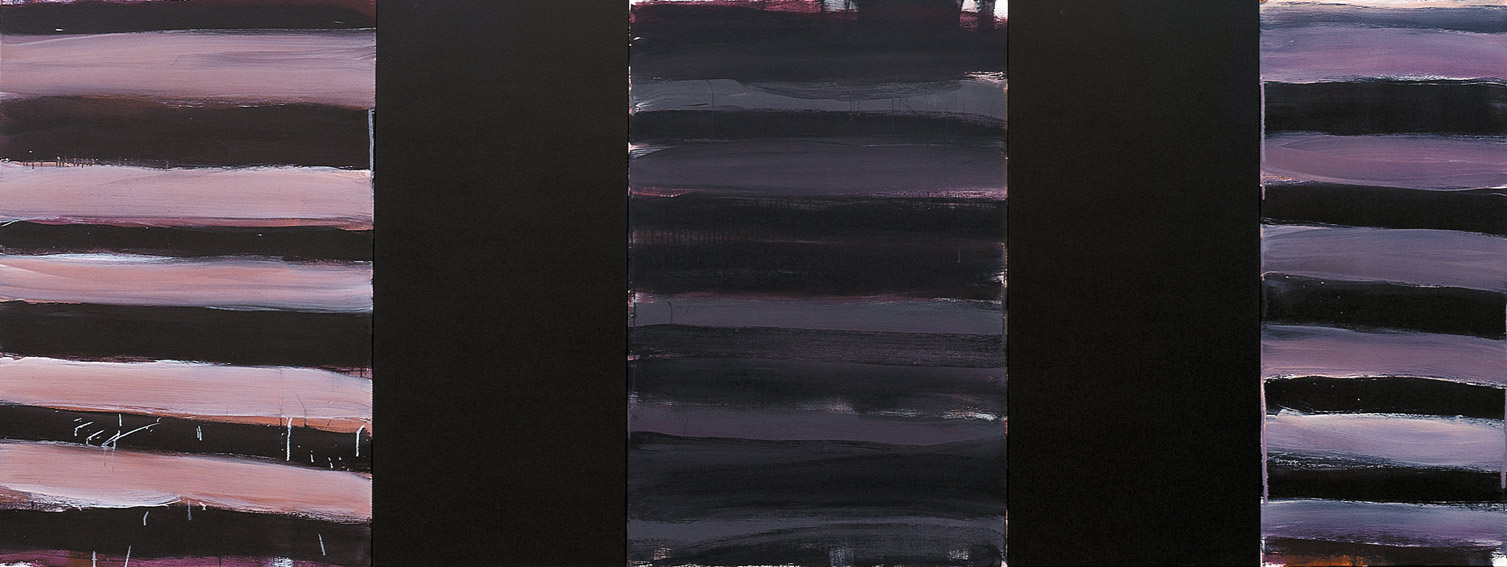 Jennifer Joseph, Forever Friday, 2007, acrylic, gesso, sand (from Shoalhaven River), pumice, kaolin and/or calcite on linen (polyptych)
I cannot find much on the internet either. So the image stands for itself.
November 9, 2008
Martin Parr on Flickr /amateur photography
Martin Parr gave a talk in association with the We are all Photographers Now exhibition put on by the Musée de l'Elysée, Lausanne, Switzerland in 2007.
The show is a survey of trends in digital photography, particularly portraiture, and how technology is changing the genre. Parr was bought in to contribute to the debate about the significance and meaning of the democratization of image making, due to more people now possessing the means to make and show images more of the time.
The characteristics of the new age of digital imagery are distribution, combination and manipulation, and the exhibition explores the way the amateur and the professional have represented distinct and often contrary approaches to photography, each battling for supremacy. It asks: Has the digital revolution tilted the field of battle irrevocably in the amateur’s favour? Or has it swept this traditional rivalry into the dustbin?
Parr, who speaks from the artistic professional perspective, says that:
I also would say that a lot of the work on Flickr is generic. It looks quite modern, because you lot are aware of trends and the language of contemporary photography....Of course I could trawl Flickr and find many outstanding images, but I am referring to the huge numbers of bland images which are in the majority. Every time I get involved in any photo competition, it is nearly always filled with tired images. Remember most people take cliches, because they believe they are connecting with good photography by replicating an image they know already.
Fair comment. The context here is that, as blogs are changing the media, so digital amateur photography (work shown on Flickr whether it is produced through film or digitally) is changing the way professional photography---both commercial and artistic---is practised. That old duality is changing and the categories of 'amateur' and 'professional' are being undermined by the flow of images. What lies in the middle ground? Can we go behind the boring cliches and the celebration of photographers as photographers that Parr highlights?
Most amateur work as exhibited on Flickr is pretty poor---as judged in kitsch in the language of a modernist aesthetics--and I include my work in that judgement. There are lots of tired, bland cliched images. It seems that it's possible to make images as unconsciously as one consumes them, bypassing the critical sense entirely. Roger Scruton, the conservative art critic wrote:
Kitsch therefore relies on codes and clichés that convert the higher emotions into a pre-digested and trouble-free form—the form that can be most easily pretended. Like processed food, kitsch avoids everything in the organism that asks for moral energy and so passes from junk to crap without an intervening spell of nourishment.
Conservative yes---but true nevertheless. However, the full story would explore the ways that digital camera has changed the various genres of photography: portraiture, landscape, street, still life etc.
Though amateur digital photography is developing its own aesthetic, which is different from the modernist one ---the work produced is hardly avant garde in the sense of being critical of the practices of photography or changing photographic language. If Parr is right then that should be the starting point of the debate of where we are trying to take our photography.
We are learning how to be photographers in a new way as we develop our own language and create our projects in a post modern world where the old cliches of representing reality have been dumped. Many of us still cling to the old modernist aesthetic understanding of photography as we recycle the cliches of past images, and work within old romantic and modernist understandings of the photographer artist.
in the studio
I'm often frustrated by shooting in the field with close ups as the conditions are, more often than not, too difficult, such as waiting for the sun to go behind a cloud to reduce the contrast. So the first step was to shift to a constructed still life situation, such as this or this or this.

This picture was the beginning of shifting to a still life. It was constructed in the field and shot handheld with a digital camera when I was in Canberra. It gave me the impetus to make the move to working in a studio situation using a tripod, film and the Rollei.
The great control in the studio provides me with a way of getting to know, and learn about, the idiosyncrasies of the Rollei 6006, as well as to get a better quality image. The studio set up is simple: a table, a dark cloth as back drop, natural light, some roses and leaves and a vase.
November 8, 2008
Photogenic Papers
Inbetween taking photos of the roses in the garden and setting up at studio at Solway Crescent I have been exploring Photogenic Papers in an early issue of Continuum: The Australian Journal of Media & Culture from the early 1990s.These papers are online.
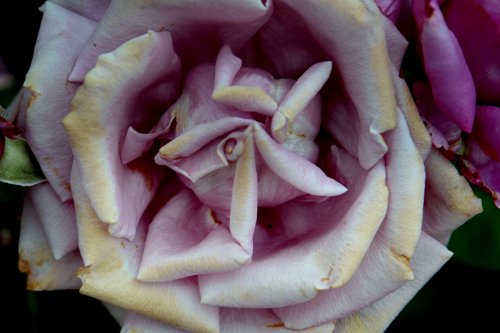 Gary Sauer-Thompson, rose, garden at Solway Crescent, 2008
In Photogenic Papers I came across a paper by Lena Jayyusi that explores and questions the way that the photograph is a semiotic object. This thesis is associated with John Tagg's The Burden of Representation: Essays on Photographies and Histories (1988) and Alan Trachtenberg's Reading American Photographs: Images as History, Matthew Brady to Walker Evans (1989).
The photograph is culturally constituted account that holds to the polysemic character of the photo-image is one that I accept and work with, so I am interested in Jayyusi's criticisms.The paper is entitled 'The reflexive nexus: photo-practice and natural history' and Lena Jayyusi begins by saying that:
Much of the debate about photography has been framed in terms of a polarity between the cultural and "natural" character of photographs, at least explicitly. Implicitly, the very terms of the inquiry have turned on the recognition of a specific character to photographs derived from their mode of mechanical reproduction. Yet the task of inquiry, as presented, has been to deconstruct this 'supposition of reality', this appearance of a window on the world, and to replace it with the analysis of all the ways that a photograph is "culturally produced", and "ideologically inflected". The photograph, as a "semiotic" object, now becomes merely the manifestation and the index of cultural codes, and/or the site of ideological and historical practices
Jayyusi argues that the terms within which much of the inquiry has been framed (be it structuralist or post-structuralist in inspiration) has systematically obscured a number of features that are central to the explication of photo-practice, some of which are located precisely in this juncture of mechanical reproduction/symbolic production that has been assumed, yet analytically displaced, in much theory.
What are these features that have been analytically displaced? Jayyusi says they are:
* the embeddedness of photo-practice in an array of other mundane practices;
* the construal of a culture/nature dichotomy is misplaced;
* the insistence on the unconstrainedly polysemic character of the photo-image( the plurality of meanings available within it ) is largely misconstrued.
Emmylou Harris: All I Intended to Be
I've started listening to Emmylou Harris' new album, entitled "All I Intended to Be".This her first solo album in five years. It was produced by Brian Ahern, the producer behind her first 11 albums (and her ex-husband) and it is the first time in 25 years they have worked together.
The opening track 'Shores of White Sand' written by Jack Wesley Routh is one of the albums less mournful songs, as it has a sense of hope and touch of redemption:
Harris wrote or co-wrote six of the 13 songs on the CD, and the music reaches back toward a sound and style that recall the country and folk influences of her earlier work prior to the innovative Wrecking Ball of 1995. Produced by Daniel Lanois and featuring her band Spyboy, it is one of my favourite album in her extensive body of work along with Pieces of the Sky (1975).
I've dipped into the both Red Dirt Girl (2000) a companion piece to Wrecking Ball and the latter Stumble Into Grace (2003), which followed the trajectory of Wrecking Ball's ethereal, otherworldly effects I was underwhelmed by some of Harris' song-writing on first hearings. All I Intended to Be is more angled toward contemporary folk music with country elements than the other way around. Does that mean Emmylou's Daniel Lanois period is over?

The space in the production from the rocked-up, grainily atmospheric sound of Wrecking Ball is retained in what is a largely acoustic album about woe, sadness and mourning of lost love and lost time. It is split between originals and covers of little-known songs that places Harris' writing in context of other writers. The music expresses the sense of Harris looking back, considering the musical road she’s travelled; one of following in the foot steps of Gram Parsons, defining and changing country music along the way.
If the ambient country–pleasant sound with its minimalist approach to their production borders on roots-music kitsch, it is Harris' voice with its aching compassion and sense of phrasing that lifts it away from kitsch.
November 7, 2008
Leunig
A little bit of humour about recent electoral events in America to end the week with a wry smile.
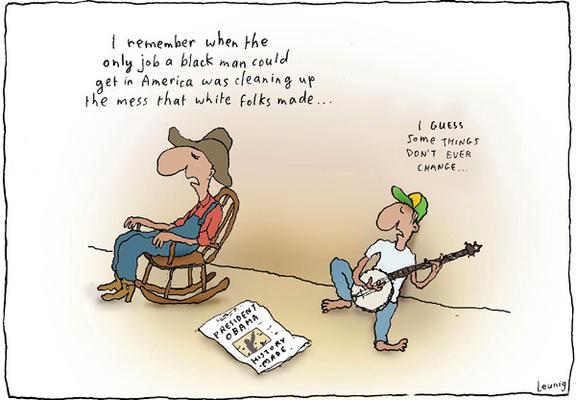 Leunig
It's a lovely way to locate Barack Obama in American history isn't it.
November 5, 2008
beach shack, Aldinga
I'm down at Victor Harbor writing a submission. I took this picture on the way down to the beach shack or weekender when I passed through Aldinga beach. Aldinga was once a holiday resort, now it is a coastal suburb of Adelaide.

This kind of postwar beach architecture is rapidly disappearing, as it is being replaced by McMansion style of architecture in a modernist style, eg.,
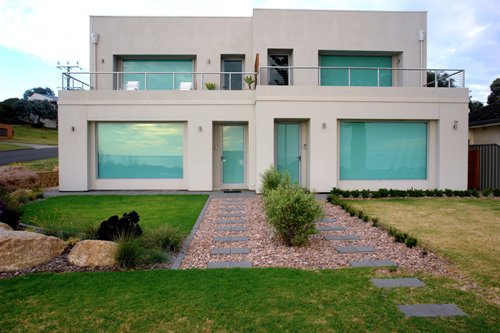 Gary Sauer-Thompson, holiday house, Encounter Bay, 2008
All the old properties along the water front of Encounter Bay and being bought up, the old shacks pulled down, replaced by these kind of new holiday homes.
November 3, 2008
German photography: Gudrun Kemsa
In Germany there are only a few schools where photography was taught in a non-commercial, artistic way. The school of design at the Folkwang School at Essen was such a place, but it didn’t become as influential as the Düsseldorf Academy of Fine Arts (Becher class) in which the German tradition of 1920’s Neue Sachlichkeit was taken seriously and used as the base for a new approach to Photography.
Neue Sachlichkeit, which rejected the self-conscious sentimentality of late Romanticism and the emotional agitation of expressionism, brought a sharply focused, documentary quality to the photographic art where previously the self-consciously poetic had held sway.
Luminos Lint has an online exhibition that showcases the work of three contemporary German Photographers-----Florian Beckers, Gudrun Kemsa and Kris Scholz--- who have studied either in Essen (Beckers) or in Düsseldorf (Kemsa, Scholz).
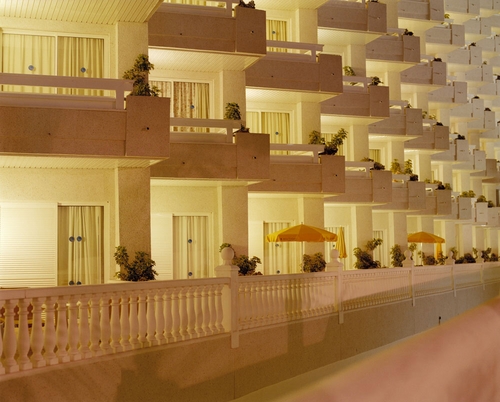 Gudrun Kemsa, Untitled, no date, from the ‘Sousse’ Series 1992 – 2007
Modern apartments in a city that are photographed at night. Despite the photographs in this series being "on location" the work is less in the genre of street photography---eg., the work of Helen Leavitt in New York---and more architectural. However, if Kemsa is not concerned with documentation or social reporting, this work is not in the tradition of architectural photography either. It is more surreal and more concerned with the construction of the picture plane.
Kemsa has published a book entitled Moving Images: Photographs by Gudrun Kemsa but I do not know anything about this text other than it consists of the work of four series.
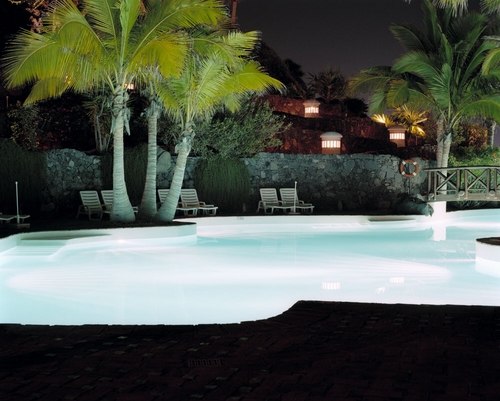 Gudrun Kemsa, Untitled [Adeje (Pool)], n.d. from the ‘Beach’ Series
The location for this image is the tourist enclave in the coastal town of Adeje in Spain. It is represented as an abandoned terrain at night, after the sun has gone. The mood or atmosphere is one of emptiness .
November 2, 2008
space: aesthetics and astronomy
This is a cosmic close-up of the eastern Veil Nebula. The Veil Nebula itself is a large supernova remnant, the expanding debris cloud from the death explosion of a massive star.
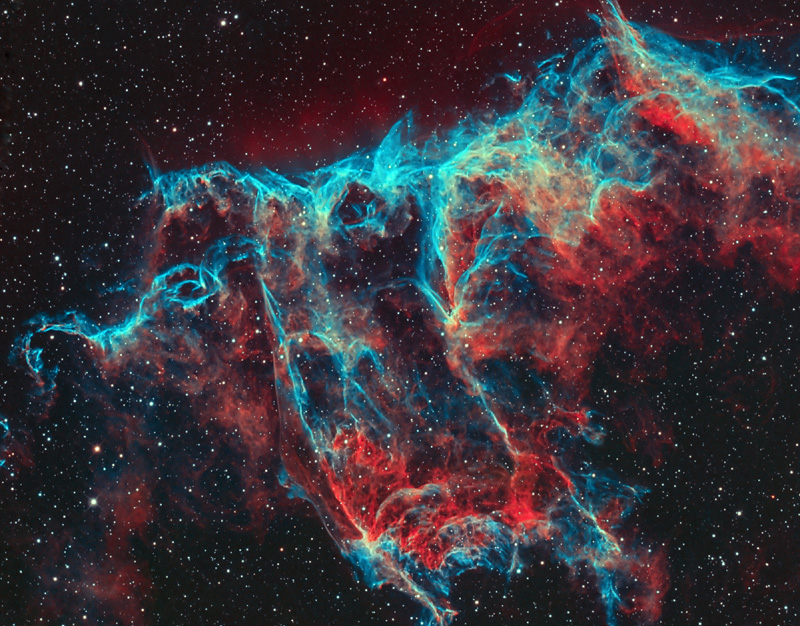 Paul Mortfield and Stephano Cancelli
It is another example of how the new generation of ground- and space-based telescopes has created an explosion of images for us to explore. I notice that The Smithsonian has joined the joined Flickr community and is posting images from the he Chandra X-ray Observatory.
Polaroid---a long goodbye?
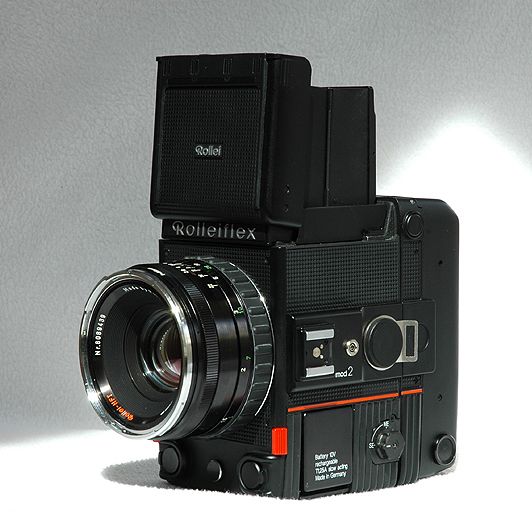
I'm trying to learn how to use the Rolleiflex 6006 that I picked up yesterday from layby. It is proving to be a difficult experience and I don't feel very confident with this sophisticated machinery. I have trouble loading the film, charging the battery, using the built-in light meter, and even taking shots. Unbelievable.
In between the above trial and tribulations I stumbled upon this interesting photoblog entitled Paper Cameras run by Amanda Gilligan in Sydney known for her Mocking Bird weblog and Monmartere photoblog. Paper Cameras is a film photography blog, and for the last week or so the focus has been on Polaroid images with interviews with photographers who continue to use this kind of film.
I've only ever used a Polaroid once or twice and I have no desire to try to attempt to acquire the Polaroid back for the Rollei 6006. I understand that the SX-70 (or Time Zero) film had a strong following from artists who used it for image manipulation.
I am surprised by the continued use of Polaroid, since the company has discontinuing production of its instant film, Polaroid no longer manufactures its instant cameras, and it is closing its factories in the United States, Mexico and the Netherlands. So the instant film is no longer being made. End of an era thanks to the shift to digital. People must getting down to their last packs of film in their fridges by now. What to do then?
Is this work showcased on Paper Cameras a mourning for the passing of this iconic medium? Or is nostalgia for an era becoming history?