|
November 30, 2008
Rosalie Gascoigne's work consists of a distinctive and poetic assemblages of found objects, such as wood, corrugated iron and road signs, and cut up and rearranged faded, naive lettering to create abstract yet evocative grids of letters and word fragments:
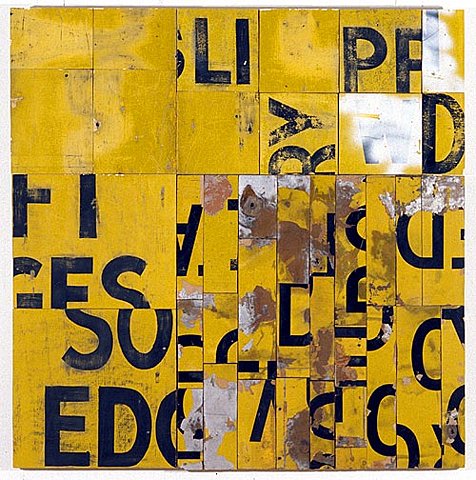 Rosalie Gascoigne, Southerly Buster, 1995, retro-reflective roadsign on craftboard
She worked exclusively with found objects, discarded or obsolete. Her art includes installations in bone, rusty farm iron, twigs, grasses or feathers, assemblages in old bee boxes, panels made from sawn up discarded soft-drink crates and road signs or old linoleum. Her initial skills in arranging were developed by years of training in the classical art of flower arranging (the modern Sogetsu school of Ikebana).
Her mature Ikebana works in the 1960s and early 1970s included arrangements and assemblages constructed from grasses, iron, driftwood and bleached bones. It was during Rosalie's phase of producing iron assemblages that she made the transition from Ikebana to producing art (or sculpture) as such.
Her last work is a series of 10 panels of sawn builders' form boards — the installation, Earth 1999.The boards sat around the Canberra home for years, Rosalie watching the light play on their surfaces, shining in the rain and drying in the sun. She liked the colours and the humble nature of the material, which she cut into rectangles and assembled into panels.
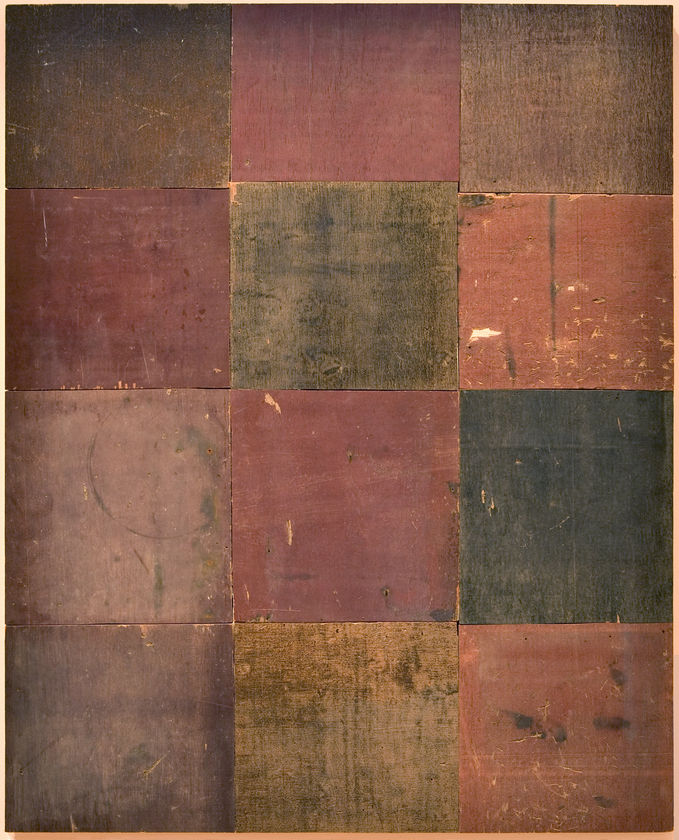 Rosalie Gascoigne, Earth 4, 1999, sawn builders form-board
This work has been interpreted in terms of uncovering the spirituality in her work, and connecting this with Australian spirituality and with spirituality in the wider Christian tradition. Australia on this interpretation is known as the land of the spirit (Terra spiritus).
What I see is largish panel consists of a grid of varying numbers of squares or rectangles. The colours are muted and subtle, ranging through browns to grey and purple, and its spareness and subtlety works on the observer, especially hung as it is around four sides of a square. Its effect is not dissimilar to the meditative presence of Rothko's Four Seasons panels at the Tate Modern, also hung this way.
|


Gascoigne's work is a collusion between, collecting the detritus of an Australian rural landscape and abstract formalism. The former has its roots in her collecting of grasses, weathered timber, rocks, feathers and flowers for interest and display.