February 28, 2005
Frank Hurley
Antartica has played a significant part in Australia's history of heroric exploration. Today Antartica is read as wilderness that needs to be preserved.

Frank Hurley,The Crystal Canoe [c.1917]gelatin silver photograph; 26.2 x 35.2 cm,National Library
There are previous posts on Frank Hurley, the Australian photographer, here and here.
The above image, and is from In a New Light: Australian Photography 1930s-2000, which is drawn from the extensive holdings in the National Library of Australia's Pictures Collection.
yesterday: in a new light
The National Library's 'In a New Light: Australian Photography 1930s–2000' enables us to engage with the history of the modern period through photographs.
We need to start reading Australian photographs as disclosing our history in the twenteith century
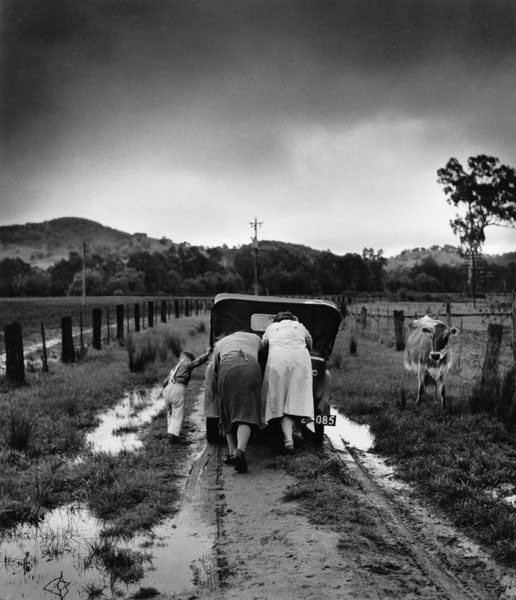
Jeff Carter, Tobacco Road [1955 or 1956]gelatin silver photograph; 30.8 x 26.8 cm,National Lbrary
Where is the man? Driving the car?
Australian rural life during the twentieth century was shaped by the processes of modernity.The photo indicates that life on a dairy farm was pretty simple. It was even more primitive as a pastoralist:
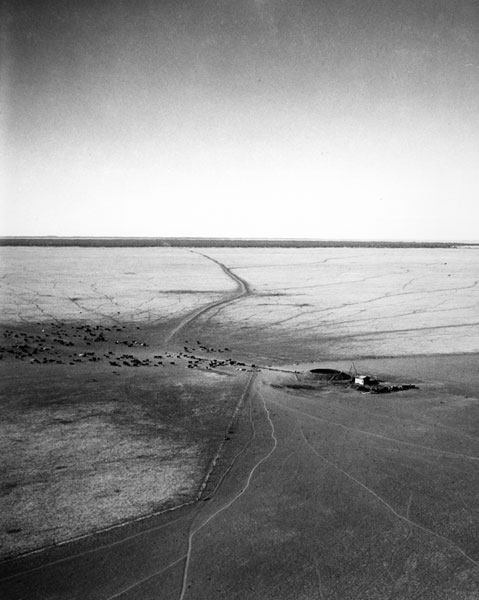
Axel Poignant, Artesian Bore, Gordon Downs 1947, gelatin silver photograph; 61.0 x 51.0 cm, National Library
It was pretty bleak landscape:
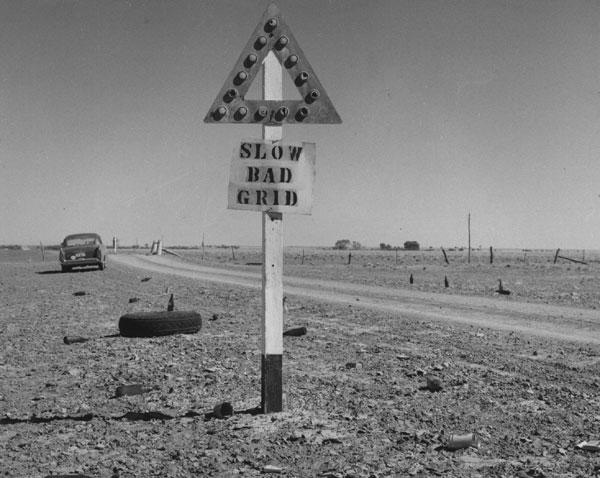
Robin V.F. Smith, Stranded Motorists Drank Beer While They Waited for Assistance When Trouble Occurred at Rough Grids, Western Queensland [between 1960 and 1964],gelatin silver photograph; 20.5 x 25.4 cm
National Library
February 27, 2005
sex, power, terror
This was the outfit that the outfit Condalezza Rice, the US Secretary of State, was wearing Wednesday (Feb 23) when she arrived at Wiesbaden Army Airfield in Germany.
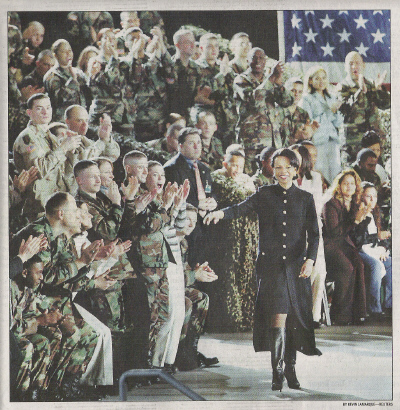
Sex and power is a powerful combination, especially when it is associated with an imperial state. The Washington Post comments:
"Rice's appearance at Wiesbaden -- a military base with all of its attendant images of machismo, strength and power -- was striking because she walked out draped in a banner of authority, power and toughness. She was not hiding behind matronliness, androgyny or the stereotype of the steel magnolia. Rice brought her full self to the world stage -- and that included her sexuality. It was not overt or inappropriate. If it was distracting, it is only because it is so rare."
More is happening here than Rice bringing her full self to the world state. The context is the military power of an imperial state. The context is one of violence of the military machine.
Who is the machine protecting us from in the 'post-9/11' environment? The dirty intolerable, unredeemable rabble that threaten us. Who are they? The terrorists.
Does not the image invoke, and bring back, memories of imperial Rome? Or Nazi Germany?
It is what Walter Benjamin, in his essay "The Work of Art in the Age of Mechanical Reproduction" (1936), called the aestheticization of politics in the age of mechanical reproduction. I would go further and say we have links to the the cult of death in modern capitalist culture of the West and its ritual of sacrifice. What Benjamin discerned in fascism's aestheticization of politics is the inevitable culmination is war.
Is this not what we have here in this image? The Cold War of yesteryear has been replaced by the war on terror. Consider this passage by Alphonse van Worden:
"...this cluster of mass-culture genres, designed to appeal to kiddies, is where Thomas Friedman, Christopher Hitchens, Ian Buruma, David Aaronovitch and other US-regime apologists set their tales of 'the Other': Iraq is populated by weird inscrutable psychos and snarling rabble, wild eyed madmen working in wondrous, invisible and secret underground weapons labs on their sinister plots against the world, for they are corrupt and greedy without ever being specifically interested in profit....'Our enemies' reside in 'dark corners of the earth,' murky landscapes where nothing is certain, a realm of fog and chaos and ambiguity."
So let us name what the image invokes: a compassionate fascism that lies behind a liberal democratic veil. Only some tough action can save the Empire in the face of such savage, brainless, nihilistic terrorists as threaten us.
Compassionate fascism. Is that too strong?
February 25, 2005
gated communities: the retreat of humanism?
A new mode of urban life?
 The link is courtesy of American Coprophagia, via Jodi Dean at I Cite. The picture is of a billboard in L.A. "corrected" by grafitti.
Tis a harsh comment that exaggerates too much. But the graffiti tells us to stay and while and think about what a gated community means.
Gated communities have traditionally been the wealthy homeowners response to the failure of law and order to deal with the crime problem in our cities. It is a retreat to enclaves behind gates from the life of the city was most marked in the sunbelt of Queensland.
The living behind walls and knowing your neighbors creates a safety zone for many for whom security is a prime concern.
Does it also reflect a nostalgia for the '60s suburbs and the fading life of the small town that provided a sense of community and a safe environment for children and to live among people who share similar values?
If so, then the desire for gated communities will increase to incorporate blocks of urban townhouses in the inner city.
So the postmodern city becomes a series of enclaves of stability in a sea of decay and crime. It is an example of inhabiting the city whilst declaring it uninhabitable. Are these gated communities an example of a "document civilization that is at the same time a document of barbarism"?
What to make of the graffiti, since physical torture by the national security state is not happening behind the walls? It strikes me that the graffiti's gesture to a prison points to the limits of a deepseated humanism, that appeals to the rationality and good will of everyone. It highlight how this humanism (eg., what is regularly given expression at Troppo Armadillo) is worn out like an old coin. Is that a fair way fo putting it.
Or, more philosophically, the process of nihilism has now begun to devalue the highest values of secular humanism?
This humanism retreats from the inhuman to live behind gates and walls. It is there, in a world that is safe, secure and unified, that one can read good literature and talk about education making us better people.
February 23, 2005
masculinity?
This is the fourth consecutive year the National Rugby League (NRL) season has started with a police investigation into allegations of sexual misconduct. Cronulla was investigated over an alleged incident in Auckland in 2002, while the Bulldogs attracted similar inquiries for separate incidents in Coffs Harbour in 2002 and 2003. In all cases, no charges were laid.
League players are deservedly under the gun at the moment for their off field behaviour to women. The night out on the town with the boys often involves the pack assault of women.
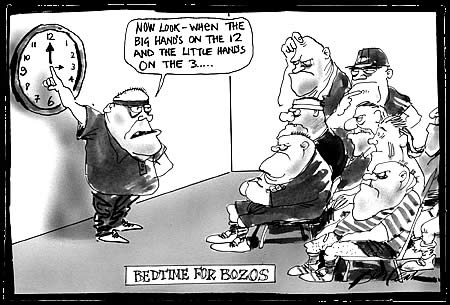
Leak's boofhead view is challenged by Catherine Lumby.
The response has been seminars, pep talks and team-building weekends to change the patriarchal culture of working-class men in rugby league.This follows the advice of the Playing by the Rules report released on December 20, 2004. This established the players' attitudes towards women, and its recommendations included educating players about their social and sexual conduct, promoting responsible consumption of alcohol and involving clubs at all levels in improving the position and treatment of women in rugby league.
This is a laudable attempt at culture change. As David Rowe points out in The Australian the masculist culture of rugby league is a :
"...homosocial world [that] has traditionally treated women with suspicion and, commonly, contempt. Feminising influences are seen from within this group as signs of weakness and encroachments on male territory tolerated only for specific purposes. One of these is sexual pleasure, sometimes, as research and court evidence reveals, with scant attention to the little matter of informed consent."
I guess the cultural change is working, as there is no attempt to cover up or pretend that nothing has happened this time.
Jason Kotte: blogging full-time
Veteran blogger Jason Kottke has decided to stop being a web designer to take on his blog Kottke.org as a full-time enterprise. He intends to fund the venture by asking readers to donate $30 to "help enable [him] to edit/write fulltime.
Jason runs an interesting site and he has the critical mass. Kotte.org attracts about 25,000 visitors per day, are starting to be able to be able to make a living from their blogging.
Good luck to him. This 'going pro' is a push in the right direction, even if it uncertain that it is viable in New York city. His list of supporters is growing.
Here is Jason's account of the big move:
"And yet, I almost quit last spring. The site was getting out of hand and wasn't fun anymore. It was taking me away from my professional responsibilities, my social life, and my relationship with my girlfriend. There was no room in my life for it anymore. As you can imagine, thinking of quitting what had been the best thing in my life bummed me right the hell out.After thinking about it for a few weeks, I had a bit of an epiphany. The real problem was the tension between my web design career and my self-publishing efforts; that friction was unbalancing everything else. One of them had to go, and so I decided to switch careers and pursue the editing/writing of this site as a full-time job."
Like others I can understand that conflict.It also pulls me in two. The conflict has resulted in the quality of this site dropping over the last six months as my work has shifted from part-time to full-time.
Yet online personal publishing, which is different from journalism and is not supported by advertising, should be taken very seriously indeed. This is because in the new education marketplace the academic job of being paid to read, write, to engage intellectually, and to teach students to think critically in a democracy is being undermined through casual labour who just teach.
What do we call this new kind of online activity that contributes to the public culture? A blog artist? Jason does talk about the arts being supported by patrons. Or A freelance blogger? A dot.com entrepreneur? Whatever it is, it is very different to this kind of corporate activity.
February 22, 2005
Ponch Hawkes
Apologies about the lack of postings over the last week or so. I've been working full time, and then painting the cottage at night and on weekends. Basically I'd run out of energy and just wanted to relax.
An easy way into it:
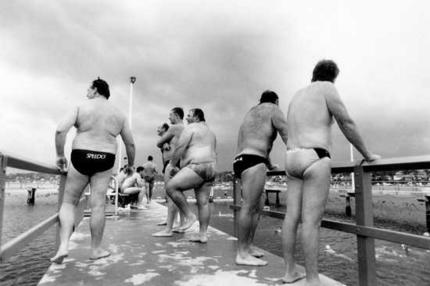
Ponch Hawkes, Swell
A bit of a blurb in The Age.
February 19, 2005

Jackson Pollock+ cold war
Many years ago the Marxist critique of modern art rejected Jackson Pollock for his splurgy, random knot of lines that threaded their way across the canvas and over the edges.

Jackson Pollock, IA, 1948
I recall reading the art criticism of Serge Guilbaut's, How New York Stole the Idea of Modern Art, and turned it into a weapon of the Cold War.
True, the CIA did realize the potential of abstract expressionism to be used as a tool in the cultural Cold War as an embodiment of western freedom contrasted sharply against grey Stalinist conformity. The CIA worked with the Museum of Modern Art to promote the abstract expressionists, funding touring exhibitions in Europe, as an expression of liberty.
However,Guilbaut's, How New York Stole the Idea of Modern Art, crudely reduced abstract expressionism to a tool of U.S. foreign policy. This reduces abstract expressionism to its Cold War context.
Is the above work by Pollock an example of abstract expressionism created from the necessity of bearing witness to the experience of the terrible moment of history through which they lived? Is it impulse The impulse is to take a stand for individual personality and freedom in an age of tyranny and conformity?
February 18, 2005
Jackson Pollock
Abstract Expression was often portrayed as an epic struggle between man and material might unfold. Process was paramount. With grand, heroically scaled gestures, the action painter created an art of confrontation and catharsis.

Jackson Pollock, Lavender Mist,1950
Nearly half a century later, contemporary response to the rhetorical excesses that helped establish action painting as a "heroic" art form has been tempered, and the view of abstract expressionism as the triumph of American painting has fallen out of fashion.
Thankfully. However, Pollock had a big impact on the history of American art.
February 16, 2005
art censorship
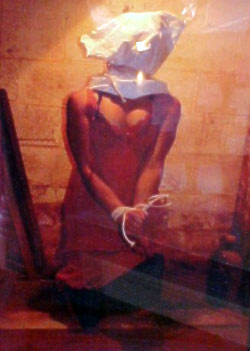 An exhibition of photographs in the Vanguard Exhibition depicting women bound, handcuffed, chained and hooded like tortured Iraqi prisoners has triggered a conflict between Broken Hill Council and the Broken Hill City Art Gallery.
I stand with the Art Gallery on this against the city fathers.
Titled, 'Terror Begins at Home', the exhibition is by a local artist Angela Fitzpatrick, who said it was based on the infamous images of Iraqi prisoners at the Abu Ghraib prison, with the intention of "showing the parallels in our homes". She said the photos highlighted the plight of victims of domestic violence, and attempts to censor her work were outrageous.
Broken Hill has the third-highest rate of domestic violence in NSW, with 277 offences recorded in 2003 in a region of 21,000 people.
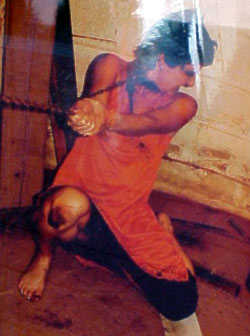 The conflict arises because a directive from the council's general manager, James Hall, and mayor Ron Page, to Jacqui Hemsley, director of the Broken Hill City Art Gallery, to remove the 11 photos, intended to highlight domestic violence from their prime window position.
The reason was provided by the NSW MP, and former Mayor, Peter Black. The exhibition would put at risk future state government grants.
The images are online. As far as I can gather the art gallery has been directed to turn some photographs in the Vanguard exhibition away from public sight.
So it is not just about money. It is about the violence in the homes, the style of the photos and their link to the images from Abu Ghraib prison in Iraq.
It is a provocative linkage for sure. But isn't an autonomous art meant to disturb? What is the point of affirming domestic violence? Who wants an art that, in Adorno's words, "slips into a conservative posture where it dishes out cheap comfort and propaganda in favour of the status quo." (Aesthetic Theory, p.467)
February 15, 2005
a moment
I was browsing the archives of Janus Head and I came across the work of Mathew Ziff:
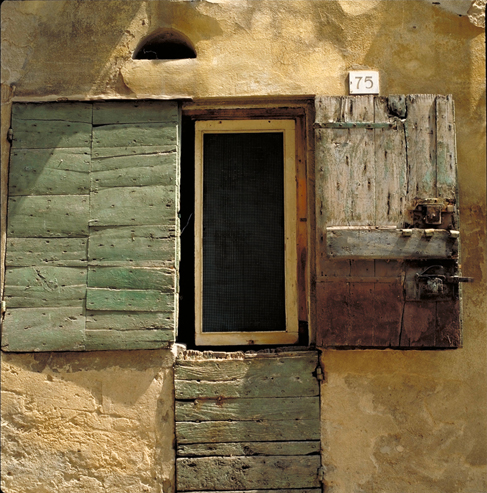
Mathew Ziff, Square Window
An image is all I have time for. I'm struggling to find the time, space and energy to keep things going. I was going to write a post on the shift from literary and art works to theory, with its concerns about how we read, interpret and understand meaning. Initial concerns about theory and literature sa are expressed by Sophia Masson over at Troppo Armadillo.
Update:17 February
There is more from Sophia Masson here on theory and literature in Australian secondary schools.The humanist approach to literature comes through more strongly, as does the antagonism to theory and aesthetics. Sophia sees theory as 'interpretations' which are basically ideological frameworks that close down all individual response.
There is more on traditional reading of literature plus the usual modernist condescension towards postmodernism (Derrida and Foucault) over at John Quiggin.
February 14, 2005
Global Warming #2
The Kyoto Protocol, which is a first attempt to address global warming becomes international law on Wednesday.Melissa Fyfe, writing in The Age, reports that most scientists now agree that greenhouse gases from industry, electricity use and cars have caused the planet to warm 0.6 degrees in the past century. Because the gases can live in the atmosphere for 50 to 200 years, another increase in warming is already locked in, regardless of action on cutting back pollution.
Global warming is causing polar glaciers and Brown Glacier on Heard Island to melt, Pacific Islands to flood, and oceans to turn acidic from absorbing carbon dioxide. The Great Barrier Reef is also threatened:
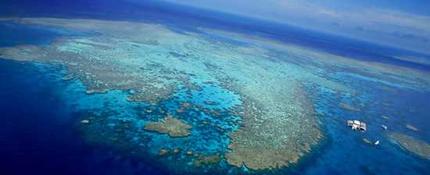
The Great Barrier Reef's coral could disappear in as little as 20 years as sea temperatures rise faster than expected, says Professor Ove Hoegh-Guldberg, director of the Centre for Marine Studies at the University of Queensland. He says bleaching will occur and coral will die regardless of what happens in the battle against global warming.
"It is shocking to wake up and realise we really are in a desperate time...We may see a complete devastation of coral communities on the reef and a major change to the pristine values, which at the moment are our pride and joy.We are likely to see corals rapidly disappear from great parts of the Barrier Reef, as it has already from large parts of the Caribbean."
Modelling by marine scientists shows that coral regularly bleaches when global temperatures rise between one and two degrees, but it may recover in some summers when bleaching does not occur. At two degrees and above, coral bleaches every year - with most dying off. If a remnant population managed to survive and carbon dioxide was stabilised in the atmosphere our beautiful coral reefs will come back in a couple of hundred years.
So why such little action? This is one reason:

Loy Yang
Though Victoria promote itself as a clean, green state, leading the way on environmental initiatives, it is one of the nation's worst greenhouse gas polluters.The state's electricity is generated by burning brown coal in the La Trobe Valley cheap source of power, and it was used to help build a manufacturing industry in Victoria.
But today the question is whether the benefits of cheap coal fired electricity outweighs the costs to the environment.
February 13, 2005
Who cares?
I'm continually amazed at how much the comings and goings of the British Royalty are dutifully reported and commented on in the Australian media. Tis hardly the stuff of fairy tales. loved by those Anglophile monarchists out of sorts with a multicultural Australia.
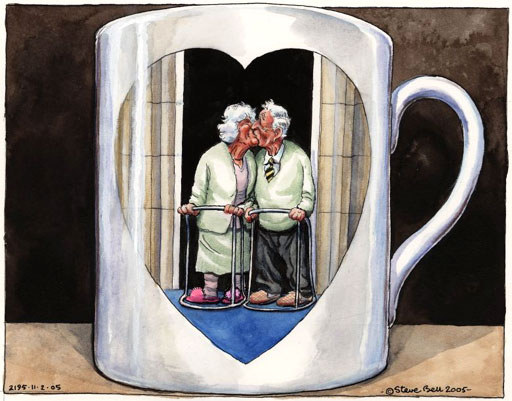
Steve Bell
Who cares whether Prince Charles and Camilla Parker Bowles will tie the knot?
Maybe, it is because the news is really about celebrity and style with its classic love triangle narrative about jealousy, heartbreak, loneliness and tragedy?
February 11, 2005
rewriting modernism
We live in a time when the principle of rationality, as embodied in the exchange relationships of the market, tramples tradition underfoot.
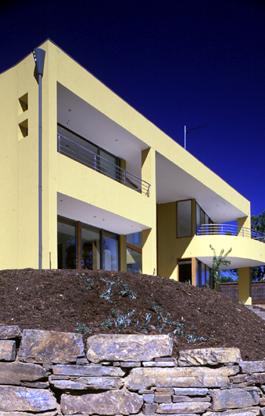 Would this Max Prichard Bartel Gardiner House, Adelaide SA, 2001 be an example?
I reckon that it is.
It turns its back on the regional architecture that had developed. It treats the past as trash that needs to erased to the groundd to make way for the new.
Now you could say that modernism has become a tradition; one that we have reacted against in the name of a different kind of dwelling.
If so, then how do we rewrite the meaning of a modernist modernity?
That we inhabit the city only to declare that it is uninhabitable?
That has been our experience of cities as forms of living in the 20th century, has it not?
February 9, 2005
progressive architecture?
A lot of the new inner city architecture in Adelaide is along these modernist lines:

Nelson Architects, Parkland Residence, North Adelaide 2000
The blurb says:
"The Parklands Residence, is a modern townhouse overlooking Adelaide's Parklands. Set in a local heritage area, the street facade explores the reinterpretation of a Grand Terrace house whilst asserting rational yet sympathetic proportions to its surrounds."
This has little sympathy with the heritage housing stock around it. It is an enclosed airconditioned machine that makes no use of the city's cooling winds. Nor does it little by way of living inside/outside spaces. It shouts money, international and arrogance. This kind of modernism cannot be called progressive architecture. It could be situated anywhere.Theris little attempt at reworking the modernist heritage.
Adealide is not a megapolis and, unlike Sydney, will never become one. I am more interested in an architecture that takes the regional character in a globalized world. In Adelaide that means the inner city cottages, keeping the heritage street facades and building a new and sustainable dwelling on the back. That gives you a different kind of townhouse; one that responds to the local heritage and environment and so develops a regional identity.
This would be one way to explore a regional identity in architecture, as it is in food and wine. It is a different pathway to the desire for security, seclusion and enclosing oneself in opposition to the hurried actuality of the city.
An example of regional architecture from Tasmania is this small single storey cottage, which enjoys waterfront Derwent River views to the South West and a canopy of mature trees to the North West:

Gilby Vollus Architects,Watchorn House, 2000
February 8, 2005
where has the care gone?
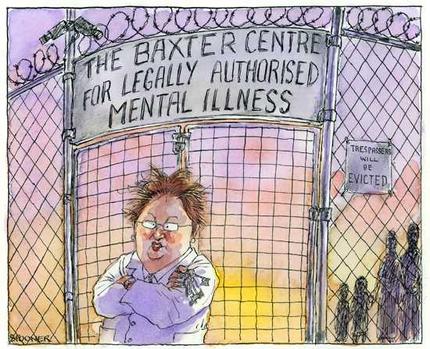
The case is reminiscent of One Flew Over the Cuckoo's Nest:
Spooner
As Alan Fels says:
"This is but one particularly flagrant example of how people affected by schizophrenia and other mental illnesses are neglected and allowed to drift into homelessness, neglect and, in many cases, prison or some other inappropriate institution."
What has gone from the prison-like regime in immigration detention centres is any concern to protect mentally disturbed people.
Our prisons are now full of mentally ill people. Law and order is being used to deal with the mentally ill who have been de-institutionalized and lack proper community health care. Our jails have become dumping grounds for the mentally ill.
February 7, 2005
Deleuze on Bacon
Gilles Deleuze on Francis Bacon in The Logic of Sensation:
"Bacon thus pursues a very pecular project as a portrait painter: to dismantle the face, to rediscover the head or make it emerge from beneath the face."pp.20-21.
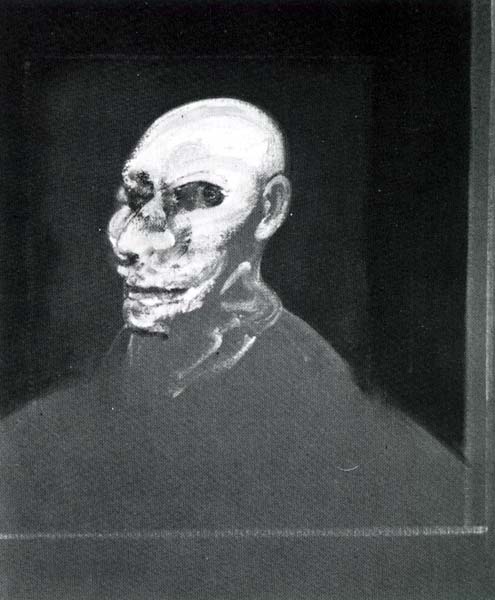
Francis Bacon, Painting (head of man),1950
Deleuze says:
"The bone belongs to the face, not the head. According to Bacon, there is no death's head. The head is deboned rather than bony, yet it is not at all soft, but firm. The head is of flesh, and the mask itself is not a death mask, it is a block of firm flesh that has ben separated from the bone: hence the studies for a portrait of William Blake." (p.25)
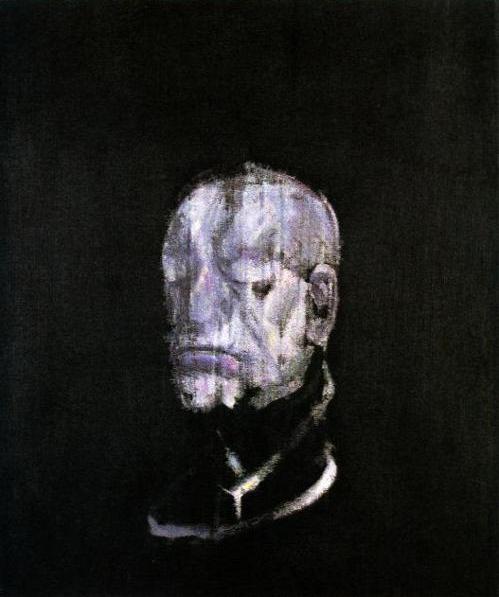
Francis Bacon, Study for a Portrait, After the life mask of William Blake, 1955
The relationship is one of head and meat.
a salutory tale
Remember all the fuss about the rebuilding of World Trade Centre after 9/11? Remember the THINK design, which showed a pair of airy latticework cylinders arising over the twin towers' footprints and incorporated various components of a World Cultural Center? The one where commercial development would have been pushed to the periphery of the site. Remember the winning design by Daniel Liebskind?
Have a quick look here. Well the New York Review of Books has a tale to tell. It was accurately foretold by Ada Louise Huxtable:
[New York is] "a city incapable of the large, appropriate gesture in the public interest if it costs too much....If the usual scenario is followed, the debate will lead to a "solution" in which principle is lost and an epic opportunity squandered. With the best intentions the Municipal Art Society, a conscientious watchdog of the city's urban quality, will announce a competition to determine what should be done with the site. The results will make a nice little exhibition, and discussions and lectures will be held. All this will be ignored by the movers and shakers making big building plans under the banner of physical and symbolic reconstruction. There will be a fuss in the press, with letters to the editor, pro and con. City Hall, in a split political decision between greed and glory, will come out for the builders and a memorial---a monument or a small park, something financially inoffensive in the larger scheme of things."
The usual scenario has been followed. Commerce wins. Libeskind was quickly sidelined and replaced by David Childs the developer's (Larry Silverstein) architect. The developer calls the shots and he wanted a developer office building.
February 5, 2005
the dominant male scopic regime
The link is courtesy of Evan Jones over at Alert and Alarmed. Evan's references to Kurt Nimmo's photographs caught my eye. Working through the online material I came across Kurt Nimmo, Voyeurism, 2005, from the collage series.
 This is a good illustration of the dominant male scopic regime of a phallocentric culture: the women is the passive object of the voyeuristic male gaze that constricts and tortures the female body.
The state of otherness produced by the male gaze is always a condition of inferiority and baseness.
In this visual regime of male representations women are figured as a lack, an absence, a default; as a inferior version of male subjects.
Why not smash the mirror and step through the screen of male representations to an underground world hidden from the surveying, voyeristic, categorizing male eye.
Why not step onto the dark continent beyond this visual regime?
I look at the above image and text and wonder: can we develop a healthy dialectic of the visual (image and visual language) in response to the privileging of the eye of reason, without radical rejecting vision or embracing an antivisual purism?
The anti-visual discourse is a reaction to pure perception; to the picture as a window; to the mind mirroring the world; to the image as a mimesis of a real or ideal world; to representation as an enframing that turns the world into a picture that can be viewed from afar.
Hence the hegemony of the eye. It is the master sense of modernity.
February 3, 2005
Francis Bacon #7
Back to Francis Bacon, to the body as figure, Gilles Deleuze, the word and the image.
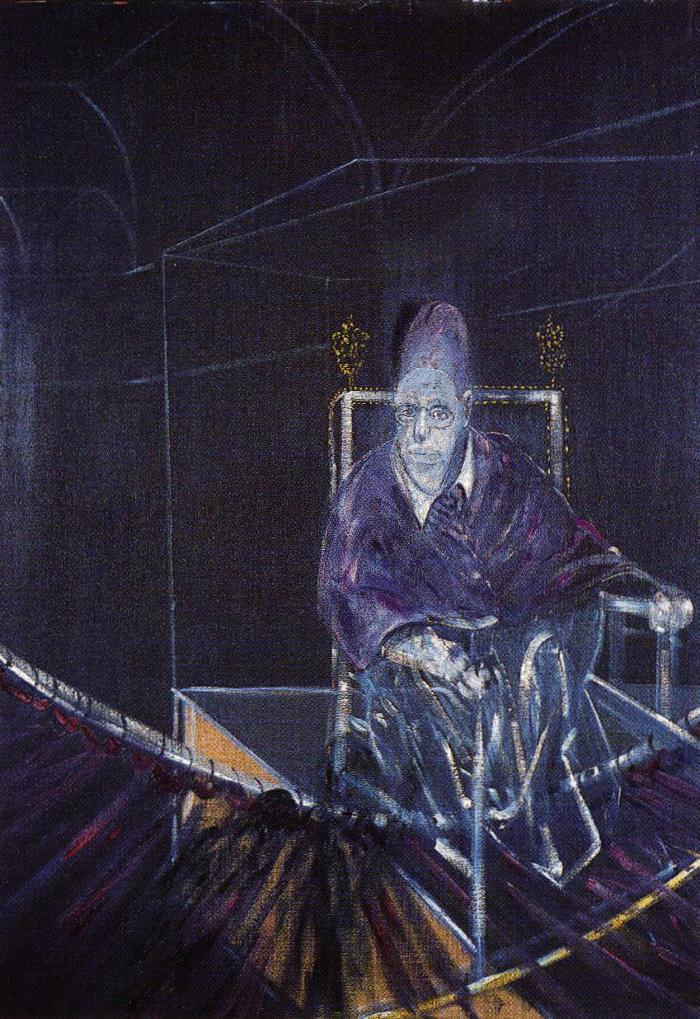
F.Bacon, Pope 1, 1951
In the Logic of Sensation Gilles Deleuze writes:
"There are two ways of going beyond figuration (that is, beyond both illustrative and the figurative): either towards abstract form or towards the Figure. Cezanne gave a simple name to this way of the Figure: sensation. The Figure is the sensible form related to a sensation; it acts immediately upon the nervous system, which is of the flesh, whereas abstract form is addressd to the head, and acts through the intermediary of the brain, which is closer to the bone."(p.34)
That is very insightful. The way of the form dominated in the modernist regime in the art institution. Surrealism was repudiated in favour of Cubism and astact expressionism by Alfred Barr at the Museum of Modern Art.
What was repudiated was the rebellious Bataillian tendency of Surrealism, which returned to the body, sensation and intensity of experience.
February 2, 2005
Philip Johnson
Philip Johnson, the notable American architect, has died. An influential architect, he was a founder of the US international style of glass towers architecture.

Philip Johnson, The GlassHouse, 1949
Johnson said that, "I am a whore and I am paid very well for high-rise buildings." He recognized that, "The people with money to build today are corporations -- they are our popes and Medicis." Johnson turned away from high modernism to postmodernism. His AT&T Building (1984) in New York City, was designed as the headquarters of what was then the United States' major telecomunications corporation. Its Renaissance allusions and its pediment evoking Chippendale furniture, became a landmark of postmodern design:
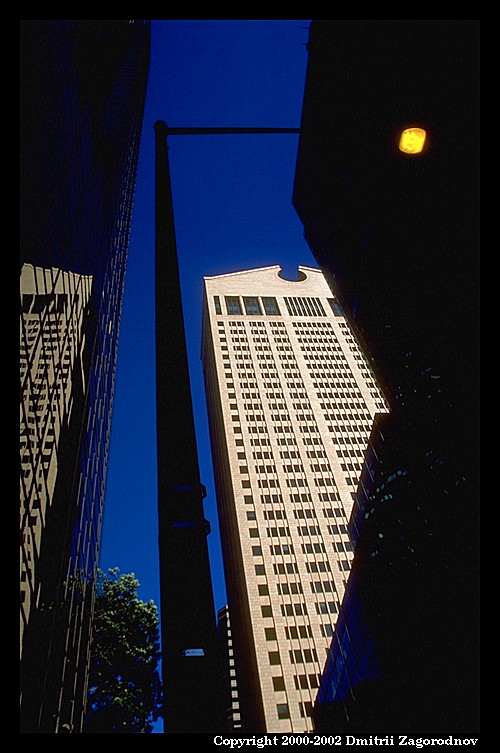
Philip Johnson AT&T Building, New York, Photo Dmitrii Zagorodnov
Summer 2000
A celebratory architect, who walked the line between the need for establishment recognition and artistic credibility.
February 1, 2005
spam attack
This weblog was under sustained massive comment spam attack on the weekend. I have had to close down commenting, but this has just pushed the spammers to Trackback. There is now a massive trackback attack under way.Junk for code is a link-spam vulnerable blog. So every form of feedback within this blog has become a target.
The spam problem has intensified in the past couple of weeks, with most of it coming from the US. Australian spammers have gone quiet I've had lots spamming about pills, porn and casinos flowing onto on my free outlet, which is then exploited, to pump up the search engine rankings of particular sites.
Clearly money is being made from selling Viagra, porn, and online poker. A lot on money is being made because the consumer demand is there. So the entrepreneurs and marketers see email and comment spam as bulk advertising. So my incoming email traffic consists of approximately 24% legitimate email and 76% spam.
An interview with a spammer.
These link spammers are using my bandwidth and blog space and they are abusing it by putting their commercial messages there. That should be illegal as it represents an invasion of my property.
Spaming has become a production line activity as this diagram of the architecture of a spam attack shows:

It uses zombie networks with the master computer in the circulatory system located in a safe offshore locations (China?)Zombies are personal computers compromised by viruses (or Trojan Horses) that allow the perpetrator to remotely control the machine and direct the attack, often through a botnet. When the network of Zombies receives instructions from its Master, each individual Zombie begins generating a flood of malicious traffic aimed at a single target/victim machine or network. That is the architecture of a distrubted denial-of-service attack.
The tools to increase the sophistication of these sorts of attacks are being developed by programmers. The next step is to control, or take over the servers, that can be used to launch attacks so that a vast inventory of well-connected Internet reflection servers can be obtained and managed. The end user is vulnerable to this reflection server attack since the heavy packet flow will no longer be discernible, as it will have diffused into neighboring routers rather than following a single path.

The heavy packet flow will no longer be discernible because it will have diffused into neighboring routers rather than following a single path.
Is there a design flaw in the old network technology of the internet?