March 31, 2005
River Murray
The picture below of the Stockyard Plains is of a salt interception scheme near Waikerie in South Australia.
So much underground salty water enters the River Murray that it is intercepted just before it enters the river and then pumped to a holding basin.This keeps the salt level of the River down for irrigators and towns that rely on the water.

Alas, the salty water of the basin--a lake to all intents and purposes --is not contained within the basin. The basin is leaking and as it does it kills all the vegetation around it, including the farmland, and contaminating the underground water systems.
The leaks are so great that new ponds are forming nearby the original one.

On the ground knowledge suggest that water from the basin is leaking back into the river.
Many more of these kinds of salt basins are planned along the Riverland section of the River Muuray.
March 29, 2005
about museums
A quote:
"From the onset of the Enlightenment, museums were largely monuments to the idea of modernist progress. The exhibitions in these museums represented the development of scientific knowledge as well as the exploration and colonization of the world by European nations, with the spoils of that process being collected and classified in keeping with a sense of Western superiority. The vision shaping these institutions was one that stridently drew a line along the axis of modernity, imperialism and progress. The modernist project was considered to be linear and constant. The emergence of postmodern and post-colonial theory questioned the irreversibility of modernity and exposed the power relations that underlay colonial expansion. In so doing, it placed in question the whole nature of museums and their collections. The severance of the link between modernity and progress, combined with the recognition that museums could no longer be a confident expression of imperialism and colonialism, presented challenges to any new museum. The conundrum was especially acute for a museum that was given the mantle of a national museum. This was the case with the National Museum of Australia."
March 27, 2005
Paul Hester: In memoriam

I never really clicked to the poppy music of Crowded House and so I didn't pay them that much attention. I did see the final concert played by Crowded House outside the Sydney Opera House on television in the mid-90's (1996?), but I only stayed for a few Neil Finn songs then flicked channels.
I didn't see Hester's Foxtel TV show, The Max Sessions, though I saw and enjoyed the earlier ABC-TV show, Hessie's Shed in 1998.
March 26, 2005
celebrity, Michael Jackson, media
One unique aspect of pop culture is celebrity, as can be seen in Jeff Koons, Michael Jackson and Bubbles, (porcelain ceramic blend, 1988): 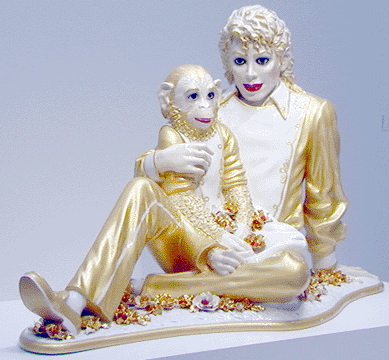 Celebrity is a fascination of the media, whether it be idolization or defilement.
Both seem to go hand in hand in the dream-world of pop culture.
Remember OJ Simpson? Monica Lewinski and Bill Clinton? Now we have the Michael Jackson child abuse allegations.
Michael Jackson is a key celebrity figure---a star of popular culture---noted for his weirdness and widely acknowledged to have been one of best song-and-dance man in decades.
The weirdness is increasingly being seen to be creepy and freaky: Michael Jackpot, a freaky clown, Wacko Jacko, living in his own fantasy world.
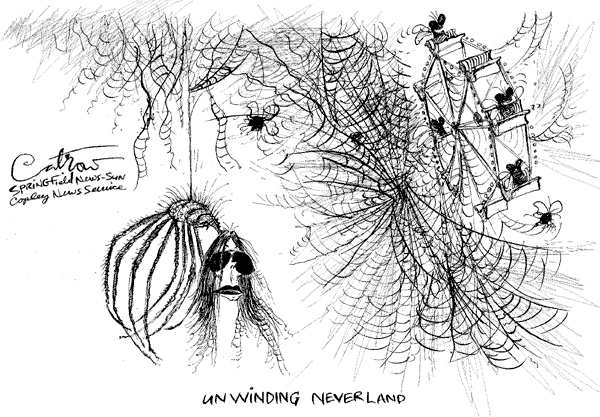
I was never a fan of his music, even when he was with the Jackson Five. The Motown dance routines, videos left me bemused, whilst the 80's pop (eg., Off the Wall, Thriller and Bad)passed me by. I never really clicked to the style of MTV culture with its false appeal to the romantic primitivism of the street, bohemia, the outcast, the bizarre and the surreal. MTV's elaborate network of fragmentary significations did not stike me as very subversive.
Jackson represents the black man who made himself, or become, white. He is seen to have erased his blackness and transfigure himself with ghostly pallor and pert features at a time when black culture is culturally privileged.
Now I'm just a pointy-headed type (a cultural critic) who should stay off the popculture turf. But we are talking about the celebrity industry with its commodities of salacious rumours and innuendo, its addiction to the false and unreal and its tradition of "yellow journalism" with its sensationalism and scandal-mongering.
From my reading of the American media about the Michael Jackson child molestation trial is that Jackson has been judged to be as guilty as hell. According to the media the case has been made beyond the shadow of a doubt.Jackson is beyond redemption. He has been publicly convicted and branded a sexual predator.
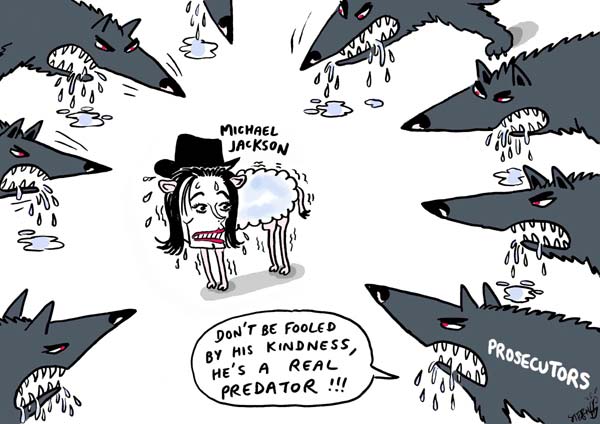
Stephane Peray, The Nation
The long drawn-out trial as a form of showbiz or circus will add to Jackson's celebrity status as the cable channels are in a feeding frenzy over this. Their style is to press every unconscious emotional button, and to manipulate every quivering emotion into outraged indignation. And they've hit gold with a narrative about an innocent child being abused by a rich freak who bought his way out of his shameful perversion the last time.
Child abuse is stamped all over this in the cable narrative. It suggests that allegations related to paedophilia and child porn have become the preferred form of celebrity-bashing for today's society.
I really have no idea what is going on in the trial with respect to the allegations. The procsecution claims that Jackson has been a pedophile Peter Pan for years.
March 25, 2005
Atget, photos, ontology
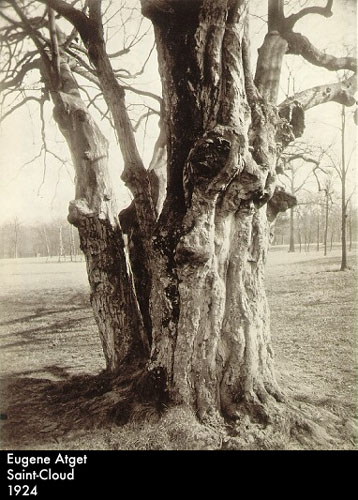
Atget, Saint-Cloud, 1924
Andrew Benjamin is quoted as saying:
"Representation involves presence. It gives presence to what had hitherto not been presented."
Representation, in short, is pervasively ontological.
This puzzles me. How is the above image a performance of a profoundly resonant ontologies?
March 24, 2005
The ontology of representation
I'm on my way down to Victor Harbour for the Easter break and so I've little time to post.
But do have a read of this. It is a review by Thomas Huhn of Andrew Benjamin's Art, Mimesis and the Avant-Garde: Aspects of a Philosophy of Difference, (London & New York: Routledge, 1991) in Surfaces It looks to be an interesting use of aesthetics.
 Surfaces as an e-journal no longer seems to be functioning, as the last, truncated issue was in 1999.
Is that due to the death of Bill Readings?
The closure is a pity. I do think that digital publication is the future not print. Print is old technology.
I will come back to the Benjamin book when I'm down in Victor. The 12 essays, written during 1986-1990, are an art writing shaped by an informed, theoretical (aesthetic) eye. This means that paintings as representations no longer simply address or provoke a viewer; they demand and entail an interpreter.
An interview with Andrew Benjamin.
March 23, 2005
Cultural Heritage
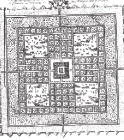 The city of Adelaide is laid out as a a grid surrounded by parklands. Hence the city is situated within a park.
This conception of a city has a long history. The functional colonial template for Adelaide was an amalgam of town planning influences that can be traced as far back as Ancient Greece.
This park--known as the Adelaide Parklands--is contantly under threat from developers, City Councils and state governments of every political persuasion. The citizens have defended the park for the people of Adelaide against the pro-development lobby. It is an urban space that stands in opposition to the high volumes of through traffic in the city, and the acceptance of Victoria Square, a major public space, being gutted by bitumen to allow a huge volume of east-west through traffic.
Adelaide is a city stagnating. This is primarily because it has been given over to cars, and turning its back on the great potential of by building on the great legacy of its original city plan. Adelaide should celebrate its squares and parklands instead of allowing them to degrade. It remains trapped in a 1960s North American car city instead of redefining itself as a people-friendly city with lively public spaces.
A new battle is forming with the Rann Labor Government. The pro- developers want to build new buildings in the middle of Victoria Park racecourse to attract more motor sport and to secure major events. The draft bill--The Adelaide City Parklands Bill provides the legislative framework for managing the urban park.
March 22, 2005
Fragments: Eugene Atget & Walter Benjamin
Two images:
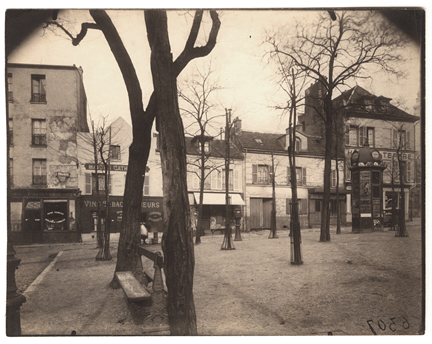
Eugene Atget, Place Du Tertre,1922.
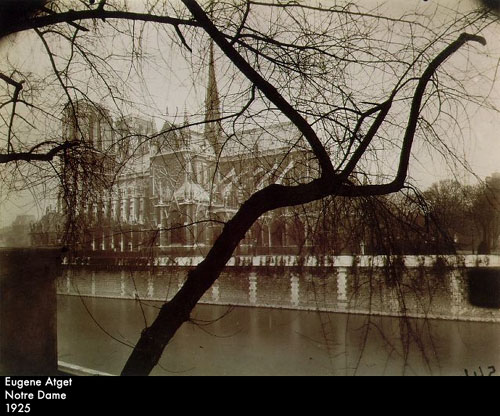
Eugene Atget, Notre Dame, 1925
These images of Paris in the 1920s are fragments of a body of work. They can be juxtaposed to fragments from Walter Benjamin's unfinished Arcades project. He writes:
"The street becomes a dwelling for the flaneur; he is as much at home among the facades of houses as a citizen is in his four walls. To him the shiny, enamelled signs of businesses are at least as good a wall ornament as an oil painting is to the bourgeois in his salon. The walls are the desk against which he presses his notebooks; news-stands are his libraries and the terraces of cafes are the balconies from which he looks down on his household after his work is done."1938
The streets of Paris were Atget's home.
March 21, 2005
picture theory
a quote:
"Like others before him Mitchell acknowledges the fact that we live in a society dominated by pictures and visual simulations. The current preoccupation with media images goes so far as to constitute a "common culture" (1) which defines our era -- an era Mitchell describes as the end of postmodernism. The postmodern mode of representation is one which represses language and absorbs it into image. Even modern thought itself is re-oriented around visual paradigms which threaten to overwhelm any possibility of discursive mastery. This fixation with representation gives rise to Mitchell's speculation that "the problem of the twenty-first century is the problem of the image" : he sees the need for a study of picture theory as predicated on the notion that we live in a culture dominated by pictorial image, yet remain unable to understand the power of the picture despite an abundance of theories on the subject."
The quote is from this review of J. T. Mitchell, Picture Theory: Essays on Visual and Verbal Representation. (Chicago, University of Chicago Press, 1994.)
March 20, 2005
aesthetics & rock criticism
A lot of music criticism works within, but does not question the classical/light duality, or the serious and the popular, and does not see them as two halves of a whole. This is particualary evident amongst those who conceive of musical value in terms of its structural complexity and independence from the commercial logic of the market economy.
What this ignores is Walter Benjamin's insight about the liquidation of art in the sense that art as we have known it is coming to an end. As Susan Buck-Morss puts it, this means that:
"Bourgeois art has always been a commodity, bought and sold on the market, so the commodification of art is not the point. His argument is, rather, that the technological conditions of production have so thoroughly blurred the boundary between "art" and cultural objects generally that its special, separate status cannot be maintained. Engineering has challenged the special status of architecture, journalism that of literature, photography that of painting, cinema that of theater."
Consequently, the those who valorize European classical music as art tend to examine rock music primarily in terms of harmony and structure, as these are understood and valued in classical music, not rock. This approach attempts to validate rock by focusing on the small amount of it that lives up to traditional fine art values.
What is needed is a rock criticism that honors rock's own complexity rather than the ways in which it approaches the aesthetic standards of other styles.
It is only this way that we can begin to understand a live version of the perennial Grateful Dead tune,'Dark Star' or Brian Wilson's advanced harmony and his impressive studio experiments in timbre and overdubbing, Cream's appropriation of the blues into 1960s rock, with its celebrating both incarnations of the style, or the experimentation of Pink Floyd.
March 19, 2005
musical modernism, rock music, aesthetics
The modernist understanding of music interprets music to have no meaning other than its harmonic and formal structure (pretty orderly sound), whilst noise is held to be the expression of human emotion, social practices, social responses to music and political control and money.
This formalist account of music mostly refers to classical music. It is hard to justify this understanding of music given that the dominant economic system of our time is one in which ownership equals profit.This is seen with popular music, which is controlled by giant corporations selling product. On the other hand,the noise of rock music can be understood as a rupture or resistance toward the dominant ideals of classical music.
High cultural theoriests sometimes dismiss the repetitions of popular music as infantile and psychotic. Adorno is a case in point. This interprets popular music as an inferior form of music.
The contradictions of popular culture make it clear that in order to support itself, a capitalist system must provide products which contradict its goals. Hence we have the situation in which music megacorporations release anti-corporate songs by the Clash, the Sex Pistols, and Gang of Four, or hegemonic institutions like Geffen and CBS Records release anti-authoritarian works by Public Enemy. This music matters because it is an important way in which young people accommodate themselves to the contradictions of capitalism.
If we turn to Attali's modes of music outlined in Noise, and repetition mode of music in particular, we can see that its industrial progress in recording technology, makes way for a whole new mode of understanding music. Examples are Phil Spector's work, the tape-manipulated songs of Brian Wilson's such as "Good Vibrations" on Smile or the Beatles "A Day in the Life" on St Pepper. These songs could never be fully re-created in any other manner.This indicates that rocck music can maintain musical creativity within a commercial framework.
Does rock elude or supersede aesthetics, as some claim? One way that rock music can be understood is that it is a rupture or resistance toward the dominant ideals of classical music because it is a music of bodily desire and movement. This bodily desire highlights how the body senses reality in a biological or animalistic sense.
The aesthetic is a fundamentally cognitive experience. Not feeling good in my body is my way of criticizing the definition my culture gives to a situation. Cultural meanings are sensed bodily as being wrong. Just plain wrong as the badness hits you in the gut. So aesthetics is the body's form of critical cognition, and that this sensory knowledge can and should be trusted politically.
It is an aesthetics after art.
March 18, 2005
noise and music
I'm reading Jacques Attali's Noise: The Political Economy of Music, which was originally published in French in 1977. We previously mentioned the text here.
From a brief glance the book is a criticism of the modernist understanding of music as autonomous and unrelated to the turbulent political, social and economic world in which it is composed and performed.
He argues that music expresses changes that are only manifest latter in our culture; music is a harbinger of change, an anticipatory abstraction of the shape of things to come.
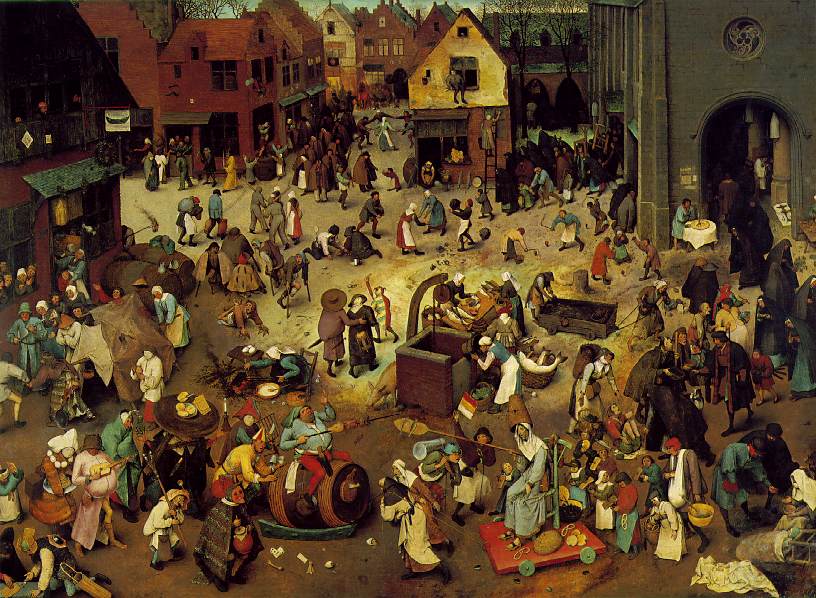
Brueghel the Elder, Carnival's Quarrel with Lent
Attali thinks that this painting represents his own ideas about music, noise, and politics. If we draw a line from the upper left corner to the lower right corner, the painting divides into two "zones." Carnival is the left zone. Lent is the right zone. These zones represent two antagonistic cultural and ideological modes of organization. Attali pits noise (i.e., discord, revolution, freedom) against harmony (i.e., order, regulation, constraint)---'tis a reworking of Nietzsche's Dionysian and Appollonian modes of life.
The theis is that an outside noise intrudes on the existing order of harmony; eventually, he says, those noises that persist are absorbed into the harmony, creating a new harmony that will have to try to hold its own against some unknown noise of the future. The sobriety of Lent will always be countered by a joyous Carnival, Attali says, and where the two modes of behavior meet there will always be Quarrel.
His political economy of music is structure around four successive codes or modes:
- Sacrifice: the ritual code based on fear, when violence is channelled into acceptable rituals binding the group in which music had a "use value" outside exchange.
-Representation: the code based on exchange and harmony in which music became an object of exchange. The greater professionalization demanded a greater separation between performer and audience, which necessitated the beginning of musical exchange value as musicians began working for patrons and royalty.
-Repetition: the age of sign exchange, dominated by a "speech without
response" and a code of normality in which music became a part of mass production and consumption as industrial revolution took hold. Music become a strategic consumption under the control of corporate music industry. The musical work is now wholly commodified is capable of being stockpiled for future listening and, as a commodity, it is removed from the musical workmanship that created it.
-Composition: the future possibility of passing beyond sign exchange into a new community in which music is basically about improvisation. As a musical code composition is a return to personal usage and meaning in music, an escape from the economic and political structures that have arisen around music the previous 500 years.This mode is indicated by the new compositional and performing styles and philosophies of John Cage and the free jazz artists of the 1960s and in the noise manifestoes and instruments of Luigi Russolo.
These four historical stages of music production, each of which creates a particular relationship, or network, between individuals and their social organizations.
March 17, 2005
a visual loop
To look at this you will need to click and drag upward very slowly and you'll move forward.
Drag down and you'll move back.
This is a loop so you will eventually end up back where you started.
March 16, 2005
in a postmodern world
I'm reading Catherine Lumby's 'Gotcha: Life in a Tabloid World.' The first chapter begins thus:
"In his groundbreaking study of journalism and popular culture, 'Popular Reality,' John Hartley sketches something he calls the postmodern public sphere, in which he finds a reversal of many hierarchies that our intellectual and political traditions have held dear. In the postmodern world, he argues, the image has triumphed over the word and the vox pop has triumphed over the opinion of experts. The public sphere is an image-saturated space which is both 'intensely personal(inside people's homes and heads)' and 'extensively abstract(pervading the planet).'"
I reckon that is dead right. We do live in a culture saturated with a rapidly changing montage of images and ideas that sidelines sustained argiument, logical reasoning and respect for expertise.
March 15, 2005
the critical impact of architecture?
Some questions about architecture that address that part of architecture that is not shaped by the dominant banal commerical logic of the developers.
Does architecture form the framework of life?
Does it just provide comfort and convenience for daily life? Well, I for one, want more than that. Most architectural forms I have inhabited either at home or work have provided neither comfort nor convenience.
Does architecture do anything more than that? Something else? Something unsaid? I yearn for that.
Does it subvert what is normal, expected and taken for granted in our daily lives? Should it?
Does it's form cut through to the contradictions we live and retain them in their intensity?
Does it give rise to a critical dialogue withe urban context and our mode of life?
Most of the architecture we see fits smoothly into the international magazines and websites. Can it move beyond this to give expression to a new form of dwelling?
March 14, 2005
political cartooning
The National Museum of Australia has a brief to exhibit and collect materials relating to Australian history. One of its strongest collecting areas is its extensive collection of political cartoons, which it has built up through its annual political cartooning competition.
A selection of the 2004 competition is online in the form of an exhibition entitled Behind the Lines.
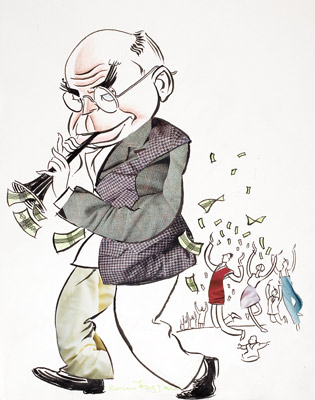
Rocco Fazzari, Pied Piper, Sydney Morning Herald, 2004
March 13, 2005
pop philosophy#2
Many of us live in a shadowland, due to us living damaged lives caused by historical forces beyond our control. Often the clearing illuminated by light is small.
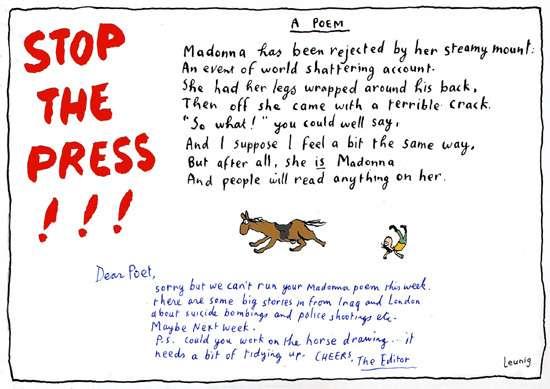
Leunig
I'm not hinking of an event such as walking home from a restaurant this man and being stabbed in the back in a random attack. I'm thinking in a psychoanalytic sense of us mostly we live in the shadowlands and bearing the scars of our past pain.
This way of thinking is usually seen in terms of a split subject divided between the conscious ego in a world of unconscious chaotic forces. Our ego is like a cork bobbing on the ocean of the unconscious.
We struggle to strengthen the ego, the "I" self, the conscious/rational identity, so it would be more powerful than the unconscious. Most of us struggle to become more civilized and productive as well as a correctly heterosexual adult capable of caring for others.
I'm becoming ever more convinced that this is an impossible desire and that we live the illusion of an ego as a unified conscious self identified by the word "I".
March 12, 2005
John Oswald & plunderphonics
As we saw earlier the pioneering Canadian composer,John Oswald, deals directly with the issues of copyright, appropriation, sampling in music. Copyright, which was originally intended to facilitate the exchange of ideas, is now increasingly being used to stifle it.
A reaction to this is Oswald's 'plunderphonics', which is a form of musical collage. According to Oswald, a plunderphone is "a transformed but still recognizable audio quote." A plunderphonic composition is a specific, radical form of collage in which all materials have been appropriated from existent music. It is a politically motivated genre which is focused on the notion of free samples and challenging perceived hypocrisy of musical copyright law.
Grayfolded was an example of taking existing music and someway making it different or, ideally, making it better.
Another is "Plexure", which is completely assembled from other CDs and features over 1,000 'electroquoted' contemporary pop artists from the past decade. A myriad of sources are used---moments of Madonna, Prince, Nirvana, Edie Brickell, Deee-Lite, Julee Cruise, U2, Jane's Addiction, Metallica, Talking Heads, EMF, C+C Music Factory, Fine Young Cannibals, Annie Lennox, and the Red Hot Chili Peppers. This disc debuted in 1993, so much of the recording is culled from the late 1980s/early 90s.
Another project in making sound collage from existing musics is plunderphonics.The 1989 release of Plunderphonic was made at Oswald's own expense. Oswald made 1,000 copies of the not-for-sale Plunderphonic, distributed free to radio stations, libraries and others. It's cover artwork represented a naked Michael Jackson with a woman’s body. It was destroyed by the recording industry acting on the request of plundered artist Michael Jackson.
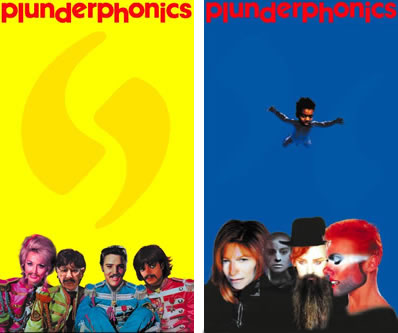 69 plunderphonics 96 contains 60 tracks, from the Swinging Sixties to the Numb Nineties that creates constellations of sonic diversity.
It consists of two hyper-dense discs. These cover the gamut of progressive musical endeavour: punk meets classical, schmaltz marries metal, jazz divorces rap and electronica kills world music.
March 11, 2005
pop philosophy
This is good advice for those of us who live on our wits in the urban jungle:
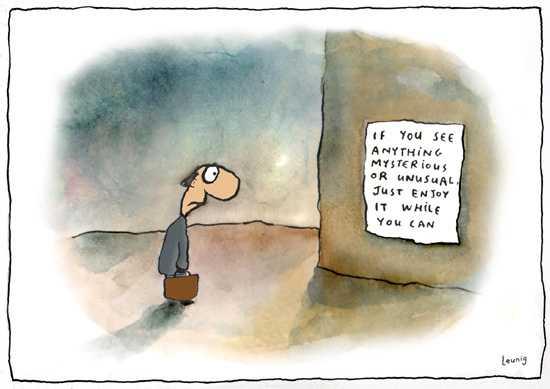
I do not do it enough, even though I take a moment to smell the roses.
I either live at fullspeed or in a state of collapse.
March 10, 2005
Life-threatening weather
People living along the coast of far north Queensland have been waiting nervously for the category-five cyclone Ingrid heading their way.

Now downgraded to category four Tropical Cyclone Ingrid crossed the far north Queensland coast in a remote area south of Lockhart River.The cyclone has winds of around 230kph and is accompanied by a storm surge of around two metres on top of rising tides that will inundate low lying areas.
Meanwhile those of us who live in South Australia swelter in the heat. I was in Port Pirie the other day and it was around 42-45 degrees with a strong, hot north wind blowing. That is also life-threatening weather.
Fairy tales?
Judging from the media coverage a fairy tale is being played out with the Danish Royalty's extended visit in Australia:
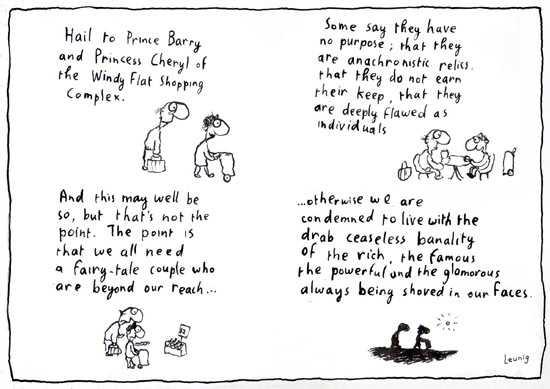
What ever happened to Prince Charles? He was hardly noticed. That should hearten the Republican movement. Alas we have the "people's princess" Mary, regal and refreshingly ordinary, and extremely popular. She is a celebrity of pop culture.
And yet there is something more.
It all connects to a fairy tale of a young woman being rescued by a handsome prince and living happily ever after in a castle far, far away. From memory the fairy tale is a sleeping Snow White waiting for her prince or Rapunzel stuck in her tower.
Are we not talking about the fantasy of royalty here?
March 8, 2005
music in the public domain
I don't have that much time for the Art Music paradigm based around the genuis composer and its system of notation, originality, individuality and property rights.
In his 'A History of Plunderphonics' Chris Cutler says that the first "plunder pieces" of the early musique concrete and John Cage works, such as 'Imaginary Landscape No.l' (1939).'Imaginary Landscape No.4' (1951), and 'Imaginary Landscape No. 5' (1955). These works belonged firmly in the Art Music camp where blatant plundering remained fairly off limits due to the tradition of originality and creating from scratch.
At that time there was little two-way traffic between high and low art (each borrowing and quoting from the other), which only proceeded apace with the arrival of postmodernism.
There was no real messing about with other people's work even though the importation of readymade materials into artworks has been a common practice and one which has accumulated eloquence and significance in a modernist and post-art institution.
In this essay entitled, 'Plunderphonics, or Audio Piracy as a Compositional Prerogative', John Oswald writes messing about with other people's work. He says:
"The reuse of existing recorded materials is not restricted to the street and the esoteric....the equipment is available, and everybody's doing it, blatantly or otherwise. Melodic invention is nothing to lose sleep over.... There's a certain amount of legal leeway for imitation. Now can we, like Charles Ives, borrow merrily and blatantly from all the music in the air?"
John answers the question this way:
'...as This Business of Music puts it, "The public domain is like a vast national park without a guard to stop wanton looting, without a guide for the lost traveller, and in fact, without clearly defined roads or even borders to stop the helpless visitor from being sued for trespass by private abutting owners."...'
The Beatles' tapework on 'Tomorrow Never Knows' from the 1966 LP 'Revolver' and 'Revolution No 9' on 'The White Album' are full of plundered radio material. So is the early work of Frank Zappa Varese-esque concrete pieces, such as 'Absolutely Free,' 'Lumpy Gravy' and 'Only In It For The Money,' all made in 1967.
A classic example of plunderphonics in pop culture is John Oswald's Greyfolded (1994)
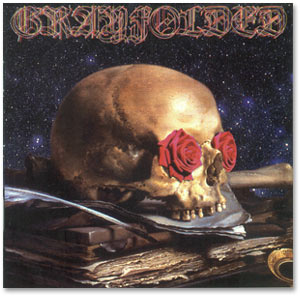 In the 1990s, at the invitation of Phil Lesh, Oswald took over 100 official recordings of the Grateful Dead's legendary song Dark Star.
These range from its fiery beginnings in the psychedelic cauldron of Haight-Ashbury in the '60's to the ultra-tech presence of the Dead in the '90's.
These recordings are built, layered and folded to create one new re-composed 2 hour song.
Oswald concludes his essay by saying:
"All popular music (and all folk music, by definition), essentially, if not legally, exists in a public domain. Listening to pop music isn't a matter of choice. Asked for or not, we're bombarded by it. In its most insidious state, filtered to an incessant bass-line, it seeps through apartment walls and out of the heads of walk people. Although people in general are making more noise than ever before, fewer people are making more of the total noise; specifically, in music, those with megawatt PA's, triple platinum sales, and heavy rotation. Difficult to ignore, pointlessly redundant to imitate, how does one not become a passive recipient?"
Does not Oswald's plunderphonics challenge our current understanding of originality, individuality and property rights? The old values and paradigms of property and copyright, skill, originality, harmonic logic, design and so forth are not adequate to a musical world opened by plunderphonics.
March 7, 2005
Rem Koolhaas
Just a flashy building?
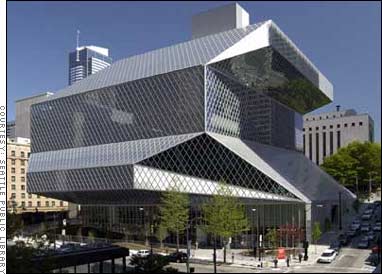
Koolhass, Seattle Public Library, 2003
Is the library the last civic stronghold of a past era based on the book?
What would a public library look like in the age of the internet, electronic media and digital information?
March 6, 2005
Rem Koolhaus: Sea Terminal
An architectural form that is about the networks of transport and communication:

Rem Koolhaas, Zeebrugge Sea Terminal, Belgium.
Some background on Koolhaas here.
Does this building capture modernity's promise of liberation and its transitoriness? Does it go beyond architecture as a commodity? Clearly it is not simply architecture as art. Does it reside somewhere in a space between architecture as commodity and art?
Is this a rewriting of modernity? Should architecture see its task as coming to terms with our experience of modernity and our desire for dwelling?
March 5, 2005
some questions
If Auschwitz stands for the ultimate uninhabitability of modernity, then it implies the impossiblity of dwelling and being at home. How do we inhabit the megapolis--be at home in the transitory world of a Sydney or Los Angeles?
Has this impossibility been given architectural form?
Does being at home in modernity mean making oneself at home all over again, as opposed to retreating to the pastoral as a way to recovering a sense of belonging and rootedness now lost?
Is architecture able to come to terms with our experience of modernity as opposed to building cheap innercity apartments, prestige corporate buildings and suburban McMansions?
I do not know the answer to these questions. But answering them would involve reworking the past.
March 4, 2005
Dylan & the Dead
These contributors to America who widened the scope of popular music during the 1960s and 1970s and are now cultural icons.

Herb Greene Grateful Dead and Bob Dylan, 1980s
Since Garcia's death, the Grateful Dead music scene has splintered into countless factions and evolved into a flourishing jam band movement, where the music is too often is buried between aimlessly ambling jams. Few groups within the movement seem to be able to deliver the goods: crafting meaningful songs and breaking new musical ground. Will Phil Lesh's extended jam sessions do so?
Dylan's current work is marked by odd flashes of inspiration. But he appears as the fading rock icon: a pale, puffy ghost, the burned-out shell of the classic voice-of-a-generation who had written a body of classic songs. Dylan is the icon of sixties culture rolled up into the rockabilly intellectual.Today we live with the Dylan myth or spectre.
Do we then look back to the time when the icons of Americana came together?
Sad to say, the music they made together was not as good as the photo. On 'Dylan And The Dead' (1989) Dylan used the Dead (much like the Band earlier in his career) as his backing band on his songs. Though the Dead were an effective backing band nothing much by way of interesting music came of the tour. A dreary effort.
On the other hand, the Grateful Dead often paid tribute to Bob Dylan by performing his songs in their concerts. Thus we have their 'Postcards of the Hanging', which, as a tribute album to Dylan, is only moderately successful. Nothing earth shattering or innovative here that stretches the songs to their limits. During the later 1980s and early 1980s the Grateful Dead took fewer risks, had litle new material and had fallen into some semblance of a routine with little experimentation. They becanme a tight unit with little in the way of being musically avant-garde.Those days were well gone.
Maybe we have to go back to fire and brimstone beginnings of the Grateful Dead and the Allman Brothers Band in the late 1960s and early 70s. Live/Dead, for instance, contains the finest rock improvisation ever recorded.
March 3, 2005
K.D. Lang
I came home from Victor Harbor to the apartment late this morning and found Suzanne was listening to this:
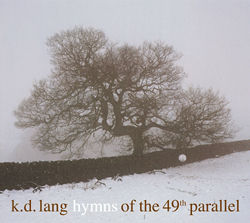 I've never followed the trajectory of Kathy Dawn Lang's career and so I do not know the country-informed Shadowland (1988) and Absolute Torch and Twang (1989)—and so I cannot compare her to Emmylou Harris.
Nor did I go hear KD Lang on her recent Australian tour in February, which featured the city orchestra's of Sydney, Melbourne, Brisbane and Adelaide as her backing band. However, from the little I have heard I recognize Lang's brillant voice and her artistic sensibility.
Hymns of the 49th Parallel is a Canadian songbook as it is a covers album of fellow Canadian song writers -----Neil Young, Joni Mitchell, Leonard Cohen and Jane Siberry.I do not know the work of Ron Sexsmith and Bruce Cockburn. A review.
I find the album a bit too uniform in somber sentiment and veers towards a risk-averse, adult-contemporary pop. However, Lang's passionate vocal delivery is capable of drawing out the pain in some of the songs especially Cohen’s "Hallelujah."
March 2, 2005
I'd be never connected with the 1980s Glam rock thing even though I recognized the art school roots of a lot of British pop. And I never really listened to Rozy Music apart from what I heard on the radio or saw on TV.
A quote from K-Punk on the difference betweeen British and American pop/rock music:
"British pop's irreducible artificiality makes it resistant to the Romanticist naturalization that the likes of Greil Marcus and Lester Bangs achieved in respect of American rock. There is no way of grounding British Art Pop in a landscape.Not a natural landscape in any case.
If Art Pop had a landscape it would be the agressively anti-naturalistic one Ferry collaged together on 'Virginia Plain' (named after one of his paintings, which was itself named after a brand of tobacco). Is this an internal landscape, what the mind's eye sees? Perhaps. But only if we recognize that - as Hamilton's collage and Ballard's fiction insist - in the late twentieth century the 'space' of the internal-psychological was completely penetrated by what Ballard calls the media landscape.
When the British pop star sings, it is not 'the land' which speaks (and what does Marcus hear in the American rock he mythologizes in Mystery Train if not the American land?) but the deterritority of Amerikan-originated Consumer culture."
K-Punk mentions Brian Ferry and Roxy Music as examples and says:
"Part of what made the early Roxy sound so cold - particularly by comparison with the hot authenticity of American rock - was the fact that they were evidently not an aggregation of pontaneous, creative subjects, but a meticulously executed Duchamp-type Concept: a group whose every gesture was micro-designed, and who credited their stylist, fashion designer Anthony Price, on their album sleeves."
March 1, 2005
Different perspectives
A bird's eye view:

Unknown Photographer, [Newcastle Harbour Coal Shipping Terminal] [c.1873]albumen photograph; 26.2 x 34.5 cm, national Library
This is more within the landscape

Peter Dombrovskis, Giant Kelp, Hasselborough Bay, Macquarie Island, Tasmania, 1984, cibachrome; 64.2 x 51.4 cm, National Library
The image is about being in a place