April 30, 2005

April 29, 2005
Archibald Prize 2005
The 36 finalists for the 2005 Archibald Prize awarded to the best portrait painting are online. The prize is for a portrait of some man or woman distinguished in art, letters, science or politics.
My impression is that it is all very conservative and safe:
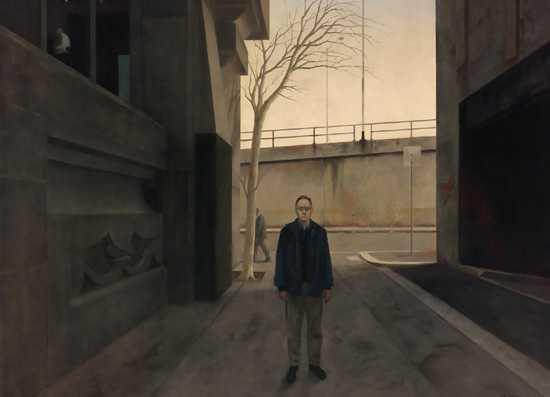
Rick Amor, Shane Maloney, 2005
That is pretty much a replay of Jeffrey Smart's work of the 1950s.
The winner was far more innovative:
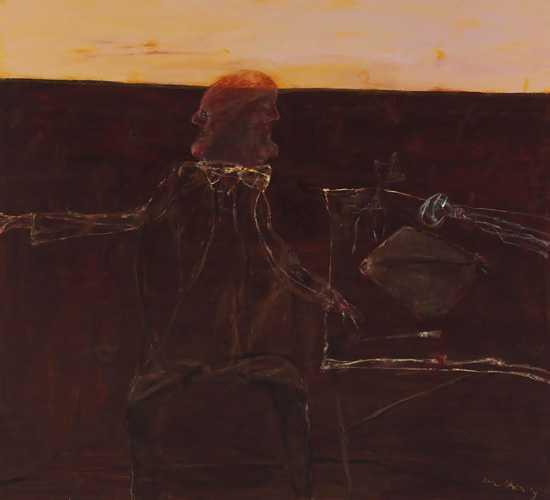
John Olsen, Self Portrait Janus Faced, 2005
April 28, 2005
political art
A quote:
"We can highlight three different breeds of contemporary political art. First, there is a trend towards naturalism: simply reproducing the details of a particular political subject. Second, there is opinionated political art, which promotes the artist's view of political or material inequality. Third, there are ironic works that take up inequalities with a wink and a grin. Instead of passionate exposures of injustices that inspire people to action, these brands of art are more likely to deaden political events and make them seem farcical."
The future of political art is to tell the truth about today's society--isn't that political enough?
April 27, 2005
space
The Hubble space telescope has been in orbit for 15 years, during which time it has taken over 750,000 images of the universe. To celebrate, NASA has released two new pictures. One is of the Whirlpool Galaxy, with a smaller, companion galaxy on one of its arms.

An image of spiral galaxy M51 (NGC5194), the Whirlpool Galaxy, taken by the Hubble Space Telescope
Servicing Mission 4, the last scheduled flight of the space shuttle to the Hubble Space Telescope, has been cancelled. Hubble is going to end soon. Of the six gyroscopes the spacecraft carries to enable it to focus on a fixed point in the sky, three have shut down. Hubble can continue to perform its mission with the three remaining units, but if one more gyroscope fails, it will lose its ability to maintain the quality of its images.
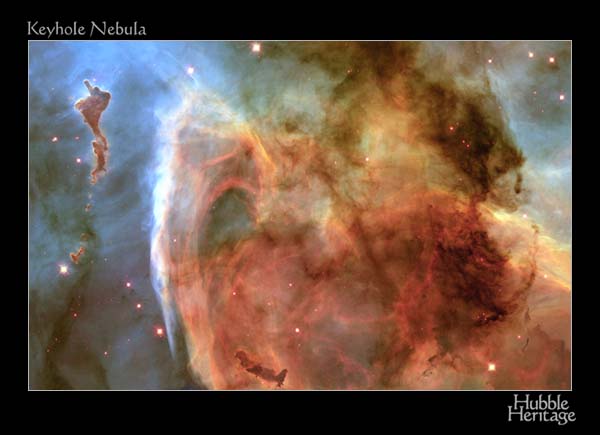
Hubble Space Telescope Keyhole Nebula
There is no immediate replacement for Hubble.
April 26, 2005
Robert Doisneau
This image is in the news:

Robert Doisneau, Kiss by the Hotel de Ville,1950
We need to remember that it is part of an interesting and humorous body of photography

Robert Doisneau, The Cellist,1957
Most of the work is street photography within the tradition of Brassaï, Kertesz, Atget, and Cartier-Bresson:

Robert Doisneau, Un Regard Oblique,1948
Doisneau's work was primarily a series of snapshots that documented life in the suburbs of Paris in the 1950s that were produced with Rolleiflex and Leica cameras.
April 25, 2005
Sidney Nolan: Gallipoli
At Gallipoli in 1915 Australians had high hopes, but it all ended in devastation. It was a mission not fully concluded: a retreat with nothing gained in a military sense.
A myth has been woven around it, based on celebrating the failed assault on Turkey in 1915 as the birthplace of the nation and developing the national tradition of extolling bravery.
This processes of national myth-making involves making the best of a bad situation; of glorifying the victims, the losers, the people who tried hard but didn't quite make it. Hence we have the coupling of sending Australians to their death, Australian heroism, and British military incompetence.
Today the mythmaking is expressed in stump political speeches full of cliches about heroism, ultimate sacrifices and war.

Sidney Nolan, Gallipoli, 1950
One theme of Nolan's work is failure and the trauma of war. He links the Australian mythopoiesis with Greek mythology to question the Legend wrapped around the volunteer citizen Diggers:

Sir Sidney Nolan,Anzac Swimming at Gallipoli, mixed media
I cannot find many images from Nolan's Gallipoli series online.
April 21, 2005
oh well
It is not good news. The hierarchy of the Catholic Church has decided to continue to resist modernity with the election of Joseph Ratzinger as Benedict XVI.
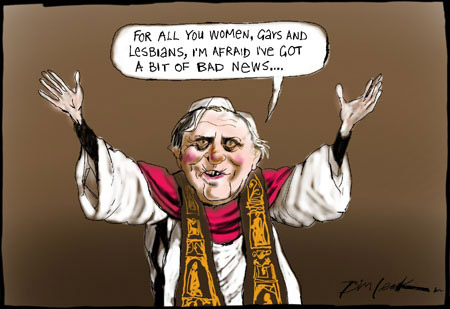
Bill Leak
The stern doctrinal conservatism, the willingness to crush the hopes of liberal reformers, the determination to punish priests and theologians who stray from Rome's strict theological conservatism, and the trenchant opposition to modern secular values (materialism, liberalism, feminism etc) will continue.

The liberal Catholics have problems.
April 19, 2005
April 18, 2005
Johnnie Johnson obituary
I see that Johnnie Johnson, who played piano on most of Chuck Berry's big records, has died.
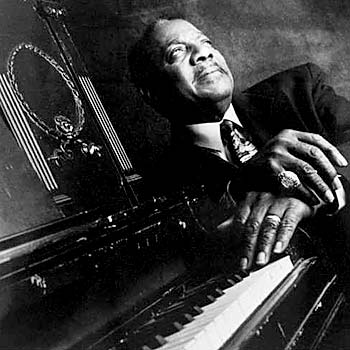
Johnson incorporated the boogie-woogie style of piano playing into rock 'n' roll.
I hadn't realized that Johnson had also composed most of the music of the big Chuck Berry songs, such as "Maybelline," Rock 'n' Roll Music", "School Day" and "Sweet Little Sixteen" and "Carol."
Johnson often composed on the piano and Berry converting it to guitar and writing lyrics. However,Johnson was never given co-writing credit. So it is understandable that Johnson sued Berry in 2000 for a share of the songs they had composed together.
Berry and Johnson split in 1973, but they reunited in 1986 for Berry's 60th birthday concert in St. Louis, captured in Taylor Hackford's acerbic documentary "Hail! Hail! Rock 'n' Roll."
Keith Richards remembers.
April 17, 2005
Stand Up Get Up
I watched the first episode of the ABC's new popular music show Stand Up Get Up last night. Entitled 'We Shall Overcome', it very quickly traced the birth of political music, looking at folk music's pivotal role in the fight for human rights from the American union movement and the 1960's civil rights movement to the struggles against apartheid and for Native American rights.
The point made was that 'People can remember tunes, but they don't remember speeches and that music unites people in a movement. Fair enough.'We Shall Overcome' does that job.
Philip Gomes thought it was fun.
Woody Guthrie, Peter Seeger and Bob Dylan were the key figures. Dylan's music was interpreted as defining the mood of his generation--- Blowing in the Wind---- in a style that combined rock and folk music. But why the great emphasis on Peter, Paul and Mary? Why them when there was nothing about music and Aboriginal Land Rights in Australia, nor any mention of Midnight Oil?
It was a conventional understanding of politics--that of the folkies and 1968er's understanding of a protest song. Hence the images of folkies strumming guitars and singing their dissent in Greenwich Village coffeehouses. That signifies a protest song railing against capitalism, war, racism, rising unemployment and an indifferent government
Stand Up Get Up did not broaden that understanding of politics and music to explore rock music's criticism of everyday life in a consumer culture, by say the Dylan of Highway 61 Revisited, or the Kinks, or the Ramones or the Velvet Underground.
April 16, 2005
Dark Star
The Grateful Dead's "Dark Star" is a cultural touchstone in rock music as it signifies the experimental side of rock music through casting aside the once-accepted demands of the short, self-contained pop song.
'Dark Star crashes
pouring its light into ashes-
Reason tatters,
the forces tear loose from the axis-
Searchlight casting
for faults in the clouds of delusion-
Shall we go,
you and I while we can-
through
the transitive nightfall of diamonds?'
Grateful Dead,Dark Star, lyrics Robert Hunter
Hunter was the premier lyricist for the Grateful Dead.
I've been trying to get Suzanne to listen the Grateful Dead. It has been hard work. The early Anthem of the Sun, (1968)
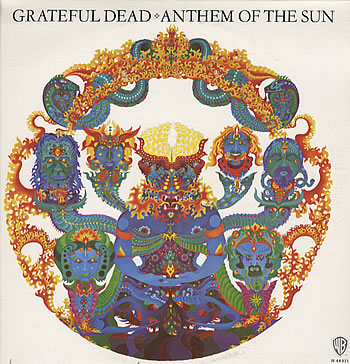 which contains some of the band's most adventurous music, is rejected as noise.
It remains noise to her even though I point out that it is an album that transgresses a rock album as just a collection of songs.
It can be viewed as the Dead creating one piece of music through combining/layering both studio and live performances.
What is created is a psychedelic musical soundscape- a musicalscape for someone going on an acid trip. BUt it is too hard-edged for Suzanne.
The Dead circa 1969/70 (Live/Dead), which turned me on, is far too harsh. LIVE DEAD, which is a snapshot of the evolution Grateful Dead circa 1969, applied the free-jazz lessons of John Coltrane to their finely-tuned, manic, and flowing boogie. It indicated that the live Dead were a wholly different, multi-headed band than the band that recorded in the studio. Piero Scarffi says that the Dead's:
'...greatest invention was the lengthy, free-form, group jam, the rock equivalent of jazz improvisation. Unlike jazz, in which the jam channelled the angst of the Afro-american people, Grateful Dead's jam was the soundtrack for LSD "trips"'.
I just loved the musical relationships and explorations in "Dark Star", and the wild improvisations of "St. Stephen" and its mutation into the dynamic "The Eleven." Here was a fusion of rock and roll energy with the psychedelic experience to fashion an endlessly elaborate interplay of sound. I reckon that Live/Dead holds its place as one of the great rock and roll records of the 20th century.
In response to Suzanne's rejection of psychedelic Dead I mention that they have their roots in American traditional folk music, bluegrass and blues, and that they played different kinds of music over the next 15 years. Though she acknowledges the differences in the music over the years, she says of the 1972 Americana Dead (the albums Workingman's Dead and American Beauty that showcase the band's songwriting sophistication) that they cannot sing. True I say. K.D, Laing they are not. They are basically a live band that plays improvised music,not a singer with a backup band. It's boring she says, when I pay some of the improverised music.
My experiences are well expessed by this quote from Steven Scaggs:
"It's an uncomfortable experience that practically every lover of Grateful Dead music has encountered: trying to explain the mojo of the Grateful Dead to someone who has never heard them before. There's the "Best Pop Hope" technique: flip on "Truckin'" and hope for the best; the "Literary History Technique": you start out with a long exegesis on the Beats, Cassidy and the Acid Trips before launching into "That's It For The Other One"; and the frontal assault on any commonly-held misconceptions, the "Metallica They Ain't" technique: playing the entire American Beauty CD in endless repeat mode.Truth is, none of these gambits is likely to succeed. The musical world of the Dead is too broad for any single or CD to cover and it is the breadth itself that is a major hook for Deadheads. Breadth alone is insufficient though for, in certain tunes that open into jams, it is the depth of musical exploration that is the turn-on. And, of course, the fact that this music evolved in performance over a thirty year period of time plays a significant role. So one could say that the Dead is four-dimensional: the breadth, depth and time components all combine to produce the musical heights."
Occasionally she says of a piece of music circa 1977 Dead in concert that it is beautiful. But not Dark Star:
"Mirror shatters
in formless reflections
of matter
Glass hand dissolving
to ice petal flowers
revolving
Lady in velvet
recedes
in the nights of goodbye
Shall we go,
you and I
While we can?
Through
the transitive nightfall
of diamonds
April 15, 2005
environmentalism
"Over the next ten years, I predict, the mainstream of the environmental movement will reverse its opinion and activism in four major areas: population growth, urbanization, genetically engineered organisms, and nuclear power."
He calls these environmental heresies. I'm interested in the urbanization bit as this involves the way we think about our cities.
Brand says that environmentalism is driven by is driven by two powerful forces---romanticism and science---that are often in opposition.
"The romantics identify with natural systems; the scientists study natural systems. The romantics are moralistic, rebellious against the perceived dominant power, and combative against any who appear to stray from the true path. They hate to admit mistakes or change direction. The scientists are ethicalistic, rebellious against any perceived dominant paradigm, and combative against each other. For them, admitting mistakes is what science is."
He says that the environmentalist aesthetic is to love villages and despise cities. Well, in Australia that would need to be qualified as loving wilderness. Brand says that:
"Urbanization is the most massive and sudden shift of humanity in its history. Environmentalists will be rewarded if they welcome it and get out in front of it. In every single region in the world, including the U.S., small towns and rural areas are emptying out. The trees and wildlife are returning. Now is the time to put in place permanent protection for those rural environments. Meanwhile, the global population of illegal urban squatters—which Robert Neuwirth’s book Shadow Cities already estimates at a billion—is growing fast. Environmentalists could help ensure that the new dominant human habitat is humane and has a reduced footprint of overall environmental impact."
Presumably that means we start to think of the cities we live in as ecologically sustainable.
That is hardly an environmental heresy. Its current practice in Australia. And I thought that MIT was meant to be at the cutting edge of things.
April 14, 2005
April 13, 2005
Francis Bacon #9: Surrealism, flesh
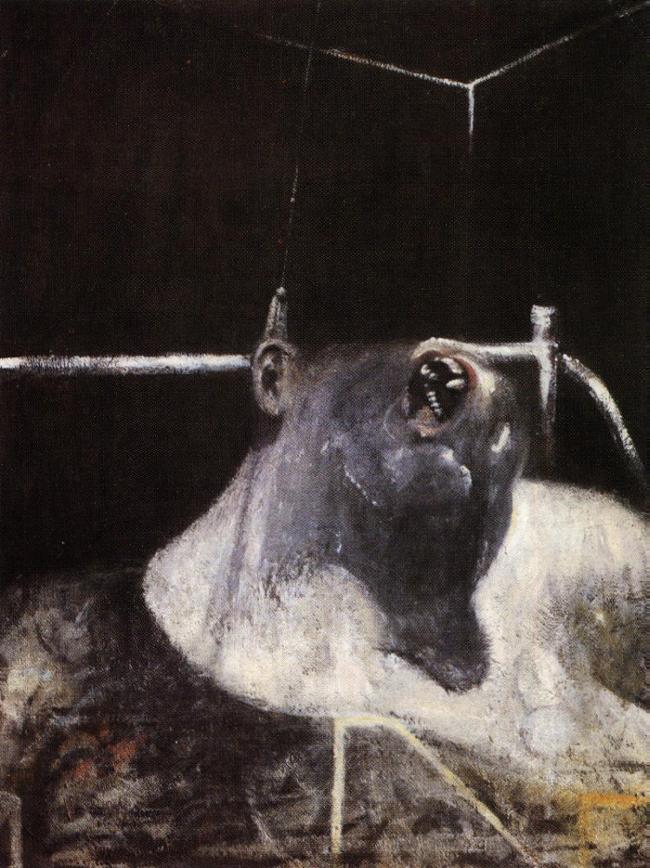
I do not think that there was much connection between Francis Bacon and George Bataille. But it is worthwhile exploring by putting them together to see what happens.
Bacon understood that humans were animals: primal and confrontational. His figures of human beings (even screaming popes) work around the animal in man.
F. Bacon, Two Figures Lying on a Bed with Attendants,1968.
It's a very Nietzschean idea: human beings as animals.
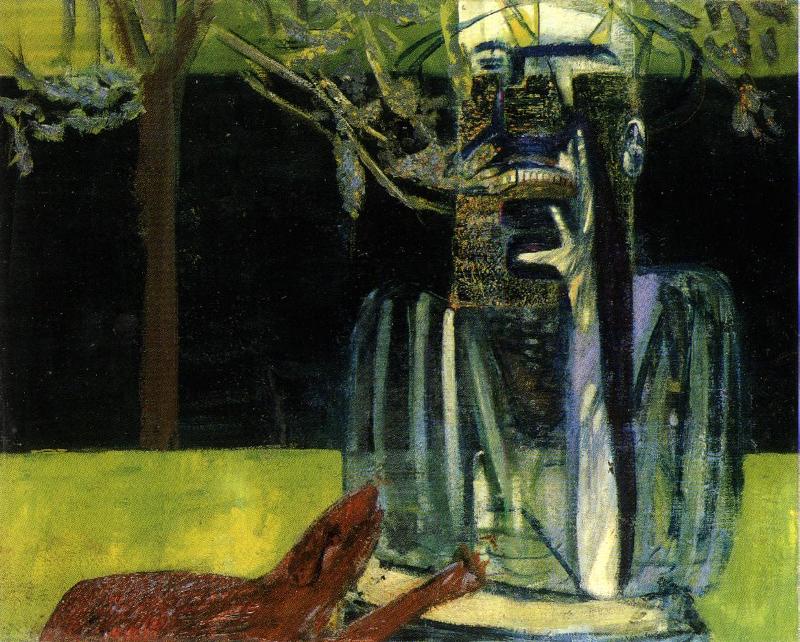
Francis Bacon, Figures in a Garden, 1936
A scream of pain? Anger? Ecstasy? It's ambiguous.
A quote:
"Flesh and meat are life! If I paint red meat as I paint bodies it is just because I find it very beautiful. I don't think anyone has ever really understood that. Ham, pigs, tongues, sides of beef seen in the butcher's window, all that death, I find it very beautiful. And it's all for sale--how unbelievably surrealistic! I often imagine that the accident that made man into the animal he has become also happened to other animals--lions or hyenas for example--while man remained a primate...I imagine men hanging in butcher's shops for hyenas, who would be dressed in fur coats. The men would be hung by their feet, or cut up for stew or kebabs."
Francis Bacon, Exclusive interview with Francis Giacobetti, 1991-2, The Art Newspaper, June 2003.
Time to reappraise surrealism as Bataille suggested? A surrealism that recognized the absence of myth in a society ruled by instrumental reason and looks a back to the primitive to gain an insight into what has been lost.
Isn't the anaimal/human nexus one way to reach back to the primitive?
April 11, 2005
inner city living versus quarter acre suburbia
There is a debate happening in Sydney about inner city living versus quarter acre suburbia living.
Referring to some comments made by Michael Costa, the NSW Roads Minister, Adele Horin says:
"When politicians talk up Australians' devotion to the quarter-acre, beware. It is usually a way to deflect blame for urban problems such as air pollution and traffic congestion onto us. It is their excuse to do nothing. If only Australians weren't wedded to the quarter-acre, they imply, politicians could curb suburban sprawl, build rail lines, and reduce air pollution. But darn it, the people rule.It is this archaic view of what Australians want that is ruining our cities. It provides the justification to build another freeway, scrap plans for train lines, and mock proposals for light rail."
The quarter acre suburbia is generally tied to fostering development, suburban sprawl and the expansion of the city boundaries. It is tied to a mode of life with its idea of mum,dad and two kids family life, a house that is a home and community as neighbourhood.
What this ignores is the diversity of modern urban living. Adelaide, for instance, has urban consolidation giving rise to inner city living, the suburbian living in the far-flung suburbs north and south of the city and seachange shift to the coastal fringe on the Fleurieu Peninsula.
April 9, 2005
excellence in editorial cartoons
In the US Nick Anderson of the Louisville Courier-Journal won the Pulitzer Prize for editorial cartooning.
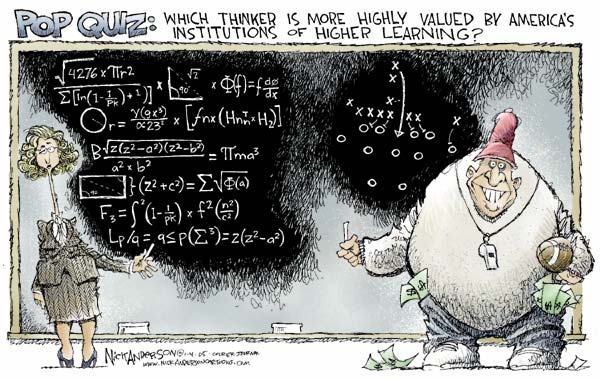
Nick Anderson
April 8, 2005
Francis Bacon #8
Francis Bacon's paintings are disturbing. His images present active figures who are defined by their activity, but their activity is fraught with violence.
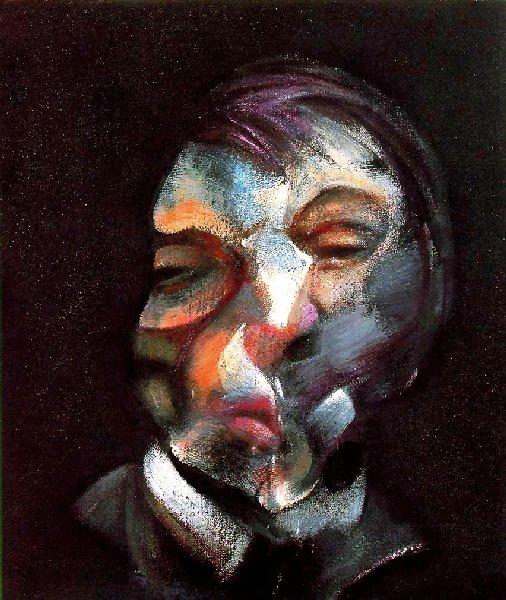
F. Bacon, Self-Portrait
This figure expresses violence, isolation, and pain of modern subjectivity. It is an images of pain and suffering it does not solicit our sympathy. We do not identify with it.
April 6, 2005
in memoriam
The media is filled with material about the Catholic pope. Even though I was educated as a Catholic I've been flicking the pages with disinterest.
Most of it is spin designed to place John Paul 11 up there with Leo 1 and Gregory 1 as one of the greats of the Church. Listening to the hype you would think that the Polish Pope had rolled back communism singlehanded in the 1980s.
Though he has not succeeded in destroying liberalism or capitalism I'm sure the moves are being made in the Church to attribute sainthood to John Paul 11.
Then I saw this:
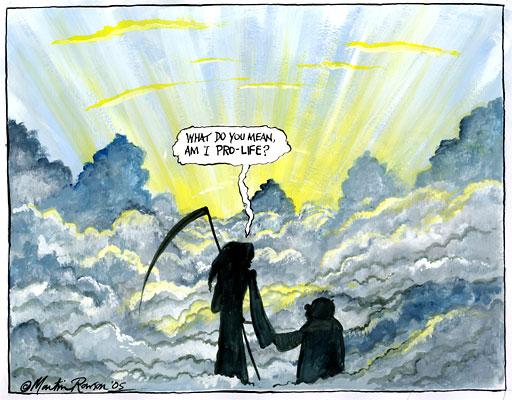
Australian Catholicism has become very conservative, thanks to the late Pope John Paul 11; so hardline conservative that it is becoming pre-modern.
But then Catholic conservatism was always pre modern.
classic photojournalism
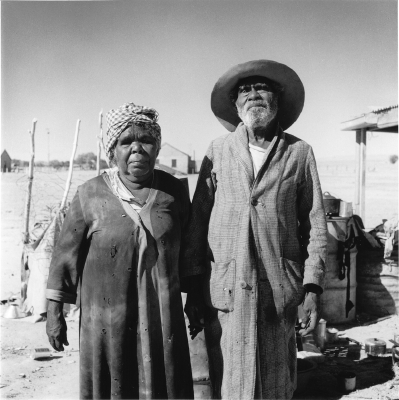
David Moore, Aboriginal Couple, Finnis Springs Mission, South Australia, 1959
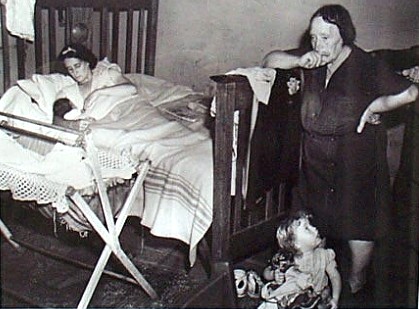
In the 1970s, photographers defined their goal as 'personal documentary' work freed from the confines of the magazine picture editors and commercial clients. David Moore developed new non-commissioned bodies of personal work in these years and from the late 1970s on further developed an abstract formal language and design emphasis in many of his formalist works that were designed for the art institution.
I much preferred the classic photojournalism of the 1940s and 1950s.
Posted by Gary Sauer-Thompson at 12:41 AM
| Comments (0)
| TrackBack
April 4, 2005
slouching towards Miles Davis
new post.
That minimalism was because I was too tired to post.
So a note on Miles Davis: the 1959's Kind of Blue album and the transition to electronic jazz rock via In a Silent Way. In a Silent Way marked the beginning of a new era in jazz; one that moved towards rock. The jazz community was bitterly divided over the notion of Miles Davis incorporating rock. Its unholy marriage of Sly and the Family Stone's There's a Riot Goin' On, sludge-funk, rock's bombastic backbeats, and jazz's reeling improvisation bitterly split the jazz community down the middle.
Many found Davis' new "directions in music" offensive to the jazz idiom. Davis' use of electric instruments and funk and rock rhythms during this period was seen as a betrayal of jazz and a commercial sellout. It is a hard to seehow walls of electrified noise and wah-wah pedals is a commercial sellout.
I've really struggled to understand the blended improvisational rock and jazz on the seminal Bitches Brew (1969) with its dense keyboard textures and polyrhythmic percussion. And I still do.
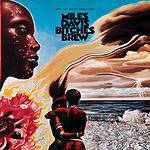 I was attracted to the spontaneous invention the swirling free-form chaos that became a kind of jagged soundscape that signified jazz's transformation. Davis brought the elements of jazz and rock together, overlaying one on top of the other in order to create a densely woven tapestry.
Still the fusion music after In a Silent Way left me left me floundering. Bitches Brew, Live at the Fillimore East and the latter A Tribute to Jack Johnson, are loud, amplified, improvisational music. It was harsh, raw and black-sounding for someone coming from the improvisations created by the 1970s Grateful Dead.
I'm beginning to realize the Dead's space jams around 1989/1990 were influenced by the improvisional fusion work of Davis that started with his In a Silent Way. In the Grateful Dead's final fifteen years their adoption of MIDI-based technology, enabled them to simulate an array of sounds and instruments. This further opened up the music, momentarily reawakened the group’s creative tendencies and allowed the sounds to be sliced, diced, shifted, and mutated with great dexterity. This is quite different from the late 1960s band that muscled its way through adrenaline-soaked exchanges.
I now realize that Davis' jazz rock fusion albums of the 1970s were spliced and collaged from the jam sessions into In a Silent Way and Bitches Brew by Miles Davis and his producer Teo Macero. Elaborate editing and post-production work is a new way to approach composition.
The other side of this is the live, spontaneous 'jam' performances of the band as in Live- Evil. It indicates that Davis was reaching outside his immediate musical environment for new inspiration. The music world of the 1970s was one of the electric guitar, the Beatles, psychedelia, loud amplifiers and Jimi Hendrix. The live music performed by Davis from this period was full of energy and it grooved. This fusion of rock and jazz took the excitement and energy of rock and combined it with the complexity of jazz.
The other approach is simplifying the melody or improvisation down to rock's level then adding jazz's more mellow qualities. That ends up with boring, easy-listening fusion.
April 3, 2005
Ten Days on the Island
Tasmania is having its annual art festival. It's called Ten Days on the Island 2005 and it is organized by Robin Archer. This is the official website but nothing much is online.
So it is time to celebrate the work of

Peter Dombrovskis
in lieu of all the good photography that is not online.
April 1, 2005
Melbourne 2030
Melbourne 2030. It states that Melbourne's future is a choice between suburban sprawl connected with a network of freeways or high-rise apartments connected by public transport.
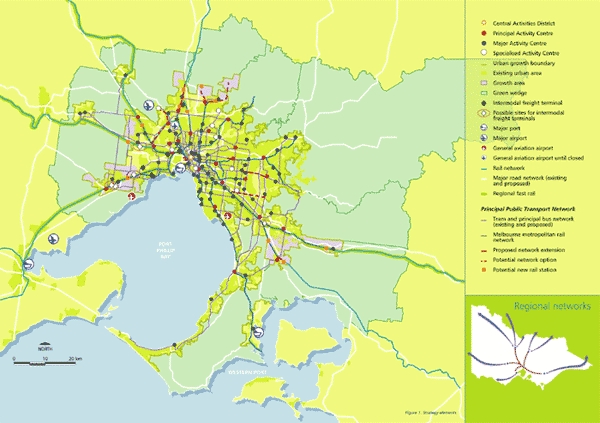
Melbourne 2030 places the emphasis on the inner city apartment living, and broadening the base of activity in suburban centres that are currently dominated by shopping to include a wider range of services over longer hours.