May 31, 2005
public art
Brisbane is an enlightened city compared to Adelaide in relation to art. It has picked up where Adelaide left off in the 1970s when the the Dunstan period ended in SA. Under the Beattie Government's creative Queensland policy an enlightened program of 2% of all public building budgets has been devoted to public art since July 1999. Around 92 projects have been registered with the Public Art Agency, totalling $14.4 million, with over 500 jobs created for artists and artsworkers throughout the State.
So Brisbane has seen a noticeable increase in art inhabiting its streets and buildings. Adelaide,in contrast, just talks about art adding creativity and zest to a boring dying city.
Public art? What immediately comes to mind are Victorian statues of N British royalty, water fountains, Anzac memorials and modernist squares and triangles. But times change as does the public sculpture.
So what has been produced in Brisbane by way of art that is located out on the streets among the people instead of being placed in an art gallery? An example:
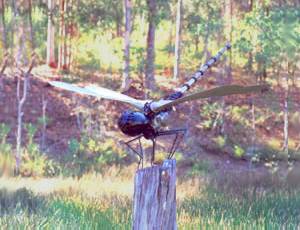
Christopher Trotter, Bunyip Dragonfly, 1998
More on public art in Brisbane can be found here.
May 30, 2005
WWI photographs
A lot of patriotic fuss was made about WWI recently in Australia with the conmemoration of the Gallipoli campaign.
An excellent colour photograph from WW1 from the Heritage of the Great War.
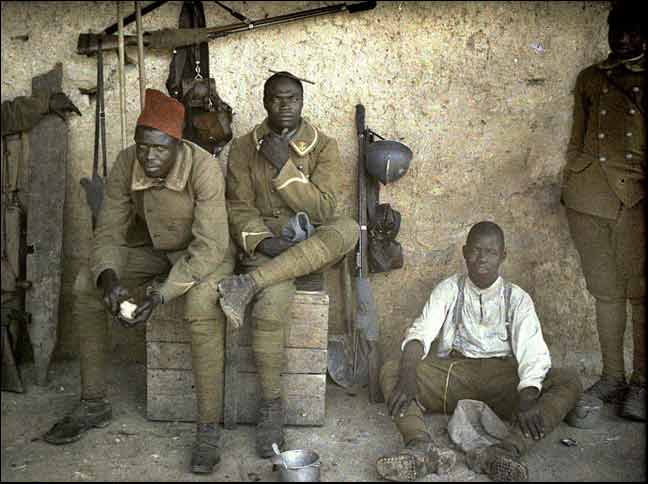
Senegalese soldiers billeting in a shack near the frontline in WW1.June 1917 in Saint-Ulrich, Northern France.
Senegal was a French colony. The colonists were fighting for their colonial masters. Just like the Australians.

ANZAC soldier carrying a wounded comrade on Gallipoli
Gallipoli was the last time Australia allowed another nation (Britain) to command their troops. After the disaster Australia vowed to retain command and therefore responsibility for its own soldiers.
Is Sydney an unsustainable mode of life?
When I was in the global city of Sydney a week or so ago I noticed how much cleaner the post Olympics city was when compared to the pre-Olympics one. The dynamic of expansion and growth was everywhere, yet the city continues to rely on private car transport rather than light rail. So more congestion and worsening smog. It is becoming more like LA as train services have been cut in the past year and around 76 per cent of Sydney commuters travel to work by car.
Sydney is a city rich in private wealth but poor in public amenities. Poor means public squalor if one thinks of infrastructure and public health services.

Nick Moir, photograph
Since the mid-1990s there has been an aversion to public debt and the emphasis of state treasuries has been to reduce government debt and decrease public sector investment in infrastructure. Budget surpluses and low government debt was the neo-liberal mantra.
May 29, 2005
Frank Hurley: war photographer
Frank Hurley was the first offical photographer to the Australian Imperial Forces in WW1. Some of his most famous battle scenes are composites of several negatives.
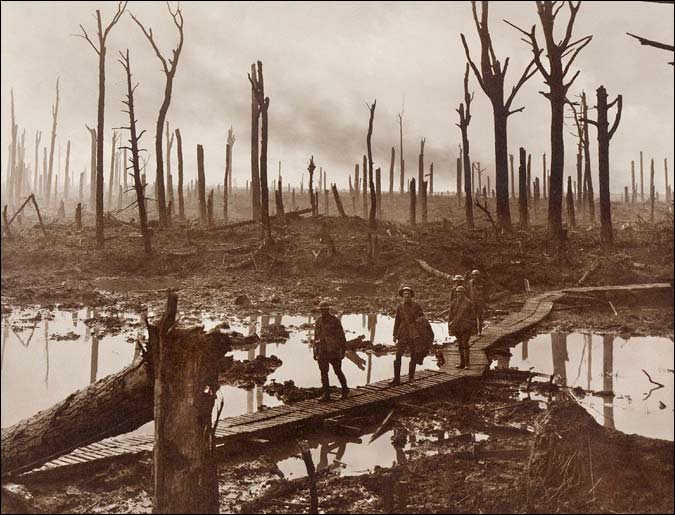
Frank Hurley, The Shell-Shattered Area of Chateau Wood, Flanders, 1917
Hurley was more than a reporter.
May 27, 2005
picturing the country?
Interesting photo collection, courtesy of Matt over at Long Sunday who linked to wood s lot.
Is it just a picturing? I reckon it's more an interpretation of the 1930s than a mirroring of what is.
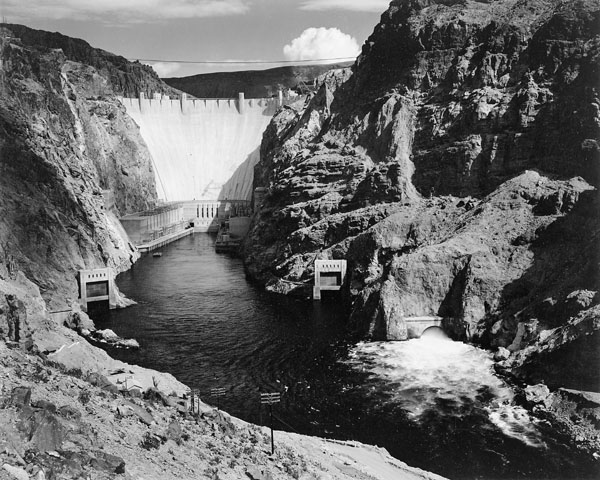
Ansel Adams, Boulder Dam, 1942
The dam is snugley tucked into nature so that it becomes a part of nature. What is not represented is the effects the dam has on the environment, or the way the dam is an imposition or domination of nature by an instrumental reason. In short, there is no critique of modernity.
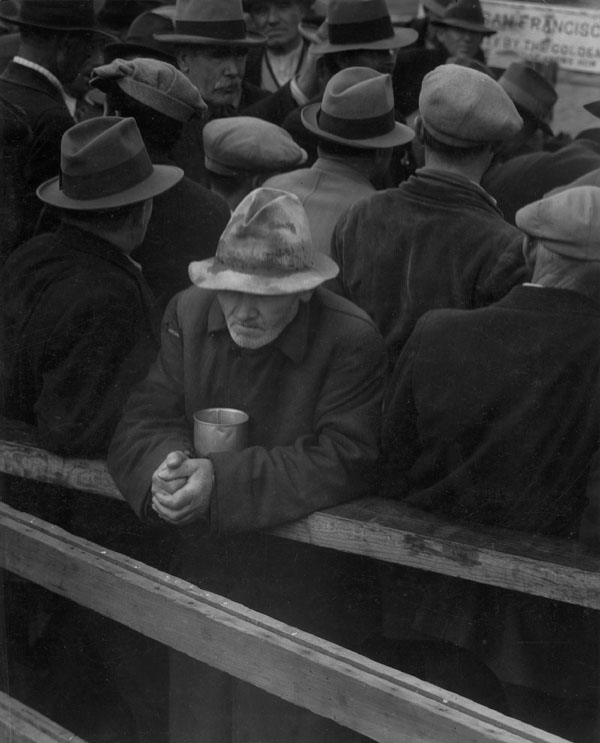
Dorethea Lange, White Angel Breadline, 1933
Modernity was transformed and presupposed by the American New Deal as a governmental response to the horrors of the Great Depression.You can understand the need for the liberal state to intervene in public works (dams) to get economic growth going so as to get people into work.
Pictures are interpretations of human actions, events and situations within a specific history.
May 26, 2005
God is not happy
Seems like God is having a few problems with those who say they speak in his name:
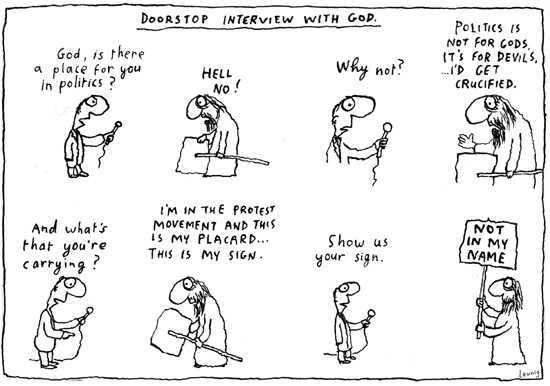
Leunig
Can't say that I blame God for being so depressed. His name is taken vain so often by Christians to do unChristian things.
May 25, 2005
Rosemary Laing: Groundspeed
Landscape photography after the collapse of the beautiful of modernism?
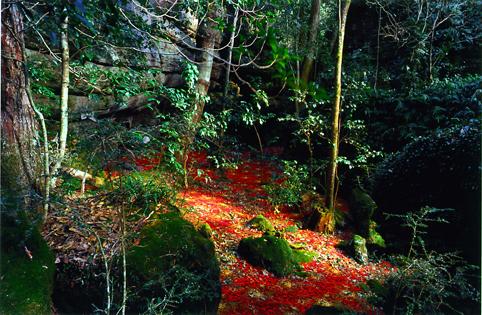
Rosemary Laing Groundspeed #4, 2001, C-type photograph
We have a staged image of mass produced floral carpets covering forest floors.
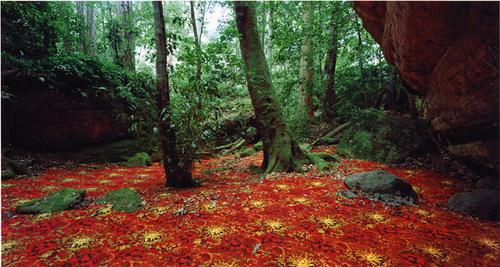
Groundspeed #2, 2001, C-type photograph
Laing has redecorated a rainforest floor with some Axminster carpets originally destined for suburban Australian parlours. In the process she has redesigned nature. It is more than nature has been been shaped by humans and so is no longer wildernesss. Laing redesigned a place we belong to. It is a representation that tries to make sense of what belonging to a place means.
The carpets dislocate that place, make it strange, and so displace us so that we are strangers----- or migrants?
Are Australians migrants? It's an old idea. We don't really belong to the ccountry because we are migrants.
May 24, 2005
Bruce Springsteen
If Dylan digs into the roots of the traditional music and old songs on The Basement Tapes sessions, as Marcus claims in his The Weird, Old America, then does Bruce Springsteen do this The Ghost of Tom Joad (1994) and the latter Devils and Dust (2005). Or does he reach back to Woody Guthrie? He has definitely journeyed back to his folk roots. But which roots are these?
I've never been comfortable with Springsteen's barnstorm rock performances and rock epics of the rebel working class rocker who is a millionare and says he speaks for the common folk on main street. It always struck me that Springston's tub thumping populism was about creating a rock mythology of authenticity and street credibility as opposed to facing himself, his country and his history in the conservative America of Ronald Reagan and George W. Bush that re-interprets Born in the USA as a patriotic anthem.
Does the Springston who returns to his folk roots (gospel) reconnect with the Dylan of The Basement Tapes? If so what about Gram Parsons?
Or has the old music died?
May 23, 2005
Rosemary Laing
When I was in Sydney on the weekend I popped into the highbrow Museum of Contemporary Art on Sunday after I became fed up with very touristy market in The Rocks. I wanted a quiet space from all the tourism and commericalism.
I caught the the unquiet landscapes of Rosemary Laing exhibition by the Sydney-based Australian photographer Rosemary Laing.

Rosemary Laing, groundspeed (Rose Petal) #17, 2001, C-type photograph
Afterwards I had coffee and cake at the MCA coffee shop and paid a pretty special price for the glistening water view of Circular Key to the Toaster.
I was most taken by the series dealing with landscape including groundspeed (2001) and the more recent work dealing with the South Australian landscape; rather than the earlier Flight research series (1999).In the groundspeed series of photographs, Laing is depicting a joining between organic (trees and rocks) and synthetic materials made of synthetic fibres (carpet).
Similarly with:

Rosemary Laing, brumby mound #5,C type photograph
The foreground is full of red furniture.
May 22, 2005
The Basement Tapes
Following his 1966 motorcycle accident, BOb Dylan retreated to Woodstock, N.Y., where he assembled a musical entourage known as simply, The Band. Robbie Robertson, Rick Danko, Garth Hudson, Levon Helm and Richard Manuel.The daily music sessions at the Big Pink house in the Catskills soon produced more than 100 new recordings of either traditional or original material.
The official Basement Tapes: a two-disc set of ad hoc performances from 1967, albeit refurbished slightly for this release, "The Basement Tapes" provides the missing link between Dylan's long, poetic songs of the mid 60s and the shorter, more direct songs of the late 60s.

The trouble is that Greil Marcus has heard the 5 CD set basement tapes bootleg. I've only heard the 1975 official release. I've I loved the feel of this music: The songs are easy, the band is having fun, and the music flows and are a precursor to Dylan's stark John Wesley Harding and the Band's stunning debut, Music from Big Pink as well as the The Band. The music of Basement sessions are seen favourably.Thus:
"At a time when most rock culture was entranced with its post-atomic origins, these songs sounded timeless, plunging into pre-industrial folk, turn of the (20th) century barrelhouse and blues, and crackling, vintage rock & roll excursions with offhand verve and a thrilling disregard for what was hip."
But I'm at a disadvantage here. I cannot listen to the span of music covered in the 105 songs. Nor can I see the connection between Dylan's Basement Tapes project and the spirit of the true underground America as embodied/enshrined in Harry Smith's Anthology of American Folk Music. Nor can I discern and grasp the roots and memory of this music.
May 21, 2005
city woes, roots and rock criticism
I'm in Sydney for some meetings.I'm working from an internet cafe in Glebe after checking out Glebe Books and Fish Records. The internet connection is very slow and the computer keeps freezing. I'm really only checking in.
I find inner Sydney very nomadic, mobile, optimistic and bohemian. It's ethos is about moving on (the highway?) cars and sex. I remembered the music of Chuck Berry and the anthems of the early Bruce Springsteen of Born to Run or Born in the USA.
AS I walked around I wondered about the winter light, bruised hopes, the broken dreams, urban loneliness and failed connections----the dark and the forboding pulse of life suggested by city woes---from the perspective of the hinterland and Adelaide.
At Glebe Books I bought Greil Marcus' The Old Weird America, which is a reprint of Invisible Republic: Bob Dylan's Basement Tapes. The Fish Music store did not have a CD of Dylan and the Band's 1967 The Basement Tapes Why not? Too yesterday? Too American? Too nostalgic? I pretty much gave up listening to Dylan after Blood on the Tracks, and I saw most of his latter output as evidence of long-term musical decline.
The Marcus book is a study of Dylan's The Basement Tapes session with The Band. What is Marcus saying about this music? Marcus contends that The Basement Tapes is far more than an odd collection of tunes. Rather, he asserts that the tapes reconnect Dylan to his "lost" folk roots through their portrayal of a rich metaphorical landscape ripe with insights into American culture. I too had once listened to the roots of American folk music: gospel music, Appalachian ballads, Memphis blues (Skip James + Mississippi John Hurt) and other traditional songs from the late 1920s such as the Carter family, that provide bedrock currents of American cultural language.
Mark Sinker observed (in The Wire no 113 Music And The American Dream Revealed?):
"Marcus's contention is that there can be found in American folk a community as deep, as electric, as perverse, and as conflicted as all America, and that the songs Dylan recorded out of the public eye, in a basement in Woodstock, are where that community as a whole gets to speak."But the country mapped out in this book is not Woody Guthrie's land for made for you and me . . . It's what Marcus calls 'the old, weird America ..the strange yet familiar backdrop to America's common cultural history termed the "playground of God, Satan, tricksters, Puritans, confidence men, illuminati, braggarts, preachers, anonymous poets of all stripes"
If this is the territory that Marcus has discovered in Dylan's most mysterious music, then why no mention of the Grateful Dead circa 1970-74? Did they too not occupy a mythic place, a psychedelic one where roses grow out of skulls. Do they not, like Dylan, have their roots in the tradition of the old weird America. Did not The Anthology of American Folk Music, edited by Harry Smith, influence Jerry Garcia as well as Bob Dylan?
Why no mention of poverty and crime, migration and exile, hopelessness and broken dreams? That was all around me I was walked around in inner Sydney. And it is all over the USA. Or is that the world of the lefty folkies loke Peter Singer singing country woes?
May 20, 2005
on the music industry
A good quote from Paul Rapp's text 'Somewhat Legal Look at the Dawn and Dusk of the Napster Controversy' (2001)
"...the wagons are circling. The music industry, over the past several years, has experienced unprecedented corporate consolidation. There were some eight major record labels a few years ago; soon there will be only four. This consolidation has resulted in a uniformity in the industry's response to the perceived dangers lurking on the internet, and a marked lack of creativity in that response.In addition, this concentration of power has greatly affected the content of the music that the majors have offered to the public. In short, there is less variety and much less volume, in terms of the number of titles and artists, in the music being offered. Artists have been handed their walking papers, dropped by labels that have decided to concentrate on chart-topping, manufactured content providers like Brittany Spears and N'Synch. Any college kid with an ear to the ground of popular music has a favorite band that has gotten the boot. Classical and jazz divisions are being eviscerated. The industry looks less like a vehicle to deliver culture and more like, well, an industry, one devoted to the lowest common denominator and to hell with everything else.
It's little wonder, then, that the music industry's cries of righteous indignation about the horrors of the Internet have been met with unstifled yawns and a few snickers of disgust. The industry has made itself into the boogey-man, and music aficionados, especially college kids, [couldn't] care less whether the industry lives or dies.
A fundamental reason why there is an MP3 phenomenon is that the music industry has failed, refused, to pick up the ball. There is no way to receive the vast majority of major label music digitally over the Internet except for free. Even if you wanted to buy major label music over the Internet, you can't, because the major labels have yet to offer their music digitally in a downloadable format."
The above quote is from this text on intellectual property rghts.
May 19, 2005
the high tech gift economy
I've just come across this review of John Alderman's, Sonic Boom: Napster, P2P and the battle for the future of music,'(2001). It is a contribution to a wide ranging debate.
The book is about the way the corporate music business has stubbornly resisted any accommodation with the new digital internet technology It's a well known story of the corporate leaders using their lobbying power and legal resources to attack the Net by having the copyright laws strengthened, blocking software development and closing down websites.
What they are defending is a particular structure of the musical industry:
"Despite the rapid changes in musical tastes over the decades, the fundamentals of its business structure have remained the same. Musicians are contracted to make recordings. Music is sold on bits of plastic to consumers. Copyright laws ensure that no one can distribute recordings without paying their owners. Everyone supposedly benefits from this arrangement. Fans are offered a wide choice of many different types of music. Musicians are able to earn a living - and a few can become seriously rich. Small companies can survive by selling niche styles of music. Large corporations can own profitable music companies as part of their multi-media empires. Having recuperated successive cultural revolutions, this business structure appeared to be immutable. It took the arrival of P2P to prove otherwise."
Alderman argues that no copyright law or encryption system is going to stop the swapping of music files between consenting adults in the long-run. There can be no return to business-as-usual for the music industry. Alderman also argues that money can be made inside the hi-tech gift economy. Free music on the Net will provide wages for musicians - and profits for their employers.
How so?
By building on the model developed by the Grateful Dead who were signed to a major label and encouraged their fans to make and trade tapes of their live performances. Alderman proposes:
"...that the music industry should learn from this tried and tested example. For a start, swapping MP3s should be accepted as the contemporary equivalent of trading bootleg tapes. Instead of fighting this phenomenon, corporate executives should realise that giving away music can be another way of making money. For instance, a tune available for free over the Net could persuade someone to buy a concert ticket or, as long as the sound quality remains superior, to purchase CD or DVD versions. Above all, the music industry must move from selling tunes to servicing fans...As one way of making money disappears, another may be opening up."
The Net was invented to allow file-sharing between computers in different locations. This concept is at the center of the technological innovation of peer-to-peer computing (P2P) that allows all sorts of devices to interact with each other. Everything linked with everything. Everyone swapping files with everyone.
May 18, 2005
an easy moment
I returned home yesterday afternoon from work. I needed some rest and to sit in the sun. I drifted in and out of sleep whilst listening to the reggae rhythms of the Grateful Dead's 1975 CD Blues for Allah.
This music is a long way from their earlier 'American Beauty'(1970) and 'Wake of the Flood'(1973) and rootsy American musical traditionalism. They were not yet just a touring old white band on a non-stop touring schedule. That came in the 1980s with the alienation, drugs. These took their toll, the magic----the development of a melody out of chaos---eased out of the music and the show became more and more of a ritual.
However, I was too tired to think about aesthetics, rock music and rock criticism, so I surfed the net looking at the day's cartoons:

good huh.
May 17, 2005
music & cancer
I returned from the day clinic after having some cancer cells on my legs and back surgically removed to hear the news that Kylie Minogue has been diagnosed with breast cancer, and has cancelled her Showgirl: The Greatest Hits Tour tour in Australia.
 Cancer has a layer of meanings in our culture at the social, scientific and cultural levels even though it is a biologically based disease.
The word "cancer" has taken on broad cultural meaning as a metaphor for a number of uncontrolled and self-destructive processes---cancer everyday as a cultural metaphor for something evil. Those with the disease become cancer patients with its sick role and given styles of coping and managing. Many patients still experience a diagnosis of malignancy as a notice of imminent doom, whilst many see the sick individual as solely responsible for their healing.
I've been recuperating this afternoon listening to the Grateful Dead's 1978 four-disc set Closing of Winterland.
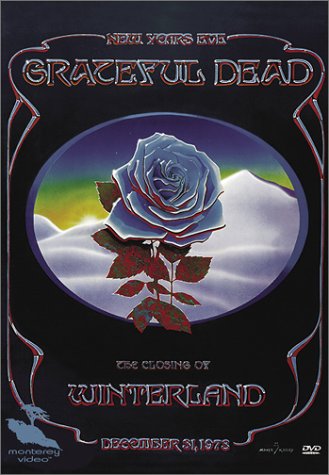 This is a legitimate piece of rock and roll music history that heralds both the closing of the venue, and the effective end of an era shaped by a city, people and place.
During the 1960s and '70s, San Francisco's Winterland Arena was home to some of the era's most memorable rock concerts, hosting such musical legends as Janis Joplin, Jefferson Airplane, The Doors, and The Who, The Band and Bruce Spingsten.
When the world-famous venue closed its doors in 1978, rock promoter Bill Graham commemorated the event by organizing one last farewell concert--and he chose his favorite band the Grateful Dead to bring the party to a close.
By the end of the 1970s, the Grateful Dead were commonly seen to be at the beginning of their musical decline as drugs began to erode the unit from within. Despite the husband and wife team of Keith Godchaux (keyboards) and former Muscle Shoals session vocalist, Donna Jean Godchaux (vocals), leaving the band shortly after this concert, the band's improvisation and in-the-moment musicality continued to remain the core of their concerts.
The improvised music of Terrapin Station and Playing In The Band is a jazzy Dead, and very different from the Pigpen/Fillimore music of the 1968-70 period. The jazz-oriented framework, which started to be tentatively explored on Wake of the Flood and put in place with the much underrated Blues for Allah, was done through quietly appropriating Miles Davis' fusion experiments of 'In a Silent Way' and 'Bitches Brew.'
Around 1972-75 Miles pointed to a door into another musical universe and he'd go through it every night when he played a concert. He and the band would create this weird free-flowing stuff and share what they made with the audience. It is a way of way of music-making more akin to the Dead playing Dark Star than to conventional jazz. The improvisation in Dark Star can differ greatly from night to night. Similarly with Miles.
Judging from the Closing of the Winterland CD The Grateful Dead circa 1978 was not a freakish hold-over from the 60s: an anachronistic hippie band that would never fade away and just went through the motions of playing their sets. The bracket Terrapin Station and Playing in the Band on disc 2 are the new launch pads for improvisation (replacing The Other One); an interplay that leads to an extended foray into a musical space that formed into free-flowing aural collages.
Though there was not much of a segue of the Terrapin Station blending into Playing in the Band, the musicians expand and elaborate on the song form, always implying the melody, groove, sense, and mood of the vocal in their solos. Thus, the better the song, the better the solo. In jazz improvisation the song form is often abandoned entirely as the soloists tackle harmony and rhythm in their purest, most abstract form.
Alas the 1980s were different story. Garcia was ill, there was a lack of inspired original material to fire them up as musicians, and they went through the motions. Apparently things looked up in the early 1990s.

May 16, 2005
celebrating the Day of the Dead
Death is the one thing we all share.
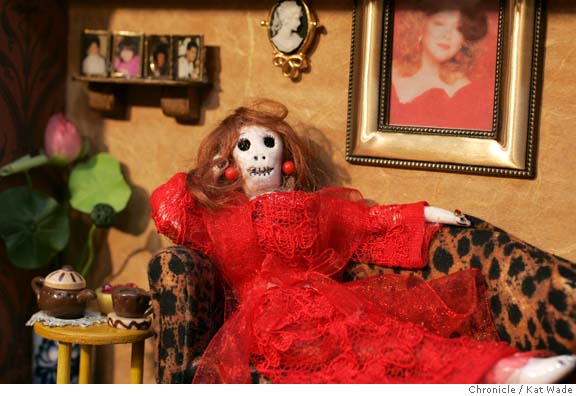
The article says:
"In death, Jannette Gonzalez finally has the leopard couch and the Chihuahua that she dreamed of having. Her daughter-in-law, Sophia Castaneda of Daly City, created a skeleton figure of Gonzalez, clad in a red lace dress, reclining on the sofa. Born in Hong Kong, Castaneda learned about the Day of the Dead from Gonzalez, 54, who died last year from a brain hemorrhage."
We should honour the dead, whilst we remember that 1 in 3 will be afflicted with cancer.
Promises that cancer could be cured provided much of the cultural meaning and nearly all of the commonwealth funding for the modern war on cancer, launched some two decades ago. The search for a cancer cure re-flected the belief that the disease arises chiefly from discrete external entities that can be attacked and eradicated.
Are things changing? is the the war on cancer reinventing itself as the quest for defective genes: cancer is genetic in origin, arising from mutations in the basic building blocks of cells that lead to unregulated growth.
Surely, only a relatively small portion of most dominant types of cancer is inherited.
May 15, 2005
marine conservation
The southern hemisphere humpback whales, which plays in Australian waters every year, is protected in Australian waters and migrates here from the waters of the Antarctic each year.

Sahlan Hayes
Japan's proposed whaling extension will be decided by the International Whaling Commission (IWC) in mid-June. If it is approved, the humpbacks that migrate to Australian waters each year to give birth in the tropical waters off northern Queensland, will be killed for 'scientific purposes'.
These are highly endangered species that came close to the verge of
extinction because of hunting and slaughtering them. Australia has consistently failed at the International Whaling Commission (IWC) to secure a southern whale sanctuary.
May 14, 2005
space and everyday life
It is commonly held that in postmodernity the everyday and space are somehow out of kilter, either because the built environment has not taken account of history or because we modern subjects have forgotten how to connect to history.
On the first point the argument is that the car has destroyed the nineteenth century city by invading it.The city has been transformed for the car (freeways, suburbs, commercial strips, car parks, petrol fumes, noise etc) and the people friendly city has been lost. The new urban landscapes are being redesigned by urban planners for the car. this remaking of urban landscapes erodes our understanding of ourselves and our identity in trying to dwell in the postmodern city.
On the second point the argument is that the built space has eroded our connection with history through a process of 'disembedding' whereby we have been, as it were, evicted from the world. We late baby boomer moderns have not changed to keep pace with the postmodern times and we find the contemporary world dizzying. We were formed in an age whose coordinates were different to the rapid changes in a digitalized postmodernity (eg., since the 1980s the world being formed by mobile phones, internet, email, sensory overload, etc); and we find ourselves immersed in images that lack depth. It is a world of mobility not roots.
May 13, 2005
Sebastiao Salgado #2
This evening I went for a walk along the cliff tops at Victor Harbor with the poodles on the edge of the southern ocean. It is almost winter, yet there was no wind, it was sub-tropical and gentle rain was falling. The balmy weather is very odd for late autumn on the edge of the southern ocean.
As we cruised the hilltop I kept an eye for the southern right whale, as I remembered this image:

Sebastiao Salgado, Among Giants, The Genesis series
Alas, I saw nothing. I was keenly disappointed. Then I remembered that the southern right migration to Antartica happens in June.
When I retuned to the weekender and turned on the free-to-air TV to catch the news of the day I saw that the Japanese whaling industry is moving back into killing whales again. The Japanese plan to expand their whaling catch in Antarctic waters and the Japanese Government refuses to recognize the Australian-declared whale sanctuary in Antarctica.
Japanese media reports have said that it will seek nearly to double its annual catch of Minke whales, currently set at 440, in the Antarctic and to catch the larger humpback and fin whales which are considered endangered by the World Conservation Union.
May 11, 2005
post-budget blues
It's budget time in Canberra. Peter Costello, the Federal Treasurer, rules, is on top of his game, and is having fun at the ALP's expense.
Budget time becomes a social occassion in Parliament with parties everywhere. The Government members are celebrating with gusto.
Some other Australians feel otherwise:
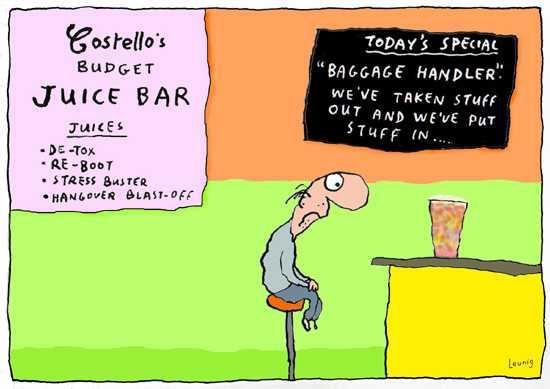
It sure don't feel too good if you are sick, vulnerable and on welfare due to life's misfortunes. Those with disabilities have been defined as a shirker by the smug and self-satisfied government members. There's not much for the vulnerable in the Costello budget and the signs are that worse is to come.
The Government rules and the media spins the ethos of a market society. They rule over those they deem to be the undeserving poor. Compassion for the vulnerable is seen as sign of sickliness and is not to be tolerated.
May 9, 2005
Bill Henson#3: interior landscapes
There is an retrospective exhibition of Bill Henson's work organized by the NSW Art Gallery. Thankfully, this exhibition is also on tour.
We have a review of the exhibition. An article in Pavement Magazine that I mentioned in an earlier post. We should recognize that Bill Henson is a major Australian artist.
What is suprising is how much landscapes dominate Henson's body of work:

Figures --sexualised, disenfranchised youth or adolescents--are then juxtaposed to the twilight atmosphere of the landscapes:

Bill Henson, Untitled #29, 2000-03
These edgy, sexually charged photographs are painterly and cinematic, and they are often about the gritty, casual events in the shadowlands of everyday life. This image, for instance, suggests adolescent prostitution. It is how many young girls make their money.
Other images are more expressions of personal sexual desire:

Bill Henson, Untitled #106, Untitled 2000-2003
We can see that the images do capture that fundamental moment of uncertainty, with one foot still in childhood, the other exploring an aspect of adulthood.
These sexual figures are located within darkened gloomy landscapes with touches of colour:

Bill Henson, Untitled #109, Untitled 2000-2003
I reckon the romanticism here is that of the interior landscape---made up of our past experiences, our fears and longings.
But what is the link between figure and landscape? Are these deliberately raised oppositions? Do they suggest that sexual desire can only be expressed in twilight zones? What are the twilight zones in our interior world of sexual desire?
May 8, 2005
Sebastiao Salgado
This is a very familar sight to me during the winter months when I'm staying at the weekender, and I walk along the cliff tops at Victor Harbor with the poodles on the edge of the southern ocean in the late afternoon.
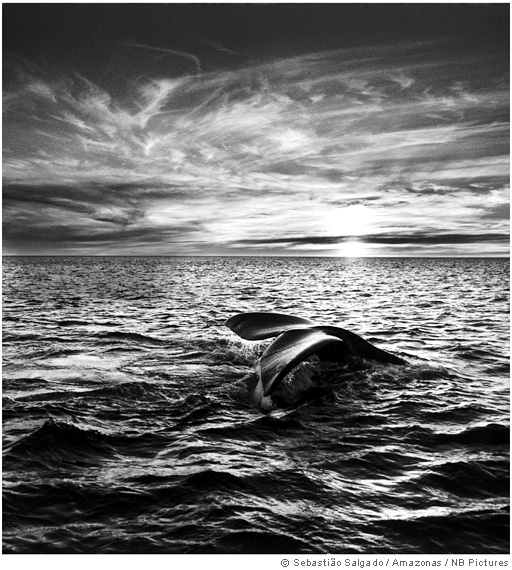
Sebastiao Salgado, Among Giants, The Genesis series
Alas, it is a sight we take for granted.
Salgadao's photos of the southern right whale were taken off the Patagonian coast of Argentina. I've never seen the southern right, which weighs over 40 tonnes, "leaping towards the sky and then splashing massively back into the water with a deafening sound that can be heard several kilometres away."

And:
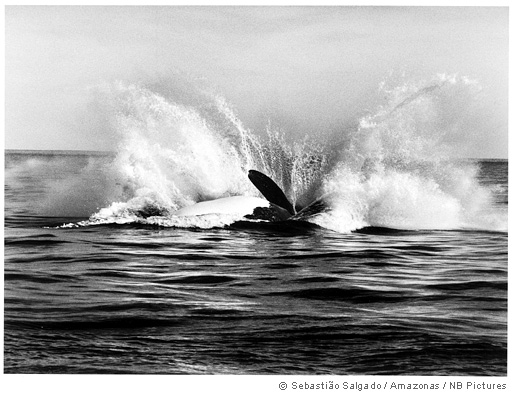
Maybe one day we will see the southern right whales leaping skyward.
May 5, 2005
Fred Williams: Pilbara series

F.Williams, Hardy River, Mt Turner,
Fred William's Pilbara Series of paintings are currently hanging in the Ian Potter Centre, National Gallery of Victoria (NGV) in Melbourne. They were donated by Rio Tinto Limited to the NCV as a Federation Gift to the people of Australia in August 2001.
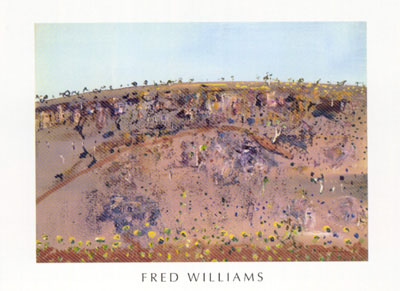
F.Williams, Iron Ore Hill, Mt Turner
The Pilbara series was the last major series painted by Williams before his death in 1982, and it is the only series by Williams to have been kept intact.
May 4, 2005
democracy?
The cartoon refers to the British election.

But it could be any liberal democracy, couldn't it?