|
October 08, 2003
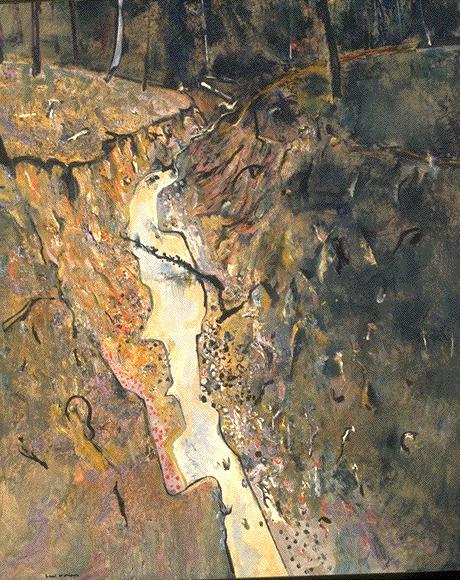
F.Williams, Wild Dog Creek, 1977.
Everybody seems to love the work of Fred Williams. The landscapes are seen to be iconic and they have become an inescapable part of our national visual culture.
But we did not always see the Australian landscape in this abstract way:
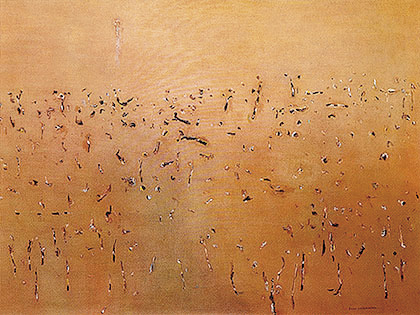
F. Williams, Yellow Landscape, 1968-69
We used to see the landscape very differently. Recall Hans Heysen and his gum trees from early in the twentieth century:
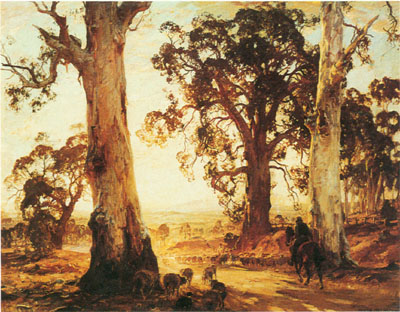
Hans Heysen, Droving into the light,
That is how we once saw the Australian landscape. Our enculturaled perceptual system took it to be the adequate representation of reality. Many in country and coastal towns still see the landscape in that traditional way as visual truth. That mimetic representation of reality became a particular style with the advent of modernism. It was once a defining style; the way of making better pictures though matching them to an external reality. Heyson dd it better than his predecessors.
Or so the story went.
So the way we see our landscape has a particular kind of history. We live and produce within the horizon of a particular closed historical period.
We can understand Fred Williams in terms of modernist abstraction and form meeting the old Australian landscape tradition. Something new is created:
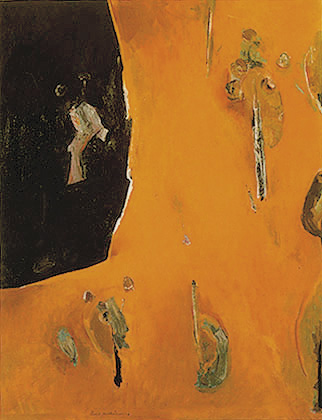
F. Williams, Waterpond in a Landscape 111, 1966
Williams has become a narrative template for us. A modernist one. Remember that one? Modernist aesthetics structured our visual culture in terms of utopianism, formalist aesthetic values, the artist as autonomous entity, and the transcendent character of art. It saw itself as universal not regional; asserted an essential connection between the visual arts and social reconstruction, and presupposed a revolutionary unfolding of history through visual culture.
Well, it too is eroding.
From the viewpoint of philosophical aesthetics we do not really talk about how we have learned to see. Yet the way we see has a history. Our visual culture is marked by different modes of viewing our world, and these modes of visuality are composed of technology, materials and cultural frameworks.
Just think of how different the cinema is to easel painting praticed by Fred Williams. Different historical modes of pictorial representation.
|


Why haven't I discovered *this* delightful site before. I introduced my oldest brother to the delights of art and observing the Australian landscape through Fred Williams. I'm linking to here...please keep going!