January 31, 2005
Global Warming
If you read the financial press as I do, then you cannot but help notice how cool it is to adopt a sceptical view of global warming. Coolness and scepticism are a part of the street cred of budding go getters in the financial market.
Two images of the same geological site at different points in time, courtesy of David Perleman at the San Francisco Chronicle.
Contrast this one:
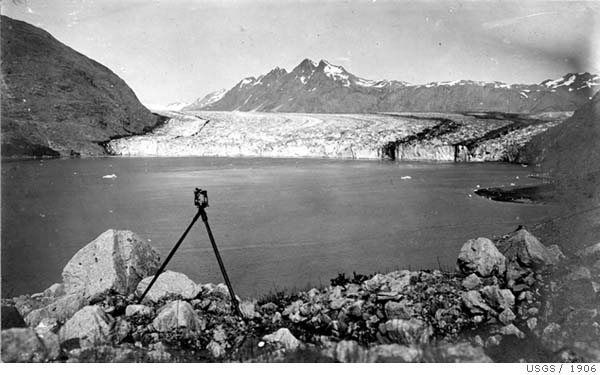
The photo shows the calving terminus of Carroll Glacier at the head of Queen Inlet. No vegetation is visible.
Then this 98 years latter:
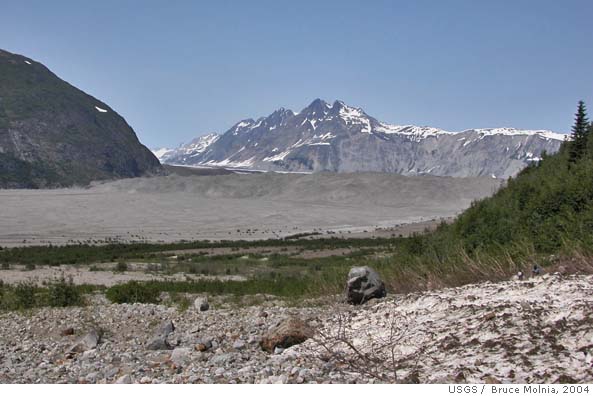
Bruce Molnia, Carroll Glacier, 2004, U.S. Geological Survey
The 2004 photograph shows that the terminus of Carroll Glacier has changed to a stagnant, debris-covered glacier.
Glaciers throughout Alaska are shrinking more and more rapidly,
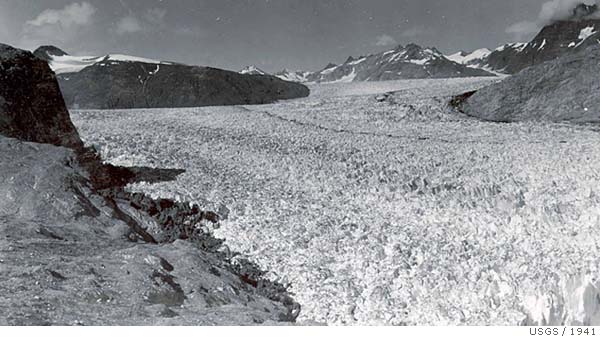
U.S. Geological Survey, Alaska's Glacier Bay National Park, 1941
This shows the glacier 2,000 feet thick. Now look at difference 63 years latter:
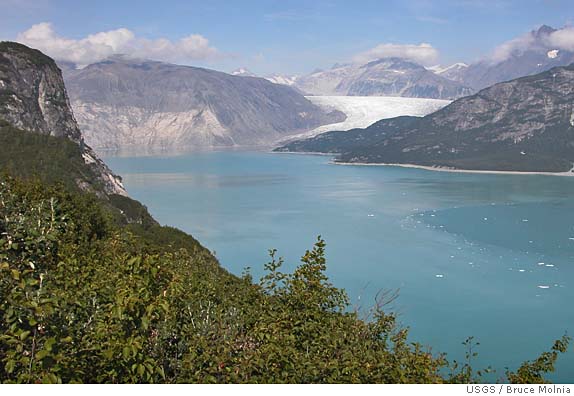
Bruce Molnia,Glacier Bay National Park, 2004, U.S. Geological Survey
This shows changes to Riggs Glacier in Muir Inlet and the growth of vegetation.
January 30, 2005

January 29, 2005

January 28, 2005
Australian photoblogs
The blogging awards are a great idea and depend on the hard work of Kekoc
Boudist was voted best Australian Photoblog:
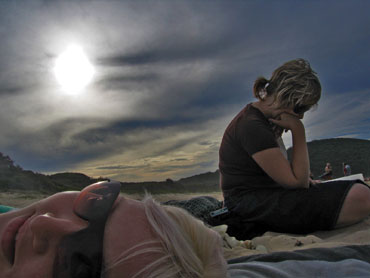
D.Boud, Grey beach
The runner up was Shutterbug:

An interview with Tracey Hoyng
By now, we can talk about an Australian photography?
January 27, 2005
Australia Day
Michael Leunig says:
"Seeing as Australia Day celebrates the arrival of European culture on this continent I thought I should depict one of the enjoyable and infuriating interfaces between the two cultures (depending upon wether you're a cockatoo or an apricot grower). The apricot, a European import of great importance, and the sulphur crested cockatoo, a triumphant native and major headache to Australian fruit growers and gardeners, are celebrated here.I have depicted a raucous feast and a common source of disappointment, shock, fury, alarm... and eventually, humour and philosophy. Nature in this land just has to be reckoned with and accepted. There's nothing quite like discovering your entire crop of fruit demolished by a flock of cockies.
I think also that the most vibrant and unique part of Australian patriotism lies in a widespread and deep affection for the unique natural heritage of this land. I wanted to humorously and joyously give emphasis to this aspect which can be shared by all."

Leunig, Australia Day 2005, Apricot Harvest
January 26, 2005
ugly cities
Guy Rundle, had an op.ed in The Age,last week that draws attention to, and highlights, the ugly urban design in Melbourne. He says:
"Ever since the late 1980s, Melbourne has been immeasurably disfigured by rows and rows of ultra-cheap apartments, flats and low-grade offices made possible by the development of the "tilt-slab" method of construction. Tilt slab is just as it sounds - the building is constructed from a series of pre-fabricated concrete sheets, with a minimum of steel framing and a total absence of brick, plaster or, God forbid, wood - and its total uniformity is thus guaranteed. Even the minimal design required of steel-and-glass skyscrapers in the mid-20th century is absent from tilt slab. In South Melbourne, which was once filled with brick warehouses and factories, it has spread between the flyovers like a yeast infection. It is, in short, the shortest way to kill a city."
The same process is happening in Adelaide in the inner city as the old warehouses in King William and Gilles Street are torn down to make way for tilt slab airconditioned boxes.
Rundle says that one way of dealign with this is to reverse:
"...the presumption of the planning laws, so that the onus is on developers to show that they are making an effort to add to the beauty of the city, rather than on protesters to show that it is detracting from it."
I do not think that design/aesthetic arguments will work. Economics rules the city. The city is seen as a machine to make money not a place for people to live.
January 25, 2005
Hans Bellmer
Amongst Andre Breton's collection
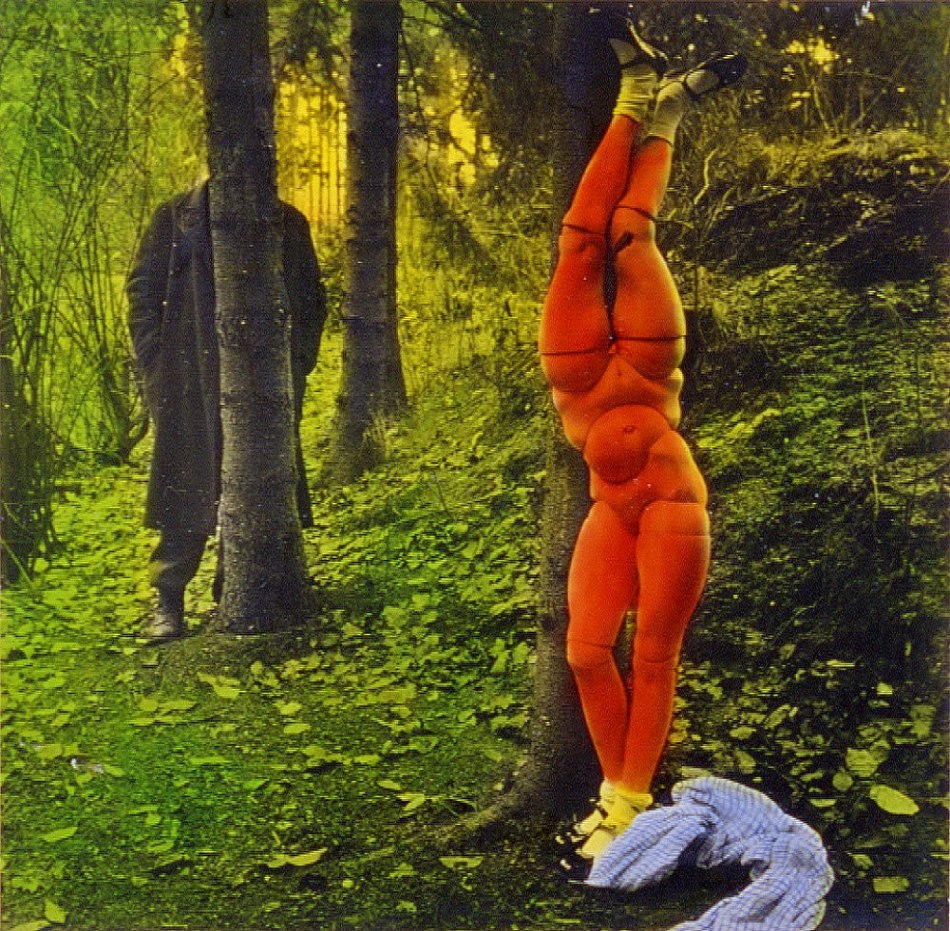
Surrealism was about reuniting conscious and unconscious realms of experience so that the world of dream and fantasy would be joined to the everyday rational world in a surreality. Breton saw the unconscious as the wellspring of the imagination and hedefined genius in terms of accessibility to this normally untapped realm, which, he believed, could be attained by poets and painters alike.
January 24, 2005
Bacon #6: contrasts
Joseph Duemer over at Sharp Sand writes:
"Twenty below zero last night, fifteen below tonight. The dogs are really pissed off about the weather. The terriers have to put fleece jackets on, a great indignity."
A contrast. I write:
"36 degrees today, 25 tonight, 38 tomorrow and more on the way.People and animals are pissed off about the weather. It is hard to go for walks in the heat in the late afternoon as nobody wants to step out of the shade. Few can sleep at night."
All I feel capable of doing at the moment is find a Bacon image to post before I drop off.

Francis Bacon, one of Three Studies for a Portrait of Mick Jagger, 1982
It is too hot to concentrate on reading Deleuze's, the logic of sensation. My mind says leave the intellectual stuff of chapter one until the temperature cools down. Move on. Look for something simple. In Chapter 2 Deleuze connects high culture with pop culture says:
"...modern painting is invaded and beseiged by photographs and cliches that are already lodged on the canvas before the painter even begins to work. In fact, it would be a mistake to think that the painter works on a white and virgin surface.The entire surface is already invested virtually with all kinds of cliches, which the painter will have to break with." (p.11)
That would be the case for a celebratory figure such as Jagger.Ther would be layers of images, cliches and associations.
Deleuze goes on to say:
This is exactly what Bacon says when he speaks of the photograph:it is not as figuration of what one sees, it is what modern man sees.It is dangerous not simply because it is figurative, but because it claims to reign over vision, and thus to reign over painting."
Suprisingly, Deleuze does not comment on either the modernist account of a pure high culture being contaminated by consumer visual culture or the purity of the romantic vision.
Is not that way of understanding a visual not a cliche? Do we not now live amidst an archive of images in our everyday life?
That is all that I can manage for tonight.
January 23, 2005
Rock Criticism
Tis a cool Sunday morning in Adelaide and I have had a few moments to myself to be able to look around the web. I do not have that luxury very often.
Is cultural criticism all but dead now? When commentators ask these kind of questions they are mostly looking back to the cultural criticism of yesteryear, when a narrow high culture literary criticism ruled.
That hegemony is now going.Thank goodness.
I found a literay culture overbearing and stuffy and accepted that the counter culture of the 1960s and 1970s expressed in Rolling Stone and Creem magazines as a breathe of fresh air. Yet that never really displaced a literary one did it?
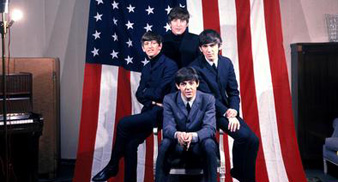
Cultural criticism is more democratic now, as it is starting to be produced from below, and is far more diverse. As George Cotkin says:
"Cultural criticism has certainly changed over the years. The old days of the critic who wielded unchallenged authority have happily passed. Ours is a more pluralistic age, one not beholden to a narrow literary culture. Today cultural criticism is alive and well, populated at the top by giants such as Harold Bloom, Susan Sontag, Richard Rodriguez, Morris Dickstein, Eve Kosofsky Sedgwick, and Frederic Jameson: all critics with differing perspectives and concerns. And cultural criticism, more than ever, is percolating up from below. Blogs and Amazon reviews are opening up the cultural space of criticism, offering new possibilities."
The online world is the key to these new possibilities as you can see here and here, to take two different kinds of examples.
And rock criticism? It is filled with nostalgia for the past and the privileging of old-timey rock 'n' roll:
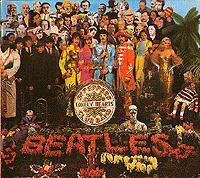 This 1969 album now sounds so tired and a hackneyed.I have not listened to it for years. I go back to Revolver.
Yet it is still celebrated as one of the greatest rock albums.It helped to create the rock and teen pop divide (rock is good, pop is bad) and a culture of reverence for the celebrities and icons of rock.
Give me early Velvet Underground and Nico anyday.
Or the Beach Boys Pet Sounds.
Yet this is yesterday: a time before the record industry set out to convince consumers record industry that songs made by clueless kids manufactured to resemble some marketing team's composite of a successful pop star is what popular music is, and should be, about.
So is the old rock criticism in need of some debunking. Has it decayed?
A history of rock criticism. Have the critiques or "think pieces" being replaced by gossip and artist profiles? Do rock critics now write for each other and rock musicians and so their work remains somewhat irrelevant to the broader culture?
January 22, 2005
two images of empire
The imperial president and first lady:

The speech to the people:
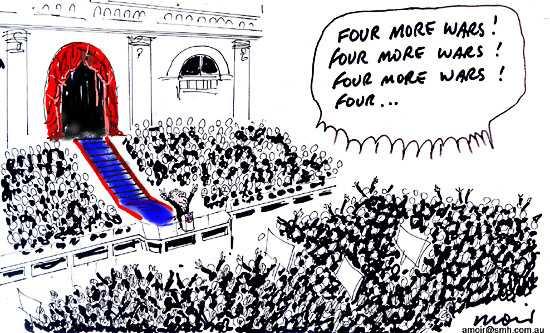
There is a very classical Roman feel to the spectaccle of this new empire don't you think?
January 21, 2005
New York: an ecologically sustainable city?
An interesting article by David Owen on the ecological sustainability of New York. He starts by saying:
Most Americans, including most New Yorkers, think of New York City as an ecological nightmare, a wasteland of concrete and garbage and diesel fumes and traffic jams, but in comparison with the rest of America it is a model of environmental responsibility. By the most significant measures, New York is the greenest community in the US, and one of the greenest cities in the world. The most devastating damage humans have done to the environment has arisen from the heedless burning of fossil fuels, a category in which New Yorkers are practically prehistoric. The average Manhattanite consumes petrol at a rate that the country as a whole hasn't matched since the mid-1920s, when the most widely owned car in the US was the Ford Model T. Eighty-two per cent of Manhattan residents travel to work by public transit, by bicycle, or on foot. That's 10 times the rate for Americans in general, and eight times the rate for residents of Los Angeles County. New York City is more populous than all but 11 states; if it were granted statehood, it would rank 51st in per-capita energy use.
That brings me up short. The argument is that New York is sustainable mode of urban life because it is the antithesis of the ethos of suburban sprawl, freeways, the single family home surrounded by grass and cars.
I immediately think of Sydney as a pollution zone.Why Sydney? It is Australia's global city of power and money. And so it is our equivalent to New York. But Sydney is also a spawling suburban city, and does not have a Manhattan.
Owen acknowledges that Manhattan is "loud and dirty, the subway is depressing and the fumes from the cars and cabs and buses can make people sick." Then he adds:
"Because densely populated urban centres concentrate human activity, we think of them as pollution crisis zones. Calculated by the square metre, New York City generates more greenhouse gases, uses more energy and produces more solid waste than most other American regions of comparable size. On a map depicting negative environmental impacts in relation to surface area, therefore, Manhattan would look like an intense hot spot, surrounded, at varying distances, by belts of deepening green."
Well that is how I see it.
But Owen argues against this view of Manhattan as he is debunking some environmental shibboleths. New York, he says, has a lot to teach us about being green.
Own's is an anti-sprawl argument made by contrasting New York with a sprawling car-invaded LA and the empty spaces of Washington that enables people to move out of cars into public transport.Achieving sustainability means discouraging, rather than encouraging sprawl,and reducing people's needs for cars. So the idea is to work in a big office block in the inner city and live in an apartment nearby.
American environmentalism, like its Australian counterpart, advocates the preservation of wilderness and wildlife, and has an anti-city bias. Owen says:
"That bias is evident in the technical term that is widely used for sprawl: "urbanisation". Thinking of freeways and malls as "urban" phenomena obscures the ecologically monumental difference between Phoenix and Manhattan, and fortifies the perception that population density is an environmental ill. It also prevents most people from recognising that RMI's famous headquarters--- which sits on an isolated parcel more than 290 kilometres from the nearest significant public transit system - is sprawl."
This is true.
But the return to the inner city from suburbia is not matched by a redesign of the old city so that it becomes more people friendly in Australia. It is still a car dominated city, and local authorities resist rolling back the car to make way for people.
Owen goes on to say that:
"Standing between us and any conceivable solution to our energy nightmare are our cars and the asphalt-latticed country we have built to oblige them. Those cars have defined our culture and our lives. A car is speed and sex and power and emancipation. It makes its driver a self-sufficient nation of one. It is everything a city is not.Most of the car's most tantalising charms are illusory, though. By helping us to live at greater distances from one another, driving has undermined the very benefits that it was meant to bestow."
January 19, 2005
Francis Bacon #5
There has been a movement in Western academic and artistic circles for reclaiming the body and repositioning its locus and identity. Body theories and body art have become topics of attention as well as subjects of philosophical discussion.
The extensive body of work by Francis Bacon is central to this:
 Reactions to Bacon have been hostile.
Consider this quote from Raymond Mortimer, New Statesman and Nation, 14 April 1945 about "Three Studies for Figures at the Base of a Crucifixion"
"[This]seems derived from Picasso's Cruifixion, but further distorted, with ostrich necks and button heads protruding from bags - the whole effect gloomily phallic, like Bosch without the humour. These objects are perched on stools, and depicted as if they were sculpture, as in the Picassos of 1930. I have no doubt of Mr Bacon's uncommon gifts, but these pictures expressing his sence of the atrocious world into which we have survived seems [to me] symbols of outrage rather than works of art. If peace redresses him, he may delight as he now dismays."Oh well.
The bodies in Francis Bacon's figure paintings are distorted.
I have not got very far with my reading of Deleuze's Logic of Sensation have I? I am intrigued by the Bacon isolated the iconic Figure from the rest of the painting which are scrubbed into a blur or a field of colour. This makes them devoid of any illustrative or narrative function. They become a background.
Update
I notice that a Gauche is starting a reading group on this text this spring. Maybe some comments will be posted on a Gauche about the conversations of the reading group.
Maybe I should make reading Logic of Sense into a little project of my own.
January 18, 2005
a wry comment
a nice comment on political life:

Leunig
The background is here and here.
It's a tough life. Full of stress. Many cannot handle it. Their bodies become sick. A leader of the opposition gets few breaks.
Saturn and its moons
The Cassini spacecraft is the first to explore the Saturn system of rings and moons from orbit. Cassini entered orbit on Jun. 30, 2004 and immediately began sending back intriguing images and data.

Saturn
Cassini-Huygens is an international collaboration between three space agencies. Seventeen nations contributed to building the spacecraft. The Cassini orbiter was built and managed by NASA's Jet Propulsion Laboratory. The Huygens probe was built by the European Space Agency. The Italian Space agency provided Cassini's high-gain communication antenna.
The European Space Agency's Huygens Probe dived into Titan's thick atmosphere in January 2005.

A composite picture produced from images taken by the European Space Agency's Huygens probe during its successful descent to land on Titan shows a full 360-degree view around Huygens.
The left side, behind the space probe shows a boundary between light and dark areas. The white streaks near this boundary could be ground "fog," as they were not immediately visible from higher altitudes. As the probe descended, it drifted over a plateau, center, and headed towards its landing site in a dark area, right. These images were taken from an altitude of about 8 kilometers and a resolution of about 20 meters per pixel.
January 17, 2005
digital photomontages
Guillem Ramos-Poquí is a painter who has regularly created digital photomontages since 1996.

G. Ramos-Poquí, Orwell's Prediction, Study 2003,Digital photomontage, inkjet.
There is a juxtapositioning of layers or objects in a similar way to a poet composng verses. This way of using montage combines a series visual metaphors into a complex narrative about complex issues.

G. Ramos-Poquí,"The One-Dimensional Man, Homage to Marcuse, study", 2003. Digital photomontage, inkjet.
January 16, 2005
Tsumani:Testimonials & help
Bandah Aceh

Phoenix Rising, one of many civic helicopter pilots currently helping rebuild the lives of those affected by the Tsunami.
The bird's eye view does not, and cannot, capture the lived experience of the effect of a natural disaster on peoples lives.
You can find some personal stories, testimonials and images over at the Library of Life.
This website aims to compile the life stories of millions of people around the world, thereby creating the world's first universal digital record of life.
Do take time and have a read of the personal stories about the impact of the tsunami. This immediacy is what is missing from the coverage by the big corporate media (press and televison).

Jeff Hodge, Tsunami Aftermath, waves of destruction
I've only just discovered this way of helping the tsunami victims. Please have a look and lend a hand. Dear John Quiggin is offering to donate one Australian dollar for every comment on this post at his site to the Australian Red Cross tsunami appeal... Click on the hyperlink, and when there, post a comment.
Please do it now as he only has 342 comments. More are needed.
January 15, 2005
Aceh:above and below
Before and after as seen by the satellite's eye:
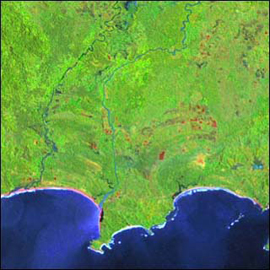
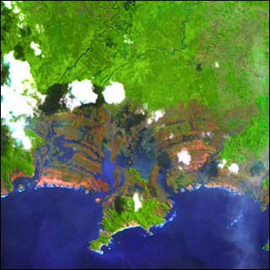
And on the ground, in the unseen civil war zone, we would see something like this:

Francisco de Goya, Nothing. It Speaks for Itself, Disasters of War
The international cameras do not see the dead bodies of the civil war in Aceh
January 14, 2005
a torn fragment
This cut down of a panoramic photo does not really work as a representation of the devastation of town of Badah Aceh.View it as a torn fragment.

Mike Bowers, Banda Aceh
But I have left it because it is a good visual expression of the lived experience of the disaster. It is all darkness and blurry detail with a touch of light in the distance. It has a touch of Goya about it.
The Indonesian military has fought a brutal, if low-level guerilla war, to crush the Achnese independence movement. The tsunami hasn't stopped hostilities.

Francisco de Goya, Bury Them and Be Silent, Disasters of War
Most believe that more than 14,000 Achnese have died since the war began in the 1970s.
Indonesia is anxious to stop foreigners getting as close to this secret conflict and to hide a civil war from the international press.
January 13, 2005
This article about development along Australia's fragile coastal shore by David Campbell is so true.
David understands the conflict to be one "...raging between the demands of burgeoning development on the one hand and local concerns about the preservation of neighbourhood character on the other."
Andrew Dyson represents this conflict well.
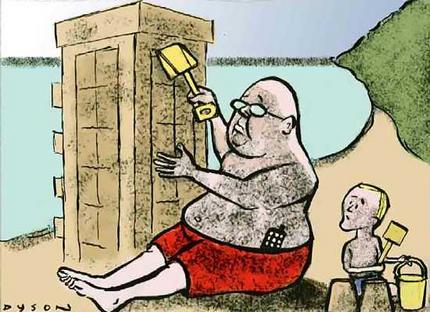
My experiences in Victor Harbor, south of Adelaide, confirm Campbell's description that the conflict works in terms of "developers [being] extremely persistent, constantly pushing neighbourhood character boundaries as they gradually grind down any opposition.
And so it goes: a resort here, an apartment complex there. Another precedent is set and, before you know it, the village atmosphere that originally attracted you to the area has gone."
It is called progress. As Campbell observes the booster lobby usually says that development means more people bringing money into the town, more work for local tradesmen. Things change. You can't live in the past."
Campbell acknowedges that but says a significant influx of people places greater pressure on already limited coastal infrastructure. That is true too. But other considerations are cultural heritage, character of place, the life of a place and an appropriate kind of development. A 100-room multi-storey resort does not fit with a sleepy, windswept little fishing village.
January 12, 2005
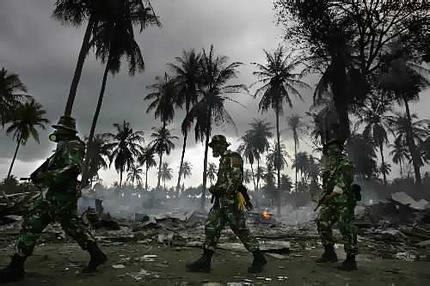
AP, Indonesian soldiers, who have been recovering the bodies of tsunami victims, walk past piles of smouldering debris on the outskirts of Banda Aceh.
January 11, 2005
Tsunami #12:more odd reactions
The following are some excerpts from an interview on Saudi/UAE's Al-Majd TV with Sheikh Fawzan Al-Fawzan, a professor at the Al-Imam University. It was recorded and translated by the MEMRI TV Monitor Project:
"These great tragedies and collective punishments that are wiping out villages, towns, cities, and even entire countries, are Allah's punishments of the people of these countries, even if they are Muslims."Some of our forefathers said that if there is usury and fornication in a certain village, Allah permits its destruction. We know that at these resorts, which unfortunately exist in Islamic and other countries in South Asia, and especially at Christmas, fornication and sexual perversion of all kinds are rampant. The fact that it happened at this particular time is a sign from Allah. It happened at Christmas, when fornicators and corrupt people from all over the world come to commit fornication and sexual perversion. That's when this tragedy took place, striking them all and destroyed everything. It turned the land into wasteland, where only the cries of the ravens are heard. I say this is a great sign and punishment on which Muslims should reflect.
"All that's left for us to do is to ask for forgiveness. We must atone for our sins, and for the acts of the stupid people among us and improve our condition. We must fight fornication, homosexuality, usury, fight the corruption on the face of the earth, and the disregard of the lives of protected people."
The Islamic fundamentalists do have a thing about sexuality. Is battling sex what life is all about? It is about sexual, repression avoiding certain sexual sins and fixating on sexual dimension of life to the virtual exclusion of everything else.
Tsunami: Maldives & coral reefs
The Maldives had no warning of the tsunami, even though there was a 4 hour timelag.
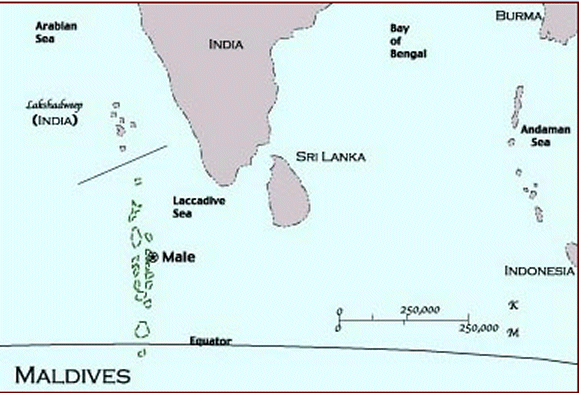
How come the Maldives were not informed? We know that the Thai Meteorological Department had been warned of an impending tsunami one hour before it happened,but failed to issue a public warning before the tsunami struck.
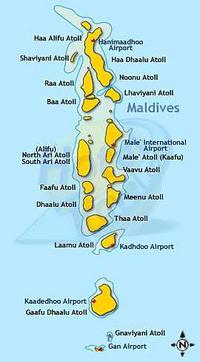 Some parts of the Maldives were so severely lashed by last month's tsunami that the map of the paradise cluster of nearly 1200 tiny islands literally needs to be redrawn.
Most of the low-lying Maldives escaped the full fury of the tsunami.
But the south-eastern stretch of atolls, famed for some of the world's best scuba diving, took a direct hit, with waves as high as four metres.
These waves packed enough power to batter islands into new shapes and, in some cases, wipe them off the map completely.
The Maldives were lucky. The tsunami waves that hit them were much smaller than the walls of water up to 10 metres high reported elsewhere. As they did elsewhere, the first waves struck the islands' eastern shores, which faced the epicentre, and then swirled round to crash into their western seaboard.
In the Maldives the phenomenon was a life saver, with the second wave cresting so soon after the first that it simply washed people back on to the shore.
It is also likely that the coral reefs helped to save the Maldives. Australia will lend a hand to repair the damaged coral reefs.
January 10, 2005
public spaces as mixers of public experience
First this description of the former central market of Les Halles, known as the belly of Paris, by Nicola Ouroussoff in the New York Times:
"The market of Les Halles, housed in Victor Baltard's stunning glass-and-steel pavilions, was one of the great monuments of 19th-century Paris.Packed with humanity, it embodied the modern vision of the city as the great mixer of human experience, a place whose creative energy was derived from its pitch of social friction.
To Parisians, the demolition of the pavilions in the early 1970's was an architectural atrocity, comparable to the mid-1960's demolition of McKim, Mead & White's Beaux Arts-style Pennsylvania Station. The creation of the Forum des Halles on the same spot - a soulless warren of underground shops that has been a favorite haunt of drug dealers - exemplifies the worst of late-20th-century Modernity, with its tabula rasa approach to history and its penchant for sterile inhuman spaces."
There were so many public spaces as mixers of public experience that were destroyed in that way.
Les Halles is undergoing a major renovation.

Rem Koolhaas's proposal for Les Halles,
Its eye catching and poppy work from the OMA. Is it a rennovation of the modern vision of the city as the great mixer of human experience?
That modern vision was right. We do need urban places whose creative energy are derived from its pitch of social friction. Modernism failed to deliver on that promise:
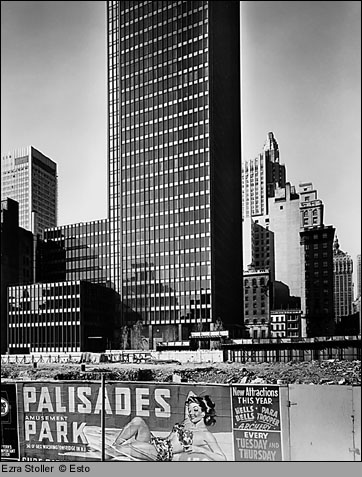
Ezra Stoller Seagram Building, New York NY, Photographed 1958, Mies van der Rohe, Architect
More of Stoller's photographic images of modernism here if you are not convinced. These suggest that modernism became more concerned with the idealization of architectural form, and forgot about creating a city that would enable a great mixing of different human experiences.
Koolhaas is aware of the double condition of runaway development and disciplinary paralysis in our cities.
Tsunami #10: some odd reactions
There have been some strange reactions to the tsunami.
An image:
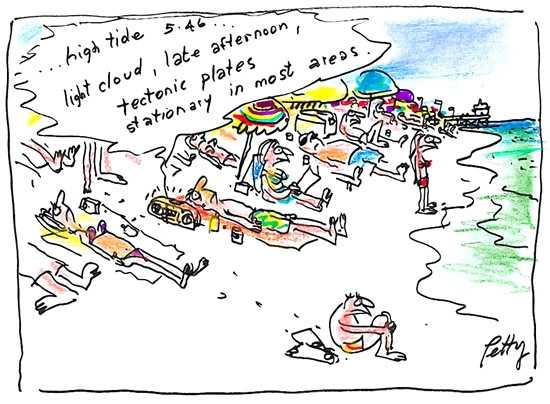
Okay that is humour. Maye a swip at the tourism industry in Thailand.
This quote is different:
"I got truly upset about the tsunami only when I discovered I knew someone who died in it. Until then, I'd been shocked and fascinated. That, though, is the more normal reaction. How many people really can't sleep for worrying about starving Africans? How many more stay awake at the prospect of a dull lunch date or a looming villa holiday with dodgy friends?"
Harry Mount, from The Daily Telegraph, should go back to watching Murdoch Television.
There is more.
It gets worse. Here is some fundamentalist Islamic reasoning why it is God's wrath for sin' by Ibrahim Al-Bashar, an advisor to Saudi Arabia's Justice Minister. He argued on the Saudi Arabian/UAE Al-Majd TV channel that the sins of the affected countries caused the tsunami:
"Whoever reads the Koran, given by the Maker of the World, can see how these nations were destroyed. There is one reason: they lied, they sinned, and [they] were infidels. Whoever studies the Koran can see this is the result…"Some intellectuals, philosophers, and journalists - may Allah show them the straight path – say this is the wrath of nature. Whoever is angry must have a soul and a brain in order to act out his anger. Does the earth have a brain and a body with a soul? They talk about the wrath of nature, or else they claim that what happened was due to a fissure in the depths of the earth, which the earth's crust could not bear. They connect cosmic matters.
"But who is the one that cracked it, split it, and commanded it to quake?! Why don't we ask that question? Who is the one that sent the wind? Who sent the floods? But they tell you that it was due to the ebb and tide, and that the barometric depressions are to blame. Who commanded them to do so?
"These countries, in which these things occurred – don't they refrain from adopting Allah's law, which is a form of heresy? Man-made laws have been chosen over Allah's law, which has been deemed unsuitable to judge people?! Whoever does not act according to Allah's law is a heretic, that's what Allah said in the Koran. Don't these countries have witchcraft, sorcery, deceitfulness, and abomination?"
Nor should we forget the right wing global warming sceptics who are saying that environmentalsit claim the tsumani was caused by global warming.
January 9, 2005
last post
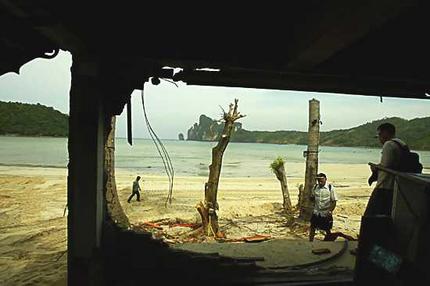
Tamara Dean, Last post ... Joe Berman, Howard Klevansky and Steven Rudman visit one of the last places where their relative Avadya was seen alive.
January 8, 2005
Why?
You would have thought that tsunami disaster could change the political dynamic in Aceh. This is an area that is rich in natural gas but remains one of Indonesia's poorest regions and it is riven by civil war.
Aceh, Indonesia as seen from the air:

Those who have flown over Aceh say they have never seen such utter destruction.It goes for mile after mile.
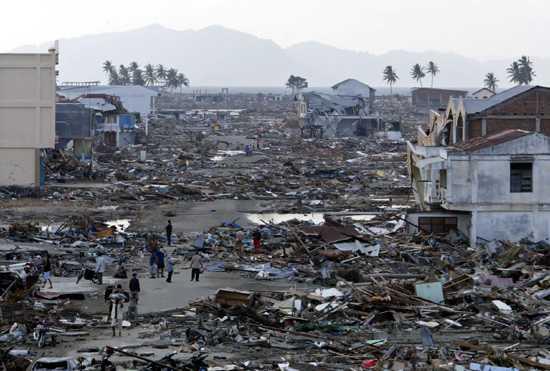
Three waves swept through on the day when everything changed.It is described as a mountain of water.
Australian scientists have calculated the size of the tsunamis, claiming that the biggest were as high as eight-storey buildings.The biggest ones hit areas closest to the earthquake's epicentre, 320 kilometres west of Medan, Sumatra. 30-metre waves hit Banda Aceh.
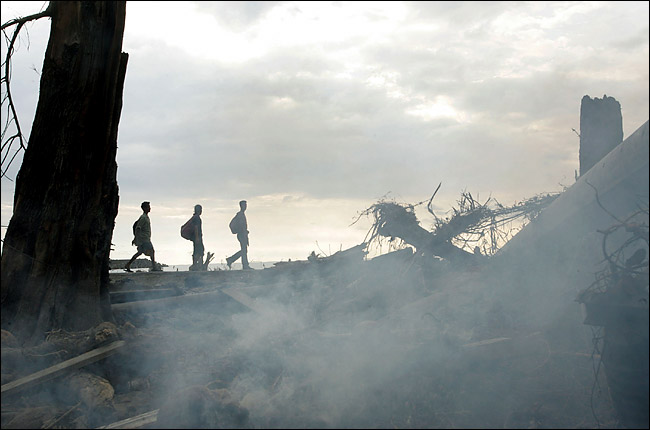
Tyler Hicks/The New York Times
Sio you can see why families displaced by the tsunami are heading to refugee camps close to Banda Aceh, Indonesia, on Friday.Those camps offer the only hope for survival.
And yet the civil war in Aceh continues. The old political dynamic remains the same.
It's a form of madness.
January 7, 2005
Tsunami: satellite images
Gleebruk village,Aceh before Tsunami,April 12 2004:

After Tsunami

Image analysis
creativity
I just stumbled into this whilst coming across this.
It opens up a world of the internet as a creative medium for thinking, collaborating, drawing, communicating, coding, talking, performing, exhibiting, imagining, visualising and writing.
January 6, 2005
Tsunami #9 lived experience
A "lived experience account" of the tsunami from a Thai tourist spot called Ao Nang, a small tourist resort town in Krabi province just east of the island of Phuket.
Called, 'Of heroism and cliches' it is by David Simmons, has a photo essay by Martin Young and is published in Asia Times. Simmons and Young work for Asia Times.
Do the images from Sri Lanka, Indonesia, India and Thailand serve as a wake-up call about how vulnerable we are to the forces of wind, rain and sea? Do we realize that some people permanently face the fate temporarily doled out by nature to the Maldives: being flooded by the sea?

Do we realize that the emission of greenhouse gases associated with industrialization and strong economic growth is causing global warming at a rate that began as significant, became alarming and is now unsustainable in the long term?
sexy skyscrapers
A design for a skyscraper in the shape of a woman's leg:

An interesting way to fuse the modern element of the machine and the traditional element of the sexy organic body.
January 5, 2005
images of destruction
Thanks to modern media technology we are spectators of calamities taking place in the countriesaround the Indian Ocean. We find ourselves overwhelmed by the thousands of harrowing images of the disaster that have been produced by the hundreds of cameras, videos and satellites in the hands of professional, specialized journalists, European tourists and ordinary people (locals).
These images and sounds living room are a quintessential postmodern experience. It diffentiates our world in postmodernity from the world of the Lisbon or Krakatoa disasters.
We find that we hunger for a more direct and immediate on the ground contact. Ceneus.com---a Sri Lankan blog--is well worth reading.
Before the waves of destruction:

Waves of destruction
After:
At ChiensSansFrontiers in Sri Lanka they say:
"42 US Marines landed in Sri Lanka yesterday and not a soul said a word. As they got out of the plane that brought them to Colombo they posed for the cameras, and smiled. Looks like they'd done the one week(!) crash course on how to smile in a miss world show. They say 1500 are on their way.We ask for doctors and they send us soldiers. How many people here think they're really here to help Sri Lanka? Can I see a show of hands? No one?"
Another side to the politics of aid.
Some images of the after effects of the waves of destruction:

This image evokes empathy for the plight of those who lost their loved ones. And:

Reuters, Indian survivors search for belongings in Nagapattinam.
Do we not make an ethical turn to compassion in relation to the suffering of others who have nothing?
This side of the politics of disaster, which is explored in The Hindu, shows the way our ethic of compassion is filtered.

Our response to the waves of images of destruction that flood into living rooms is to search for ways to select the images so as to construct some sort of meaning in the form of a story (stringing concepts together) that is based on our shocked affects to the images.The story we construct is about our sorrow and compassion for the suffering of others. We then try to act on that compassion in the best way that we can.
We then criticise those who lack compassion for those who have suffered.
We can ask: do the images awaken or undermine compassion as an emotion and an ethic?

We can also ask: do aesthetic philosophies connect image affect, concept and ethics. Or do they, like Deleuze, concentrate on effect and concept and sunder the ethics?
cultural creation
Radio Free Babylon. Sounds good doesn't it.
Check them out folks. 'Them' is an innovative media creation syndicate. There is a blog called Random Scratch.
But there is more. A sample of the music work:

Times New Romans, an album.
Great album cover. I love the insertion of the gulf course and the satellite dish amidst the ruins.
The album cover is a reworking of one of Claude Lorraine's well known landscapes featuring Aeneas,who was linked to the foundation of Rome. The particular painting is entitled Landscape with Aeneas at Delos:.

National Gallery, London
Whilst exploring the website have a listen to the music produced by Radio Free Babylon. Here is the Title track. And the lyrics.
Did I mention the comics? I love the idea of Existential Dawg, a dog with no name, who thinks too much and listens to the Stones. I hope that he can judge the trashy product of corporate rock from the good music.
Radio Free Babylon. They disrupt the everyday and the opinionated links we make between words (& art & music) and experience; the links that speak as if the world were easily translatable into a common language and experience that we all share.
January 4, 2005
Tsunami#8 Life amidst death
Indonesia 
AFP, Only a mosque stands in Meulaboh after the tsunami that hit Aceh province.
Thailand

Photographs of the missing displayed on the debris of houses in the southern fishing town of Ban Nam Khaem, Thailand.
And:

Peter Dejong, AP. Relatives of tsunami victim Ainal Mardiah, 52, carry her body through rubble in Banda Aceh, Indonesia, where 30,000 are still missing.
tropical paradises
Many European tourists head straight to the gems of south Thailand to soak up the sun along tropical beaches, dive on spectacular coral reefs and indulge in a languid, sometimes lascivious, lifestyle.Thailand is very hot right now.
These tourist areas were badly hit by the massive waves and walls of water crashing into coastal towns and beach resorts lining the Andaman coast of Phuket island, as well as Krabi and Phang-nga on the adjacent mainland, Trang, Ranong and Satun further south.
Khao Lak district in Phang-nga province was very badly affected.
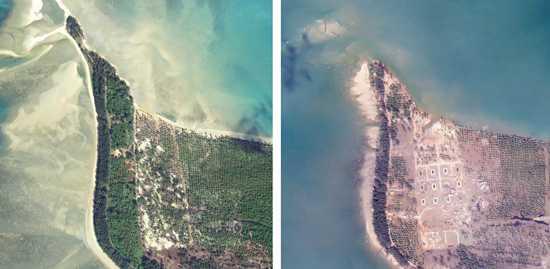
Reuters, Satellite images show the popular tourist destination of Khao Lak in southern Thailand before and after the tsunami struck.
The Indian Ocean has a significant threat from both local and distant tsunamis" and should have a warning network but has never shown the initiative to do anything. Thai officials had plenty of time to warn tourists. They reportedly played down warnings, afraid that if there was a false alarm, tourism might be seriously damages as had happened once before.When the broadcasts were beamed to tourist resorts in the country's south they underestimated the threat.
Thailand will need months to repair the damage to its lucrative tourism industry.
The Maldives may not be so lucky. Maldives a cluster of atolls in the Indian Ocean, are heavily dependent on travel and tourism. It was badly damaged by the tsunami, which left at least 117 dead or missing and caused damage that is estimated at more than 1.3 billion dollars -- or, twice the nation's gross domestic product.
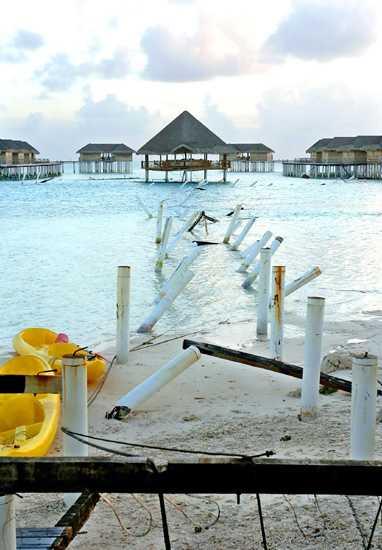
AP
How then to lend a hand? Getting the tourists back is one answer.
However, the Asian tsunami has delivered unto the Maldives that nation's worst nightmare, a disaster foretold: being drowned by the sea. As this is a country whose highest point is just 7 feet above sea level, global warming could, over time, produce destruction similar to that wreaked by the tsunami. The atmosphere warms, the sea grows hotter, water levels rise, and the Maldives suddenly discover that they are no longer a cohesive population of mostly Sunni Muslims.
The Maldives are in danger of being transformed into an underwater coral reef.Hence their concerns.
January 3, 2005
tsunami #7: Christian afterburn
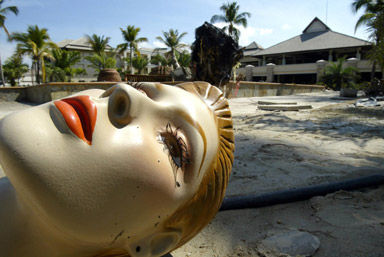
The fundamentalists are now openly saying that the tsunami disaster is the will of God sitting in judgement on the sinfulness of humanity.
So says Phillip Jensen, the Anglican Dean of Sydney,who holds that a sovereign God rules all things. He said disasters were part of God's warning that judgement was coming. When asked if the tsunami was the will of God, he replied:
"Yes. The will of God in this world involved his creation of the world, but it also involves his judgment upon the sinfulness of humanity and it also involves his salvation of people through the death and resurrection of his son. And so all the beautiful things we see in this world are an expression of his creative goodness to us and all the disasters of this world are part of his warning the judgment is coming, and both these things should focus our mind on the death and resurrection of his son and how he saved us."
Judgement is coming? Were those living on the shore of the Indian ocean punished because they were more sinful than those in he West?
Similar sentiments were expressed by Amjad Mehboob, the chief executive of the Australian Federation of Islamic Councils:
"We believe that whatever happens in the world, it happens with the sanction of God, and nothing can happen without his sanction. No one could say whether the victims had brought the disaster on themselves, only God could know that."
God sanctioned the tsunami!
And Rabbi Mordechai Gutnick, president of the Organisation of Rabbis of Australia, said to question God was to question with our finite minds His infinite wisdom. "What we consider tragedies are part of His plan, and the final result is what counts." The world runs to God's plan.
Presumably,the reasoning is this. God rules the world. If God is warning us, then it is either because human beings have stayed from God's teaching, or they are wicked and done evil. Evil ones need to be punished. Therefore, they need to be punished by a wrathful God.
So God send the tsumani. That is the inference. Hence there is no benevolent God guiding human affairs.It is Lisbon all over again. The Christian fundamentalists have a credibility problem because Christians believe that God is all-loving and that his compassion and love reach out to all, especially to the most helpless and abandoned.
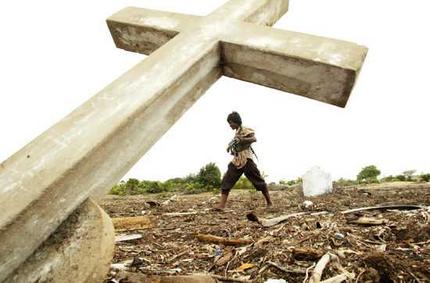
Jason South
Their views are really the counter enlightenment, and it should be treated as such. The values they express are fundamentally at odds with the education in our universities.
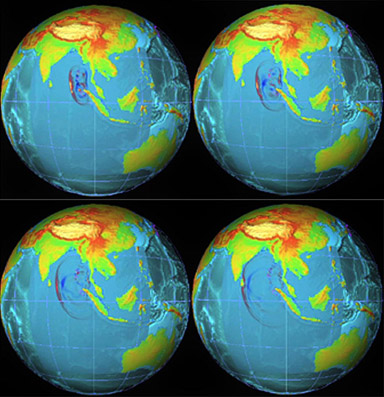
The explanation given there is that the tectonic plates off Sumatra, collided, causing an earthquake and then the tsunami.There was compression between the Indian and Burmese tectonic plates. Scientists would argue that one plate that comprised the landmass from India to Australia has broken up into two. The initial eruption happened near the location of the meeting point of the Australian, Indian and Burmese tectonic plates.
That is the explanation for the suffering caused by settlements being swamped by then giant waves of the tsunami, and then turned into a nightmarish landscape of sludge, flattened homes and tangled corpses.
So what do we do about the clash of biblical values with the values of our universities? You can imagine the religious fundamentalists setting out to remodel our universities to "balance" college courses with the religiously correct rightwing views based on biblical values.
Christians are being evasive about tackling the fundamentalists. Barney Zwartz, the religious editor of The Age, says:
"Theodicy discusses suffering as a theoretical abstraction to be justified by logical inference from an abstract philosophical deity who is reduced to a set of attributes: perfect goodness, perfect knowledge, perfect power. This philosopher's god is a metaphysical creation of the Enlightenment for purposes of argument - the person and teaching of Jesus, for example, does not enter the discussion."
This is a reference back to Voltaire and the Lisbon earthquake.
Barney misses the problem.It is the fundamentalists who are talking in terms of the judgement of an powerful, wrathful God, and who forget about the compassionate ethics of Jesus.
Update
Rowan Williams talks more sense. A post on theodicy by Mark Bahnisch over at Troppo Armadillo.
January 2, 2005
Tsunami: Aceh, on the ground
Satellite image of coastline of Aceh:
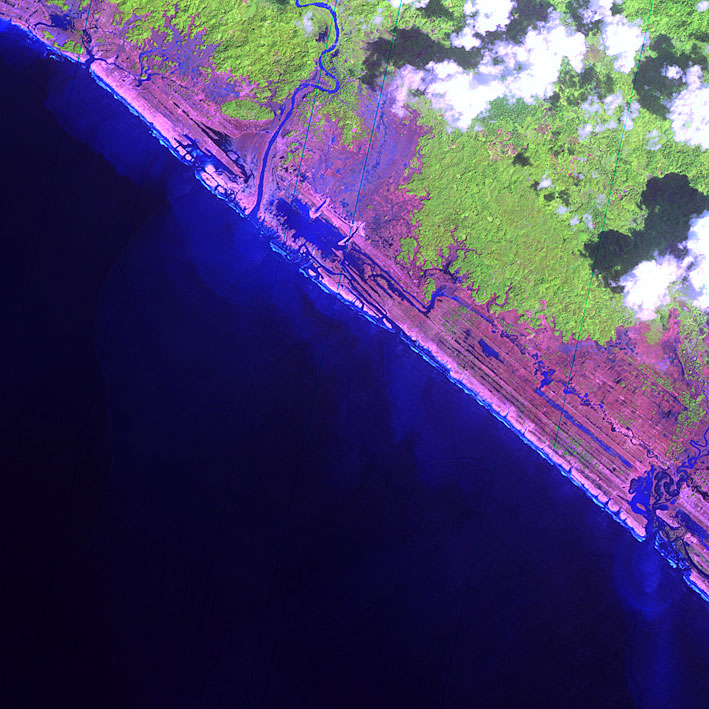
National University of Singapore
It shows the extent of the damage along the coastline.
The reality of the devastation on the gound:
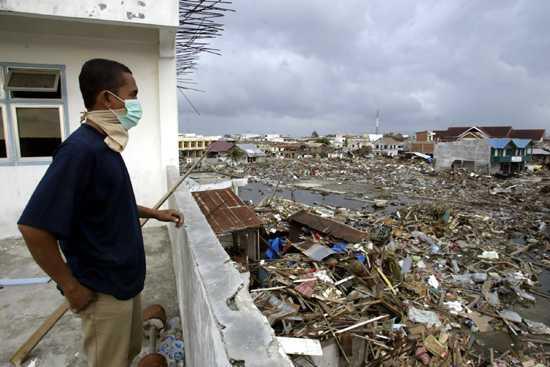
AP, Muhammad Sayati surveys the devastated commercial district of Banda Aceh from the terrace of his uncle's damaged store.
One week latter and there is no sign of any ability to clear the massive amounts of debris and black mud in this isolated town.
But relief has arrived
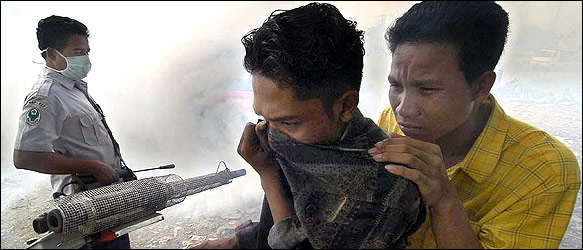
Getty images,A health official, left, fumigating near victims' bodies in Banda Aceh.
January 1, 2005
Asian Tsunami: Satellite Images of Banda Aceh
It is now clear that Banda Aceh in the north western part of the island of Sumatra, Indonesia has been hit the hardest by the earthquake and the subsequent tsunami.

National University of Singapore
The satellite images below show the extent of the damage.
Before the tsunami

After the tsunami


Some commentary on Aceh can be found over at public opinion. This is devastation on a large scale.
Tsunami in Sri Lanka: Three Images
The Christian fundamentalists see the tsunami as the wrath of God, a harbinger of things to come; a judgement from God for sins committed by human beings. There's a revengeful God pulling the levers of nature to punish the sexually wicked.
See Paul Kidd for more on a Christianity that has lost any sense of no compassion for the suffering of others.

Jason South, Palm leaves inscribed with the names of the dead mark the sandy graves of 64 residents of the fishing village of Manalkadu, Jaffna, on the southwestern coast of Sri Lanka.
The whole village was destroyed by the tsunami.

Jason South, A skull uncovered by the tsunami that hit the southern coast of Sri Lanka.
A brief account of Tim Costello's visit to Galle in Sri Lanka.

Jason South, Hundreds of bodies lie in a makeshift morgue in the hospital in Galle.
Non religious commentary about the tsunami can be found here.
Update:2 Jan
Extended commentary by Tim Costello, chief executive of World Vision Australia,in Sri Lanka