December 31, 2004
MOMA Revamped
Yoshio Taniguchi has revamped MOMA.Yoshio Taniguchi has designed a new building of classic white boxes, around the old facade which doubles the size of MoMA's galleries. It is a self-effacing building that rejects the status of icon.

Computer image courtesy MoMA, The Museum of Modern Art,New York.
The result is a grand and elegant creation that incorporates the old façades on 53rd Street but completely transforms the interiors and the garden façades on 54th Street. It still is a building of straight lines and galleries as classic white boxes.
MoMA is famous for its modernist narrative created under Alfred Barr One entered Modernism through Post-Impressionism. All roads led through Cubism, and all began with Paul Cezanne. Art encompassed life, including the art of design, and it culminated in postwar America.
MoMA had two related purposes: to represent the history of modern art and to stay in touch with the most recent contemporary work.
December 30, 2004
Asian Tsunami: nature v humanity
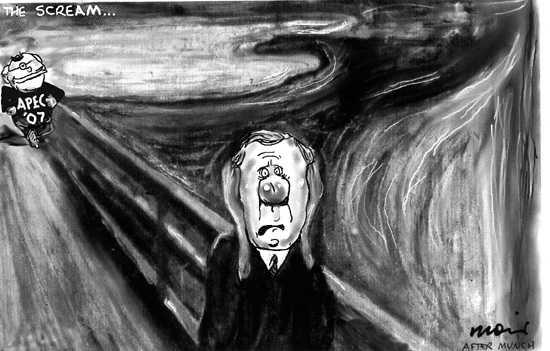
This cartoon reverses the modernist conception of human beings as the masters of the universe, or the controllers of nature, who can bend nature to their will with a flick of their glittering technoscience.

Moir
The earthquake and tsunami highlight the modernist illusions of whipping nature into shape. Nature has real powers of its own.
A pity people do not take the ecological effects of greenhouse emissions and global warming on their region seriously.
More commentary here.
comment spam
Due to heavy spamming over Xmas the file mt-comments.cgi has been disabled. So the comments function is turned off. No comments can be made, nor any trackbacks.
We are currently in the process of a long overdue upgrade to Movable Type v3.14 plus MT-blacklist as a first step to deal with the pernicious comment spam problem. It would appear that there has been a targeting of MT, due to the popularity of its publishing system, by the spammers.
I've been waiting for Movable Type to fix the bugs in their MT-blacklist software that resulted in escalating comment spam that caused extreme server loads. Movable Type has been working on the problem.
I'm not sure whether the spam comment problem has been solved. People are voting with their feet and moving on --to WordPress.
In the meantime--until the upgrade has gone through--comments can be emailed to me and I will incorporate them into the post as an update.
Update
The upgrade has been successful. Problems have been encountered with installing the Blacklist plugin.We will work on that tomorrow.
December 29, 2004
human tragedy
An earthquake happens in Sumatra in Indonesia. That tectonic movement triggered a tsunami, which then crashed into the shorelines of seven countries in the Indian Ocean, causing havoc.

Hellmut Issels
Debris, wreckage, devastation and human suffering is everywhere on coastline after coastline of India, Indonesia, Sri Lanka and Thailand.
The death toll has topped 50,000 and is rising.
Update:1 Jan
3 days latter and the death toll has tripled to 150,000 and still rising. The vast majority of the deaths are in Indonesia and Aceh which are the least assessed areas because of logistical constraints.
December 28, 2004
Sacred heart
As we know faith-based fundamentalisms have a very Manichean view of the world.
The Christian version of good and bad is based on the Bible that is read literally. It gives us the Sunday School God that blesses our nation above all others and the small-town, Bible Belt moral agenda.
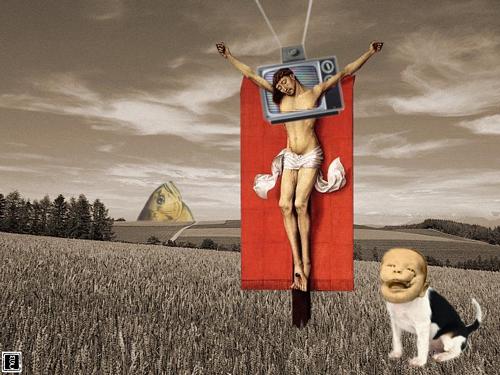
I interpret the head of Christ inside the television set as the new American-style fundamentalist Christianity, which repudiates the Enlightenment and transforms religion into a right wing extremism of blind patriotism based on mythology about war.
That extermism constructs our enemy (described as Islamofascism, Islamist extremism, global jihad) is seen to have no rational agenda beyond the desire to destroy the United States Britain and Australia out of remorseless, theologically-inspired hatred and pathological loathing for their values. The enemy is the underground monster threatening the survival of Western civilization.
This kind of religion provides the cliches that undewrites the patriotic script handed to us by the mythmakers.
December 27, 2004
Xmas joy
Whilst the rest of the nation splashes out in a post-Xmas splurge Adelaide shopper's desires remain frustrated. The shops in South Australia will be closed until Wednesday.
Tis Xmas joy elsewhere. The cash registers are ringing more than ever.
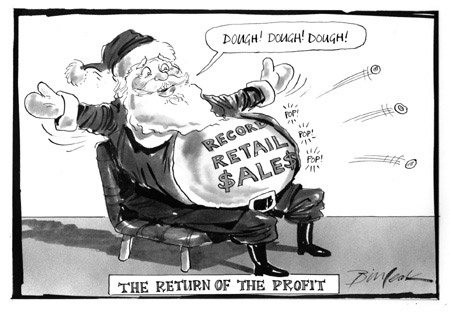
Leak
There is a change in consumer's buying pattern.apparently. There is a bigger emphasis on post-Christmas shopping than on pre-Christmas purchases.The latter tend to be smaller, whilst the big items are puchased post-Xmas.
Most of it goes on the credit card.
December 25, 2004
John Butler Trio
I was given a CD of the John Butler Trio's 'Sunrise over the Sea' for Xmas:

Tom Walker, Rehearsing for Album, 2002
I cannot play the CD at the shack as we do not have a CD player. So I will have to wait until I return to Adelaide. From the little I've heard on the television this folk/blues rock/reggae mixture of music and politics works well. Apparently they also like letting the music wander like on like the Grateful Dead. Like the Dead the word is that the John Butler Trio is better live than in the studio.
A review of a gig. A deflationary US review of the album.
December 24, 2004
Hollywood's global reach
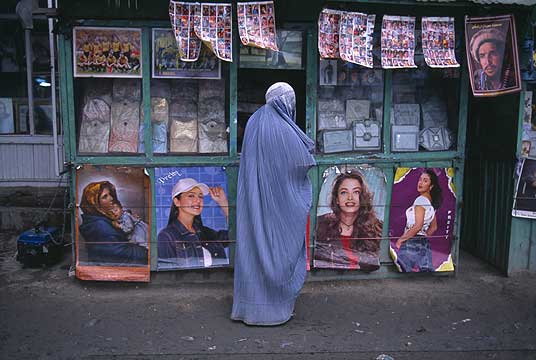
Steve McCurry a street scene in Afghanistan
The contrast here between modern and premodern is graphic.
I notice the reach of Hollywood when I flick through free-to-air television. Most of the programmes on free-to-air are American sit com or crime and punishment (eg., CSI or Law and Order). These shows by numbers appeared to be churned out according to a rigid formula by specialised production houses. The US culture industry must be working 24 hours a day turning out the product.
Free-to-air has sunk pretty low in terms of quality. It is becoming more and more what it actually is: a commercial entertainment platform for advertisers to sell product by spinning dreams for consumers.
December 23, 2004
cartoons as critique
Two cartoons as a form of cultural critique that work to develop a culture of resistance to what is.
A political one from Britain:
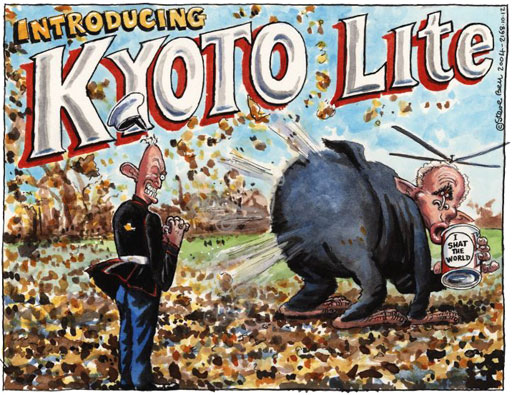
This is much ruder, tougher and more irreverant than the cartoonists working in Australia.
Some commentary on climate change in Australia. Some commentary on US politics and climate change.
Another kind of critique from America:
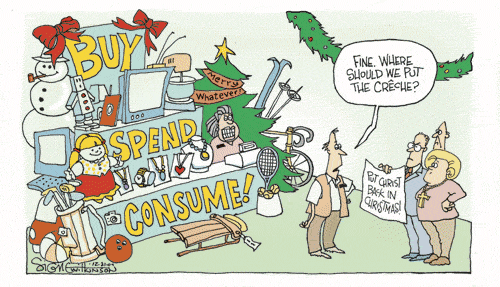
Though understated this cartoon is very effective in showing the banality and commercialism of American consumer culture around a religious event in a Christian nation. It highlights the contradiction between the market and culture and gently critiques those who think that both go together like a hand and glove.
December 22, 2004
in a tailspin
Tis getting close to Xmas

Moir
I know its crazy but the national security state is becoming paranoid.Terrorists threats are seen everywhere. Everyone is a suspect. The borders are constant surveillance. We live in a fortress suspecting those inside and outside.
December 21, 2004
Grey Album#2
Remember Danger Mouse and Grey Tuesday? Brian Burton's Grey Album represented a daring "mash-up" of Jay-Z's The Black Album and the Beatles' eponymous 1969 work (popularly known as The White Album).

Dangermouse, The Grey Album.
We now have an article by Philip Gunderson in Postmodern Culture. Philip says:
"Grey Tuesday was an unqualified (and unauthorized) success. Disobedient consumers, who had not been given the option of purchasing the album through "legitimate" commercial channels, downloaded in excess of one million Grey Album tracks. Had it been available for purchase at a brick-and-mortar store, such numbers would have put the album firmly in Billboard's Top Ten."
The context is music fans being fed up with the high prices (and outright price-fixing) of commercially available music, opting to share music files via peer-to-peer file sharing networks. In response, record labels are attempting to coerce music fans back into the exchange relationship.
What then is the significance of this music consumer revolt around the Grey Album?
Philip Gunderson says:
" One could say that consumers have taken over the distribution of musical goods and services to the detriment of those who have heretofore controlled the means of musical production. The near-instantaneous, viral replication of information on a global network renders moot the legal formalities of trademark and copyright. The traditional radio station, with its fixed formats and mind-numbingly repetitive playlists, has been effectively displaced by technologies that allow music fans to specify what they want to hear and when they want to hear it."
Does this expess a mutation in the organisation of noise, in the nature of sounds and in the technology (a free exchange via MP3) that is used to order noise with sense and so make music? Is it a new mode of music that Jacques Attali talks about?
An interview with Jacques Attali, author of Noise: The Political Economy of Music
December 19, 2004
Another example of contingency in human affairs.

Presumably the US smart bomb did not do what it was supposed to do.
December 18, 2004
life in a war zone
Everyday life is marked by luck.

Stephen Ferry, Bullet hole from stray bullet, with a view of downtown Medillen, Colombia, 2002
Such a bullet just happens.
We could easily be hit by a stray bullet in a war zone. The controlling power of reason to make a liveable life does not take away the role of luck.
Can we make ourselves immune to luck?
December 17, 2004
the endless highway to the promised land

Don Bartletti, Bound to El Norte Teotihuacan, State of Mexico, Mexico, September 11, 2000
Each year, en route to the United States, thousands of migrants like this Honduran boy stow away through Mexico on the tops and sides of freight trains.
December 16, 2004
cultural conservatism
When I saw this Leunig cartoon cultural conservatism popped into my mind.

Leunig
Cultural conservatism's theme is the decline and twilight of Australian culture, as evidenced in the deterioration of literacy, the pervasiveness of anti-intellectualism, political correctness, postmodernism in the academy, and the mind-numbing lack of thinking.
How do we preserve culture?
Life would be better if everyone just studied the classics. Why the classics? The classics are far superior to all other texts.
My reaction? I remember an epigraph from Bob Dylan's 'All Along the Watchtower': "There must be someway out of here…."
December 15, 2004
a plug
The news
The Tarkine book
An image in the book by Robert Gray

Robert Gray, Rock formation, Near Pieman R, Tarkine Wilderness, Tas
Support the Tarkine, one of Australia's most pristine and endangerd wilderness areas. The trainforest is under threat from logging mid next year when a moratorium on logging in the Tarkine is lifted.
Buy the book from WWF for Xmas.
December 14, 2004
appearances and representations
From 1968?

Situationist International, Abolition of alienated work.
The poster looks back to Marx.
Now a quote from a favorite underground text (1967) of our innercity, winebar media radicals:
"When the real world changes into simple images, simple images become real beings and effective motivations of a hypnotic behavior. The spectacle as a tendency to make one see the world by means of various specialized mediations (it can no longer be grasped directly), naturally finds vision to be the privileged human sense which the sense of touch was for other epochs; the most abstract, the most mystifiable sense corresponds to the generalized abstraction of present day society." Guy Debord, Society of the Spectacle (#18)
The 1991 Gulf War was seen as one such spectacle. I would suggest the Melbourne Cup is another example. The culture industry another.
But Debord goes further. His main argument of his Society of the Spectacle is focused on consumer/media/information society. He argues:
"The whole of life of those societies in which modern conditions of production prevail presents itself as an immense accumulation of spectacles. All that was once directly lived has become mere representation."
This quote refers to our media and consumer society, organized around the consumption of images, commodities, and spectacles/
Does not the modern global economy the contemporary global economy maintain, perpetuate, and expand its influence through the production, presentation and manipulation of representations. Is not our lived world of daily life mediated by images? Has not capitalism invented a visual form for itself?
A review The reviewer remarks that it may be Greil Marcus, in his book, Lipstick Traces, who has done the most in recent times to promote the visibility of the Situationists.
"Lipstick Traces follows the history of punk rock back to the tradition of Dada and situationist theory. Both Jamie Reid (creator of much of the graphic "look" of punk) and Malcolm McClaren (self-styled "creator" of the Sex Pistols) acknowledge the influence of the SI on their own work, and the legacy of punk rock may well be the last great youth movement which involved not only a musical revolution, but total social critique (with a soundtrack)."
Alas, I have not read Lipstick Traces.
While Marx focused on the factory, the Situationists focused on the city and everyday life, supplementing the Marxian emphasis on class struggle with a project of cultural revolution and the transformation of everyday life.
December 13, 2004
another eye?
Reverence for place

David H.Gibson, from Ireland Portfolio
A different kind of eye? Another kind of looking?
December 12, 2004
the eye, base materialism, and the informe
"The visual is essentially pornographic."
So says Frederic Jameson in his Signatures of the Visible (London, 1990)>
That expresses contemporary cultural theory's mistrust of visuality very clearly. It is mistrust that construes the world as a spectacle to be observed from afar by a disembodied mind. It is a gaze that that petrifies and objectifies. So I guess that we need to talk in terms of a hegemonic perspectivialist regime that transfixes the Other as an insect on a pin. Hence the disembodied gaze of the eye of the mind.
The central modernist question of form of "good" or "significant" form (the main agenda of modernism) was premised on various optical theories that underpinned the single-minded focus on visual form. These presupposed a notion of the eye as a purely abstract organ, cut off from the bodily pulses to which it is connected. A relationship is established that excludes everything but the axis between the eye and framed forms mounted vertically on the wall.
Are there not gazes that “care for”? Embodied gazes?
The counterimpulse is the Bataillian one toward "impurity and obscurity", which is developed in order to pursue the "critique of visual primacy". This is a valorization of the low and dirty and rejected, such as eroticism and the unconscious. This "base materialism" works in terms of the notion of informe, which describes workings of "base materialism" as pure destructive action; the informe is what indifferenciates and confuses the world of meaning and form and its clear-cut differences.
December 11, 2004
beyond mirroring
Most of the renewed focus on vision over the past decade understands itself as a critique of representation. This critique has primarily taken the form of a critique of the transparency and naturalness of vision--- what philosophers have called the mirror of nature.
At the philosophical level the basic position of the critique of representation involves a rejection of the proposition that the fundamental relation of a person to the world consists in the relation of the content of an individual mind to the world of objects, events, and states of affairs as represented by that content.
Instead, it is held that the most fundamental variety of human action consists in the apparently unthinking, skilled action that makes up much of our everyday activities, and that does not require mental guidance or intervention for its successful accomplishment .
December 10, 2004
political cartoons

The context and the background.
A controversial cartoon.
An academic account of political cartoons:
'In defence of the political cartoonists’ licence to mock', by Haydon Manning and Robert Phiddian of Flinders University in the Australian Review of Public Affairs, Vol. 5, No. 1, December 2004.
This is a response to an earlier article, 'Cartoonists and Political Cynicism', by
Michael Hogan, University of Sydney in the Australian Review of Public Affairs, Volume 2, Number 1, July 2001
December 9, 2004
personal
This is me:
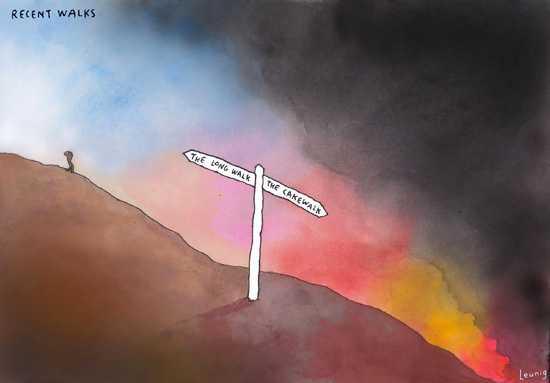
Leunig
I always take the long road. I never really arrive anywhere. I'm tired of all the walking.
Maybe that is life. Just being tired.
December 8, 2004
tis strange
The National Party in Australia meets the Prague Literary Review.the common ground is Pasolini's Salo 120 Days of Sodom.
What caused the banning of this film in 1976 in Australia.
Was it the depiction of fascism-cum-sadism to close too home? Was it the tough anger at capitalism's ever-increasing power? Was it the homosexuality? The abuse of power? Was it the horrible world of de Sade, where there is no place for compassion and an inversion of normal human values and exchanges? Was it the sexual violence? The use of pornographic elements.
Then Salo was unbanned in 1993.
December 7, 2004
December 6, 2004
December 5, 2004
Rolling Down the Lost Highway
I'm on the road to Canberra in an hour or so and I have run out of time to post.
So Have a read of this. It is an article about Norman Klein's, The History of Forgetting: Los Angeles and the Erasure of Memory, from vol 2.(2000) issue of Modernity: Critiques of Visual Culture.
Klein characterizes the Los Angeles cityscape:
"...as a "topology of forgetfulness." Klein uses the term "erasure" to denote the city's tendency to displace, deny, or unrecognizably alter its past. His argument attempts to illustrate the manner in which social as well as natural forces promote a disappearance of history. The transformation of farmland to housing, natural disasters which constantly redefine the landscape, and individual efforts to re-shape one's self are several examples Klein uses to illustrate the city's status as a space without a past."
Sounds like Sydney to me.
December 4, 2004
Eureka
Australians yesterday commemorated the 150th anniversary of the Eureka Stockade.
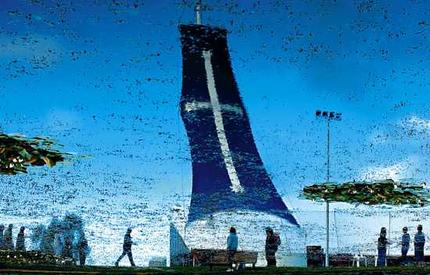
The Southern Cross flies over yesterday's dawn service in Ballarat, Victoria.
According to legend the Southern Cross flag was hand-stitched by women on the goldfields from their petticoats and was raised above the stockade in defiance of the British.
The violence at Eureka goldfield in Victoria, near the city of Ballarat, was the country's first and only armed uprising against colonial tyranny. In 1854 a group of 120 angry miners made a stand against crippling taxes enforced by an over-zealous police force. They built a ramshackle blockade, raised the Southern Cross and confronted red-coated government troops. When the soldiers stormed the camp two days later, they easily overwhelmed the poorly armed rebels. 30 diggers and five police were killed.
Courts in Victoria refused to convict 13 men charged with high treason. Mining licence fees were scrapped, miners were given the vote and the colony soon acquired a democratically elected parliament.
This is a controversial commemoration because the flag has anti-establishment, republican connotations. The Southern Cross did not fly over federal Parliament in Canberra this week, but it could be found in the building. It had a token presence in the foyer of two of the building's four entrances--the Senate and the House. However, the flag was hoisted above every state parliament as part of the celebrations.
The Eureka flag is a political sign. Why not adopt the Eureka flag as our national flag?
The events of Eureka should be restored to its previous position as a central legend of Australian nationalism, the birthplace of Australian democracy, and a reminder of the link between our democratic traditions and Australia becoming a republic.
December 2, 2004
dunno
I came across this whilst wandering through the back issues of The Age..
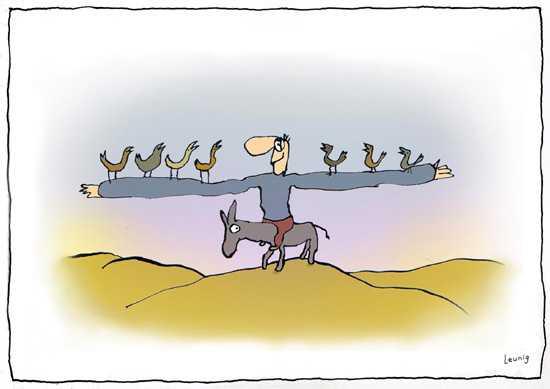
Leunig
I remembered discussing it with friends over morning coffee earlier in the week, when we were discussing Australian cartoons vis-a-vis American ones---it was generally felt that Australian cartoons have more bite than American ones. The latter are dummed down so as not to upset the advertisers was the argument.
That used to be the case in Australia aroung the time of the cancer cigarette links were going public.
This cartoon was mentioned as an example of the reader sometimes not being able to figure out what is going on.
I find it one of those dunno ones.