November 30, 2004
summer+bushfires
Summer has hit Australia. There have been high temperatures (38-42 degrees) in south-eastern Australia. That heat means bush fires.
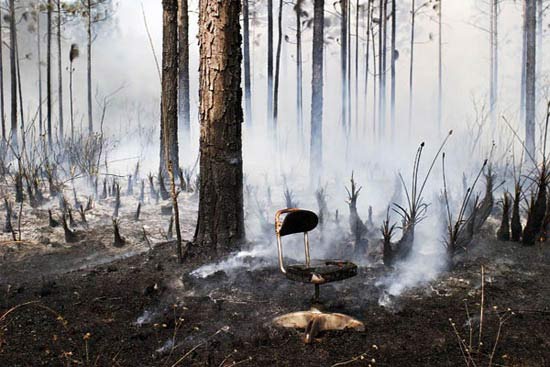
Michael Julius, In the brushfire 2, 2004, File Magazine
The heat means death if you do not take care.
November 29, 2004

November 28, 2004
Cities: signs of protest
This article by Adele Horne is about the contradictions in urban consolidation in Sydney, but it applies equally to other Australian cities.
Urban policy in Australia favours a densely-packed city in the interests of efficient land use. Governments find it more efficient to provide water, sewerage and especially public transport if we lived closer together, and not in an suburban sprawl with its backyards, plenty of space, and two cars in the garage.
What has happened? Adele describes it well:
"We watch old residential neighbourhoods demolished and blocks of units rise in their place. Vacant sites are put to use, not as parks, but for medium-density housing. We can't complain. In fast-growing Sydney, people need housing as close to the city as possible. But the compact between government and citizens was 'you accept the flats and we will look after your neighbourhood'. The compact is breaking down. The deal is proving one-sided."
In Sydney that means urban consolidation has outstripped the ability of the rail or bus system, or the responsible ministers, to cope. People still drive their cars because usually it is quicker and more reliable than an ailing public transport system. State governments refuse to invest in light rail or public transport and they prefer to make our cities more car-dependent.
The cars are eating our urban life in the inner city.
Apart from Western Australian Labor Government, which has reversed the old ratio byspending $5 on public transport for every $1 on roads, The legacy of Labor state governments is new roads for more cars.
November 27, 2004
A galaxy?

(Image: Opte.org)
No.
It is Barrett Lyon's famous graphical visualisation of the internet. The bigger version of image is Here. Each colour on this Opte map represents a region; North America, blue; Europe/Middle East/Central Asia/Africa, green; Latin America, yellow; Asia Pacific, red; Unknown, white.
It is a part of project to make a visual representation of a space that is very much one-dimensional, a metaphysical universe. It maps the entire internet in a single day.
Barrett Lyon, a networking engineer based in the US, says:
"After some testing and beta code I proved that with enough bandwidth it is possible to scan the entire Internet with a single computer. The 1/5th of the Internet map only took about 2 hours to create, yet it generated nearly 200k/sec of traffic and put my machine at a load of 60+ while scanning. If you apply the math, the entire internet would take about 10 hours to scan and another hour or two for the visual map output."
Visual culture in the twentieth century has been dominated by photography and cinema as a “cultural interface”. This has been seen in terms of a technological organization of space and perception, of structuring time and narrating stories—whose basis, many have argued, is a photographic ontology.
In the past 20 years digital technologies have come more and more to replace the photographic in the creation of film images and images. As William J. Mitchell says "the new graphic currency that digital imaging technology mints is relentlessly destabilizing the old photographic orthodoxy, denaturing the established rules of graphic communication, and disrupting the familiar practices of image production and exchange."
Some resources
November 26, 2004
political imagery
An iconic image?
I think it is.
The context is a lonely, sombre Labor Opposition leader seen walking towards his meeting with the ALP National Executive. Mark Latham is exposed, isolated and alone, as he heads to yet another debriefing on Labor's crushing loss.
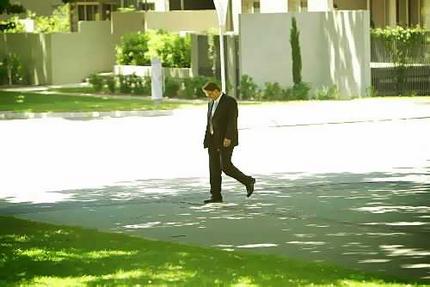
Penny Bradfield, Mark Latham on his way to the national executive meeting in Canberra yesterday.
At the antional executive meeting Latham blamed Labor's fourth consecutive election defeat on state issues and in subsequent days they all jumped on him.
The image was picked up and reworked by Leunig.
November 25, 2004

November 24, 2004
Lloyd Rees/in Melbourne
I had a day in Melbourne today in and I was able to find an hour or so to walk around my old haunts in Fitzroy and Collingwood. I had no interest Lygon St Carlton, as the bohemian kind of scene of the 1970s had long gone, when it went upmarket and became very boring. Brunswick Street become the bohemian centre of Melbourne, then it attracted money and people, and the rents went up.
I peeped in here and saw some Lloyd Rees works on paper.
I did not have time to go inside and have a close look.

Lloyd Rees, South Coast, Pastel/Mixed Media
The bohemia culture of writers, artists, musicians and poets with its roots in the 1960s was still there in Carlton, Fitzroy and Collingwood. From what I could make out these areas have seen significant increases in property values, particularly residential and commercial rent. Commerce has descended and the inner city bohemian culture that has nurtured so much creative activity looked a thin. Was commerce killing it? Was it the drugs and prostitution around the Commission flats?
November 23, 2004
I as Eye
Courtesy of American Samizdat, early version

Elliott Erwitt, Buckminister Fuller in Helicopter, unknown date
This presupposes the eye--I see--- that collects all the impressions that are unified by the I as Eye.
Was the eye the dominant sense organ of the twentieth century?
November 22, 2004
two images
new online photography magazine called File. Have a look. I did. I came across this:

The link is courtesy of Cameron Stephen over at notReality, a photoblog

Cameron Stephen, Swirl
I have think it is the image makers in our culture who are working in a new way of thinking: one that is more open and multiple and does not acknowledge hierarchies, beginnings and endings, or segmental and oppositional divisions. It It is a thinking in terms of assemblages.
Have another look at Rustfetish. What you see is difference, heterogenous elements coming together.
Is this not a rhizomatic way of thinking?
November 21, 2004
Richard Avedon#3
'Tis a fine portrait:

Richard Avedon, Marilyn Monroe, 1957, Gelatin silver print
Marilyn is a cultural image of what men desired. Their fantasy is of a sexual life freed from the constraints of an imprisoning and empty suburban life. It is one of impossible desire.
Then there was Marilyn the person, who performed in public for the men.
We can interpret the photo as being surrounded by layers of images. It is part of an archive of images of Marilyn (past and present) and of others that are stored in our culture; with new images being constantly generated from the archive. So we come understand our past, present and future through an (increasingly virtual) image world that surrounds and enframes us.
Our experiencing events critically in the present is made possible by our faculty of judgment that is informed by public knowledge and the image making apparatus.
To understand contemporary culture it is necessary to develop an image culture that allows us to jump historical layers of time as well as between actual and virtual.

Maddona, Don't Tell Me, video clip
We need to find the tools to enable us understand the interplay between virtual and actual.
November 20, 2004
the politics of culture
Courtesy of Uggabugga. A new seal for the US Department of Justice:

Translation: the end justifies the means.
This is a Justice Department under John Ashcroft that dumped the liberal distinction between religion and the state and trampled over the rights of American citizens in the name of fighting international terrorism.
November 19, 2004
Richard Avedon#2
I'd ignored Avedon in recent years. I had considered his work glib and superficial. Not this time.

Richard Avedon, George Engleback, Retired Farmer, Republican Delegate, Hillsboro, Missouri, from Democracy 2004 series
Definitely not this time.
November 18, 2004
Richard Avedon
Richard Avedon's portraits have filled the pages of the America's magazines fro many a long year.
His photographic reputation was earned as a fashion photographer but his greatest achievement have been his reinvention of the genre of photographic portraiture. He is seen as one of the premier American portrait photographers.
The New Yorker has published an unfinished portfolio of the work of Richard Avedon.
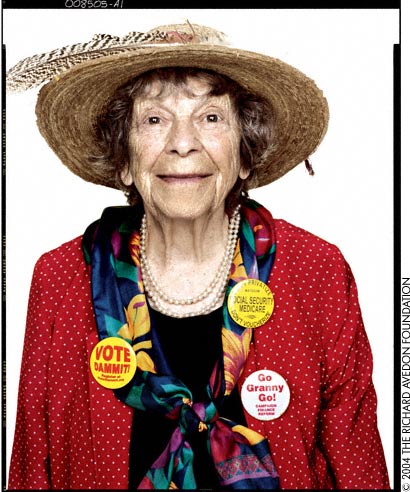
Richard Avedon, Doris (Granny D) Haddock, 94, US Senate candidate, from Democracy 2004
Doris made a year long walk across America to rally support for election reform. I just love the Go Granny Go button.
There was a special exhibition of his work at Museum of Modern Art.
November 17, 2004
the picturesque
The explorer's eye was not an innocent eye: it was culturally informed and his vision of the new space of Australia informed by a constructed vision.
An example of the constructed vision was the picturesque. It sees the landscape as a frame for aesthetic appreciation.
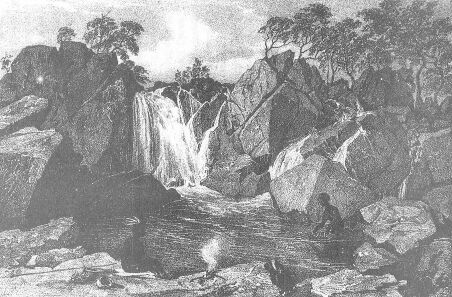
This illustration in Mitchell's explorer journal is constructed within the conventions of the picturesque.
Sir Thomas Mitchell, PLATE 37: Cobaw Waterfall with Natives Fishing, Three Expeditions into the Interior of Eastern Australia, Vol 2
In the picturesque views are seen as being artistic but containing elements of wildness or irregularity, with the picturesque being distinguished from the sublime and beautiful. In colonial Australia the picturesque (often park-like scenery) included the suggestion that the land was adapted to European inhabitation and agriculture--for the sheep runs of the pastoralists.
Aesthetics is aligned with economics.
November 16, 2004
The cartographic eye
I'm on the road. So postig will be light. I came across a book called The Cartographic Eye by Simon Ryan. It was written nearly a decade ago.
Glancing through it I saw that it was about how the early explorers saw Australia. They saw the space of Australia in terms of Empire: space was a universal, measureable and divisible entity that is out there as a natural state. This space was seen by the authoritative and knowledgeable observer.
The explorer, as the authoritative and knowledgeable observer, is seeing the new land for the first time. The explore accurately describes the new land that he sees.
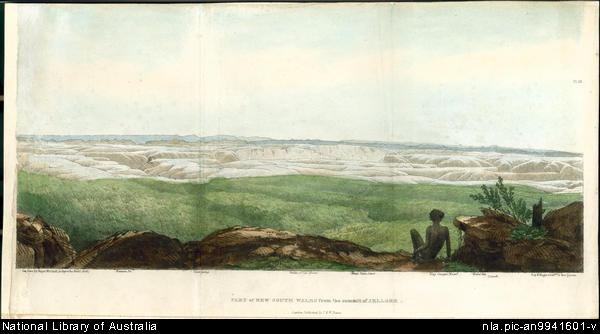
Sir Thomas Mitchell, General View of Sandstone Districts from the summit of Jellore, in Three Expeditions into the Interior of Eastern Australia, Vol 2.
The explorer's eye is a solar eye, an elevated eye looking down on the space before him. The explorative gaze is a mastery of space that is within the colonial enterprise of finding suitable land for grazing and cultivation.
November 15, 2004
Francis Bacon#2
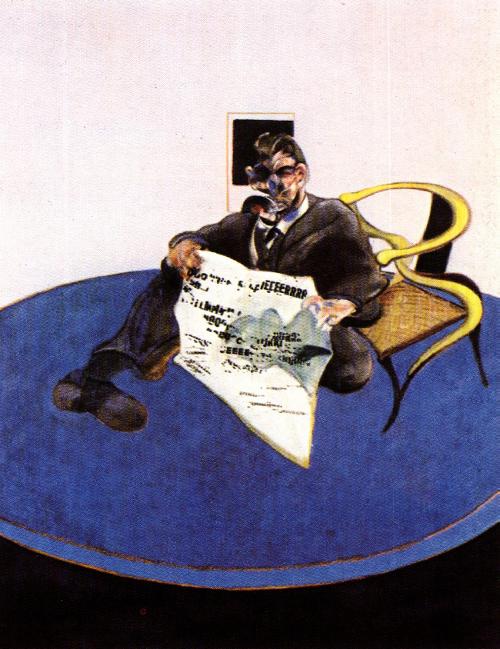
Francis Bacon, Study for a Portrait, 1970
From Daniel Smith's Introduction:
"The question Deleuze poses to an artwork is not “What does it mean?” but rather “How does it function?” Deleuze thus treats Bacon’s work as a multiplicity (although he does not use this term in the book) and attempts to isolate and identify the components of that multiplicity. Deleuze frequently returns to the three simplest aspects of Bacon’s paintings—the Figure, the surrounding fields of color, and the contour that separates the two—which taken together form a “highly precise system” that serves to isolate the Figure in Bacon’s paintings."
That requires us to think.
November 14, 2004
surrealism re-evaluated
Surrealism comes and goes through the threads of junk for code. I don't see it as an art historical movement of the 1930-40s that died out because it had reached a dead end, was rejected by conservatives and subsequently replaced by abstraction and abstraction expressionism.
I see it as a part of our culture and so in informing the way we write about our culture. It is a subterranean current.
An example would be the Lester Bangs approach to rock journalism. This rock aesthetic celebrates the momentary anarchistic explosion of rock expression, sees the stream of consciousness as revolutionary and connects it with gore outrage and death as a way to cope with the gnawing void of our nihilistic present.
Surrealism: Desire Unbound by Jennifer Mundy, is the text, of an exhibition that questions the way we understand surrealism according to this review by Peter Mauro.
Mauro says that:
'...a static essentializing conception of the term "desire" has traditionally been a stumbling block in most scholarly work on the movement. Even in many of the revisionist studies of the 1980?s and 1990?s, influenced by Anglo-French feminist and deconstructivist philosophies, the role of "desire" in Surrealism was generally assumed to be one of phallocentric glorification and the subjugation of women. Often, the revolutionary role that desire played in the early years of the movement in terms of the contestation of sexuality, power, and bourgeois socio-economic norms has often been de-emphasized, while its supposed gender-exclusivity has been heavily critiqued under the auspices of the "male gaze" and "misogyny."'
Mauro is right. "Desire' is a key philosophical category that has its roots in Hegel's Phenomenology of Spirit and was subsequently given a Freudian /Nietzschean interpretation by the French in the 1930s and 1940s. This does need to be recovered from the layers of more recent interpretation.
Mauro says of this kind of feminist and deconstructivist of criticism, which became very popular in the Anglo-American academy, that it:
'...often assumed an almost relentless one-sided negativity. This tended to foster a disregard for the truly radical projects of the group, the fiercely independent activities of many of the women associated with Surrealism, and Surrealism?s potential use value as a critical methodology for analyzing late twentieth century media culture. In short, the movement and its philosophies regarding gender, sexuality, pornography, desire, and other key concepts were often reduced to a few simplified and negatively toned Freudian buzz words such as "fetish," "obsession," and "repression."'
Mauro goes on to say that Neil Coxon, one the contributors, offers the most thorough reconsideration of the definition and significance of desire for the movement.
"Cox establishes the centrality of the writings of several ancillary figures such as de Sade, Heine, and Bataille for Bretonian Surrealism. Cox posits Sadean sexuality, with its emphasis on non-reproductive and non-monogamous sexual activities, as a cornerstone for the Surrealist notion of "love." He argues that rather than simply being a cover for the sexual exploitation of women, Surrealist "love," in contrast to bourgeois "love," in fact promoted a critical linkage between acts of love, atheism, and revolutionary morality. Therefore, love ceases to be simply a vehicle by which to subjugate women and takes on a political potential by being in opposition to bourgeois conceptions of morality and desire."
I think this is on the right track with respect to Bataille. I would distinquish Bataille's understanding of surrrealism from Breton's conception of, surrealism. There is conflict and disgreement here, not harmony, even if the disagreements are unclear in a philosophical aesthetic sense.
November 13, 2004
Gram Parsons: a musical note
I listened to the Rolling Stones 1971 Sticky Fingers CD today. I haven't heard it in a decade or so. This album is generally approached from the perspective of rock music, celebratory culture, the facile nihilism of sending dead flowers, radical drug chic, and living the rock star excesses of the 1970s.
That approach is a sort of proto-Batillian approach to rock and roll often mixed the politics of anarchy. You know, the Lester Bangs, surrealism, psychosis and death style of writing; with its romantic sense of being betrayed by the sellout to the culture industry, and the hero ending up like Ozzie Osbourne on reality TV.
This time I approached Sticky Fingers from left of field, after listening to the Byrd's Sweethearts of the Rodeo CD.
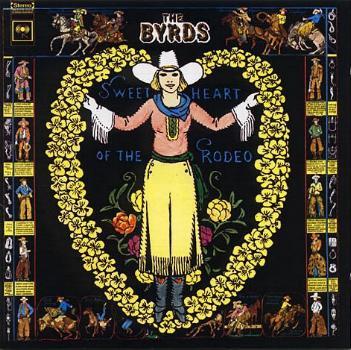 What I listened to was the 1997 CD reissue of the album, which improves on the original with its eight strong bonus tracks, including four cuts with Gram Parsons singing lead).
And then I listened to the solo albums of Gram Parsons.
You can see Parson's influence on the Rolling Stone's classic Sticky Fingers, even though that quality album is very much slow, bluesy, druggy music. "Wild Horses" is a very good country song, up there with Parson's work, such as 'Hickory Wind' and 'In my Hour of Darkness.' I presume this influence of Parsons is due to Keith Richards having greater musical control over Sticky Fingers. I presume the same situation happened with Exile on Main Street, as this album of pain and despair mostly approached rock music from country blues.
Parson's work on the bonus tracks on Sweethearts of the Rodeo certainly broke though the limits of the Byrd's Sweetheart's pioneering country rock. For all their embrace of country music, the Byrds remained the Byrds,and they never broke free from their past. It was Parsons who broke new ground with his own songs and his rich emotional interpretations of old country material that made them sound so contemporary. Since the Byrd's innovative song writing had pretty much dried up, the band on Sweethearts of the Rodeo were a launching pad for the creation of a new kind of music. It was Gram Parsons who took the next step and became the country-rock pioneer.
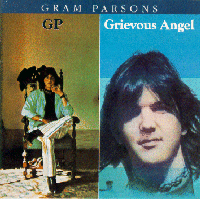 Gram Parson's two solo albums (GP/Grievous Angel) are an influential body of work. He was a good songwriter whilst his creative musical abilities made country sound more like rock & roll, and gave rock a sense of country's history. I have yet to hear the work Parson's did with 'The Flying Burrito Brothers', especially the debut The Gilded Palace of Sin.
None of this innovative music is mentioned in Greil Marcus' Mystery Train--he is too focused on Dylan, The Basement Tapes and the Band. This is a pity because this country rock moment--the 5 years from the 1968 Sweethearts to the 1973 Grievious Angel--represents the creative joy of making music as distinct from the culture of show business and the hard-core, lucrative industry business of promotion for profit by the culture industry.
That moment of country rock music steeped in Americana and historical and mythic American imagery was wider than the work of Dylan and The Band. See the fine post by Francis Xavier Holden on Willie Nelson's early album Redheaded Stranger
November 12, 2004
Deleuze & Bacon
I've started reading Gilles Deleuze's book on Francis Bacon called Francis Bacon the logic of sensation.
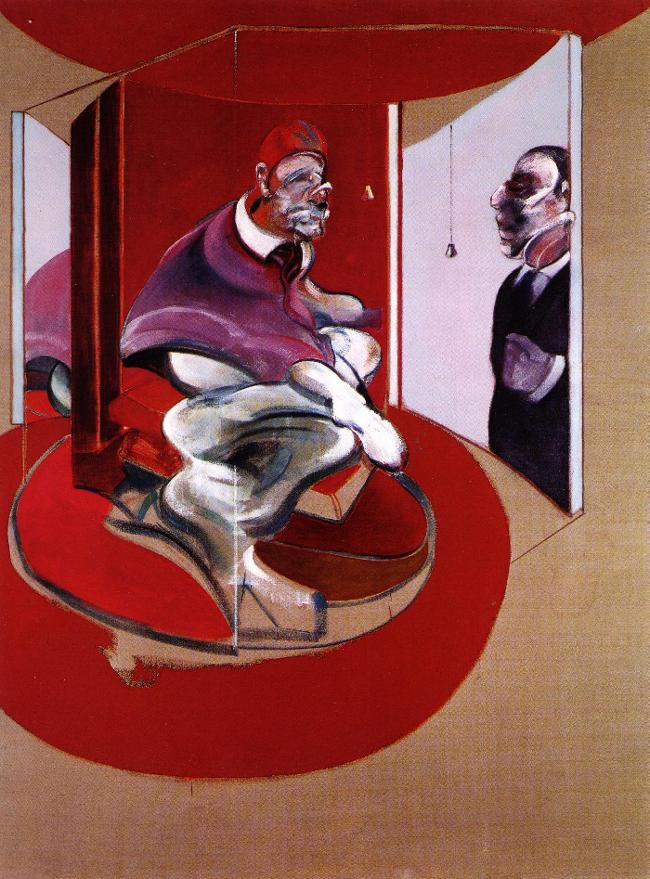
Francis Bacon, Study of Red Pope 1962, Second Version, 1971
Daniel Smith says that the Logic of Sensation can be read as a philosophical study of Bacon’s paintings and also as a crucial text within Deleuze’s broader philosophy of art. Smith says that as a philosopher Deleuze’s aim in his analyses of the arts is to create new concepts that correspond to both a particular aspect of Bacon’s paintings but also finds a place in “a general logic of sensation,” that is different from perception, which is the secondary rational organization of a primary, nonrational dimension of sensation.
This is no work of philosophy as a work of art criticism of Bacon's paintings.
November 11, 2004
Reflections on Art
A nice quote from Alain Badiou from a talk
"I think the great question about contemporary art is how not to be Romantic. It's the great question and a very difficult one. More precisely, the question is how not to be a formalist-Romantic. Something like a mixture between Romanticism and formalism. On one side is the absolute desire for new forms, always new forms, something like an infinite desire. Modernity is the infinite desire of new forms. But, on the other side, is obsession with the body, with finitude, sex, cruelty, death. The contradiction of the tension between the obsession of new forms and the obsession of finitude, body, cruelty, suffering and death is something like a synthesis between formalism and Romanticism and it is the dominant current in contemporary art."
Would this be an example of formalist-Romantic.?
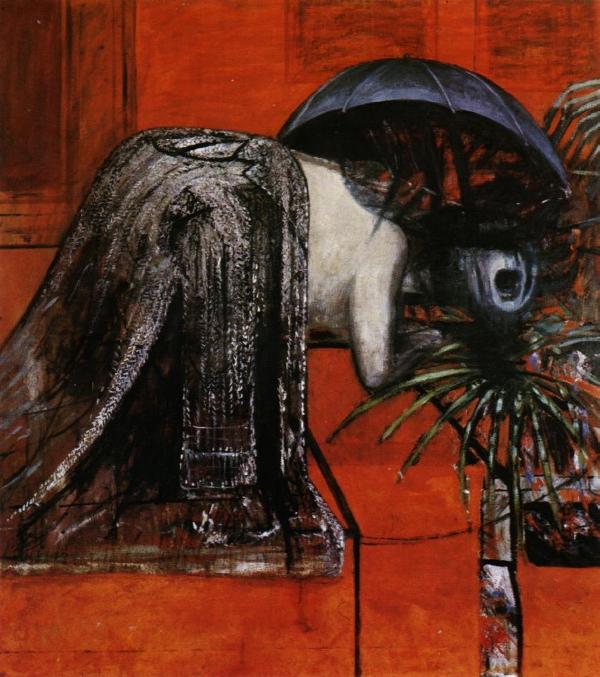
Francis Bacon, Figure Study II, (The Magdalene), 1945-46
If the key question is how not to be formalist-Romantic, then what to be instead? Is it to create something new as a challenge to what we already know; a creation of a new knowledge?
November 10, 2004

November 9, 2004
recoil
The world of instrumental reason:

Ezra Stoller, Salk Institute (Louis I. Kahn), 1977
You can understand why being with a whore is a release from the repressions of power and work.

Ezra Stoller, Seagrams interior (Mies van der Rohe), 1958
Or at least why Adorno and Bataille thought so. One recoils from the bleakness of modernist world:

Ezra Stoller, Salk Institute for Biological Research, La Jolla CA, Photographed 1977, Louis Kahn, Architect
And yearns for this
November 8, 2004
surrealism, sex, prostitution
Over at philosophical conversations there is a post on Adorno's picture of modernity as one of living in a wholly abstract and instrumental world, where each object we encounter holds meaning only as a representative of the class to which it belongs and a tool for our use. In another post on surrealism, the unconscious and desire, it is observed that:
"The surrealistic impulse is the flow of desire, a self in flux... The liberatory impulse is the unrepressed gratification of sensual desire with its promise of a guiltless and nonrepressive way of life. The sign of that life of liberated instincts is childhood. It is a very seductive image of redemption."
What would such a life be like? What would such a life be like in Adorno's kind of modernity? What do we get when we juxtapose or montage the two posts at philosophical conversations?
One suggestion is Gilles Deleuze and Félix Guattari, Anti-Oedipus: Capitalism and Schizophrenia. This text uses desire and the unconscious to step outside the horizons of art and literature to positing desiring-machines which create history, society, culture and the economy.
Bataille offers another suggestion. It is a life with a prostitute. It is the courtesan or prostitute, who is relegated to the margins of bourgeois society, who embodies the life of "forbidden" unrestrained sexuality.
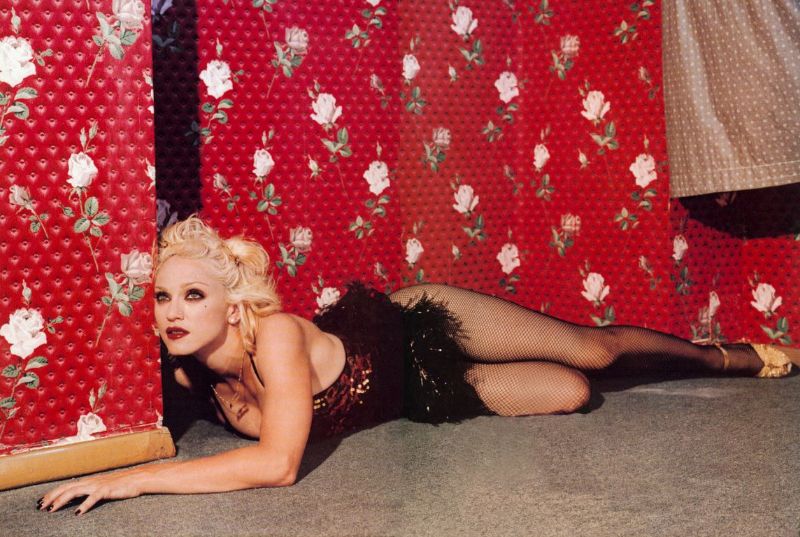
Bettina Rheims, Madonna, 1994
In the Dialectic of Enlightenment (p.70) Horkheimer and Adorno say that it is the fact of the courtesan's (Circe in the text) exclusion that is the key to the suppressed dimension of freedom.
Circe is the keeper of a forbidden hedonism. The cessation of the pain of work, an indispensable aspect of any non-repressive order, and is made possible by surrender to Circe and a night of all consuming pleasure. This rejuvenates the body and eases the layers of civilized repression.
November 7, 2004
illuminating eye
In fact, in 1941, with the rise of abstract expression in the US surrealism was declared dead, and it has been described as such in all art history books since that time. The US embraced the view of abstract artists that the chaos of action painting and automatism were expressions of freedom.
In Australia surrealism was deeply felt in the 1940s to the extent that we can talk in terms of Australian surrealism.
This silencing is a shame because visual representation of the object was called into question by the surrealists, then re-instated. It --as the eye--became part of the uncanny logic of the unconscious.
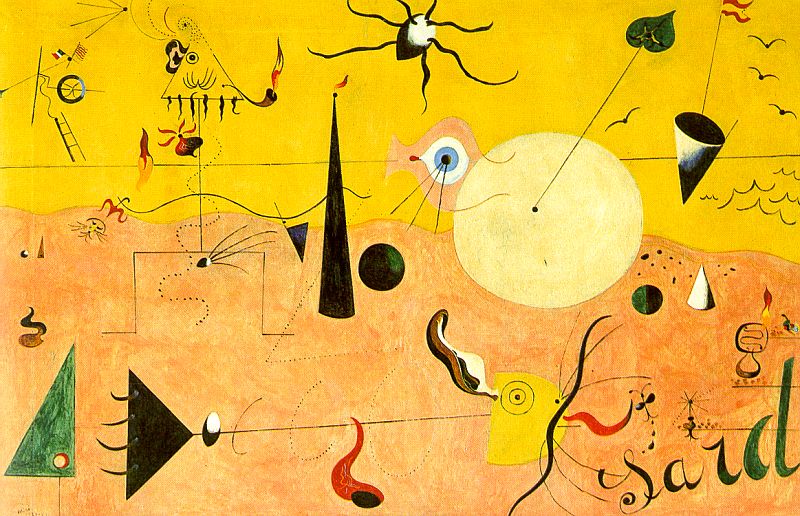
Joan Miro, Catalan Landscape:The Hunter, 1923-24.
The turn to using the form of children's art was a way to recapture the freshness of vision. Children's art was valued for its naive spontaneity and celebration of the moment, imaginative use of visual language, and its universality and candor.
November 6, 2004

November 5, 2004
an innocent eye
Nature is greatly abstracted according to the surrealist ideas of psychic automatism and dream imagery. If these are traces of the unconscious, then what of the eye?
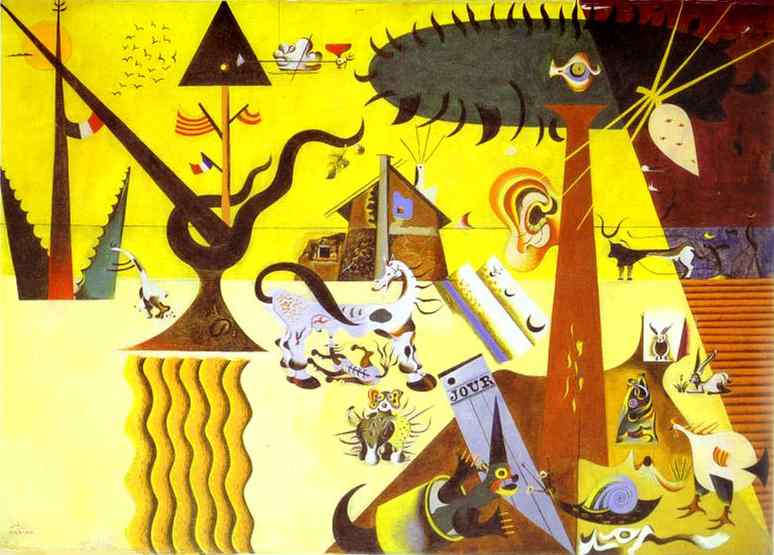
Jean Miro, The Tilled Field, 1923/24. Oil on canvas
Miro's eye is a different eye to the Cartesian one that surveys nature to dominate, control and exploit.
Is Miro's eye the innocent eye that lies beyond the corrupted habitual vision of everyday life. The innocent eye of childhood's visionary wonder? That means a renewal of vision.
One that was not based on restoring a naive mimesis of childhood, but rather wrenching objects out of their normal contexts .
November 4, 2004
the eye
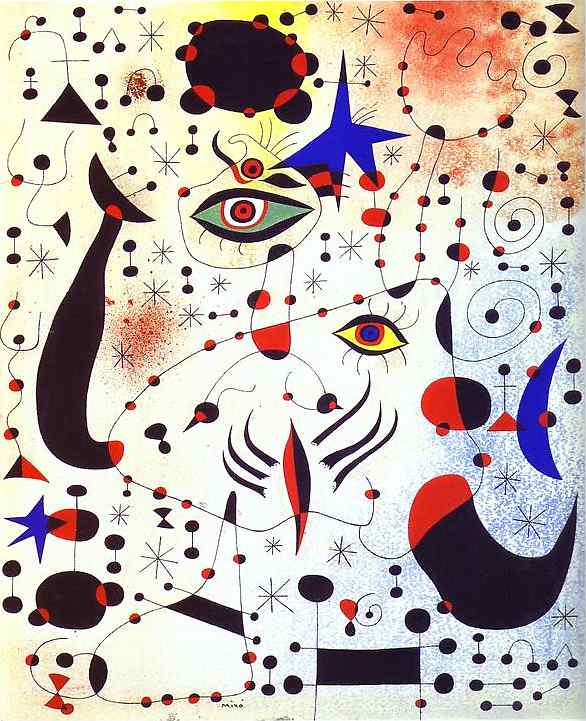
Joan Miro, Ciphers and Constellations, in Love with a Woman, 1941. Gouache and terpentine on paper.
It is an innocent eye that does not appear to challenge visual primacy and which stands in contrast to Bataille's summoning of darkness and the usual slashing mutilation of the eye the surrealist tradition.
Is it the eye of the artist as seer?
November 3, 2004
moral values
It has been a nightmare this morning. The server has been down, the internet is slow and the spam attack has been heavy. It has been like this since 6am.
I presume that there is an extraordinary traffic level across the entire network. I presume that the servers have reached their limit. Even if these are temporary failures that are self-correcting as requests are processed by the servers, the connections on the most severely affected servers means that linkup requests from Australia are clogged up for hours on end.
This makes it difficult to try and make sense of the US election. So the post needs to be simple.
The voting in the US election was not as blind as Steve Bell makes out:
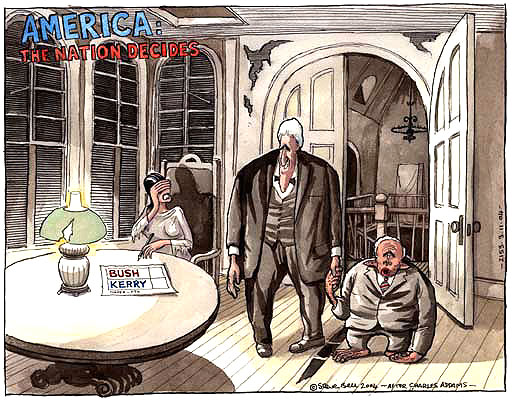
The social conservatives knew what they were doing about moral values---gay marriage and no to abortion. The marriage equality movement lost eleven out of eleven ballot measures this election. The anti-gay Ballot also passed in 11 states. They were instruments in a strategy designed to get the evangelicals out to vote for Bush.
Karl Rove, the key Republican political strategist, knew what he was doing. He used the issue of gay marriage, as a wedge issue because it would attract culturally conservative evangelical Democrats —"the rednecks" —to the Republicans. Give them the extra votes to get Bush over the line.
We have this kind of biopolitics happening in Australia too. The defenders of moral values are now talking about abortion, the culture of convenience and a ban on late-term abortions. A year or so back they were were talking about putting a stop to euthanasia.
Our bodies are not our own anymore. The conservative state wants a say in what we do with our bodies. Human rights is dismissed as 1970s style social engineering.
The culture of convenience. It refers to the idea of the idea of abortion being used as a back-up for failed contraception. Behind it sits a move by pro-life conservatives in federal parliament to move to amend the law on abortion.
Beware the moral crusaders. They have some old scores to settle with the 1968ers.
November 2, 2004
holiday
This is where I have been for the last couple of days. Living in a piece of South Australian colonial history on the original historic property on the edge of Lake Alexandrina.

Under the Ramsar Convention, The Coorong and Lakes Alexandrina and Albert are recognised as a wetland of international significance. Poltalloch Station has approximately 17 kilometres of shoreline along Lake Alexandrina, and although the birds appeared to be plentiful, their numbers are actually decreasing.
Alas, the Melbourne Cup passed me by. I did not even dream about the spectacle. Aah to think that I missed the fashion, the glamour, the champagne…….(oh, and of course the horses). I did not worry about spending far too much on my outfit – and on drinks – and ending up with nowhere to stay.

To tell the truth I had forgotten all about the hottest social event of the year. I was watching the rain sweep across Lake Alexandrina waiting for the drama of the sunset that never came. It rained in Melbourne too:

