|
November 27, 2004
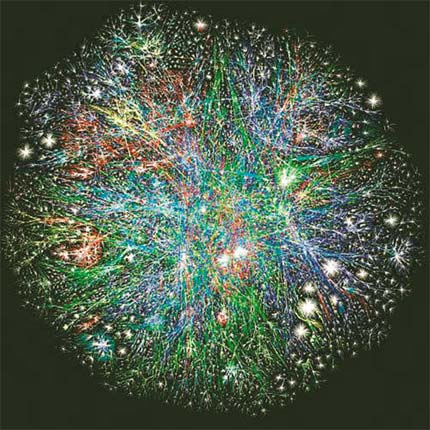
(Image: Opte.org)
No.
It is Barrett Lyon's famous graphical visualisation of the internet. The bigger version of image is Here. Each colour on this Opte map represents a region; North America, blue; Europe/Middle East/Central Asia/Africa, green; Latin America, yellow; Asia Pacific, red; Unknown, white.
It is a part of project to make a visual representation of a space that is very much one-dimensional, a metaphysical universe. It maps the entire internet in a single day.
Barrett Lyon, a networking engineer based in the US, says:
"After some testing and beta code I proved that with enough bandwidth it is possible to scan the entire Internet with a single computer. The 1/5th of the Internet map only took about 2 hours to create, yet it generated nearly 200k/sec of traffic and put my machine at a load of 60+ while scanning. If you apply the math, the entire internet would take about 10 hours to scan and another hour or two for the visual map output."
Visual culture in the twentieth century has been dominated by photography and cinema as a “cultural interface”. This has been seen in terms of a technological organization of space and perception, of structuring time and narrating stories—whose basis, many have argued, is a photographic ontology.
In the past 20 years digital technologies have come more and more to replace the photographic in the creation of film images and images. As William J. Mitchell says "the new graphic currency that digital imaging technology mints is relentlessly destabilizing the old photographic orthodoxy, denaturing the established rules of graphic communication, and disrupting the familiar practices of image production and exchange."
Some resources
|


